
A Single Audit Compliance Engagement Letter establishes the formal agreement between an organization and its auditor. It outlines the scope, objectives, and responsibilities for auditing federal awards under Uniform Guidance. This document ensures legal clarity and professional standards are met during the financial review process. To help you get started, below are some ready to use template options.
Image cover: Essential Single Audit Engagement Letter Templates and Compliance Guide
Letter Samples List
- Single Audit Compliance Engagement Letter
- Single Audit Management Representation Letter
- Single Audit Governance Communication Letter
- Single Audit Internal Control Deficiency Letter
- Single Audit Major Program Determination Letter
- Single Audit Subrecipient Monitoring Compliance Letter
- Single Audit Federal Awards Engagement Letter
- Single Audit Prior Year Findings Update Letter
- Single Audit Corrective Action Plan Acknowledgment Letter
- Single Audit Legal Counsel Inquiry Letter
- Single Audit Exit Conference Summary Letter
- Single Audit Independence Confirmation Letter
- Single Audit Material Weakness Notification Letter
- Single Audit Final Opinion Delivery Letter
Single Audit Compliance Engagement Letter
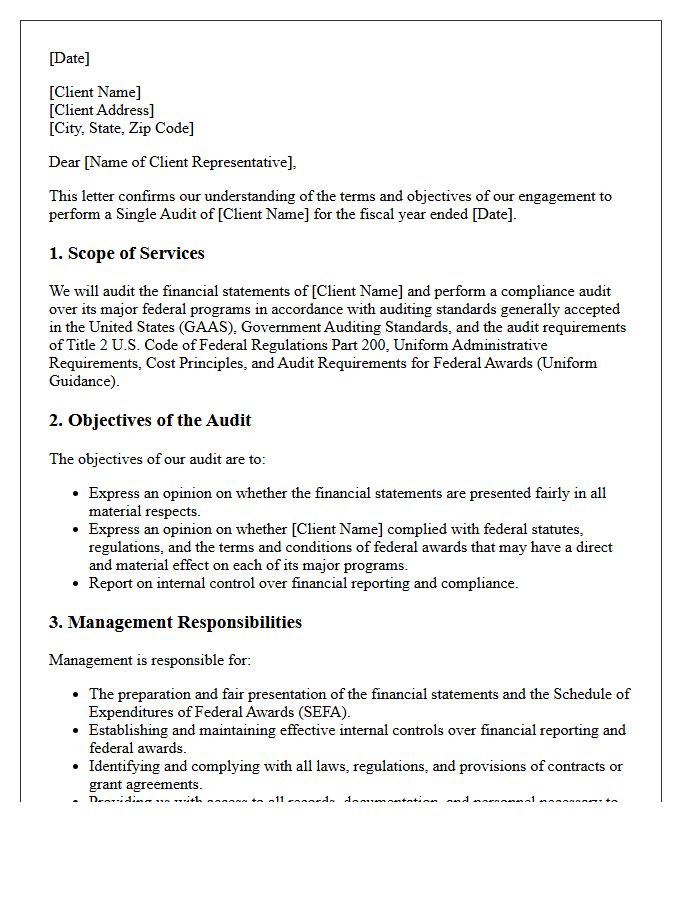
A Single Audit compliance engagement letter is a legally binding contract between an organization and its auditor. It outlines the scope of work for entities spending over $750,000 in federal funds. This document clarifies responsibilities for maintaining internal controls and ensures adherence to Uniform Guidance standards. It serves to prevent misunderstandings by defining the audit's objectives, limitations, and reporting requirements. Reviewing this letter is essential to confirm that both parties understand their roles in verifying the legal use of federal awards and protecting the organization from non-compliance risks.
Single Audit Management Representation Letter
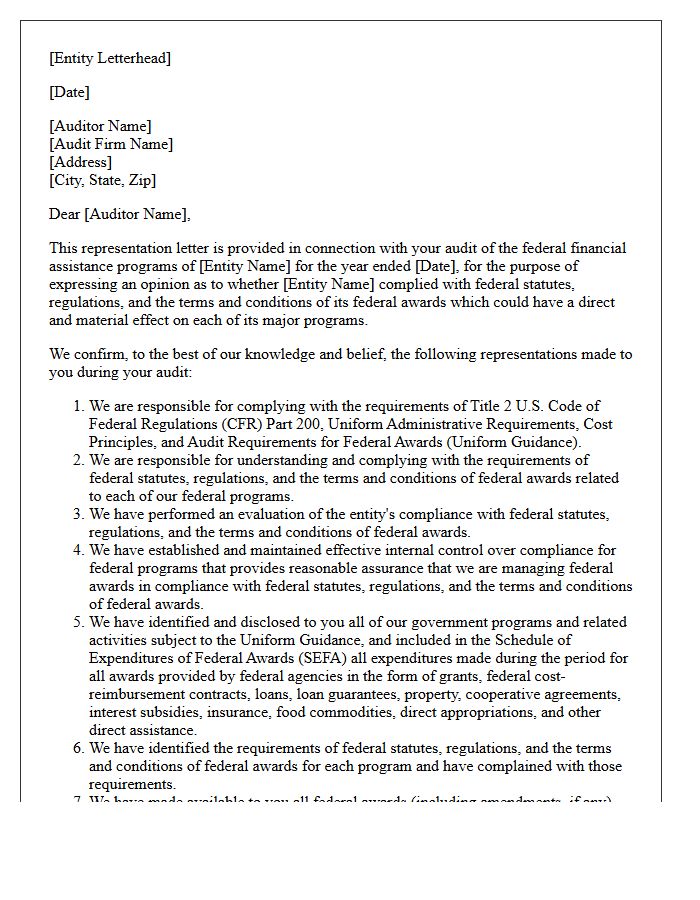
A Single Audit Management Representation Letter is a formal document provided by an auditee to the external auditor. It confirms that management has fulfilled its responsibility for preparing financial statements and complying with federal awards requirements. This letter serves as critical audit evidence, documenting verbal representations and acknowledging responsibility for internal controls and the disclosure of any known non-compliance. It is an essential component of the Single Audit process under Uniform Guidance, ensuring transparency and accountability between the organization and federal funding agencies.
Single Audit Governance Communication Letter
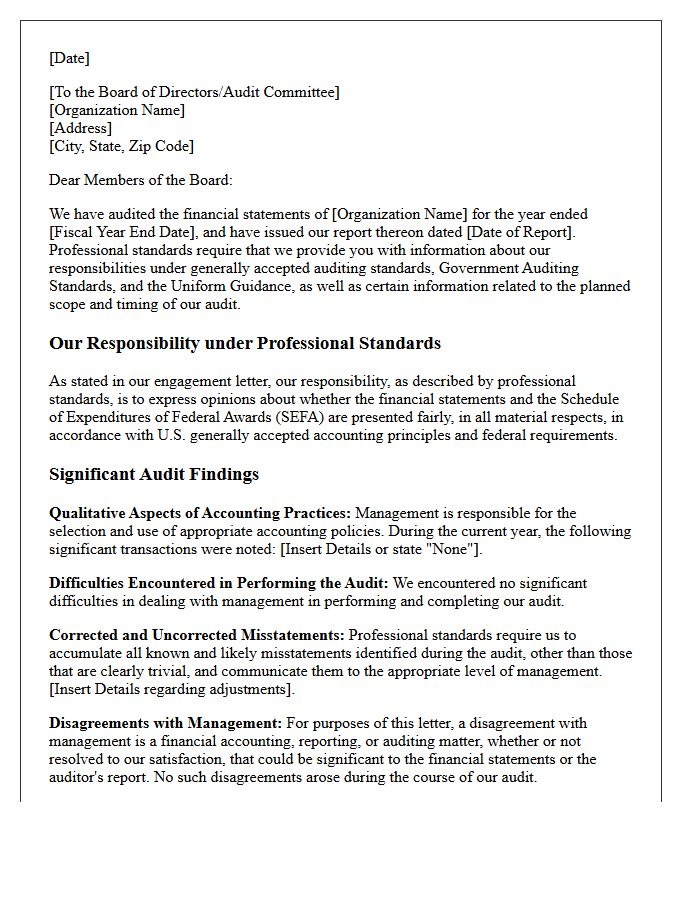
The Single Audit Governance Communication Letter is a critical document issued by auditors to those charged with governance. It highlights significant findings, internal control deficiencies, and compliance issues identified during an audit of federal awards. This formal communication ensures transparency regarding financial reporting risks and management's responsibilities. Understanding these results is essential for maintaining accountability and ensuring future eligibility for federal funding. It serves as a vital tool for oversight bodies to address material weaknesses and improve organizational compliance frameworks effectively.
Single Audit Internal Control Deficiency Letter
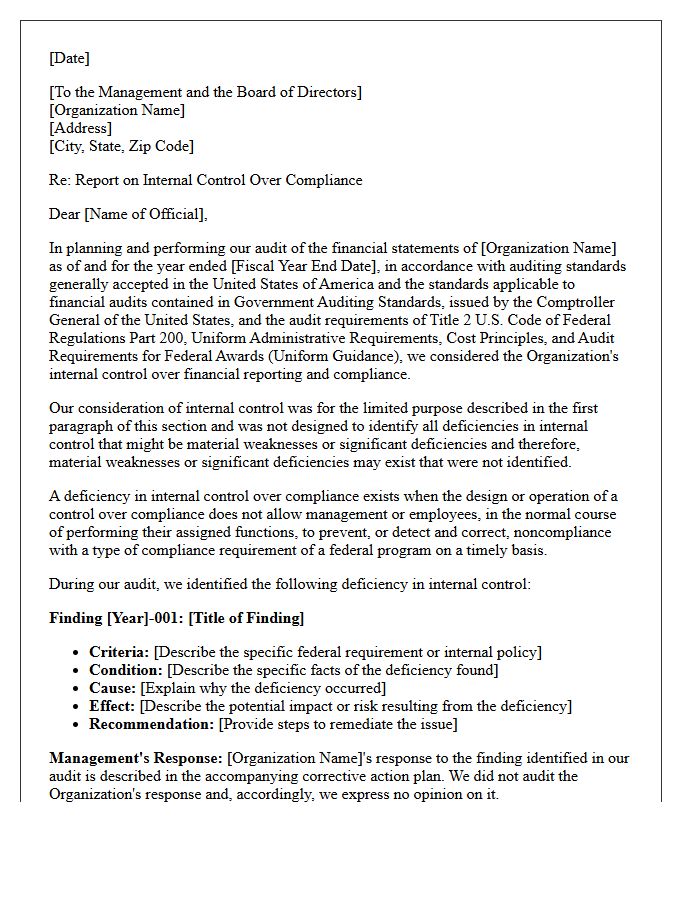
A Single Audit Internal Control Deficiency Letter identifies weaknesses in an organization's financial management of federal awards. It classifies issues as either a significant deficiency or a material weakness, indicating the severity of the risk. Recipients must address these findings through a corrective action plan to ensure compliance and maintain funding eligibility. Understanding these classifications is essential for audit transparency and long-term operational integrity within federal programs.
Single Audit Major Program Determination Letter
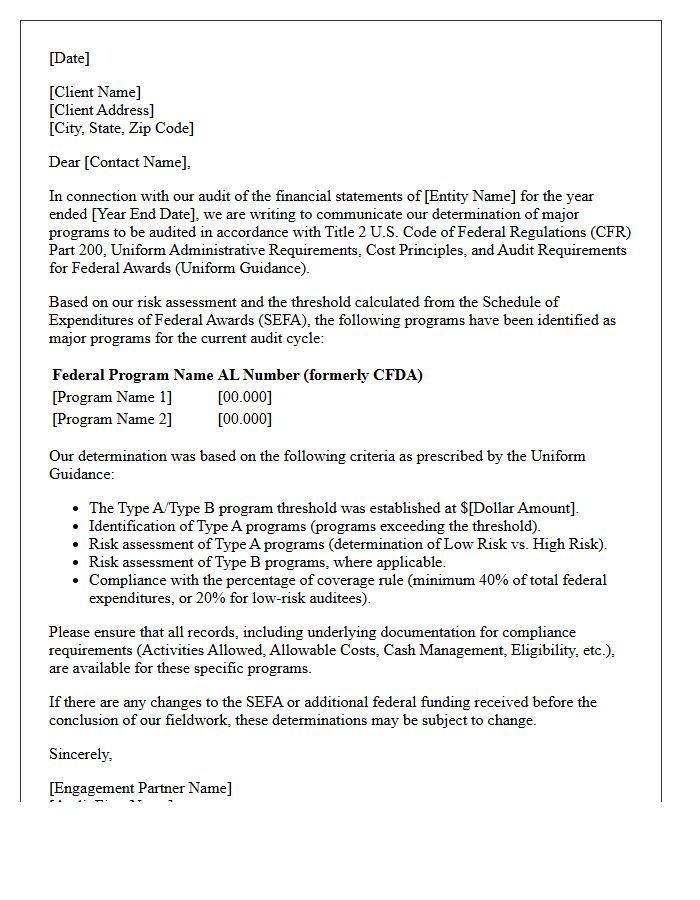
A Single Audit Major Program Determination Letter is a critical document issued by auditors to identify federal programs selected for detailed testing. This risk-based approach evaluates programs based on prior audit findings, federal expenditures, and inherent program complexity. Auditors utilize the Uniform Guidance framework to categorize programs as Type A or Type B. Understanding this selection process is essential for auditees to prepare documentation and ensure compliance with federal awarding agency requirements, ultimately confirming that major programs are managed effectively and financial statements remain accurate.
Single Audit Subrecipient Monitoring Compliance Letter
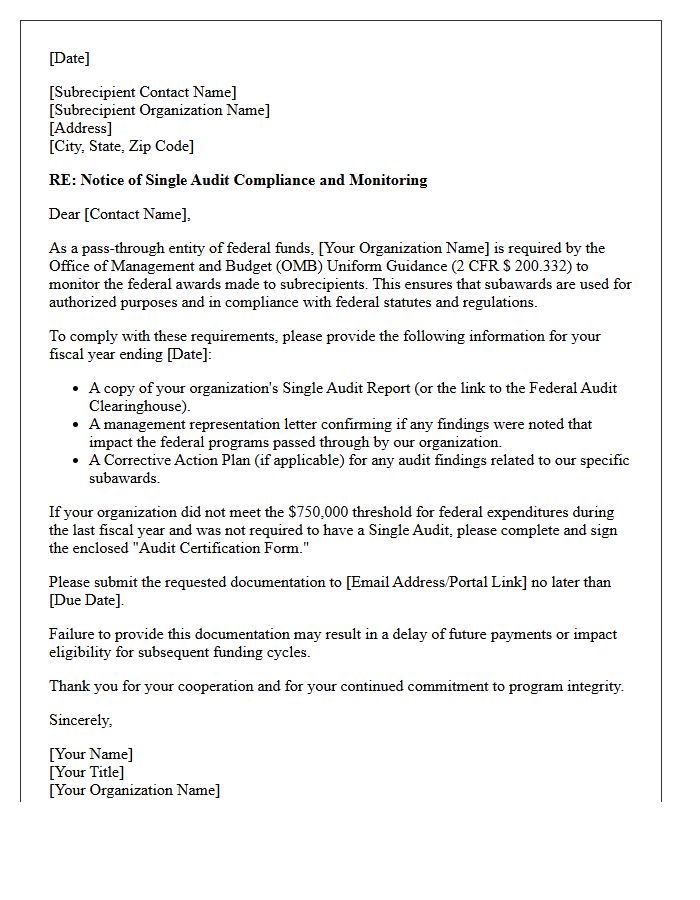
A Single Audit Subrecipient Monitoring Compliance Letter is a vital document used by pass-through entities to verify that subrecipients adhere to federal regulations. Under Uniform Guidance, prime recipients must monitor lower-tier entities to ensure federal awards are used for authorized purposes. This letter summarizes audit findings, corrective action plans, and internal control evaluations. It serves as formal evidence of oversight, mitigating financial risks and preventing disallowed costs. Ensuring timely issuance of these letters is essential for maintaining audit readiness and demonstrating accountability to federal awarding agencies during a compliance review.
Single Audit Federal Awards Engagement Letter
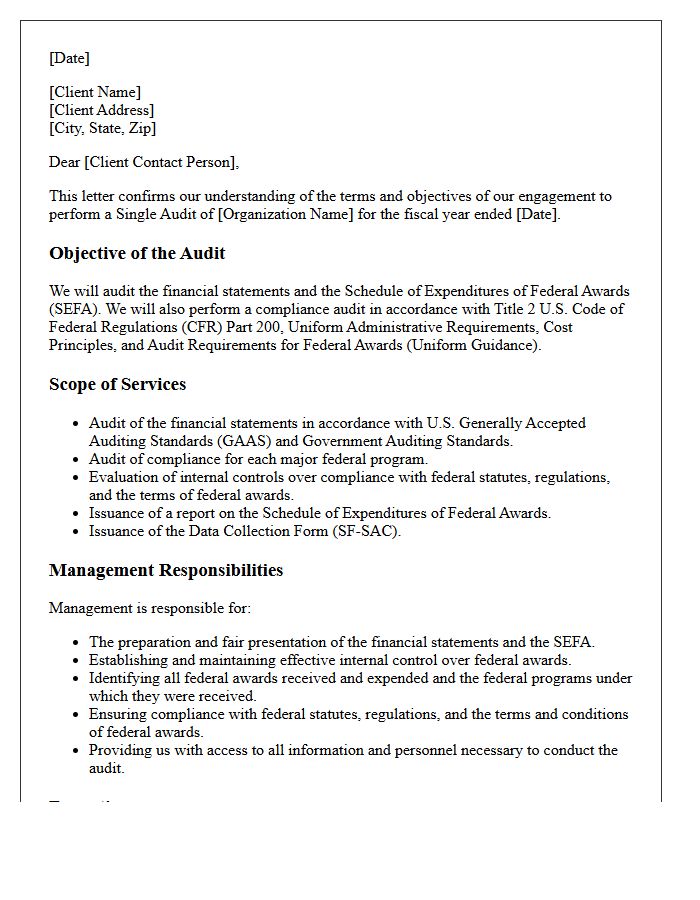
A Single Audit Federal Awards Engagement Letter is a legally binding contract between an organization and an independent auditor. It establishes the scope of work, responsibilities, and compliance requirements mandated by the Uniform Guidance. This document ensures both parties understand the objectives of auditing federal expenditures and reporting internal control weaknesses. Clear terms are essential to ensure the audit meets regulatory standards, preventing potential funding issues or legal non-compliance with government oversight agencies.
Single Audit Prior Year Findings Update Letter
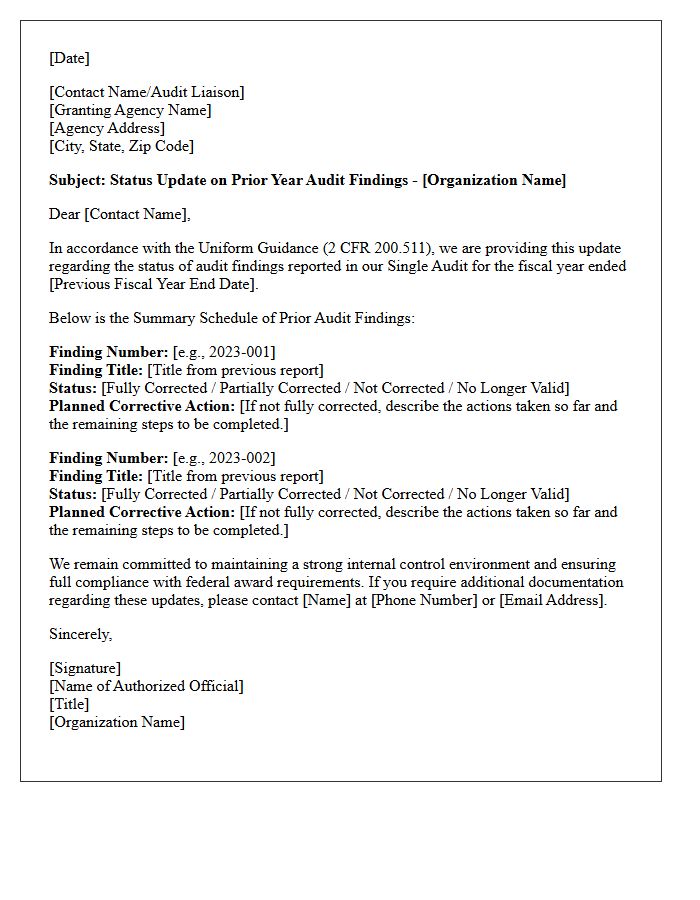
A Single Audit Prior Year Findings Update Letter is a critical compliance document used to track the resolution status of previous audit deficiencies. It provides a summary of corrective actions taken by an organization to address past non-compliance or internal control weaknesses. Federal awarding agencies and pass-through entities use this update to verify that prior audit findings have been properly remediated. Ensuring this letter is accurate and timely is essential for maintaining eligibility for federal funding and demonstrating effective financial oversight and accountability during the current audit cycle.
Single Audit Corrective Action Plan Acknowledgment Letter
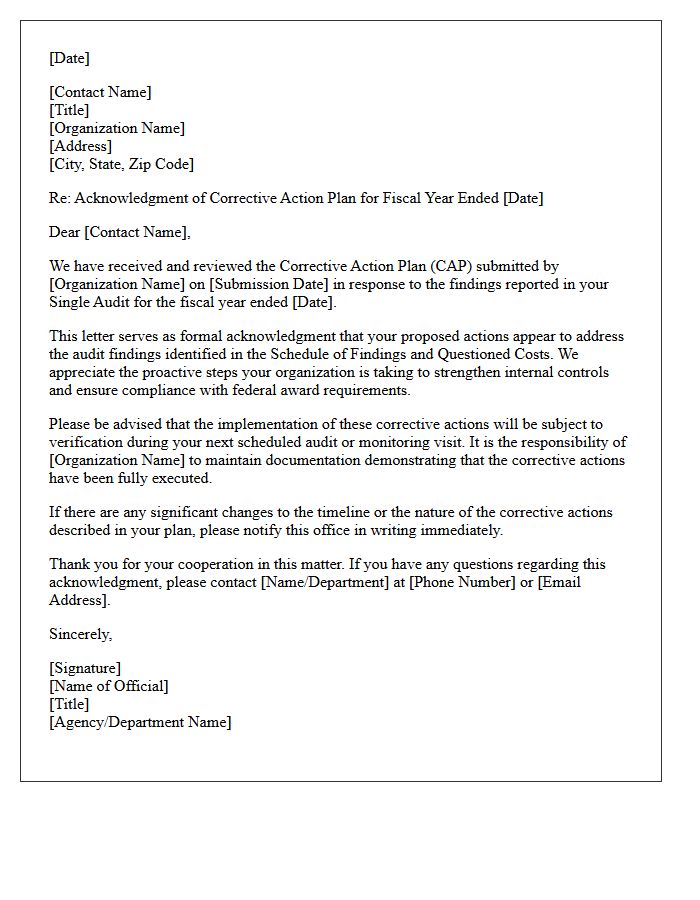
A Single Audit Corrective Action Plan Acknowledgment Letter is a formal document issued by a pass-through entity to verify they have received and reviewed a subrecipient's strategy for fixing compliance issues. This letter confirms that the proposed corrective actions adequately address audit findings related to federal awards. It serves as a vital component of audit resolution, ensuring accountability and federal compliance. Receivng this acknowledgment signifies that the oversight agency agrees with the remediation steps, helping to maintain eligibility for future funding while mitigating potential financial risks and internal control weaknesses.
Single Audit Legal Counsel Inquiry Letter
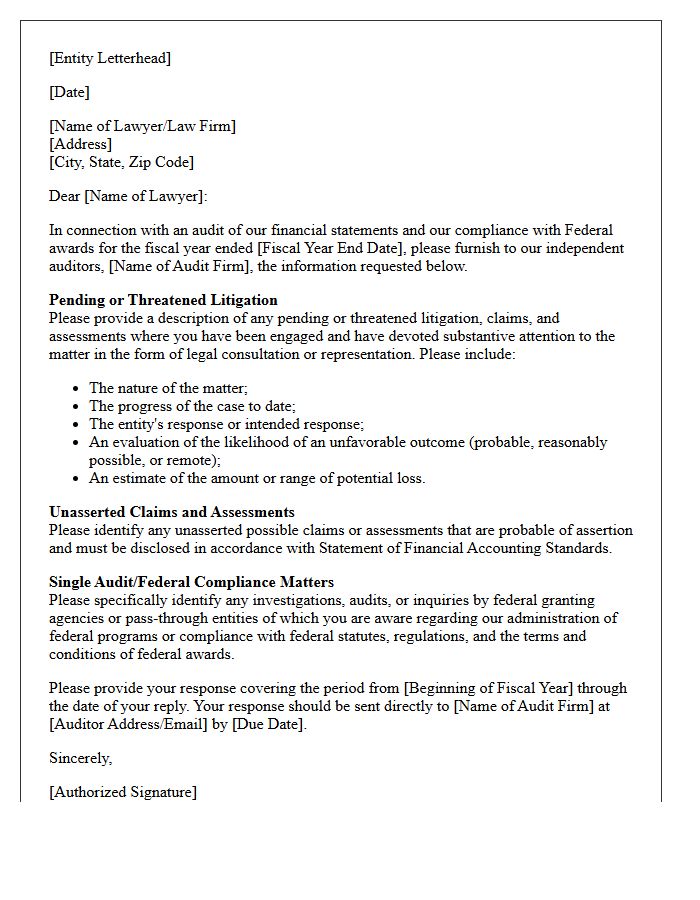
A Single Audit Legal Counsel Inquiry Letter is a vital communication sent by auditors to a client's legal representative during a federal compliance audit. It seeks to identify contingent liabilities, pending litigation, or unasserted claims that could financially impact the organization. This process ensures the accuracy of financial statements and verifies adherence to federal award requirements. Providing a timely, comprehensive response is essential for legal counsel to help auditors assess potential risks and ensure the entity remains compliant with Uniform Guidance standards.
Single Audit Exit Conference Summary Letter
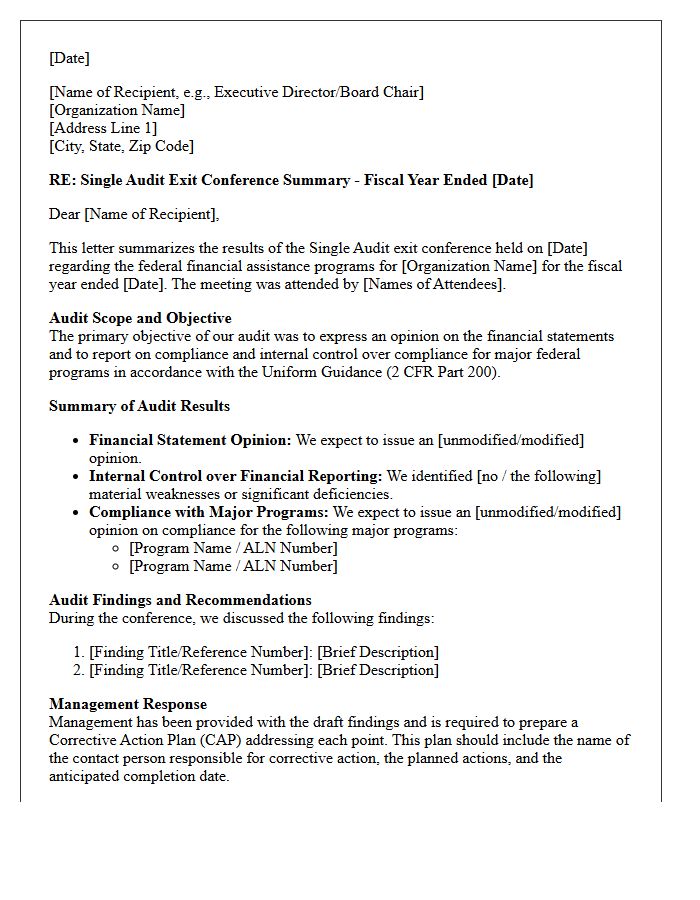
The Single Audit Exit Conference Summary Letter serves as a formal conclusion to the federal compliance review process. It highlights preliminary audit findings, questioned costs, and internal control deficiencies identified during the engagement. This document ensures clear communication between auditors and management before the final report is issued. It is a critical opportunity for the auditee to discuss corrective action plans and clarify any discrepancies. Understanding this summary helps organizations prepare for official public disclosure while ensuring all regulatory requirements and federal grant conditions have been accurately addressed and documented.
Single Audit Independence Confirmation Letter
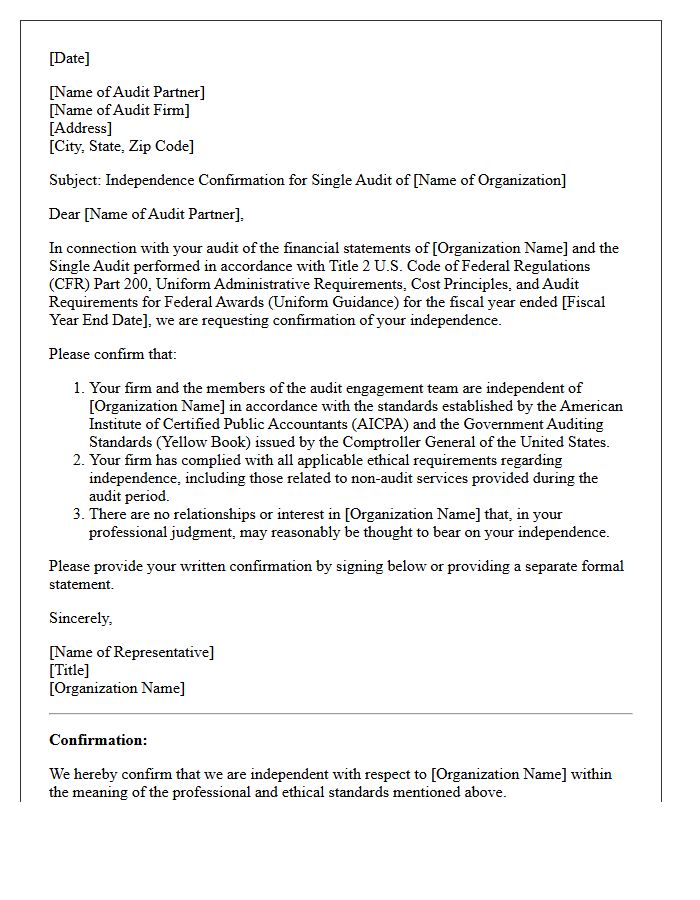
A Single Audit Independence Confirmation Letter is a critical document ensuring auditor objectivity during federal grant examinations. It officially verifies that the audit firm and its staff maintain no financial, personal, or professional conflicts of interest with the auditee. This confirmation fulfills Generally Accepted Government Auditing Standards (GAGAS) requirements, safeguarding the integrity of the financial oversight process. By signing this letter, auditors provide documented evidence of their impartiality, which is essential for maintaining compliance with Uniform Guidance regulations and ensuring public trust in the allocation of federal funds.
Single Audit Material Weakness Notification Letter
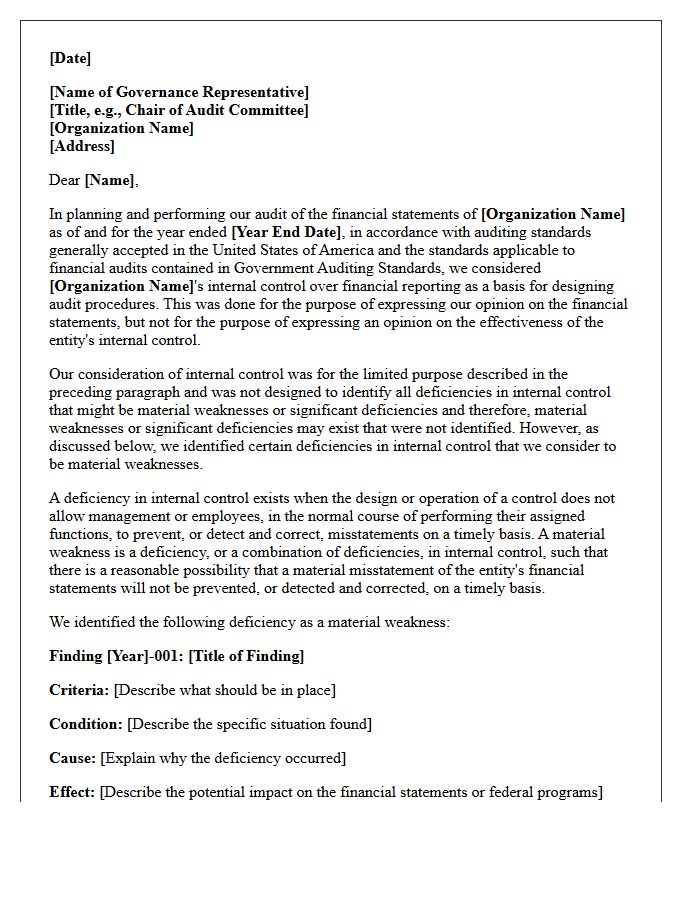
A Single Audit Material Weakness Notification Letter is a critical formal communication from an auditor to management. It identifies a material weakness, which represents a significant deficiency in internal controls over financial reporting or federal compliance. This letter indicates a high probability that a material misstatement will not be prevented or detected timely. Organizations must provide a Corrective Action Plan to address these findings, as unresolved weaknesses can jeopardize future federal funding and increase audit risk levels during regulatory oversight. Prompt remediation is essential for maintaining organizational integrity.
Single Audit Final Opinion Delivery Letter
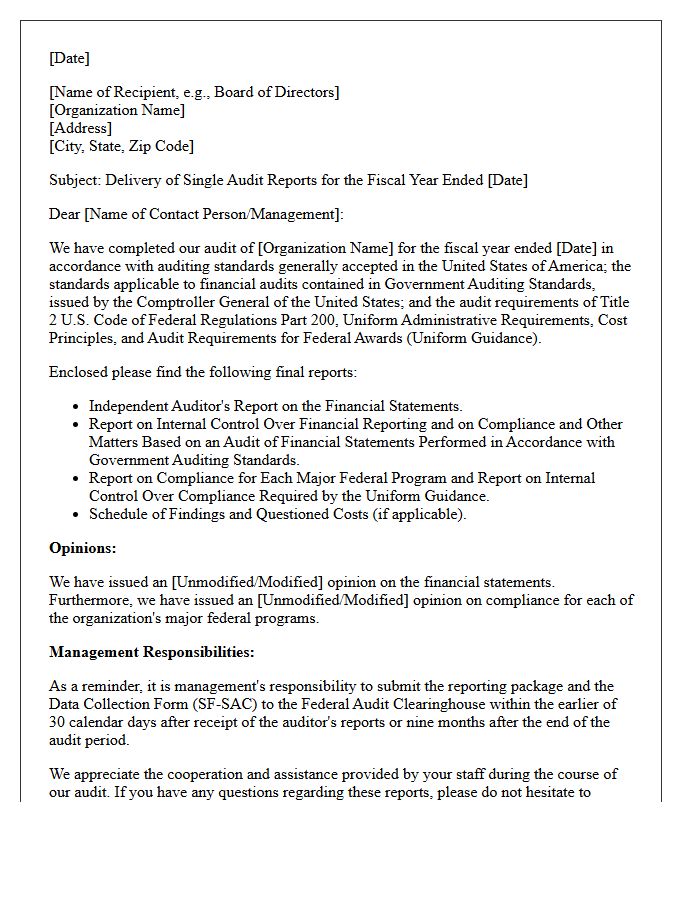
The Single Audit Final Opinion Delivery Letter is the formal document issued by independent auditors to report their findings on federal award expenditures. It confirms whether the entity complied with direct and material requirements under Uniform Guidance. This letter is crucial for transparency, as it includes the Auditor's Opinion on financial statements and internal controls. Grant recipients must submit this finalized report to the Federal Audit Clearinghouse to remain eligible for future funding and demonstrate proper fiscal stewardship of government resources.
What is a Single Audit compliance engagement letter?
A Single Audit compliance engagement letter is a formal agreement between an independent auditor and a non-federal entity that outlines the scope, objectives, and responsibilities for an audit conducted under the Uniform Guidance (2 CFR 200) for organizations spending $750,000 or more in federal awards.
What are the auditor's primary responsibilities in a Single Audit engagement letter?
The auditor is responsible for performing procedures to obtain reasonable assurance about whether the entity complied with federal statutes, regulations, and the terms of federal awards, as well as expressing an opinion on the Schedule of Expenditures of Federal Awards (SEFA).
What management responsibilities must be documented in the engagement letter?
Management is responsible for maintaining effective internal controls over federal programs, preparing the SEFA, ensuring compliance with grant requirements, and providing the auditor with access to all financial records, personnel, and relevant documentation.
Does a Single Audit engagement letter cover the detection of fraud?
The letter states that while the audit is designed to provide reasonable assurance of detecting material noncompliance, it is not specifically designed to identify all instances of fraud or illegal acts; however, the auditor will communicate any significant findings or internal control deficiencies identified.
Why is the scope of the Single Audit engagement letter different from a standard financial audit?
The scope is broader because it must specifically address compliance requirements for "Major Programs" as determined by a risk-based approach defined by the Office of Management and Budget (OMB) Compliance Supplement, in addition to the standard financial statement audit.


Comments