
The Financial Crimes Enforcement Network mandates strict adherence to the Memorandum on Suspicious Activity Report Filing Deadlines to ensure regulatory compliance. Financial institutions must file reports within thirty days of detecting potential illicit activity to mitigate risks and avoid penalties. This guide outlines essential timelines and legal requirements for compliance officers. To assist your workflow, below are some ready to use templates.

Image cover: Mastering the Clock: SAR Filing Timelines, Strategic Memorandums, and Ready-to-Use Templates
Letter Samples List
- Initial Suspicious Activity Report Filing Deadline Compliance Letter
- Thirty-Day Suspicious Activity Report Extension Request Letter
- Continuing Activity SAR Filing Requirement Notification Letter
- Board of Directors SAR Deadline Escalation Letter
- Late SAR Filing Justification and Remediation Letter
- Financial Crimes Enforcement Network SAR Deadline Acknowledgment Letter
- Internal Compliance Memorandum SAR Escalation Letter
- Suspicious Activity Report Filing Deadline Reminder Letter
- Ninety-Day Continuing SAR Review and Submission Letter
- Compliance Department SAR Deadline Confirmation Letter
- Law Enforcement SAR Deadline Delay Request Letter
- Post-Investigation SAR Filing Deadline Warning Letter
- Internal Audit Finding on SAR Timeliness Letter
Initial Suspicious Activity Report Filing Deadline Compliance Letter
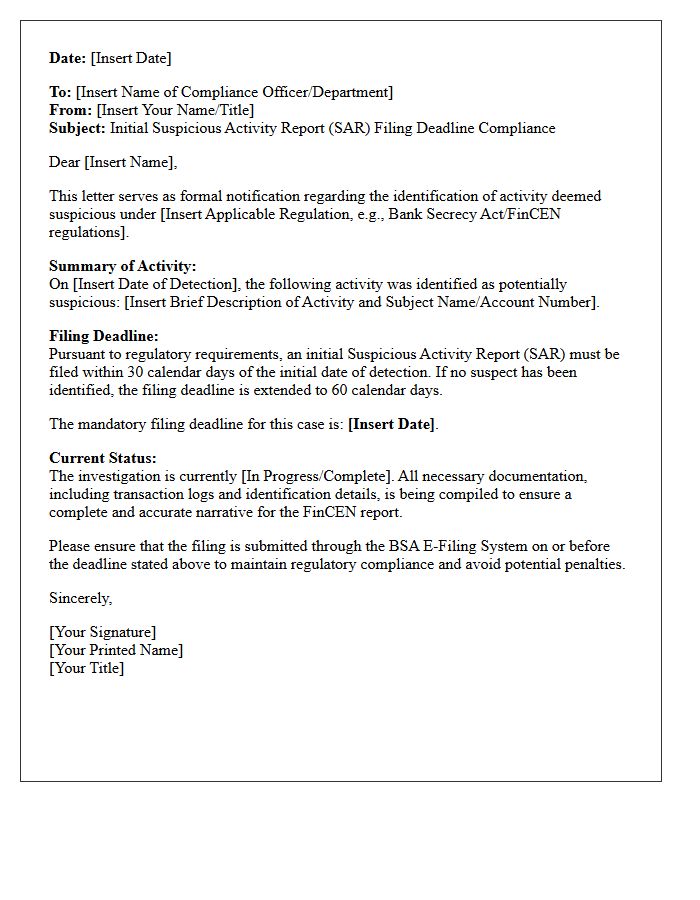
The Initial Suspicious Activity Report Filing Deadline Compliance Letter is a formal notification issued to financial institutions regarding regulatory timelines. This document ensures that firms adhere to FinCEN requirements by reporting potential money laundering or fraud within 30 days of detection. Maintaining strict SAR compliance is essential to avoid severe legal penalties and regulatory scrutiny. Understanding the specific filing deadlines mentioned in this letter helps organizations mitigate risk and uphold the integrity of the global financial system through timely suspicious activity reporting.
Thirty-Day Suspicious Activity Report Extension Request Letter
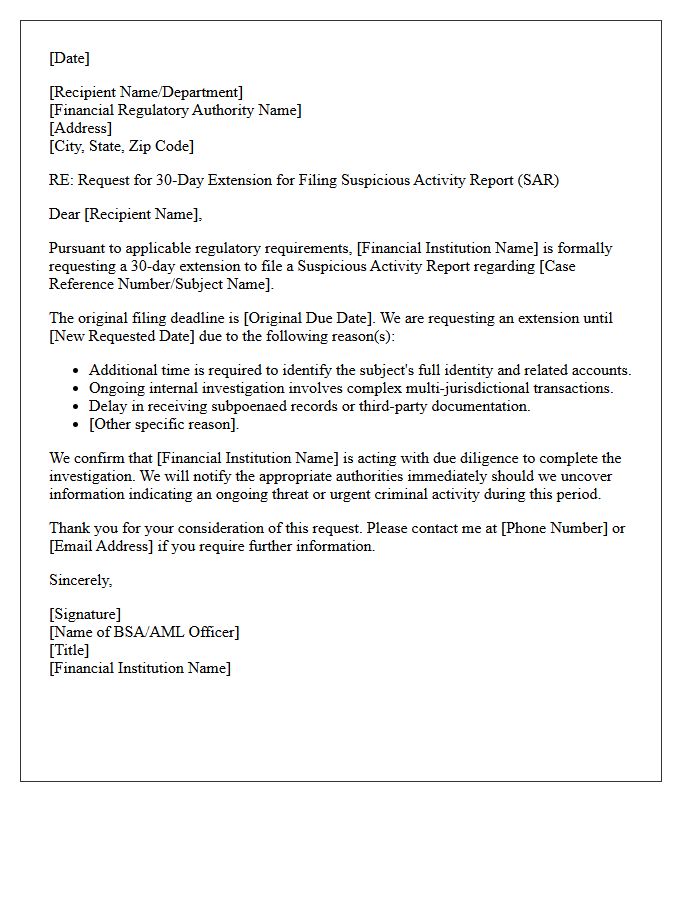
A Thirty-Day Suspicious Activity Report Extension Request Letter is a formal notification sent to regulatory bodies when a financial institution requires additional time to investigate potential illicit behavior. This document is crucial for maintaining regulatory compliance under the Bank Secrecy Act. It must clearly outline the extenuating circumstances preventing a timely filing, such as ongoing complex litigation or pending data from third parties. Timely submission of this request helps organizations avoid severe penalties while ensuring the accuracy and integrity of their financial intelligence reporting.
Continuing Activity SAR Filing Requirement Notification Letter
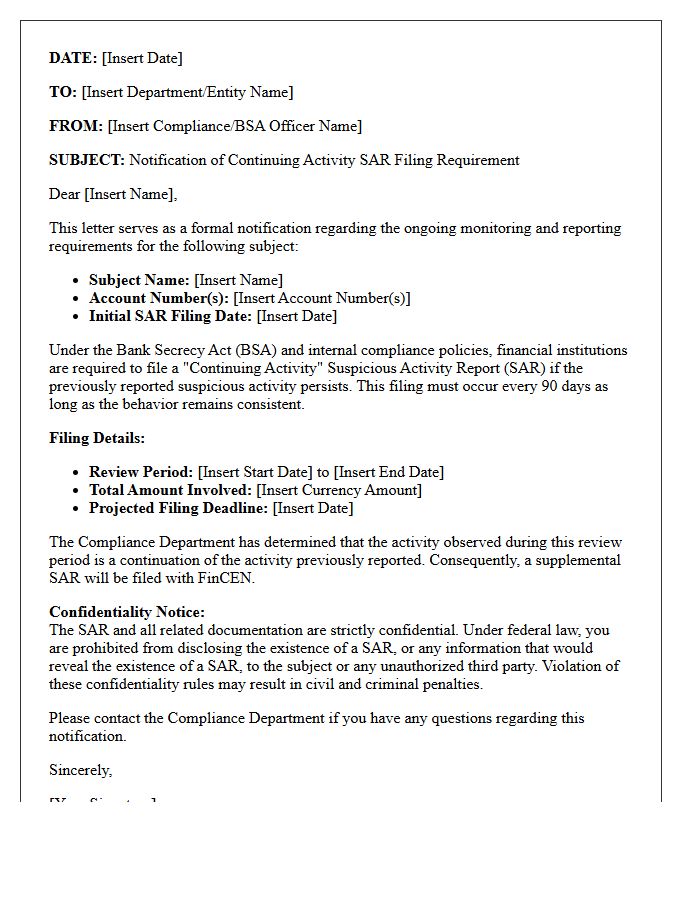
A Continuing Activity SAR Filing Requirement Notification Letter is a critical communication from FinCEN or regulatory agencies. It informs financial institutions that a specific subject's suspicious activity requires ongoing monitoring and periodic report filings. Recipients must submit follow-up reports every 90 days if the illicit behavior persists. Maintaining confidentiality is mandatory, as disclosing the letter's existence to the subject violates federal law. This notification ensures consistent oversight of potential money laundering or fraud, streamlining the tracking of long-term criminal patterns within the financial system.
Board of Directors SAR Deadline Escalation Letter
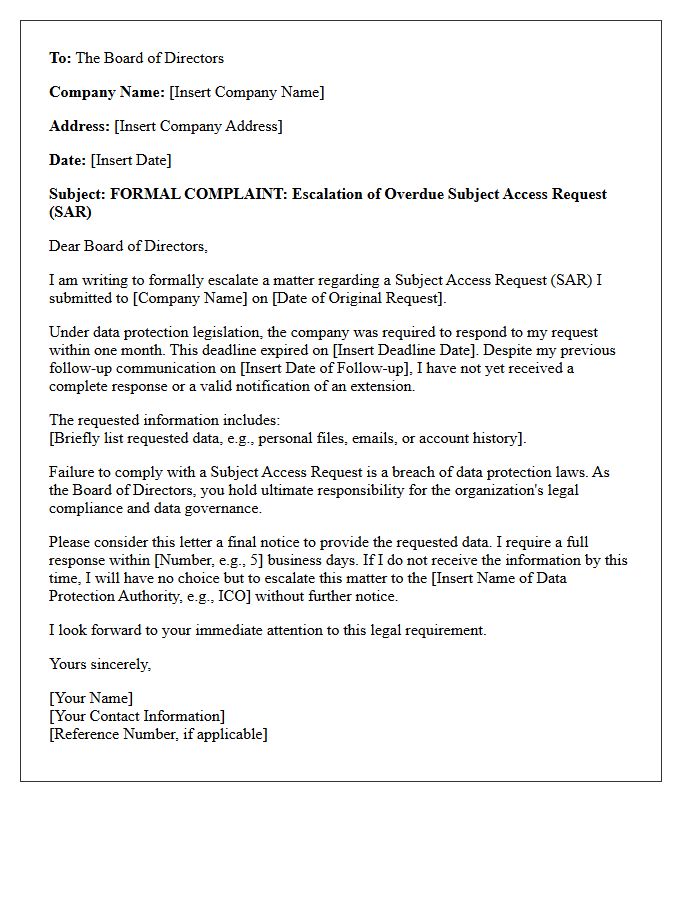
A Board of Directors SAR Deadline Escalation Letter is a critical compliance communication used when a Suspicious Activity Report filing is delayed. This formal notice alerts senior leadership to potential regulatory breaches and significant operational risks. It ensures the board maintains oversight of anti-money laundering obligations and mitigates personal liability. Timely escalation is essential for maintaining transparency with examiners and preventing severe legal penalties or enforcement actions against the financial institution. This document serves as a high-level audit trail for internal governance and risk management protocols.
Late SAR Filing Justification and Remediation Letter
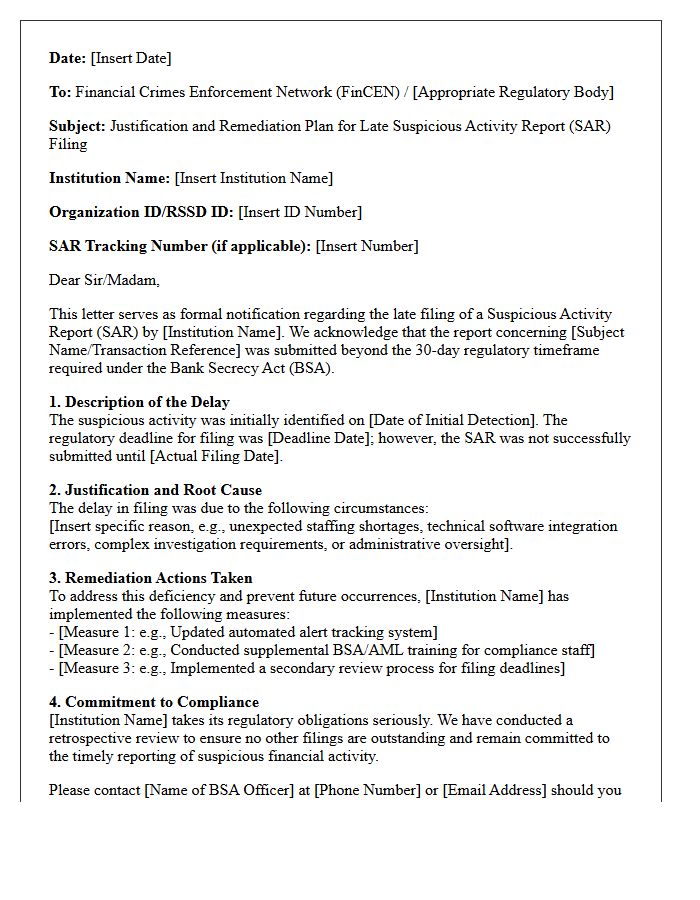
A Late SAR Filing Justification and Remediation Letter is a formal document submitted to FinCEN or regulatory bodies to explain why a Suspicious Activity Report was delayed. It must detail the specific compliance failures that led to the breach and provide a clear remediation plan to prevent recurrence. Effective letters emphasize internal control enhancements, staff training, and updated monitoring systems. Demonstrating proactive voluntary disclosure and a commitment to AML standards is essential to mitigate potential enforcement actions and penalties during a regulatory audit.
Financial Crimes Enforcement Network SAR Deadline Acknowledgment Letter
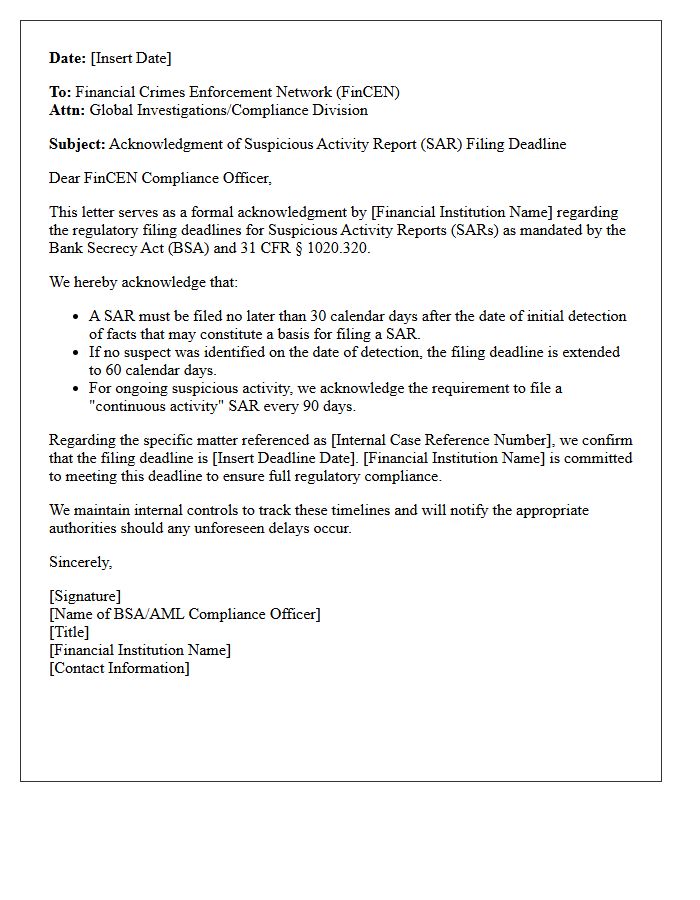
The Financial Crimes Enforcement Network (FinCEN) issues a SAR Deadline Acknowledgment Letter to confirm the receipt of a Suspicious Activity Report. This document serves as official verification that a financial institution has met its regulatory filing obligations under the Bank Secrecy Act. It is crucial for compliance officers to retain this letter for audit purposes, as it provides a timestamped record proving the report was submitted within the mandatory legal timeframe. Proper archiving ensures defense during regulatory examinations regarding anti-money laundering protocols and reporting consistency.
Internal Compliance Memorandum SAR Escalation Letter
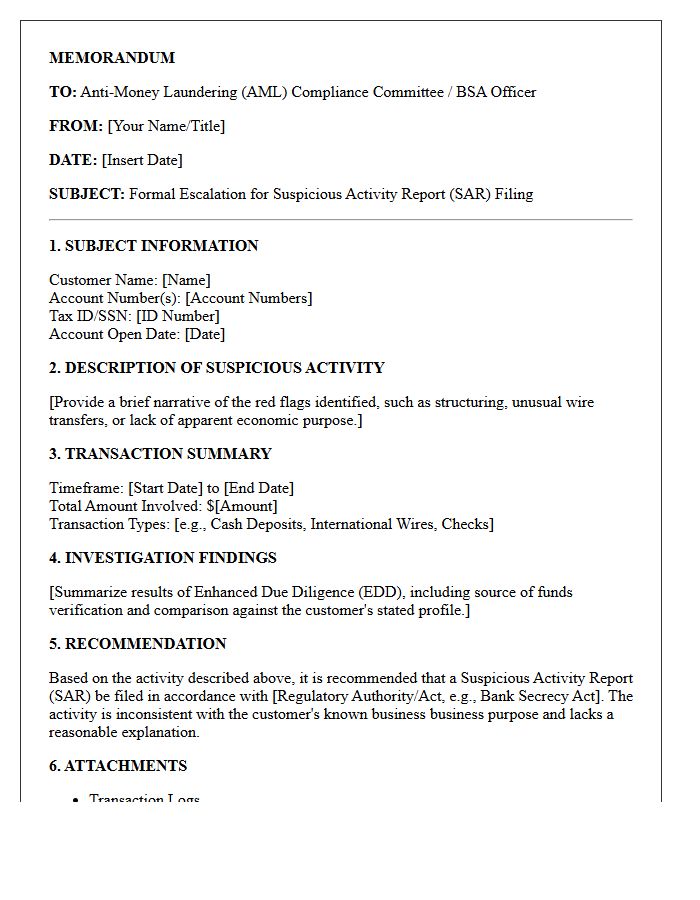
An Internal Compliance Memorandum SAR Escalation Letter is a formal document used within financial institutions to signal high-risk activity. It serves as a critical bridge between investigators and the BSA Officer when suspicious behavior warrants a formal filing. This memorandum ensures that anti-money laundering (AML) concerns are properly documented, reviewed, and escalated to meet federal regulatory standards. Providing a clear audit trail, it justifies the decision-making process for filing a Suspicious Activity Report (SAR), helping the institution mitigate legal risks and maintain regulatory compliance.
Suspicious Activity Report Filing Deadline Reminder Letter
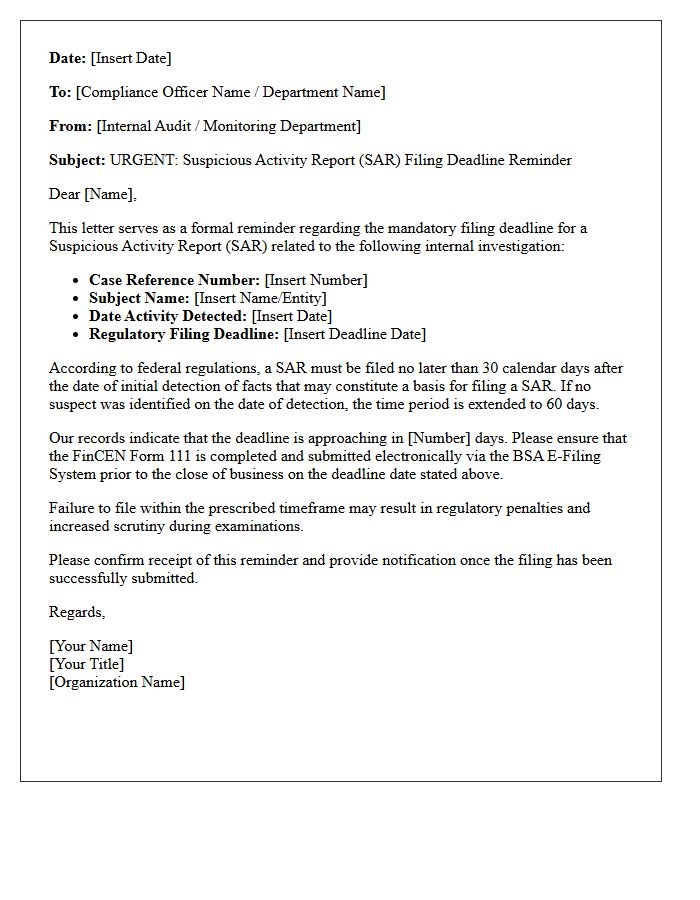
A Suspicious Activity Report (SAR) filing deadline reminder letter is a critical compliance notice sent to financial institutions. It serves as an urgent alert to ensure timely reporting of potential money laundering or fraud to regulators like FinCEN. Missing the mandatory 30-day window can result in severe legal penalties and regulatory fines. These letters help organizations maintain strict adherence to the Bank Secrecy Act, ensuring that suspicious transactions are documented and submitted before the legal cutoff to mitigate institutional risk and protect financial integrity.
Ninety-Day Continuing SAR Review and Submission Letter
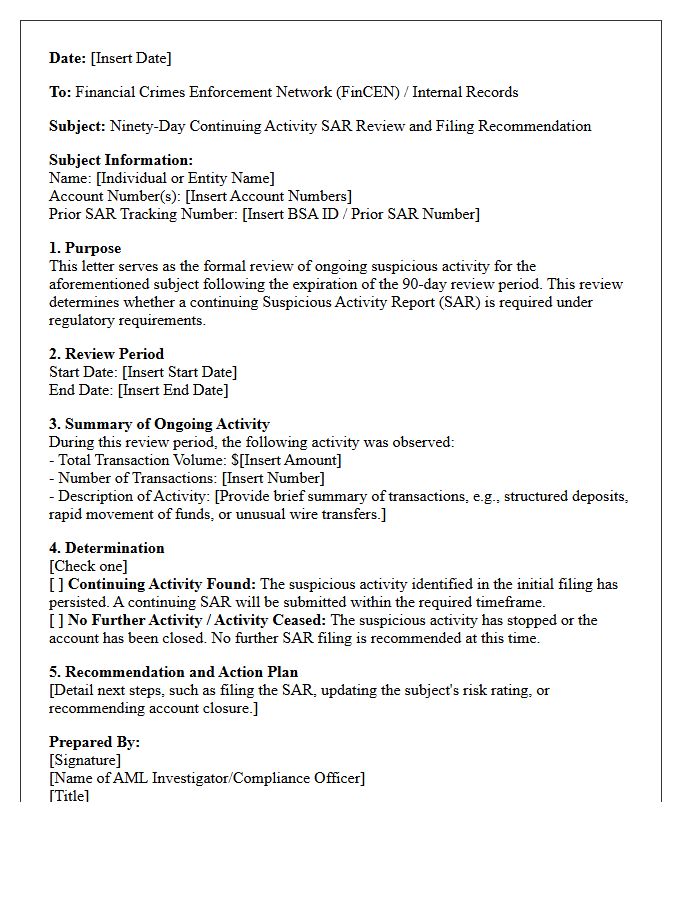
The Ninety-Day Continuing SAR Review and Submission Letter is a regulatory requirement for financial institutions to report ongoing suspicious activity. After filing an initial Suspicious Activity Report (SAR), institutions must monitor the subject's behavior. If the illicit activity persists, a follow-up SAR must be filed every ninety days. This process ensures law enforcement receives continuous intelligence on money laundering or fraud patterns. Compliance departments must maintain strict documentation and timelines to avoid regulatory penalties while ensuring that all supplemental reports provide a clear narrative of the continuing criminal behavior.
Compliance Department SAR Deadline Confirmation Letter
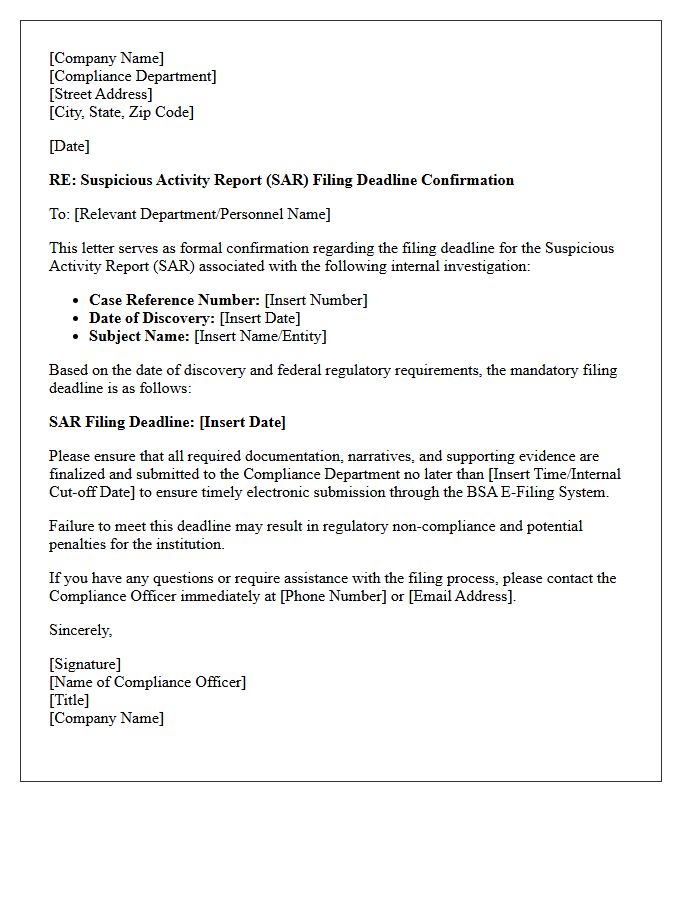
A Compliance Department SAR Deadline Confirmation Letter is a formal document verifying that a Suspicious Activity Report was filed within the regulatory timeframe mandated by FinCEN. This letter serves as critical evidence during audits or examinations, proving the institution met its legal obligations under the Bank Secrecy Act. It typically includes the case reference number, submission date, and confirmation of internal review completion. Maintaining these records is essential for demonstrating effective anti-money laundering oversight and avoiding penalties for non-compliance or late filings.
Law Enforcement SAR Deadline Delay Request Letter
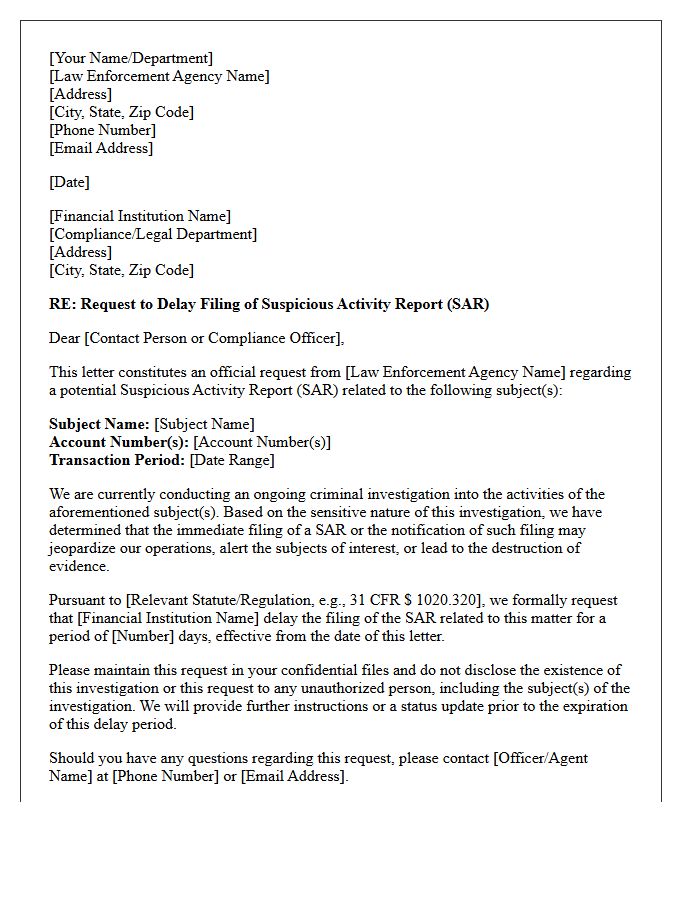
A Law Enforcement SAR Deadline Delay Request Letter is a formal notification sent to FinCEN or regulatory bodies. It is used when an active investigation requires a financial institution to postpone filing a Suspicious Activity Report to avoid alerting suspects. This legal tool prevents the "tipping off" of subjects, ensuring that premature documentation does not compromise ongoing criminal probes. Compliance officers must document the specific law enforcement official's request and the justified extension period to maintain regulatory alignment while assisting sensitive government operations.
Post-Investigation SAR Filing Deadline Warning Letter
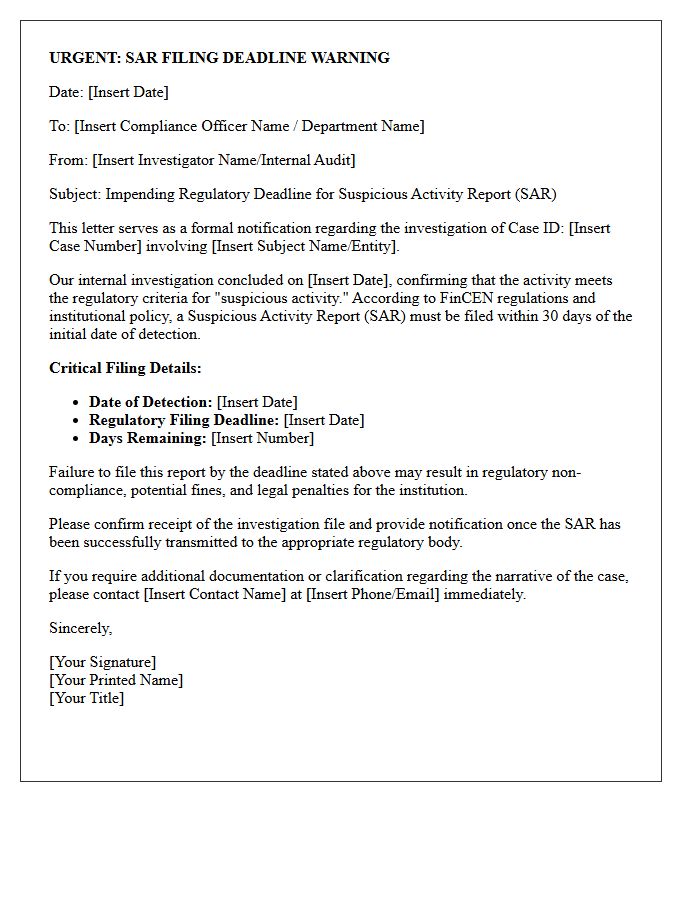
A Post-Investigation SAR Filing Deadline Warning Letter is a formal notification from financial regulators or compliance departments. It highlights a critical compliance failure regarding the timely submission of Suspicious Activity Reports. Financial institutions must file a SAR within 30 days of detecting potential illicit activity. Receiving this warning indicates that your internal monitoring failed to meet federal deadlines. Failure to remediate these delays can lead to severe regulatory penalties, fines, or increased legal scrutiny. Prioritizing automated tracking and prompt investigation is essential to maintain anti-money laundering standards and avoid enforcement actions.
Internal Audit Finding on SAR Timeliness Letter
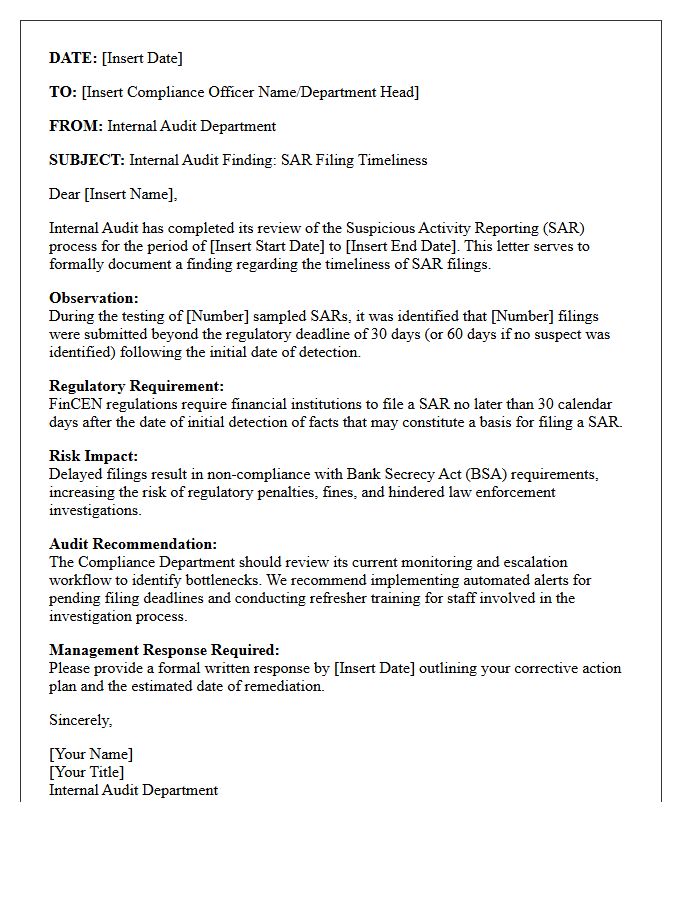
An internal audit finding regarding a SAR Timeliness Letter typically identifies regulatory non-compliance with FinCEN reporting deadlines. Financial institutions must file Suspicious Activity Reports within 30 days of detecting potential illicit activity. A formal finding indicates systematic delays in investigative workflows or documentation gaps. Addressing these deficiencies is critical to avoid enforcement actions and severe civil money penalties. Banks must implement robust monitoring systems and enhanced oversight to ensure all suspicious transactions are reported promptly, maintaining the integrity of the institution's anti-money laundering framework and meeting legal expectations.
What is the standard deadline for filing a Suspicious Activity Report (SAR)?
Financial institutions must file a SAR no later than 30 calendar days after the date of initial detection of facts that may constitute a basis for filing a report. If no suspect was identified on the date of detection, the deadline may be extended to 60 calendar days to allow for identifying a subject.
When does the "clock" start for a SAR filing deadline?
The filing timeframe begins when the financial institution, in the course of its review, determines that it has met the threshold of "suspicious" activity. This follows the initial detection phase where a formal review or investigation confirms the activity is reportable under FinCEN regulations.
Are there exceptions for mandatory immediate notification in SAR filing?
Yes. In situations involving ongoing violations that require immediate attention, such as active money laundering schemes or terrorist financing, financial institutions must immediately notify appropriate law enforcement authorities by telephone in addition to filing a SAR within the standard deadlines.
What are the requirements for filing a SAR on continuing suspicious activity?
For ongoing suspicious activity, a financial institution should file a "continuing activity SAR" every 90 days. This timeline allows for a 120-day cycle between filings (90 days of activity plus the 30-day filing window) to provide law enforcement with continuous monitoring data.
Can a financial institution request an extension for a SAR filing deadline?
No, there are no formal regulatory provisions for requesting an extension to SAR filing deadlines. Institutions must prioritize investigative resources to ensure compliance with the 30-day or 60-day windows to avoid regulatory penalties or "Failure to File" enforcement actions.

Comments