
A legal hold is a critical process used by organizations to ensure the preservation of relevant data during litigation or investigations. Issuing a formal evidence preservation notice prevents the destruction of potential evidence and ensures legal compliance. Understanding these protocols protects your company from sanctions and data loss. To help you get started, below are some ready to use template.

Image cover: Legal Hold and Evidence Preservation: Essential Templates and Best Practices
Letter Samples List
- Legal Hold Notice Letter for Suspected Embezzlement and Fraud Investigation
- Evidence Preservation Letter Regarding Regulatory Inquiry by the Securities and Exchange Commission
- Anti-Money Laundering Compliance Legal Hold Letter for Account Transaction Records
- Document Preservation Letter for Consumer Class Action Lawsuit Involving Overdraft Fees
- Legal Hold Letter for Commercial Loan Default and Foreclosure Proceedings
- Internal Data Breach Investigation Evidence Preservation Letter
- Evidence Preservation Notice Letter for Suspicious Activity Report Archival Data
- Legal Hold Letter Regarding Employment Dispute and Wrongful Termination Claim
- Insider Trading Investigation Document Preservation Letter for Wealth Management Division
- Evidence Preservation Letter for Mortgage Lending Discrimination Inquiry
- Legal Hold Notice Letter Pertaining to Cross-Border Tax Evasion Allegations
- Know Your Customer Compliance Audit Evidence Preservation Letter
- Corporate Bankruptcy Proceeding Legal Hold Letter for Creditor Communications
Legal Hold Notice Letter for Suspected Embezzlement and Fraud Investigation
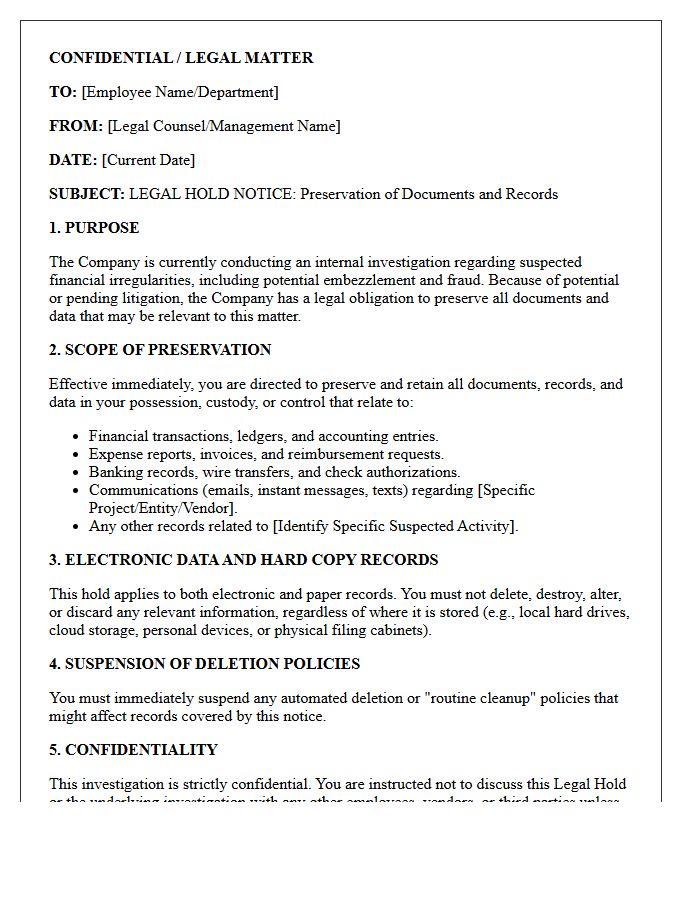
A Legal Hold Notice is a critical document issued during suspected embezzlement or fraud investigations to prevent spoliation of evidence. It legally mandates the preservation of all relevant data, including emails, financial ledgers, and digital logs. Recipients must immediately cease routine document destruction policies to avoid severe judicial sanctions. Ensuring the integrity of the audit trail is the most important step in protecting the organization's ability to prosecute or defend its position. Timely distribution to all key custodians ensures that potential proof of financial misconduct remains intact for forensic analysis and future litigation.
Evidence Preservation Letter Regarding Regulatory Inquiry by the Securities and Exchange Commission
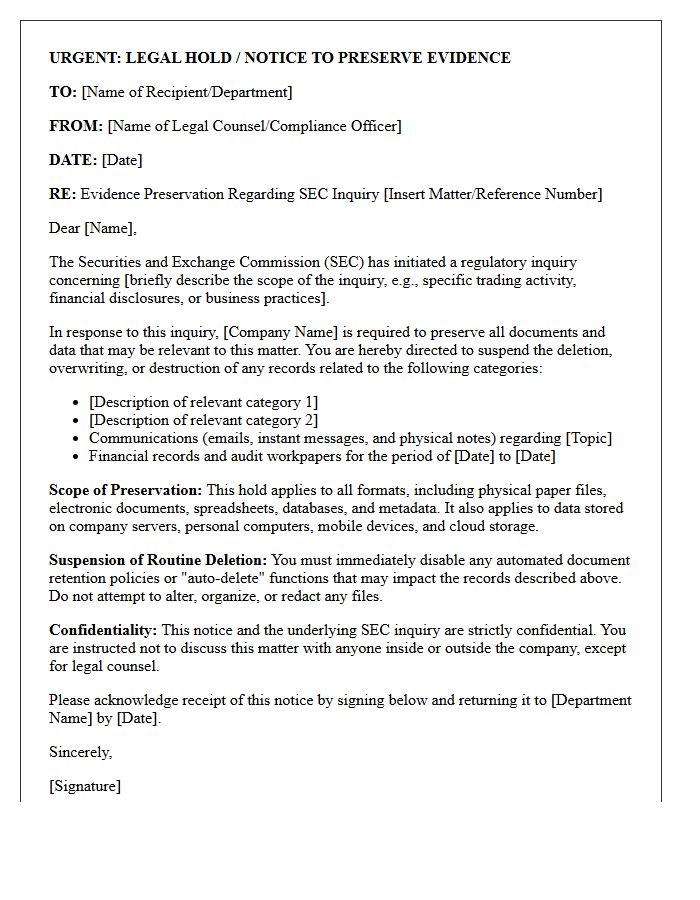
An Evidence Preservation Letter is a critical legal notification issued during an SEC inquiry, mandating the immediate suspension of routine data deletion policies. It requires organizations to safeguard all potentially relevant records, including emails, financial statements, and encrypted messages, to prevent spoliation. Failure to comply can result in severe sanctions, fines, or adverse legal inferences. Recipients must promptly implement a legal hold and ensure all employees understand their obligation to maintain data integrity. Adhering to these requirements is vital for demonstrating transparency and avoiding obstruction of justice charges during federal investigations.
Anti-Money Laundering Compliance Legal Hold Letter for Account Transaction Records
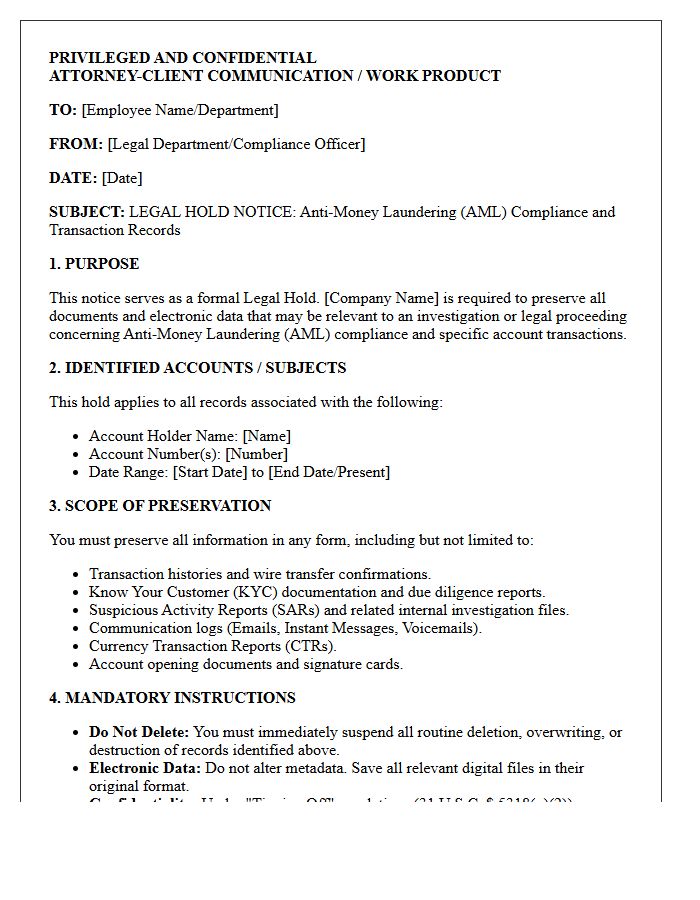
An Anti-Money Laundering (AML) Compliance Legal Hold Letter is a formal notification issued during financial investigations to prevent the destruction of evidence. It mandates the immediate preservation of account transaction records and related documentation, overriding standard data retention policies. Financial institutions must comply to avoid severe legal penalties or charges of spoliation. This directive ensures that potential evidence remains accessible for regulatory audits or criminal inquiries. Recipients must halt all automated deletion processes to maintain the integrity of financial data throughout the duration of the legal matter.
Document Preservation Letter for Consumer Class Action Lawsuit Involving Overdraft Fees
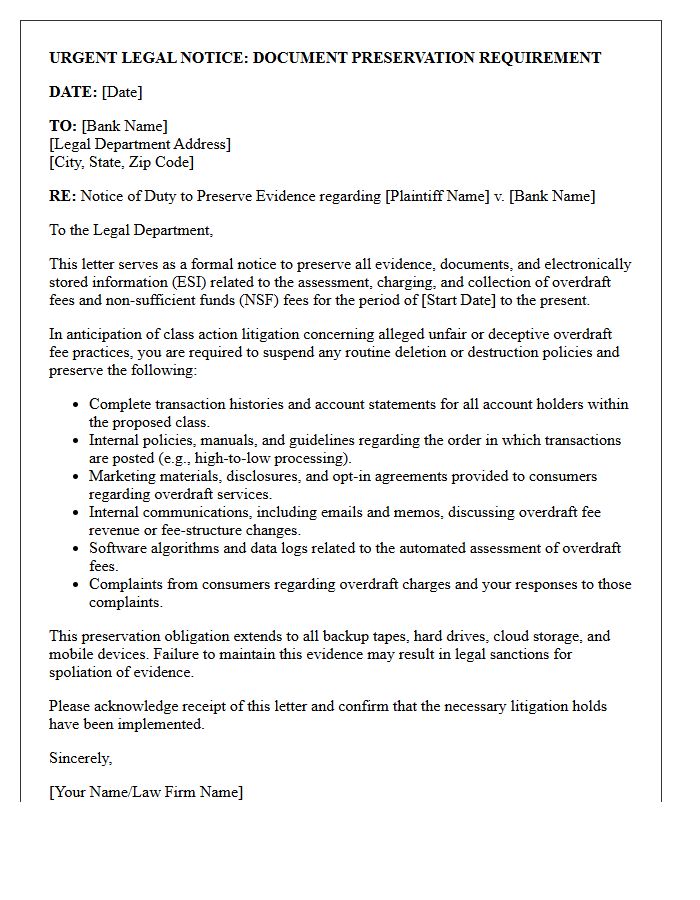
A Document Preservation Letter is a critical legal notice requiring banks to safeguard all evidence related to overdraft fees. In a consumer class action lawsuit, this mandate prevents the destruction of transaction logs, account agreements, and internal communications regarding fee assessments. Preserving these electronic records ensures that data remains available for discovery and litigation purposes. For affected consumers, this process protects the integrity of the case, allowing legal teams to calculate damages accurately and prove systemic patterns of predatory billing or unfair financial practices by the institution.
Legal Hold Letter for Commercial Loan Default and Foreclosure Proceedings
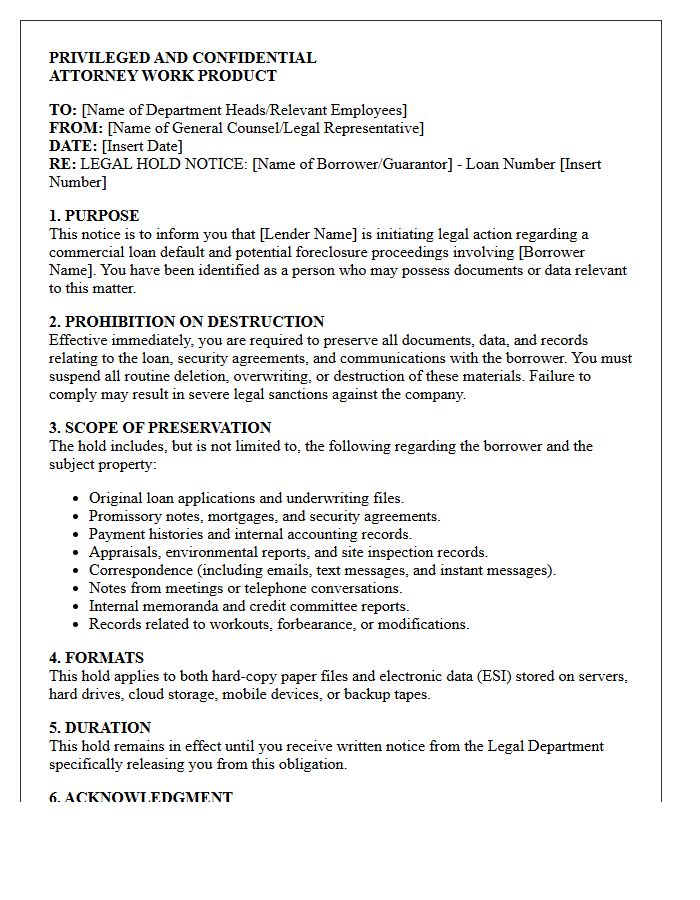
A legal hold letter is a critical directive issued during a commercial loan default to ensure the preservation of evidence. It mandates that all parties immediately cease the destruction of relevant documents, electronic data, and communication records. For lenders and borrowers, maintaining litigation readiness is essential to avoid severe court sanctions. This legal obligation remains in effect throughout the foreclosure proceedings, securing a transparent audit trail for all financial transactions and correspondence related to the default, which is vital for any subsequent legal action or judicial dispute resolution.
Internal Data Breach Investigation Evidence Preservation Letter
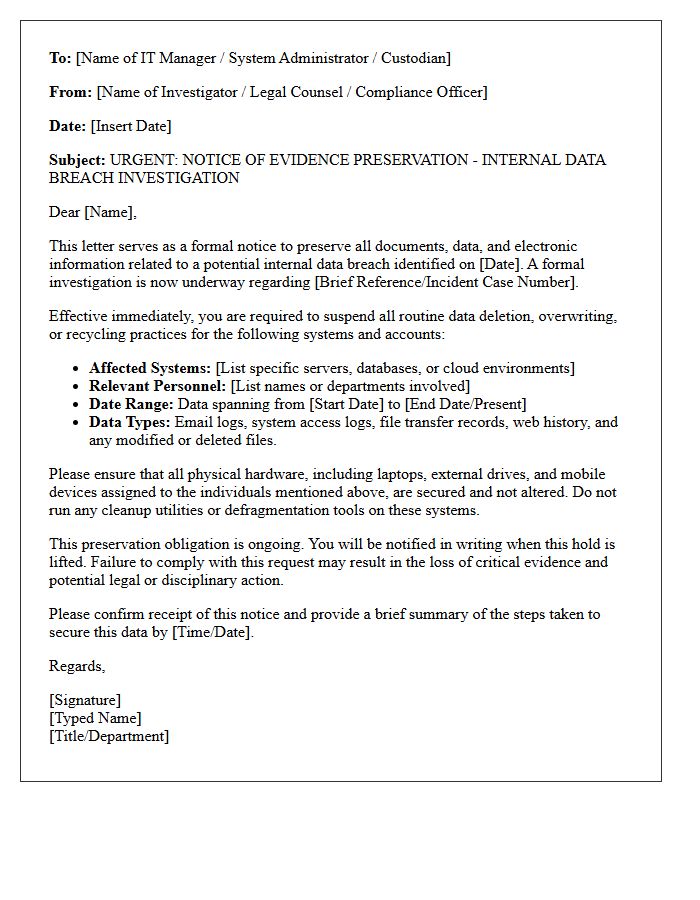
An Internal Data Breach Investigation Evidence Preservation Letter is a critical legal document issued to ensure the immediate protection of potential evidence. It mandates that employees and IT staff halt routine data deletion and litigation hold protocols. This formal notice prevents the destruction of system logs, emails, and metadata essential for forensic analysis. By securing a verifiable audit trail, organizations mitigate legal risks and fulfill regulatory compliance obligations. Timely distribution is vital to maintaining the integrity of digital assets during cyber security incident response and subsequent discovery phases.
Evidence Preservation Notice Letter for Suspicious Activity Report Archival Data
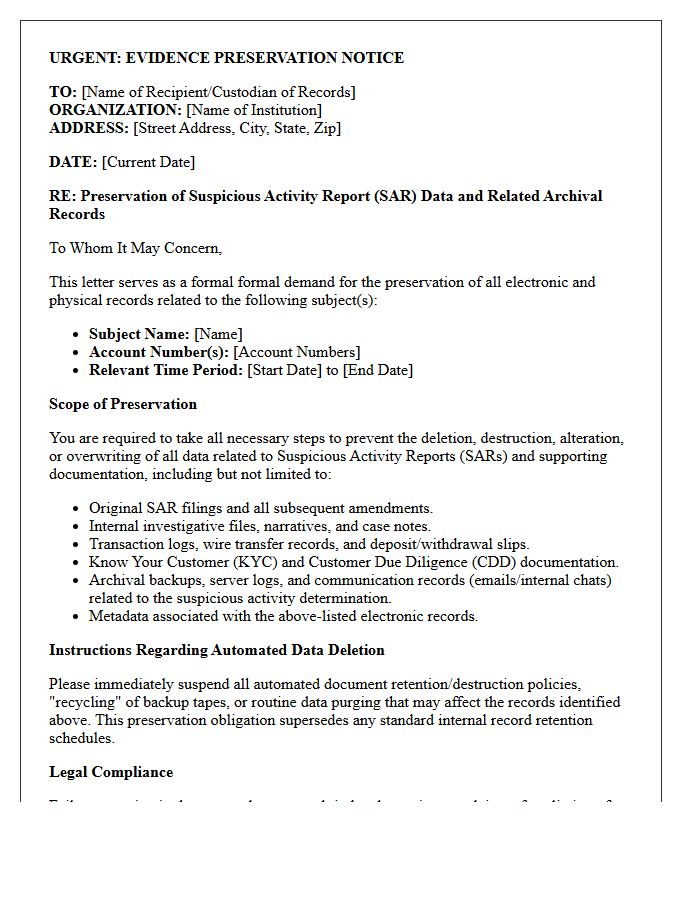
An Evidence Preservation Notice Letter is a critical legal directive sent to financial institutions to ensure Suspicious Activity Report (SAR) data remains intact. It mandates the immediate retention of specific archival records, preventing the deletion or routine purging of sensitive documentation. This notice is essential for maintaining a clear audit trail during federal investigations. Recipients must strictly adhere to non-disclosure requirements, as unauthorized sharing of SAR information is a criminal offense. Compliance protects the integrity of financial crime investigations and ensures that vital evidence remains available for judicial review or regulatory oversight.
Legal Hold Letter Regarding Employment Dispute and Wrongful Termination Claim
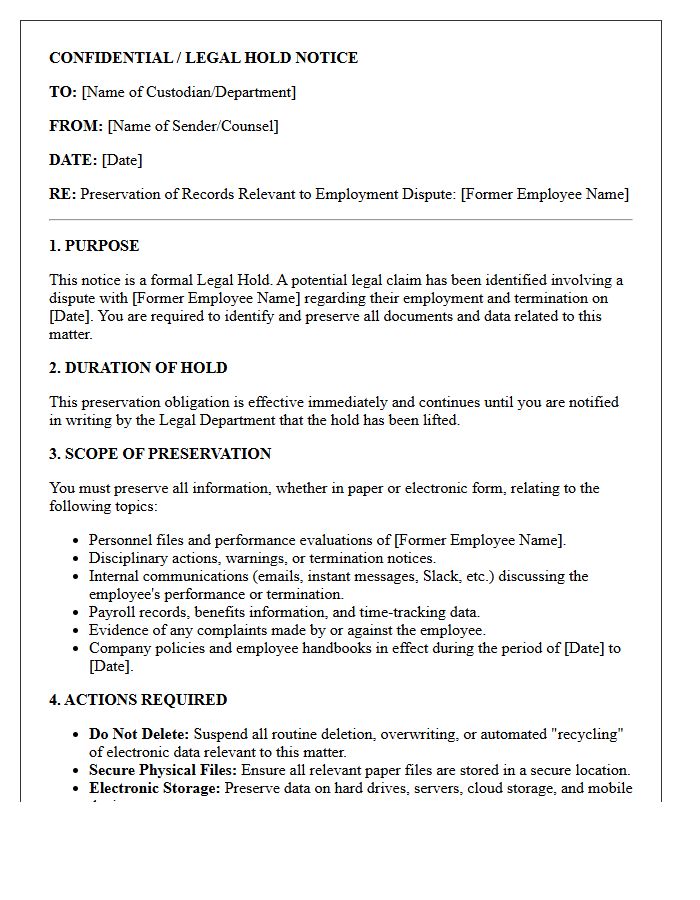
A legal hold letter is a critical preservation notice issued during employment disputes or wrongful termination claims. It legally mandates the employer to secure all relevant evidence, including emails, personnel files, and internal communications, preventing data destruction. For employees, this ensures that vital digital footprints are protected for future litigation. Failing to comply can lead to severe court sanctions for spoliation of evidence. Understanding your right to demand this litigation hold is essential for safeguarding facts and ensuring a fair legal process during formal workplace conflicts.
Insider Trading Investigation Document Preservation Letter for Wealth Management Division
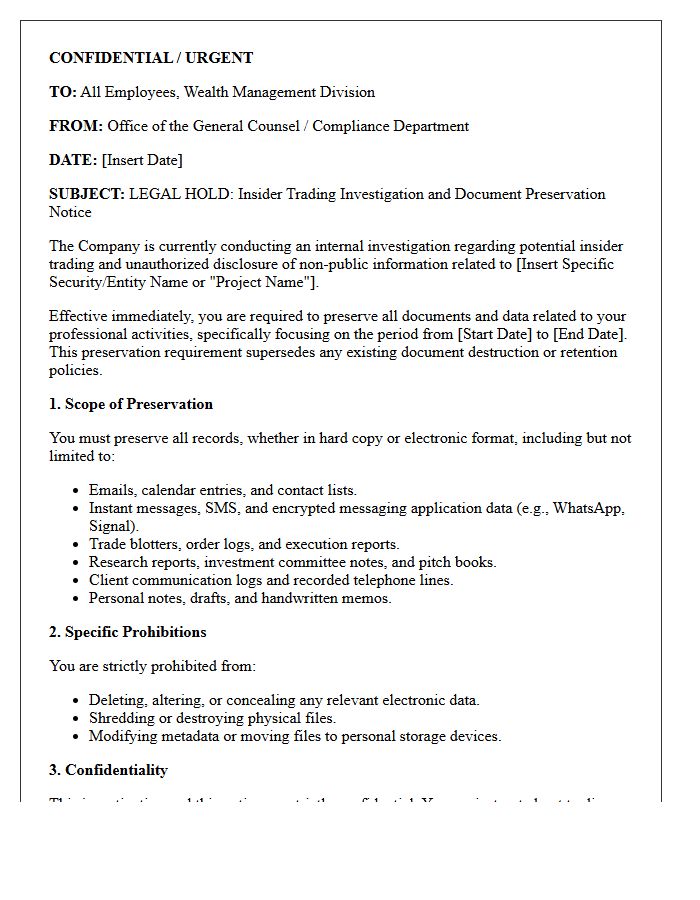
Wealth management divisions must prioritize a document preservation letter immediately following notice of an insider trading investigation. This formal notification, or "legal hold," mandates the strict retention of all electronic communications, trade logs, and client files. Failure to suspend routine data deletion protocols can lead to severe regulatory sanctions or charges of obstruction. Compliance officers must ensure that all relevant employees acknowledge the hold to maintain evidentiary integrity. Proactive document management is the most critical step in defending against allegations of market abuse and ensuring full transparency with legal authorities.
Evidence Preservation Letter for Mortgage Lending Discrimination Inquiry
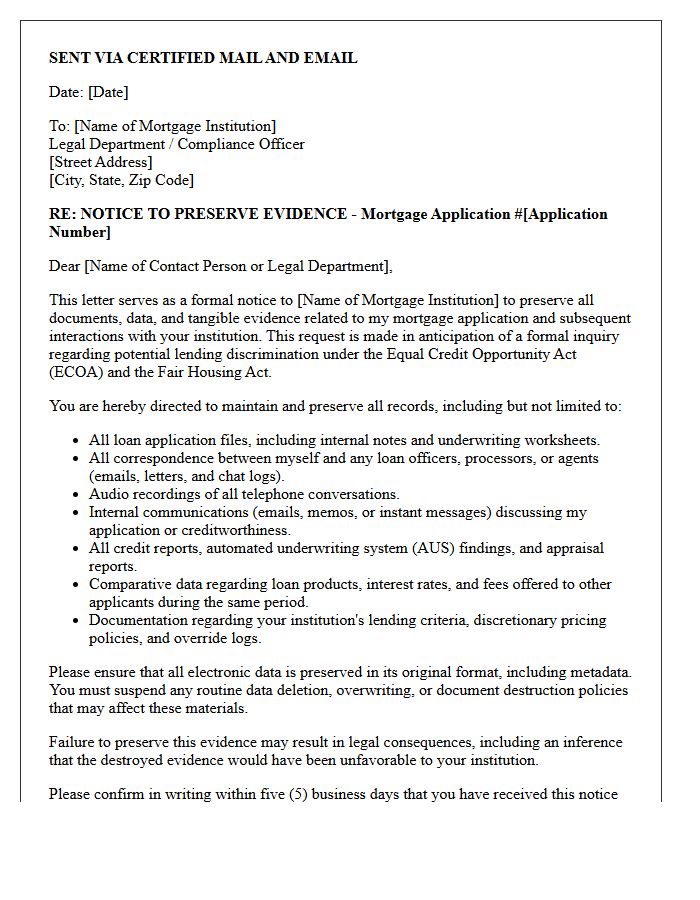
An Evidence Preservation Letter is a critical legal notice issued during a mortgage lending discrimination inquiry. It mandates that financial institutions halt routine data deletion to safeguard potential evidence, such as loan applications, underwriting algorithms, and internal communications. For victims of fair lending violations, this document ensures that digital records and physical files remain accessible for investigation. Failing to comply can lead to severe legal sanctions, making it the foundational step in proving discriminatory practices or disparate impact within the mortgage industry.
Legal Hold Notice Letter Pertaining to Cross-Border Tax Evasion Allegations
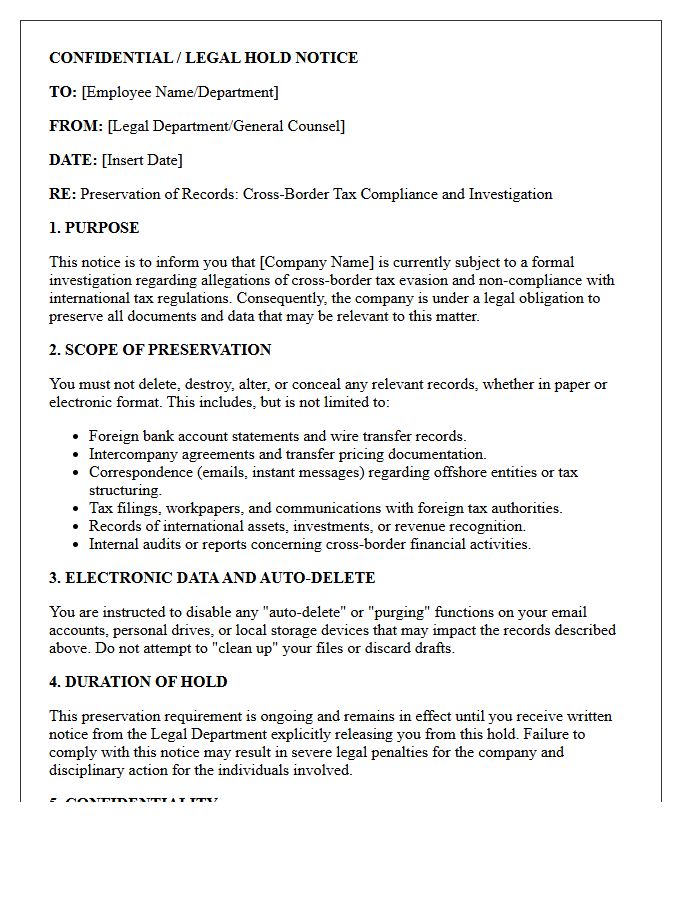
A legal hold notice is a critical directive requiring the immediate preservation of all relevant documents and electronic data during investigations into cross-border tax evasion. Recipients must suspend routine data deletion to ensure compliance with international regulatory inquiries and potential litigation. Failure to maintain these records can lead to severe spoliation sanctions and criminal penalties. This notice ensures that evidence regarding offshore accounts, international wire transfers, and tax reporting remains accessible for legal discovery. Promptly acknowledging the hold and identifying all "custodians" of information is essential for demonstrating institutional transparency and legal cooperation.
Know Your Customer Compliance Audit Evidence Preservation Letter
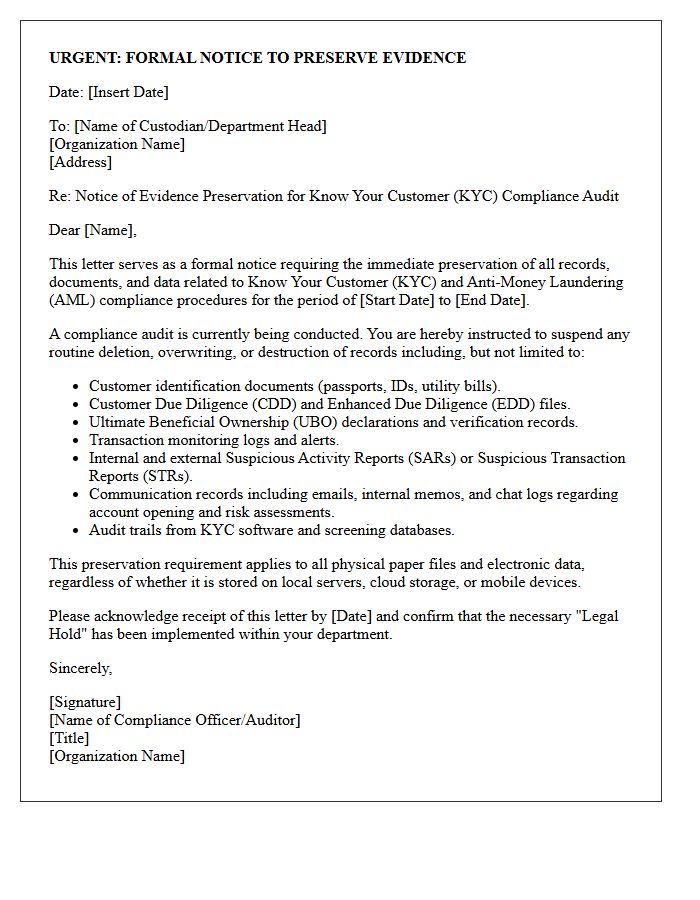
A Know Your Customer Compliance Audit Evidence Preservation Letter is a formal legal notification issued to financial institutions during regulatory investigations. It mandates the immediate retention of all audit evidence, including client identification records, risk assessments, and transaction logs. This document ensures that potential evidence remains unaltered and accessible for investigators. Failure to comply can lead to severe legal penalties or charges of spoliation. For compliance officers, these letters serve as a critical directive to suspend routine data deletion protocols and safeguard the integrity of the institution's AML/KYC verification history.
Corporate Bankruptcy Proceeding Legal Hold Letter for Creditor Communications
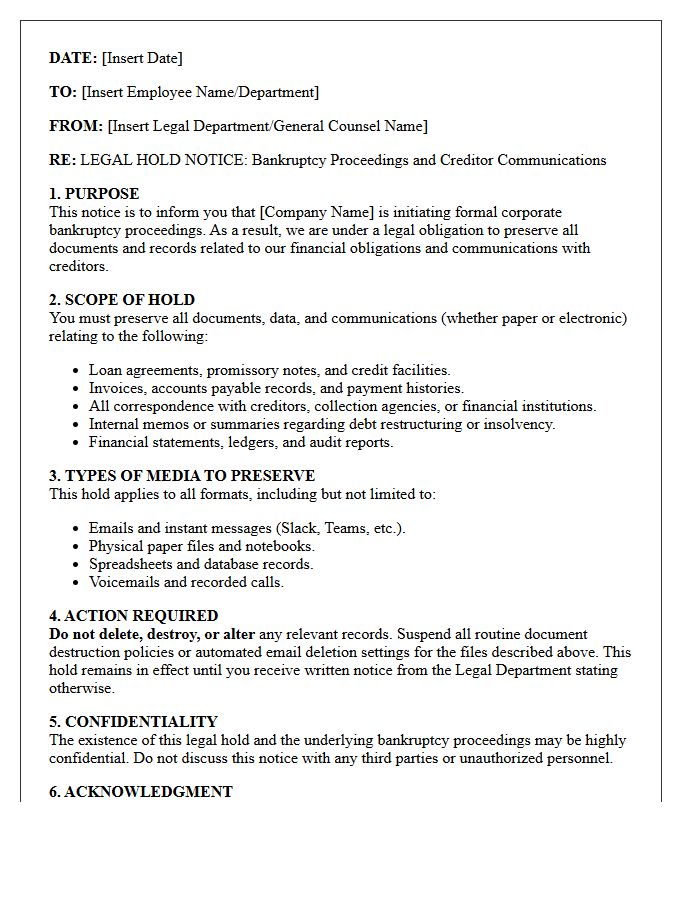
A Corporate Bankruptcy Proceeding Legal Hold Letter is a critical directive requiring creditors to preserve all records related to a debtor. Upon receiving this notice, you must immediately suspend routine document destruction to comply with litigation preservation mandates. This ensures all financial contracts, invoices, and electronic communications remain available for court review. Failure to adhere to these requirements can result in severe legal sanctions or the loss of claims. Maintaining a documented chain of custody is essential for protecting your interests during the restructuring or liquidation process.
What is a Legal Hold and why is it necessary?
A Legal Hold is a process used by organizations to preserve all forms of relevant information when litigation is reasonably anticipated. It is necessary to ensure that potentially discoverable evidence-such as emails, documents, and digital records-is not deleted or altered, fulfilling the legal duty to preserve evidence and avoiding spoliation sanctions.
What information is typically included in an Evidence Preservation Notice?
An Evidence Preservation Notice typically includes a description of the legal matter, a specific definition of the data to be preserved, a list of identified custodians, instructions on how to suspend routine data deletion policies, and a formal acknowledgment requirement for the recipients to confirm compliance.
Who are the "custodians" in the context of a Legal Hold?
Custodians are individuals or entities within an organization who have possession, custody, or control of records and data relevant to a specific legal matter. Identifying the correct custodians is a critical step in ensuring that all relevant Electronically Stored Information (ESI) is identified and protected from destruction.
What are the consequences of failing to comply with a Legal Hold?
Failure to comply with a Legal Hold can lead to "spoliation of evidence," resulting in severe judicial sanctions. These may include monetary fines, adverse inference jury instructions (where the court assumes the missing evidence was unfavorable to the party), or even a default judgment against the non-compliant party.
When can a Legal Hold and Evidence Preservation Notice be officially released?
A Legal Hold can be released only when the underlying litigation, investigation, or audit has reached a final resolution, including the exhaustion of all appeals. Once the legal obligation to preserve is terminated, the organization must issue a formal release notice before resuming standard document retention and disposal schedules.

Comments