
Managing a Notice of Letter of Credit Expiration is vital for maintaining global supply chain stability. This document alerts beneficiaries and banks that a credit facility is nearing its end date, preventing unintended payment defaults or shipment delays. Understanding the formal notification process ensures continuous financial coverage. To help you draft your official correspondence, below are some ready to use templates.

Image cover: Professional Letter of Credit Expiration Notice Templates and Samples
Letter Samples List
- Notice of Letter of Credit Expiration Letter
- Final Advisory Letter for Letter of Credit Expiration
- Standby Letter of Credit Expiration Notification Letter
- Commercial Letter of Credit Expiration Warning Letter
- Irrevocable Letter of Credit Expiration Notice Letter
- Export Letter of Credit Expiration Alert Letter
- Import Letter of Credit Expiration Notice Letter
- Revolving Letter of Credit Expiration Status Letter
- Documentary Letter of Credit Expiration Declaration Letter
- Trade Finance Letter of Credit Expiration Letter
- Confirmed Letter of Credit Expiration Notice Letter
- Unconfirmed Letter of Credit Expiration Advisory Letter
Notice of Letter of Credit Expiration Letter
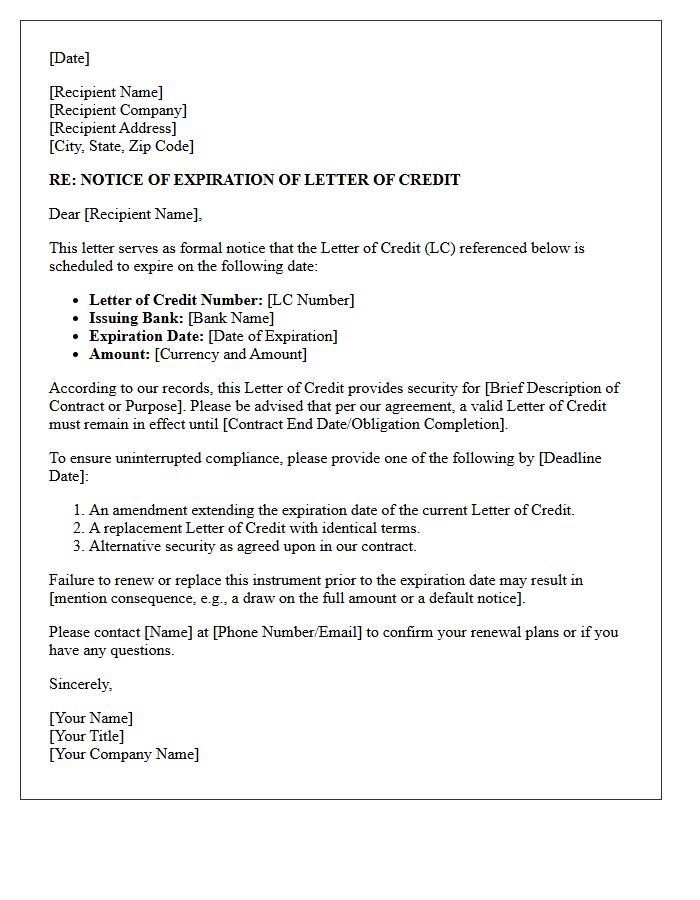
A Notice of Letter of Credit Expiration Letter is a formal notification issued by a bank to inform the beneficiary and applicant that a Letter of Credit is approaching its expiry date. It is crucial to monitor this timeline, as failure to present compliant documents or request an extension before the deadline results in the termination of payment guarantees. Recipients should immediately review the validity period to ensure all contractual obligations are met, preventing financial loss or the need for costly re-issuance in international trade transactions.
Final Advisory Letter for Letter of Credit Expiration
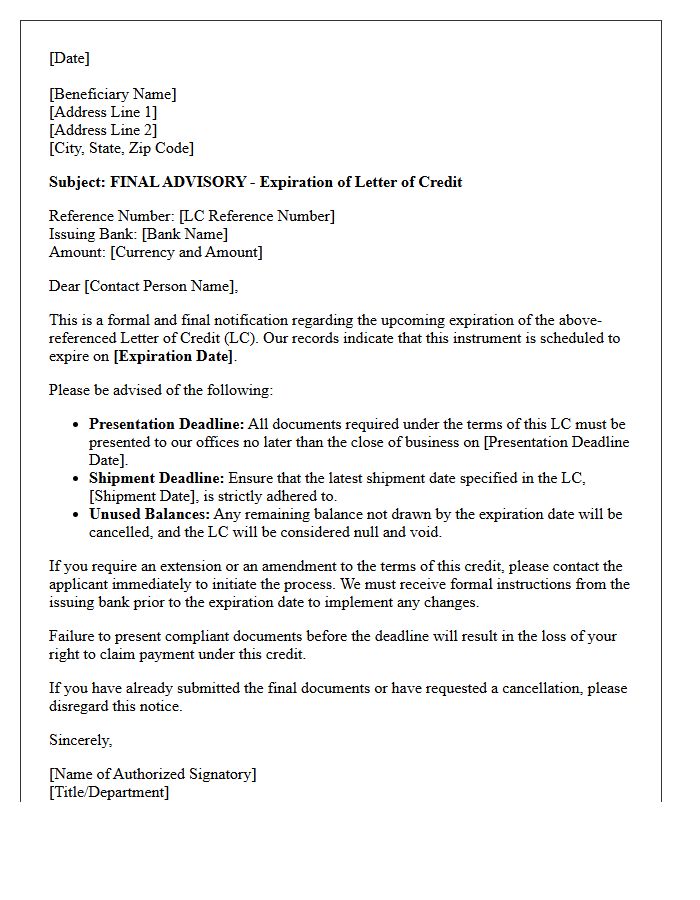
A Final Advisory Letter serves as a critical notice that a Letter of Credit is approaching its expiration date. Beneficiaries must ensure all compliant documentation is presented to the bank before this deadline to guarantee payment. Once the credit expires, the financial obligation of the issuing bank terminates immediately. It is essential to review the expiry terms and request any necessary amendments or extensions promptly. Failure to act before the cutoff results in the loss of payment security, potentially leaving the seller unprotected in international trade transactions.
Standby Letter of Credit Expiration Notification Letter
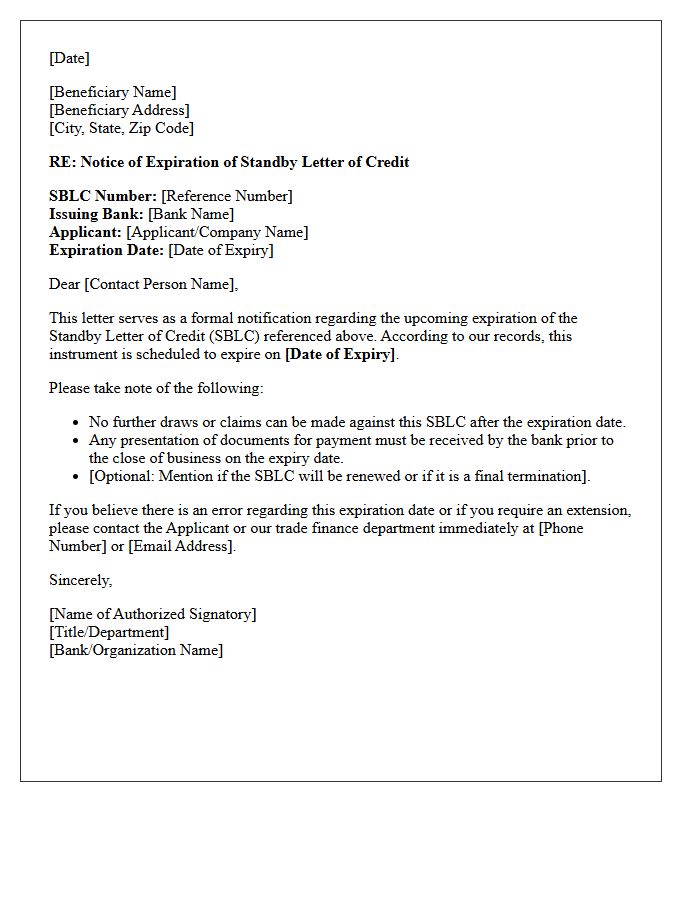
A Standby Letter of Credit (SBLC) Expiration Notification Letter is a critical legal document issued by a bank to inform beneficiaries that a financial guarantee is nearing its end. This formal notice ensures all parties are aware of the maturity date to prevent an accidental lapse in security. It serves as a final opportunity to request an extension or draw funds if contractual obligations remain unmet. Timely acknowledgment is essential to maintain financial protection and avoid the risks associated with an expired credit instrument in international trade or construction projects.
Commercial Letter of Credit Expiration Warning Letter
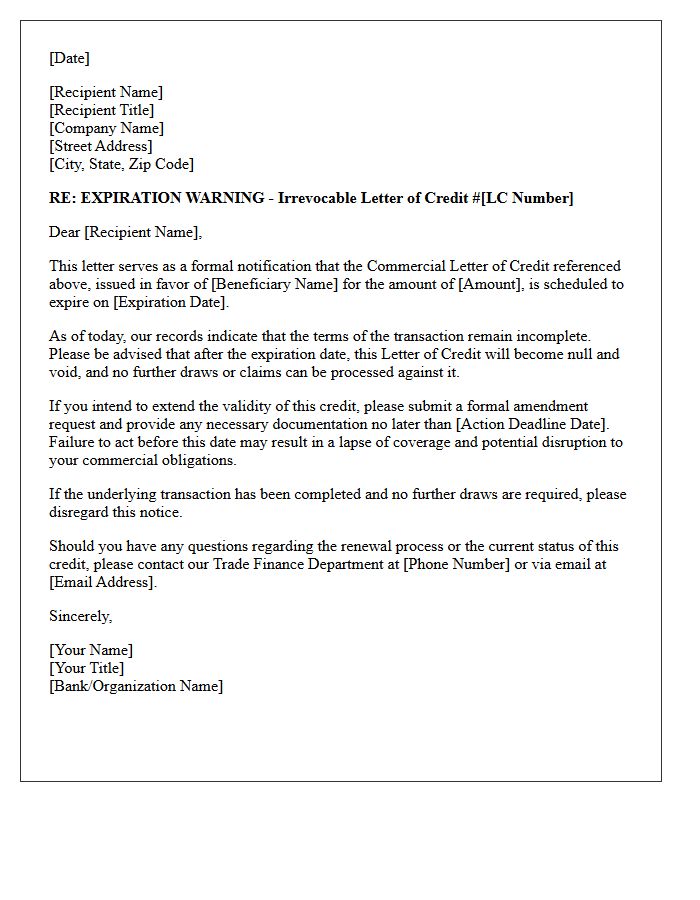
A Commercial Letter of Credit Expiration Warning Letter serves as a critical formal notification issued by a bank to a beneficiary or applicant. This document alerts parties that the credit facility is nearing its end date, risking the cancellation of payment guarantees. It is essential to act promptly upon receipt to arrange an extension or ensure all shipping documents are presented before the expiry deadline. Failure to manage these timelines can lead to significant financial loss, discrepancy fees, or the total voiding of the underlying trade transaction security.
Irrevocable Letter of Credit Expiration Notice Letter
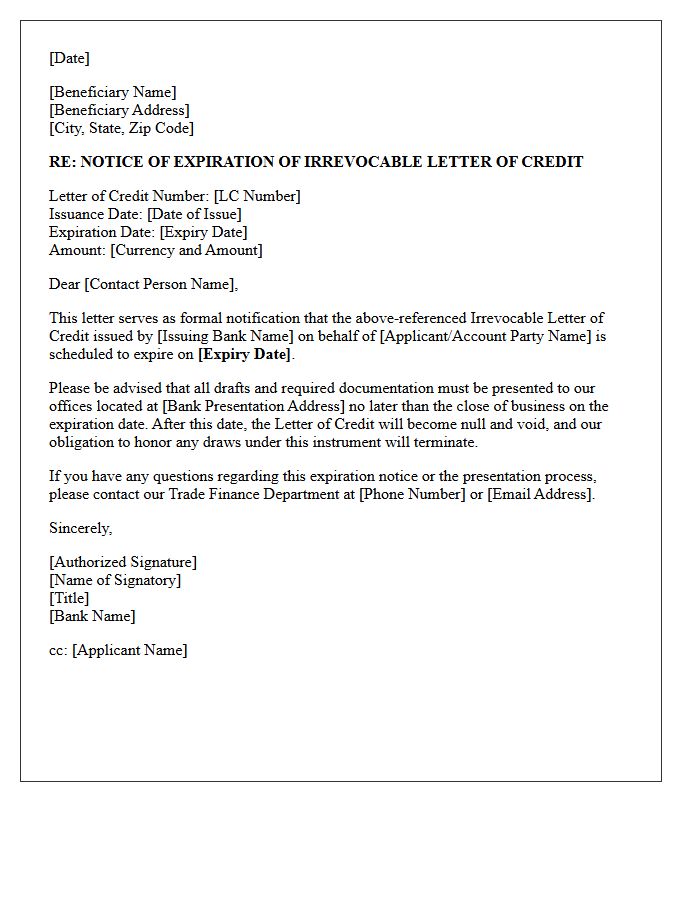
An Irrevocable Letter of Credit Expiration Notice Letter is a formal notification issued by a bank to inform beneficiaries that a financial guarantee is nearing its end. This document is critical because, once expired, the payment security provided by the issuing bank ceases to exist. Beneficiaries must carefully review the expiry date and specific presentation terms to ensure all required documentation is submitted on time. Failure to act before the deadline results in the total loss of the guaranteed funds, making timely communication essential for international trade compliance.
Export Letter of Credit Expiration Alert Letter
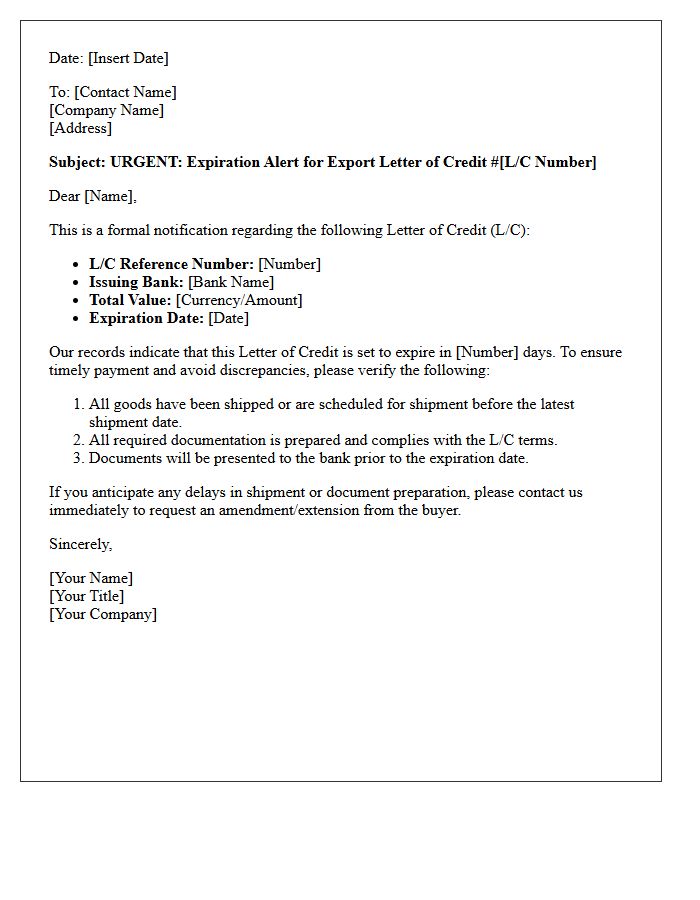
An Export Letter of Credit Expiration Alert Letter is a critical formal notice sent to a beneficiary regarding an approaching expiry date. It serves as an urgent reminder to present required shipping documents to the bank before the credit lapses. Failure to act promptly can lead to payment refusal and financial loss. Exporters must ensure all terms are met and strictly adhere to the deadline specified in the original credit agreement. If additional time is needed to fulfill the shipment, a formal amendment must be requested immediately to maintain payment security.
Import Letter of Credit Expiration Notice Letter
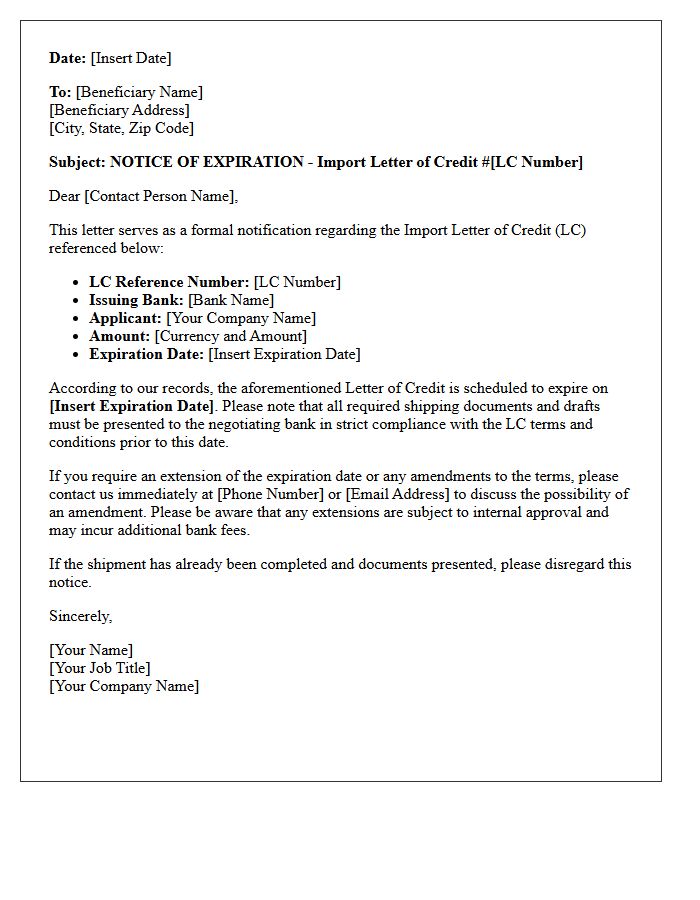
An Import Letter of Credit Expiration Notice is a critical document notifying the applicant that their financial instrument is approaching its expiry date. To ensure uninterrupted trade operations, the importer must act immediately to either extend the validity via an amendment or allow the credit to lapse if obligations are met. Failure to monitor these notices can lead to payment defaults, shipment delays, and voided legal protections. Timely responses help maintain healthy relationships with beneficiaries and confirm that all contractual terms align with the current shipping schedule.
Revolving Letter of Credit Expiration Status Letter
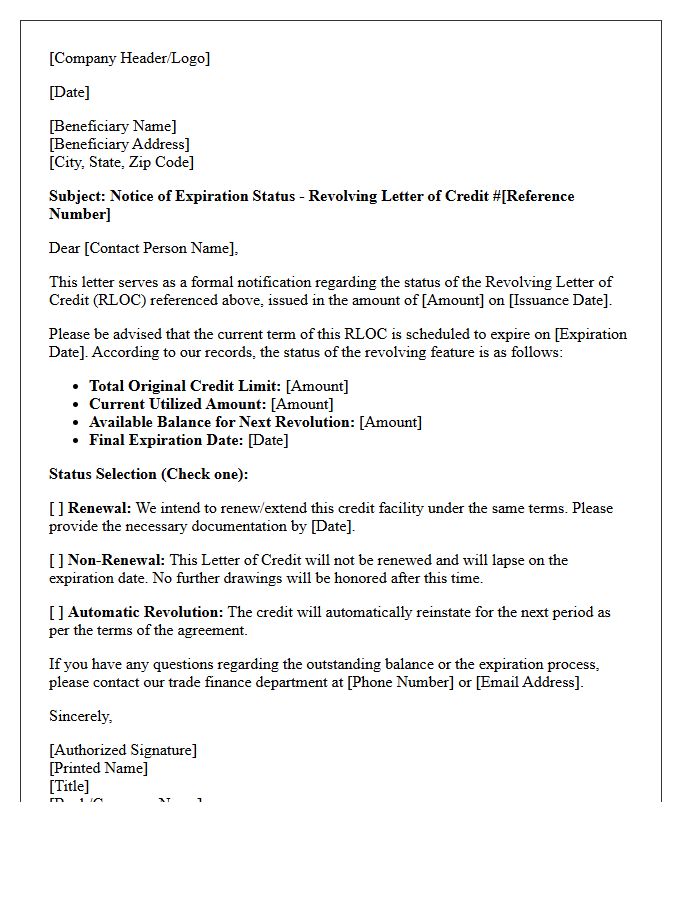
A Revolving Letter of Credit Expiration Status Letter is a critical formal notice confirming the termination of a credit facility. It informs the beneficiary that the revolving credit limit is no longer available for drawdowns due to reaching the maturity date. Businesses must track this status to ensure continuous liquidity and avoid disruptions in trade cycles. Understanding this document is essential for financial reconciliation and managing future borrowing capacity effectively. Always verify the final balance and closure terms to maintain accurate corporate accounting and professional banking relationships.
Documentary Letter of Credit Expiration Declaration Letter
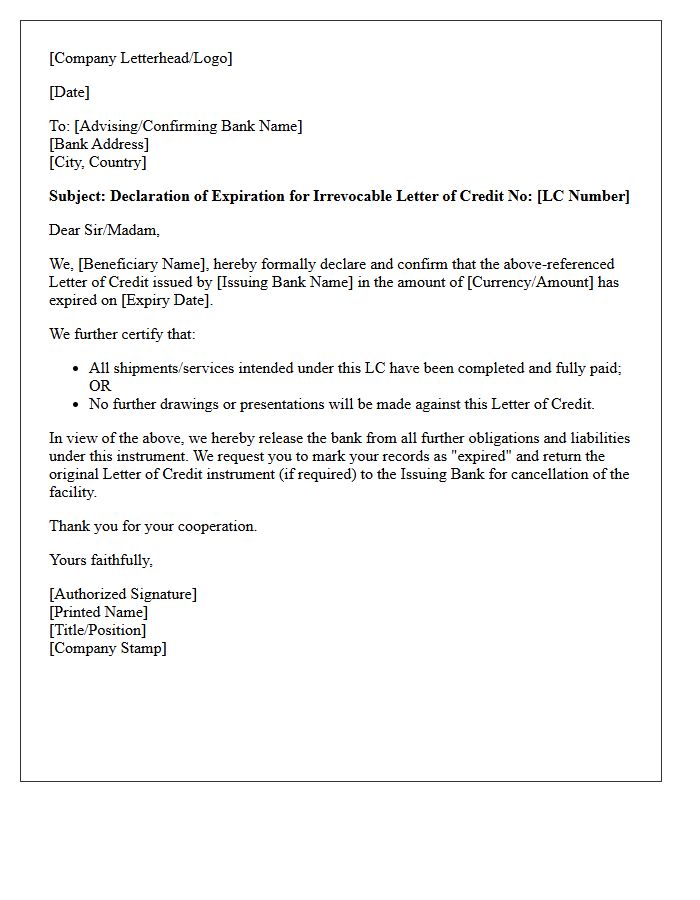
A Documentary Letter of Credit Expiration Declaration Letter is a formal notification issued by the beneficiary to confirm the expiry of a credit facility. This document is essential for releasing collateral or reducing the bank's contingent liability once the credit's validity period ends without full utilization. It ensures that both the issuing bank and the applicant are legally informed that the financial obligation has terminated. Clear identification of the LC number and the specific expiry date is required to ensure accurate record-keeping and formal closure of the trade finance transaction.
Trade Finance Letter of Credit Expiration Letter
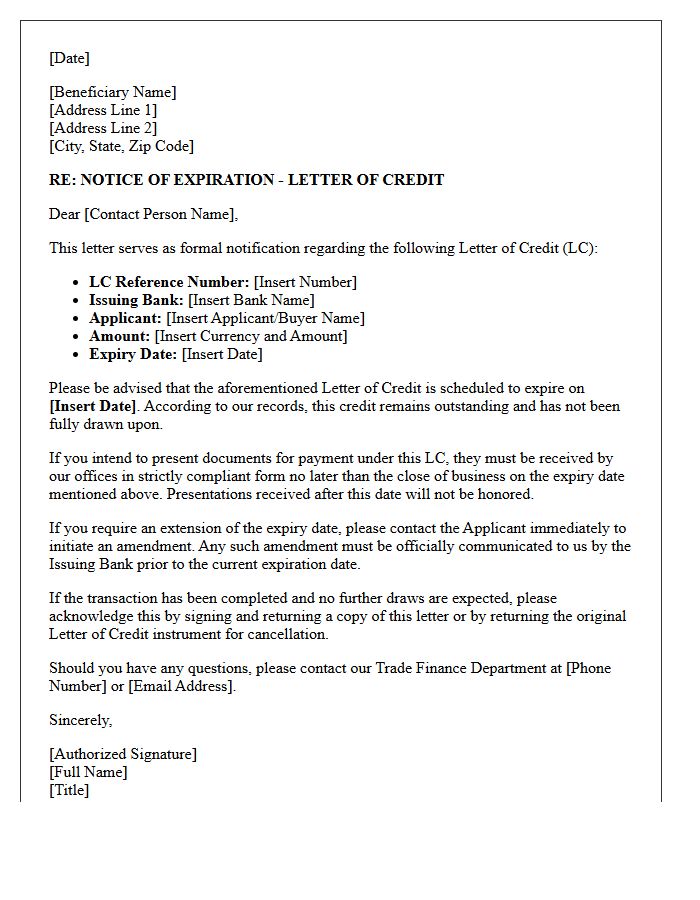
A Trade Finance Letter of Credit Expiration Letter serves as a formal notification that a credit facility is nearing its end. This document is crucial for managing liquidity and ensuring compliance within international trade. Parties must review the expiry date to avoid payment defaults or shipment delays. If the underlying commercial transaction is incomplete, the beneficiary or applicant must request an amendment or extension immediately. Timely communication prevents the cancellation of financial guarantees, protecting the interests of both exporters and importers during the settlement process.
Confirmed Letter of Credit Expiration Notice Letter
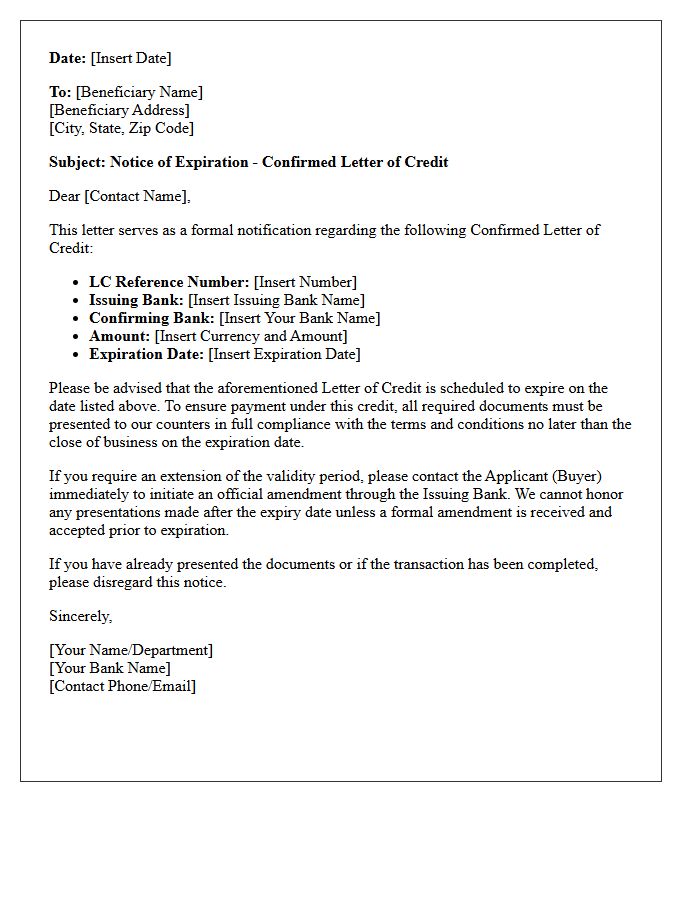
A Confirmed Letter of Credit Expiration Notice Letter is a formal notification sent by a bank to inform the beneficiary that the credit is nearing its expiry date. This document is critical because it warns the exporter to present complying documents or request an extension before the guarantee terminates. Since a confirmed LC involves a second bank's payment guarantee, missing this deadline results in the loss of payment security. Parties must act immediately upon receipt to ensure the validity of the credit remains intact for the underlying trade transaction.
Unconfirmed Letter of Credit Expiration Advisory Letter
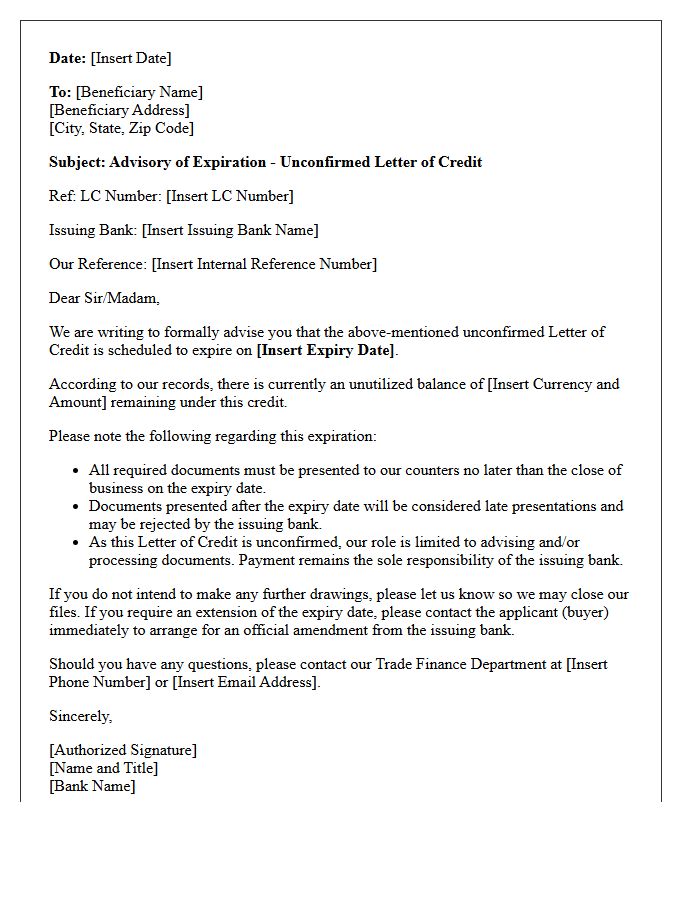
An Unconfirmed Letter of Credit Expiration Advisory Letter is a critical formal notice sent by a bank to a beneficiary. It warns that a specific credit is nearing its validity deadline without a guarantee from a local bank. Recipients must ensure all shipping documents strictly comply with terms and are presented before the expiry date to secure payment. Ignoring this advisory risks financial loss, as the bank's obligation to pay terminates once the credit expires. Timely action is essential to request extensions or finalize the trade transaction securely.
What is a Notice of Letter of Credit Expiration?
A Notice of Letter of Credit Expiration is a formal communication sent by an issuing bank to the beneficiary and the applicant, stating the specific date and time when the credit facility will no longer be valid for drawing funds.
What happens when a Letter of Credit expires?
Once a Letter of Credit reaches its expiration date, the issuing bank's obligation to pay is terminated. The beneficiary can no longer present documents for payment, and any unused credit balance is typically released back to the applicant's line of credit.
Can an expired Letter of Credit be renewed or extended?
Yes, a Letter of Credit can be extended through an official amendment if both the applicant and the beneficiary agree to the new terms before the actual expiration date; however, once it has fully expired, a new credit facility usually must be established.
What is the difference between the expiry date and the presentation period?
The expiry date is the final day the Letter of Credit is valid, while the presentation period is a specific timeframe (usually 21 days) after shipment during which the beneficiary must submit documents to the bank. Documents must be presented before both the presentation deadline and the expiry date.
What should a beneficiary do upon receiving an expiration notice?
Upon receiving a notice, the beneficiary should immediately review the shipping schedule to ensure all documents can be presented to the bank before the deadline. If the timeline is insufficient, they should request an extension from the applicant to avoid payment risk.


Comments