
If a bank fails to remit funds after documents are presented, you must issue a Tracer for Payment Under Letter of Credit. This formal inquiry tracks the status of overdue settlements and ensures compliance with international banking standards. Effectively communicating with the issuing bank minimizes financial delays and improves cash flow. To simplify your process, below are some ready to use template.

Image cover: Letter of Credit Payment Tracer: Professional Samples and Templates
Letter Samples List
- Initial Tracer Letter for Payment Under Letter of Credit
- Second Tracer Letter for Outstanding Letter of Credit Payment
- Final Escalation Tracer Letter for Letter of Credit Settlement
- Urgent Tracer Letter for Overdue Letter of Credit Payment
- Routine Tracer Letter for Pending Letter of Credit Remittance
- Tracer Letter Requesting Status of Letter of Credit Payment
- Tracer Letter for Reimbursement Claim Under Letter of Credit
- Tracer Letter for Unpaid Letter of Credit Document Presentation
- Follow-Up Tracer Letter for Letter of Credit Negotiation Payment
- Swift Message Tracer Letter for Letter of Credit Funds Release
- Inquiry Tracer Letter for Delayed Letter of Credit Payment
- Official Tracer Letter for Defaulted Letter of Credit Payment
Initial Tracer Letter for Payment Under Letter of Credit
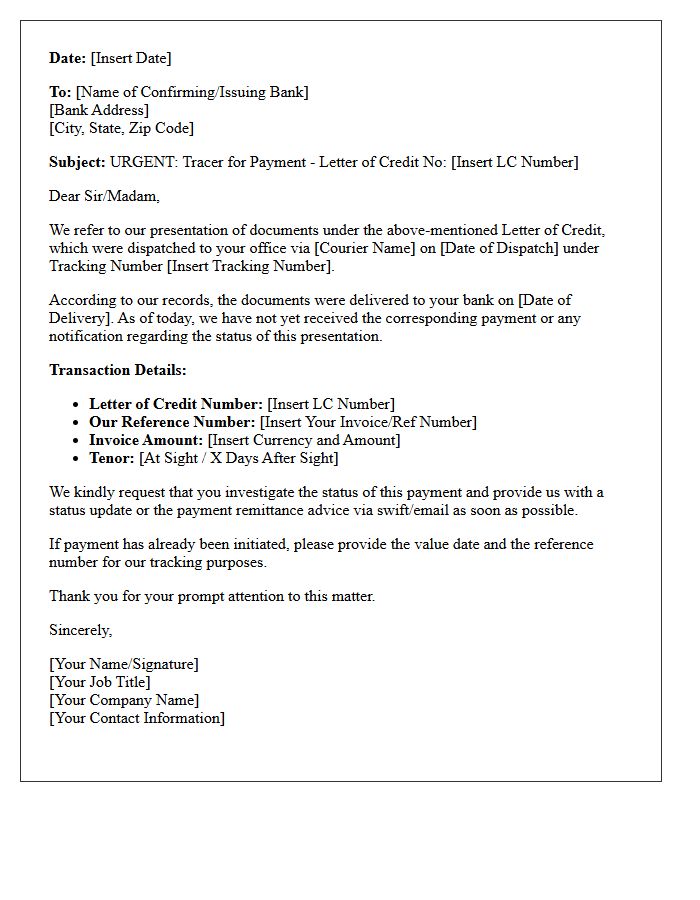
An Initial Tracer Letter is a formal inquiry sent by the beneficiary to the nominated bank when payment for a Letter of Credit is delayed beyond the expected timeframe. Its primary purpose is to track the status of documents and ensure funds are being processed. This communication serves as critical evidence of follow-up in international trade, prompting the bank to identify potential discrepancies or logistical bottlenecks. Timely dispatch of a tracer helps maintain cash flow and confirms that all presentation deadlines were met according to UCP 600 standards.
Second Tracer Letter for Outstanding Letter of Credit Payment
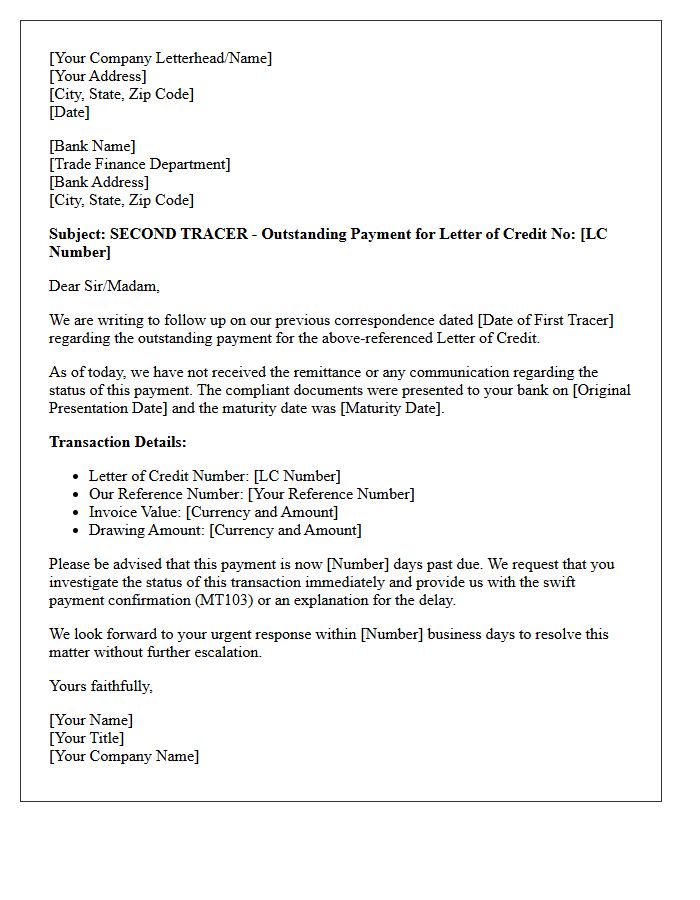
A Second Tracer Letter is a formal follow-up issued when a bank or beneficiary receives no response to an initial inquiry regarding an outstanding Letter of Credit payment. This document serves as an urgent demand to resolve processing delays or discrepancies. It is crucial for maintaining cash flow and ensuring international trade compliance. If this secondary notice remains unaddressed, it often escalates to a formal payment dispute or legal intervention to enforce the financial obligations established under the original credit terms.
Final Escalation Tracer Letter for Letter of Credit Settlement
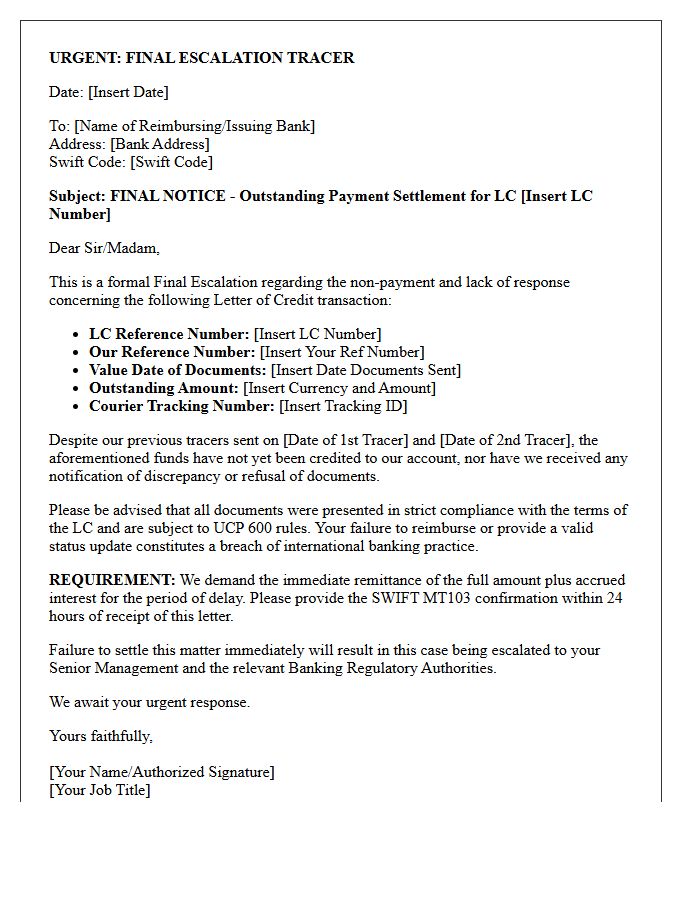
A Final Escalation Tracer Letter serves as the critical last formal notice before initiating legal action or arbitration for an unpaid Letter of Credit. This document warns the issuing bank of non-compliance with UCP 600 standards. It demands immediate settlement of outstanding funds, citing the specific credit reference and default duration. Sending this letter is essential for creating a definitive paper trail, proving that all reasonable amicable efforts were exhausted to resolve the payment discrepancy before escalating to banking regulators or judicial debt recovery processes.
Urgent Tracer Letter for Overdue Letter of Credit Payment
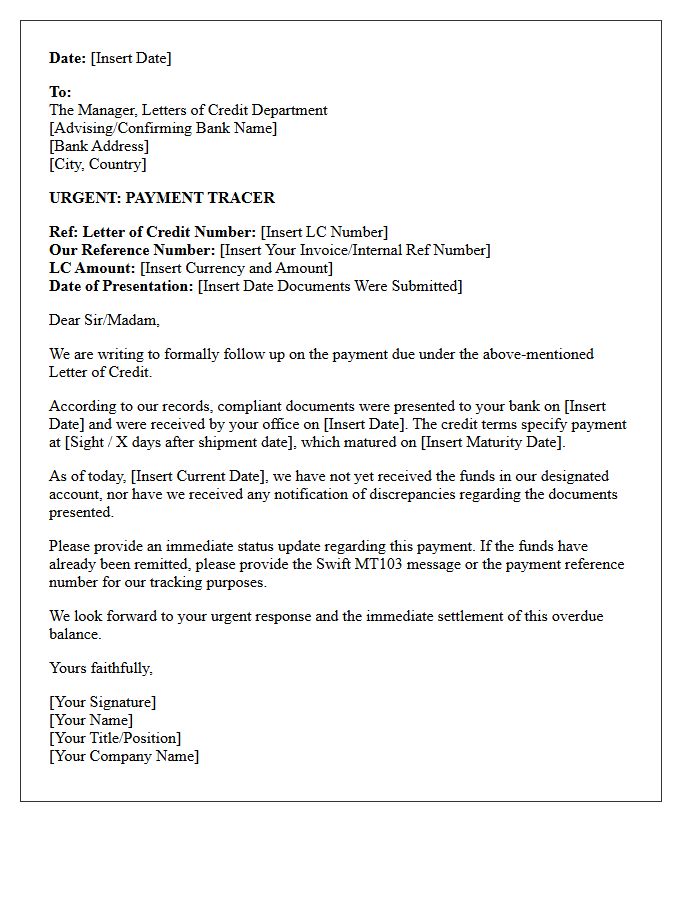
An Urgent Tracer Letter is a formal demand sent by a beneficiary's bank to a non-paying issuing bank to resolve an overdue Letter of Credit payment. It serves as a critical communication tool to investigate processing delays, verify document discrepancies, or address potential defaults. This document ensures legal traceability and pressures the counterparty to fulfill their financial obligation immediately. Timely issuance is vital to maintain liquidity and mitigate credit risk in international trade transactions where payment terms have already expired.
Routine Tracer Letter for Pending Letter of Credit Remittance
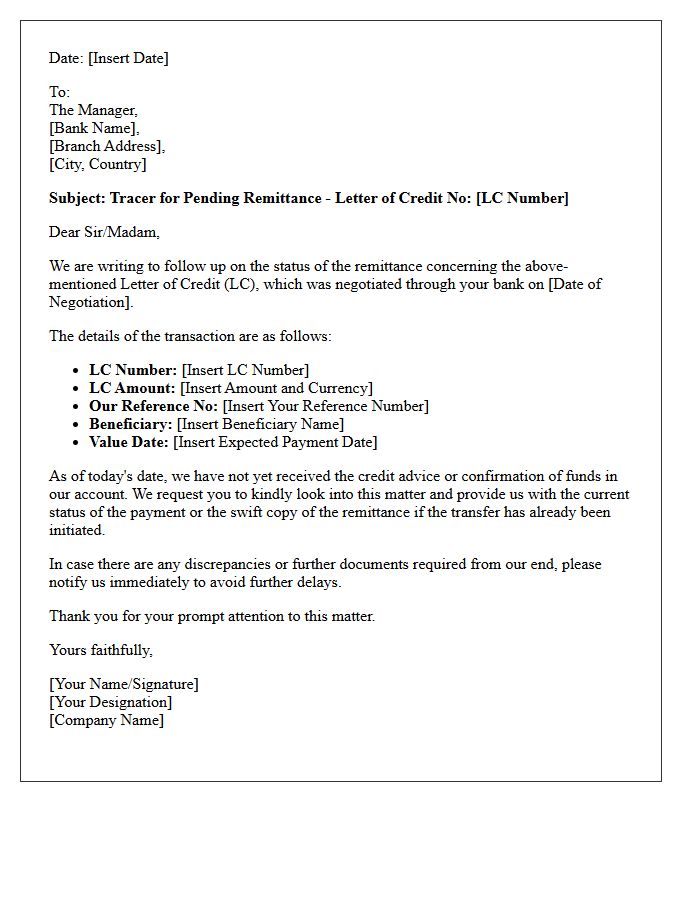
A Routine Tracer Letter is a formal inquiry sent by a beneficiary to a bank to track a pending remittance under a Letter of Credit. This document acts as an official follow-up when payment is delayed beyond the expected timeframe. Its primary purpose is to identify bottlenecks in the settlement process, confirm the status of funds, and ensure all documentary conditions have been satisfied. Maintaining a clear paper trail through tracers is essential for effective cash flow management and resolving international trade discrepancies promptly between the advising and issuing banks.
Tracer Letter Requesting Status of Letter of Credit Payment
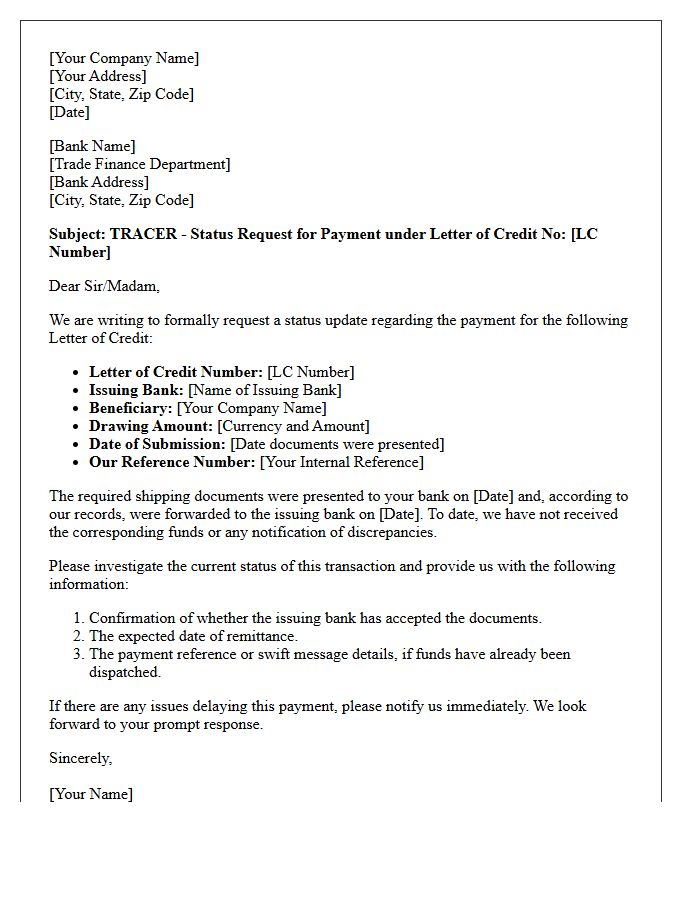
A Tracer Letter is a formal inquiry sent by a beneficiary to their bank to investigate delays in receiving funds. This document is essential when a Letter of Credit payment exceeds the expected processing timeframe. It prompts banks to track the transaction through the SWIFT network to identify bottlenecks or missing documents. Issuing a tracer ensures accountability between the issuing and nominating banks, helping to expedite the settlement process and resolve discrepancies that may be stalling the transfer of international trade finance proceeds.
Tracer Letter for Reimbursement Claim Under Letter of Credit
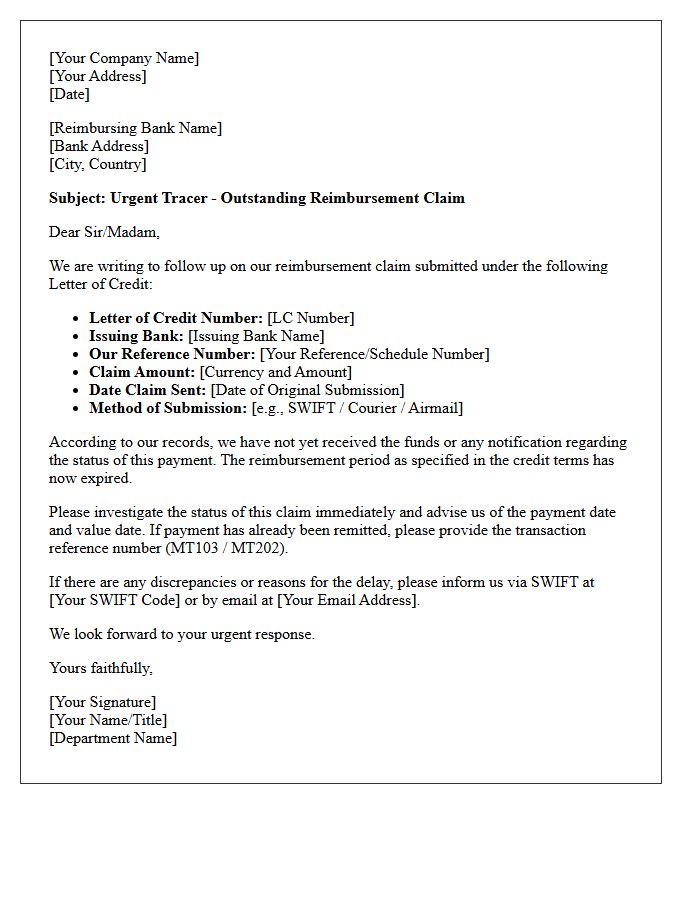
A tracer letter is a formal inquiry sent by a beneficiary to a nominated bank when payment for a reimbursement claim under a Letter of Credit is delayed. Its primary function is to track the status of funds and expedite the settlement process. This document serves as a critical follow-up tool, ensuring that the reimbursing bank or issuing bank addresses discrepancies or processing bottlenecks. Sending a timely tracer helps maintain cash flow and provides documented evidence of communication should a payment dispute escalate into a formal collection issue.
Tracer Letter for Unpaid Letter of Credit Document Presentation
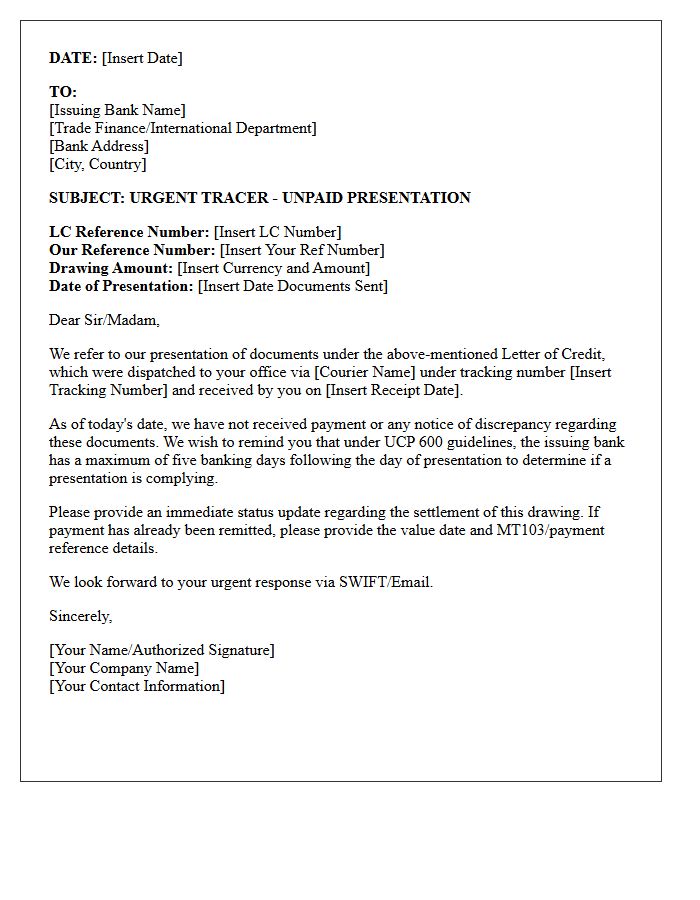
A tracer letter is a formal inquiry sent by a beneficiary's bank to an issuing bank when payment for a Letter of Credit presentation is delayed beyond standard timeframes. Its primary purpose is to demand a status update and ensure documents were not lost or overlooked. Under UCP 600 rules, banks must act promptly; therefore, a tracer serves as a critical escalation tool to resolve communication gaps and accelerate the settlement of funds for unpaid international trade transactions.
Follow-Up Tracer Letter for Letter of Credit Negotiation Payment
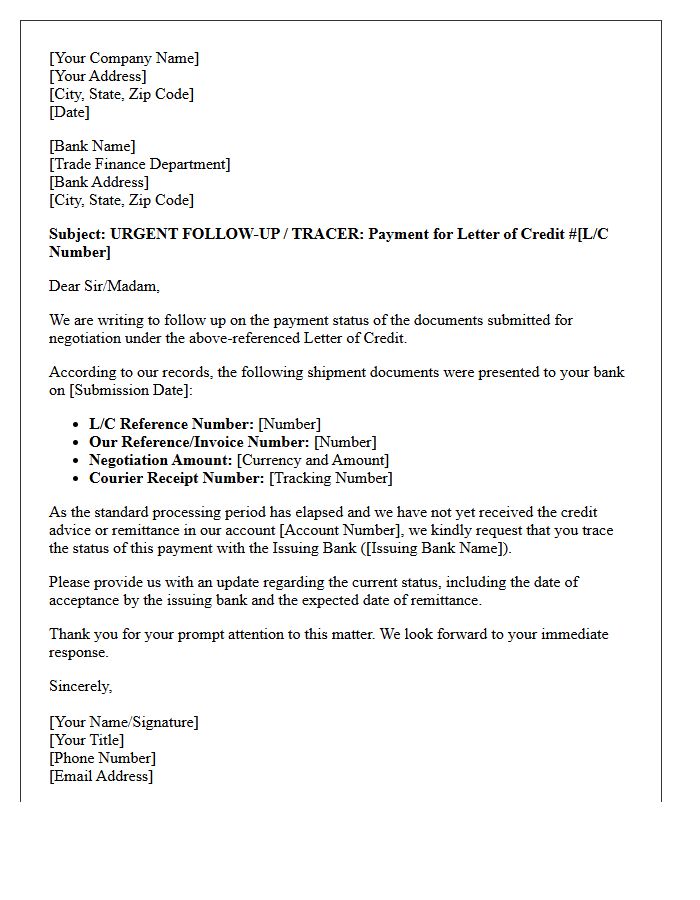
A Follow-Up Tracer Letter is a formal inquiry sent by a beneficiary to their bank when a Letter of Credit payment is delayed. This document serves as a critical communication tool to investigate discrepancies, track the status of fund transfers, and expedite the negotiation process. It ensures that the nominated bank addresses potential bottlenecks in document examination or international wire processing. Timely dispatch of a tracer helps mitigate liquidity risks and confirms that all contractual compliance requirements are met for successful trade settlement.
Swift Message Tracer Letter for Letter of Credit Funds Release
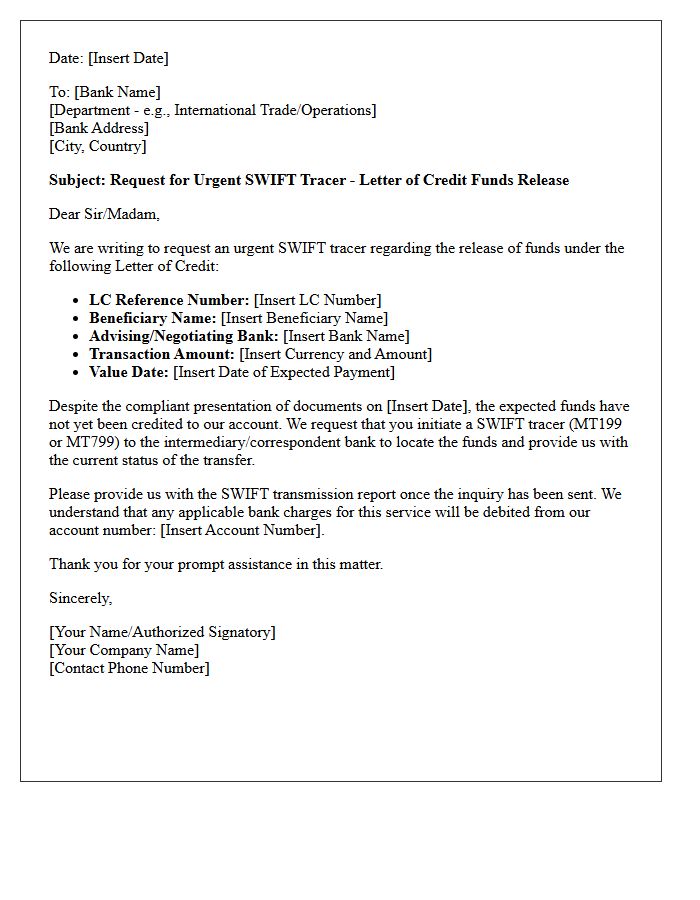
A Swift Message Tracer is a critical communication tool used by banks to investigate delays in Letter of Credit funds release. This electronic query follows the transaction path to locate missing payments or resolve discrepancies between issuing and advising banks. It acts as an official audit trail, ensuring transparency and accountability in international trade finance. By initiating a tracer, beneficiaries can verify if funds are stuck in intermediary banks, helping to expedite the settlement process and resolve banking hurdles efficiently when expected payments fail to arrive on schedule.
Inquiry Tracer Letter for Delayed Letter of Credit Payment
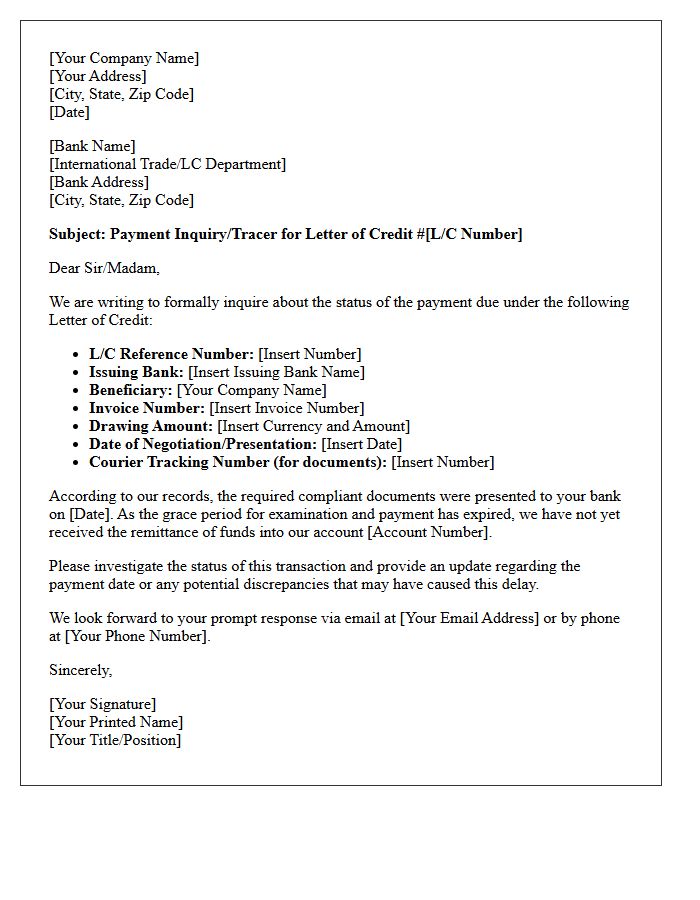
An Inquiry Tracer Letter is a formal request sent by a beneficiary to a bank to locate a delayed Letter of Credit payment. This document acts as a critical communication tool to investigate processing bottlenecks or routing errors within the banking chain. It ensures accountability and pushes for immediate status updates regarding the funds. To expedite the resolution, you must include the unique LC reference number, the exact transaction amount, and the issuance date. Sending a tracer is essential for maintaining healthy cash flow and resolving international trade discrepancies effectively.
Official Tracer Letter for Defaulted Letter of Credit Payment
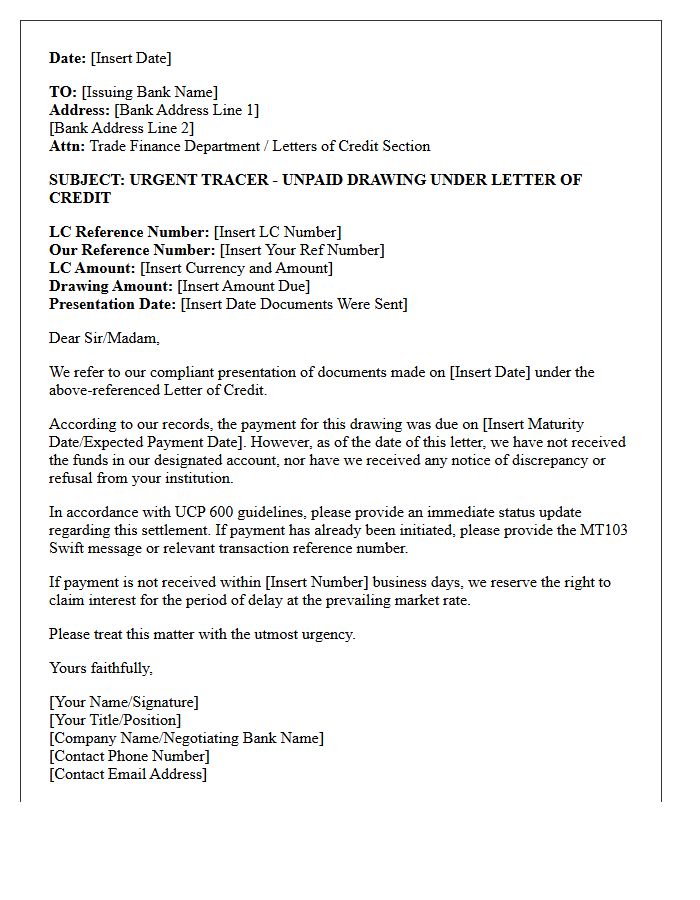
An Official Tracer Letter is a critical formal communication used to investigate a defaulted Letter of Credit payment. When an issuing bank fails to remit funds by the maturity date, the beneficiary or negotiating bank dispatches this document to demand an immediate status update. It serves as legal evidence of a payment demand, tracking the transaction's progress through the banking system. This letter helps identify processing errors, discrepancies, or liquidity issues, ensuring the beneficiary retains their right to payment under international trade rules like UCP 600.
What is a tracer for payment under a Letter of Credit?
A tracer is a formal communication sent by the beneficiary's bank to the issuing or nominated bank to inquire about the status of a payment or the processing of documents submitted under a Letter of Credit (LC).
When should a beneficiary request a payment tracer?
A payment tracer should typically be initiated if payment has not been received within the standard turnaround time (usually 5 to 7 banking days) after the documents have been taken up as compliant or after the maturity date of a usance LC.
What information is required to send a tracer for an LC payment?
To send an effective tracer, you must provide the Letter of Credit number, the presentation reference number, the dollar amount, the date the documents were dispatched, and the name of the issuing bank.
Are there bank fees associated with sending an LC tracer?
Yes, most negotiating or collecting banks charge a nominal communication fee (often called a swift fee or tracer fee) to cover the administrative costs of sending the inquiry to the issuing bank.
What is the difference between a tracer and a payment reminder?
While often used interchangeably in trade finance, a tracer is a formal inter-bank SWIFT message (usually MT799 or MT759) that requires a documented response, whereas a reminder is an informal follow-up between the exporter and importer.

Comments