
A Model Risk Management Deficiency Letter is a formal notification issued by regulators or internal auditors identifying weaknesses in financial modeling frameworks. It highlights failures in governance, validation, or data integrity that require urgent remediation to ensure regulatory compliance and institutional stability. Addressing these gaps is critical for robust risk oversight. Below are some ready to use template.

Image cover: Professional Templates and Samples for Addressing Model Risk Management Deficiencies
Letter Samples List
- Model Validation Failure Deficiency Letter
- Inadequate Model Documentation Deficiency Letter
- Model Input Data Quality Deficiency Letter
- Model Governance And Oversight Deficiency Letter
- Model Implementation And Coding Error Deficiency Letter
- Ongoing Model Performance Monitoring Deficiency Letter
- Stress Testing Model Shortcoming Deficiency Letter
- Anti-Money Laundering Model Weakness Deficiency Letter
- Unapproved End User Computing Model Deficiency Letter
- Third-Party Vendor Model Risk Deficiency Letter
- Incomplete Model Inventory Management Deficiency Letter
- Delayed Model Issue Remediation Deficiency Letter
- Unjustified Model Assumptions And Limitations Deficiency Letter
Model Validation Failure Deficiency Letter
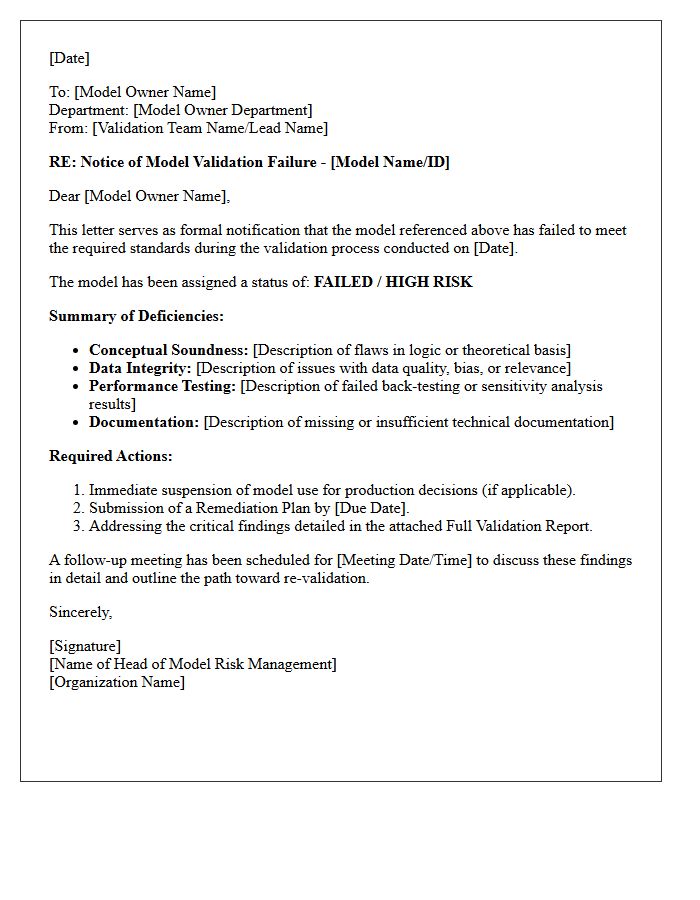
A Model Validation Failure Deficiency Letter is a formal regulatory notification issued when a financial institution's internal risk models fail to meet compliance standards. It highlights critical methodological weaknesses, data inaccuracies, or insufficient governance processes identified during an audit. Receiving this letter necessitates immediate remediation actions to address technical gaps and ensure the model's reliability for decision-making. Failure to resolve these deficiencies can lead to severe regulatory penalties, operational restrictions, and increased capital requirements, making prompt resolution essential for maintaining institutional integrity and legal standing.
Inadequate Model Documentation Deficiency Letter
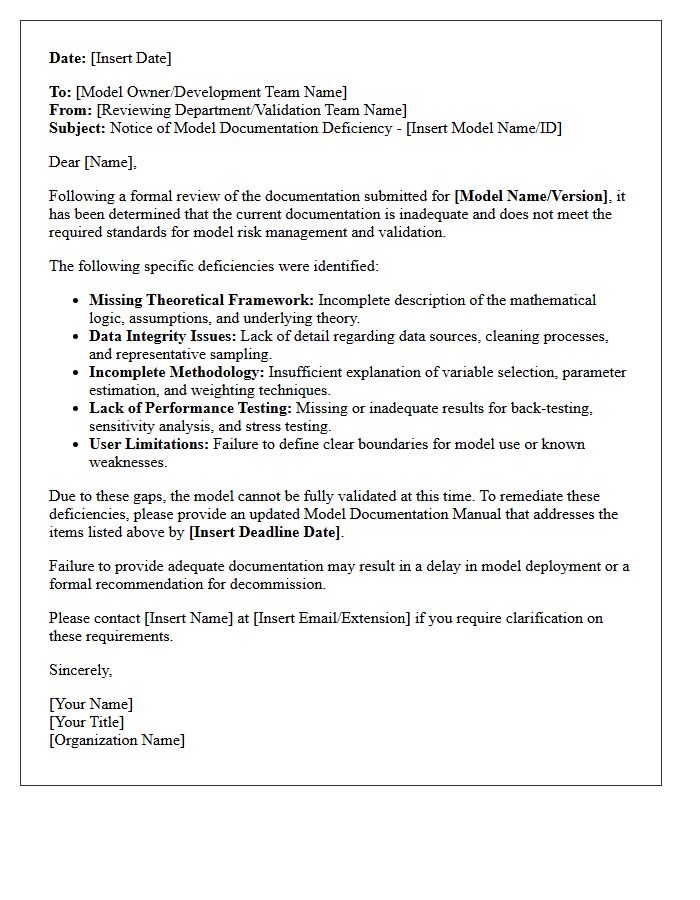
An Inadequate Model Documentation Deficiency Letter is a formal regulatory notice issued when a financial institution's model risk management fails to meet transparency standards. It highlights a critical lack of technical detail regarding model assumptions, data integrity, or validation processes. Receiving this letter indicates that the documentation is insufficient for independent reviewers to replicate results or assess potential risks. To resolve this deficiency, firms must provide comprehensive evidence of governance compliance and clear mathematical justifications to satisfy regulatory expectations and ensure institutional safety.
Model Input Data Quality Deficiency Letter
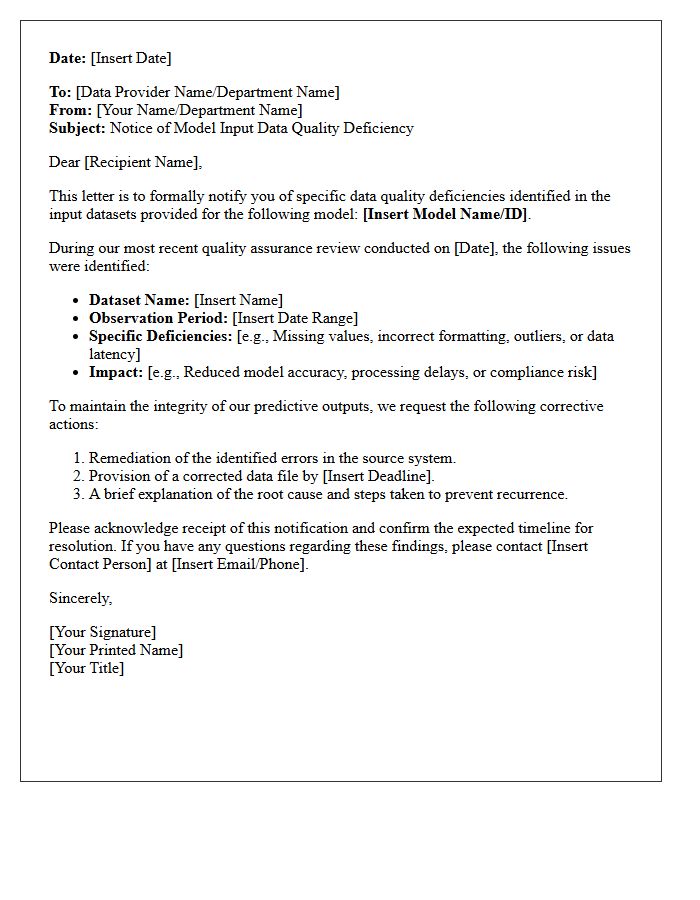
A Model Input Data Quality Deficiency Letter is a formal notification issued by regulators or auditors when a financial institution's model outputs are compromised by poor-quality underlying data. It highlights critical gaps in data integrity, completeness, or accuracy that undermine risk assessments. Receiving this letter necessitates an immediate remediation plan to improve data governance and validation processes. Failure to address these deficiencies can lead to regulatory sanctions, increased capital requirements, and a formal rejection of internal models used for critical decision-making or regulatory reporting compliance.
Model Governance And Oversight Deficiency Letter
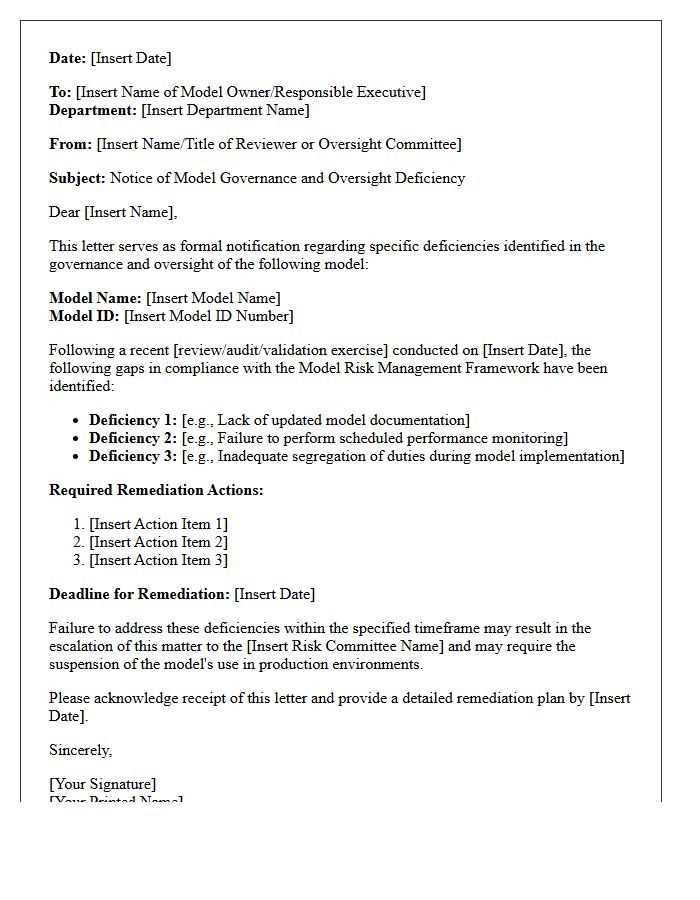
A Model Governance and Oversight Deficiency Letter is a formal regulatory notice identifying critical weaknesses in an institution's risk management framework. It highlights failures in model validation, data integrity, or inventory management that could lead to financial instability. Receiving this document necessitates an immediate remediation plan to address technical gaps and policy inconsistencies. Failure to rectify these compliance lapses can result in severe enforcement actions, fines, or operational restrictions. Ensuring robust internal controls and transparent reporting is essential to satisfy supervisory expectations and mitigate model-related risks effectively.
Model Implementation And Coding Error Deficiency Letter
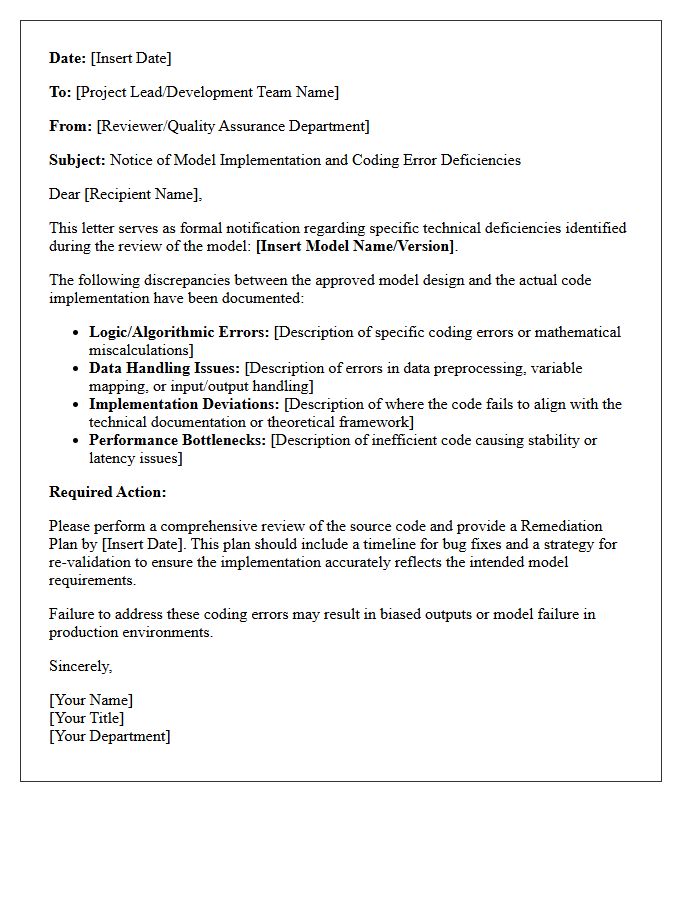
A Model Implementation And Coding Error Deficiency Letter is a formal regulatory notice identifying discrepancies between a financial model's theoretical design and its actual software execution. It highlights coding vulnerabilities, logic gaps, or data integration flaws that compromise model integrity. Financial institutions must address these findings to ensure compliance and risk mitigation. Prompt remediation is essential to prevent operational failures and maintain regulatory approval. Failure to resolve these technical errors can lead to inaccurate reporting and significant financial exposure within the institution's risk management framework.
Ongoing Model Performance Monitoring Deficiency Letter
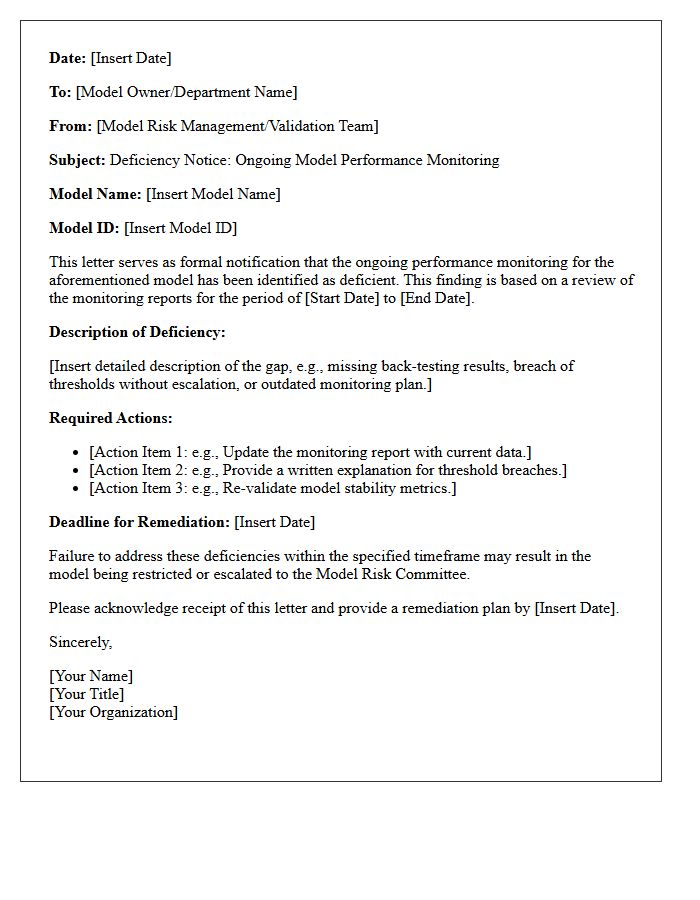
An Ongoing Model Performance Monitoring Deficiency Letter is a formal regulatory notification issued when a financial institution fails to adequately track its predictive models. It highlights failures in real-time validation, data integrity, or drift detection. To resolve this, banks must implement robust internal controls and governance frameworks to ensure models remain accurate over time. Failure to address these gaps can lead to increased operational risk and severe regulatory penalties. Proactive monitoring is essential for maintaining compliance with safety and soundness standards in automated decision-making processes.
Stress Testing Model Shortcoming Deficiency Letter
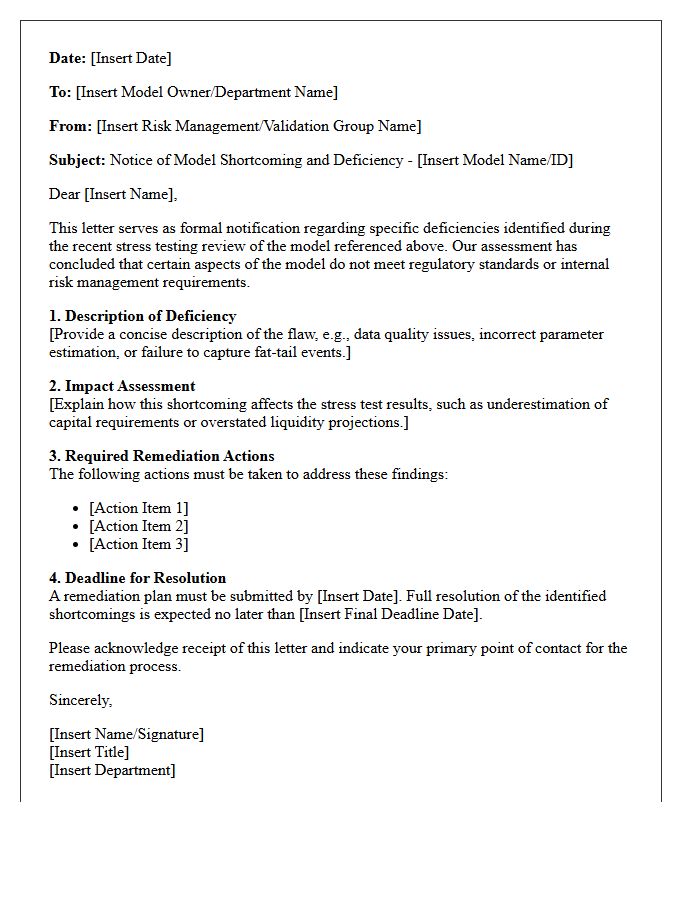
A Stress Testing Model Shortcoming Deficiency Letter is a formal regulatory communication issued by supervisors like the Federal Reserve. It notifies a financial institution that its capital projections or risk assessments contain material weaknesses. These deficiencies often relate to inadequate data quality, flawed assumptions, or weak internal controls. Receiving such a letter signifies that the bank's internal models failed to meet prudential standards, potentially leading to restricted capital distributions or requirements for immediate remedial action to ensure financial stability and robust risk management.
Anti-Money Laundering Model Weakness Deficiency Letter
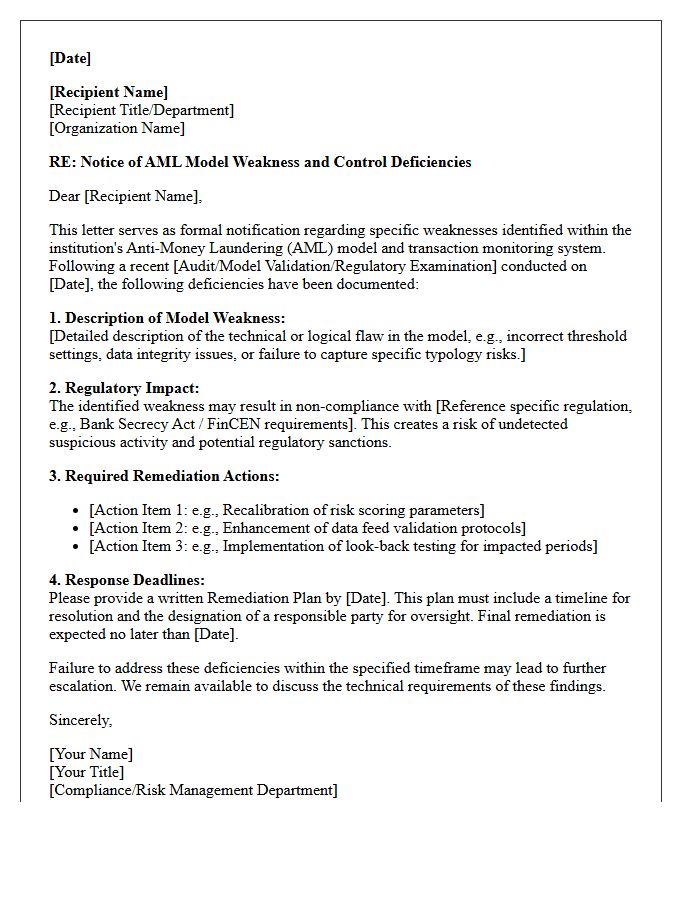
An Anti-Money Laundering Model Weakness Deficiency Letter is a formal regulatory notification identifying critical flaws in a financial institution's compliance systems. These letters highlight failures in transaction monitoring, risk scoring, or data integrity that could allow illicit activities to bypass detection. Receiving this document signifies that your AML framework lacks the necessary rigor to satisfy legal standards. Addressing these model validation gaps is essential to avoid severe penalties, consent orders, and reputational damage. Institutions must prioritize remediation through enhanced testing, improved algorithms, and robust governance to ensure effective financial crime prevention.
Unapproved End User Computing Model Deficiency Letter
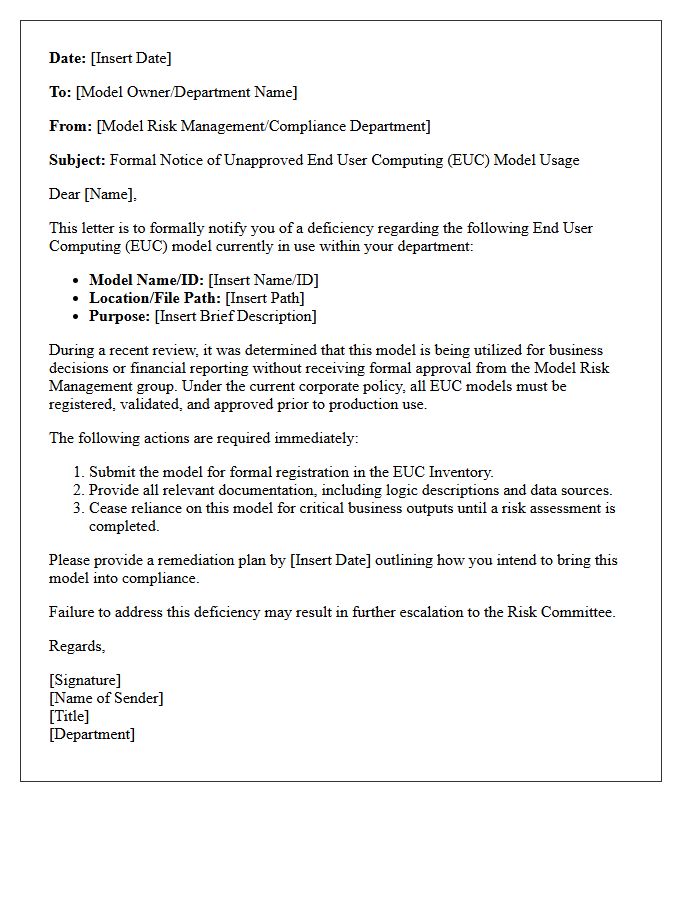
An Unapproved End User Computing (EUC) Model Deficiency Letter is a formal regulatory or audit notification identifying security risks within unauthorized spreadsheets, databases, or local scripts. These tools often lack the governance, version control, and data integrity checks required for financial reporting or operational stability. Receiving this letter indicates that shadow IT processes bypass internal controls, creating potential for significant errors or data breaches. Organizations must remediate these findings by implementing a formal EUC framework to ensure compliance, mitigate operational risk, and maintain institutional accountability.
Third-Party Vendor Model Risk Deficiency Letter
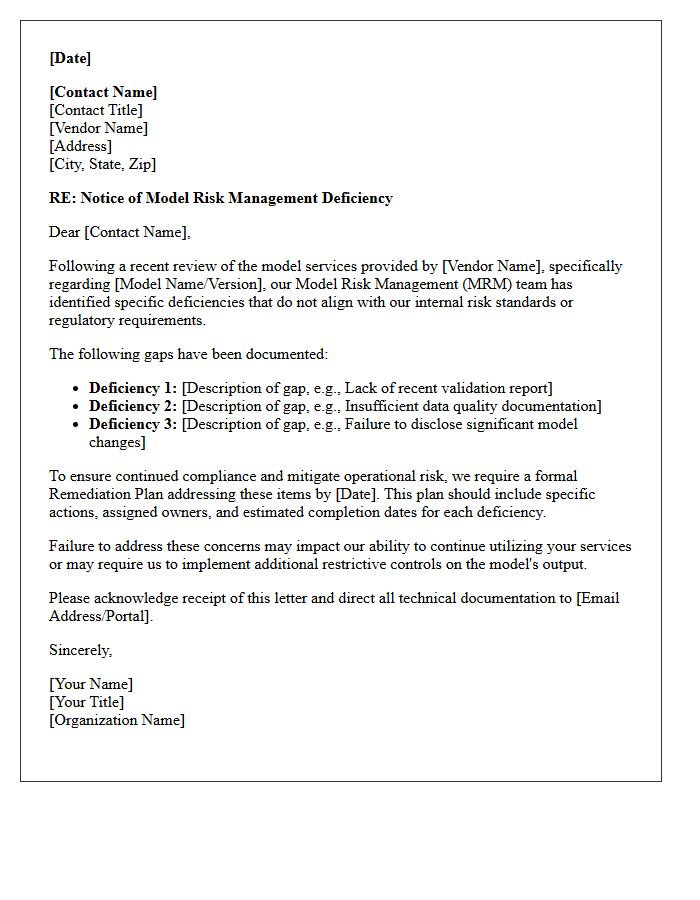
A Third-Party Vendor Model Risk Deficiency Letter is a formal notification from regulators or internal auditors identifying gaps in a firm's risk management framework. It highlights specific failures in monitoring, validating, or documenting external algorithmic tools and financial models. Addressing these deficiencies is critical to ensure compliance with regulatory standards like SR 11-7. Organizations must provide a comprehensive remediation plan to mitigate potential operational, financial, and reputational threats posed by flawed vendor-supplied software or data analytics systems.
Incomplete Model Inventory Management Deficiency Letter
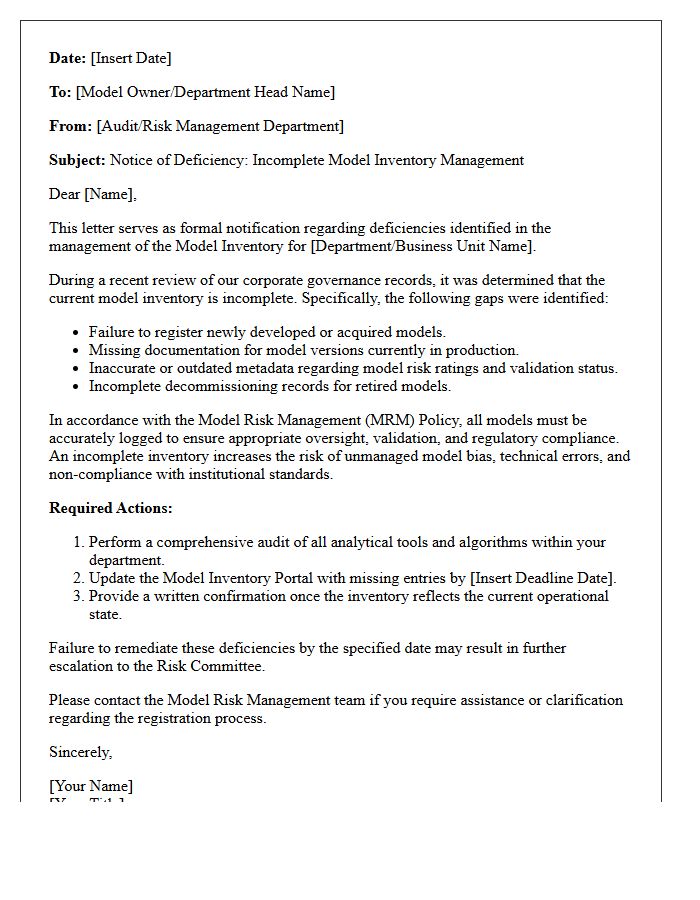
An Incomplete Model Inventory Management Deficiency Letter is a formal regulatory notice identifying gaps in a financial institution's model risk management (MRM) framework. It signals that the organization has failed to maintain a comprehensive repository of all active, retired, or in-development analytical models. This deficiency suggests inadequate oversight, potentially leading to unmitigated operational risks and non-compliance with SR 11-7 standards. Addressing this requires immediate remediation of data gaps to ensure every model is tracked, validated, and monitored to satisfy rigorous regulatory expectations and maintain institutional safety.
Delayed Model Issue Remediation Deficiency Letter
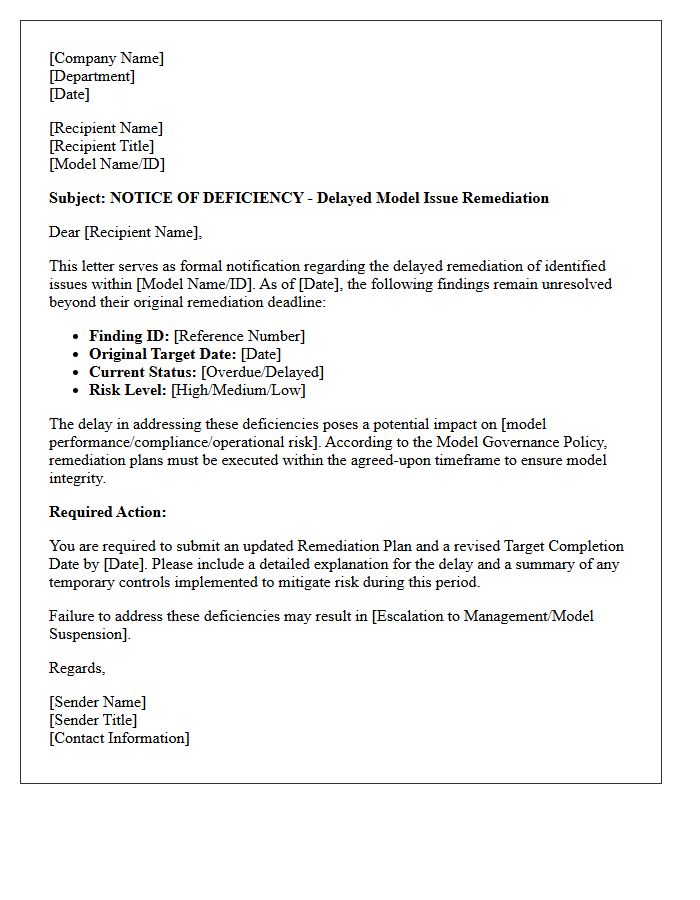
A Delayed Model Issue Remediation Deficiency Letter is a formal regulatory notification issued when a financial institution fails to resolve identified model risk weaknesses within the mandated timeframe. It signifies that internal controls or validation processes are inadequate, potentially leading to increased capital requirements or operational restrictions. This letter serves as a critical warning that persistent non-compliance in model governance may result in severe supervisory actions. Boards must prioritize these remediations to ensure accurate financial reporting and robust risk management frameworks while avoiding further escalation from regulatory bodies.
Unjustified Model Assumptions And Limitations Deficiency Letter
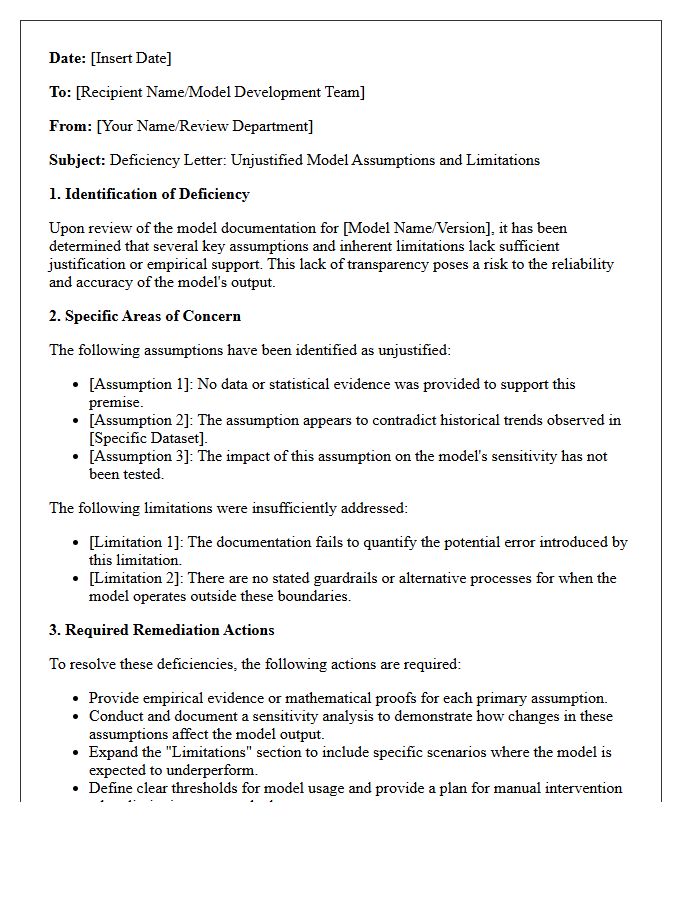
An Unjustified Model Assumptions and Limitations Deficiency Letter is a formal regulatory notice issued when a financial institution's risk modeling lacks rigorous validation. This document flags critical failures in documenting statistical methodologies, data integrity, or the qualitative adjustments used to project outcomes. Regulators use these letters to demand transparent evidence that model constraints are understood and mitigated. Addressing these deficiencies is essential to ensure compliance, as unsupported assumptions can lead to significant underestimation of risk and potential capital inadequacy during stress testing cycles.
What is a Model Risk Management Deficiency Letter?
A Model Risk Management Deficiency Letter is a formal notification issued by regulatory bodies-such as the Federal Reserve or the OCC-identifying specific gaps or failures in a financial institution's model governance, validation processes, or internal controls as defined under SR 11-7 guidelines.
What are the common causes for receiving a MRM deficiency notice?
Common causes include inadequate model documentation, lack of independent validation, failure to monitor model performance (backtesting), insufficient data quality controls, and weak board oversight regarding the model inventory and risk appetite.
What is the difference between a Matter Requiring Attention (MRA) and a deficiency letter?
While both highlight issues, a deficiency letter often precedes or accompanies a formal MRA. A deficiency indicates a specific regulatory non-compliance or technical weakness in the MRM framework that requires a remediation plan and a defined timeline for resolution to avoid further enforcement action.
How should an institution respond to a Model Risk Management Deficiency Letter?
An institution should respond by conducting a root-cause analysis, developing a comprehensive Remediation Action Plan (RAP), assigning executive accountability, and establishing a rigorous project timeline to address each cited gap with evidence of sustainable improvement.
What are the consequences of failing to remediate MRM deficiencies?
Failure to address deficiencies can lead to "Matters Requiring Immediate Attention" (MRIAs), formal Consent Orders, restrictions on using specific models for capital calculations, increased regulatory capital surcharges, and significant reputational damage.


Comments