
Financial institutions and businesses must comply with anti-money laundering regulations by filing a Large Cash Transaction Reporting Notice when dealings exceed specific thresholds. This letter informs clients about mandatory federal disclosures to ensure transparency and legal compliance. Understanding these requirements protects your business from penalties and audits. To help you get started, below are some ready to use template.
Image cover: Official Notice Templates and Samples for Large Cash Transaction Reporting
Letter Samples List
- Large Cash Transaction Regulatory Reporting Notice Letter
- Customer Identification Request Letter for Large Cash Transactions
- Bank Secrecy Act Cash Reporting Compliance Letter
- Commercial Account CTR Exemption Approval Letter
- Annual Currency Transaction Exemption Review Letter
- Source of Funds Verification Letter for Cash Deposits
- Aggregated Daily Currency Transaction Notice Letter
- Anti-Structuring Legal Warning Notice Letter
- Mandatory Cash Threshold Reporting Alert Letter
- Account Restriction Letter Pending CTR Information
- Large Cash Withdrawal Acknowledgment Notice Letter
- Corporate Customer CTR Exemption Revocation Letter
Large Cash Transaction Regulatory Reporting Notice Letter
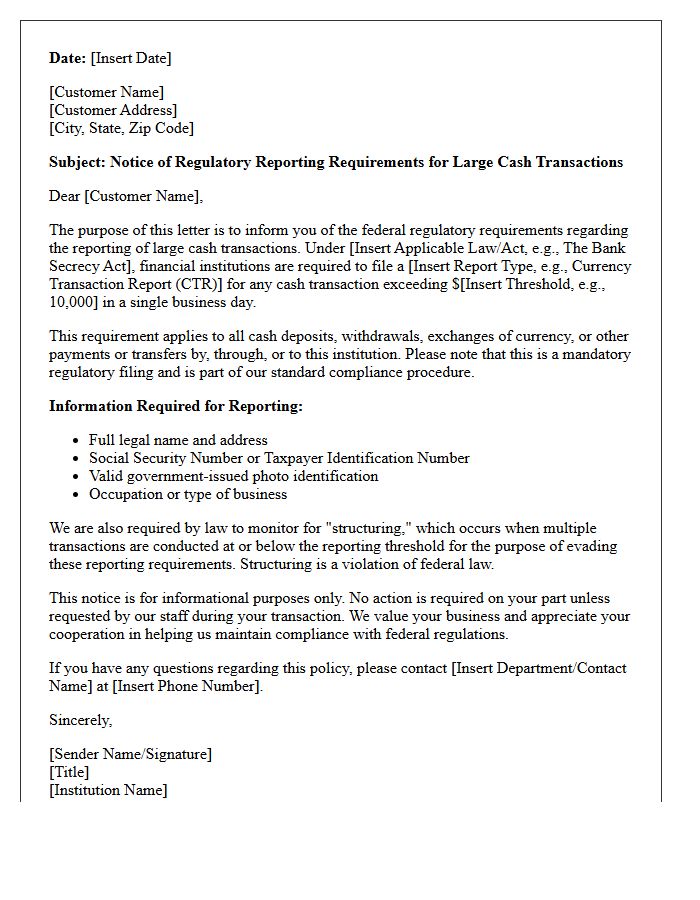
A Large Cash Transaction Regulatory Reporting Notice Letter informs customers that financial institutions must report physical currency transactions exceeding $10,000 to government authorities like FinTRAC or FinCEN. This mandatory process prevents money laundering and terrorism financing. It is crucial to understand that structuring payments into smaller amounts to avoid detection is illegal and can trigger suspicious activity reports. This letter serves as a formal transparency notice, ensuring compliance with federal anti-money laundering regulations while maintaining the integrity of the global financial system.
Customer Identification Request Letter for Large Cash Transactions
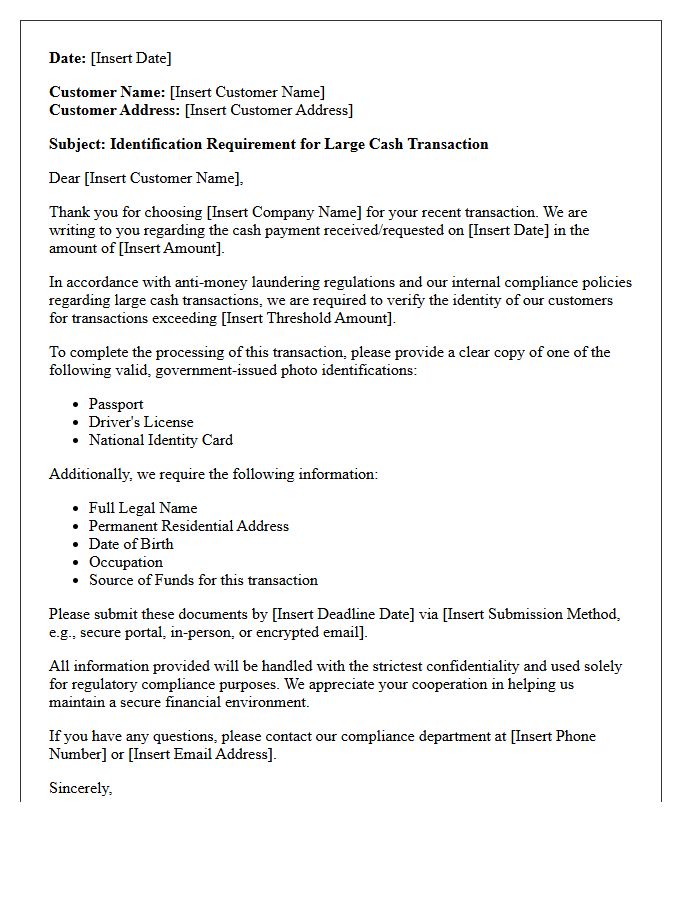
A Customer Identification Request Letter is a mandatory document used by financial institutions to comply with Anti-Money Laundering (AML) regulations. When a large cash transaction occurs, banks must verify the identity of the individual or entity involved to prevent financial crimes. This formal request typically asks for valid government-issued photo identification and proof of address. Providing accurate information promptly ensures regulatory compliance and prevents account freezes. Understanding these requests is essential for maintaining financial transparency and ensuring the legitimacy of significant currency movements within the global banking system.
Bank Secrecy Act Cash Reporting Compliance Letter
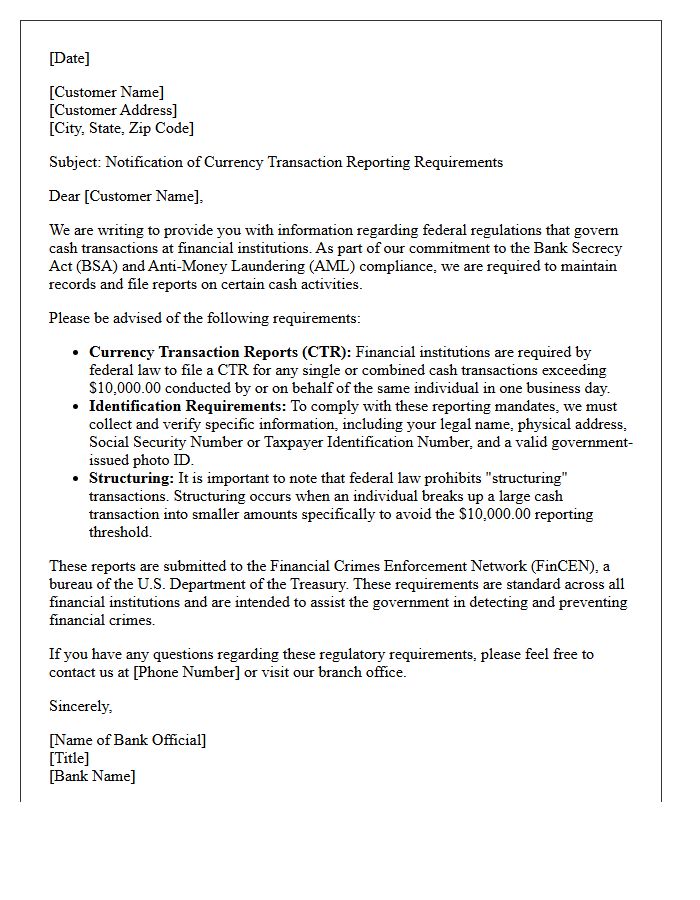
The Bank Secrecy Act (BSA) requires financial institutions to monitor and report suspicious activities to prevent money laundering. A Cash Reporting Compliance Letter is a formal notification sent to customers who frequently engage in large currency transactions. This letter serves as an educational tool, explaining federal requirements for filing Currency Transaction Reports (CTRs) on cash deposits or withdrawals exceeding $10,000. It also warns against structuring, which is the illegal practice of breaking down large sums into smaller amounts to evade reporting thresholds and maintain financial transparency.
Commercial Account CTR Exemption Approval Letter
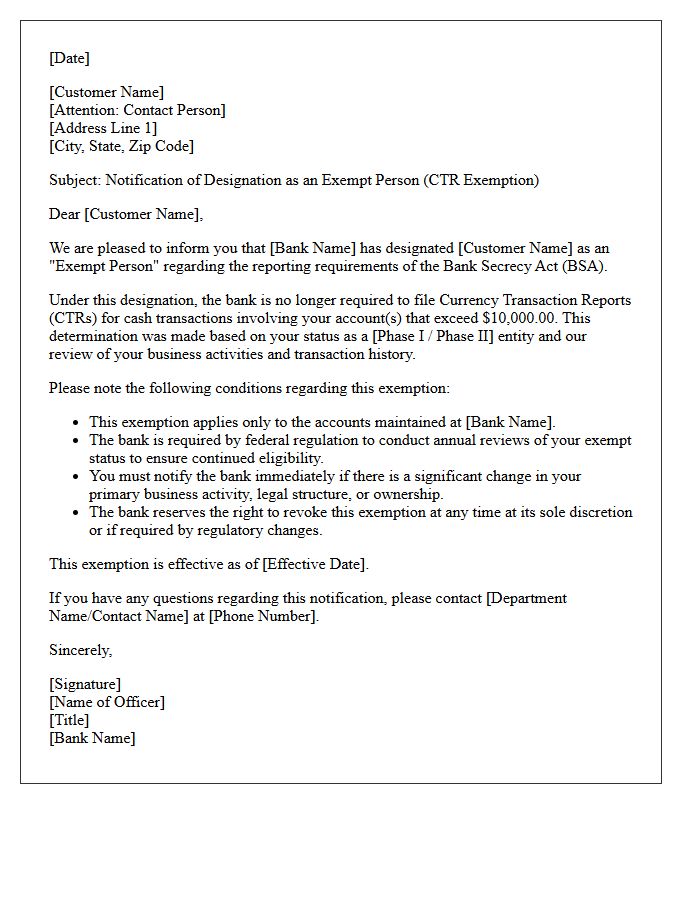
A CTR Exemption Approval Letter is a formal document issued by a financial institution to a business customer, confirming their status as an "exempt person" under FinCEN regulations. This designation allows the bank to stop filing Currency Transaction Reports for cash deposits or withdrawals exceeding $10,000. To qualify, a Phase II entity must typically maintain a transaction account for two months and meet specific operational criteria. This streamlining improves banking efficiency and reduces administrative burdens for high-volume commercial accounts while ensuring regulatory compliance.
Annual Currency Transaction Exemption Review Letter
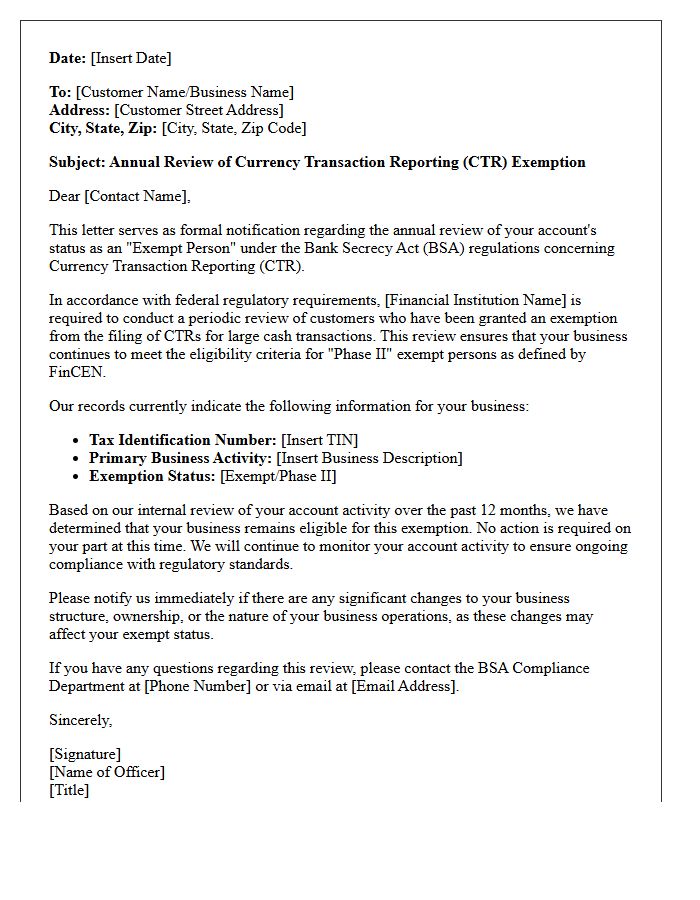
Financial institutions use the Annual Currency Transaction Exemption Review Letter to verify a commercial customer's continued eligibility for CTR exemptions. This essential regulatory process ensures that "Phase II" entities, such as payroll customers or habitual cash-intensive businesses, still meet specific FinCEN requirements. Banks must document this annual review to maintain compliance and mitigate money laundering risks. Failure to perform this assessment accurately can result in the loss of exempt status, requiring the manual filing of Currency Transaction Reports for all future qualifying deposits or withdrawals.
Source of Funds Verification Letter for Cash Deposits
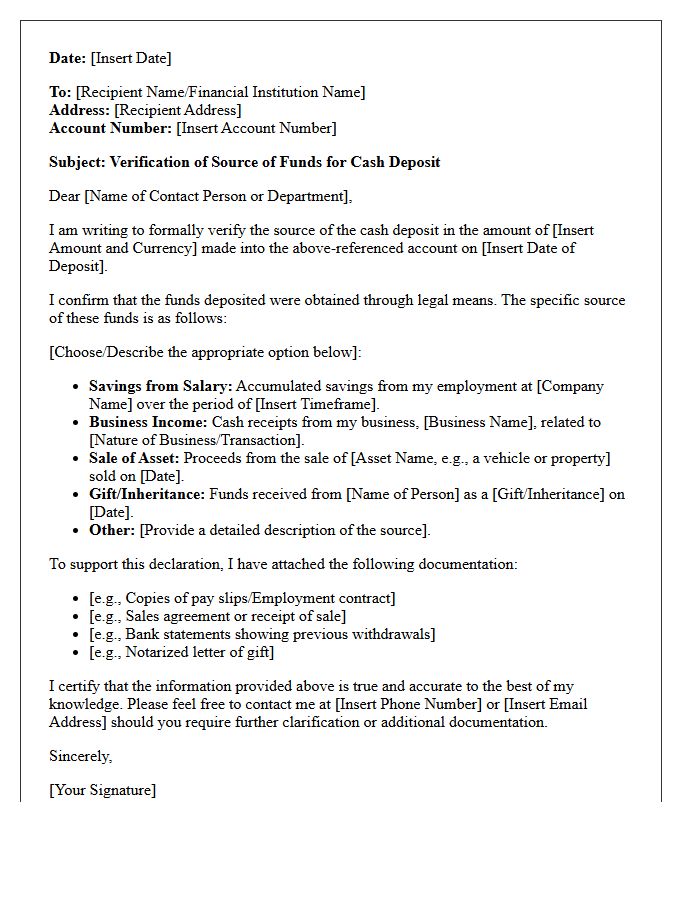
A Source of Funds Verification Letter is a formal document required by banks to prove the legal origin of significant cash deposits. It ensures compliance with Anti-Money Laundering (AML) and Know Your Customer (KYC) regulations. To be valid, the letter must be issued by a certified professional, such as an accountant or solicitor, detailing how the money was acquired-through inheritance, property sales, or savings. Providing transparent supporting evidence prevents account freezes and ensures a smooth transaction process during financial auditing or high-value purchases like real estate.
Aggregated Daily Currency Transaction Notice Letter
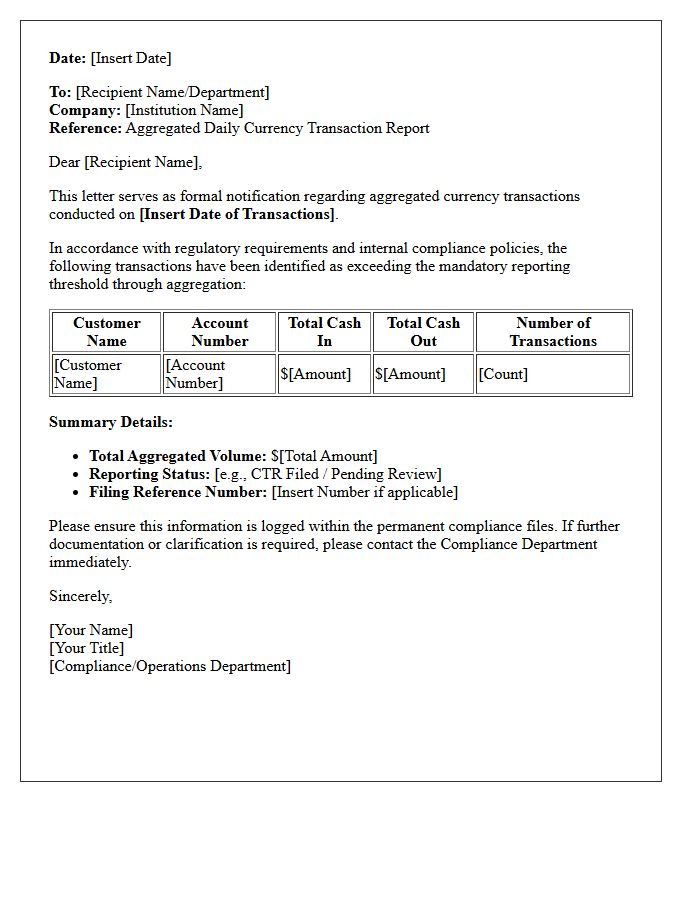
An Aggregated Daily Currency Transaction Notice Letter is a formal notification issued by financial institutions to report multiple cash transactions involving the same individual. Under AML regulations, banks must combine all deposits or withdrawals made within a single business day. If the total exceeds $10,000, it triggers a mandatory Currency Transaction Report (CTR) to federal authorities. Receiving this notice indicates that your cumulative cash activity has reached the legal threshold for government monitoring to prevent financial crimes like money laundering or structuring.
Anti-Structuring Legal Warning Notice Letter
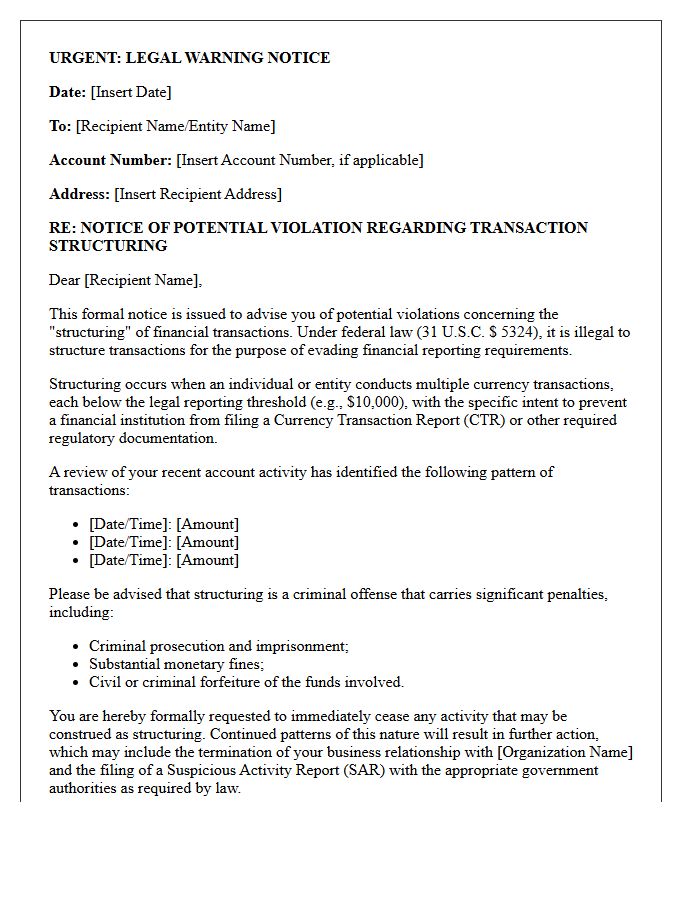
An Anti-Structuring Legal Warning Notice Letter is a formal notification issued by financial institutions when transaction patterns suggest an attempt to evade Bank Secrecy Act reporting requirements. Structuring involves intentionally breaking large cash deposits into smaller amounts to bypass the $10,000 threshold. This letter serves as a critical compliance alert, informing the client that such activity is a federal crime. Receiving this notice is a serious matter, as continued suspicious behavior typically leads to account closure and mandatory Suspicious Activity Report (SAR) filings with government authorities.
Mandatory Cash Threshold Reporting Alert Letter
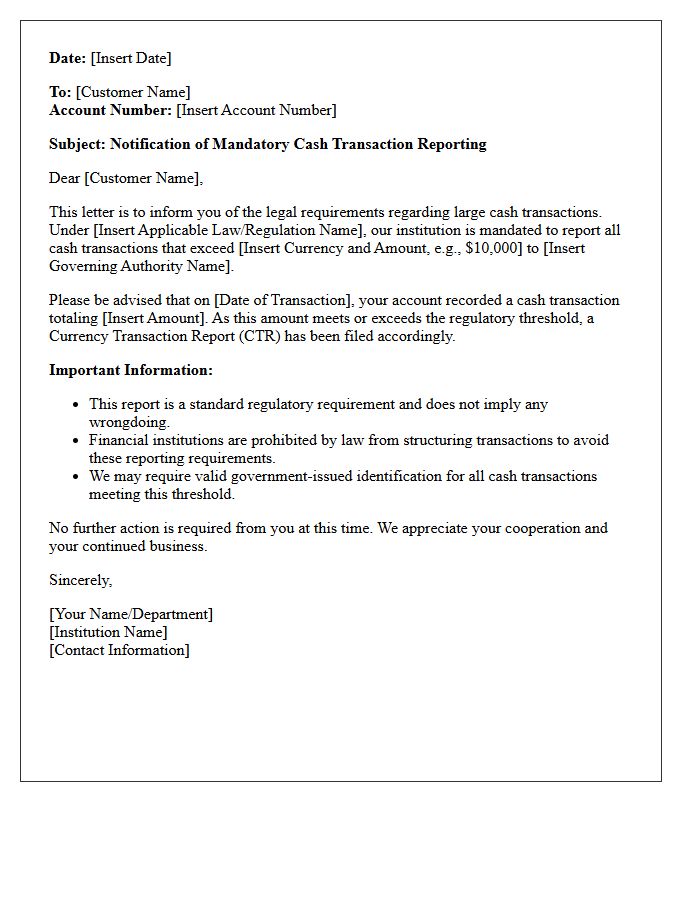
A Mandatory Cash Threshold Reporting Alert Letter is a formal notification issued by financial institutions when a transaction exceeds the legal cash limit, typically $10,000. This document serves as a compliance warning, informing the client that a Currency Transaction Report (CTR) has been filed with government authorities like FinCEN. It is crucial to understand that these reports are mandatory under anti-money laundering laws to prevent financial crimes. Recipients should ensure all future large deposits are properly documented to maintain regulatory transparency and avoid potential investigations into their banking activities.
Account Restriction Letter Pending CTR Information
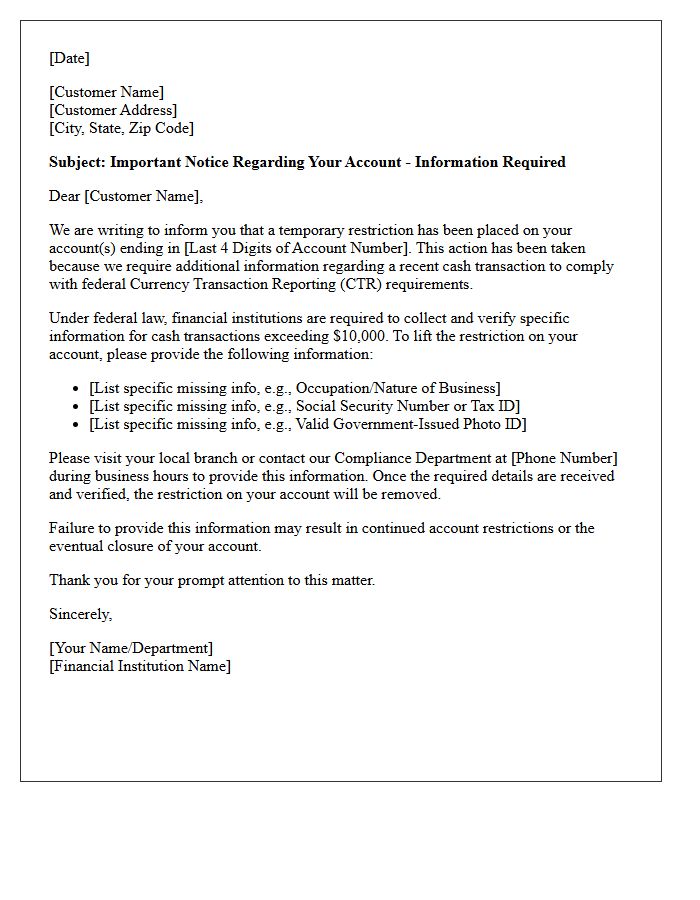
An Account Restriction Letter Pending CTR Information is a formal notice indicating your bank has limited access to your funds. This occurs when the financial institution requires additional details to file a Currency Transaction Report (CTR) for cash movements exceeding $10,000. To resolve this, you must promptly provide the requested beneficial ownership or source of funds information. Failure to comply can lead to permanent account closure. Ensuring regulatory compliance by submitting accurate data is the fastest way to lift the freeze and restore full banking functionality.
Large Cash Withdrawal Acknowledgment Notice Letter
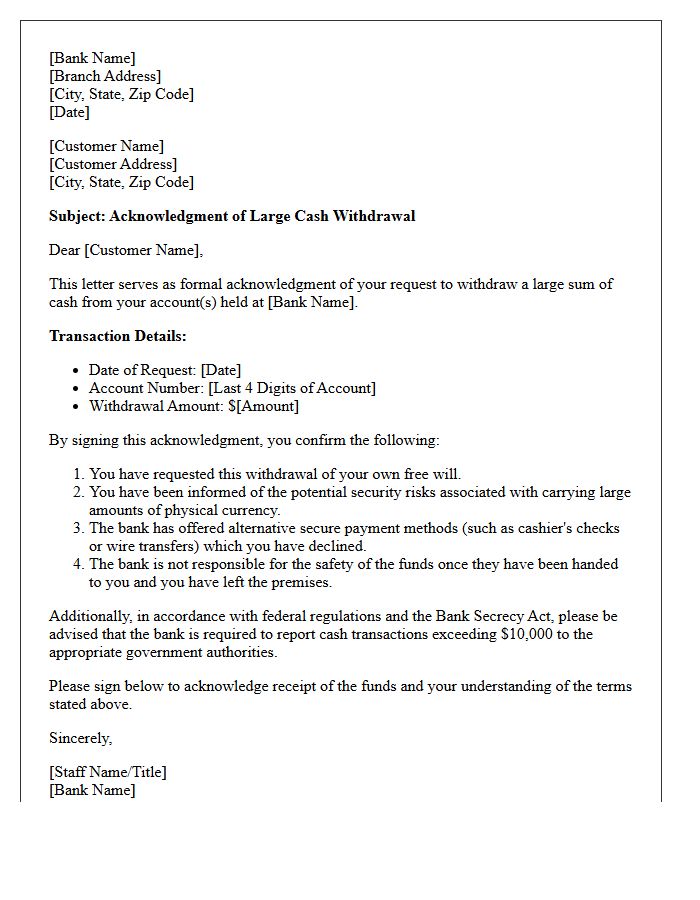
A Large Cash Withdrawal Acknowledgment Notice Letter is a formal document used by financial institutions to document significant currency disbursements. Its primary purpose is to ensure regulatory compliance with anti-money laundering (AML) laws and Bank Secrecy Act requirements. By signing this notice, the customer acknowledges the inherent risks of carrying large sums of cash, such as theft or loss. Additionally, it serves as a formal record that the bank has fulfilled its due diligence obligations and informed the client of potential mandatory reporting to government authorities for transactions exceeding specific legal thresholds.
Corporate Customer CTR Exemption Revocation Letter
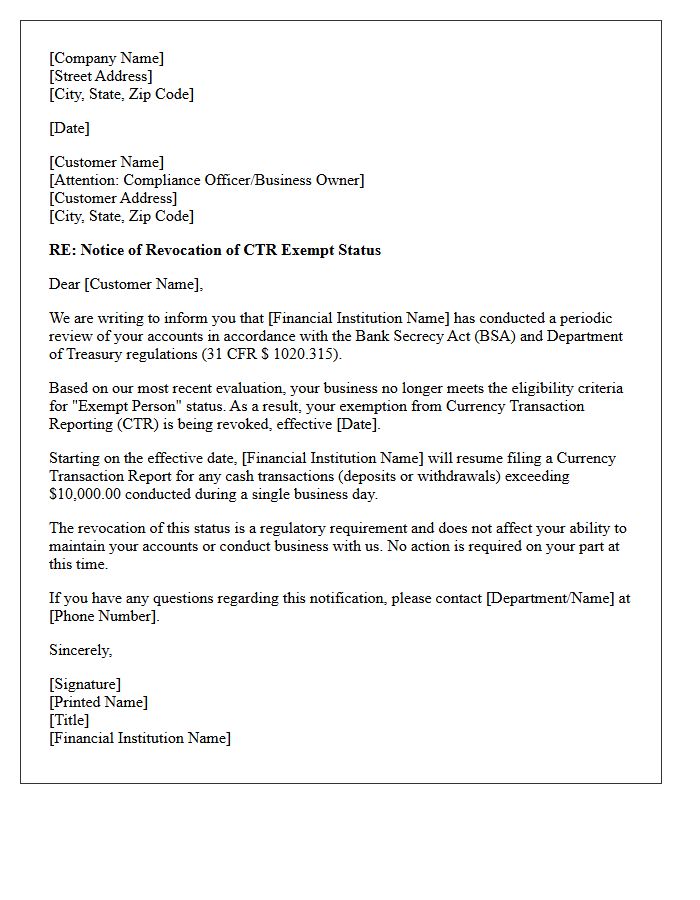
A Corporate Customer CTR Exemption Revocation Letter is a formal notification issued by a financial institution to a business client. This document serves to revoke the entity's exempt status regarding Currency Transaction Reports (CTRs). Once revoked, the bank must legally resume filing reports with FinCEN for all cash transactions exceeding $10,000. This action typically occurs due to non-compliance, changes in the customer's business activities, or failure to meet annual eligibility requirements. It is a critical compliance step to ensure transparency and adhere to Anti-Money Laundering (AML) regulations.
What is a Large Cash Transaction Reporting Notice Letter?
A Large Cash Transaction Reporting Notice Letter is a formal notification sent by financial institutions to inform customers that a cash transaction exceeding the legal threshold (typically $10,000) has been reported to government regulatory authorities, such as FinCEN or AUSTRAC, in compliance with Anti-Money Laundering (AML) laws.
Why did I receive a notice regarding a large cash transaction report?
You received this notice because you completed a physical currency transaction-such as a deposit, withdrawal, or currency exchange-that met or exceeded the mandatory reporting limit set by federal law. Banks are legally required to file a Currency Transaction Report (CTR) for these activities regardless of the legitimacy of the funds.
Do I need to take any action after receiving this reporting notice?
In most cases, no action is required from the customer if the source of funds is legitimate and the transaction was documented correctly at the time of the deposit or withdrawal. However, you should retain the letter for your personal financial records and tax documentation.
What information is included in a Large Cash Transaction Report?
The report submitted to regulatory authorities includes the account holder's full name, Social Security Number or Tax ID, address, date of birth, the exact amount of the transaction, and the specific location where the cash exchange occurred.
Does a large cash transaction report trigger an automatic tax audit?
No, a Large Cash Transaction Report does not automatically trigger an IRS or tax audit. The data is primarily used by law enforcement to track large-scale movement of physical currency and to prevent financial crimes like money laundering; however, consistently large cash movements may be reviewed if they do not align with reported income.

Comments