
Protect your recruitment business by using a formal Letter Asserting Agency Ownership to confirm candidate representation. This essential document establishes a clear paper trail, prevents fee disputes, and solidifies your right to a commission after introducing talent to a client. Ensure your professional interests are legally protected during the hiring process. Below are some ready to use templates.

Image cover: Official Candidate Ownership Notice: Templates and Guidelines for Recruitment Agencies
Letter Samples List
- Letter Asserting Agency Ownership of Introduced Candidate
- Formal Letter of Claim for Agency Candidate Introduction
- Letter Asserting Exclusive Agency Representation of Candidate
- Notice Letter of Prior Introduction and Candidate Ownership
- Letter Disputing Direct Hire and Asserting Agency Ownership
- Candidate Submission Claim and Agency Ownership Letter
- Letter of Assertion Regarding Terms of Business and Candidate Ownership
- Agency Fee Entitlement and Candidate Ownership Notification Letter
- Letter Asserting Right of Representation for Submitted Candidate
- Candidate Introduction Acknowledgment and Ownership Assertion Letter
- Formal Letter Asserting Agency Ownership Rights Over Introduced Applicant
- Letter of Notification Enforcing Agency Ownership of Candidate
Letter Asserting Agency Ownership of Introduced Candidate
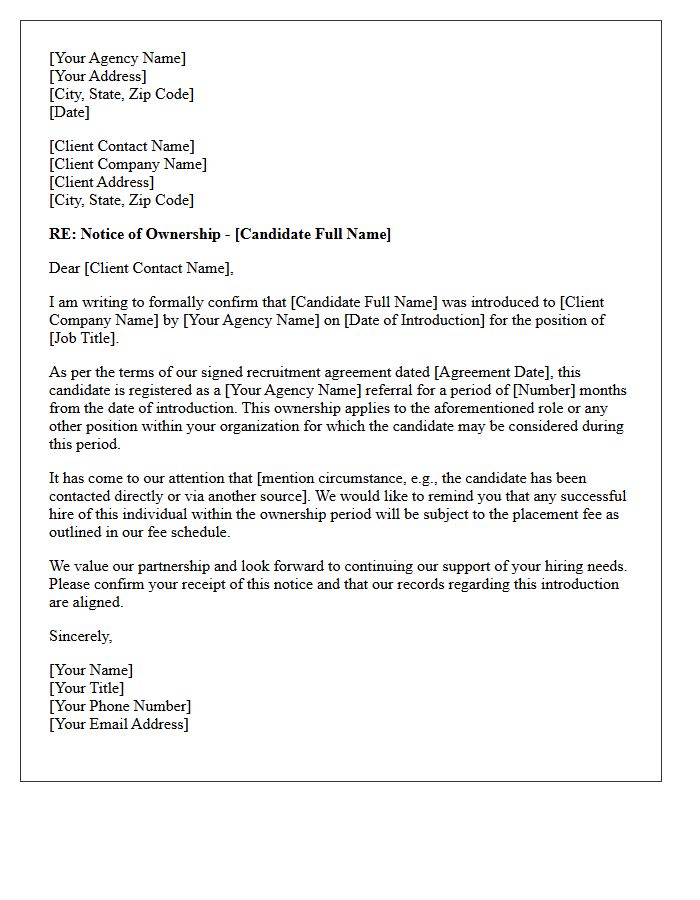
A Letter Asserting Agency Ownership is a critical legal document used by recruitment firms to protect their commission rights. It formally notifies a client that the agency first introduced a specific candidate, establishing a referral period. This notification prevents disputes if the client attempts to hire the individual independently or through another source. To be effective, the letter must include the candidate's name, the submission date, and reference the signed terms of business to ensure the agency remains the effective cause of the hire and receives payment.
Formal Letter of Claim for Agency Candidate Introduction
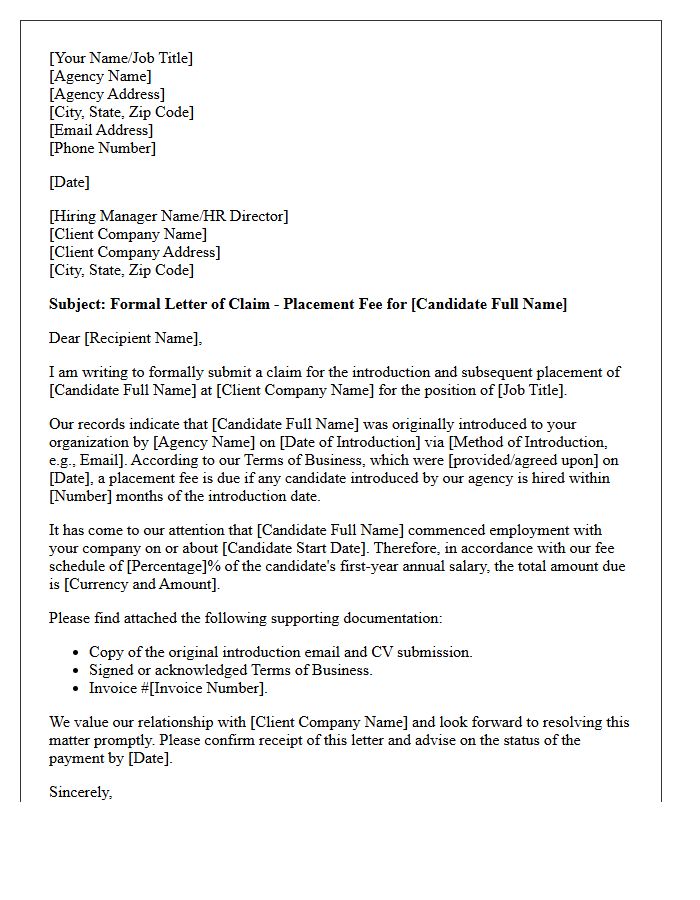
A formal Letter of Claim is a legal notification sent by a recruitment agency to a client who hired a candidate without paying the agreed fee. This document asserts the agency's ownership of the introduction based on established terms of business. It must clearly detail the candidate's name, the date of referral, and the evidence of the "effective cause" of hire. Sending this letter is a critical step in formal debt recovery, serving as a final warning before initiating litigation to secure the unpaid placement commission.
Letter Asserting Exclusive Agency Representation of Candidate
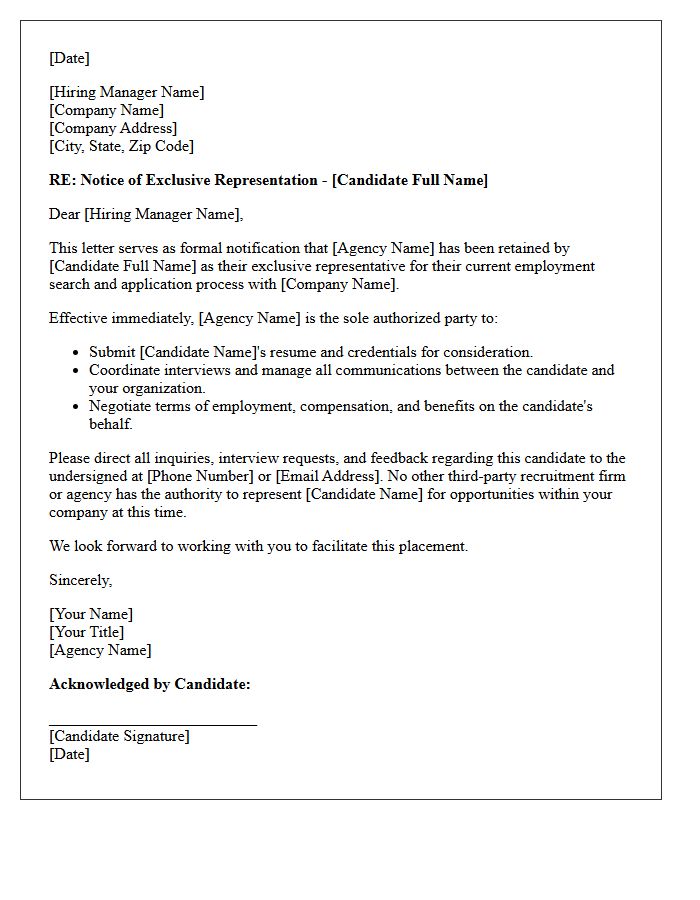
A Letter Asserting Exclusive Agency Representation establishes a legally binding relationship between a candidate and their talent agent. This document notifies employers or casting directors that the agent holds the exclusive right to negotiate contracts, manage schedules, and collect commissions on the candidate's behalf. It is crucial for preventing multi-agency disputes and ensuring professional legal protection during employment searches. By formalizing this representation, the candidate centralizes all professional inquiries, which streamlines communication and reinforces their brand authority within the competitive job market or entertainment industry.
Notice Letter of Prior Introduction and Candidate Ownership
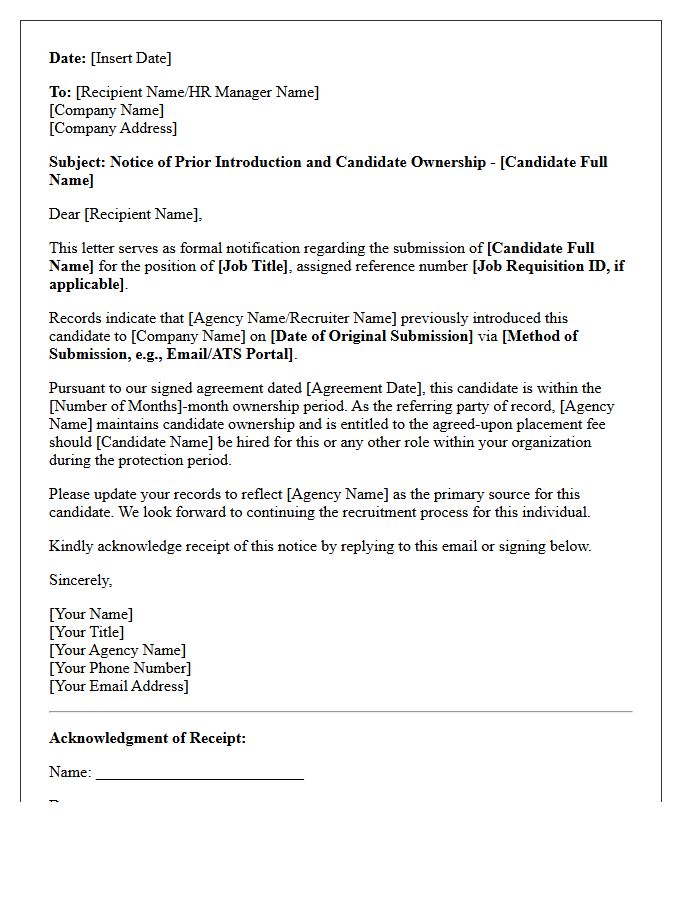
A Notice Letter of Prior Introduction is a critical document used in recruitment to establish candidate ownership. It serves as formal proof that a headhunter or agency previously introduced a specific professional to an employer. This notice protects the recruiter's right to a placement fee by preventing "double submission" conflicts. For employers, tracking these letters ensures clear attribution and avoids legal disputes over commission claims. Maintaining accurate records of these introductions is essential for transparent hiring workflows and managing third-party vendor relationships effectively within your talent acquisition strategy.
Letter Disputing Direct Hire and Asserting Agency Ownership
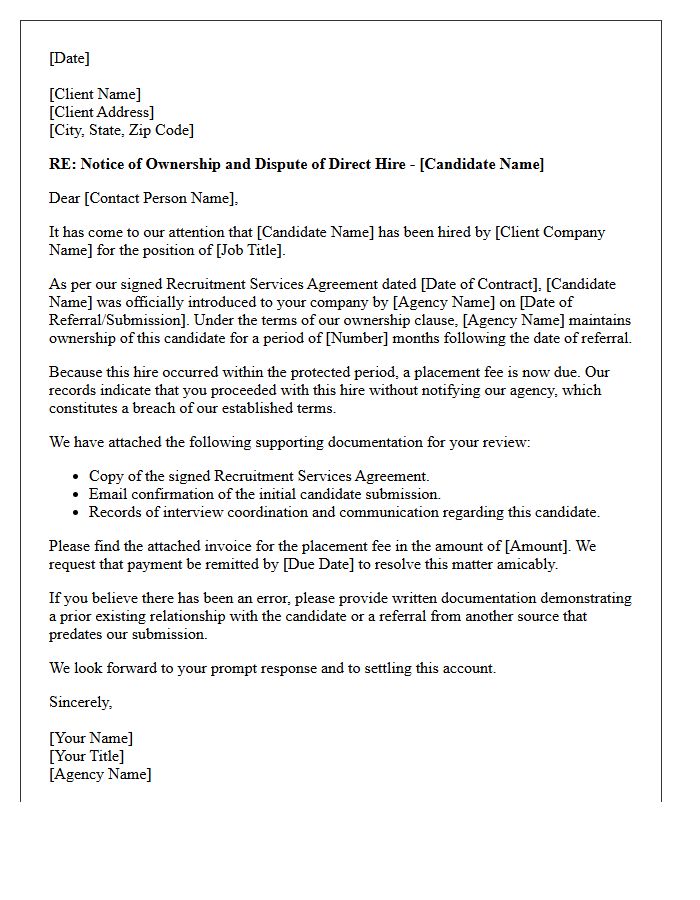
A dispute letter is a formal legal notice used when a client attempts a direct hire, bypassing agreed-upon recruitment fees. It asserts the agency's ownership of the candidate based on the initial referral and signed terms of business. The document must highlight the referral period and provide proof of introduction to establish a breach of contract. Sending this letter is the essential first step in protecting your firm's revenue, demanding the placement fee, and preventing unauthorized "backdoor" hires through clear documentation of your professional services.
Candidate Submission Claim and Agency Ownership Letter
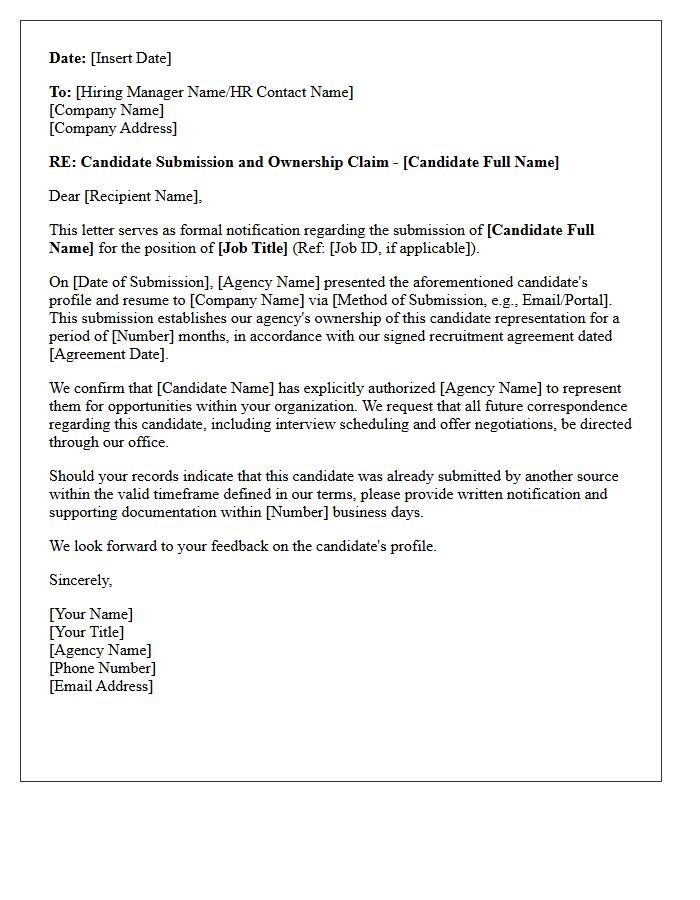
A Candidate Submission Claim establishes which recruitment firm holds the legal right to a candidate's introduction. The Agency Ownership Letter serves as formal evidence of this representation, typically valid for six to twelve months. This documentation is crucial for preventing "double submittal" disputes and ensuring the correct agency receives the placement fee. To maintain ownership validity, agencies must obtain clear consent from the candidate before submission. Understanding these protocols protects the commercial interests of both the hiring entity and the staffing partner during the talent acquisition process.
Letter of Assertion Regarding Terms of Business and Candidate Ownership
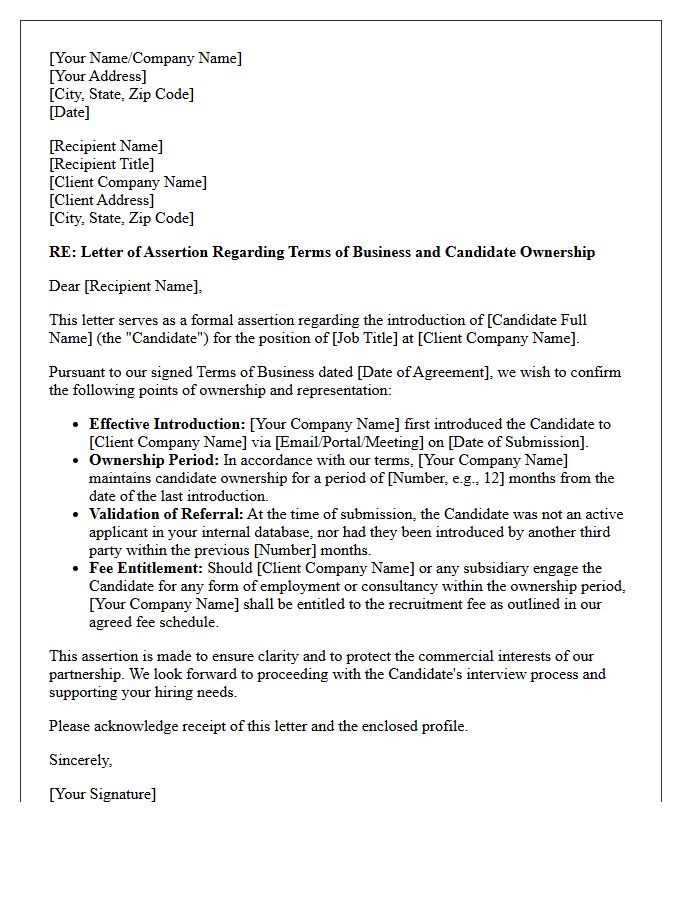
A Letter of Assertion is a critical legal document used by recruitment agencies to confirm Candidate Ownership. It formally declares that a specific professional was introduced to a client under established Terms of Business. This prevents disputes over placement fees by providing a clear audit trail of the referral process. Understanding this document is essential for protecting commission rights and clarifying contractual obligations between agencies and employers. It ensures that the recruiter's efforts are legally recognized, safeguarding the revenue generated from successful hires within defined ownership periods.
Agency Fee Entitlement and Candidate Ownership Notification Letter
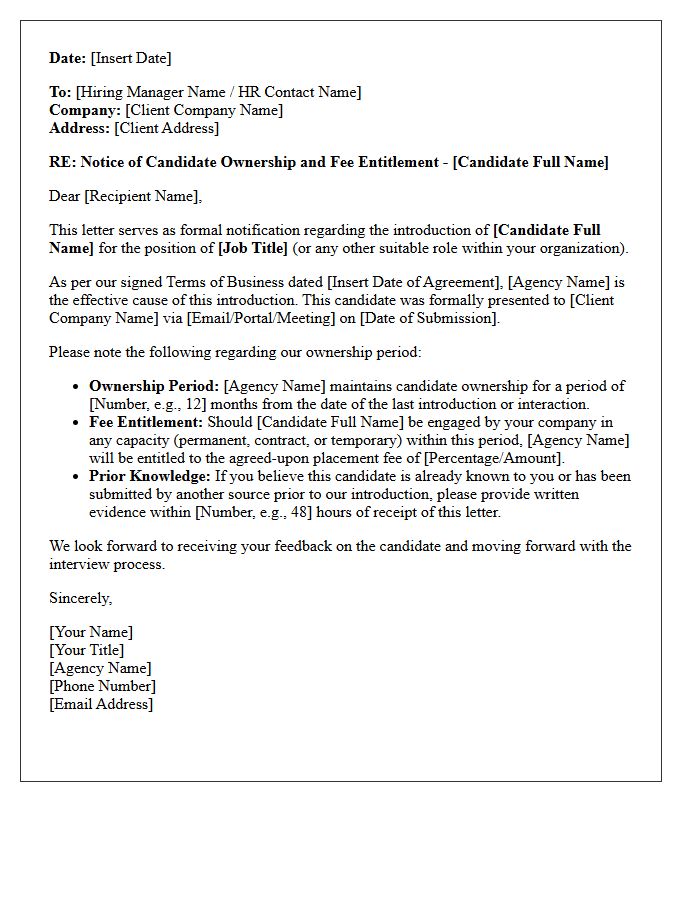
An Agency Fee Entitlement and Candidate Ownership Notification Letter is a formal document sent by recruitment firms to protect their commercial interests. It establishes a legal record that a specific candidate was introduced to a client, triggering a defined ownership period. This notification prevents disputes by ensuring the agency is recognized as the effective cause of hire, securing their right to professional fees if the candidate is employed within the contractual timeframe. It serves as essential evidence of professional representation during the hiring process.
Letter Asserting Right of Representation for Submitted Candidate
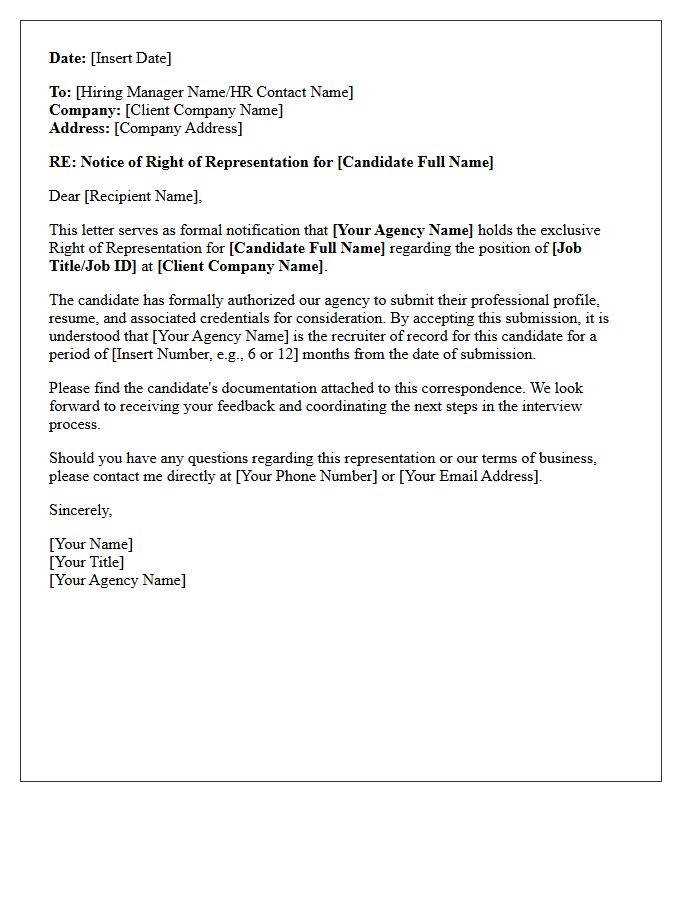
A Letter Asserting Right of Representation is a formal document used in recruitment to prove a legal agreement between a headhunter and a job seeker. It protects the recruiter's commission by confirming they are the exclusive representative for a candidate's submission to a specific employer. This letter prevents "double submissions" and ownership disputes between agencies. For candidates, signing this ensures their application is handled professionally by a single point of contact, while employers use it to verify which firm holds the valid referral rights for the submitted talent.
Candidate Introduction Acknowledgment and Ownership Assertion Letter
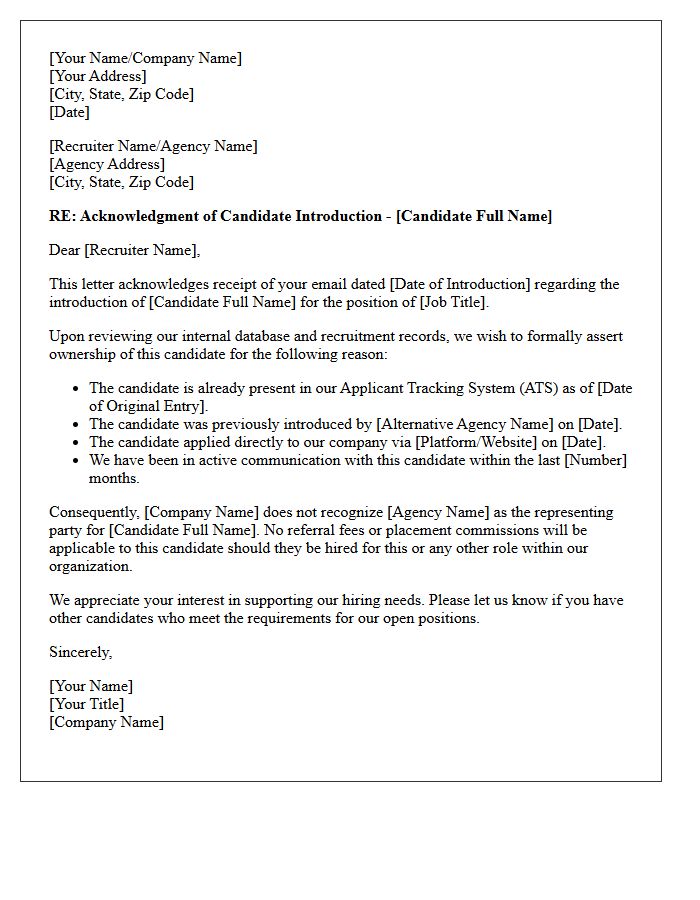
A Candidate Introduction Acknowledgment and Ownership Assertion Letter is a vital document sent by recruiters to clients to confirm a referral. It serves as a formal ownership assertion, establishing that the agency introduced the specific candidate first. This protects the recruiter's right to a placement fee if the candidate is hired within the contractual period. By providing a clear paper trail, this letter prevents disputes over candidate sourcing and ensures legal protection regarding recruitment terms and commission eligibility. It is an essential tool for maintaining transparent professional relationships and securing earned revenue.
Formal Letter Asserting Agency Ownership Rights Over Introduced Applicant
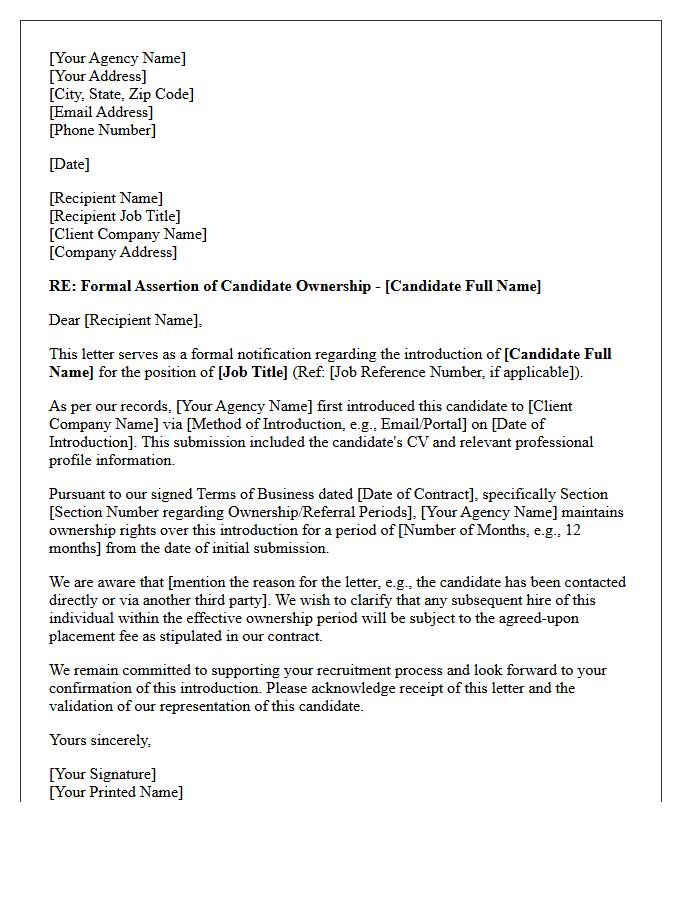
When a recruitment firm introduces a candidate to a client, they must issue a formal letter asserting agency ownership rights to protect their financial interest. This document legally establishes that the agency is the effective cause of the introduction, triggering entitlement to a placement fee if the applicant is hired within the contractual ownership period. Clear documentation prevents potential "backdoor hires" and ensures the agency's proprietary rights are recognized over competing firms or direct applications, safeguarding the commission and maintaining professional transparency during the hiring process.
Letter of Notification Enforcing Agency Ownership of Candidate
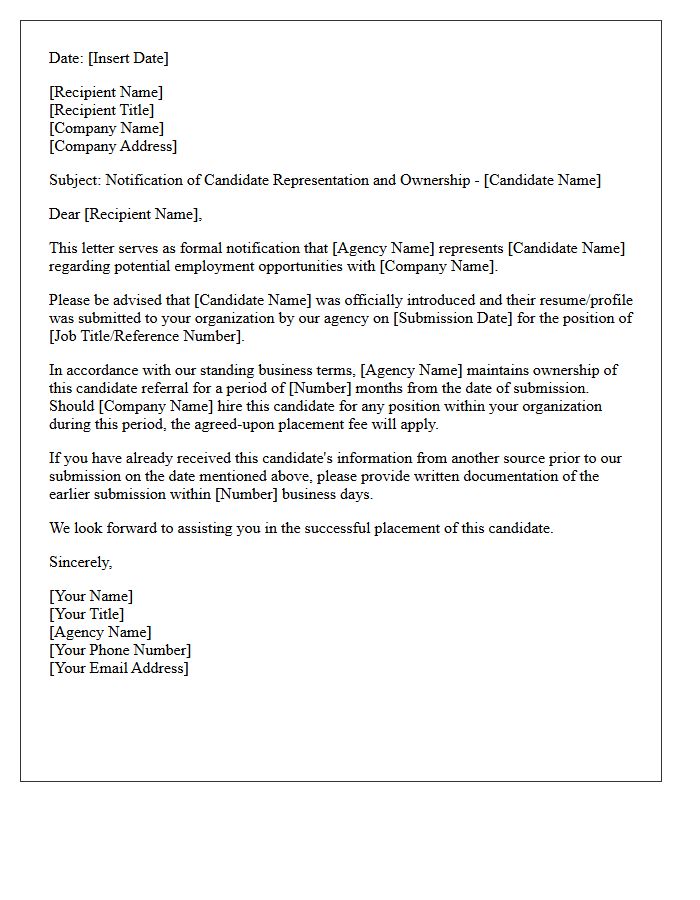
A Letter of Notification is a formal document used to establish Agency Ownership of a candidate within the recruitment process. It serves as legal proof that a specific firm introduced the talent to an employer first, protecting their right to a placement fee. To ensure validity, the letter must include the candidate's name, the submission date, and the representation period. This notification prevents disputes over multiple submissions and clarifies which agency is the authorized intermediary for the hiring transaction, ensuring professional accountability and fee protection.
What is a Letter Asserting Agency Ownership of a candidate?
This is a formal legal notice sent by a recruitment firm to a client to officially document that the agency introduced a specific candidate first, thereby establishing a contractual right to a placement fee if that candidate is hired within the ownership period.
When should an agency send a candidate ownership assertion letter?
The letter should be sent immediately upon discovering that a client is interviewing or hiring a candidate previously introduced by the agency, especially if the client claims the candidate applied independently or through another source.
What key elements must be included in an agency ownership claim?
The document must include the candidate's full name, the exact date and time the CV was originally submitted, proof of the client's receipt of the introduction, and a reference to the signed Terms of Business governing the referral.
How long does "ownership" of a candidate typically last?
Standard recruitment industry contracts usually define a "candidate ownership period" or "referral period" of 6 to 12 months from the date of the most recent introduction or activity regarding that candidate.
Can a client bypass an agency if the candidate applied directly after the introduction?
No, provided the agency can prove they were the "effective cause" of the introduction. A Letter Asserting Agency Ownership reinforces that the agency's initial referral initiated the hiring process, protecting the firm's entitlement to the commission regardless of subsequent direct applications.

Comments