
Our comprehensive Digital Asset and Cryptocurrency Risk Advisory Letter provides critical insights into market volatility, security vulnerabilities, and regulatory compliance requirements. This guide helps financial professionals navigate the complex landscape of virtual currencies while protecting client interests through proactive disclosure. Safeguard your practice and ensure full transparency in digital investments. Below are some ready to use templates.
Image cover: Protecting Your Portfolio: Cryptocurrency and Digital Asset Risk Advisory Templates
Letter Samples List
- Digital Asset and Cryptocurrency Risk Advisory Letter for Banking Institutions
- Letter of Advisory on Cryptocurrency Exposure and Volatility Risks
- Regulatory Compliance Risk Advisory Letter Regarding Digital Asset Portfolios
- Strategic Advisory Letter on Decentralized Finance and Banking Integration Risks
- Anti-Money Laundering and Cryptocurrency Risk Management Advisory Letter
- Advisory Letter on Custodial Risks of Digital Assets in Commercial Banking
- Cybersecurity and Digital Asset Threat Mitigation Advisory Letter
- Letter of Risk Advisory Concerning Stablecoin Liquidity and Reserve Audits
- Operational Risk Advisory Letter for Banking Cryptocurrency Exchange Partnerships
- Market Risk Advisory Letter for Institutional Digital Asset Investments
- Third-Party Vendor Risk Advisory Letter for Cryptocurrency Payment Gateways
- Smart Contract Vulnerability and Banking Operations Advisory Letter
- Letter on Counterparty Risk Advisory in Digital Asset Transactions
Digital Asset and Cryptocurrency Risk Advisory Letter for Banking Institutions
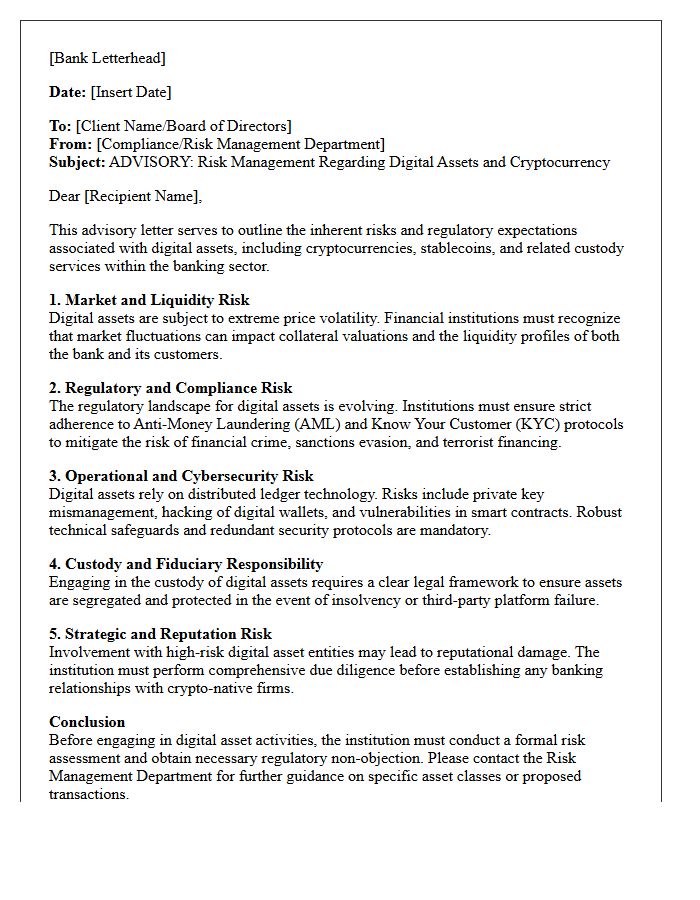
Banking institutions must prioritize the Digital Asset and Cryptocurrency Risk Advisory Letter to ensure operational safety. This guidance emphasizes robust risk management frameworks to address liquidity, legal uncertainties, and fraud associated with crypto-assets. Banks are required to notify regulators before engaging in digital activities, ensuring compliance with anti-money laundering standards. Understanding these supervisory expectations is crucial for maintaining financial stability and protecting consumers within the evolving digital ecosystem. Institutions must balance innovation with rigorous oversight to mitigate potential contagion risks to the broader banking system.
Letter of Advisory on Cryptocurrency Exposure and Volatility Risks
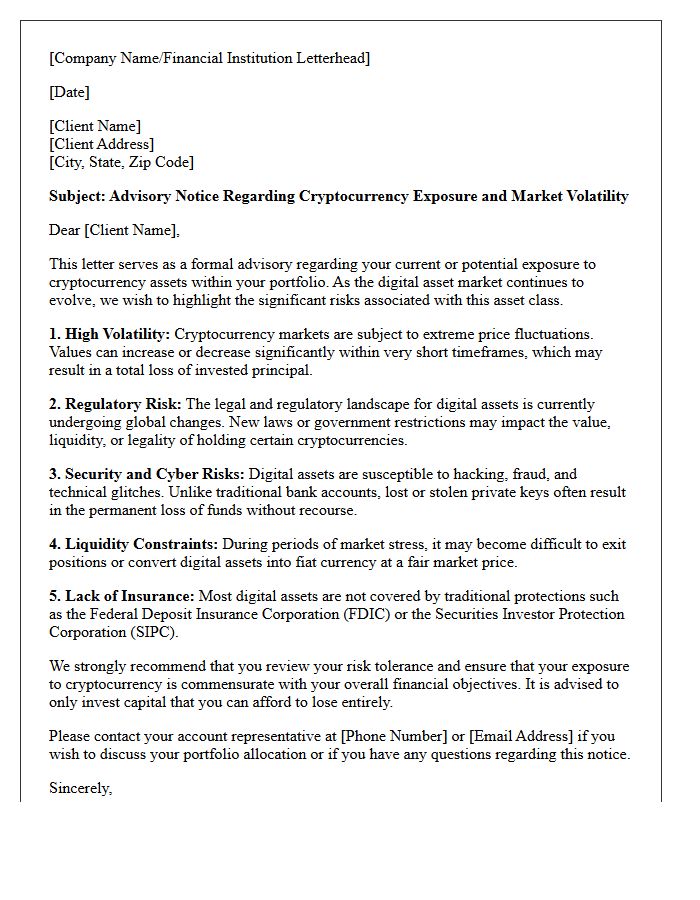
The Letter of Advisory on Cryptocurrency Exposure and Volatility Risks serves as a critical regulatory warning for financial institutions. It emphasizes the extreme price volatility and liquidity challenges inherent in digital assets. Regulators use this document to mandate robust risk management frameworks, ensuring banks maintain adequate capital buffers against potential losses. Understanding these guidelines is essential for institutions to mitigate operational risks and maintain financial stability while engaging with the evolving crypto market landscape.
Regulatory Compliance Risk Advisory Letter Regarding Digital Asset Portfolios
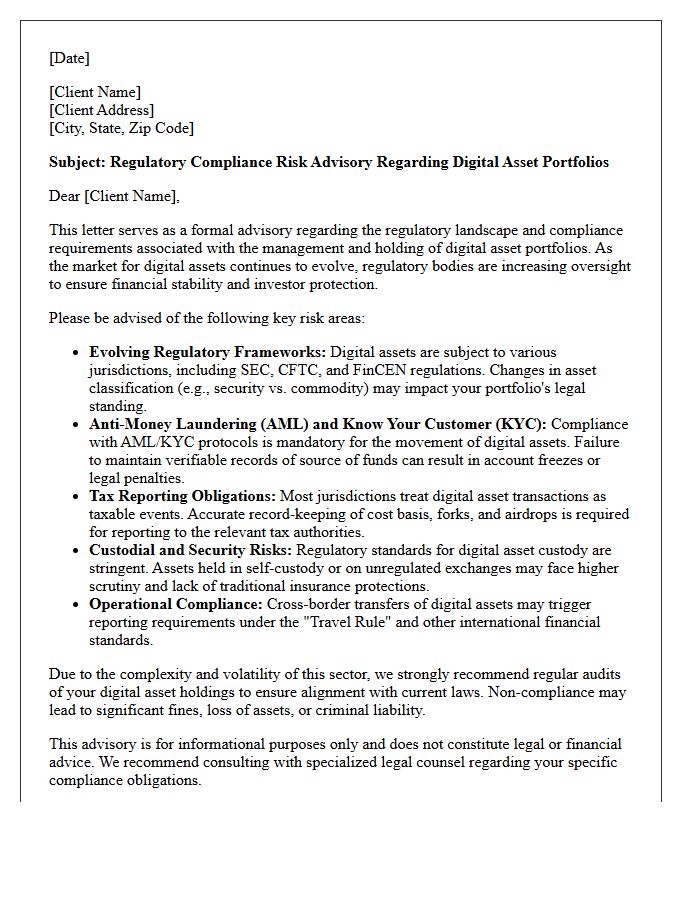
A regulatory compliance risk advisory letter serves as a critical warning for firms managing digital asset portfolios. These documents outline emerging liquidity risks, custody requirements, and anti-money laundering (AML) standards essential for legal operation. They highlight the necessity for robust internal controls to mitigate volatility and ensure investor protection. Adhering to these guidelines helps entities navigate the complex evolution of blockchain regulation while avoiding severe enforcement actions or financial penalties. Staying informed on these advisories is vital for maintaining transparency and operational integrity within the decentralized finance landscape.
Strategic Advisory Letter on Decentralized Finance and Banking Integration Risks
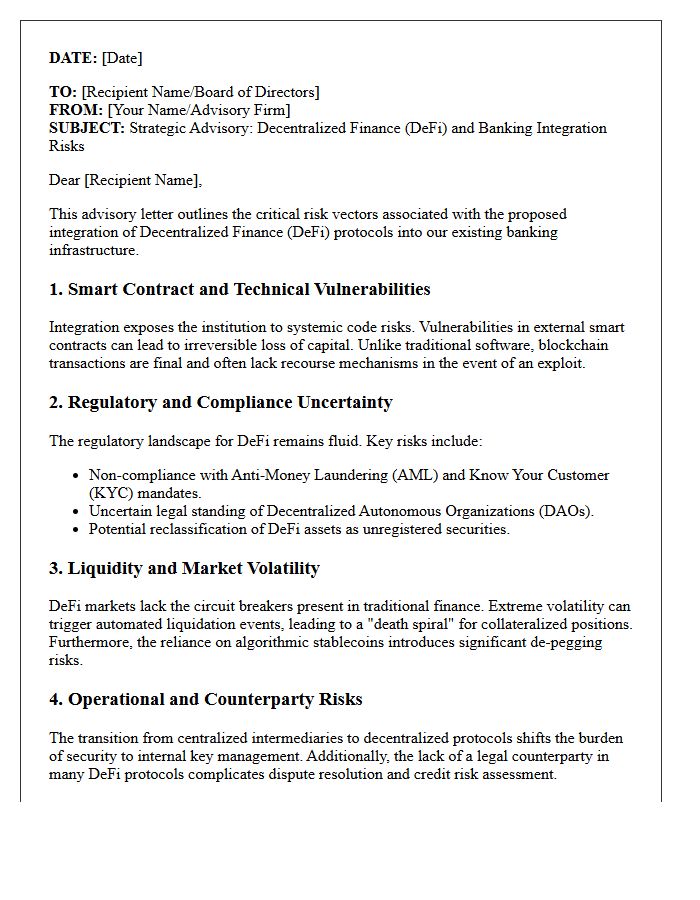
The Strategic Advisory Letter highlights critical systemic vulnerabilities arising from the convergence of traditional finance and Decentralized Finance (DeFi). It emphasizes that banking integration risks, such as liquidity mismatches and smart contract failures, could bypass conventional regulatory safeguards. Institutions must prioritize operational resilience and transparency to mitigate potential contagion. Understanding these cross-sector dependencies is essential for maintaining global financial stability as digital assets become increasingly embedded in legacy banking infrastructures.
Anti-Money Laundering and Cryptocurrency Risk Management Advisory Letter
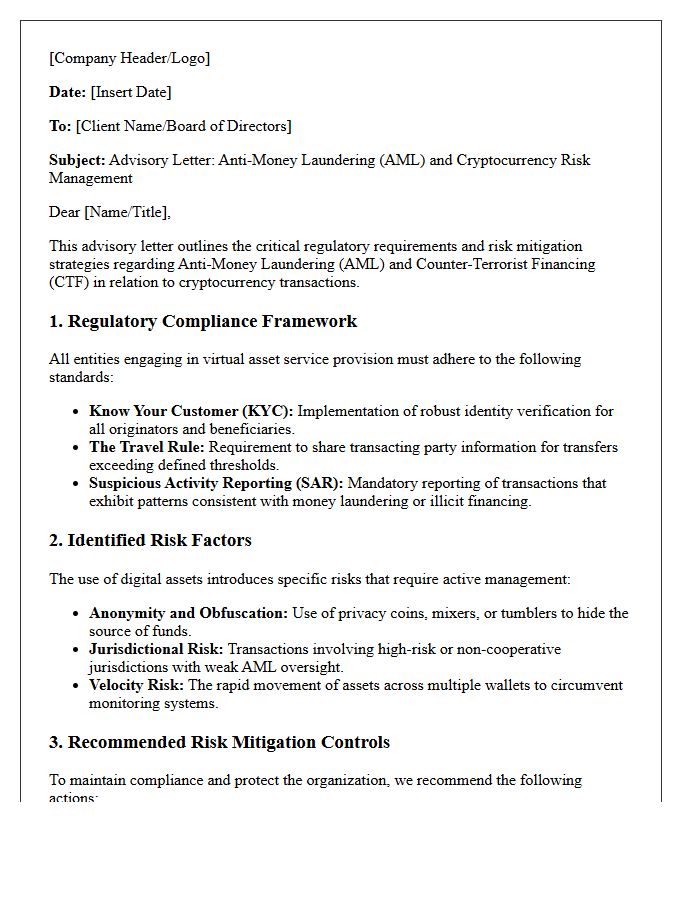
Financial institutions must address illicit finance risks associated with digital assets by following the Anti-Money Laundering and Cryptocurrency Risk Management Advisory Letter. This guidance emphasizes compliance with the Bank Secrecy Act through robust customer due diligence and sophisticated transaction monitoring. Regulators require firms to mitigate anonymity risks and bridge gaps between traditional banking and decentralized networks. Implementing a risk-based approach ensures that providers detect suspicious activities effectively, maintaining the integrity of the financial system while adapting to the evolving landscape of virtual asset service providers.
Advisory Letter on Custodial Risks of Digital Assets in Commercial Banking
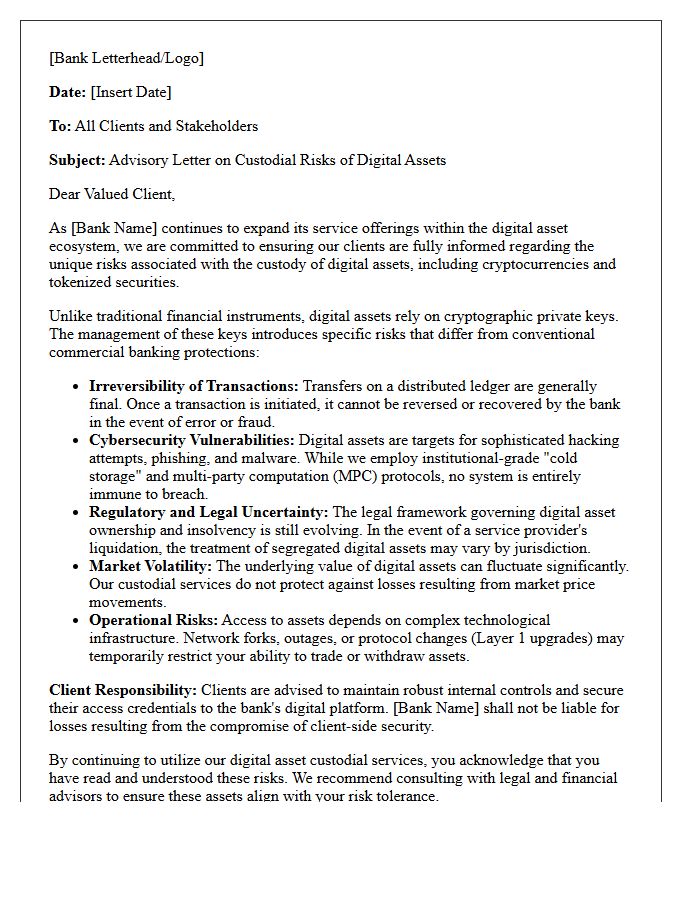
The Advisory Letter outlines critical custodial risks for commercial banks managing digital assets. It emphasizes that institutions must maintain robust risk management frameworks to address unique liquidity, operational, and legal challenges. Banks are required to ensure asset segregation and maintain clear internal controls to protect customer holdings. This guidance highlights the necessity of regulatory compliance and legal certainty regarding ownership in the event of insolvency. Understanding these safety expectations is vital for maintaining financial stability while integrating blockchain technology into traditional banking infrastructures.
Cybersecurity and Digital Asset Threat Mitigation Advisory Letter
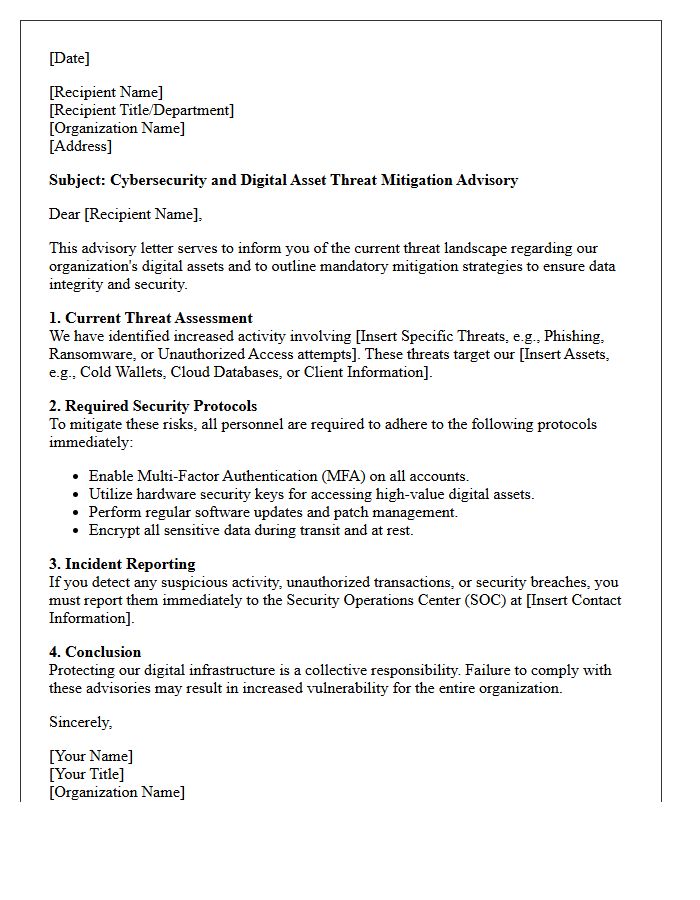
A Cybersecurity and Digital Asset Threat Mitigation Advisory Letter is a formal notification designed to inform stakeholders about emerging vulnerabilities and risk management strategies. It outlines specific technical safeguards to protect blockchain technologies and sensitive data from unauthorized access. By prioritizing proactive defense, these letters help organizations implement incident response protocols and encryption standards. Understanding these advisories is essential for maintaining operational integrity and ensuring compliance within the rapidly evolving digital landscape, effectively minimizing the potential impact of sophisticated cyberattacks on valuable organizational resources.
Letter of Risk Advisory Concerning Stablecoin Liquidity and Reserve Audits
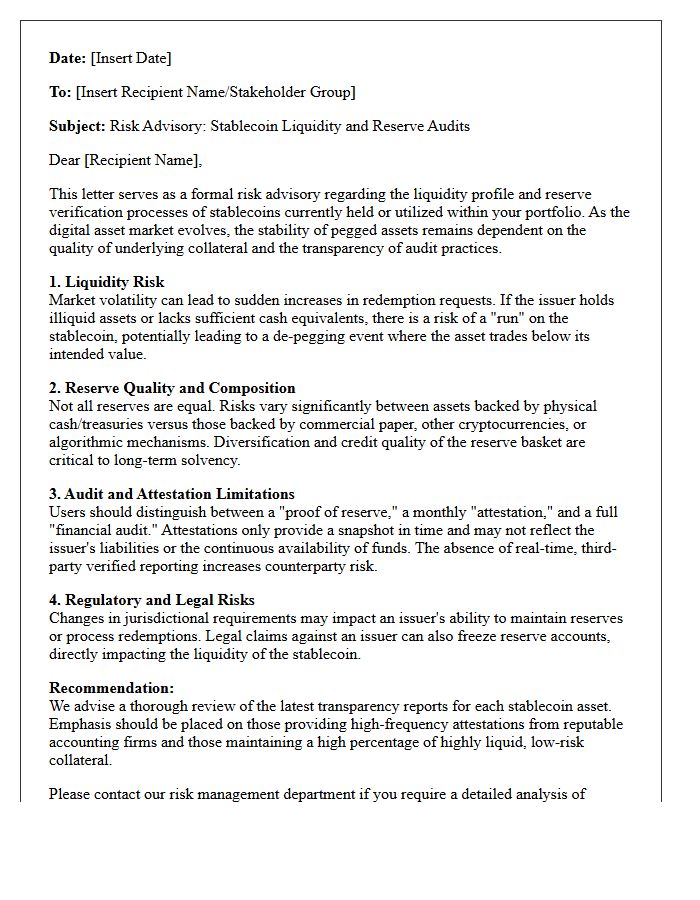
Investors must understand that the Letter of Risk Advisory emphasizes the critical necessity of transparency regarding stablecoin backing. It warns that inadequate liquidity and insufficient reserve audits can lead to systemic instability. Issuers are urged to provide verified, real-time data to ensure tokens maintain their pegs. Relying on unverified claims increases the danger of sudden bank runs or total capital loss. Regulators highlight that independent verification of assets is the only way to mitigate credit risks and protect market participants from insolvency during periods of high volatility.
Operational Risk Advisory Letter for Banking Cryptocurrency Exchange Partnerships
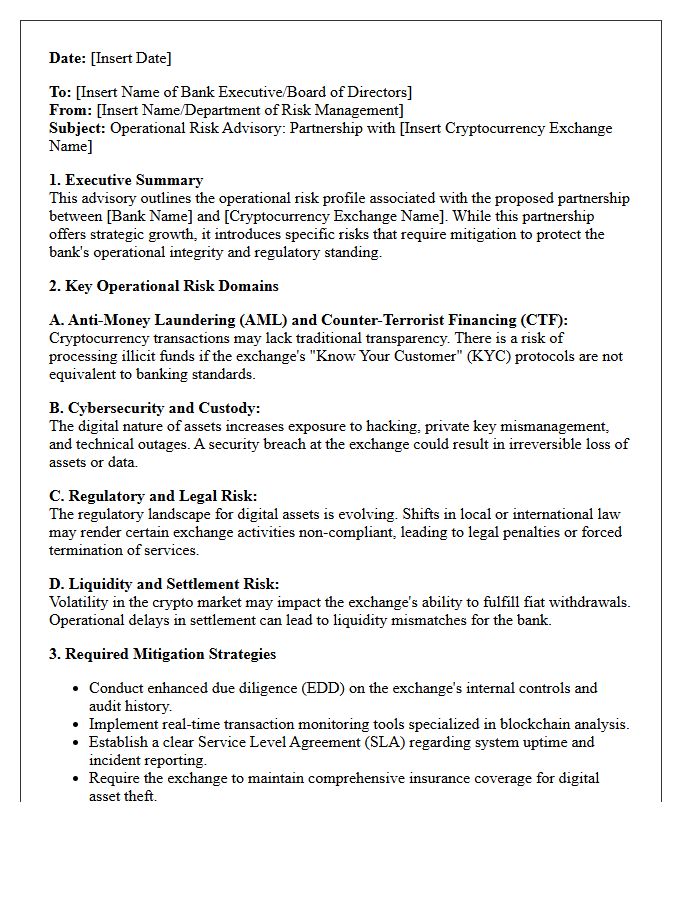
An Operational Risk Advisory Letter provides critical guidance for banks engaging in cryptocurrency exchange partnerships. These regulatory documents outline expectations for managing liquidity volatility, technological vulnerabilities, and legal compliance. Financial institutions must implement robust due diligence and real-time monitoring to mitigate risks associated with digital asset custody and settlement. Failure to align with these safety and soundness standards can lead to enforcement actions. Understanding these protocols is essential for maintaining institutional stability while navigating the evolving decentralized finance landscape and ensuring consumer protection within the regulated banking perimeter.
Market Risk Advisory Letter for Institutional Digital Asset Investments
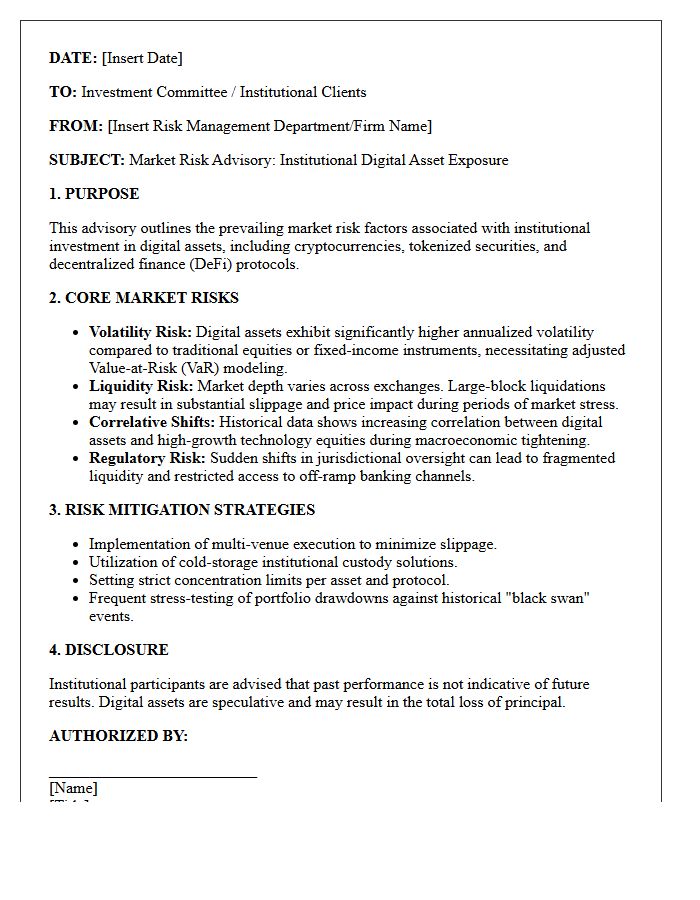
A Market Risk Advisory Letter provides institutional investors with essential regulatory guidance on managing volatility within the digital asset ecosystem. It outlines best practices for liquidity monitoring, counterparty exposure, and custody protocols. These letters emphasize the importance of robust risk frameworks to mitigate potential losses from market manipulation and systemic contagion. For institutions, adhering to these advisories ensures compliance with evolving financial standards while safeguarding capital against the unique price fluctuations and technical vulnerabilities inherent in cryptocurrency markets.
Third-Party Vendor Risk Advisory Letter for Cryptocurrency Payment Gateways
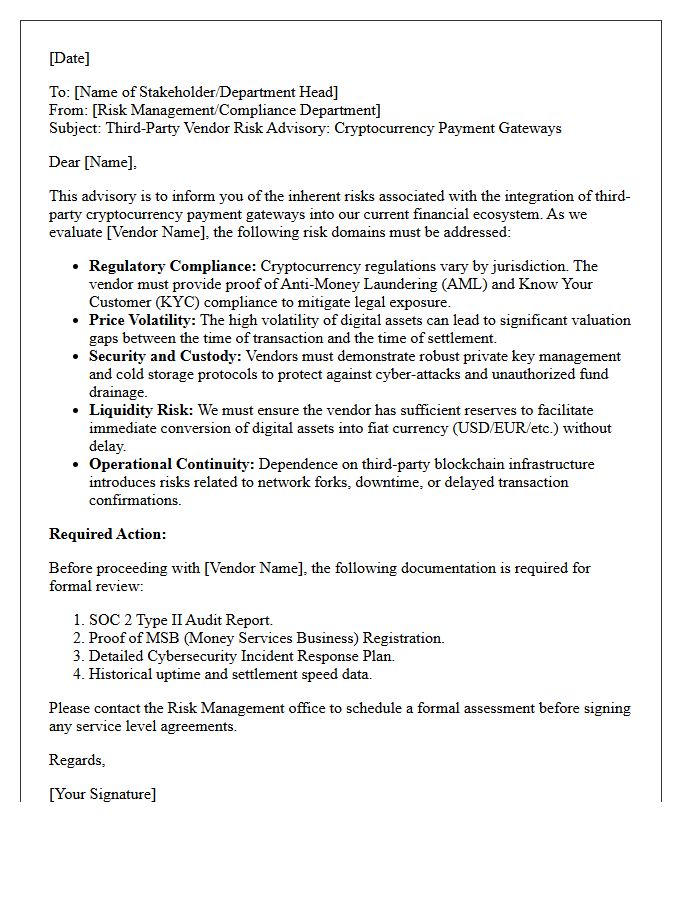
A Third-Party Vendor Risk Advisory Letter for cryptocurrency payment gateways is a critical compliance document used to evaluate the security and operational stability of digital asset processors. It addresses key risks such as anti-money laundering (AML) protocols, liquidity management, and cybersecurity vulnerabilities inherent in decentralized finance. Financial institutions must issue these letters to ensure that external vendors adhere to strict regulatory standards and data protection laws. Conducting this due diligence mitigates potential financial loss and reputational damage while maintaining the integrity of the institutional payment ecosystem.
Smart Contract Vulnerability and Banking Operations Advisory Letter
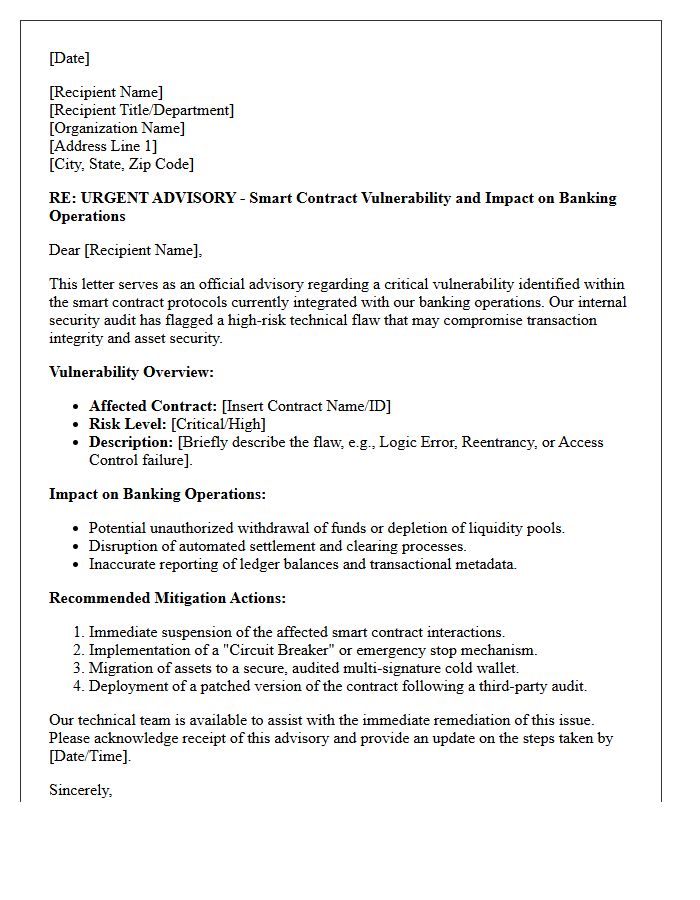
The Smart Contract Vulnerability and Banking Operations Advisory Letter highlights critical security risks for financial institutions. It emphasizes that reentrancy and logic errors in automated code can lead to irreversible capital loss. Regulators advise banks to implement robust security audits and real-time monitoring to safeguard liquidity. Understanding these vulnerabilities is essential for maintaining operational integrity and regulatory compliance. Institutions must prioritize risk mitigation strategies to bridge the gap between traditional banking stability and the decentralized complexities of blockchain-based smart contract execution.
Letter on Counterparty Risk Advisory in Digital Asset Transactions
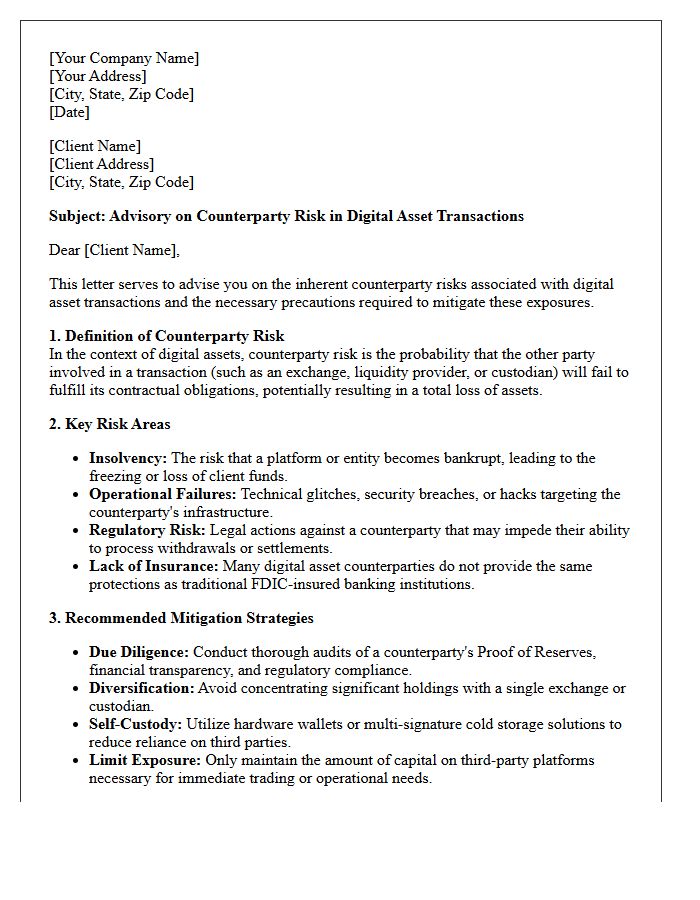
The Letter on Counterparty Risk Advisory underscores the necessity for financial institutions to manage counterparty risk when engaging in digital asset transactions. Regulators emphasize robust due diligence to assess the creditworthiness and operational stability of partners. Institutions must implement comprehensive risk management frameworks to mitigate potential losses from defaults or market volatility. This advisory serves as a critical guideline for ensuring financial stability and maintaining transparency within the evolving digital asset ecosystem, protecting both stakeholders and the broader economy from systemic threats.
What is the purpose of a Digital Asset and Cryptocurrency Risk Advisory Letter?
The advisory letter serves to formally outline the specific market, technical, and regulatory risks associated with digital assets, ensuring that clients or stakeholders make informed decisions while acknowledging the inherent volatility of the cryptocurrency ecosystem.
What are the primary market risks highlighted in a digital asset advisory?
Primary market risks include extreme price volatility, liquidity constraints during market stress, and the potential for total loss of principal due to the speculative nature of decentralized finance (DeFi) and unbacked crypto-assets.
How does the letter address the technical risks of self-custody and private keys?
The advisory emphasizes that digital assets rely on cryptographic private keys; losing these keys, or falling victim to hacking and phishing, results in the permanent and irreversible loss of funds, as there is no central authority to recover them.
What regulatory and legal disclosures are included in the advisory?
The letter discloses that digital assets are often not covered by traditional protections like FDIC or SIPC insurance and notes that the evolving global legal framework may impact the legality, tax treatment, or transferability of specific tokens.
Why is an acknowledgment of risk necessary for cryptocurrency transactions?
An acknowledgment confirms that the participant understands the complex risk profile of blockchain technology, thereby mitigating professional liability for advisors and ensuring compliance with financial transparency standards.


Comments