
A Zero Balance Account Audit Confirmation Letter is an official request used to verify that a specific bank account maintains no outstanding funds or liabilities. This document ensures financial transparency and accuracy during the auditing process by confirming account statuses with financial institutions. It helps auditors mitigate risk and prevent undisclosed transactions. Below are some ready to use templates.
Image cover: Guide to Zero Balance Account Audit Confirmation: Sample Templates and Best Practices
Letter Samples List
- Zero Balance Account Audit Confirmation Letter
- Corporate Zero Balance Structure Confirmation Letter
- Master Account Sweep Verification Letter
- Subordinate Zero Balance Account Status Letter
- Year-End Zero Balance Audit Letter
- Automated Sweep Transfer Confirmation Letter
- External Auditor Zero Balance Verification Letter
- Concentration Account Zero Balance Confirmation Letter
- Daily Sweep Zero Balance Audit Letter
- Zero Balance Account Maintenance Confirmation Letter
- Consolidated Zero Balance Liability Confirmation Letter
- Zero Balance Account Closure Confirmation Letter
Zero Balance Account Audit Confirmation Letter
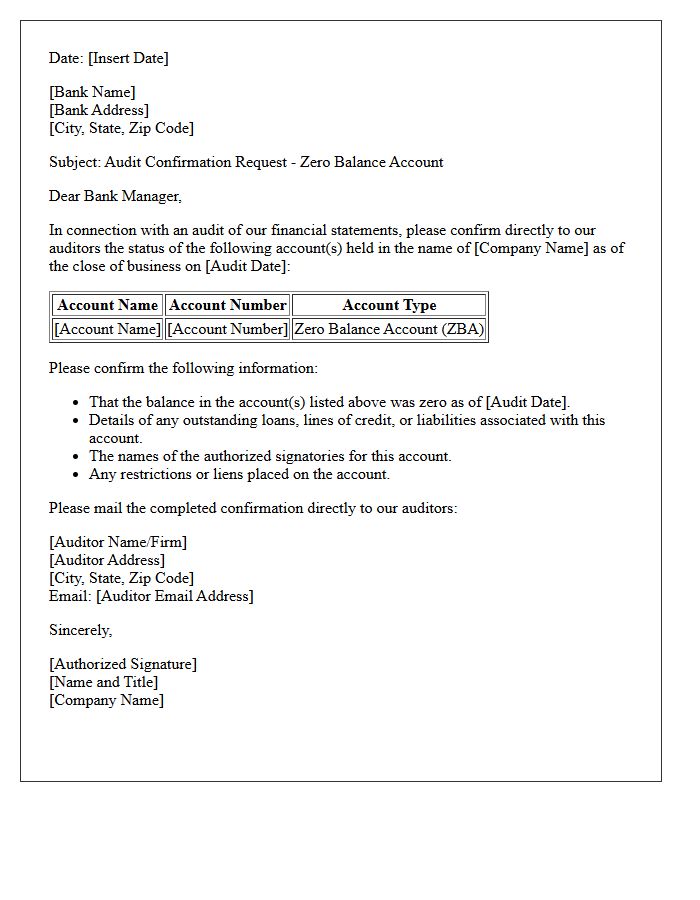
A Zero Balance Account Audit Confirmation Letter is a formal request sent by auditors to financial institutions to verify that a specific account held no funds at year-end. This process is crucial for detecting unrecorded liabilities or potential fraud by ensuring closed or empty accounts are accurately reported. It provides independent evidence to confirm the completeness of financial statements. Even if an account shows zero activity, obtaining this confirmation mitigates audit risk and ensures all banking relationships are transparently disclosed to stakeholders and regulatory bodies.
Corporate Zero Balance Structure Confirmation Letter
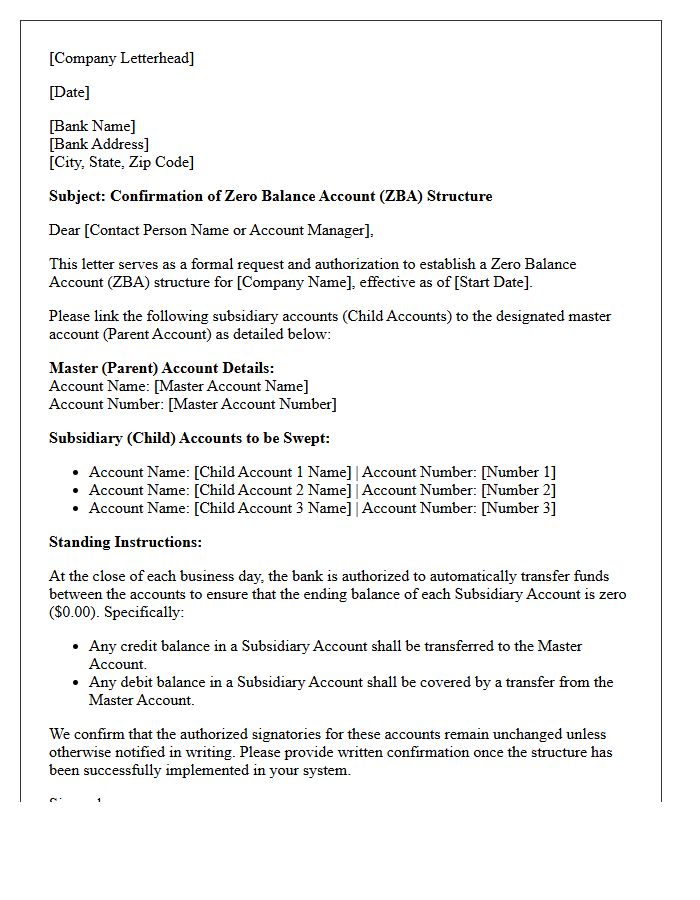
A Corporate Zero Balance Structure Confirmation Letter serves as official verification of an automated liquidity management arrangement. This document confirms that subsidiary accounts maintain a zero balance by sweeping funds into a central master account daily. It is essential for financial auditing and legal compliance, proving that the corporation utilizes a ZBA structure to optimize working capital and simplify cash pooling. Banks issue this letter to validate the operational linkage between accounts, ensuring transparency for stakeholders regarding consolidated cash positions and internal fund movements within the corporate group.
Master Account Sweep Verification Letter
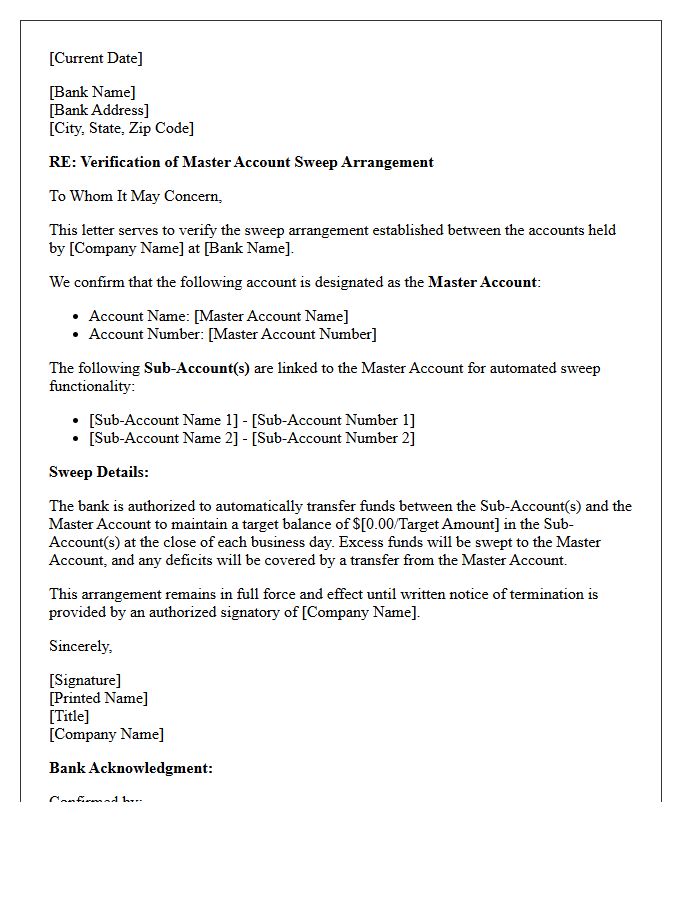
A Master Account Sweep Verification Letter is a formal document used to confirm the automated transfer of funds between primary and sub-accounts. It serves as essential proof for audits and regulatory compliance, ensuring that liquidity management strategies are correctly documented. This letter verifies the specific parameters, limits, and authorization protocols governing the movement of capital. Financial institutions use this record to validate account balances and maintain transparency in corporate cash pooling arrangements, protecting the organization's financial integrity during internal or external verification processes.
Subordinate Zero Balance Account Status Letter
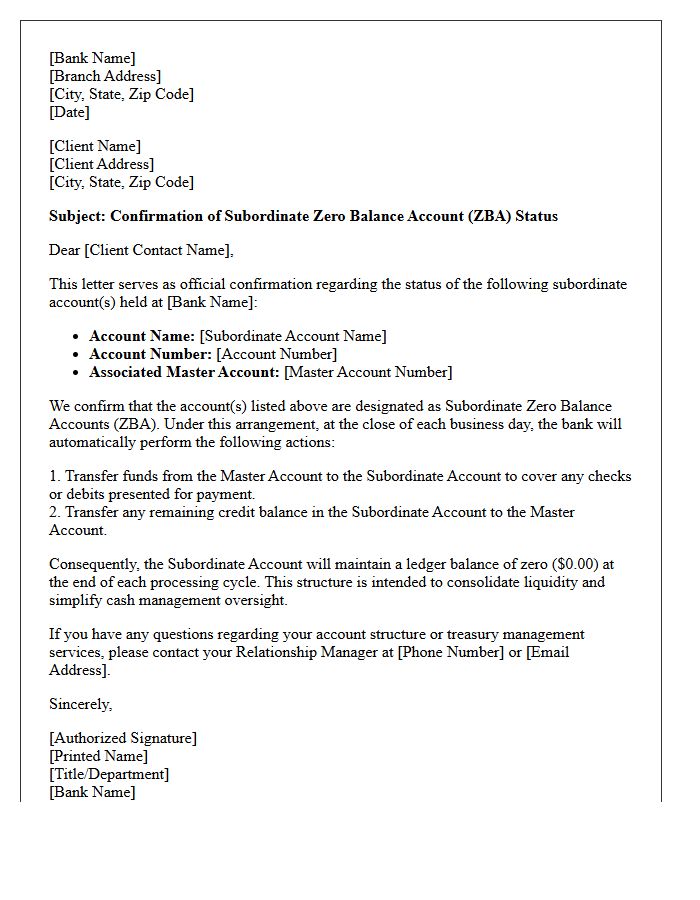
A Subordinate Zero Balance Account Status Letter is a formal document verifying that a secondary account maintains a zero balance by automatically sweeping funds to a master account. This letter is crucial for corporate transparency, confirming that all residual funds are consolidated daily. It serves as essential proof for auditors and financial institutions that the specific sub-account reflects no independent debt or surplus, ensuring streamlined liquidity management and precise oversight of organizational cash flows within a complex banking structure.
Year-End Zero Balance Audit Letter
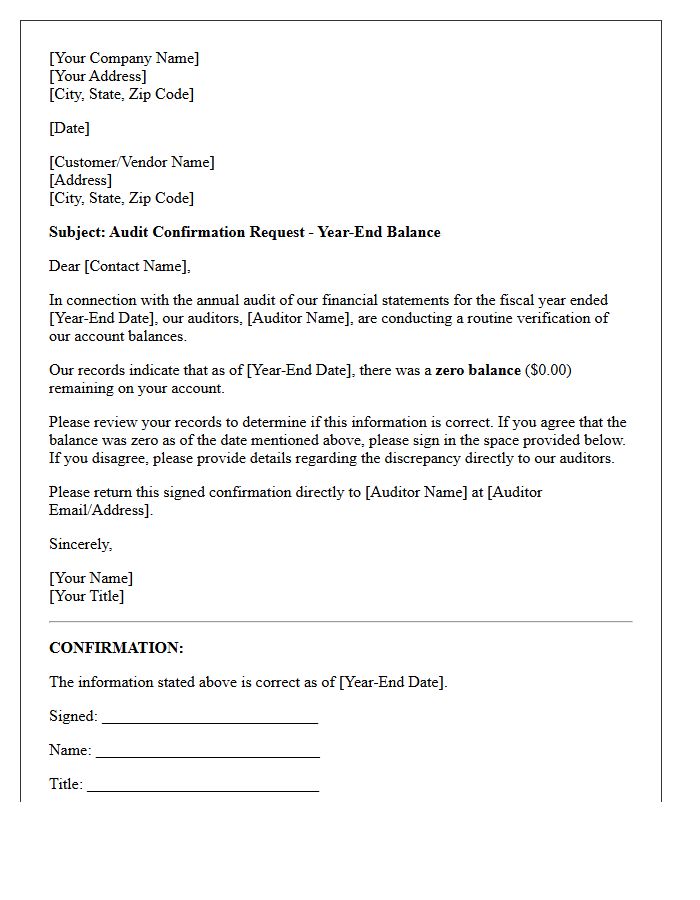
A Year-End Zero Balance Audit Letter is a critical financial verification document sent by auditors to banks or creditors. It confirms that a specific account maintained a nil balance at the close of the fiscal year. This process ensures the accuracy of financial statements by validating that no undisclosed liabilities or outstanding debts exist. For businesses, responding promptly to these requests is essential for regulatory compliance and maintaining audit integrity, as it provides independent evidence that financial records match external banking data.
Automated Sweep Transfer Confirmation Letter
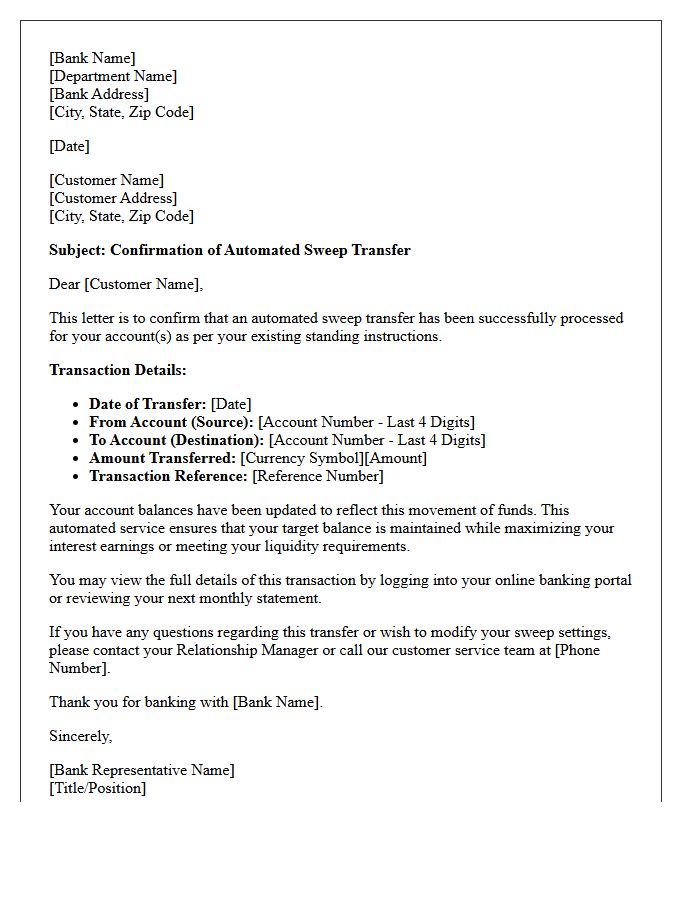
An Automated Sweep Transfer Confirmation Letter serves as official documentation for the recurring movement of funds between bank accounts. This letter verifies the setup of automated instructions designed to optimize liquidity and maximize interest earnings. It details specific thresholds, target balances, and the frequency of transfers. Reviewing this document ensures that your cash management strategy is accurately implemented, providing a clear audit trail for financial oversight. Always confirm that the source and destination accounts are correct to maintain seamless automated wealth management and operational efficiency.
External Auditor Zero Balance Verification Letter
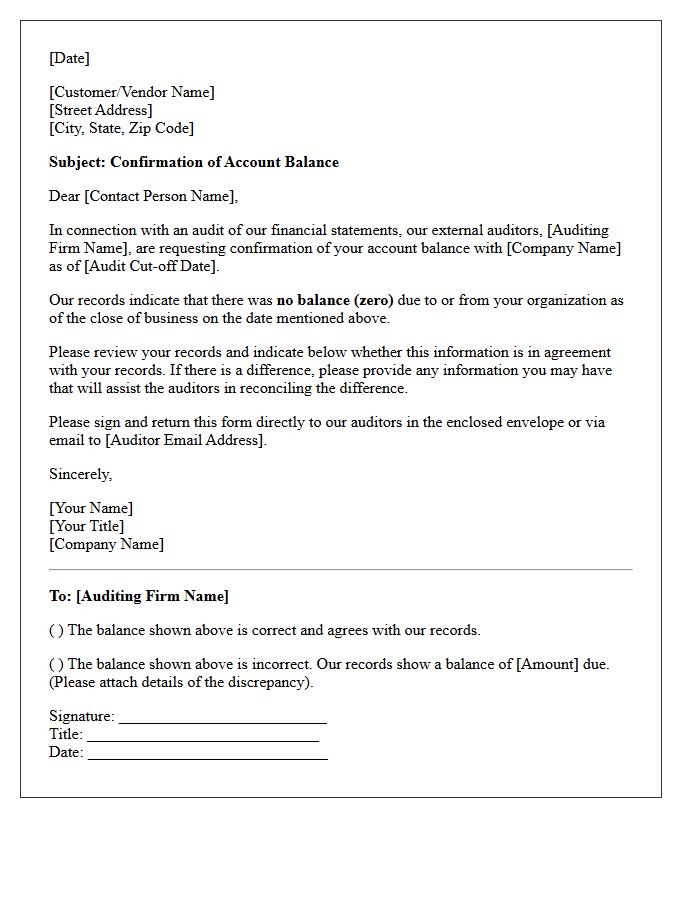
An External Auditor Zero Balance Verification Letter is a formal document used to confirm that a specific account or debt holds no outstanding liability. During a financial audit, independent verification ensures the accuracy of reported figures by contacting third parties directly. This process mitigates risks of fraud or accounting errors by validating that balances were fully settled by a certain date. It serves as crucial audit evidence, providing stakeholders with assurance regarding the integrity of the company's financial statements and its recorded debt obligations.
Concentration Account Zero Balance Confirmation Letter
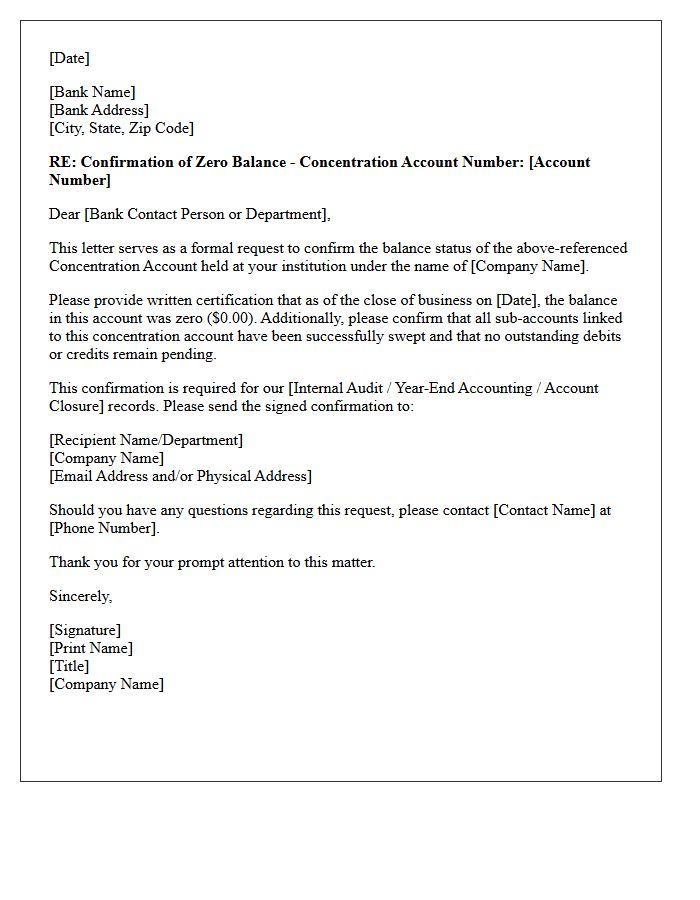
A Concentration Account Zero Balance Confirmation Letter is a formal document issued by a bank to verify that a specific disbursement account maintains a zero balance at the end of each business day. This process occurs because funds are automatically swept into a master concentration account to optimize liquidity management. Businesses use this letter to provide audit evidence, ensuring internal controls are functioning correctly and that no idle cash remains in secondary accounts. It confirms the automated target balancing structure essential for efficient corporate treasury operations and financial reporting accuracy.
Daily Sweep Zero Balance Audit Letter
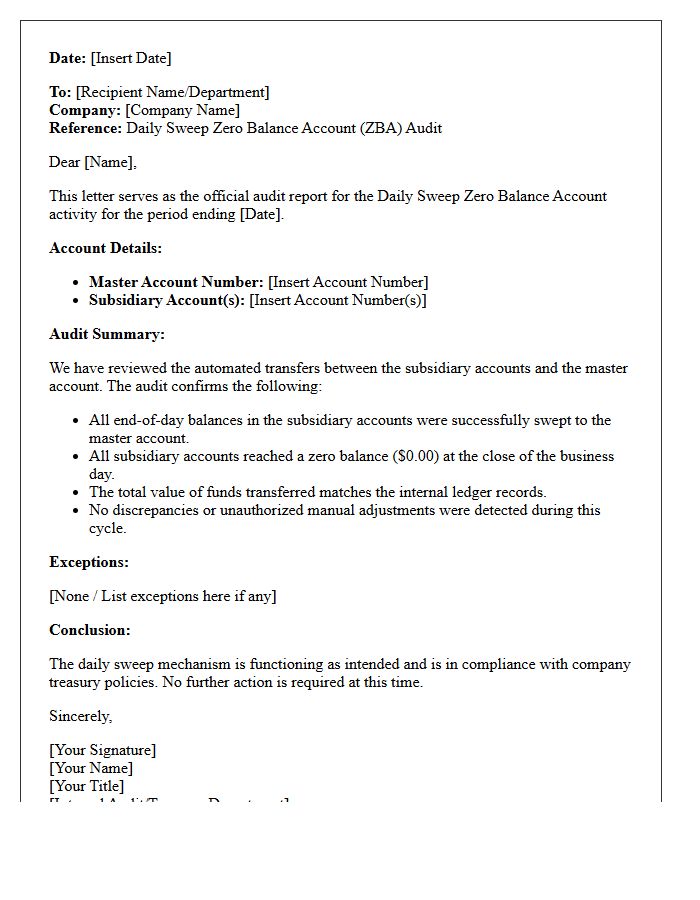
A Daily Sweep Zero Balance Audit Letter is a critical document used to verify that funds were successfully transferred from a subsidiary account to a main concentration account. The sweep process ensures the secondary account maintains a zero balance at the close of each business day. This audit trail provides essential evidence for financial transparency, confirming that automated cash concentration movements occurred accurately. It is a vital tool for internal controls, helping businesses monitor liquidity, prevent unauthorized discrepancies, and simplify the reconciliation of complex corporate banking structures.
Zero Balance Account Maintenance Confirmation Letter
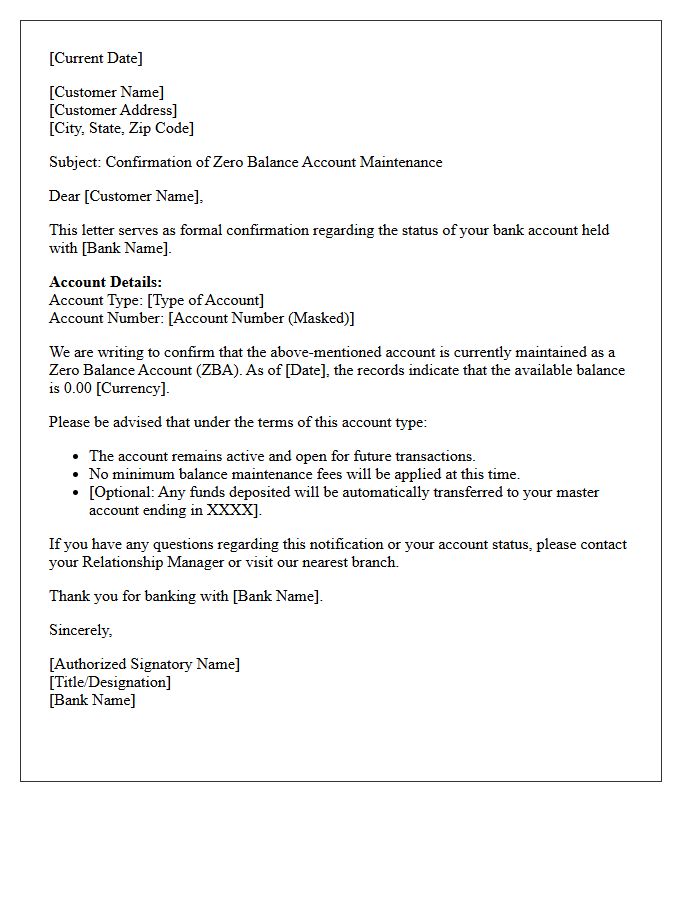
A Zero Balance Account Maintenance Confirmation Letter is an official document issued by a bank verifying that a specific account carries no remaining funds or liabilities. It serves as formal evidence that the account is active but empty, or has been successfully settled prior to closure. This letter is crucial for corporate auditing, reconciling financial statements, and ensuring no hidden fees accrue. It provides legal protection for the account holder, confirming that all contractual obligations are met and the financial relationship is transparently documented for regulatory compliance.
Consolidated Zero Balance Liability Confirmation Letter
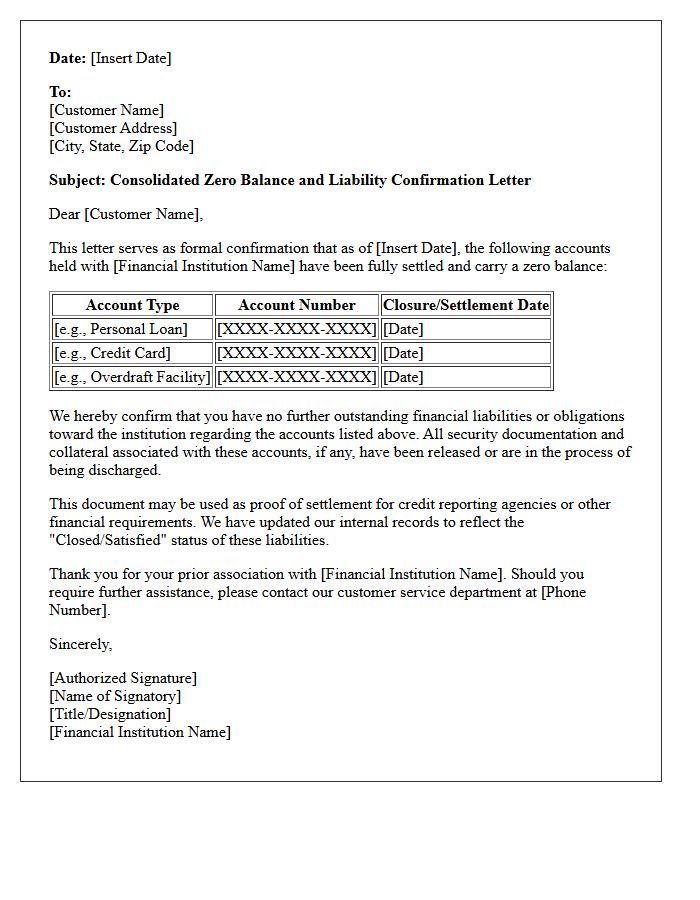
A Consolidated Zero Balance Liability Confirmation Letter is an official bank document certifying that a borrower has fully repaid all outstanding debts across multiple accounts. This letter serves as definitive legal proof that no further financial obligations exist toward the lending institution. It is crucial for credit score restoration, as it ensures credit bureaus update your status to closed or settled. Always retain this document to prevent future disputes, clear collateral liens, and provide evidence of financial integrity when applying for new loans or background checks.
Zero Balance Account Closure Confirmation Letter
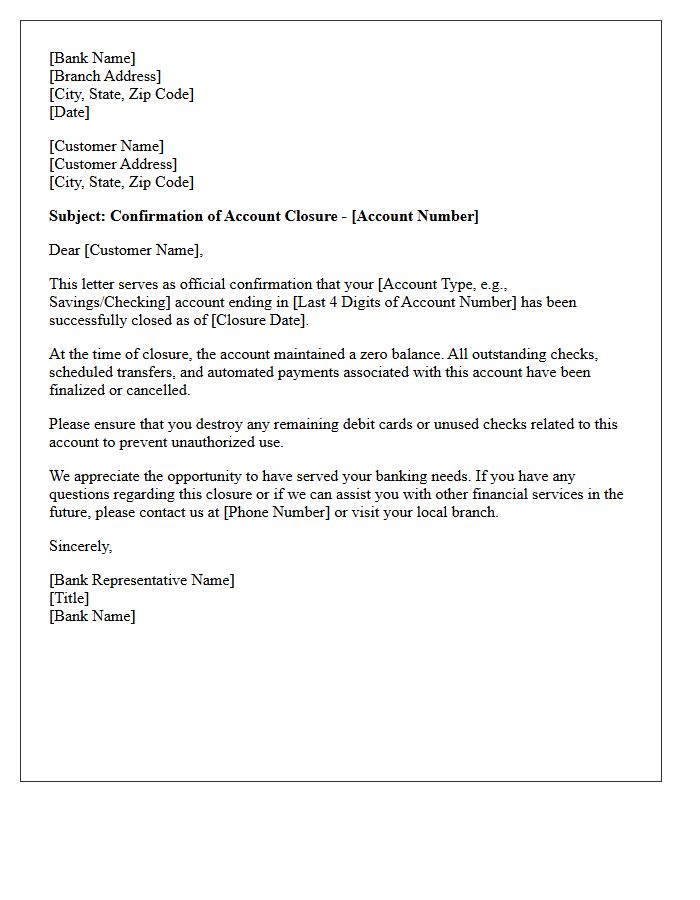
A Zero Balance Account Closure Confirmation Letter is an official document issued by a bank verifying that a specific account is permanently shut. It serves as legal proof of closure, ensuring no future maintenance fees or hidden charges accrue. This letter is essential for maintaining a healthy credit profile and preventing identity theft. Always cross-verify that the final balance was exactly zero before termination. Retain this physical or digital record safely to resolve any potential future disputes regarding your financial history or banking status.
What is a zero balance account audit confirmation letter?
A zero balance account audit confirmation letter is a formal request sent by auditors to a financial institution to verify that a specific account held no funds and had no outstanding liabilities at the close of the reporting period.
Why do auditors confirm bank accounts with a zero balance?
Auditors confirm zero balance accounts to ensure completeness of financial records, verify that no undisclosed debts or liens exist, and mitigate the risk of "off-balance sheet" financing or unrecorded transactions.
What information is required in a zero balance confirmation request?
The request typically includes the legal name of the entity, the specific account number, the effective audit date, and an authorized signature from the account holder granting the bank permission to disclose information.
How does a zero balance confirmation help prevent financial fraud?
It prevents fraud by verifying that closed or empty accounts are not being used for unauthorized activities, such as circular "kiting" schemes or hiding unauthorized corporate loans that could misrepresent a company's solvency.
Can a bank refuse to provide a zero balance audit confirmation?
Banks generally provide these confirmations upon receiving proper client authorization; however, failure to provide one often results in a scope limitation for the auditor, potentially leading to a qualified audit opinion.

Comments