
Protect your brand and customers by issuing a Cease and Desist Letter to shut down fraudulent phishing domains mimicking official bank portals. These legal notices demand the immediate removal of deceptive sites used for identity theft and financial fraud. Acting swiftly mitigates reputational damage and prevents further security breaches. To help you take action, below are some ready to use template.
Image cover: Protect Your Bank: Phishing Domain Cease and Desist Templates
Letter Samples List
- Cease and Desist Letter for Fraudulent Phishing Domains Mimicking Bank Portals
- Letter of Cease and Desist Regarding Fraudulent Bank Portal Phishing Domains
- Legal Cease and Desist Letter for Deceptive Phishing Domains Impersonating Bank Portals
- Cease and Desist Letter for Trademark Infringement and Fraudulent Bank Phishing Domains
- Formal Demand Letter to Cease and Desist Fraudulent Bank Portal Mimicking Domains
- Cease and Desist Letter Regarding Unauthorized Domains Phishing Bank Portal Credentials
- Urgent Cease and Desist Letter Against Fraudulent Domains Replicating Banking Portals
- Notice and Cease and Desist Letter for Cyber Fraud and Bank Portal Phishing Domains
- Cease and Desist Letter Enjoining the Operation of Fraudulent Bank Phishing Portals
- Bank Impersonation and Phishing Domain Cease and Desist Letter
- Cease and Desist Letter for Malicious Phishing Domains Simulating Authentic Banking Portals
- Intellectual Property and Phishing Domain Cease and Desist Letter for Banking Portals
Cease and Desist Letter for Fraudulent Phishing Domains Mimicking Bank Portals
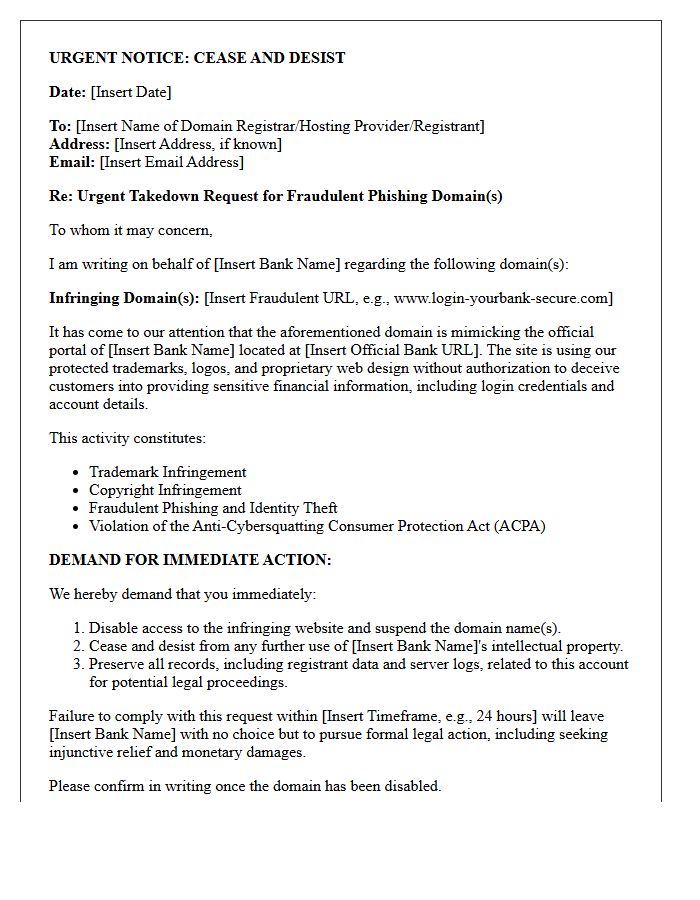
A Cease and Desist Letter is a formal legal demand used to shut down fraudulent phishing domains mimicking official bank portals. These letters target domain registrars and hosting providers to disable sites that facilitate identity theft and financial fraud. Acting quickly is essential to protect customers from entering sensitive credentials into malicious interfaces. By asserting trademark infringement and documenting deceptive practices, financial institutions can effectively mitigate cybersecurity risks and preserve brand integrity. Professional legal notification ensures that unauthorized entities immediately stop using confusingly similar assets to exploit unsuspecting users.
Letter of Cease and Desist Regarding Fraudulent Bank Portal Phishing Domains
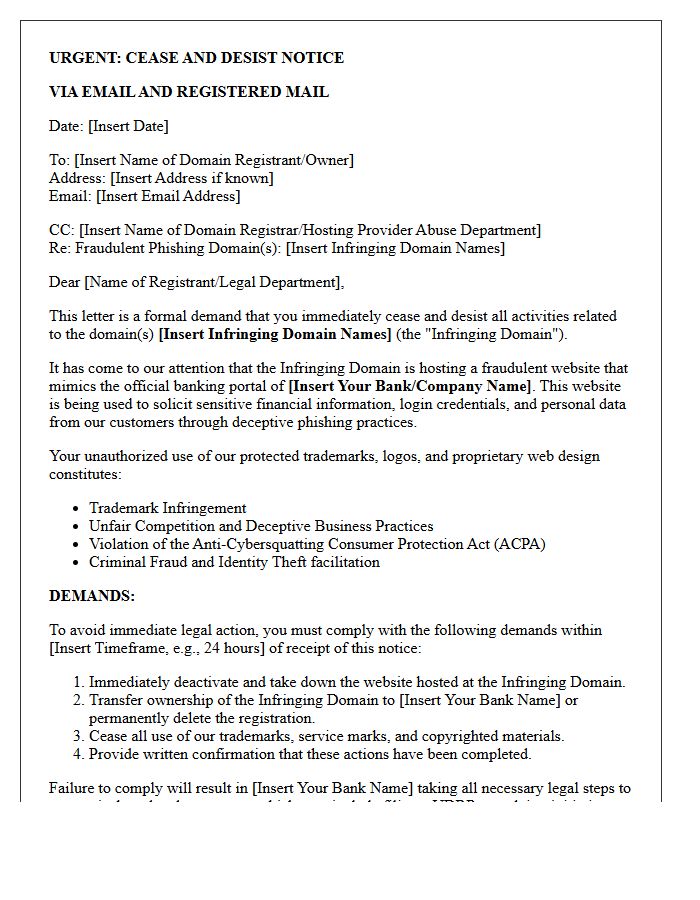
A Cease and Desist letter is a formal legal notice used to demand that malicious actors immediately shut down phishing domains mimicking official bank portals. These fraudulent sites aim to steal sensitive login credentials and financial data through social engineering. Issuing this letter is a critical first step in brand protection and intellectual property enforcement. It serves as documented evidence for future litigation or UDRP proceedings, helping financial institutions mitigate security risks, protect customer assets, and maintain digital trust against cybercriminals.
Legal Cease and Desist Letter for Deceptive Phishing Domains Impersonating Bank Portals
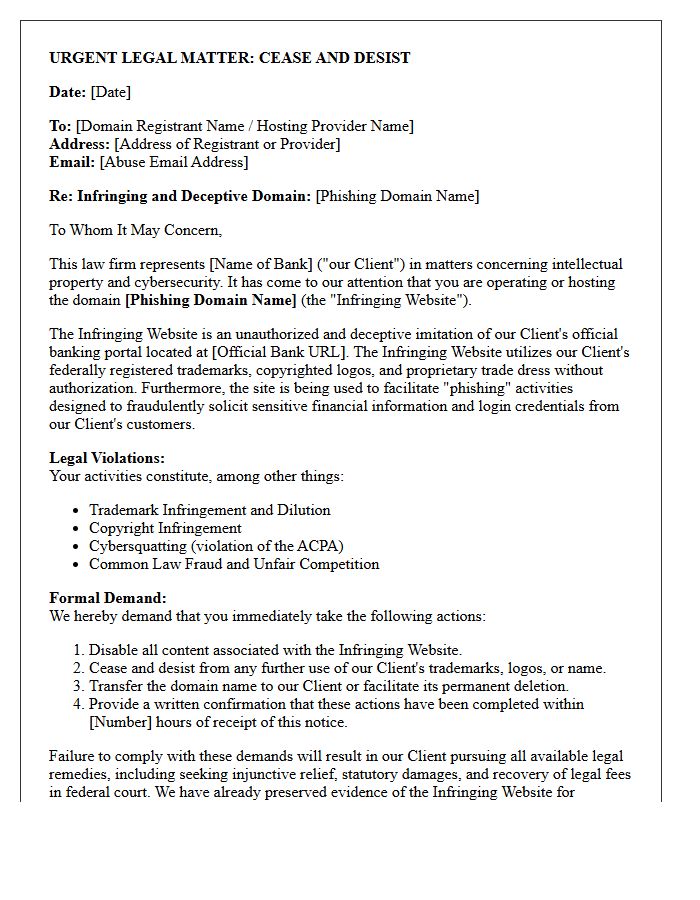
A Cease and Desist Letter is a formal legal notice issued to shut down phishing domains that maliciously impersonate bank portals. These fraudulent sites utilize deceptive URLs and branding to harvest sensitive customer credentials. Sending this notice is a critical first step in intellectual property enforcement, demanding the immediate removal of infringing content and the transfer of the domain. Legal action helps mitigate financial fraud risks and protects brand integrity by alerting hosting providers and registrars to illicit activity, forcing the permanent deactivation of harmful cyber threats.
Cease and Desist Letter for Trademark Infringement and Fraudulent Bank Phishing Domains
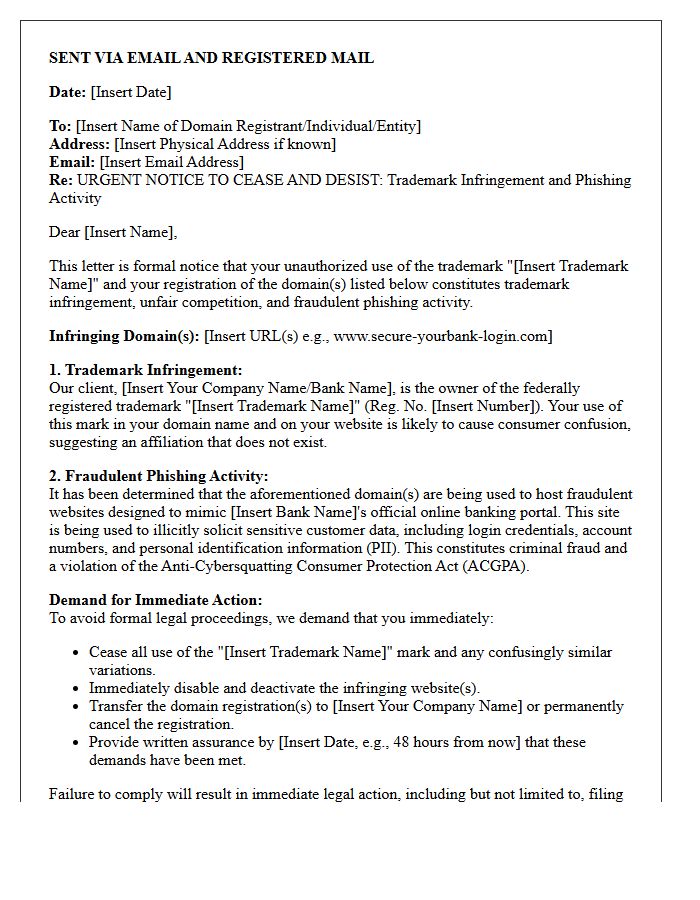
A Cease and Desist Letter is a formal legal demand used to stop unauthorized parties from using protected intellectual property. In cases involving trademark infringement and fraudulent bank phishing domains, these notices serve as critical evidence for future litigation. They demand the immediate deactivation of deceptive websites that impersonate financial institutions to steal user data. Rapidly issuing these letters helps mitigate brand damage, protects customers from cybercrime, and initiates the process of domain suspension through registrars or hosting providers to disrupt malicious phishing infrastructure effectively.
Formal Demand Letter to Cease and Desist Fraudulent Bank Portal Mimicking Domains
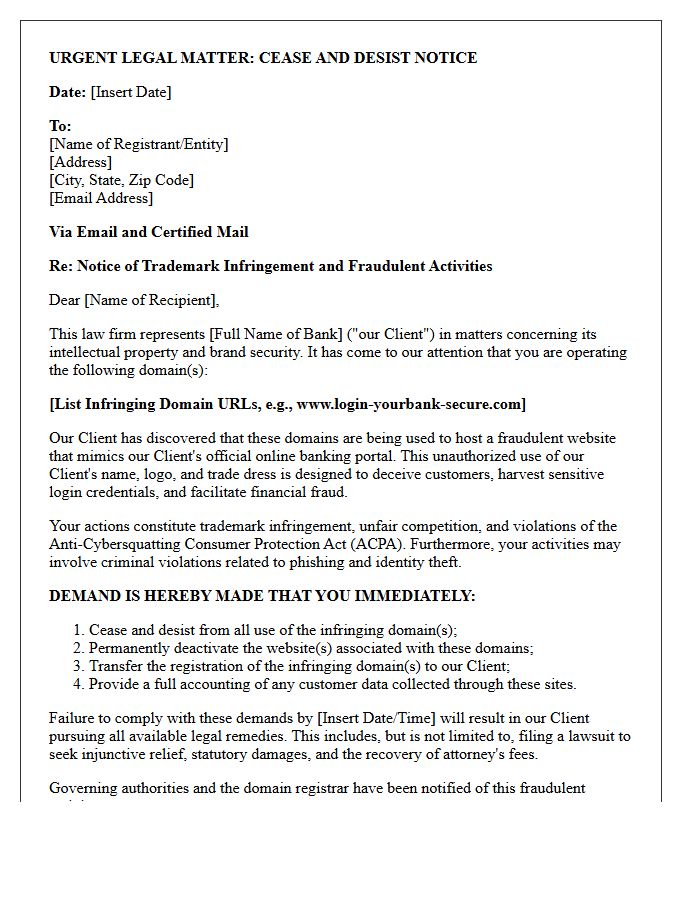
A formal cease and desist letter is a critical legal tool to stop phishing activities targeting financial institutions. It demands that bad actors immediately shut down fraudulent domains mimicking legitimate bank portals. These deceptive sites aim to steal sensitive user credentials through brand impersonation. Sending this notice establishes a formal record of the trademark infringement and security breach, providing a necessary prerequisite for potential litigation or UDRP proceedings. Timely action is essential to protect customers and maintain the integrity of the bank's digital infrastructure against cyber threats.
Cease and Desist Letter Regarding Unauthorized Domains Phishing Bank Portal Credentials
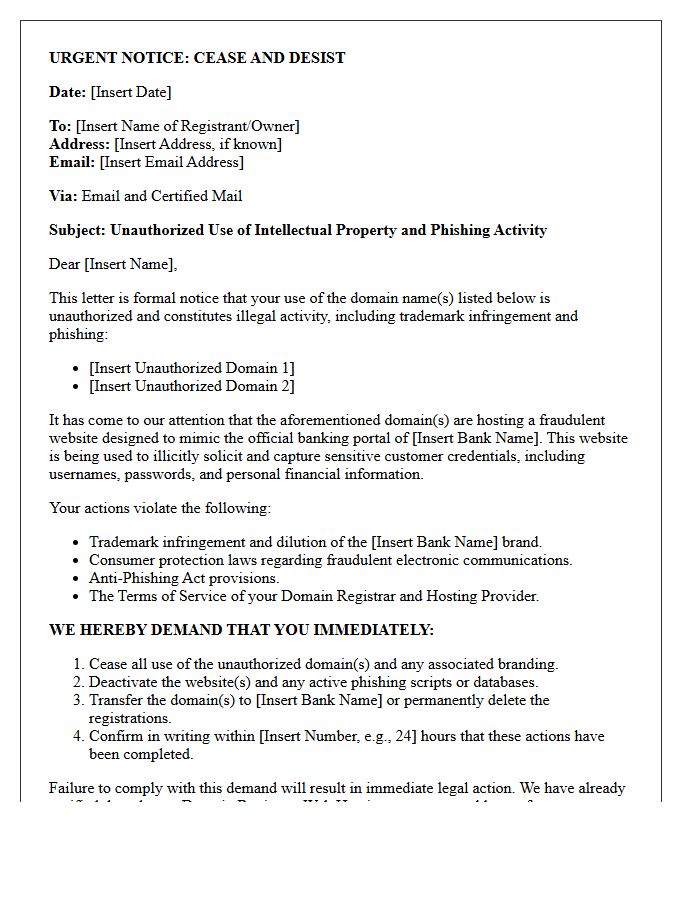
A Cease and Desist Letter is a formal legal demand requiring malicious actors to immediately stop using unauthorized domains that mimic official banking portals. These fraudulent sites are specifically designed for phishing, aiming to steal sensitive bank portal credentials and personal financial data. Sending this notice is a critical first step in establishing a legal record of infringement. It facilitates rapid domain takedown requests through registrars or hosting providers, effectively protecting customers from identity theft and safeguarding the financial institution's brand reputation and digital security infrastructure.
Urgent Cease and Desist Letter Against Fraudulent Domains Replicating Banking Portals
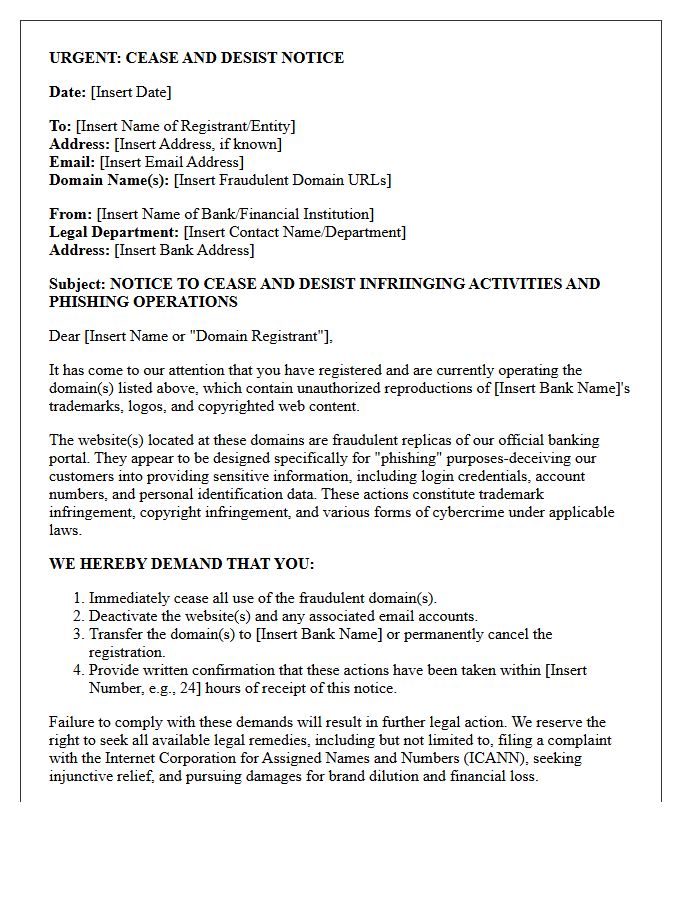
Issuing an Urgent Cease and Desist Letter is a critical legal action to dismantle fraudulent domains mimicking official banking portals. These malicious sites facilitate phishing attacks designed to steal sensitive credentials and financial data. By formally demanding an immediate shutdown, institutions protect their brand integrity and customer security. It serves as essential evidence for hosting providers and registrars to terminate malicious infrastructure quickly. Promptly addressing these trademark infringements and security threats mitigates financial loss and maintains public trust in digital banking systems.
Notice and Cease and Desist Letter for Cyber Fraud and Bank Portal Phishing Domains
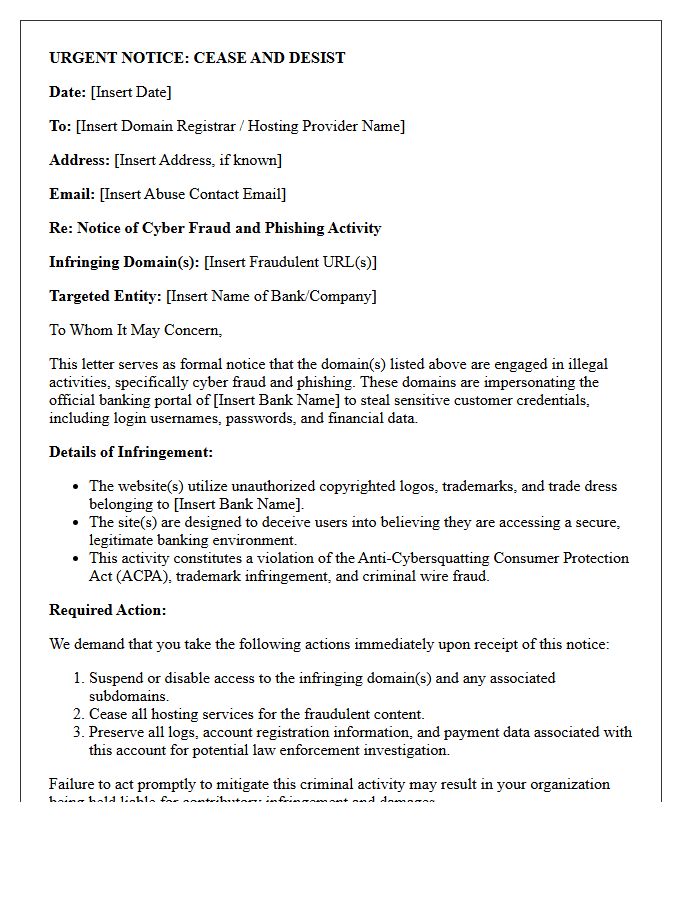
A Cease and Desist Letter is a formal legal notice issued to shut down fraudulent websites. When criminals create phishing domains mimicking bank portals, these notices demand the immediate deactivation of the malicious site. It serves as essential evidence for legal action and helps cyber fraud prevention by alerting hosting providers of criminal activity. Acting swiftly through these letters protects users from credential theft and financial loss. Ensuring intellectual property protection and domain suspension is the primary goal to mitigate online threats and maintain digital security integrity.
Cease and Desist Letter Enjoining the Operation of Fraudulent Bank Phishing Portals
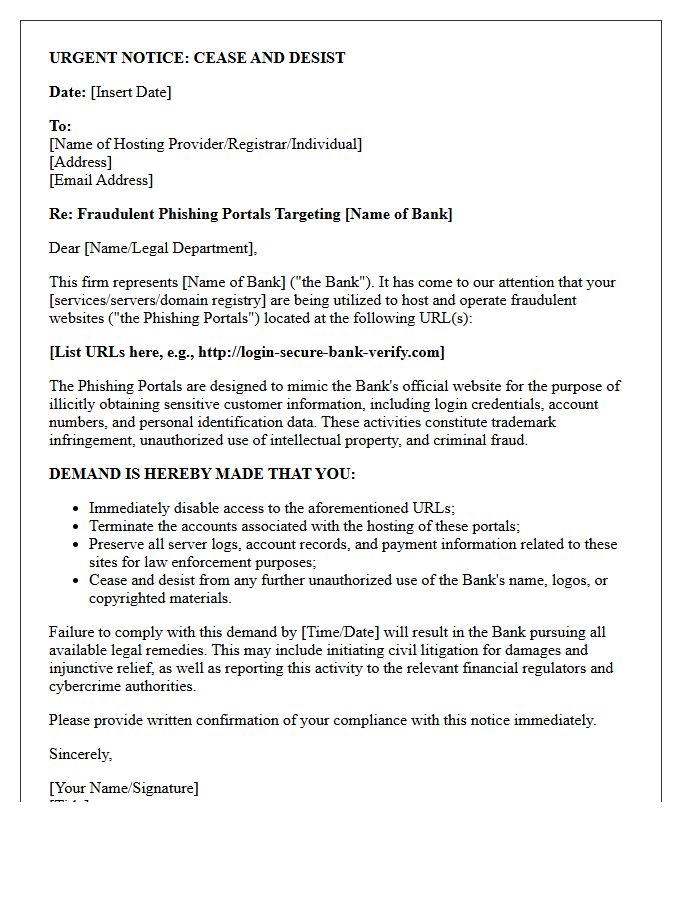
A cease and desist letter is a critical legal tool used to stop the operation of fraudulent bank phishing portals. This formal notice demands that malicious actors immediately shut down deceptive websites designed to steal sensitive credentials. By issuing this letter, financial institutions establish a legal record of trademark infringement and unauthorized activity. It serves as a necessary precursor to litigation, aiming to protect customers from identity theft and mitigate financial damages caused by cybercrime. Promptly enjoining these portals is essential for maintaining digital security and brand integrity.
Bank Impersonation and Phishing Domain Cease and Desist Letter
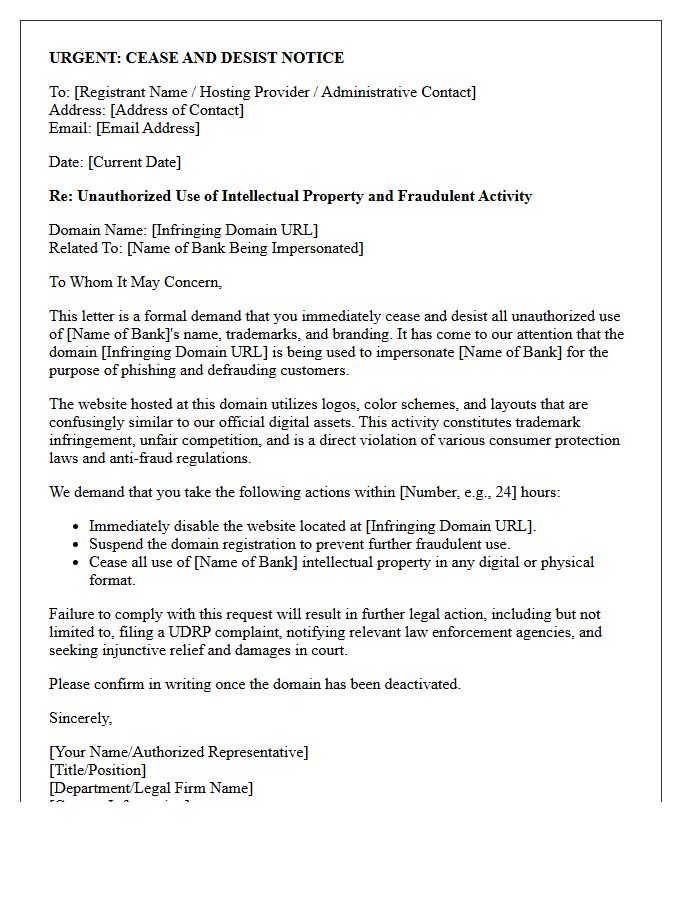
A Cease and Desist Letter is a formal legal notice used to stop bank impersonation and the operation of phishing domains. This document demands that malicious actors immediately terminate unauthorized use of protected trademarks and shut down fraudulent websites designed to steal sensitive data. It serves as a critical first step in brand protection, establishing a legal paper trail for potential litigation. By targeting domain registrars and hosting providers, these letters effectively mitigate financial fraud and safeguard consumer trust against deceptive cybersecurity threats and identity theft schemes.
Cease and Desist Letter for Malicious Phishing Domains Simulating Authentic Banking Portals
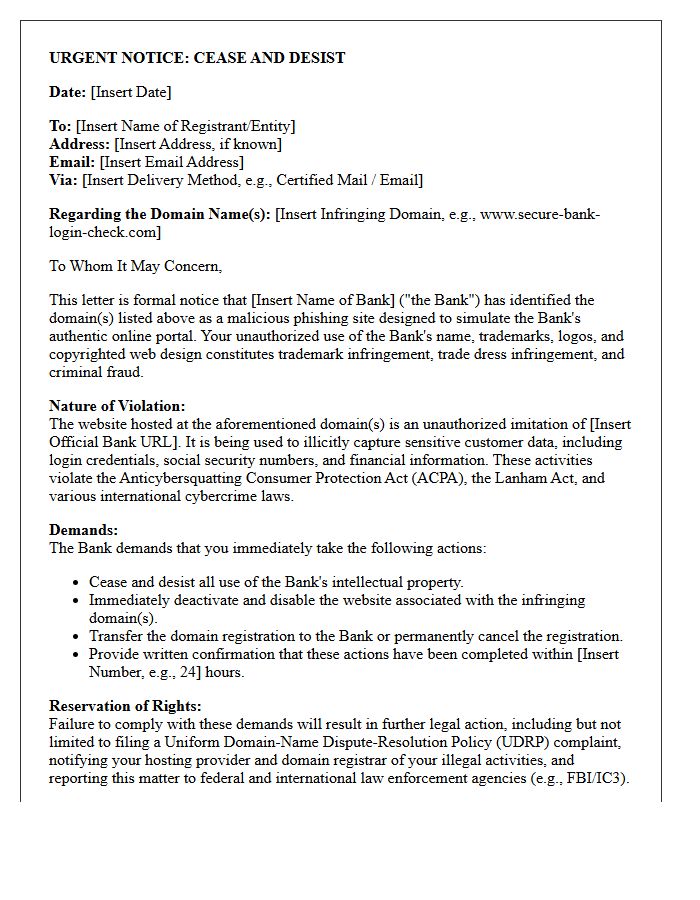
A cease and desist letter is a critical legal tool used to combat brand impersonation. When malicious actors create phishing domains simulating authentic banking portals, institutions must issue these formal demands to enforce intellectual property rights. This document notifies offenders and hosting providers of unauthorized trademark use, demanding the immediate deactivation of the fraudulent site. Timely issuance is essential to prevent financial fraud and protect consumer data. By establishing a legal paper trail, banks can expedite the takedown process and mitigate reputational damage caused by sophisticated cyber threats.
Intellectual Property and Phishing Domain Cease and Desist Letter for Banking Portals
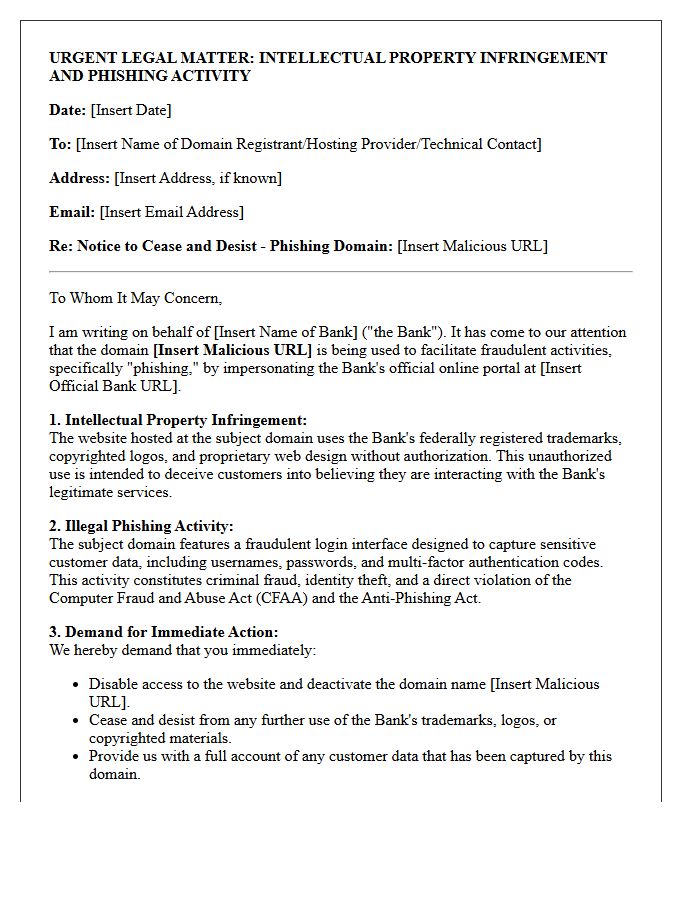
Receiving an Intellectual Property and Phishing Domain Cease and Desist Letter is a critical legal notice for banking portals. It serves as a formal demand to stop unauthorized use of trademarks, copyrighted assets, or deceptive URLs that impersonate financial institutions. These letters are essential for brand protection and preventing fraud against customers. Organizations must respond promptly to mitigate legal liability and safeguard sensitive financial data. Failure to comply can lead to litigation, domain suspension, and significant reputational damage. Ensuring cybersecurity compliance is vital when addressing these infringement claims effectively.
What is a cease and desist letter for a fraudulent phishing domain?
A cease and desist letter for a phishing domain is a formal legal notice sent to a domain registrant, hosting provider, or registrar demanding the immediate deactivation of a website that mimics a bank's portal to steal user credentials. It serves as an official warning that the site is infringing on trademarks and engaging in illegal fraudulent activity.
When should a bank issue a cease and desist for a mimicking website?
A bank should issue a cease and desist letter immediately upon discovering a "look-alike" domain that uses the bank's branding, logos, or layout to deceive customers. Prompt action is essential to prevent financial loss, data breaches, and irreparable damage to the institution's reputation.
Who are the recipients of a phishing-related cease and desist notice?
The notice should be sent to the domain registrant (if not masked), the website's hosting service provider, and the domain registrar. If the fraudulent site is being promoted via email or social media, notices may also be sent to the relevant service providers to block the distribution of the phishing links.
What legal grounds are cited in a cease and desist for banking domain fraud?
The primary legal grounds include trademark infringement, trademark dilution, and violations of the Anticybersquatting Consumer Protection Act (ACPA). Additionally, the letter cites criminal fraudulent activity, such as identity theft and unauthorized access to protected computer systems under various cybercrime statutes.
Can a cease and desist letter help in a UDRP proceeding?
Yes, sending a cease and desist letter is a critical step in a Uniform Domain-Name Dispute-Resolution Policy (UDRP) proceeding. It establishes evidence of "bad faith" registration and use by the respondent, which is a required element for a bank to successfully regain control or force the deletion of a fraudulent domain.

Comments