
Handling negative feedback requires empathy and professionalism. A well-crafted response to customer complaint regarding a branch experience can restore trust and improve brand loyalty. Addressing specific issues like long wait times or staff behavior shows that your business values accountability and service excellence. To help you draft the perfect reply, below are some ready to use template.
Image cover: Professional Templates for Resolving In-Branch Customer Service Complaints
Letter Samples List
- Letter of Apology for Excessive Wait Time During Branch Visit
- Letter Regarding Unprofessional Staff Behavior at Retail Branch
- Letter Clarifying Bank Policy Following a Branch Service Dispute
- Letter Addressing Poor Branch Facility and Cleanliness Complaints
- Letter Providing Account Compensation for Negative Branch Experience
- Standard Apology Letter for Unsatisfactory Branch Customer Service
- Acknowledgment Letter of Branch Experience Complaint Investigation
- Letter Rectifying Teller Transaction Error During Recent Branch Visit
- Letter Resolving Escalated Branch Management Customer Grievance
- Letter Requesting Meeting to Discuss Branch Experience Feedback
- Letter Addressing Branch Accessibility and Customer Accommodation Complaint
- Follow-Up Letter Assuring Improved Future Branch Service Standards
Letter of Apology for Excessive Wait Time During Branch Visit
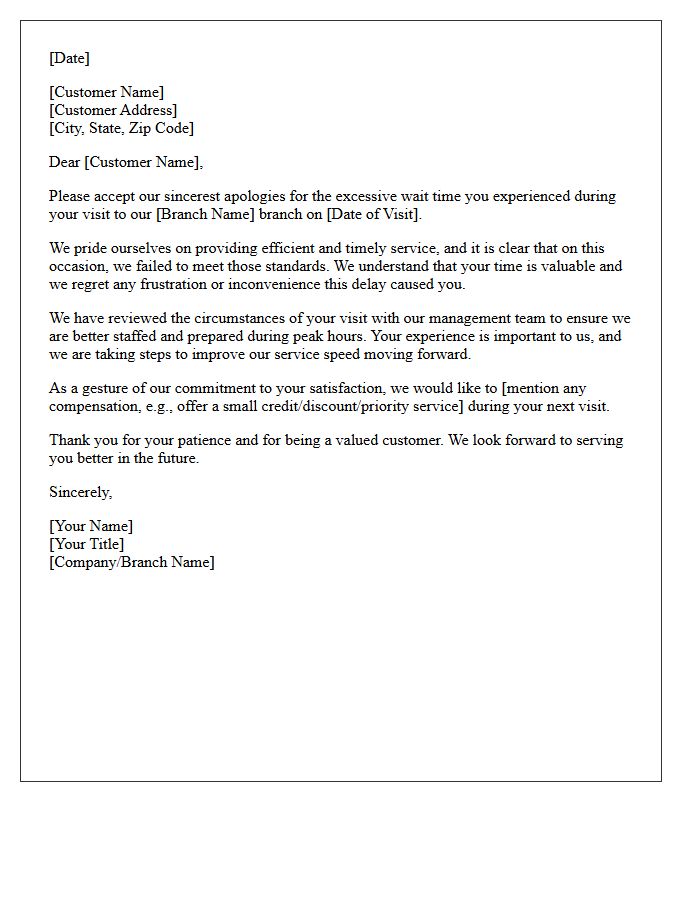
A Letter of Apology for Excessive Wait Time is essential for maintaining customer loyalty after a poor branch experience. To be effective, the message must offer a sincere apology and a transparent explanation for the delay. It should acknowledge the value of the client's time while outlining specific corrective actions taken to improve service speed. Providing a small gesture of goodwill can help rebuild trust. Professionalism and prompt delivery of the letter are key to demonstrating that the organization prioritizes customer satisfaction and operational efficiency.
Letter Regarding Unprofessional Staff Behavior at Retail Branch
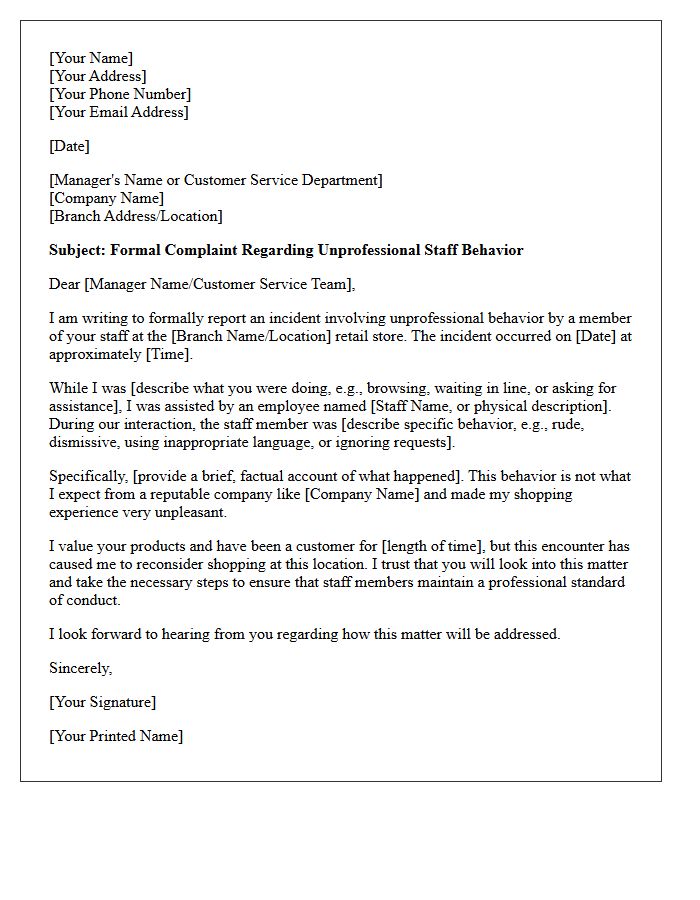
Writing a formal letter regarding unprofessional staff behavior is essential for maintaining service standards. Clearly document the specific incident, including the date, time, and the employee's name if known. Use a professional tone to describe how the conduct violated retail expectations. Providing factual details helps management implement corrective training or disciplinary action. Explicitly state your desired resolution to ensure the branch addresses these accountability concerns effectively, ultimately improving the customer experience for everyone who visits that retail location.
Letter Clarifying Bank Policy Following a Branch Service Dispute
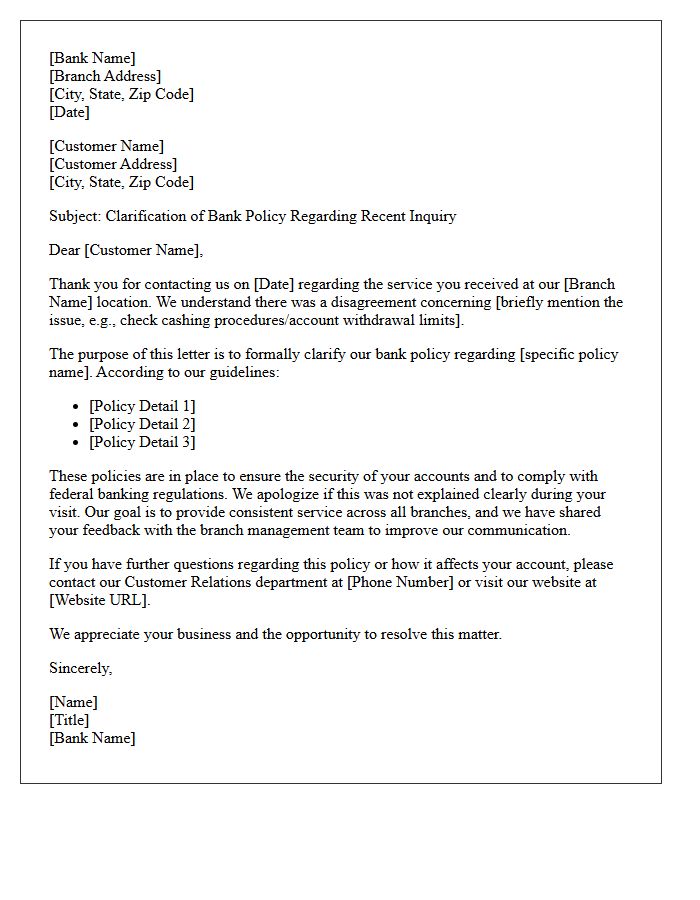
A formal letter clarifying bank policy after a service dispute serves as an official resolution record. It should explicitly restate the specific terms and conditions governing the transaction or behavior in question. This document aims to restore the professional relationship by providing transparency, addressing compliance standards, and outlining any corrective actions taken. Understanding these policy updates ensures that future interactions align with bank protocols, protecting both the consumer's rights and the institution's regulatory requirements while preventing recurring grievances through clear, written communication.
Letter Addressing Poor Branch Facility and Cleanliness Complaints
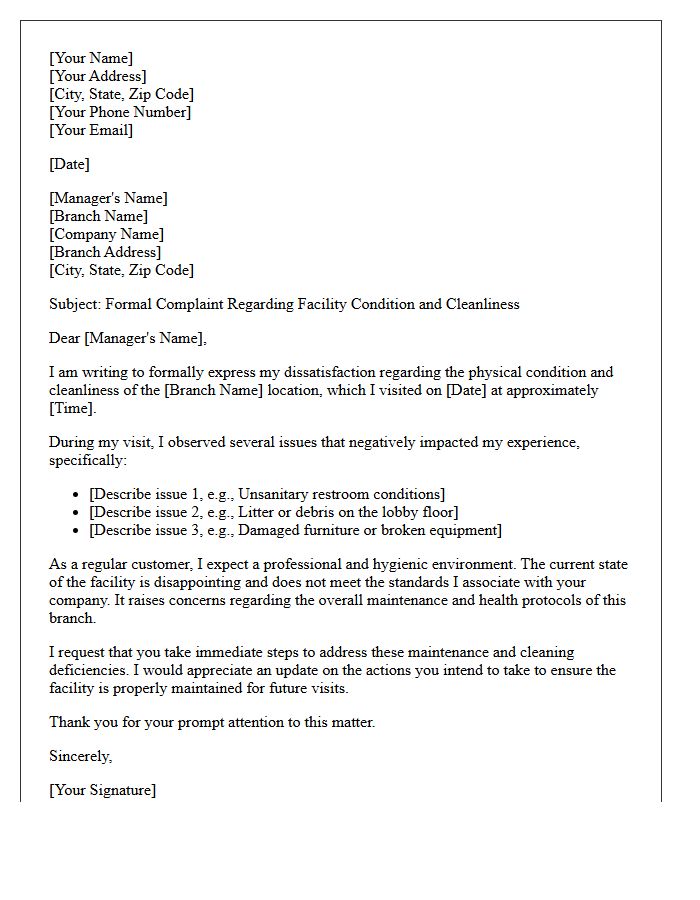
When drafting a formal letter regarding poor branch facility and hygiene issues, clearly specify the location and date of your visit. Use professional language to describe inadequate cleanliness, malfunctioning equipment, or safety concerns. State the negative impact on customer experience and request immediate remedial action or maintenance. Providing evidence, such as photos or specific timestamps, strengthens your complaint. Ensure you include your contact details to receive a formal response regarding the resolution plan and expected improvements to the branch standards.
Letter Providing Account Compensation for Negative Branch Experience
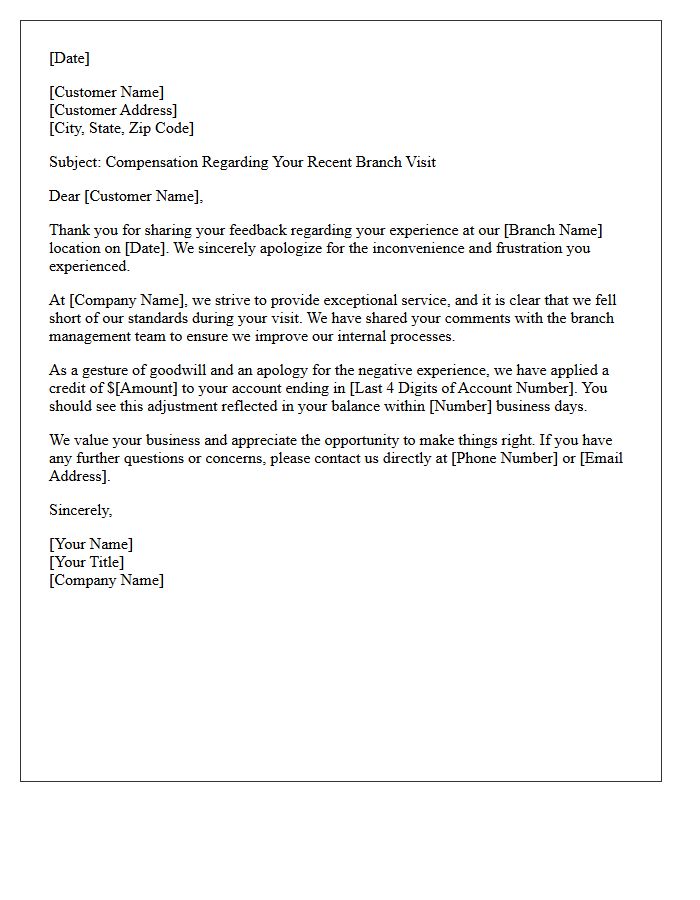
When drafting a letter for account compensation following a negative branch experience, clearly state the incident details and the specific impact on your banking relationship. Formally request a reimbursement or fee waiver as a gesture of goodwill to restore trust. Ensure the tone remains professional while emphasizing customer loyalty. Explicitly mention the desired resolution to guide the bank's response. A well-documented complaint serves as a formal record, increasing the likelihood of receiving financial redress for the inconvenience or poor service encountered during your visit.
Standard Apology Letter for Unsatisfactory Branch Customer Service
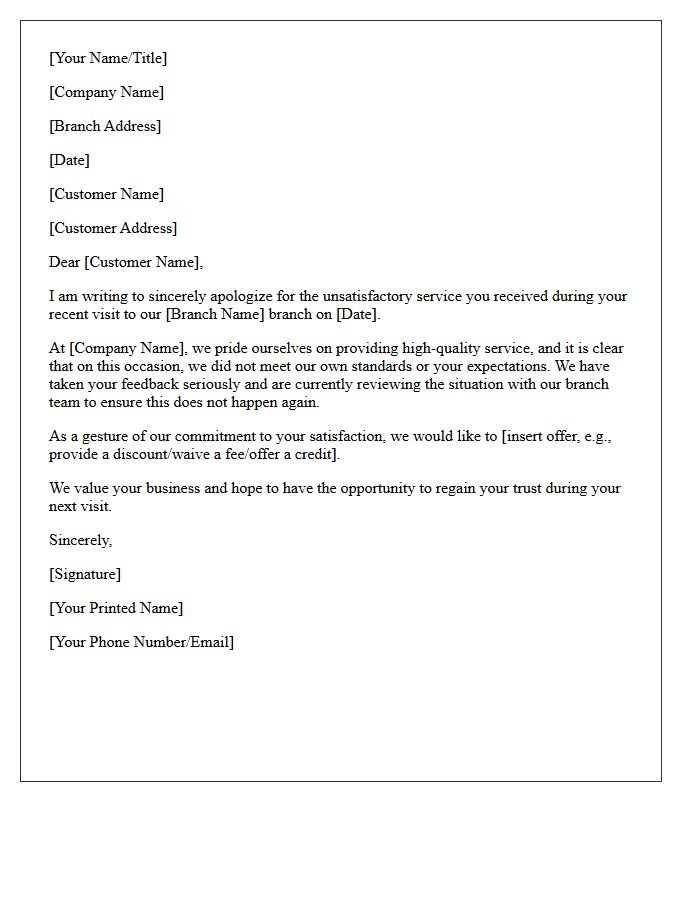
A Standard Apology Letter for unsatisfactory branch customer service is a professional tool used to restore customer trust. It must acknowledge the specific failure, offer a sincere apology, and outline clear steps taken to prevent recurrence. Promptly addressing poor service demonstrates accountability and commitment to quality. Including a restitution offer or direct contact information helps de-escalate frustration, turning a negative experience into an opportunity for brand loyalty and improved client satisfaction.
Acknowledgment Letter of Branch Experience Complaint Investigation
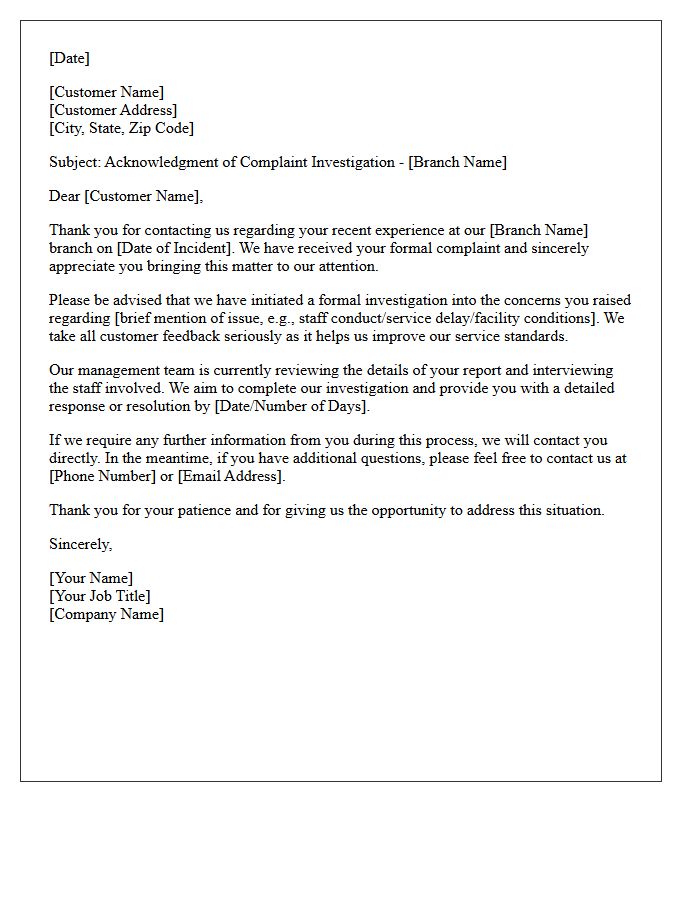
An Acknowledgment Letter confirms the formal receipt of your branch experience complaint. This essential document ensures that the financial institution is actively investigating your concerns regarding service quality or staff behavior. It typically includes a unique reference number, expected resolution timelines, and contact details for the assigned investigator. Receiving this letter is the first step in the official redressal process, providing transparency and professional accountability while guaranteeing that your feedback is being evaluated to improve future banking standards and customer satisfaction.
Letter Rectifying Teller Transaction Error During Recent Branch Visit
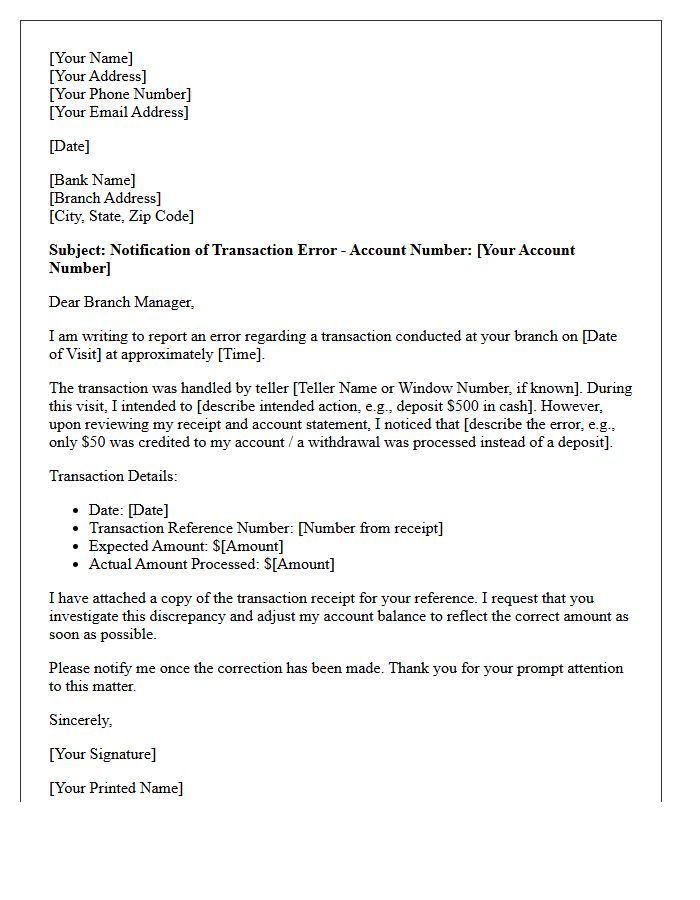
A formal rectification letter serves as official documentation to correct a teller transaction error discovered after your recent branch visit. This essential document should clearly state your account details, the specific discrepancy date, and the exact amount involved. By providing a written record, you ensure the bank initiates a formal investigation to adjust your balance accurately. Promptly submitting this notice protects your financial rights and maintains account integrity. Always keep a signed copy of this correspondence for your personal records to track the resolution process effectively.
Letter Resolving Escalated Branch Management Customer Grievance
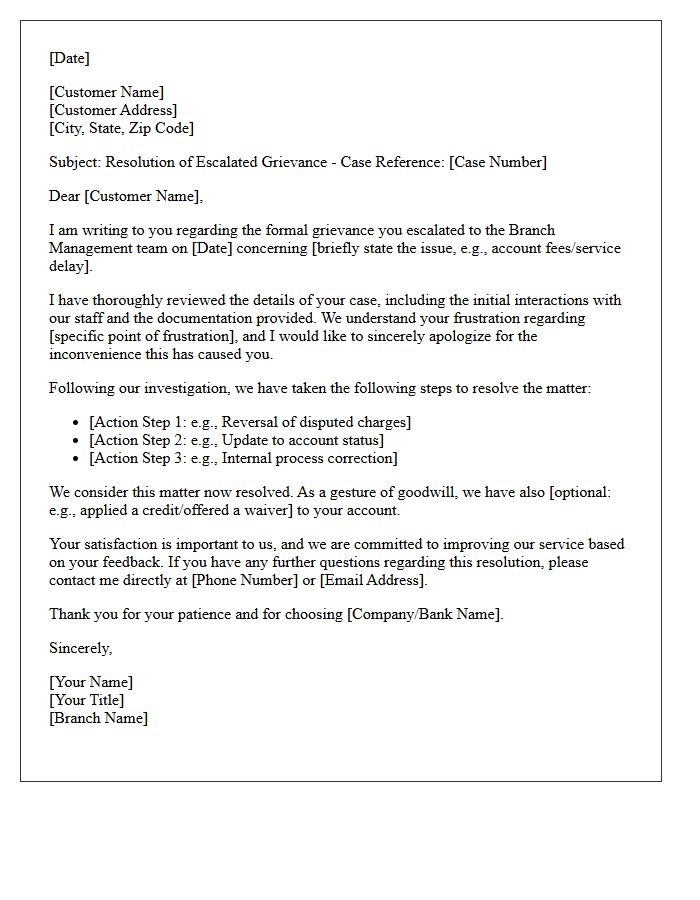
A formal letter resolving an escalated branch management grievance ensures customer retention by addressing complex service failures. This document must clearly outline the investigation findings, acknowledging specific mistakes while providing a definitive resolution or fair compensation. Effective communication at this level demonstrates accountability and professional integrity, rebuilding trust through transparency. By detailing the corrective actions taken to prevent future occurrences, management transforms a negative experience into a loyalty-building opportunity. Precision in tone and clarity in the final decision are essential for closing the dispute and maintaining the institution's reputation.
Letter Requesting Meeting to Discuss Branch Experience Feedback
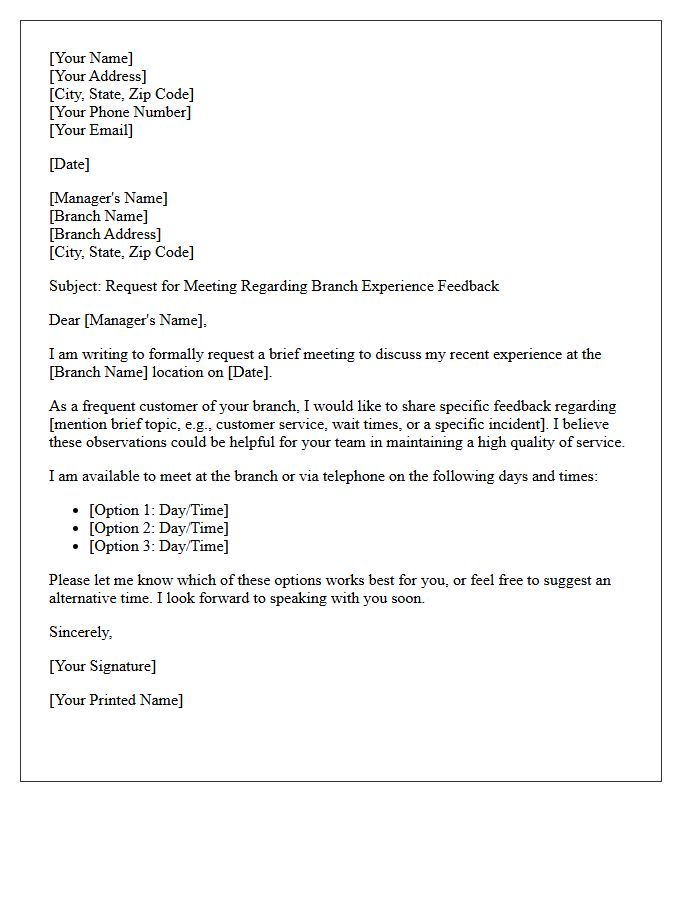
When drafting a formal meeting request to discuss branch experience feedback, clearly state your purpose in the subject line. Focus on constructive dialogue regarding specific operational observations or customer service interactions. Highlight your goal of enhancing service quality and branch efficiency. Suggest specific time slots to demonstrate professionalism and respect for the manager's schedule. Providing a brief agenda beforehand ensures the discussion remains productive and focused on actionable improvements that benefit both the staff and the clientele.
Letter Addressing Branch Accessibility and Customer Accommodation Complaint
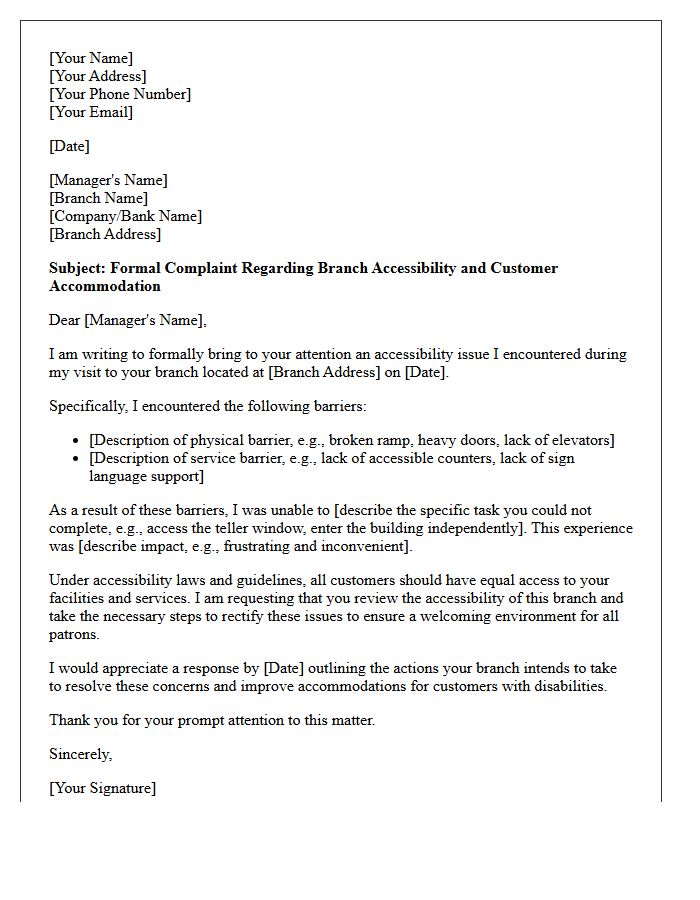
A formal letter addressing branch accessibility and customer accommodation complaints is essential for ensuring compliance with the Americans with Disabilities Act (ADA). It should clearly outline specific barriers encountered, such as lack of ramps or assistive technology, and demand immediate corrective action. Documenting these grievances helps organizations identify systemic gaps in their service delivery. Providing a detailed account ensures that businesses provide equal access to all patrons, protecting both consumer rights and the company's legal standing through proactive resolution and inclusive design improvements.
Follow-Up Letter Assuring Improved Future Branch Service Standards
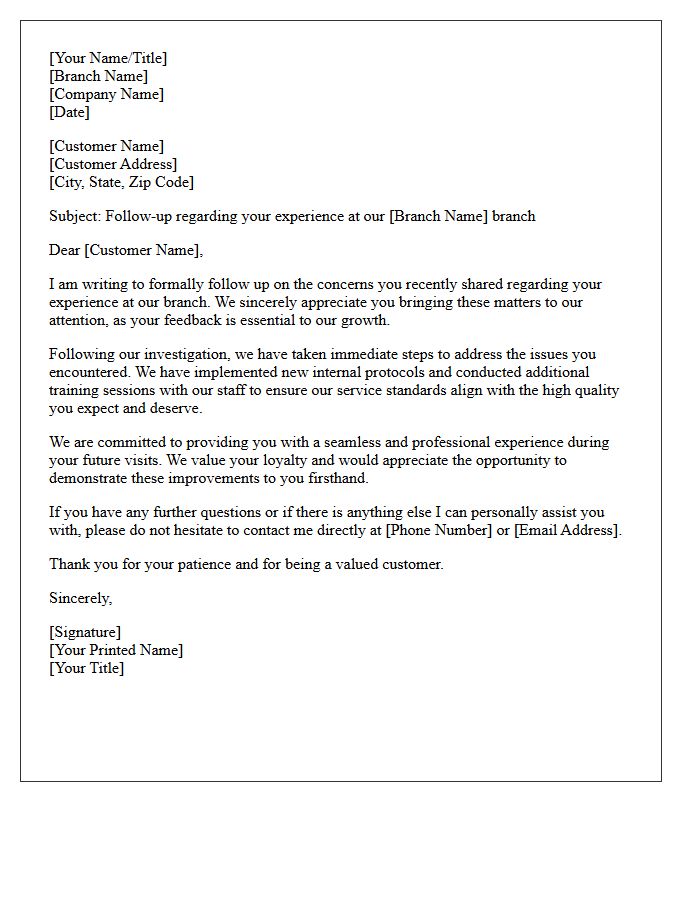
A professional follow-up letter is essential for rebuilding customer trust after a service failure. It should formally acknowledge past deficiencies while providing a clear commitment to enhanced excellence. By outlining specific corrective actions and new oversight protocols, the branch demonstrates accountability. This communication serves as a service guarantee, assuring clients that future interactions will meet high-quality benchmarks. Effective letters focus on transparency and proactive problem resolution to restore the brand's reputation and ensure long-term loyalty through measurable improvements in daily operations and staff responsiveness.
How should I respond to a customer complaint about a specific branch experience?
To respond effectively, acknowledge the specific issue immediately, offer a sincere apology for the frustration caused, and demonstrate that you are taking the feedback seriously by investigating the incident with the branch management team.
What key elements should be included in a formal complaint resolution email?
A professional resolution should include a personalized greeting, a clear summary of the customer's concern to show you listened, an explanation of the steps being taken to prevent recurrence, and a direct contact method for further follow-up.
How can we rebuild trust after a negative in-person service encounter?
Rebuilding trust requires transparency and action; inform the customer of specific changes being implemented at the branch, such as additional staff training or revised protocols, and consider offering a gesture of goodwill to encourage a return visit.
What is the recommended turnaround time for responding to a branch-level complaint?
For optimal customer retention, an initial acknowledgment should be sent within 24 hours, followed by a comprehensive resolution or status update within 3 to 5 business days depending on the complexity of the internal investigation.
Should staff names be mentioned when addressing a complaint about branch behavior?
While you should acknowledge that the specific interaction is being reviewed internally with the individuals involved, it is best practice to focus the written response on the corrective actions and company standards rather than publicly naming or shaming employees.

Comments