
Managing unpaid invoices is critical for business cash flow. This article explains how to issue a formal Notice of Dishonored Check while simultaneously handling the Revocation of Net Terms for delinquent accounts. Learn the legal necessities and professional steps to recover funds and protect your credit policies. To simplify your process, below are some ready to use templates.
Image cover: Bounced Check Notice: Formal Demand and Net Terms Revocation Templates
Letter Samples List
- Notice of Dishonored Check and Revocation of Net Terms Letter
- First Demand Letter for Dishonored Check and Net Terms Revocation
- Bounced Check Notification and Credit Revocation Letter
- Returned Payment Letter and Immediate Revocation of Net Terms
- Debt Collection Letter for Dishonored Check and Account Freeze
- Official Letter of Net Terms Revocation Due to Dishonored Check
- Final Notice Letter for Dishonored Payment and Terms Cancellation
- Account Default Letter Pending Dishonored Check Resolution
- Insufficient Funds Letter and Revocation of Commercial Credit Terms
- Dishonored Check Penalty Letter with Net Terms Revocation
- Notice of Returned Check and Termination of Net Terms Letter
- Urgent Debt Collection Letter Regarding Dishonored Check
- Revocation of Credit Terms Letter Following Dishonored Check
Notice of Dishonored Check and Revocation of Net Terms Letter
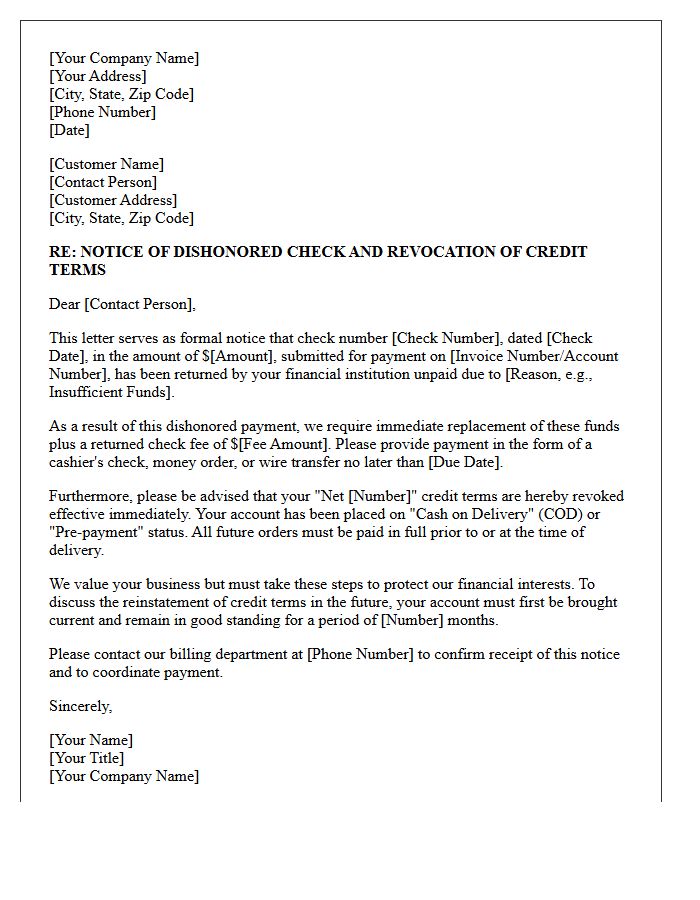
A Notice of Dishonored Check and Revocation of Net Terms Letter is a formal legal demand sent when a payment fails due to insufficient funds. This document serves as official notification that the recipient must provide immediate restitution, often including statutory NSF fees. Crucially, the letter informs the debtor that their privilege of buying on credit is terminated, requiring prepayment for all future transactions. Issuing this notice is a vital step for businesses to protect cash flow and establish a necessary paper trail for potential legal action or collections.
First Demand Letter for Dishonored Check and Net Terms Revocation
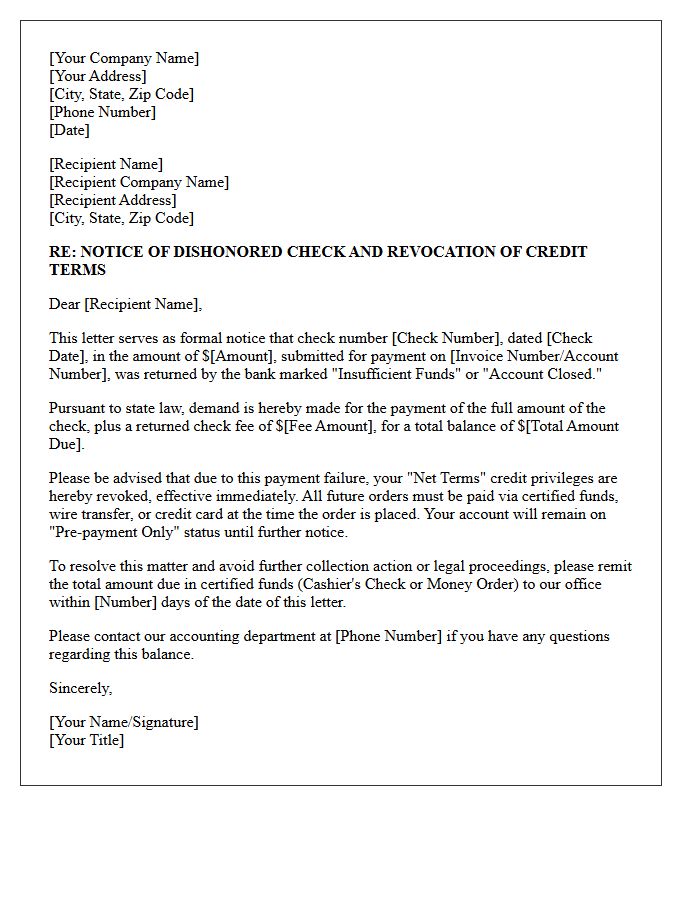
A first demand letter serves as a formal legal notice after a dishonored check occurs. This document notifies the debtor that their payment failed due to insufficient funds or a stop payment order. Crucially, it informs the client of a net terms revocation, meaning future credit privileges are suspended and immediate payment is required. To comply with legal standards, the letter must include the check number, the amount owed, and a strict deadline. Failure to settle the balance promptly may lead to civil litigation or additional statutory penalties and collection fees.
Bounced Check Notification and Credit Revocation Letter
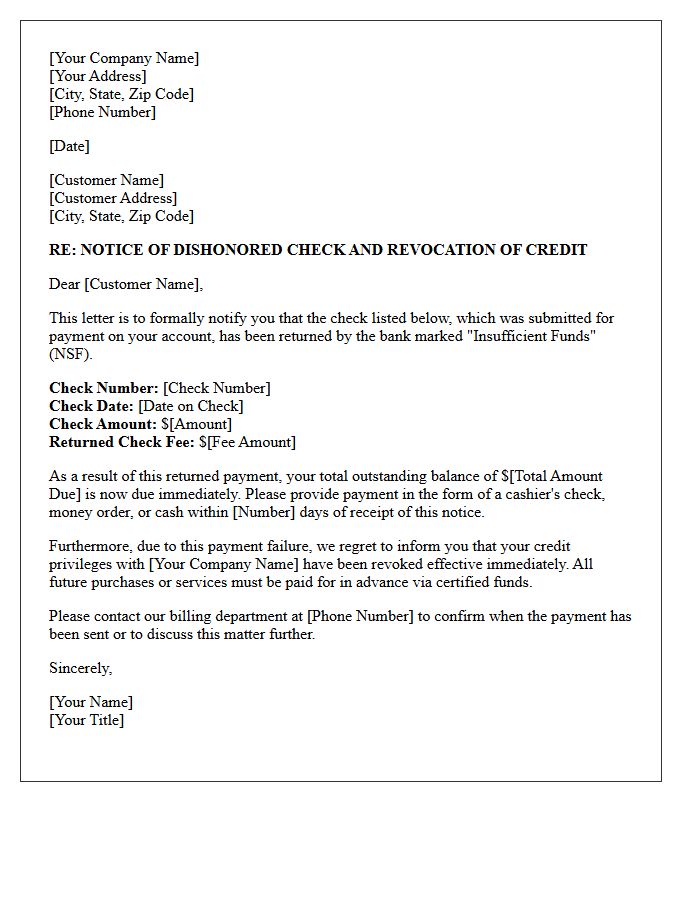
A Bounced Check Notification informs a customer that their payment was returned for insufficient funds. This formal notice often accompanies a Credit Revocation Letter, which officially terminates borrowing privileges due to payment failure. It is crucial to understand that these documents serve as legal evidence of default. Immediate action is required to settle the outstanding balance and applicable fees to prevent permanent damage to your credit score or potential legal action. Restoring account standing typically requires a guaranteed payment method, such as a cashier's check or money order.
Returned Payment Letter and Immediate Revocation of Net Terms
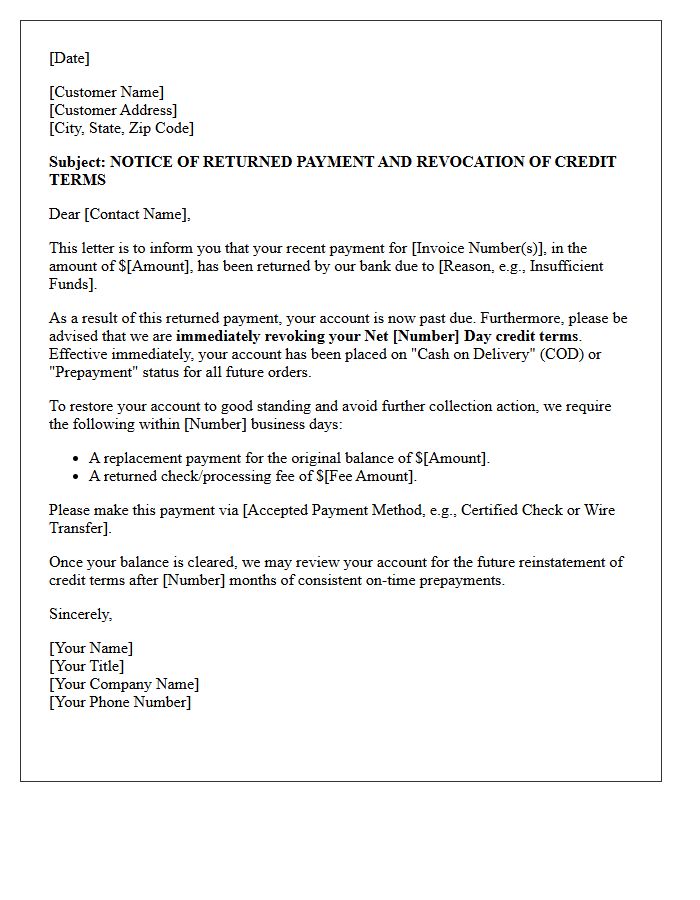
A Returned Payment Letter notifies a buyer that their recent transaction failed due to insufficient funds or account issues. This formal notice often triggers an immediate revocation of net terms, requiring the customer to settle balances instantly via secured funds. To restore credit privileges, the debtor must resolve the outstanding debt and may face additional NSF fees. Failure to respond promptly can lead to permanent account suspension or legal collection actions, as the breach of payment terms severely damages the established business relationship and credit trustworthiness.
Debt Collection Letter for Dishonored Check and Account Freeze
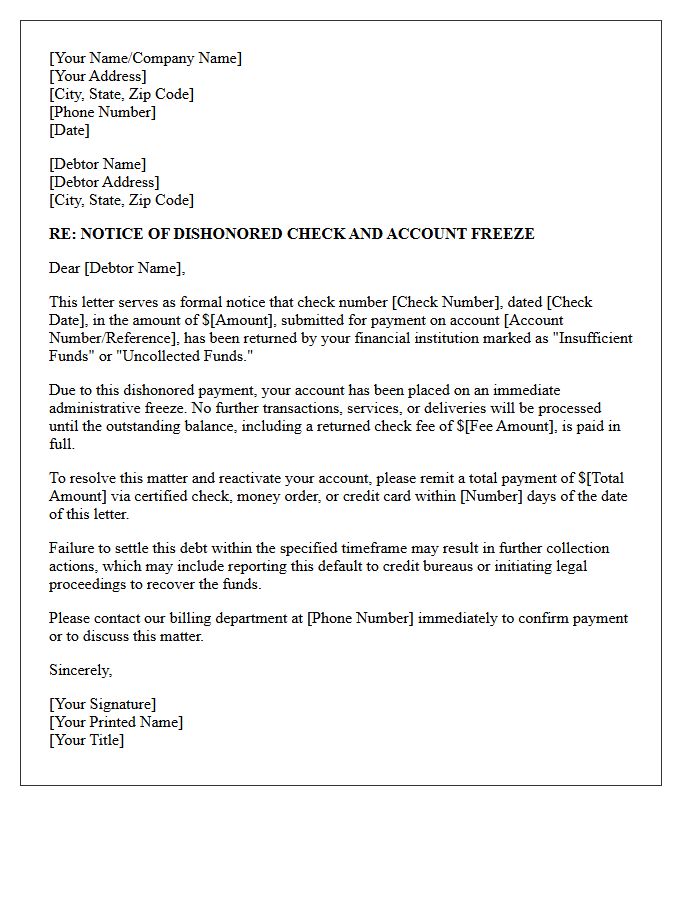
Receiving a Debt Collection Letter for a dishonored check signifies that a payment failed due to insufficient funds or a closed account. This legal notice demands immediate restitution to avoid further escalation. Crucially, creditors or authorities may initiate an Account Freeze, restricting your access to personal funds until the liability is resolved. You must verify the debt's validity and respond within the specified timeframe to prevent legal action, additional fees, or long-term damage to your credit score. Prompt communication is essential to negotiate a settlement and restore your financial standing.
Official Letter of Net Terms Revocation Due to Dishonored Check
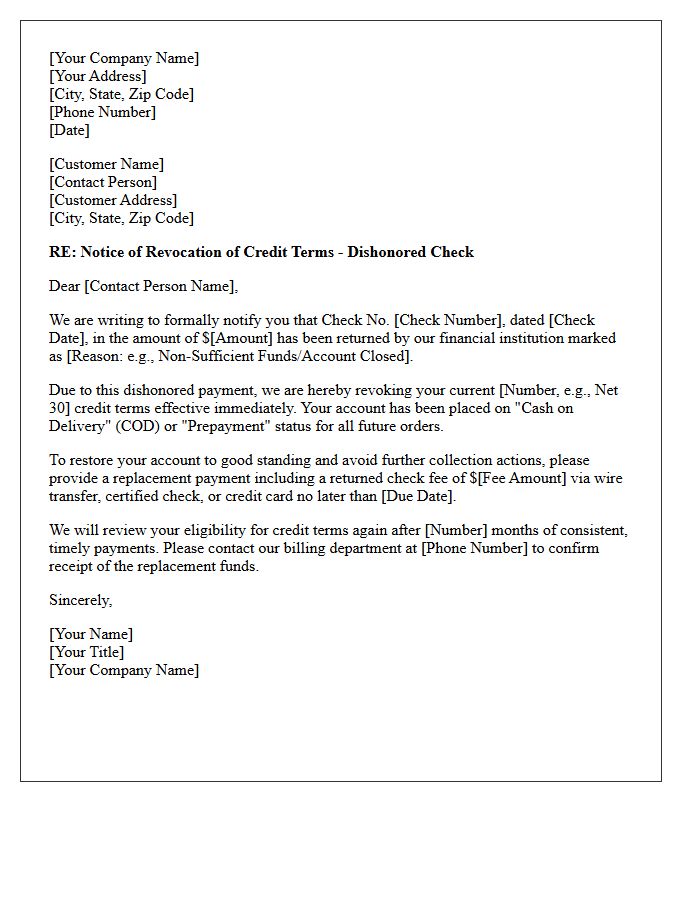
An official letter of net terms revocation notifies a client that their credit privileges have been cancelled immediately. This action typically follows a dishonored check, which constitutes a breach of the agreed payment contract. The document serves as formal notice that all future transactions must be settled via certified funds or cash in advance. It is a critical step in debt recovery, protecting business cash flow while establishing a legal record of the default and the subsequent termination of open account status.
Final Notice Letter for Dishonored Payment and Terms Cancellation
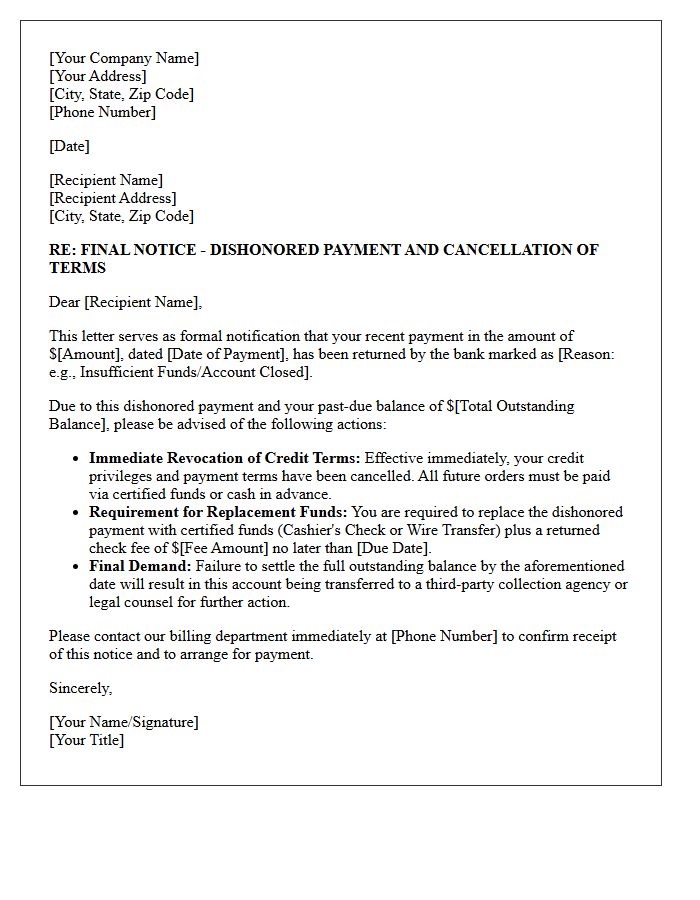
A final notice letter serves as a formal warning that a dishonored payment has occurred, typically due to insufficient funds. This document informs the recipient that their current terms cancellation is imminent unless the outstanding balance is settled immediately. It outlines the specific consequences of default, including the potential termination of services, loss of credit privileges, and referral to collection agencies. To protect your financial standing, it is critical to respond promptly to this default notice and provide a valid form of repayment to prevent further legal or contractual penalties.
Account Default Letter Pending Dishonored Check Resolution
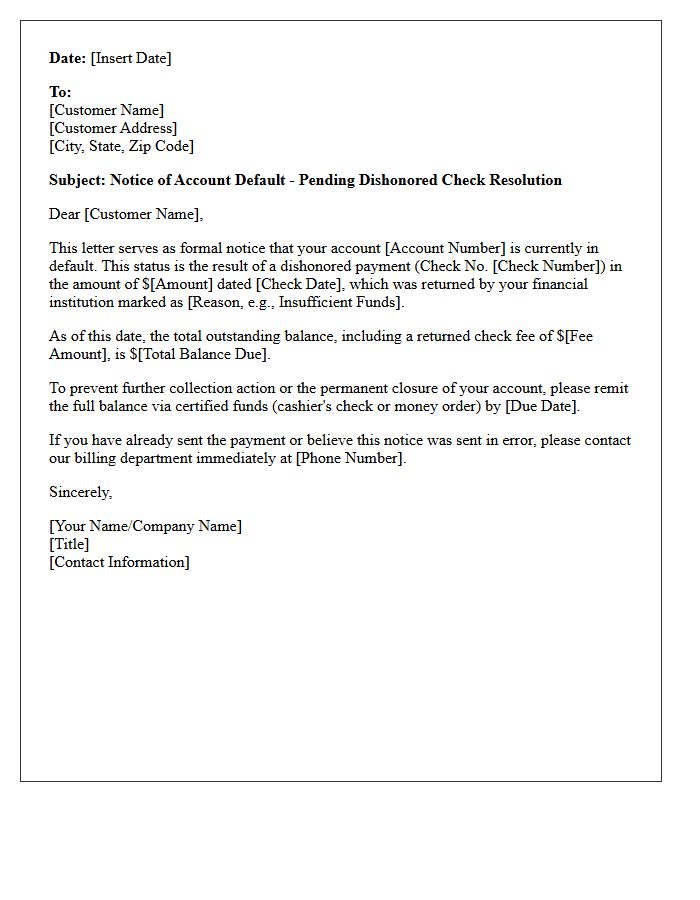
An Account Default Letter Pending Dishonored Check Resolution is a formal notice issued when a payment remains unresolved after a bank rejects a check. This status indicates that the account is at risk of legal action or permanent closure if the debt is not settled immediately. To prevent a negative impact on your credit score, you must provide cleared funds, including any applicable returned check fees, within the specified timeframe. Prompt communication with the creditor is essential to rectify the payment failure and avoid further collection efforts or litigation.
Insufficient Funds Letter and Revocation of Commercial Credit Terms
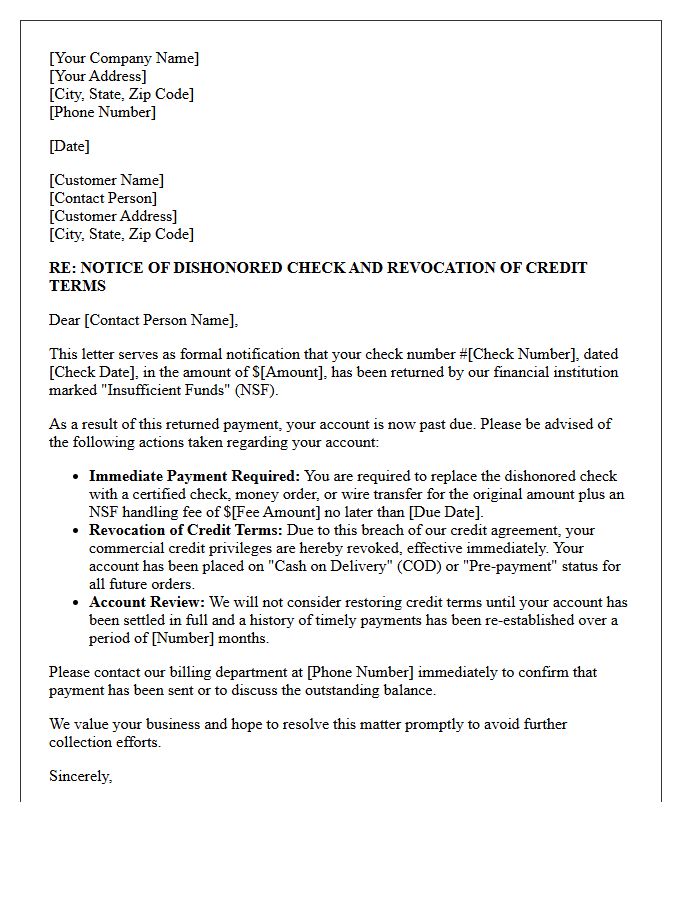
An Insufficient Funds Letter serves as formal notice that a payment was declined due to lack of capital, often triggering immediate penalties. Receiving this notice typically leads to the revocation of commercial credit terms, as the creditor loses confidence in the debtor's liquidity. Consequently, the business may be forced into cash-on-delivery requirements, higher interest rates, or total account suspension. To restore favorable repayment terms, the debtor must quickly settle the balance and prove ongoing financial stability to mitigate long-term damage to their corporate credit profile and supplier relationships.
Dishonored Check Penalty Letter with Net Terms Revocation
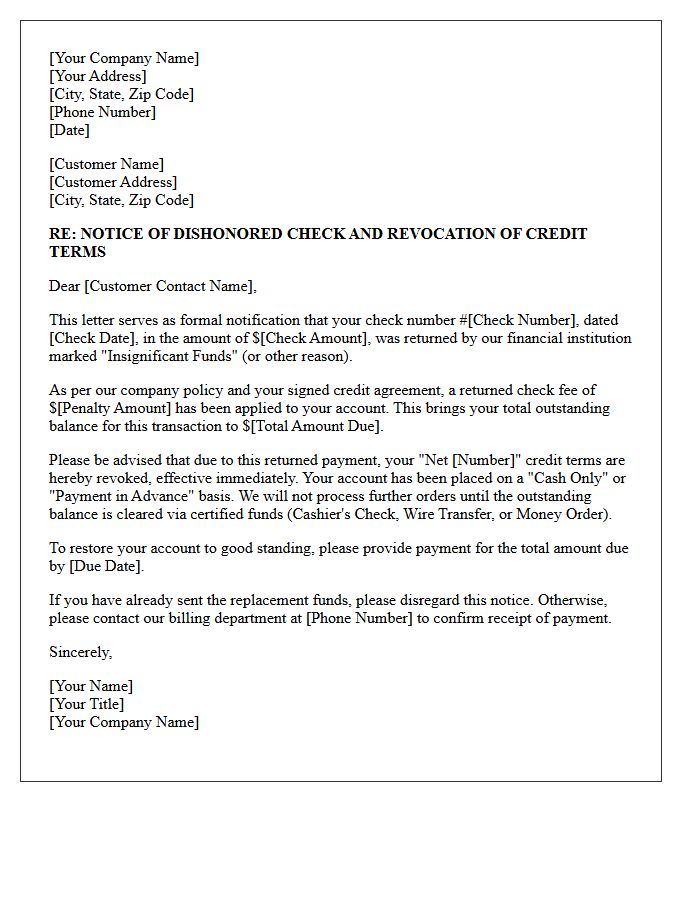
A Dishonored Check Penalty Letter notifies a client that their payment failed, typically incurring a statutory NSF fee. Crucially, this notice serves as formal documentation for Net Terms Revocation, meaning the debtor loses their privilege to pay on credit due to high risk. Future orders usually require immediate payment methods like cash or wire transfer. Issuing this letter is a vital step in protecting cash flow and establishing a legal paper trail for potential debt collection or litigation regarding the unpaid balance.
Notice of Returned Check and Termination of Net Terms Letter
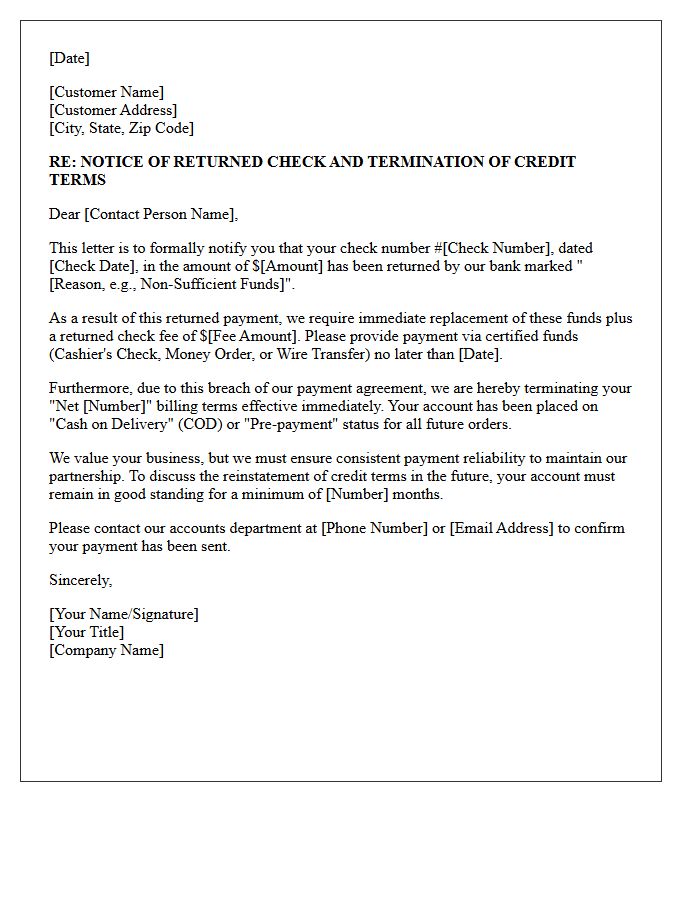
A Notice of Returned Check and Termination of Net Terms is a formal document notifying a client that their payment failed due to insufficient funds. This letter serves as legal proof of the dishonored check and demands immediate reimbursement, often including a penalty fee. Most importantly, it informs the debtor that their credit privileges have been revoked. Moving forward, the business will typically require upfront payments or certified funds to mitigate future financial risk and ensure stable cash flow after a breach of payment trust.
Urgent Debt Collection Letter Regarding Dishonored Check
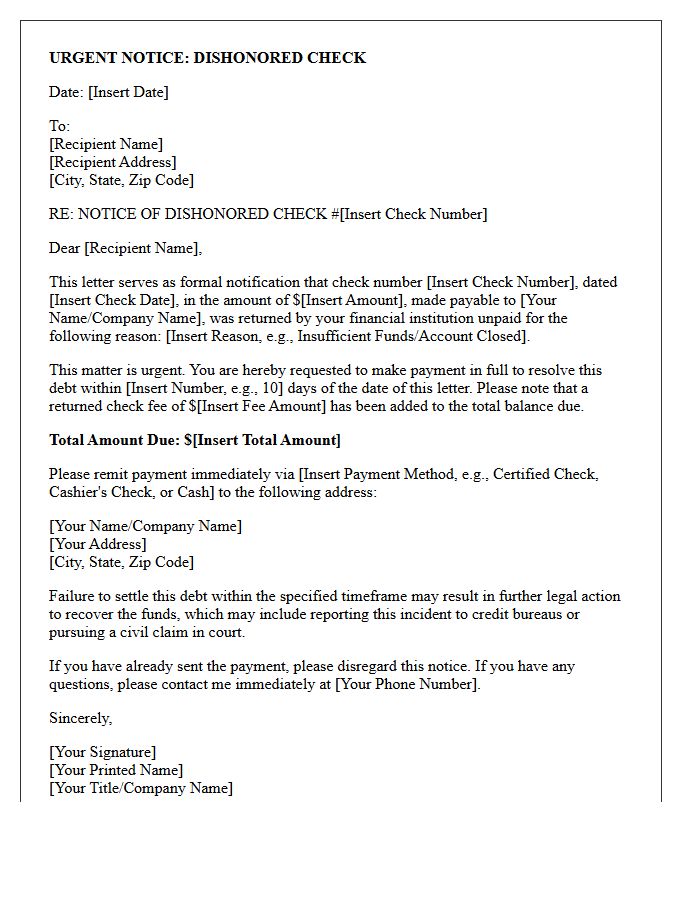
Receiving an urgent debt collection letter for a dishonored check requires immediate action to avoid legal consequences. This notice signifies that a payment was returned due to insufficient funds or a closed account. You must verify the debt's validity and respond within the specified timeframe to prevent additional NSF fees, civil penalties, or potential criminal charges. Contacting the creditor promptly to arrange a settlement is the most effective way to protect your credit score and resolve the matter before it escalates to formal litigation or further collection efforts.
Revocation of Credit Terms Letter Following Dishonored Check
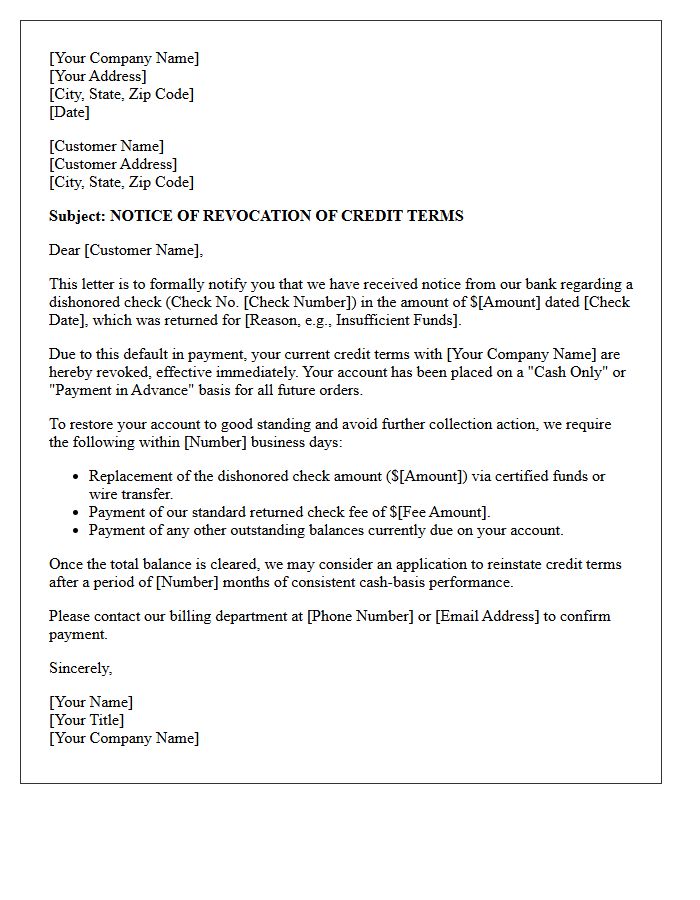
A revocation of credit terms letter is a formal notice sent to a customer after a dishonored check occurs. This document officially cancels existing payment extensions, transitioning the account to a cash-only basis to mitigate financial risk. It serves as a legal record of the default, demanding immediate settlement of the outstanding balance plus applicable NSF fees. Clear communication ensures the debtor understands that future transactions require prepayment, protecting your business's cash flow from further instability caused by unreliable payment behavior.
What is a Notice of Dishonored Check and Revocation of Net Terms?
This is a formal legal notification sent to a customer when a payment check has been returned by the bank unpaid (bounced), resulting in the immediate cancellation of their credit privileges and buy-now-pay-later arrangements.
What are the immediate consequences of receiving a notice of dishonored check?
Upon receipt, the debtor is typically required to replace the failed payment with certified funds, pay an additional administrative NSF fee, and must pre-pay for all future orders as net terms are officially revoked.
How long do I have to settle a dishonored check before legal action is taken?
Most jurisdictions require the debtor to make the payment whole within 10 to 30 days of receiving the formal notice; failure to comply may lead to civil lawsuits, collection agency referral, or criminal charges for issuing a bad check.
Can net terms be reinstated after a check has been dishonored?
Reinstatement of net terms is at the sole discretion of the creditor's credit department and usually requires a proven period of consistent pre-payments and a new credit application to demonstrate financial stability.
What information must be included in a formal revocation of net terms notice?
The notice must include the check number, the amount owed, the reason for dishonor, the specific NSF fees applied, the date net terms are terminated, and the required deadline for payment to avoid further legal escalation.


Comments