
Updating your hiring terms ensures clarity and legal compliance. This guide explains how to draft a Revised Recruitment Fee Agreement Letter to modify commission structures, payment terms, or guarantee periods with search firms. Formalizing these changes protects your budget and strengthens agency partnerships. To simplify your workflow, below are some ready to use templates.

Image cover: Professional Recruitment Fee Agreement: Updated Templates and Guide
Letter Samples List
- Revised Recruitment Fee Agreement Letter for Executive Search Services
- Contingency Search Revised Recruitment Fee Agreement Letter
- Retained Search Revised Recruitment Fee Agreement Letter
- Revised Recruitment Fee Agreement Letter for Volume Hiring Projects
- Exclusive Partnership Revised Recruitment Fee Agreement Letter
- Revised Recruitment Fee Agreement Letter for Contract Staffing
- Temporary Placement Revised Recruitment Fee Agreement Letter
- Revised Recruitment Fee Agreement Letter for International Placements
- Tiered Structure Revised Recruitment Fee Agreement Letter
- Revised Recruitment Fee Agreement Letter with Modified Payment Terms
- Flat Rate Revised Recruitment Fee Agreement Letter
- Revised Recruitment Fee Agreement Letter for Specialized Industry Roles
- Mutual Revised Recruitment Fee Agreement Letter for Preferred Suppliers
Revised Recruitment Fee Agreement Letter for Executive Search Services
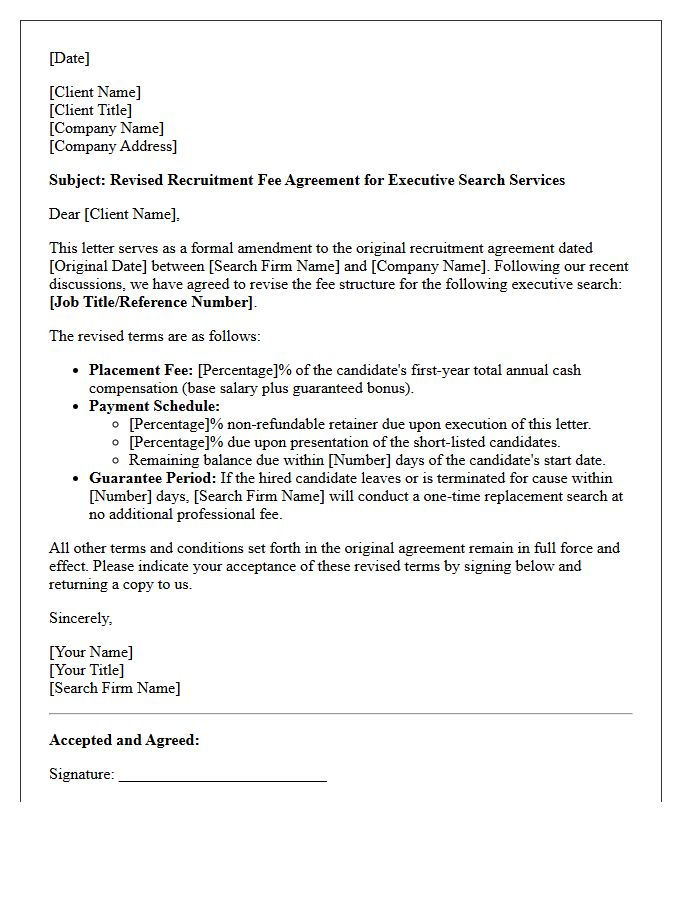
A revised recruitment fee agreement letter for executive search services ensures transparency between agencies and clients. It defines updated payment structures, such as retained or contingency fees, based on the candidate's first-year compensation. Key sections must outline the guarantee period, payment milestones, and termination clauses to prevent disputes. This document serves as a legally binding framework, aligning expectations regarding search exclusivity and candidate ownership. Clear documentation of these revised terms is essential for maintaining professional partnerships and securing top-tier leadership talent efficiently.
Contingency Search Revised Recruitment Fee Agreement Letter
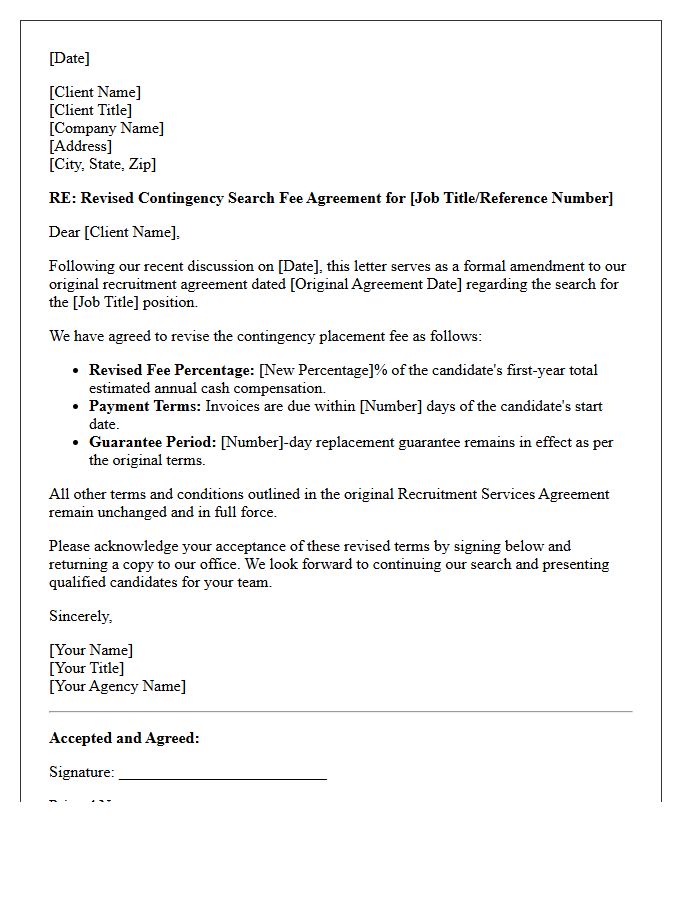
A Contingency Search Revised Recruitment Fee Agreement Letter is a formal document used to amend existing financial terms between a client and a hiring firm. It typically outlines new placement fees, payment schedules, or guarantee periods. This letter is crucial for ensuring legal transparency when market conditions or hiring needs change. By signing this revision, both parties confirm a mutual understanding of the updated contingency structure, ensuring that the recruiter is only compensated upon a successful candidate placement under the newly negotiated rates.
Retained Search Revised Recruitment Fee Agreement Letter
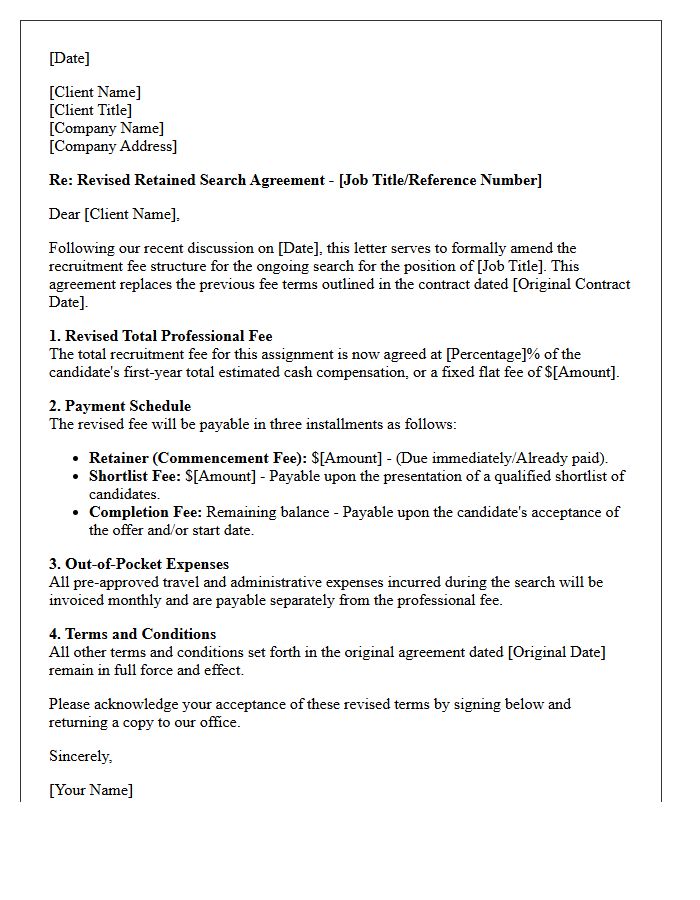
A Retained Search Revised Recruitment Fee Agreement Letter is a formal document used to update financial terms within an executive search contract. It typically outlines adjustments to the retained fee structure, payment milestones, or exclusivity clauses based on changing project scopes. This legal amendment ensures both the client and agency align on new compensation schedules while maintaining search momentum. Clear documentation of these revisions protects both parties, providing transparency and stability during high-level talent acquisition processes where initial hiring requirements or market conditions have evolved significantly.
Revised Recruitment Fee Agreement Letter for Volume Hiring Projects
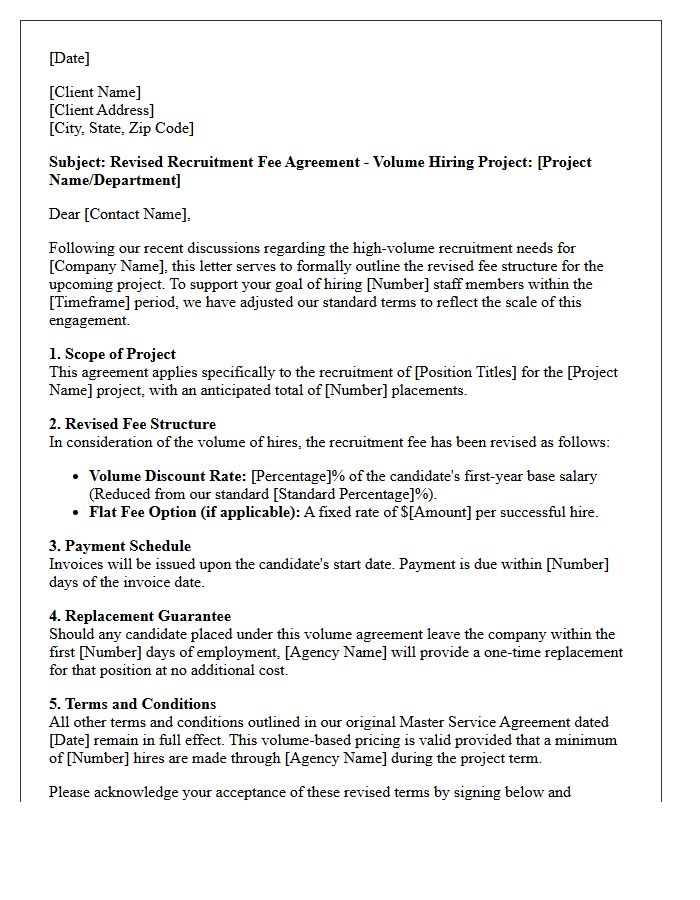
A revised Recruitment Fee Agreement Letter is essential for volume hiring projects to ensure scalability and cost-efficiency. It clearly defines the tiered pricing structure or flat-fee models tailored for large-scale talent acquisition. Key updates should focus on rebate periods, exclusive sourcing rights, and performance-based milestones to protect both parties. By formalizing these revised commercial terms, businesses can mitigate financial risks while securing the high-volume headcount needed for growth. Accurate documentation prevents disputes and optimizes the overall recruitment budget for long-term project success.
Exclusive Partnership Revised Recruitment Fee Agreement Letter
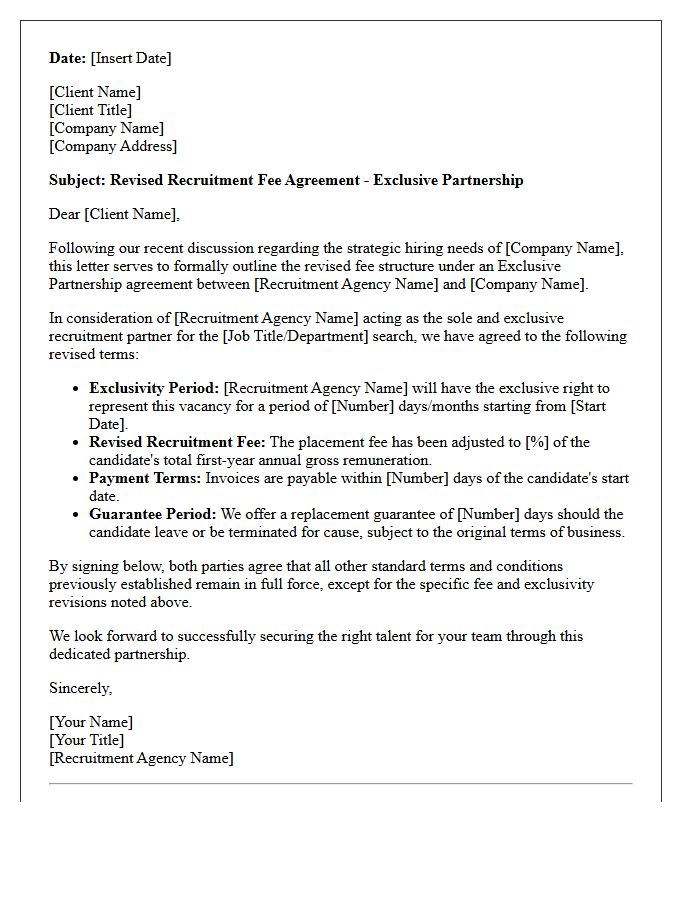
An Exclusive Partnership Revised Recruitment Fee Agreement Letter formalizes updated financial terms between an agency and a client. It confirms a sole sourcing right, meaning only one agency can provide candidates for specific roles. This legal document typically outlines adjusted contingency fees, payment schedules, and guarantee periods. By signing, both parties ensure transparency and commitment, protecting the agency's time investment while securing the client's talent pipeline. It is essential to clearly define the exclusivity duration to avoid future contractual disputes during the hiring process.
Revised Recruitment Fee Agreement Letter for Contract Staffing
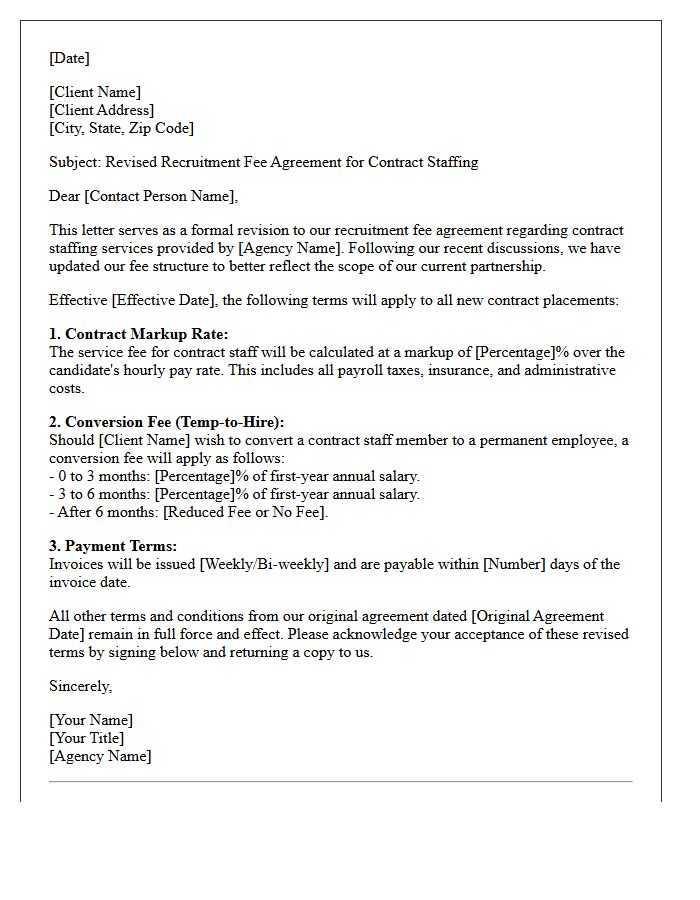
A revised recruitment fee agreement letter for contract staffing clarifies updated payment terms and service expectations. It essential to highlight the markup rate, which covers the candidate's hourly wage, statutory taxes, and agency margins. Ensure the document specifies conversion fees for permanent hiring and clear termination clauses. This legally binding amendment protects both parties by aligning financial obligations with current market rates, ensuring a transparent partnership for contingent labor placement.
Temporary Placement Revised Recruitment Fee Agreement Letter
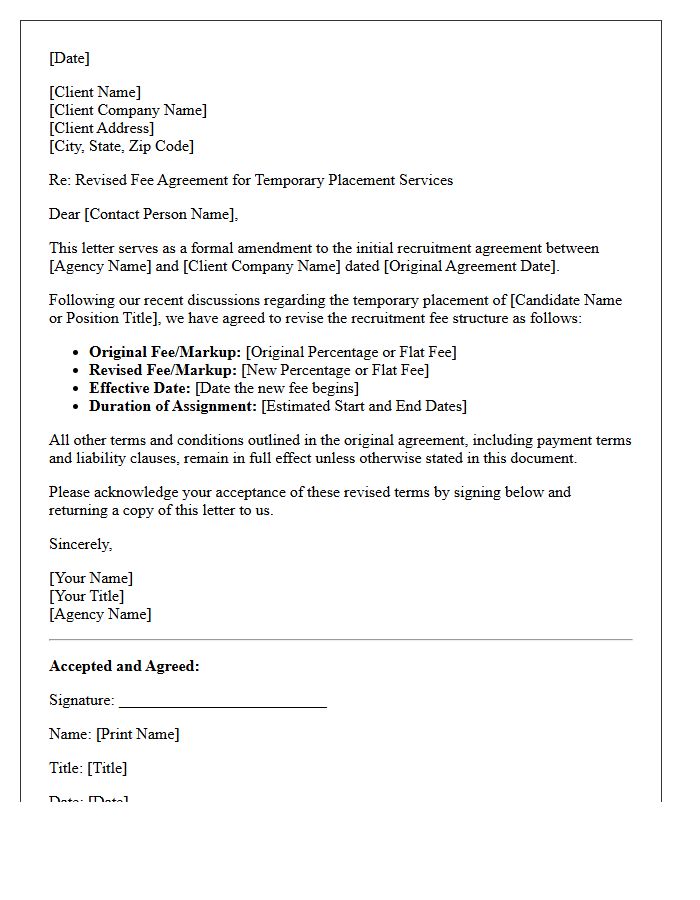
A Temporary Placement Revised Recruitment Fee Agreement Letter is a legally binding amendment that modifies existing financial terms between an agency and a client. It primarily updates the commission structure or hourly rates for interim staff. This document ensures transparency regarding payment schedules, conversion fees if a temp becomes permanent, and liability coverage. Clear written consent prevents future billing disputes, maintains professional compliance, and formally documents the negotiated adjustments to the original service contract to reflect current market demands or specific project requirements.
Revised Recruitment Fee Agreement Letter for International Placements
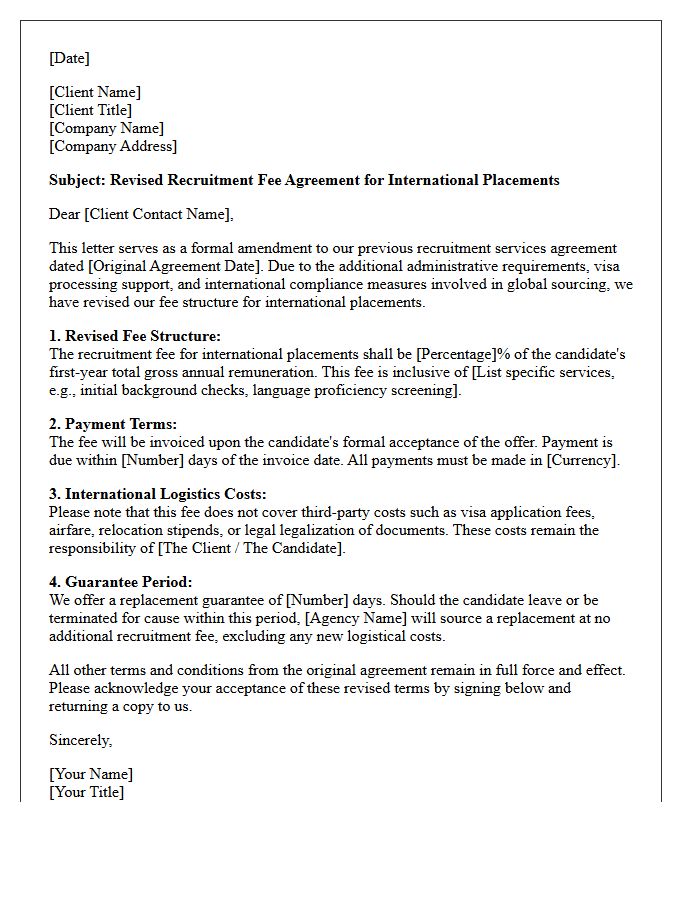
A Revised Recruitment Fee Agreement Letter for international placements is a legally binding document that outlines updated financial obligations between agencies and employers. It must clearly define the payment structure, including mobilization costs, service fees, and currency exchange protocols. To ensure compliance with global labor standards, the letter must explicitly state that no recruitment fees are charged to candidates. This revision serves to mitigate legal risks, establish clear refund policies for unsuccessful placements, and ensure transparency in cross-border hiring transactions while adhering to international recruitment ethics and local employment laws.
Tiered Structure Revised Recruitment Fee Agreement Letter
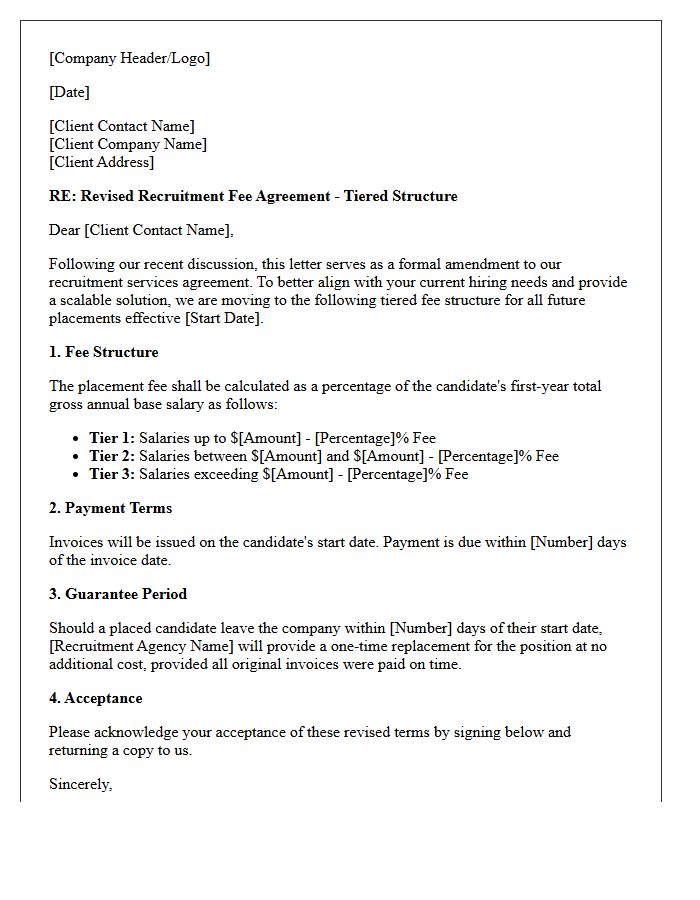
A Tiered Structure Revised Recruitment Fee Agreement Letter updates payment terms to align with hiring volume or candidate seniority. This performance-based document ensures that service costs scale according to specific milestones or placement difficulty. By formalizing a tiered framework, both the employer and agency clarify rebate periods and percentage-based commissions. It is a vital legal instrument for managing recruitment budgets efficiently while maintaining transparency in third-party talent acquisition partnerships. This revision ensures that long-term hiring strategies remain cost-effective and competitive in evolving market conditions.
Revised Recruitment Fee Agreement Letter with Modified Payment Terms
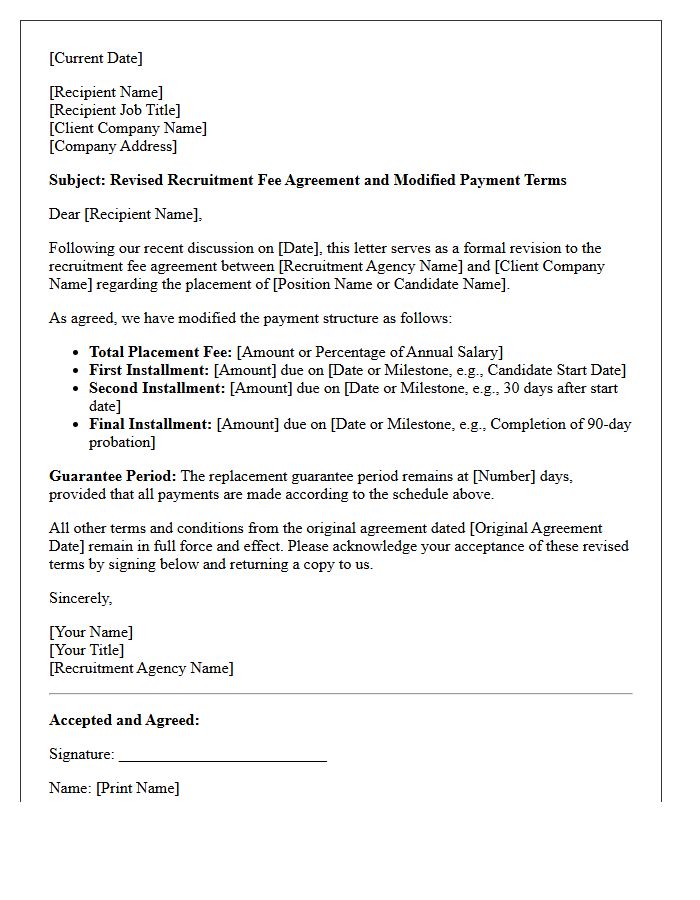
A revised recruitment fee agreement letter formalizes updated financial arrangements between an agency and a client. It is essential to clearly outline the modified payment terms, such as shifted due dates, installment plans, or adjusted rebate periods, to ensure transparency. This document legally supersedes previous contracts, preventing future billing disputes. Both parties must sign the amendment to validate the new schedule. Carefully review the payment milestones and contingency clauses to protect cash flow and maintain a professional partnership while ensuring compliance with the latest agreed-upon hiring costs.
Flat Rate Revised Recruitment Fee Agreement Letter
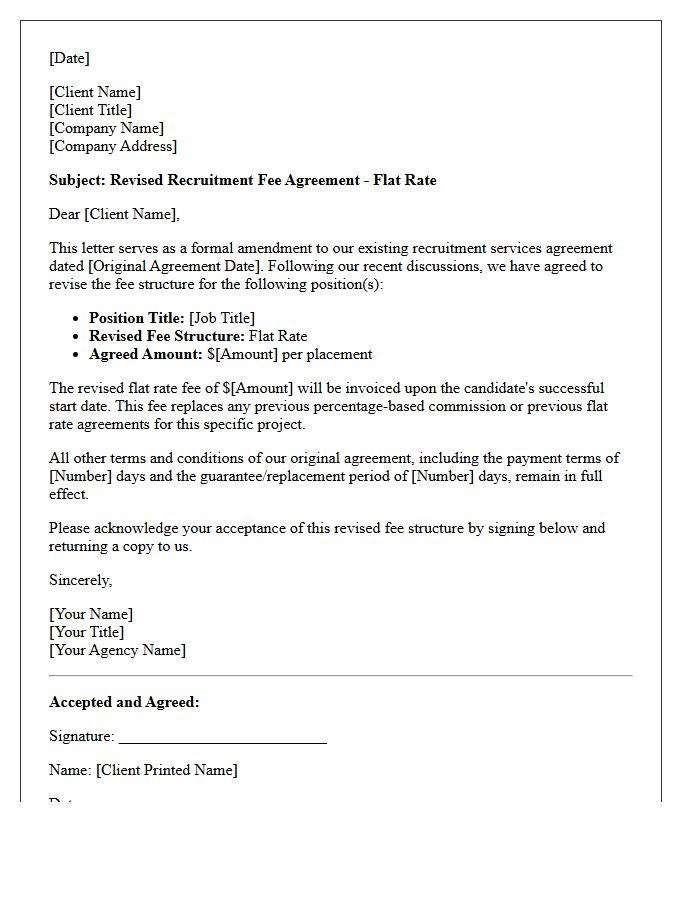
A Flat Rate Revised Recruitment Fee Agreement Letter is a formal document that modifies existing financial terms between an employer and a hiring agency. This amendment replaces percentage-based commissions with a fixed, predetermined cost per placement, ensuring budget predictability. It essential to clearly state the new payment structure, effective date, and specific job roles covered. By outlining these updated obligations, both parties maintain legal transparency and streamline the billing process for future talent acquisition services while preventing potential disputes over professional service fees.
Revised Recruitment Fee Agreement Letter for Specialized Industry Roles
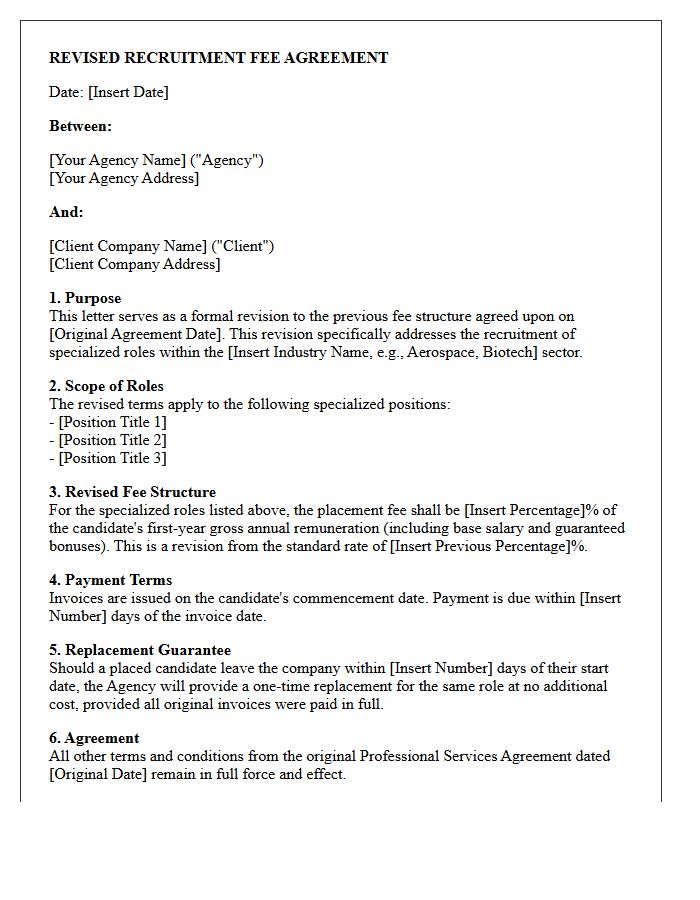
A revised Recruitment Fee Agreement is vital for securing specialized industry talent. It must clearly outline contingency or retained payment terms, specific guarantee periods, and ownership rights for candidate profiles. Updating these letters ensures compliance with niche market standards while protecting both the agency and the employer from disputes. Key clauses should address candidate replacement policies and fee structures tailored to high-skill roles. Establishing a precise, legally binding fee schedule facilitates transparency and fosters long-term partnerships in competitive sectors.
Mutual Revised Recruitment Fee Agreement Letter for Preferred Suppliers
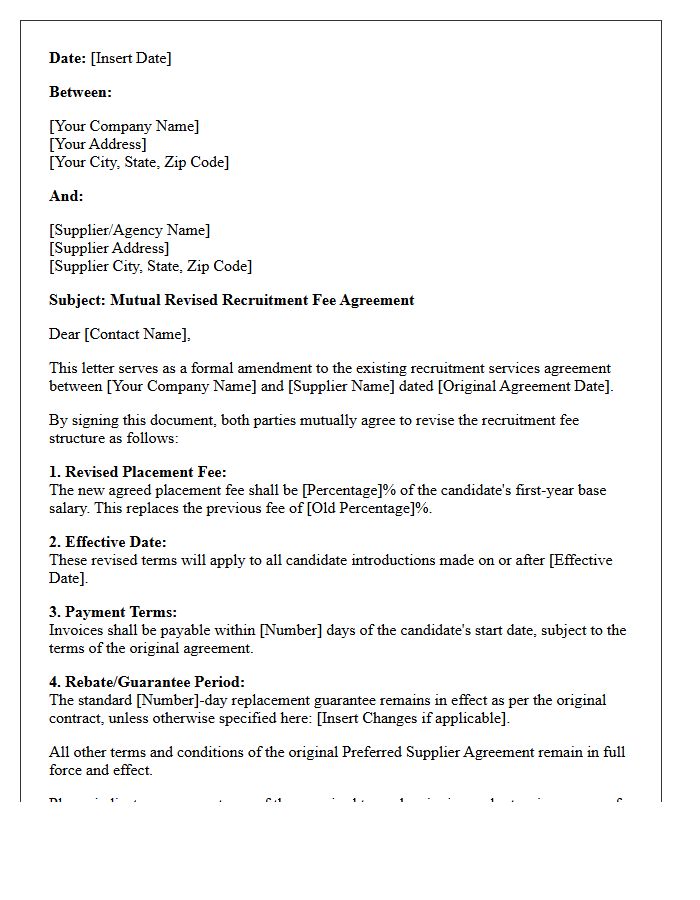
A Mutual Revised Recruitment Fee Agreement Letter is a formal document used to update the commercial terms between a client and their preferred suppliers. It ensures both parties agree on new commission structures, payment terms, and candidate ownership rules. This amendment is crucial for maintaining transparency and aligning hiring budgets with market rates. By signing this letter, agencies and employers solidify their strategic partnership, providing a clear legal framework for future placements while preventing disputes over recruitment costs and service expectations.
What is a Revised Recruitment Fee Agreement Letter?
A Revised Recruitment Fee Agreement Letter is a formal document that updates the financial terms, percentage rates, or payment schedules previously established between a recruitment agency and a hiring company.
When should a recruitment fee agreement be revised?
Agreements should be revised when there is a change in the volume of hires, a shift in the difficulty of sourcing niche talent, an adjustment in market rates, or when transitioning from a contingency to a retained search model.
Does a revised fee agreement supersede the original contract?
Yes, once signed by both parties, the revised agreement acts as an amendment that supersedes the specific financial clauses of the original contract while typically keeping other standard terms and conditions in effect.
What are the essential components of a revised fee letter?
The letter must include the effective date, the new percentage or flat fee structure, updated payment triggers (such as start date or invoice date), and a clear reference to the original agreement being modified.
Are revised recruitment fees applicable to candidates already in the pipeline?
Typically, fee revisions apply only to new candidate submissions following the date of the signature, unless the letter explicitly states that the new terms apply retroactively to active placements.

Comments