
A Letter Enforcing Back-Door Hire Clause is a formal notice sent to clients who bypass recruitment agencies to hire candidates directly. This letter asserts your contractual rights and demands the agreed introduction fee as specified in your Terms of Business. Protecting your revenue ensures business integrity and prevents fee avoidance. To help you take action, below are some ready to use templates.
Image cover: Official Notice of Back-Door Hire Clause Enforcement and Fee Invoice
Letter Samples List
- Letter Enforcing Back-Door Hire Clause Under Terms of Business
- Demand Letter for Unpaid Introduction Fee Under Recruitment Terms
- Formal Letter of Notice Regarding Unauthorized Direct Hire
- Letter of Enforcement for Candidate Circumvention Clause
- Breach of Contract Letter for Undisclosed Candidate Engagement
- Letter Demanding Placement Fee for Back-Door Hire Violation
- Official Letter Enforcing Recruitment Agency Terms of Business
- Letter of Notification Regarding Candidate Introduction Fee Liability
- Cease and Desist Letter for Terms of Business Circumvention
- Letter Claiming Agency Compensation for Unreported Candidate Hire
- Final Demand Letter for Back-Door Placement Fee Resolution
- Letter of Action for Breach of Recruitment Engagement Terms
- Legal Notice Letter Regarding Back-Door Hire Clause Violation
Letter Enforcing Back-Door Hire Clause Under Terms of Business
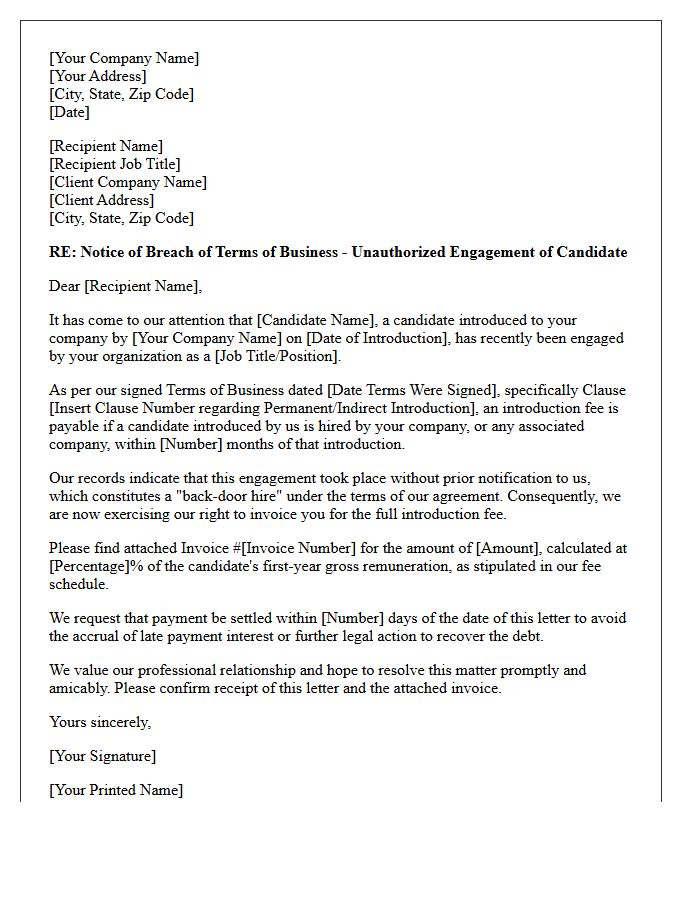
A letter enforcing a back-door hire clause is a formal legal notice sent when a client bypasses an agency to employ a candidate directly. This document asserts your contractual right to a placement fee, typically triggered if the hire occurs within a specific period after the initial introduction. To be effective, the letter must clearly reference the signed Terms of Business, provide evidence of the introduction, and include an invoice for the owed commission. Professional enforcement protects your revenue stream and maintains the integrity of your recruitment services.
Demand Letter for Unpaid Introduction Fee Under Recruitment Terms
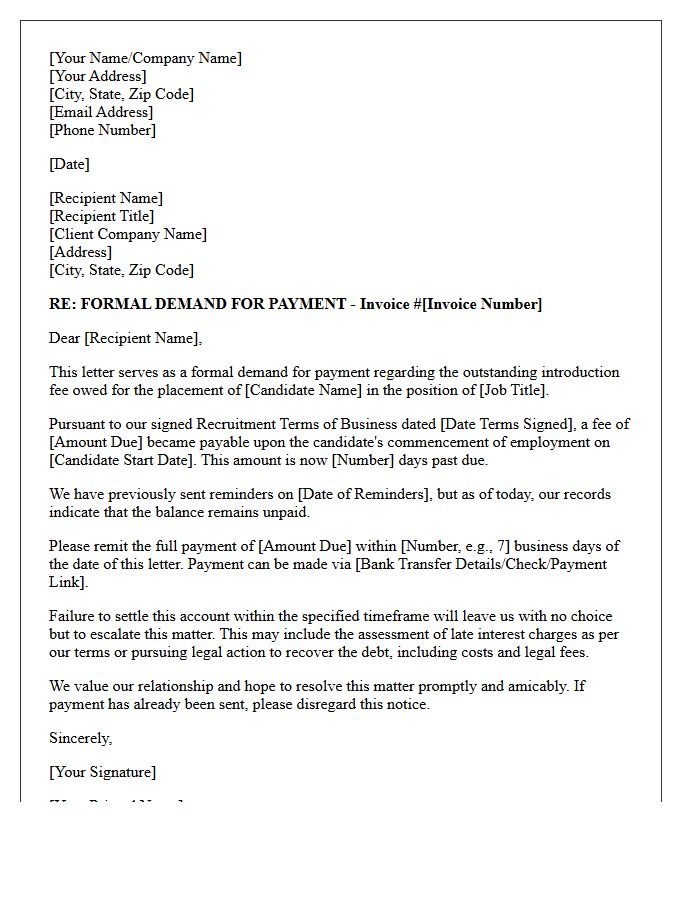
A demand letter is a formal legal notice issued when a client fails to pay an unpaid introduction fee as stipulated in your recruitment terms of business. This document serves as a final warning before pursuing litigation or debt recovery. It must clearly outline the candidate placed, the agreed fee percentage, the payment deadline, and the contractual breach. Sending this letter is a critical step to demonstrate a professional attempt to resolve the debt and provides essential evidence if you proceed to court to enforce your recruitment fees.
Formal Letter of Notice Regarding Unauthorized Direct Hire
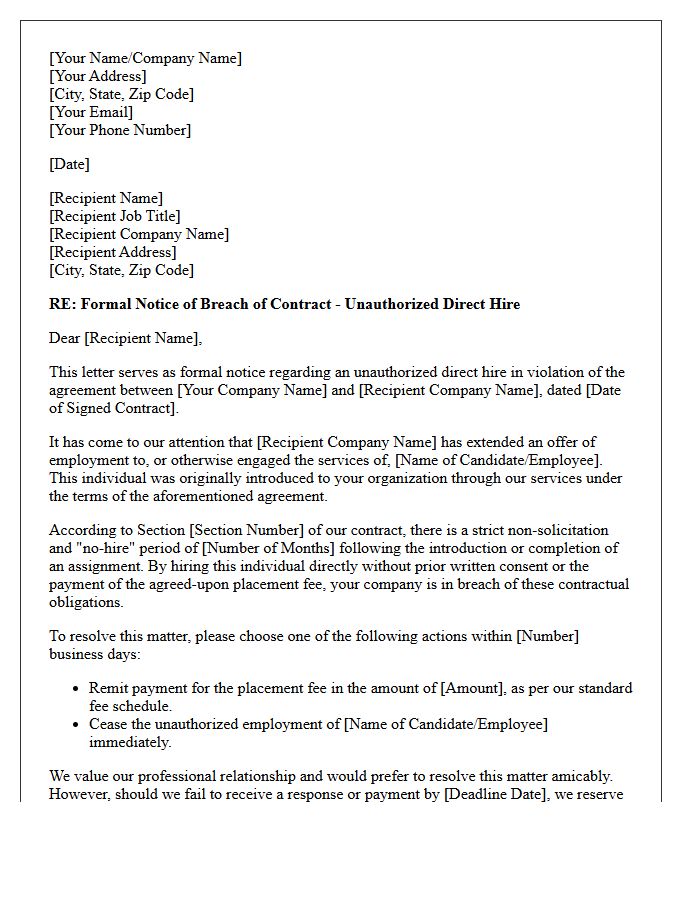
A formal letter of notice regarding unauthorized direct hire serves as a critical legal warning to third-party entities. It addresses contractual breaches occurring when a client bypasses agreed protocols to employ staff directly. This document formally asserts non-solicitation clauses and demands immediate rectification or payment of placement fees. Sending this notice is essential for protecting business interests, maintaining professional boundaries, and establishing a documented evidence trail for potential litigation or debt recovery processes. Clear communication ensures that proprietary talent acquisition investments remain legally safeguarded against unethical poaching practices.
Letter of Enforcement for Candidate Circumvention Clause
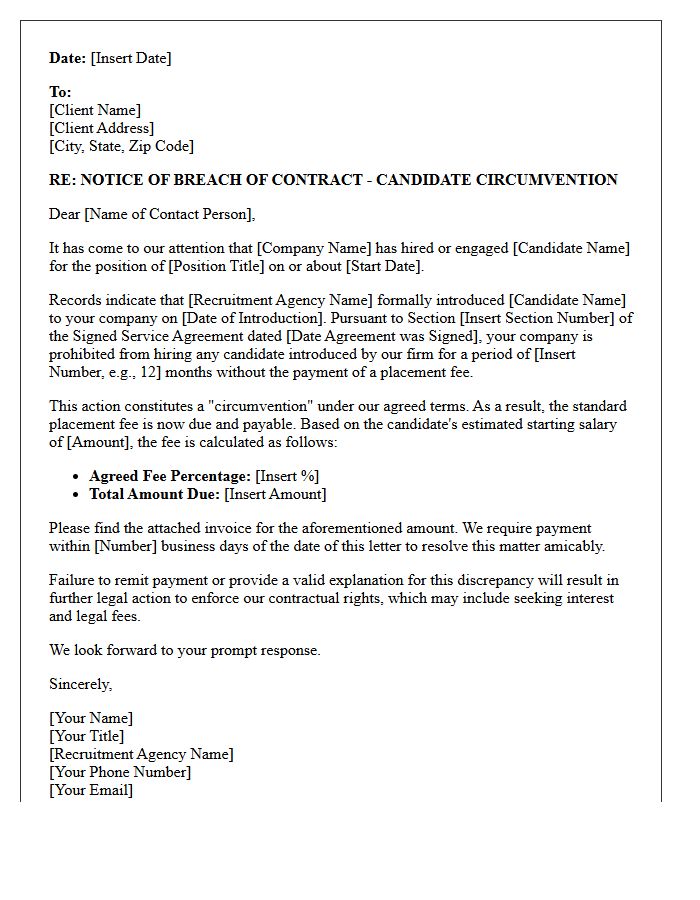
A Letter of Enforcement for a Candidate Circumvention Clause is a formal legal notice sent when a client hires a candidate directly to avoid paying contractual referral fees. This document protects recruitment agencies by asserting their right to compensation for introducing the talent. It outlines the specific breach of terms and demands the placement fee owed under the original agreement. Understanding this clause is crucial for maintaining business integrity and ensuring agencies are fairly rewarded for their sourcing efforts and proprietary candidate data during the hiring process.
Breach of Contract Letter for Undisclosed Candidate Engagement
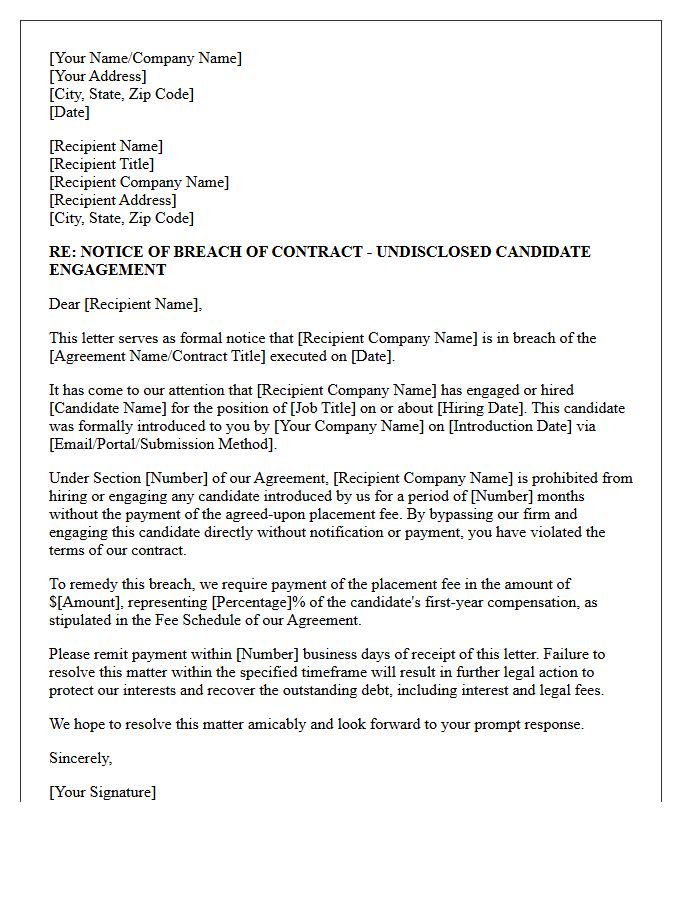
A breach of contract letter for undisclosed candidate engagement serves as a formal notice when a client hires a recruit bypassing the recruitment agency. This document asserts your legal right to a placement fee stipulated in the signed terms of business. It must clearly outline the breach, provide evidence of the initial introduction, and demand immediate payment. Issuing this letter is critical for protecting your agency's revenue and enforcing contractual obligations against "backdoor" hiring practices that violate professional service agreements.
Letter Demanding Placement Fee for Back-Door Hire Violation
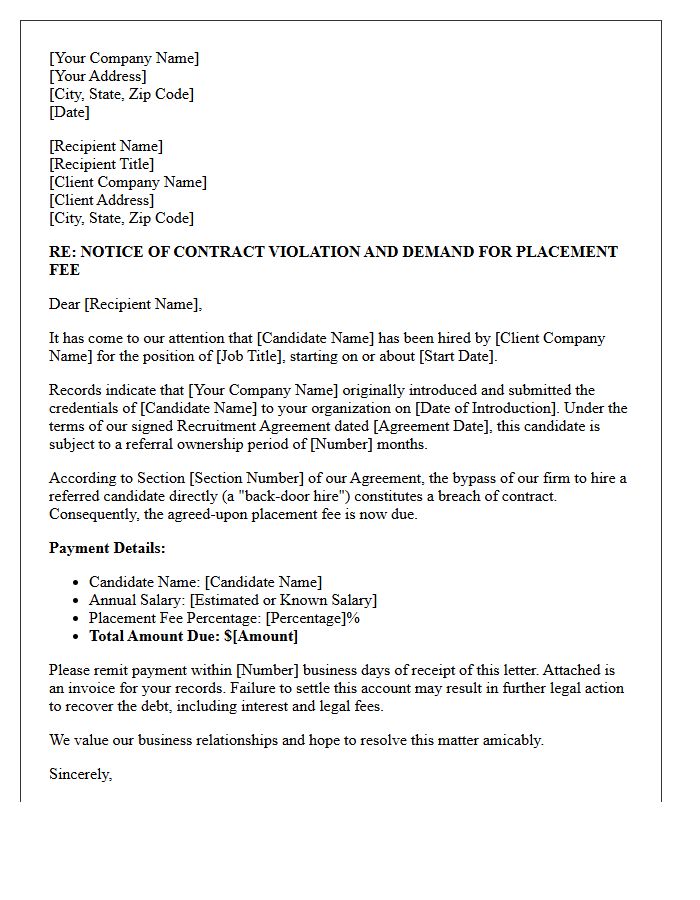
A Letter Demanding Placement Fee is a formal legal notice issued when a client hires a candidate directly, bypassing the recruitment agency to avoid contractual obligations. This back-door hire violation breaches the signed fee agreement. The letter serves as a final demand for the earned commission, detailing the referral ownership period and evidence of the introduction. It provides a crucial legal paper trail for debt collection or litigation. Recruiters use this document to enforce their terms of business and ensure compensation for their professional sourcing services and intellectual property.
Official Letter Enforcing Recruitment Agency Terms of Business
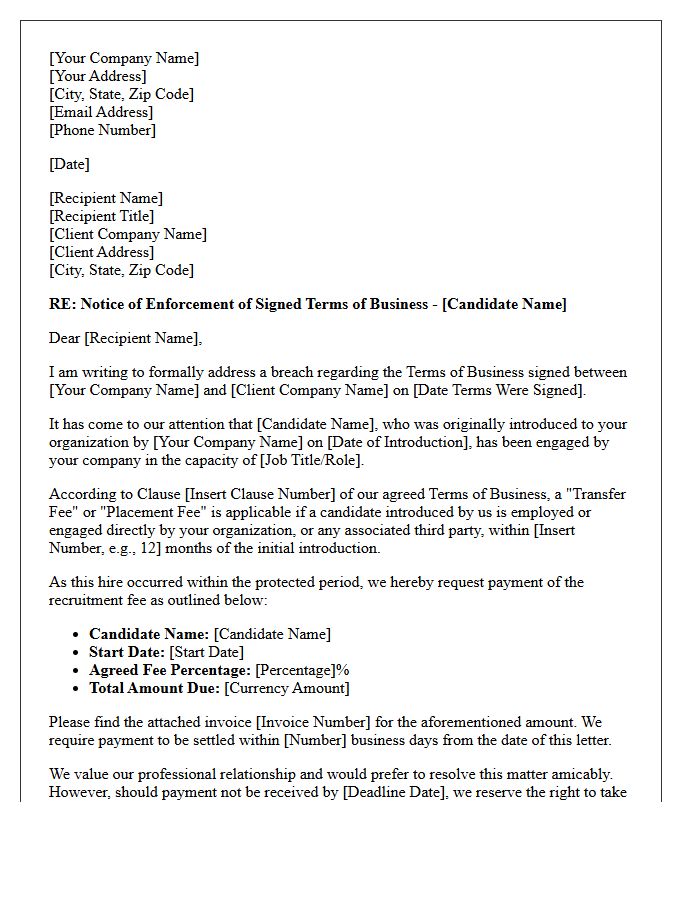
An official letter enforcing recruitment agency terms of business serves as a formal legal notice to clients who bypass agreed obligations. It typically addresses backdoor hires, where an employer recruits a candidate introduced by the agency without paying the mandatory placement fee. This document highlights specific clauses, such as ownership periods and fee structures, to demand immediate settlement. Establishing a clear paper trail through this letter is crucial for protecting intellectual property and ensuring agencies receive fair compensation for their professional sourcing services and contractual rights.
Letter of Notification Regarding Candidate Introduction Fee Liability
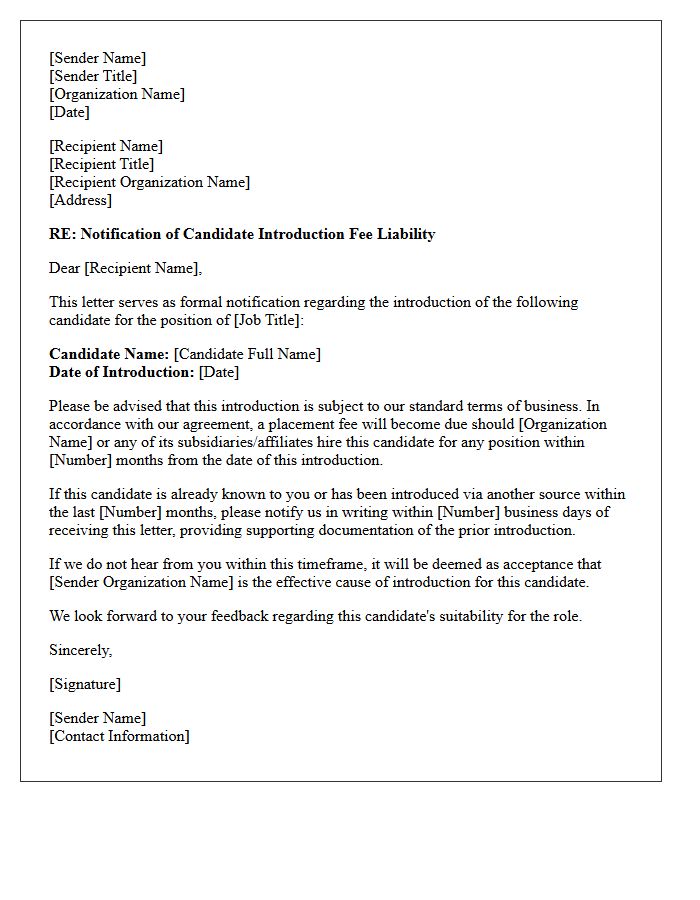
A Letter of Notification regarding candidate introduction fee liability is a formal document used to establish ownership of a job applicant. It clarifies which recruitment agency is entitled to a placement fee if the candidate is hired. To avoid dual representation disputes or unexpected financial obligations, employers must track the effective date of each referral. Promptly responding to these notifications ensures that the company remains compliant with existing service agreements and prevents legal conflicts over referral ownership during the hiring process.
Cease and Desist Letter for Terms of Business Circumvention
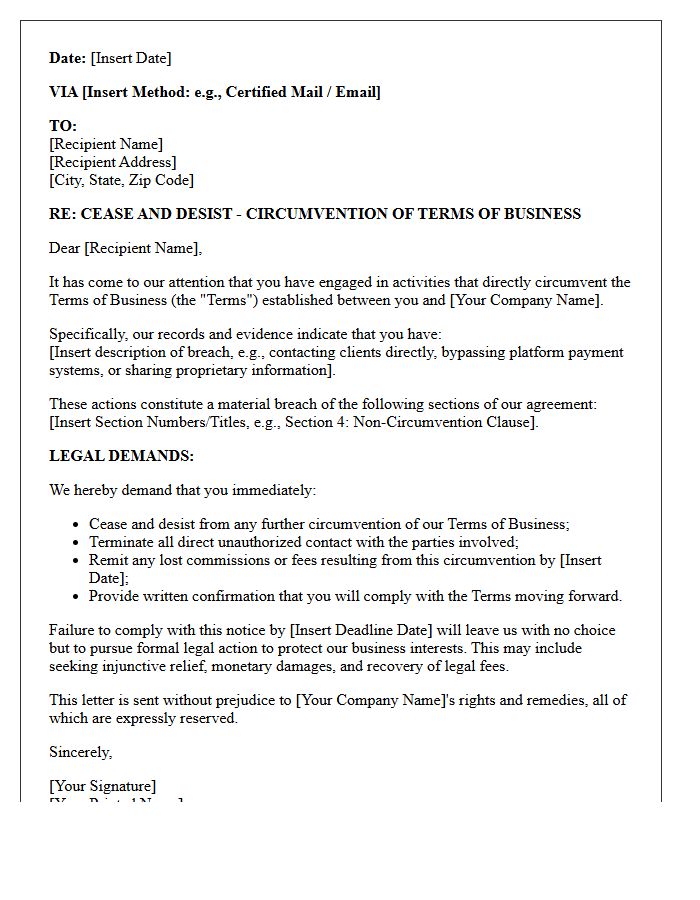
A cease and desist letter for terms of business circumvention is a formal legal notice demanding an immediate stop to actions that bypass contractual obligations. It typically addresses disintermediation, where parties attempt to avoid agreed-upon fees or service structures. This document serves as a critical warning before pursuing litigation, protecting your company's revenue and intellectual property. Clearly outlining the specific breach and required remedies ensures enforceable compliance and reinforces the legal validity of your original service agreement against bad-faith actors seeking to exploit your business model.
Letter Claiming Agency Compensation for Unreported Candidate Hire
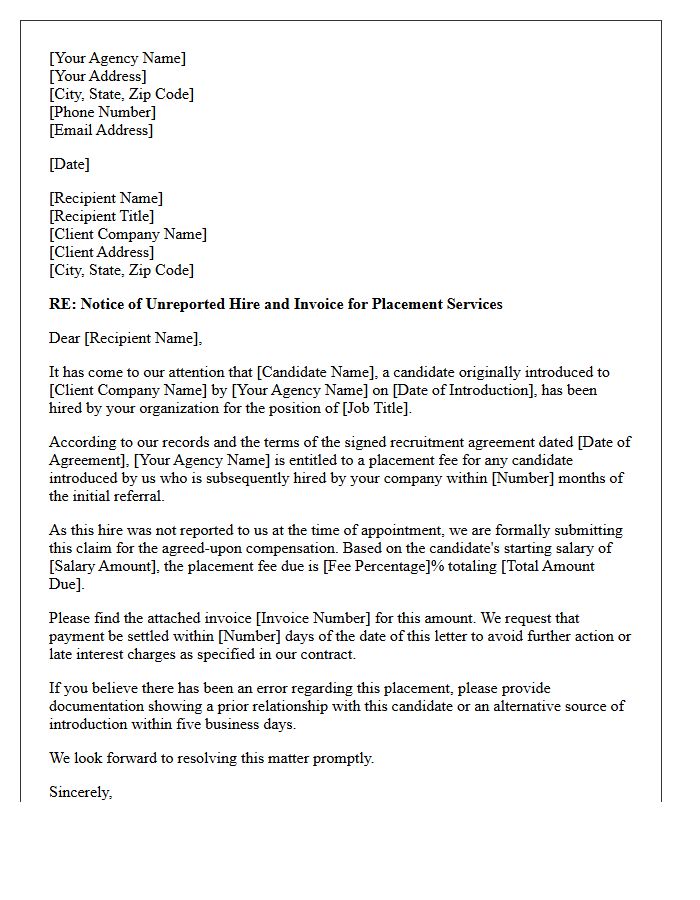
A letter claiming agency compensation is a formal demand sent when a client bypasses a recruiter to hire a candidate directly. This backdoor hire violates the signed terms of business, triggering a contractual right to a placement fee. The document must include proof of introduction, such as the original CV submission timestamp and candidate name. To ensure legal standing, clearly state the owed commission percentage and set a firm payment deadline. Protecting your referral ownership period is essential for recovering lost revenue and maintaining professional recruitment standards during fee disputes.
Final Demand Letter for Back-Door Placement Fee Resolution
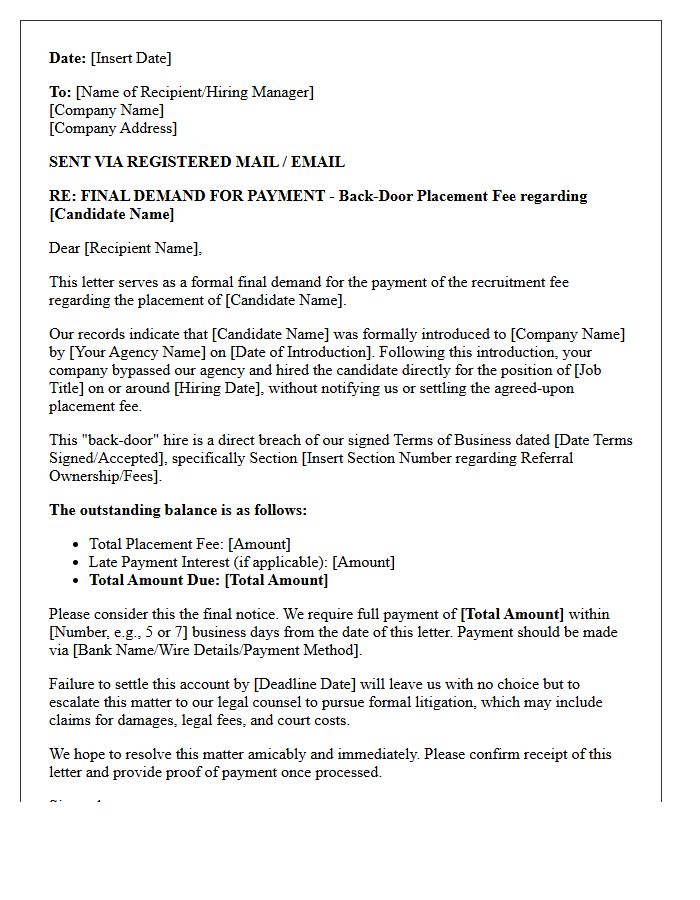
A final demand letter for back-door placement fee resolution is a critical legal document sent to clients who bypass recruitment terms. It serves as a formal notice to settle outstanding contingency fees resulting from direct hires of introduced candidates. This letter outlines the breach of contract, provides evidence of the placement, and specifies a strict deadline for payment. Issuing this notice is a mandatory step before escalating to litigation or debt recovery, ensuring the agency protects its revenue and enforces contractual ownership periods effectively.
Letter of Action for Breach of Recruitment Engagement Terms
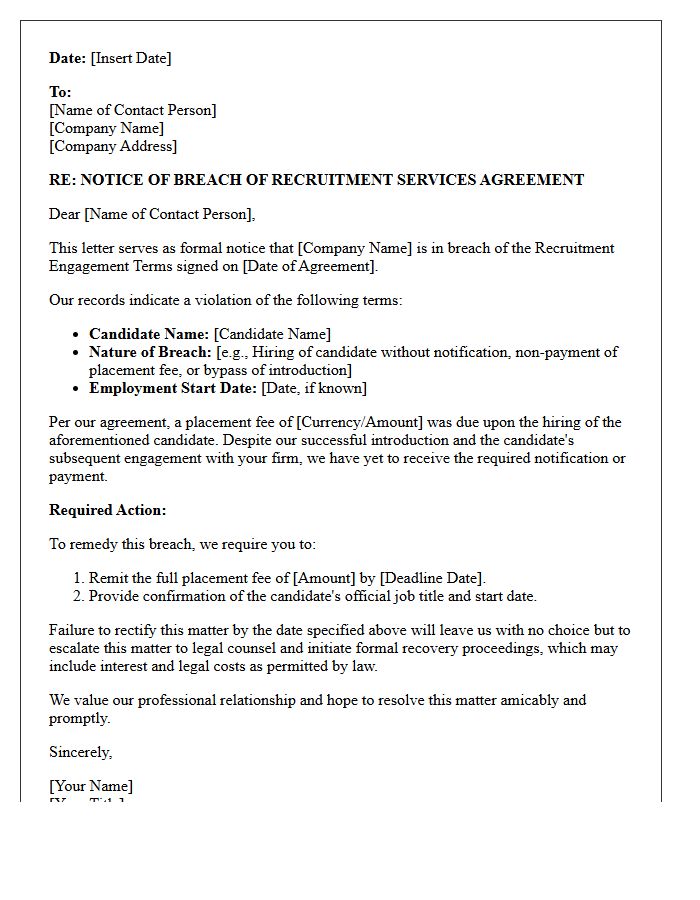
A Letter of Action for Breach of Recruitment Engagement Terms serves as a formal legal notice issued when a client violates the agreed-upon contractual obligations. This typically occurs due to "backdoor hires," where a candidate is employed without paying the recruiter's fee. The document outlines the specific breach, demands immediate payment of placement fees, and sets a deadline for resolution. Issuing this letter is a critical first step in debt recovery, establishing a clear paper trail for potential litigation to protect the agency's revenue and intellectual property rights.
Legal Notice Letter Regarding Back-Door Hire Clause Violation
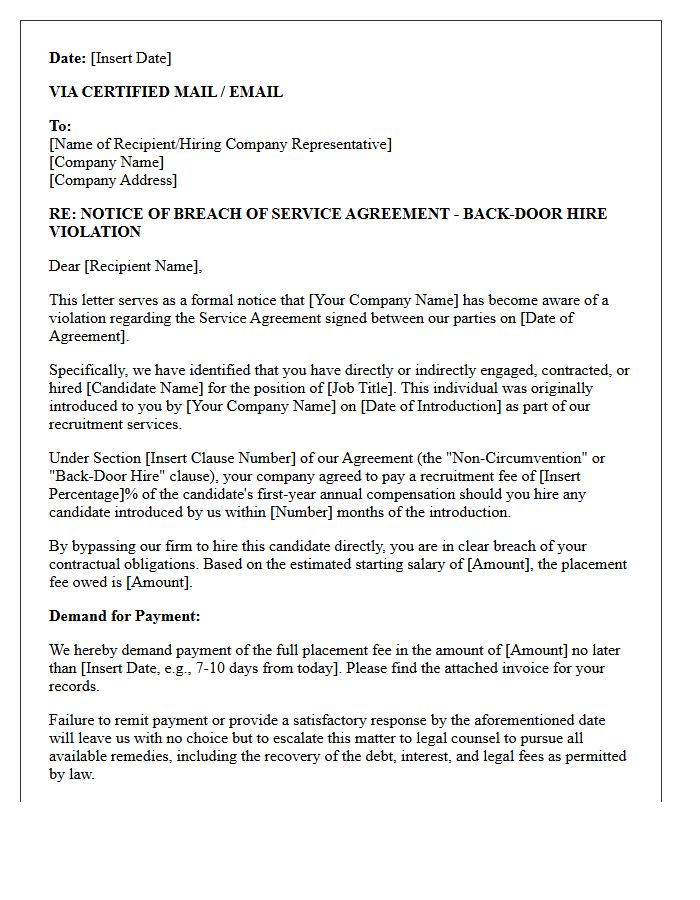
A legal notice for a back-door hire clause violation serves as a formal demand when a client bypasses a recruitment agency to hire a candidate directly. This notice asserts a breach of contract, specifically targeting the non-circumvention provisions designed to protect referral fees. It outlines the evidence of the unauthorized engagement and demands immediate payment of the agreed-upon placement fee. Sending this document is a critical first step in litigation or debt recovery, ensuring the agency preserves its right to compensation for professional services rendered.
What is a back-door hire clause in terms of business?
A back-door hire clause is a contractual provision designed to prevent clients from bypassing a recruitment agency by hiring a candidate directly, or through a third party, after they were introduced by the agency, without paying the agreed-upon placement fee.
When should I send a letter enforcing a back-door hire clause?
You should send an enforcement letter as soon as you identify that a candidate you introduced has been engaged by the client in a permanent, temporary, or consultancy capacity within the "period of restriction" specified in your terms of business.
What evidence is needed to support a back-door hire claim?
To successfully enforce the clause, you should provide documentation including the original introduction email or CV submission, proof of the candidate's interview (if applicable), the signed terms of business, and evidence of the candidate's current employment with the client, such as a LinkedIn profile or company directory listing.
What financial remedies can be sought in a back-door hire enforcement letter?
The letter typically demands payment of the full introduction fee as outlined in your fee schedule, often calculated as a percentage of the candidate's first-year remuneration. It may also include accrued interest and administrative late payment fees as permitted by the contract or statutory law.
Can a client avoid a back-door hire fee if the candidate applied independently?
Generally, if the agency made the "effective introduction" first, the client remains liable for the fee. Most terms of business stipulate that the agency's introduction takes precedence over a direct application for a set period, usually 6 to 12 months, regardless of whether the candidate also applied through other channels.

Comments