
Effective financial oversight is essential for tax-exempt entities. This guide explores the critical components of a Management Letter on Grant Compliance and Fund Accounting, ensuring your non-profit maintains transparency and meets rigorous federal audit standards. Learn how to document internal control improvements and safeguard your mission's funding integrity. To simplify your reporting process, below are some ready to use template.
Image cover: Mastering Grant Compliance: Essential Management Letter Templates and Fund Accounting Samples for Non-Profits
Letter Samples List
- Management Letter on Federal Grant Compliance and Restricted Fund Accounting Deficiencies
- Auditor Management Letter Regarding Non-Profit Fund Accounting Internal Controls
- Management Letter on Grant Expenditure Tracking and Fund Allocation Compliance
- Post-Audit Management Letter on Grant Reporting and Fund Accounting Practices
- Management Letter Detailing Findings on Non-Profit Grant Compliance and Net Asset Classification
- Management Letter on Single Audit Grant Compliance and Fund Accounting Weaknesses
- Advisory Management Letter on Non-Profit Fund Accounting and Grant Disbursement Controls
- Management Letter Concerning State Grant Compliance and Fund Segregation Procedures
- Year-End Management Letter on Grant Compliance and Fund Accounting Remediation
- Management Letter on Donor-Restricted Fund Accounting and Grant Compliance Observations
- Management Letter on Non-Profit Grant Subrecipient Monitoring and Fund Accounting
- Management Letter Identifying Deficiencies in Grant Compliance and Fund Accounting Operations
Management Letter on Federal Grant Compliance and Restricted Fund Accounting Deficiencies
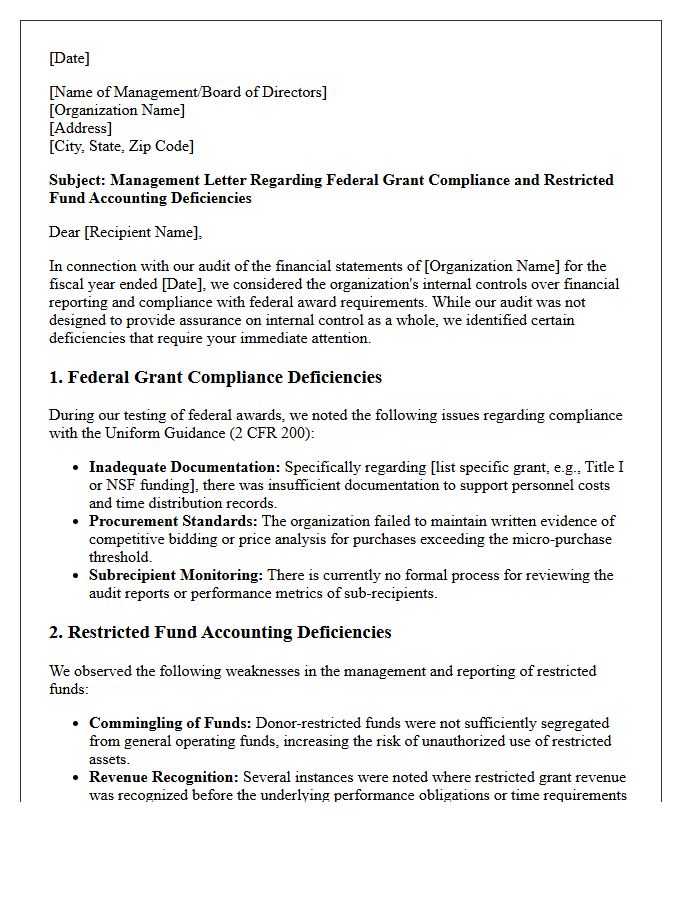
A management letter identifies critical internal control weaknesses regarding federal grant compliance and restricted fund accounting. These deficiencies often involve improper expense tracking, inadequate documentation, or the commingling of specialized funds. Failure to address these findings can lead to disallowed costs, repayment demands, or the loss of future funding. Organizations must implement robust financial oversight and strictly adhere to Uniform Guidance standards to ensure regulatory transparency. Promptly correcting these issues is essential for maintaining fiscal integrity and protecting the entity's reputation during federal audits.
Auditor Management Letter Regarding Non-Profit Fund Accounting Internal Controls
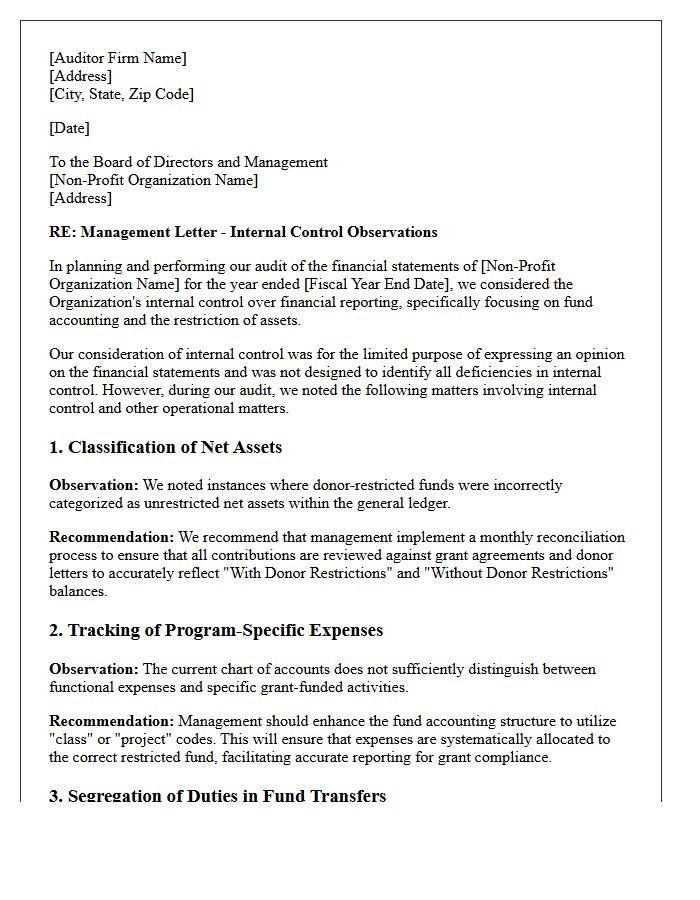
An auditor management letter evaluates the effectiveness of a non-profit's internal controls over fund accounting. This document highlights material weaknesses or significant deficiencies in how restricted and unrestricted funds are tracked. It provides actionable recommendations to improve financial oversight, ensure donor compliance, and prevent fraud. For non-profits, addressing these findings is essential to maintain transparency and protect tax-exempt status. Boards should use this feedback to strengthen governance and ensure that assets are managed according to specific grant requirements and accounting standards.
Management Letter on Grant Expenditure Tracking and Fund Allocation Compliance
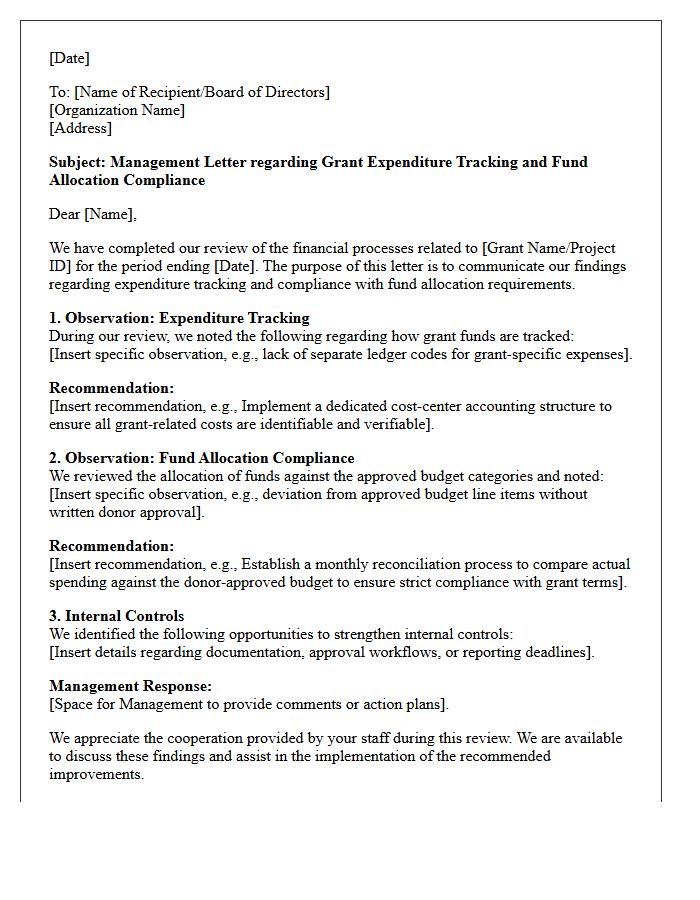
A Management Letter serves as a critical internal control tool to ensure financial integrity. It evaluates how an organization handles grant expenditure tracking and fund allocation compliance. The primary focus is verifying that expenditures align with donor restrictions and budget mandates. By identifying potential compliance risks or accounting weaknesses, the letter provides actionable recommendations to prevent fund mismanagement. Ensuring precise documentation and cost allocation accuracy protects the organization's reputation and secures future funding by demonstrating transparency and strict adherence to regulatory standards.
Post-Audit Management Letter on Grant Reporting and Fund Accounting Practices
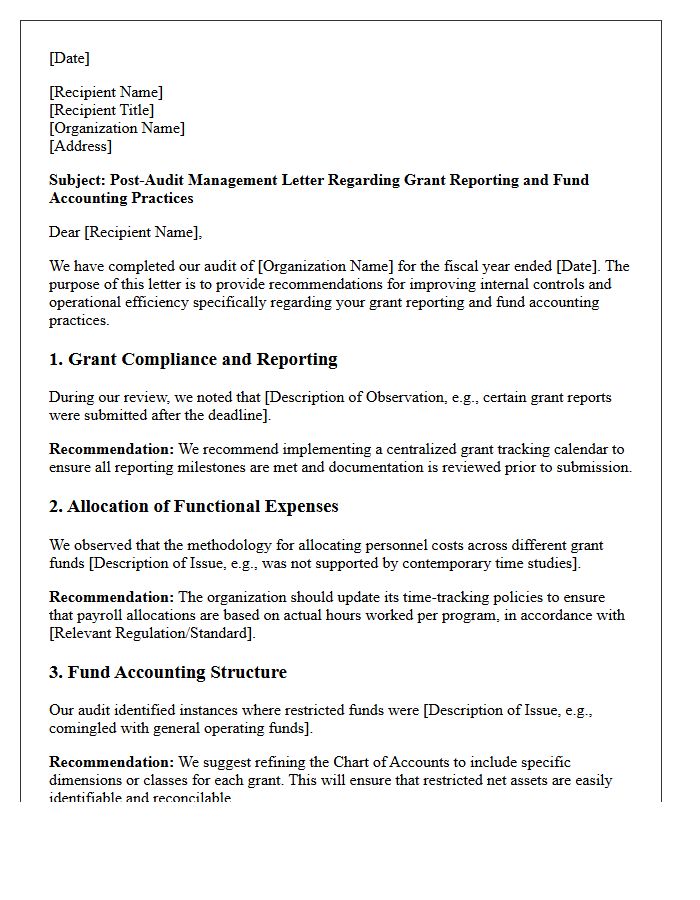
A Post-Audit Management Letter is a critical document identifying internal control weaknesses in grant reporting and fund accounting. It provides actionable recommendations to ensure compliance with donor regulations and GAAP standards. Addressing these findings is essential for maintaining financial transparency, preventing misallocation of funds, and securing future funding opportunities. Organizations must use this feedback to strengthen their audit trails, improve documentation accuracy, and mitigate risks of non-compliance in complex multi-funded environments.
Management Letter Detailing Findings on Non-Profit Grant Compliance and Net Asset Classification
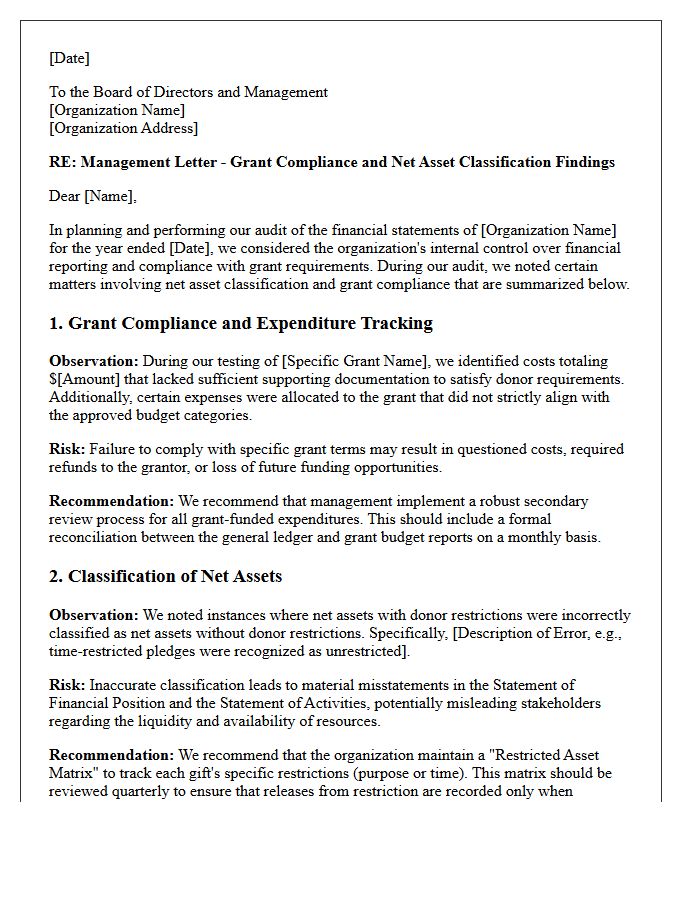
A management letter identifies critical weaknesses in grant compliance and net asset classification. It ensures restricted funds align with donor intent and legal requirements. Proper classification between with and without donor restrictions is vital for accurate financial reporting. Auditors use these findings to highlight internal control gaps, preventing the mismanagement of federal or private awards. Addressing these issues strengthens transparency, mitigates audit risks, and protects the organization's tax-exempt status. Maintaining precise records of net assets is essential for demonstrating fiscal stewardship and long-term financial sustainability in the non-profit sector.
Management Letter on Single Audit Grant Compliance and Fund Accounting Weaknesses
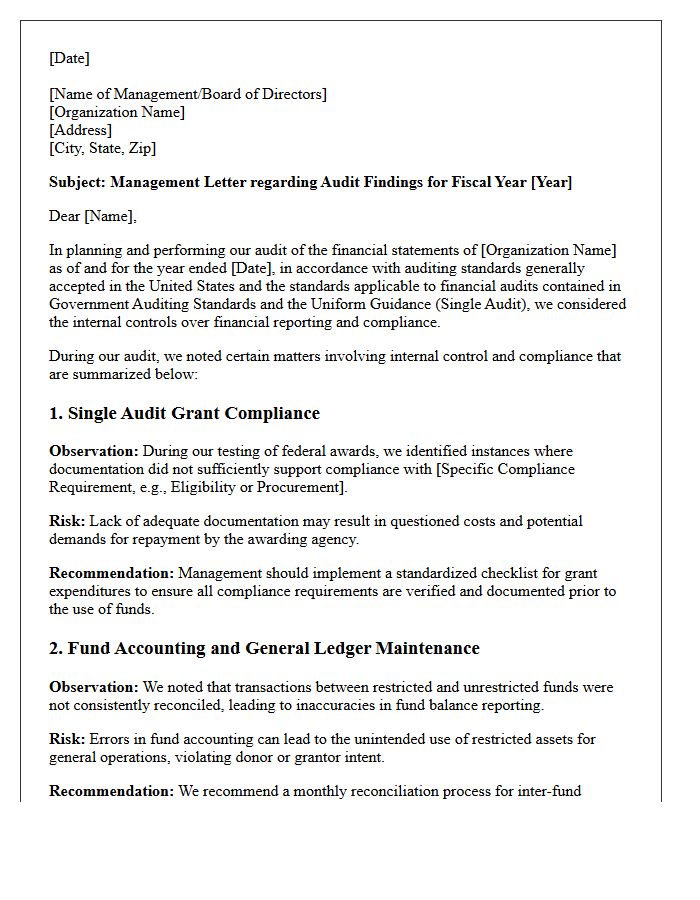
A management letter identifies critical internal control deficiencies discovered during a Single Audit. It highlights grant compliance failures, such as improper documentation or unallowable costs, which jeopardize federal funding. Additionally, it addresses fund accounting weaknesses, focusing on inaccurate financial reporting or poor segregation of duties. Organizations must address these findings to ensure fiscal accountability, maintain regulatory compliance, and prevent future audit qualifications. Understanding these weaknesses allows management to implement corrective actions, safeguarding the entity's reputation and ensuring the continued flow of essential grant revenues.
Advisory Management Letter on Non-Profit Fund Accounting and Grant Disbursement Controls
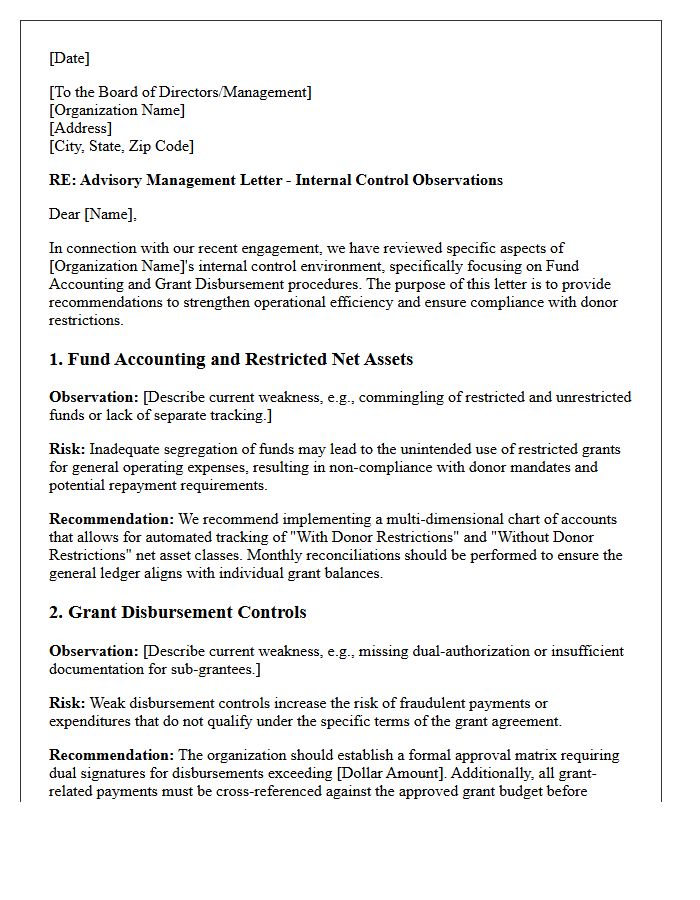
An advisory management letter provides critical insights into strengthening financial governance for non-profits. It evaluates the accuracy of fund accounting practices to ensure net assets are correctly restricted or unrestricted. Furthermore, it assesses grant disbursement controls to mitigate risks of fraud or mismanagement. By implementing these recommendations, organizations improve transparency and maintain donor compliance. This document serves as a strategic roadmap to enhance internal systems, ensuring every dollar is tracked and allocated according to its specific purpose, ultimately protecting the entity's tax-exempt status and long-term sustainability.
Management Letter Concerning State Grant Compliance and Fund Segregation Procedures
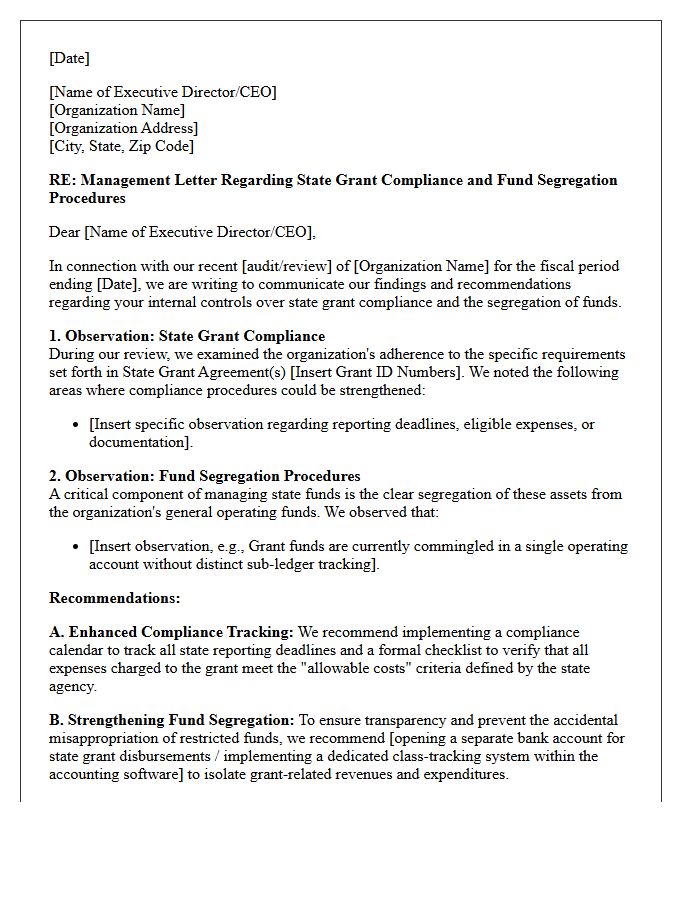
A Management Letter evaluates an organization's internal controls regarding state grant compliance. It identifies weaknesses in fund segregation procedures, ensuring that restricted state monies are never comingled with general operating accounts. Proper segregation is critical to prevent misappropriation and demonstrate financial transparency. The letter provides actionable recommendations to strengthen internal oversight, mitigate audit risks, and ensure full adherence to regulatory requirements. Addressing these findings protects the entity's eligibility for future funding by proving rigorous stewardship of public resources through formalized accounting protocols and clearly defined staff responsibilities.
Year-End Management Letter on Grant Compliance and Fund Accounting Remediation
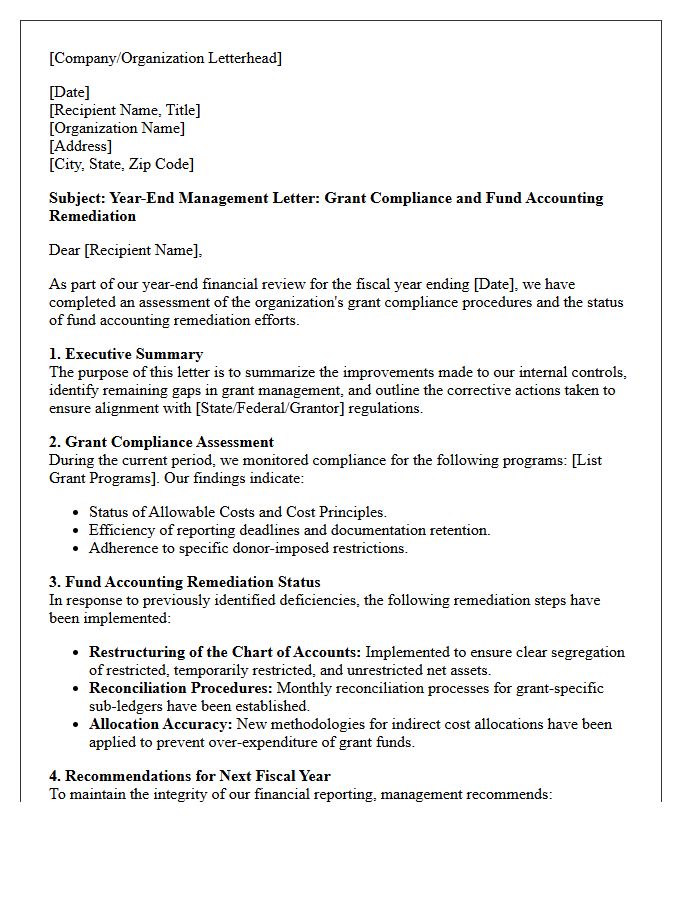
A year-end management letter is a critical audit output identifying internal control weaknesses in grant compliance and financial reporting. It outlines specific fund accounting remediation steps required to correct mismanaged restricted assets and improper cost allocations. Organizations must address these findings to ensure future eligibility for federal funding and maintain fiscal transparency. Promptly resolving these deficiencies strengthens internal controls, minimizes audit risk, and demonstrates accountability to stakeholders regarding the proper stewardship of grant-funded resources and regulatory adherence.
Management Letter on Donor-Restricted Fund Accounting and Grant Compliance Observations
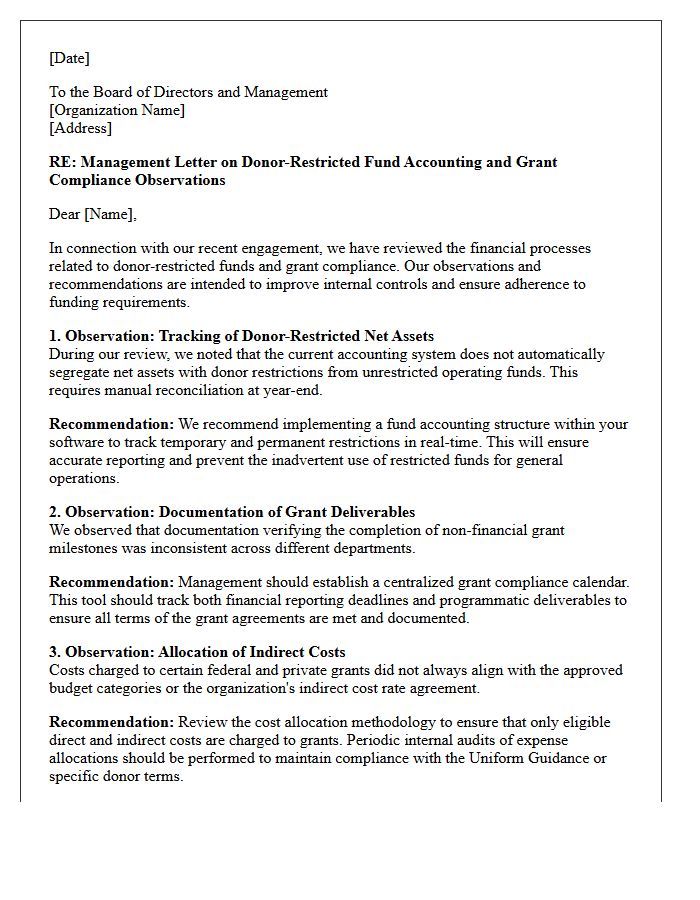
A management letter regarding donor-restricted fund accounting ensures that organizations maintain strict fiduciary oversight. It highlights critical observations on grant compliance, focusing on whether funds were utilized according to specific donor stipulations. Auditors use this document to identify internal control weaknesses, preventing the commingling of resources and potential legal risks. Addressing these findings is essential for maintaining transparency and securing future funding. Organizations must implement corrective actions to improve reporting accuracy and uphold stakeholder trust through rigorous adherence to restricted purpose mandates and regulatory guidelines.
Management Letter on Non-Profit Grant Subrecipient Monitoring and Fund Accounting
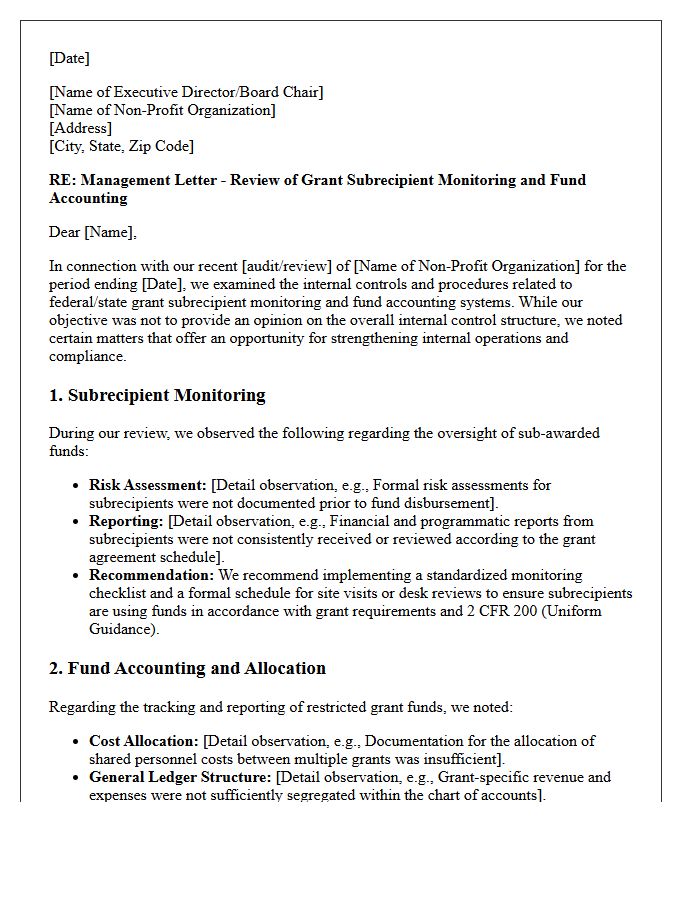
A management letter serves as a critical internal control tool for non-profit grant subrecipient monitoring. It ensures that pass-through entities evaluate risk assessments and verify that sub-awards align with federal guidelines. Key focus areas include fund accounting accuracy, which guarantees that restricted funds are tracked separately and used only for allowable costs. Regular oversight prevents financial mismanagement and maintains compliance with Uniform Guidance standards. Addressing these recommendations promptly strengthens organizational integrity, improves audit outcomes, and secures future funding by demonstrating robust fiscal accountability and transparent reporting practices across all projects.
Management Letter Identifying Deficiencies in Grant Compliance and Fund Accounting Operations
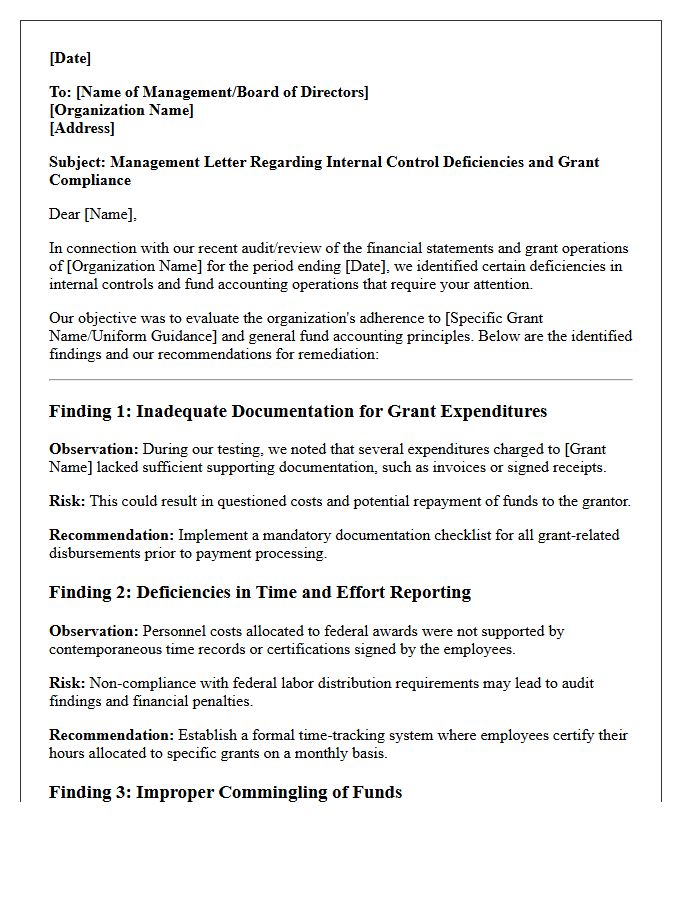
A management letter is a critical audit tool used to communicate internal control weaknesses discovered during a financial review. It specifically identifies material weaknesses or significant deficiencies in grant compliance and fund accounting operations. This document highlights risks such as the commingling of funds or failure to meet federal regulatory requirements. Organizations must address these findings promptly to ensure financial transparency, safeguard funding eligibility, and improve operational efficiency. Implementing the auditor's recommendations is essential for maintaining regulatory compliance and securing future grant opportunities through sound fiscal stewardship.
What is the purpose of a Management Letter in the context of grant compliance?
A Management Letter serves as a formal communication from external auditors to the organization's board, identifying internal control weaknesses, instances of non-compliance with grant terms, and providing actionable recommendations to improve financial oversight and mitigate the risk of disallowed costs.
How does fund accounting ensure transparency for non-profit grant management?
Fund accounting segregates resources into distinct categories based on donor-imposed restrictions, ensuring that grant funds are tracked separately from general operating capital. This system provides a clear audit trail that demonstrates exactly how specific grant monies were allocated and spent according to the legal requirements of the funding source.
What are the common internal control deficiencies noted in grant compliance audits?
Frequent deficiencies include inadequate documentation for time and effort reporting, lack of secondary approval for grant-funded expenditures, failure to monitor sub-recipient activities, and the commingling of restricted funds with unrestricted revenue streams.
How should a non-profit address "Questioned Costs" identified in a Management Letter?
Non-profits should respond by providing missing documentation to substantiate the expense, demonstrating that the cost was necessary and reasonable for the grant's objectives, or if the cost is indeed unallowable, reclassifying the expense to unrestricted funds and implementing new controls to prevent future recurrence.
What role does the "Uniform Guidance" play in audit findings for federal grants?
The Uniform Guidance (2 CFR 200) establishes the administrative requirements and cost principles for federal awards; auditors use these standards to evaluate whether a non-profit's fund accounting practices and internal controls meet the mandatory compliance benchmarks required to retain federal funding.


Comments