
An advisory letter is a critical tool for formalizing the high standard of care required in financial management. It outlines the fiduciary responsibility of advisors to act solely in their clients' best interests while ensuring regulatory compliance and transparency. This guide explores essential legal obligations and professional standards for fiduciaries. To simplify your documentation process, below are some ready to use template.
Image cover: Professional Fiduciary Advisory Templates: Sample Letters and Best Practices
Letter Samples List
- Fiduciary Responsibility Advisory Letter on Trust Asset Allocation
- Client Asset Protection and Fiduciary Duty Advisory Letter
- Conflict of Interest Disclosure and Fiduciary Advisory Letter
- Fiduciary Responsibility Advisory Letter Regarding Wealth Management Changes
- Corporate Governance and Fiduciary Compliance Advisory Letter
- Fiduciary Responsibility Advisory Letter for Institutional Investors
- Banking Compliance and Fiduciary Oversight Advisory Letter
- Fiduciary Responsibility Advisory Letter on Investment Strategy Adjustments
- Trustee Fiduciary Obligations and Risk Management Advisory Letter
- Fiduciary Responsibility Advisory Letter for Portfolio Restructuring
- Private Banking Fiduciary Duty and Transparency Advisory Letter
- Fiduciary Responsibility Advisory Letter on Regulatory Policy Changes
- Estate Planning and Wealth Transfer Fiduciary Advisory Letter
- Fiduciary Responsibility Advisory Letter Concerning Third-Party Asset Managers
Fiduciary Responsibility Advisory Letter on Trust Asset Allocation
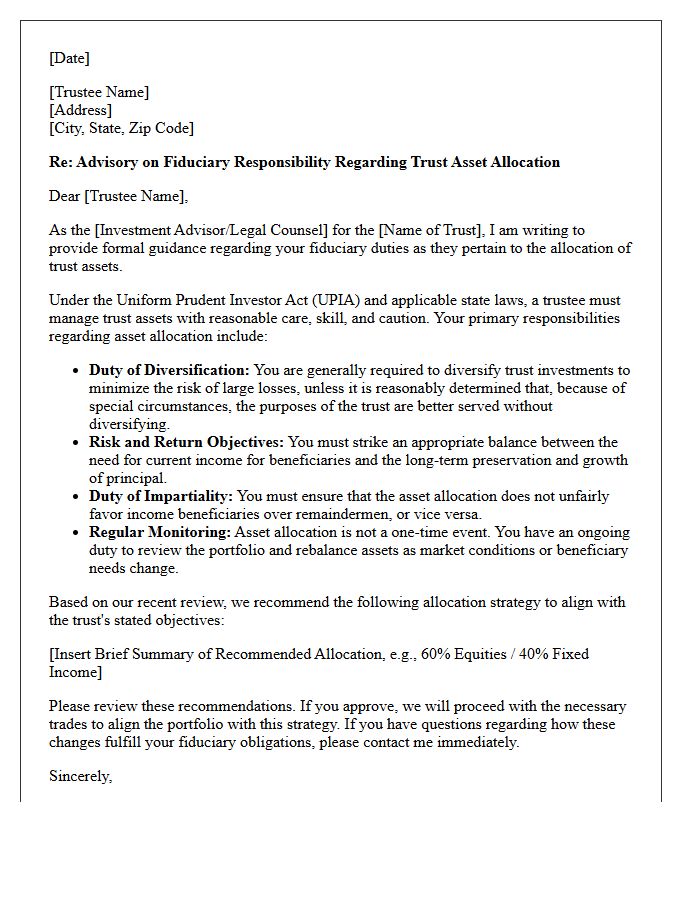
A Fiduciary Responsibility Advisory Letter provides essential guidance for trustees managing trust asset allocation. It emphasizes the legal obligation to balance risk and return while prioritizing the beneficiaries' best interests. This document outlines Prudent Investor Rule standards, ensuring that investment strategies remain diversified and aligned with the trust's specific goals. By following these professional recommendations, fiduciaries can mitigate liability and ensure long-term financial stability for the estate through disciplined portfolio oversight and strategic rebalancing.
Client Asset Protection and Fiduciary Duty Advisory Letter
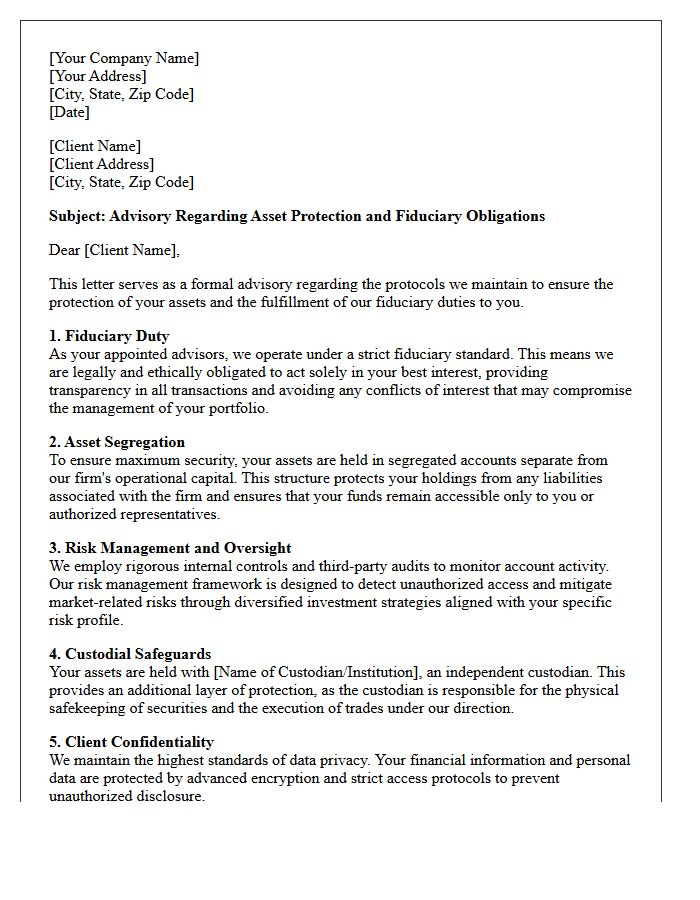
The Fiduciary Duty Advisory Letter is a critical document ensuring your financial interests remain the top priority. It formally outlines the advisor's legal obligation to act with undivided loyalty and care. This communication clarifies Client Asset Protection measures, detailing how your capital is safeguarded against institutional risks. By defining strict standards for transparency and conflict disclosure, the letter establishes a secure framework for managing your wealth. Understanding these protective protocols is essential for verifying that your investment strategy aligns with the highest ethical safeguards and regulatory requirements.
Conflict of Interest Disclosure and Fiduciary Advisory Letter
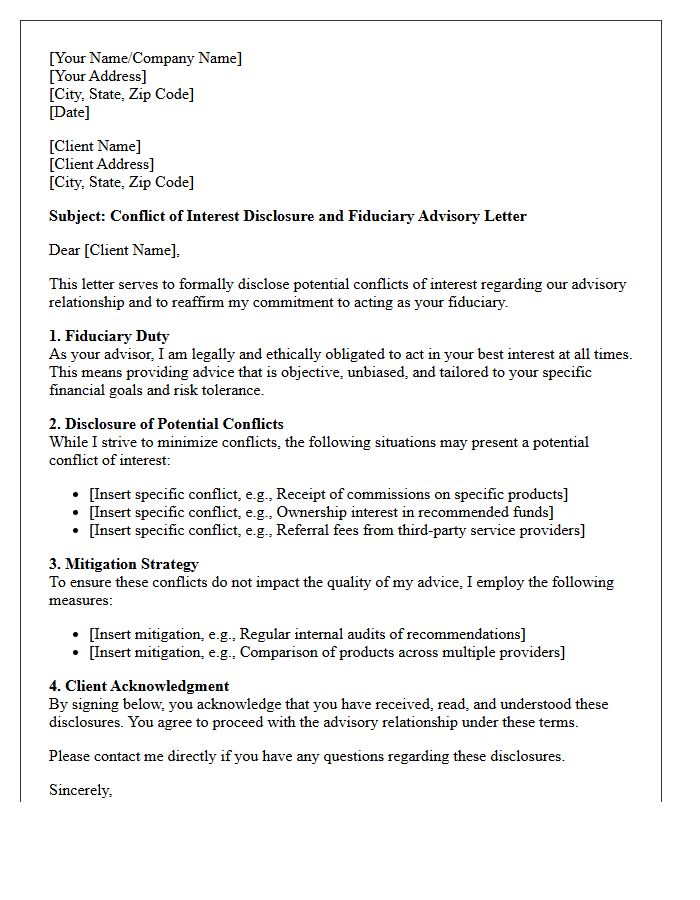
A Conflict of Interest Disclosure is a vital document that identifies potential biases or financial incentives that could compromise an advisor's objectivity. It ensures transparency, allowing clients to make informed decisions. When paired with a Fiduciary Advisory Letter, the advisor legally commits to acting solely in the client's best interest. This combination is essential for establishing trust and ensuring that investment recommendations are based on your financial goals rather than the advisor's personal gain or hidden commissions. Always review these documents to verify a professional's ethical and legal obligations to you.
Fiduciary Responsibility Advisory Letter Regarding Wealth Management Changes
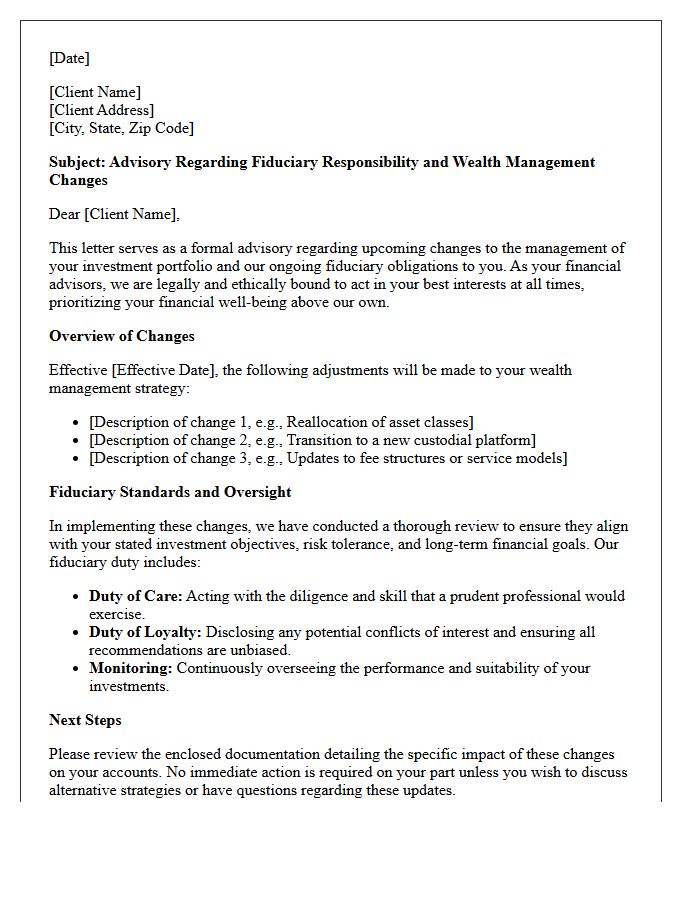
The Fiduciary Responsibility Advisory Letter outlines critical updates for investors regarding wealth management changes. It emphasizes that advisors must prioritize your financial interests above their own, ensuring transparency in fee structures and investment strategies. This document serves as a legal notice that shifts in management protocols or firm policies must adhere to strict ethical standards. Understanding these changes is essential for protecting your assets and verifying that all recommendations remain objective. Reviewing this letter helps you confirm that your portfolio management aligns with current regulatory compliance and fiduciary duties.
Corporate Governance and Fiduciary Compliance Advisory Letter
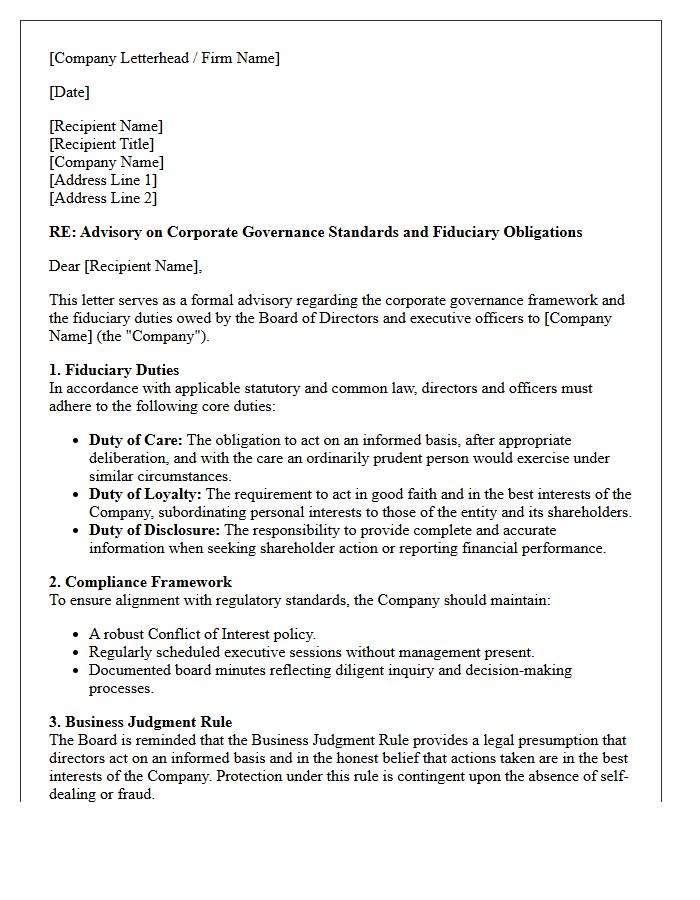
A Corporate Governance and Fiduciary Compliance Advisory Letter is a critical document ensuring board members adhere to their legal obligations. It outlines the duty of care and loyalty required to protect shareholder interests. By identifying potential conflicts of interest and regulatory gaps, the letter mitigates personal liability and litigation risks. This proactive legal instrument establishes transparent decision-making frameworks, ensuring the organization remains compliant with evolving statutory requirements while maintaining high ethical standards and operational integrity within corporate structures.
Fiduciary Responsibility Advisory Letter for Institutional Investors
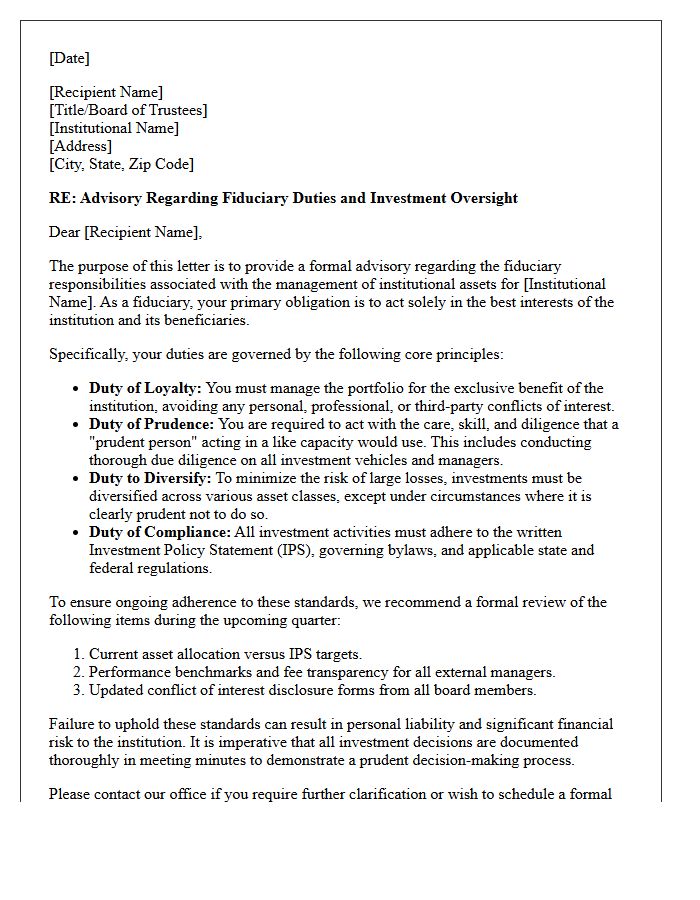
A Fiduciary Responsibility Advisory Letter provides critical guidance for institutional investors to ensure compliance with legal duties. It outlines the standard of care required when managing assets, focusing on loyalty and prudence. These letters help fiduciaries navigate complex investment decisions while mitigating liability risks. By addressing regulatory expectations and ethical frameworks, the letter ensures that trustees act solely in the best interest of beneficiaries, maintaining transparency and long-term financial integrity within the institutional framework.
Banking Compliance and Fiduciary Oversight Advisory Letter
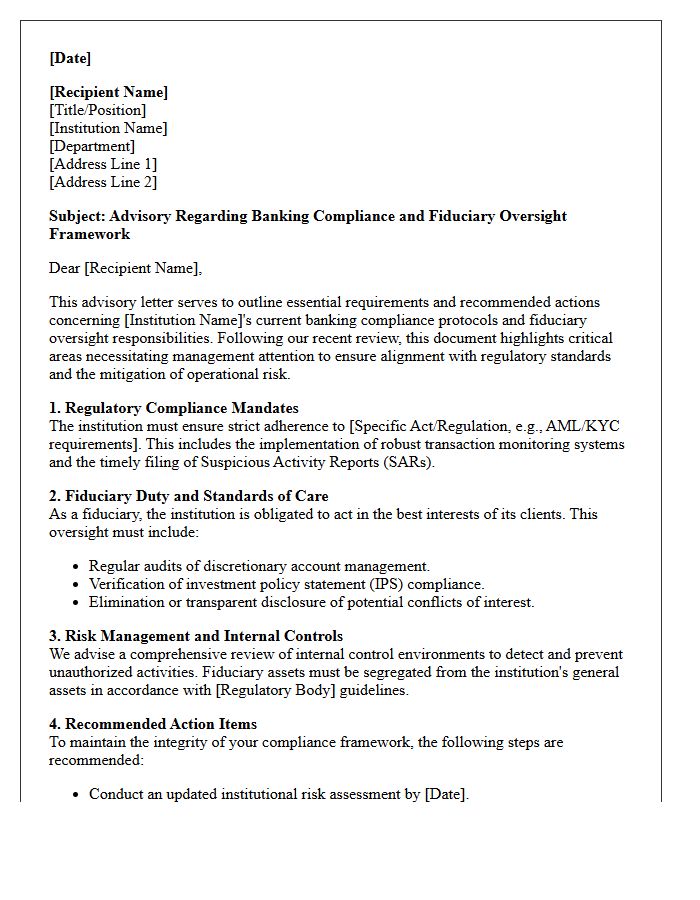
The Banking Compliance and Fiduciary Oversight Advisory Letter provides critical regulatory guidance regarding risk management and ethical standards. It outlines expectations for fiduciary duties, ensuring financial institutions prioritize client interests while maintaining legal transparency. This document serves as a benchmark for governance frameworks, helping firms mitigate operational risks and avoid penalties. By adhering to these directives, banks ensure regulatory alignment and strengthen institutional integrity, fostering trust within the global financial ecosystem. Understanding these requirements is essential for maintaining a compliant and stable investment environment.
Fiduciary Responsibility Advisory Letter on Investment Strategy Adjustments
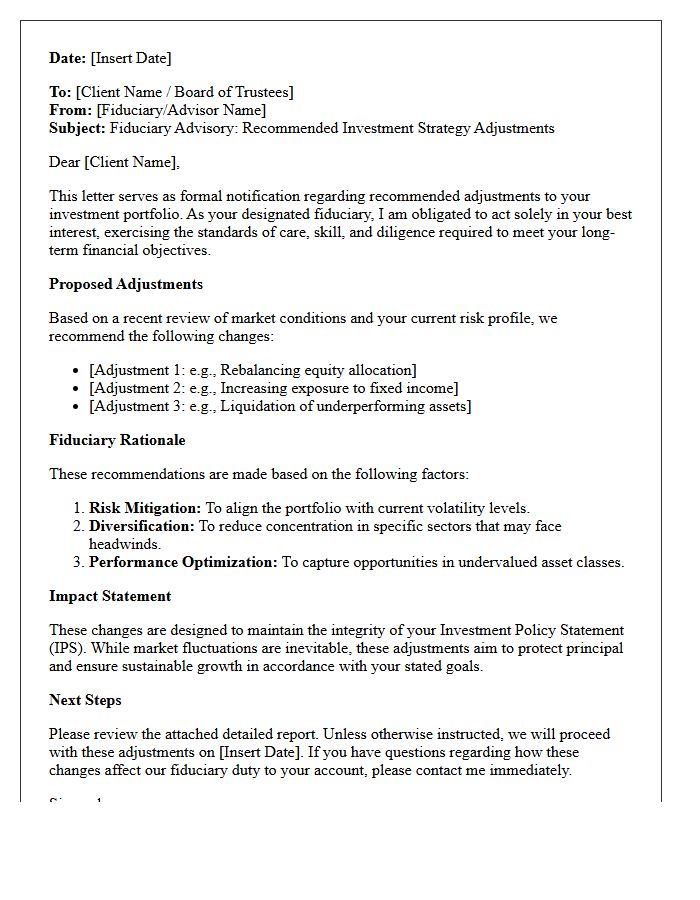
A Fiduciary Responsibility Advisory Letter provides essential guidance for plan sponsors when implementing investment strategy adjustments. It outlines how to maintain compliance with ERISA standards while rebalancing portfolios or changing asset allocations. This document ensures that all modifications prioritize the participants' best interests, documenting the prudent process used to evaluate risk and return. By following these professional recommendations, fiduciaries mitigate legal liability and ensure that strategic shifts align with long-term fiduciary duties and established investment policy statements.
Trustee Fiduciary Obligations and Risk Management Advisory Letter
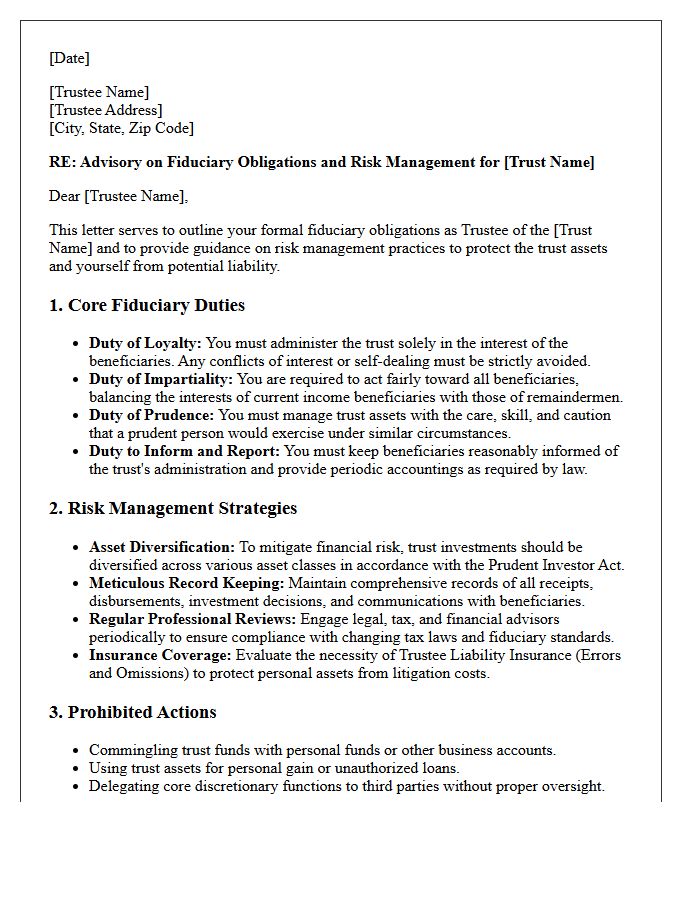
The Trustee Fiduciary Obligations and Risk Management Advisory Letter serves as a critical regulatory guideline for financial institutions. It emphasizes that trustees must uphold a strict fiduciary duty, prioritizing the interests of beneficiaries above all else. The letter outlines essential strategies for risk management, focusing on internal controls, conflict of interest mitigation, and rigorous oversight of investment activities. By adhering to these standards, fiduciaries ensure legal compliance and protect trust assets from operational or ethical failures, maintaining the integrity of the financial system and institutional reputation.
Fiduciary Responsibility Advisory Letter for Portfolio Restructuring
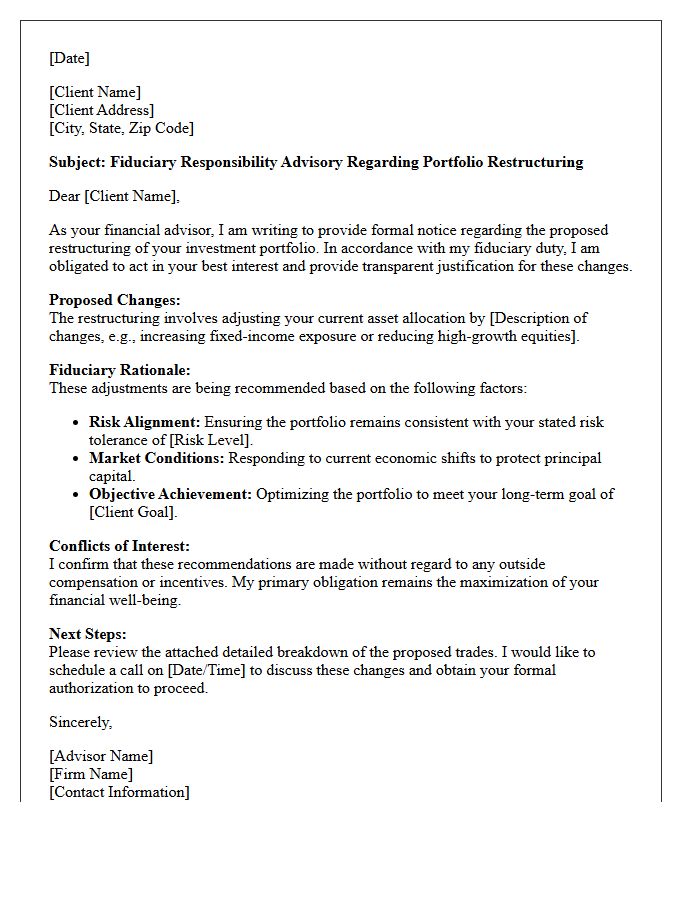
A Fiduciary Responsibility Advisory Letter provides essential legal guidance for institutional investors undergoing portfolio restructuring. This document outlines how fiduciaries must act with prudence and loyalty during asset reallocation to mitigate conflict of interest risks. It serves as a formal record that investment decisions align with the best interests of beneficiaries while adhering to regulatory standards. By documenting the rationale behind structural changes, the letter helps protect trustees from potential liability and ensures full compliance with governing laws throughout the transition process.
Private Banking Fiduciary Duty and Transparency Advisory Letter
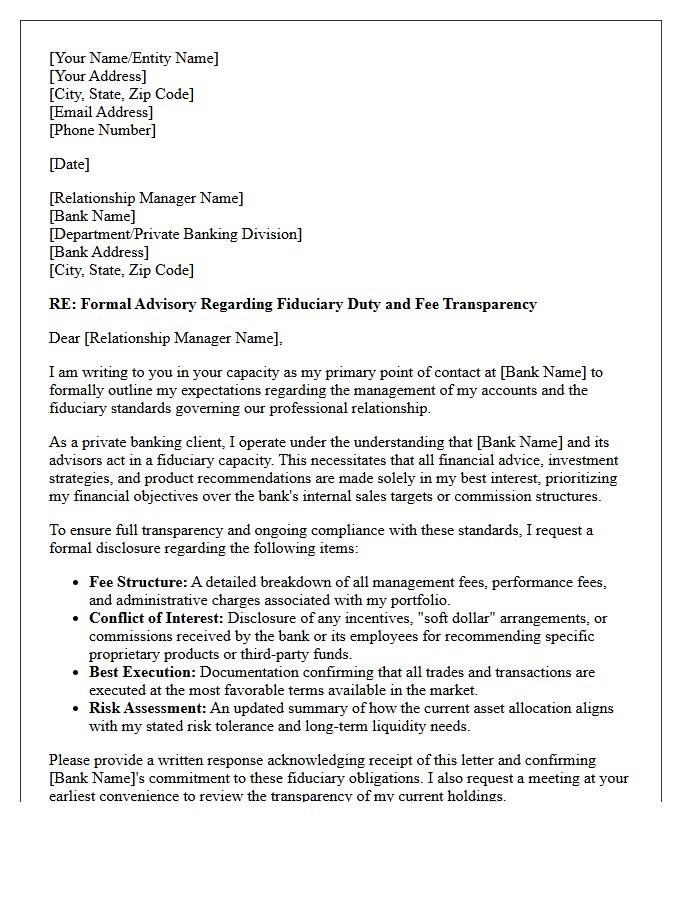
The Private Banking Fiduciary Duty and Transparency Advisory Letter mandates that financial institutions prioritize client interests over profit. This regulatory guidance enforces transparency by requiring clear disclosure of fee structures, potential conflicts of interest, and investment risks. By establishing rigorous ethical standards, the letter ensures advisors provide unbiased recommendations. It serves as a critical framework for protecting high-net-worth individuals, ensuring that wealth management practices remain accountable, legally compliant, and aligned with the highest level of professional integrity within the global financial sector.
Fiduciary Responsibility Advisory Letter on Regulatory Policy Changes
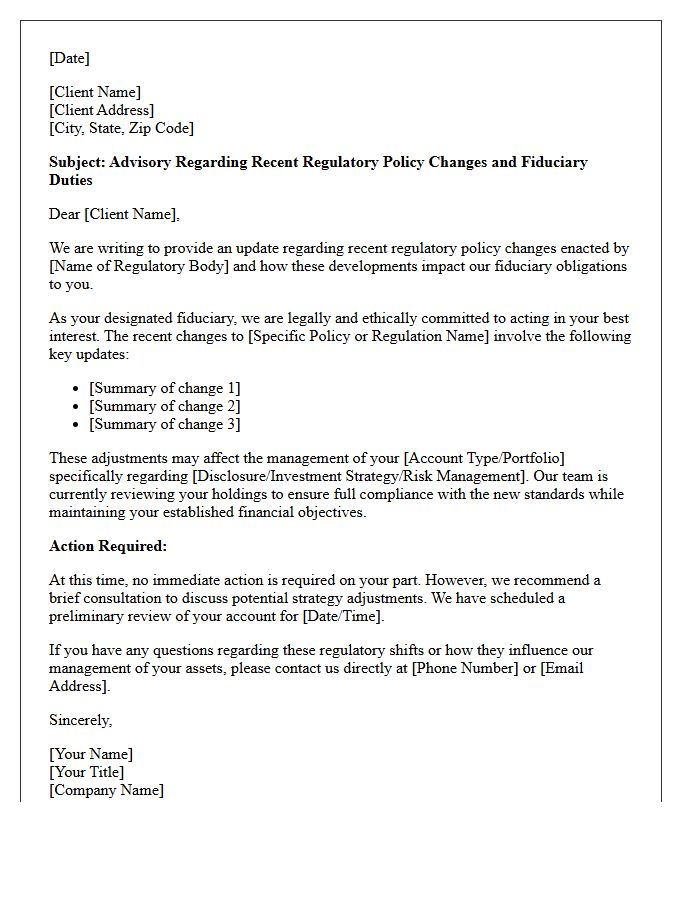
A Fiduciary Responsibility Advisory Letter outlines critical updates regarding regulatory policy changes that impact investment management. These letters provide legal clarity for fiduciaries, ensuring they maintain the highest standards of care and loyalty when navigating shifting compliance landscapes. Key focuses often include adjusted standards for environmental, social, and governance (ESG) factors, reporting requirements, and conflict-of-interest disclosures. Understanding these advisories is essential for risk mitigation, as they help trustees align their strategic decision-making with current federal oversight and statutory obligations to protect beneficiary interests.
Estate Planning and Wealth Transfer Fiduciary Advisory Letter
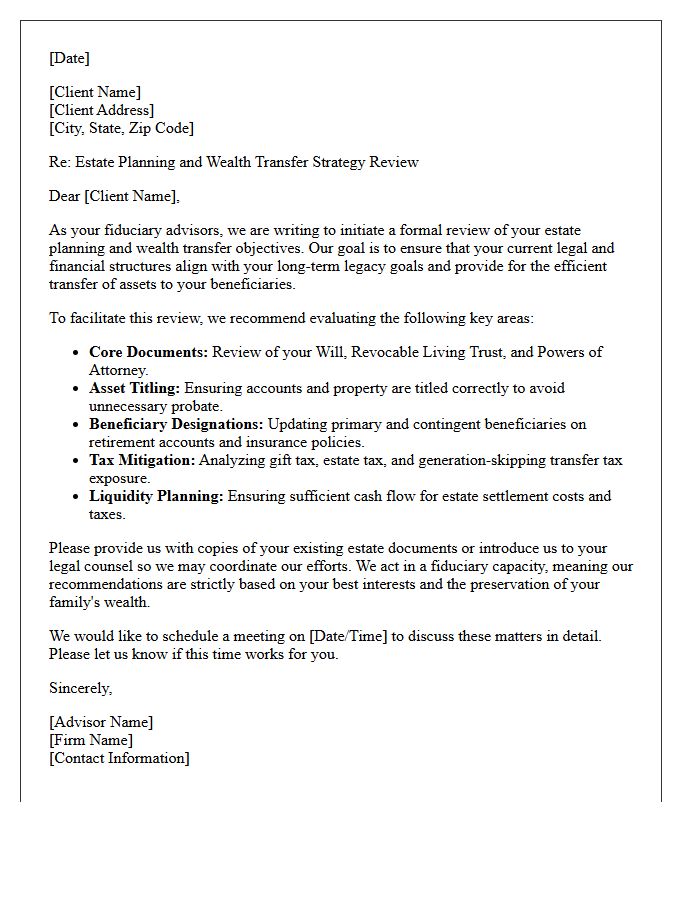
An Estate Planning and Wealth Transfer Fiduciary Advisory Letter is a critical document outlining a fiduciary's legal obligation to act in your best interest. It details strategies for the seamless transition of assets while minimizing tax liabilities. The letter ensures that wealth preservation aligns with your long-term legacy goals and compliance requirements. By formalizing the relationship between advisors and clients, it provides a transparent roadmap for managing beneficiary distributions and complex estate structures, ensuring your financial intentions are executed with professional oversight and complete integrity.
Fiduciary Responsibility Advisory Letter Concerning Third-Party Asset Managers
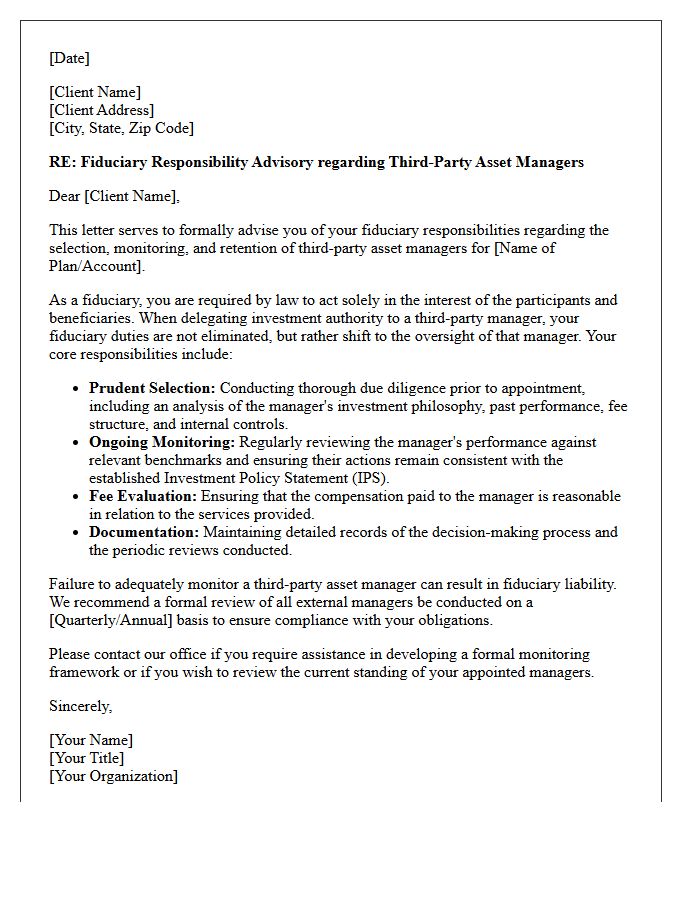
The Fiduciary Responsibility Advisory Letter outlines critical obligations for plan sponsors overseeing third-party asset managers. It emphasizes that delegating investment decisions does not absolve fiduciaries of their duty to monitor performance and fees. Sponsors must ensure prudent selection processes and maintain ongoing oversight to protect participant interests. The letter highlights that failing to address underperformance or excessive costs can lead to legal liability. Ultimately, maintaining a rigorous, documented monitoring framework is essential for compliance with ERISA standards and safeguarding retirement plan assets from mismanagement.
What is a Fiduciary Responsibility Advisory Letter?
A Fiduciary Responsibility Advisory Letter is a formal document issued by legal or financial advisors to notify plan fiduciaries of their specific duties, legal obligations, and potential liabilities under regulations such as ERISA. It serves as a framework for maintaining compliance and documenting that fiduciaries have been properly informed of their roles.
Who needs to receive a Fiduciary Responsibility Advisory Letter?
This letter is typically issued to individuals or entities that exercise discretionary authority over employee benefit plans, retirement assets, or corporate investment strategies. This includes plan sponsors, trustees, investment committee members, and corporate officers who act in a fiduciary capacity.
What are the core components of a Fiduciary Advisory Letter?
The letter generally outlines the "Prudent Expert" standard, the duty of loyalty to participants, requirements for diversifying investments, and the obligation to follow plan documents. It also provides actionable guidance on internal controls, periodic reviews, and the mitigation of conflicts of interest.
How does an Advisory Letter help mitigate fiduciary liability?
By clearly documenting the scope of responsibilities and providing legal guidance, the letter helps establish a "procedural prudence" defense. It demonstrates that the fiduciary has sought professional advice and is actively working to adhere to the high standards of conduct required by law, which can be critical during audits or litigation.
When should a Fiduciary Responsibility Advisory Letter be updated?
The letter should be updated whenever there are significant legislative changes (such as new Department of Labor regulations), changes in the composition of the investment committee, or substantial modifications to the plan's structure. Annual reviews are recommended to ensure the guidance remains aligned with current best practices.


Comments