
Stay ahead of global shifts with our Macroeconomic Trend Impact Advisory Letter. We provide expert analysis on inflation, interest rates, and fiscal policy to help stakeholders navigate market volatility and safeguard investments. Gain actionable insights into how structural economic changes affect your strategic planning and long-term growth. To help you get started, below are some ready to use template.

Image cover: Navigating Market Shifts: Strategic Macroeconomic Advisory Templates and Samples
Letter Samples List
- Inflationary Pressure Portfolio Impact Advisory Letter
- Interest Rate Escalation Commercial Lending Advisory Letter
- Global Supply Chain Disruption Corporate Banking Impact Letter
- Economic Recession Consumer Credit Risk Advisory Letter
- Foreign Exchange Volatility Institutional Banking Advisory Letter
- Housing Market Contraction Mortgage Asset Impact Letter
- Rising Unemployment Retail Banking Risk Advisory Letter
- Geopolitical Trade Sanction Macroeconomic Impact Letter
- Energy Sector Price Volatility Investment Banking Advisory Letter
- Treasury Yield Curve Inversion Strategic Planning Letter
- Macroeconomic Regulatory Tightening Compliance Advisory Letter
- Central Bank Digital Currency Macroeconomic Shift Advisory Letter
- Sovereign Debt Crisis Capital Liquidity Impact Letter
Inflationary Pressure Portfolio Impact Advisory Letter
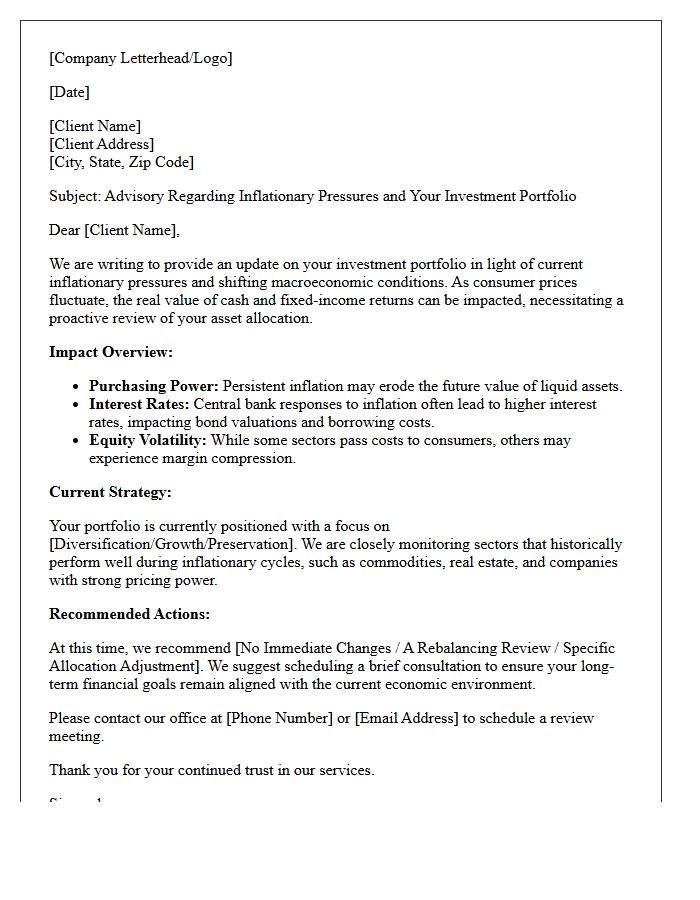
The Inflationary Pressure Portfolio Impact Advisory Letter provides critical insights into how rising prices erode purchasing power. This expert analysis helps investors identify vulnerabilities within their asset allocation, focusing on the negative effects of high consumer indices on fixed-income securities. By highlighting hedging strategies, such as commodities or inflation-protected bonds, the letter serves as a strategic guide for capital preservation. Understanding these macroeconomic shifts is essential for mitigating risk and ensuring long-term portfolio resilience during periods of sustained economic volatility and currency devaluation.
Interest Rate Escalation Commercial Lending Advisory Letter
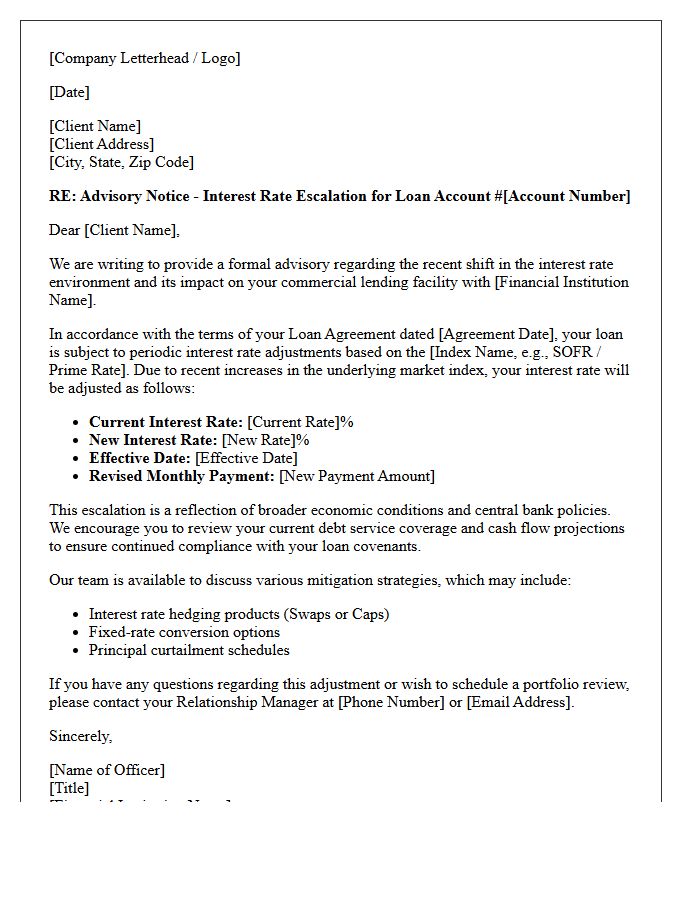
The Interest Rate Escalation Commercial Lending Advisory Letter provides critical guidance for financial institutions managing floating-rate portfolios. It emphasizes the importance of risk management practices during periods of volatile monetary policy. Lenders must conduct rigorous stress testing to evaluate a borrower's ability to service debt as costs rise. Effective strategic planning and transparent communication with clients are essential to mitigate potential defaults. Understanding these regulatory expectations ensures that commercial banks maintain financial stability while navigating complex credit risks associated with fluctuating benchmarks and narrowing interest margins in a shifting economic landscape.
Global Supply Chain Disruption Corporate Banking Impact Letter
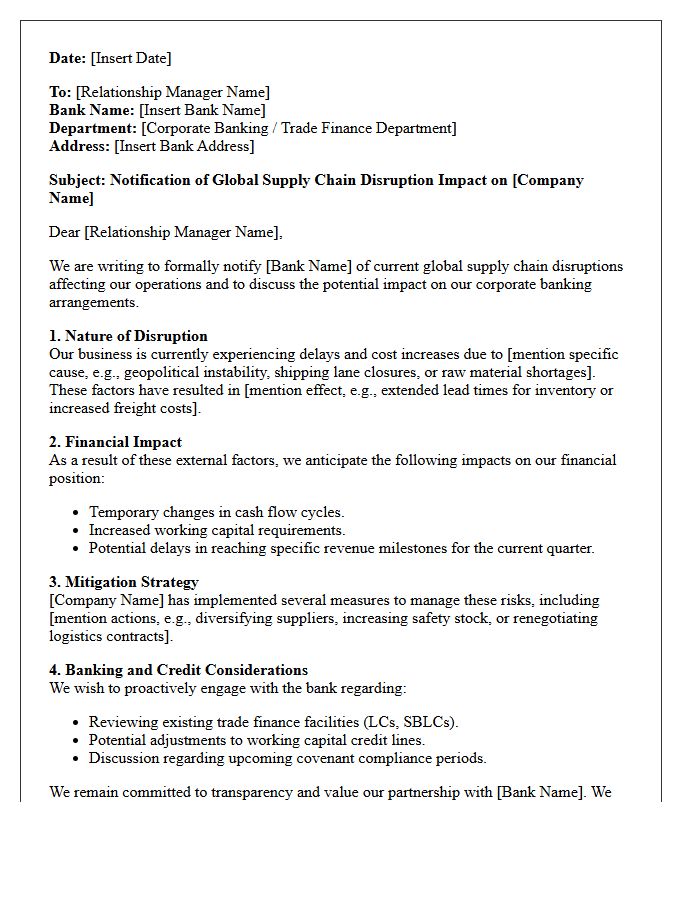
A Global Supply Chain Disruption Corporate Banking Impact Letter informs clients about how logistical bottlenecks affect liquidity management and credit availability. These formal notices outline potential volatility in trade finance costs and operational delays. Banks use these communications to advise corporations on mitigating risks associated with working capital cycles and shifting interest rates. Understanding these updates is essential for maintaining financial stability and ensuring seamless cross-border transactions during periods of economic instability. Corporations must review these terms to adjust their hedging strategies and cash flow projections accordingly.
Economic Recession Consumer Credit Risk Advisory Letter
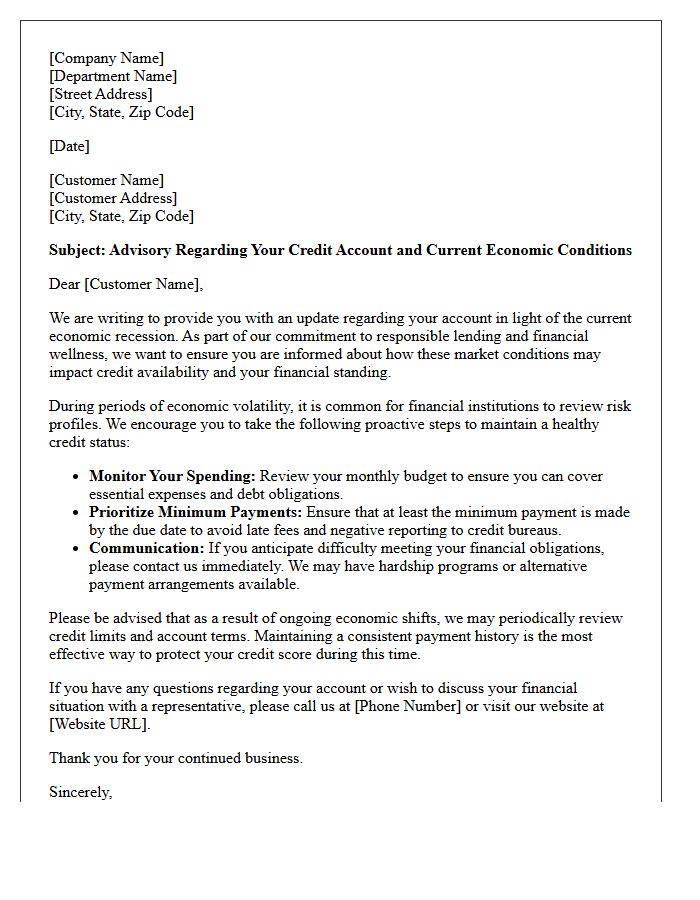
The Economic Recession Consumer Credit Risk Advisory Letter provides critical guidance for financial institutions to manage heightened default threats. It emphasizes proactive portfolio monitoring and rigorous stress testing to maintain capital stability during market downturns. Lenders must evaluate borrower creditworthiness more frequently and adjust risk appetites to mitigate potential losses. This advisory ensures banks remain resilient by implementing robust contingency plans and clear communication strategies. Understanding these regulatory expectations is essential for navigating economic instability while protecting both institutional solvency and consumer financial health.
Foreign Exchange Volatility Institutional Banking Advisory Letter
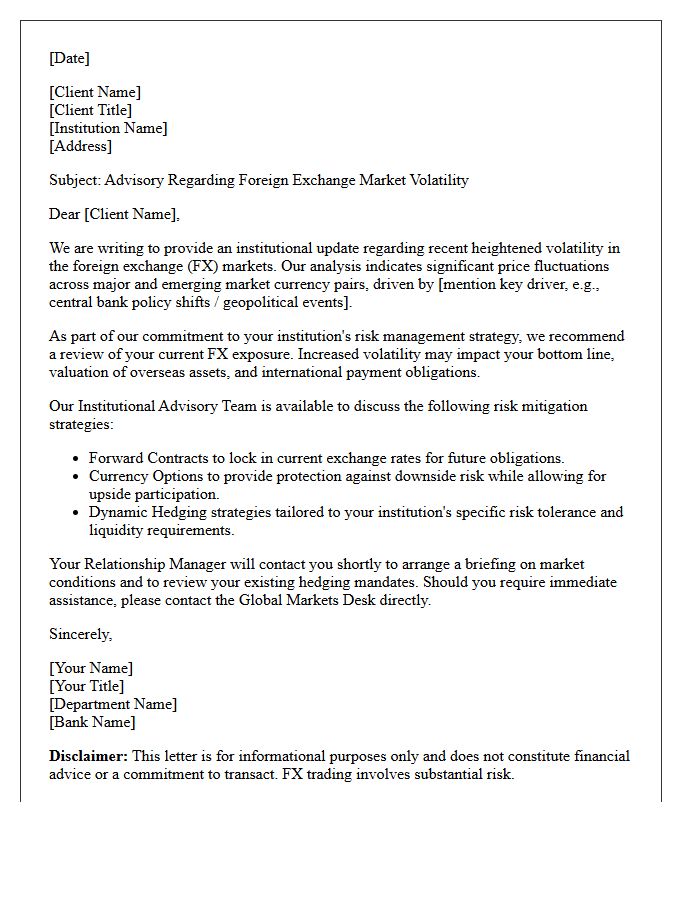
The Foreign Exchange Volatility Institutional Banking Advisory Letter provides critical market intelligence regarding currency fluctuations. It outlines risk management strategies designed for large-scale financial entities to mitigate exposure. This document analyzes liquidity shifts and macroeconomic drivers impacting global exchange rates. Institutional clients rely on these insights to optimize hedging techniques and safeguard capital against unpredictable market swings. Understanding the technical guidance within these letters is essential for maintaining fiscal stability in complex cross-border environments.
Housing Market Contraction Mortgage Asset Impact Letter
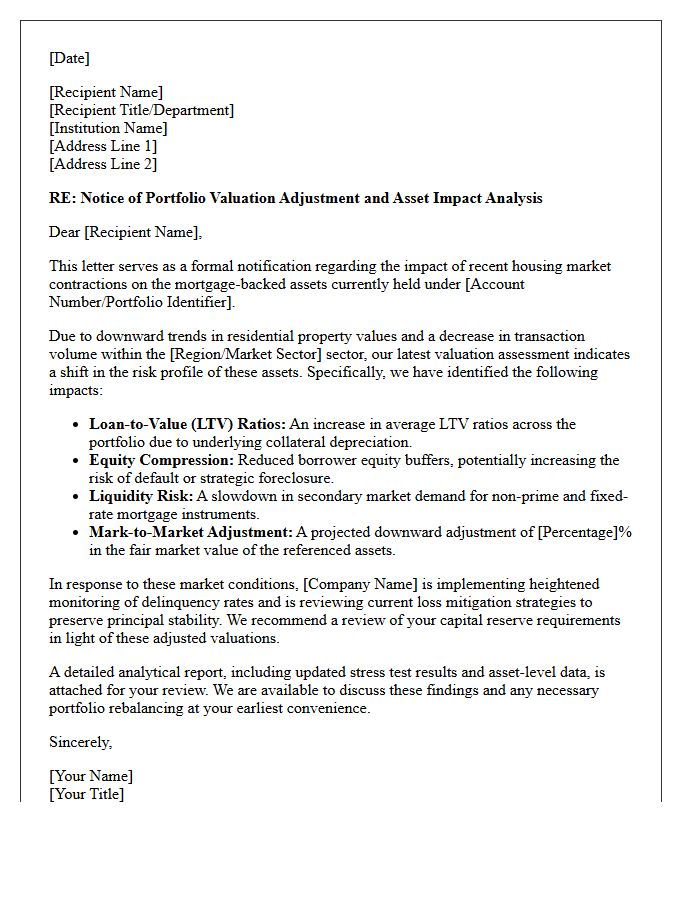
A Housing Market Contraction Mortgage Asset Impact Letter notifies investors and stakeholders about declining collateral values due to economic shifts. This document details how reduced buyer demand and falling home prices affect the performance of mortgage-backed securities. Key components include updated risk assessments, potential credit losses, and adjustments to loan-to-value ratios. Understanding this letter is essential for evaluating portfolio liquidity and anticipating interest rate sensitivities. It serves as a formal communication to manage expectations regarding asset depreciation and strategic shifts in secondary market trading during periods of significant real estate volatility.
Rising Unemployment Retail Banking Risk Advisory Letter
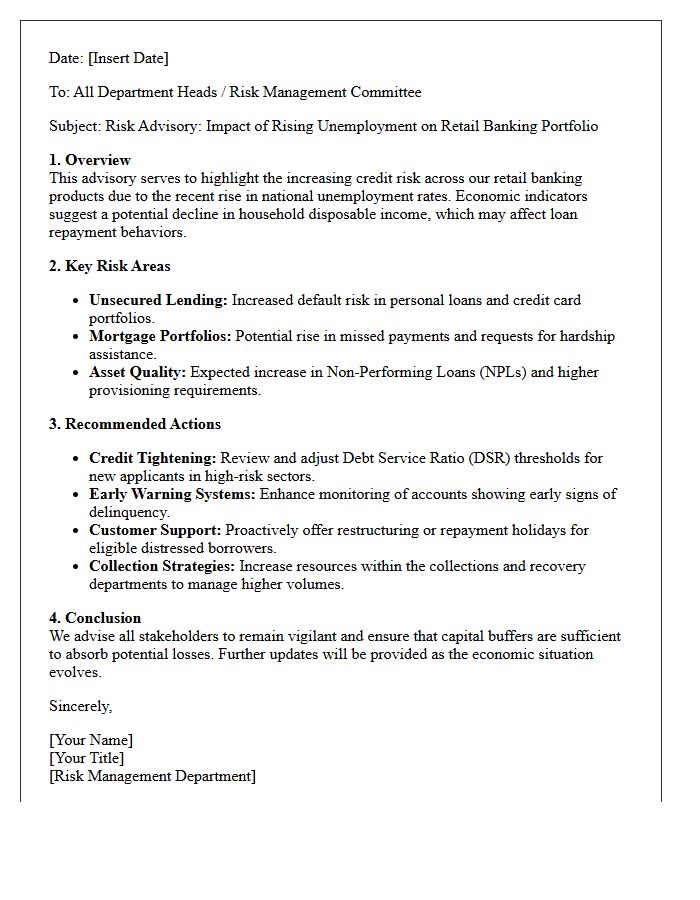
The Rising Unemployment Retail Banking Risk Advisory Letter warns financial institutions about increased credit defaults and liquidity stress. As joblessness climbs, repayment capacity diminishes, necessitating proactive risk mitigation strategies. Banks must enhance their monitoring of unsecured lending portfolios and adjust provisioning levels to maintain stability. This regulatory guidance emphasizes the importance of stress testing and early intervention to offset potential losses from deteriorating economic conditions. Understanding these advisory mandates is essential for ensuring robust portfolio resilience and compliance during periods of significant macroeconomic volatility and labor market instability.
Geopolitical Trade Sanction Macroeconomic Impact Letter
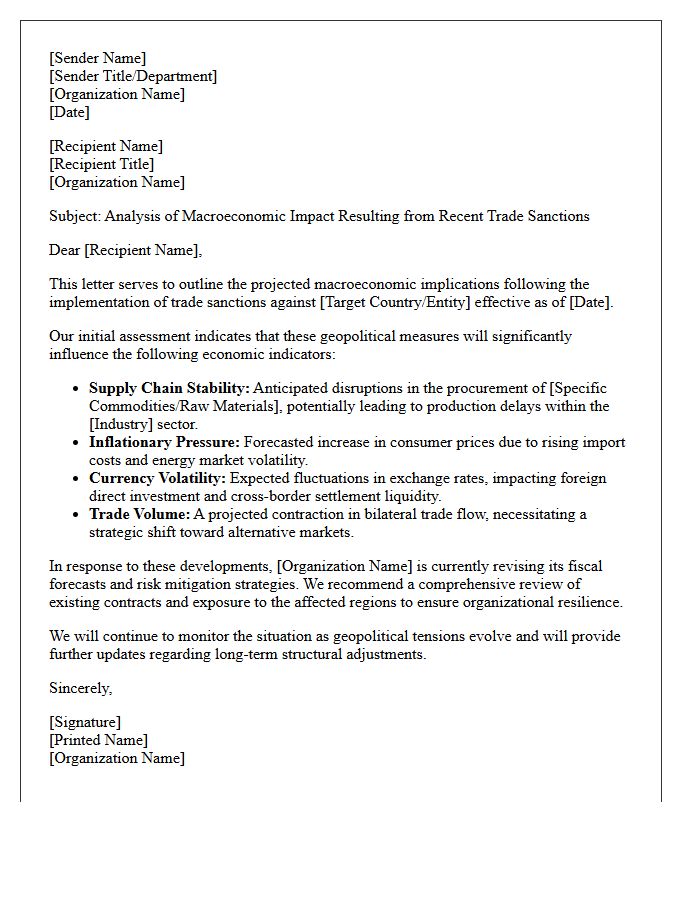
A Geopolitical Trade Sanction Macroeconomic Impact Letter evaluates how restricted trade policies and international sanctions disrupt global supply chains. These documents analyze the economic consequences for domestic markets, including inflation risks and shifts in currency valuation. Investors and policymakers use this data to mitigate exposure to geopolitical volatility. Understanding the macroeconomic impact is essential for strategic planning, as sanctions often lead to increased operational costs and market instability across interconnected financial systems, necessitating proactive risk management and legal compliance within the evolving global trade landscape.
Energy Sector Price Volatility Investment Banking Advisory Letter
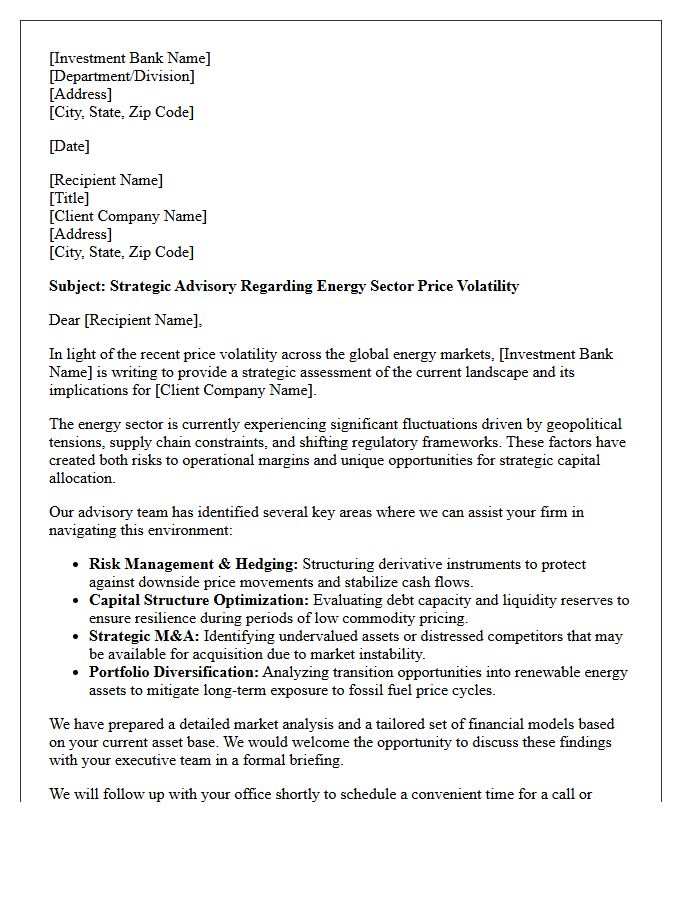
Investment banking advisory letters regarding energy sector price volatility address critical market fluctuations driven by geopolitical shifts and supply chain disruptions. These reports provide strategic risk assessment for institutional investors navigating unpredictable commodity pricing. Advisors emphasize capital preservation through hedging strategies and portfolio diversification. Understanding the correlation between global policy changes and asset valuation is essential for long-term stability. By leveraging deep sector expertise, these letters offer actionable insights to mitigate financial exposure and optimize investment returns during periods of extreme energy market instability and structural transition.
Treasury Yield Curve Inversion Strategic Planning Letter
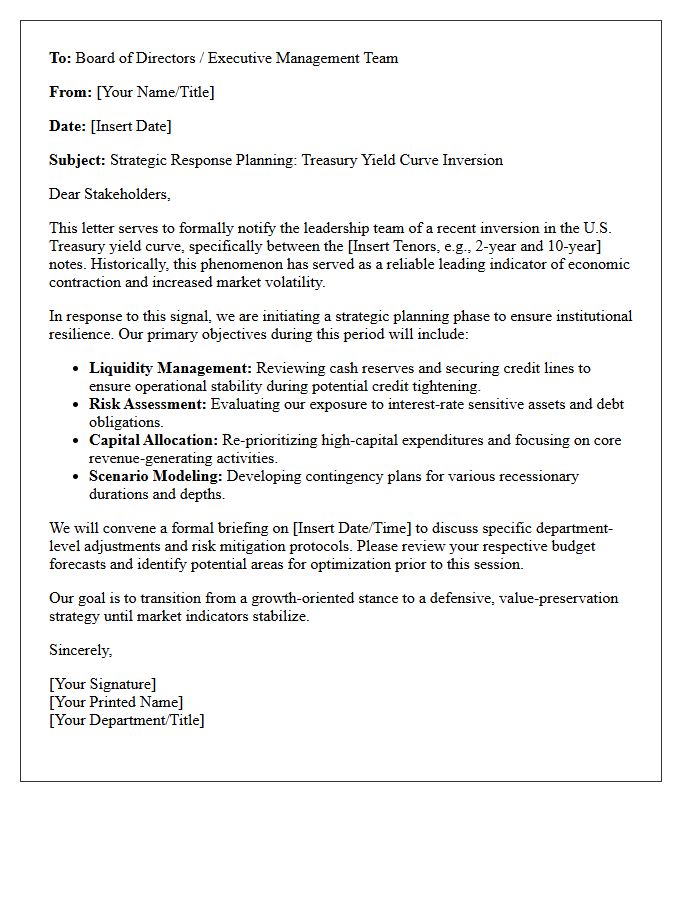
A Treasury Yield Curve Inversion strategic planning letter is a critical tool for navigating economic uncertainty. It outlines proactive measures for when short-term interest rates exceed long-term rates, often signaling an impending recession. This document guides leadership in prioritizing liquidity, risk mitigation, and capital preservation. By analyzing historical trends and market data, the letter helps organizations adjust investment strategies and operational budgets. Understanding this signal allows for informed decision-making to maintain financial stability and identify growth opportunities during periods of high market volatility and shifting monetary policy.
Macroeconomic Regulatory Tightening Compliance Advisory Letter
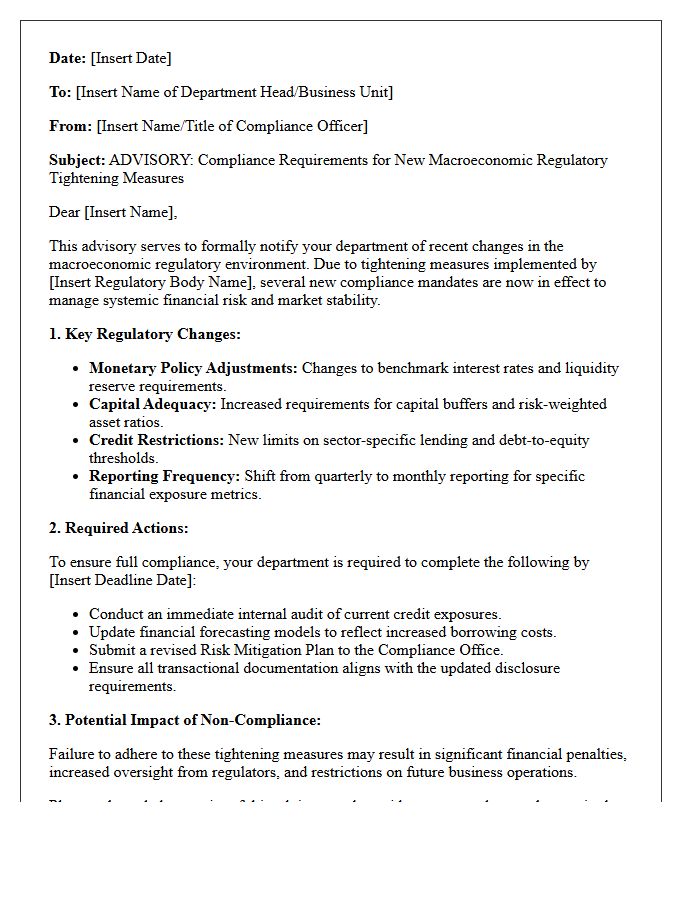
The Macroeconomic Regulatory Tightening Compliance Advisory Letter serves as a critical notification for financial institutions regarding shift changes in fiscal policy. It outlines mandatory alignment with new restrictive measures designed to curb inflation and manage systemic risk. Organizations must prioritize liquidity management and rigorous risk assessment to ensure full adherence to updated capital requirements. Failure to implement these structural adjustments can lead to severe penalties. Proactive monitoring of these regulatory updates is essential for maintaining operational stability during periods of economic contraction and heightened government oversight.
Central Bank Digital Currency Macroeconomic Shift Advisory Letter
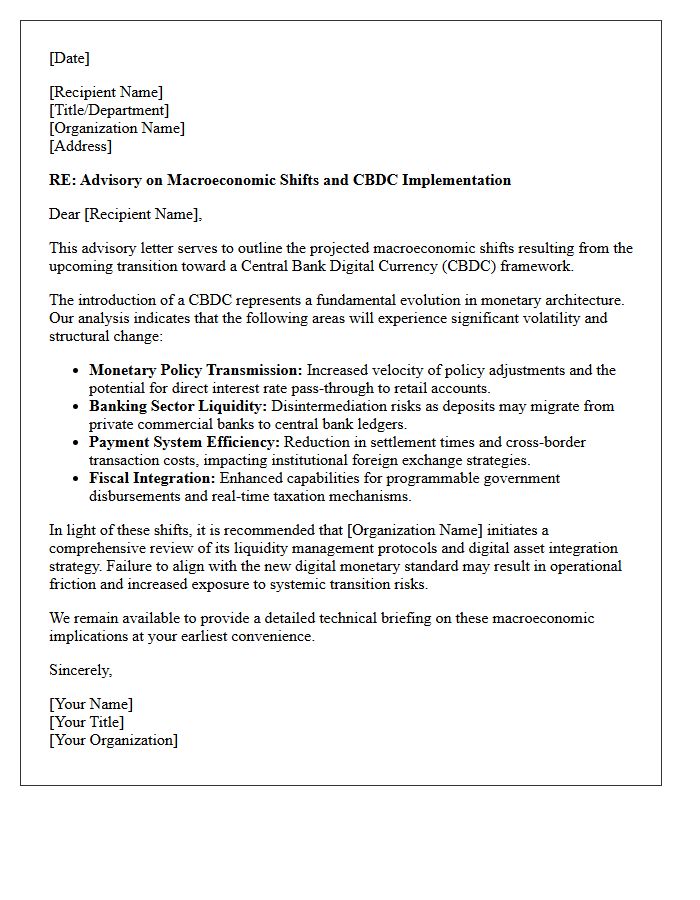
The Central Bank Digital Currency (CBDC) represents a profound macroeconomic shift in monetary policy and financial oversight. This advisory letter outlines how digital currencies issued by central banks streamline cross-border payments, enhance liquidity management, and redefine banking stability. Stakeholders must prepare for increased regulatory transparency and the potential displacement of traditional intermediaries. Understanding these structural changes is essential for maintaining a competitive edge in the evolving global economy, as the transition impacts inflation targeting, fiscal sovereignty, and the future of decentralized finance integration within institutional frameworks.
Sovereign Debt Crisis Capital Liquidity Impact Letter
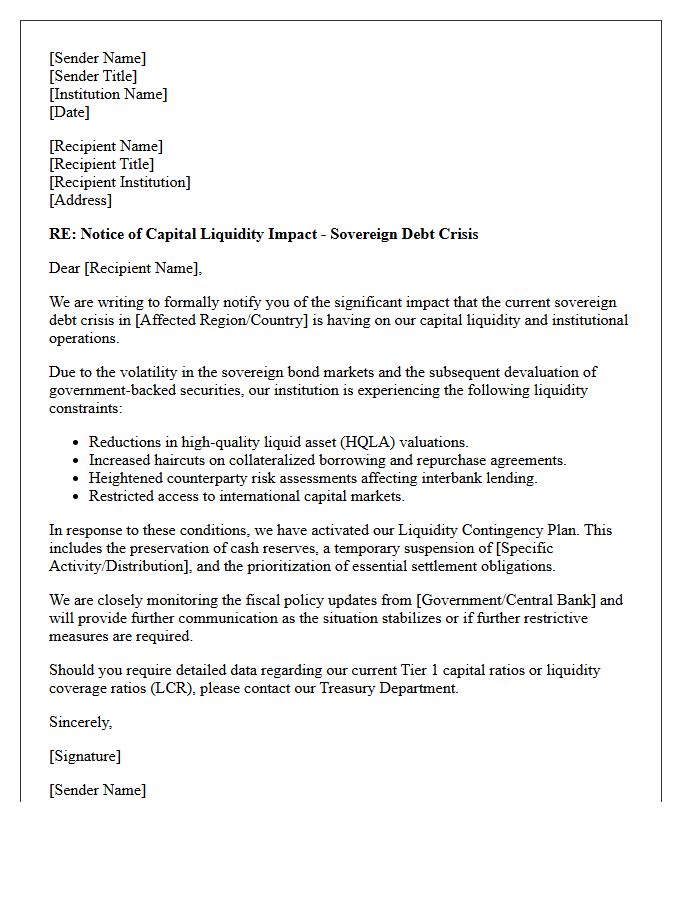
A Sovereign Debt Crisis severely disrupts global financial stability by eroding investor confidence in government bonds. When a nation faces default risk, Capital Liquidity rapidly evaporates as lenders demand higher risk premiums or withdraw funding entirely. This tightening of credit markets forces banks to restrict lending, causing a systemic "liquidity crunch" that hampers economic growth. Understanding this impact is vital for risk management, as the resulting volatility triggers sharp asset devaluations and cross-border financial contagion. Monitoring these fiscal imbalances is essential for anticipating shifts in market solvency and protecting investment portfolios during periods of intense economic distress.
What is a Macroeconomic Trend Impact Advisory Letter?
A Macroeconomic Trend Impact Advisory Letter is a strategic research publication that analyzes global economic shifts-such as inflation rates, monetary policy, and geopolitical events-to provide actionable insights on how these trends will affect specific investment portfolios and business operations.
How often are these advisory letters published?
Most advisory letters are distributed on a monthly or quarterly basis, though "Flash Updates" are often issued immediately following significant economic data releases, such as Federal Reserve interest rate decisions or unexpected GDP fluctuations.
Who can benefit most from subscribing to macroeconomic impact analysis?
This service is primarily designed for institutional investors, corporate executives, and high-net-worth individuals who need to hedge against systemic risks and align their long-term capital allocation with the broader economic cycle.
Does the advisory letter provide specific stock recommendations?
While the letter focuses on top-down macroeconomic analysis, it typically includes sector-specific outlooks and asset class preferences (such as commodities, equities, or fixed income) to help subscribers position their holdings according to current market regimes.
How does macroeconomic forecasting assist in risk management?
By identifying early warning signs of recession, currency devaluation, or stagflation, the advisory letter allows stakeholders to implement defensive strategies, adjust leverage levels, and diversify geographically before market volatility increases.


Comments