
A Subordinated Debt Financing Commitment Letter is a formal agreement where a lender pledges to provide junior capital, which ranks below senior debt during repayment. This document outlines critical terms, interest rates, and subordination clauses essential for complex corporate transactions and leveraged buyouts. It ensures financial backing while defining creditor priorities. Below are some ready to use templates.

Image cover: The Complete Guide to Subordinated Debt Financing Commitment Letters: Samples and Templates
Letter Samples List
- Subordinated Debt Financing Commitment Letter
- Subordinated Debt Mandate And Engagement Letter
- Subordinated Debt Arrangement Fee Letter
- Subordinated Debt Syndication Invitation Letter
- Banking Institution Sponsor Support Letter
- Regulatory Capital Qualification Acknowledgement Letter
- Subordinated Debt Legal Opinion Letter
- Subordinated Debt Funding Disbursement Letter
- Subordinated Debt Covenant Compliance Letter
- Subordinated Debt Condition Precedent Satisfaction Letter
- Subordinated Debt Intercreditor Acknowledgment Letter
- Subordinated Debt Default Waiver Letter
- Subordinated Debt Final Payoff Letter
Subordinated Debt Financing Commitment Letter
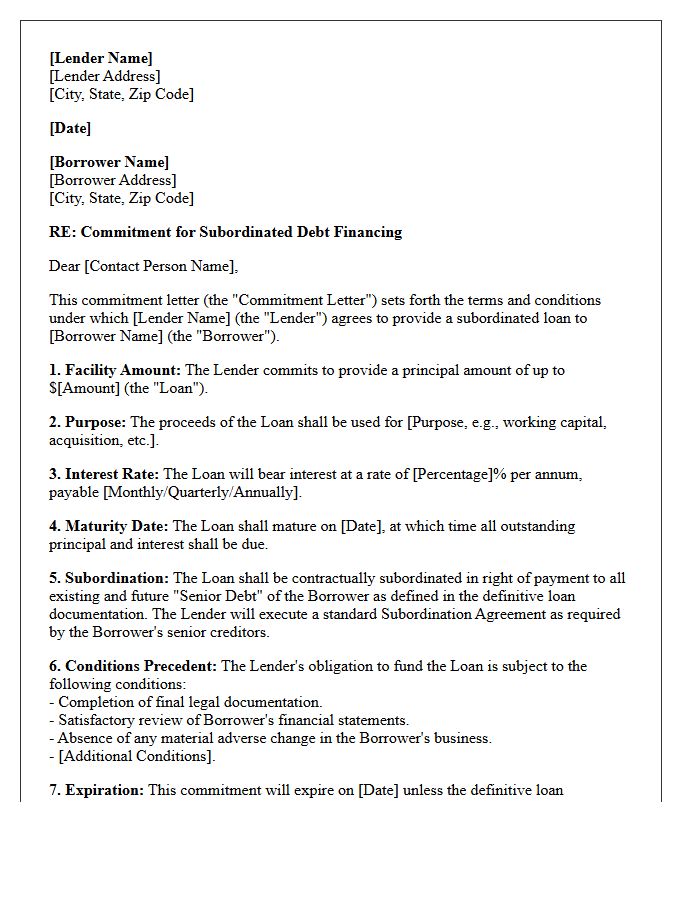
A Subordinated Debt Financing Commitment Letter is a binding agreement where a lender pledges to provide secondary capital for a transaction. Crucially, this debt ranks below senior loans in repayment priority during liquidation. It serves as vital proof of funding for acquisitions, outlining key terms like interest rates, maturity, and subordination provisions. For borrowers, this document demonstrates financial credibility to sellers, while lenders use it to define the specific conditions and contingencies that must be satisfied before the final funding is legally disbursed.
Subordinated Debt Mandate And Engagement Letter
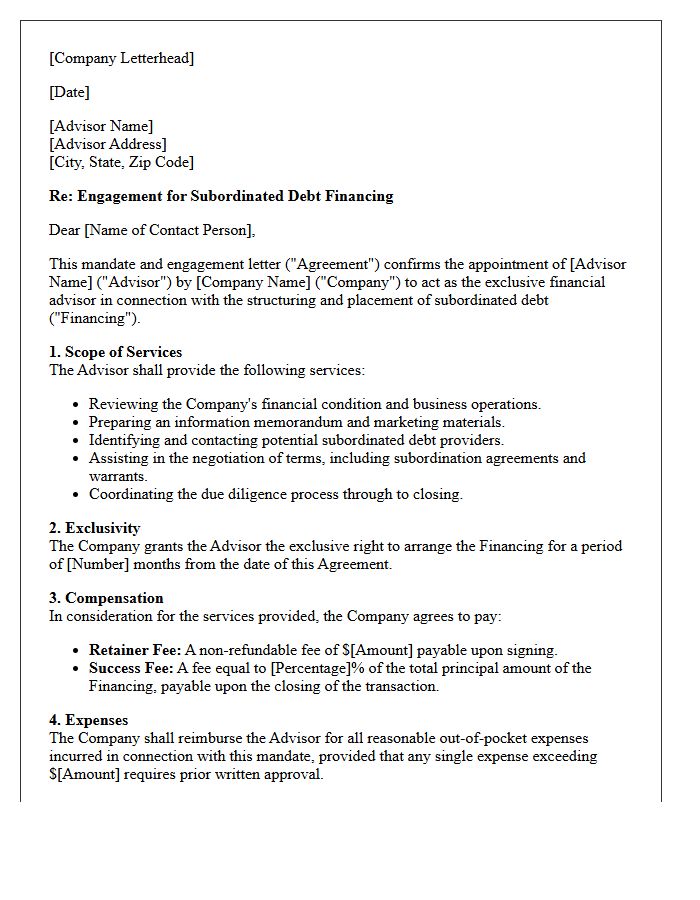
The Subordinated Debt Mandate and Engagement Letter is a critical legal agreement formalizing the relationship between a borrower and a financial advisor. It establishes the exclusive right to structure and place junior capital within a company's capital stack. Key provisions define the scope of services, success-based fee structures, and the advisor's role in identifying institutional lenders. Understanding the ranking of claims is essential, as this debt remains secondary to senior creditors. This document ensures all parties align on terms before approaching the market for complex mezzanine or subordinated financing solutions.
Subordinated Debt Arrangement Fee Letter
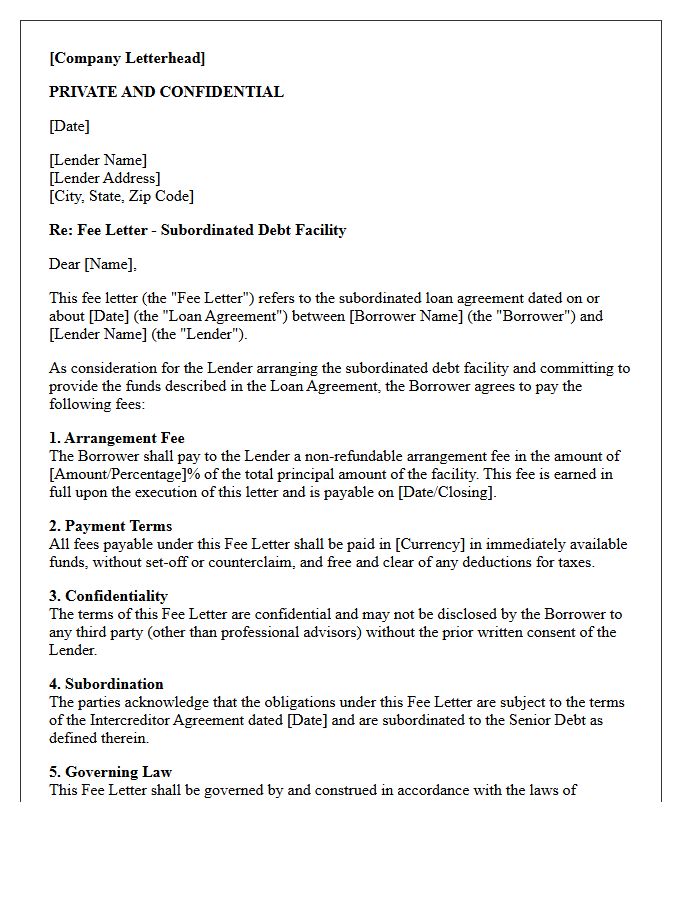
A Subordinated Debt Arrangement Fee Letter is a confidential agreement detailing the compensation paid to lenders for structuring junior financing. It specifies the upfront fees, underwriting costs, and payment schedules separate from the main loan agreement. This document is crucial because it outlines the cost of capital and ensures that fee obligations remain enforceable even if the primary transaction fails to close. Understanding these terms is essential for managing liquidity and overall debt servicing requirements in complex corporate transactions.
Subordinated Debt Syndication Invitation Letter
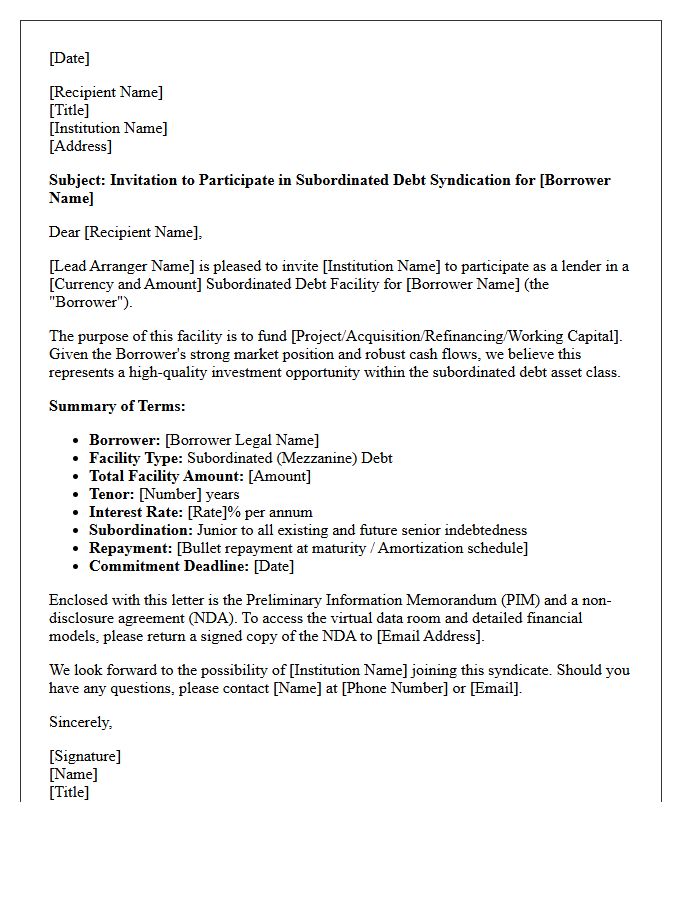
A Subordinated Debt Syndication Invitation Letter is a formal proposal sent to potential lenders to participate in a junior loan facility. It outlines the priority of payment, confirming that this debt ranks below senior obligations during liquidation. The document details key terms such as interest rates, maturity dates, and the specific subordination clause. Investors must evaluate the higher risk profile in exchange for elevated yields. Understanding the intercreditor agreement is essential, as it defines the legal rights and payment hierarchy between different classes of creditors within the syndication structure.
Banking Institution Sponsor Support Letter
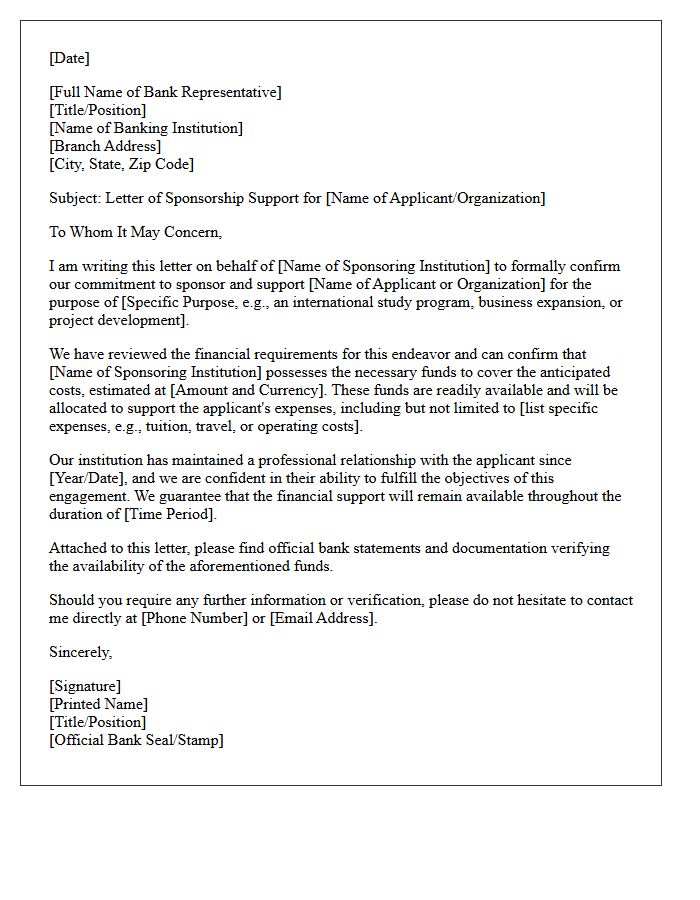
A Banking Institution Sponsor Support Letter is a formal document verifying a sponsor's financial capacity to fund an applicant's endeavors, such as international studies or visa applications. It serves as official evidence that the necessary liquid assets are available and accessible. The letter must be issued on official bank letterhead, including the account holder's name, current balance, and a bank official's signature. Ensuring the currency conversion and date are clear is vital for meeting legal requirements and demonstrating authentic financial stability to immigration or educational authorities.
Regulatory Capital Qualification Acknowledgement Letter
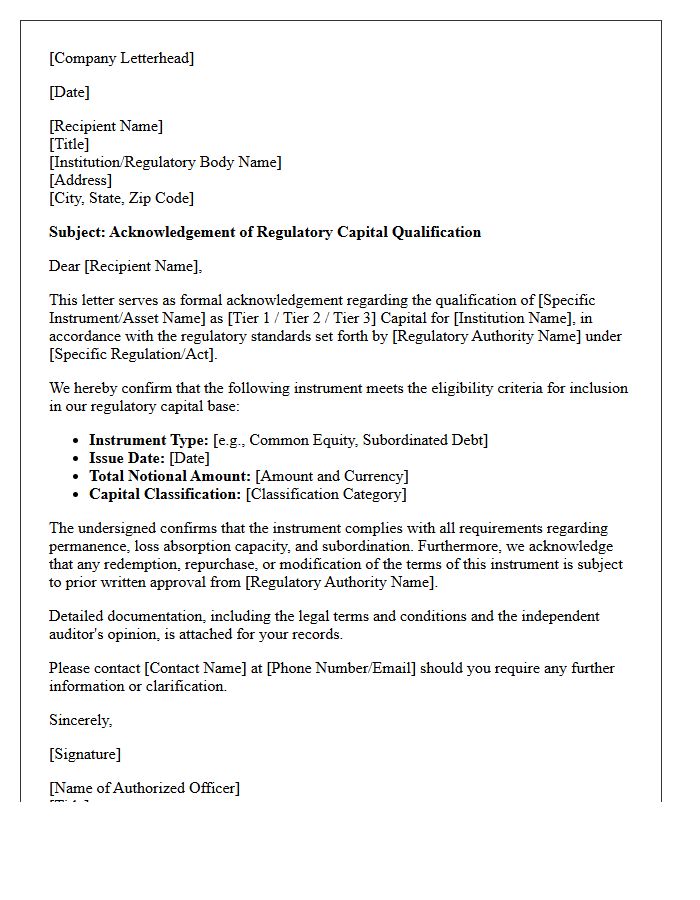
A Regulatory Capital Qualification Acknowledgement Letter is a formal document issued by financial regulators to confirm that a bank's specific financial instrument meets the criteria for Tier 1 or Tier 2 capital. This official validation ensures the capital can be used to satisfy statutory requirements and absorb losses. For financial institutions, receiving this letter is a critical step in regulatory compliance, as it provides the legal certainty needed to strengthen their balance sheets and maintain financial stability according to international banking standards like Basel III.
Subordinated Debt Legal Opinion Letter
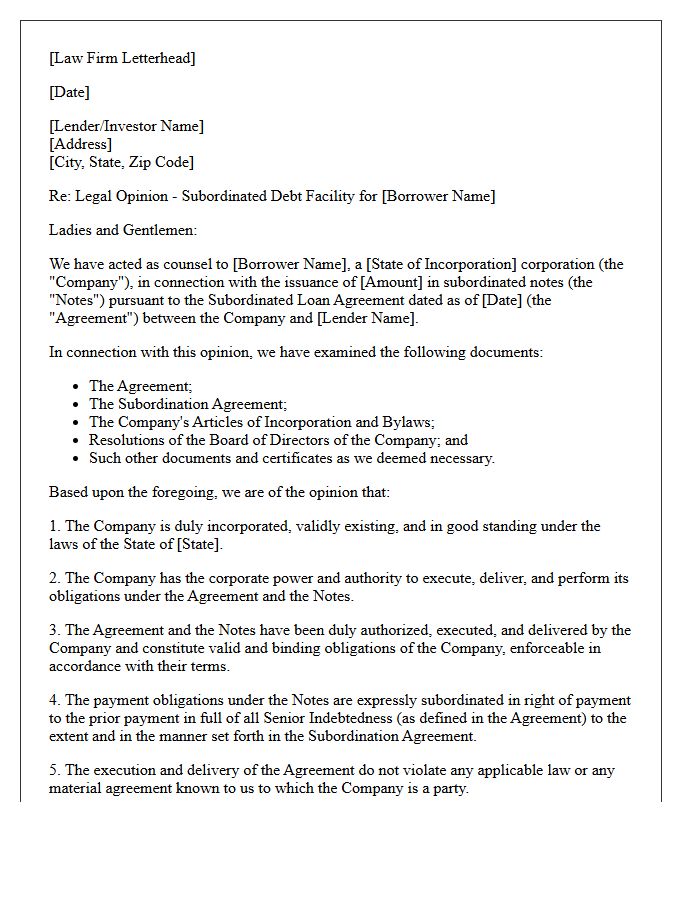
A Subordinated Debt Legal Opinion Letter is a critical document used in corporate finance to confirm the enforceability of debt ranking. It provides formal assurance that specific creditors have agreed to be paid only after senior lenders are satisfied. Counsel verifies the legal authority of the borrower and ensures the subordination clauses comply with governing laws. This letter mitigates risk for senior lenders by validating the priority of claims and ensuring the contractual payment hierarchy is legally binding and valid in the event of a corporate default or liquidation.
Subordinated Debt Funding Disbursement Letter
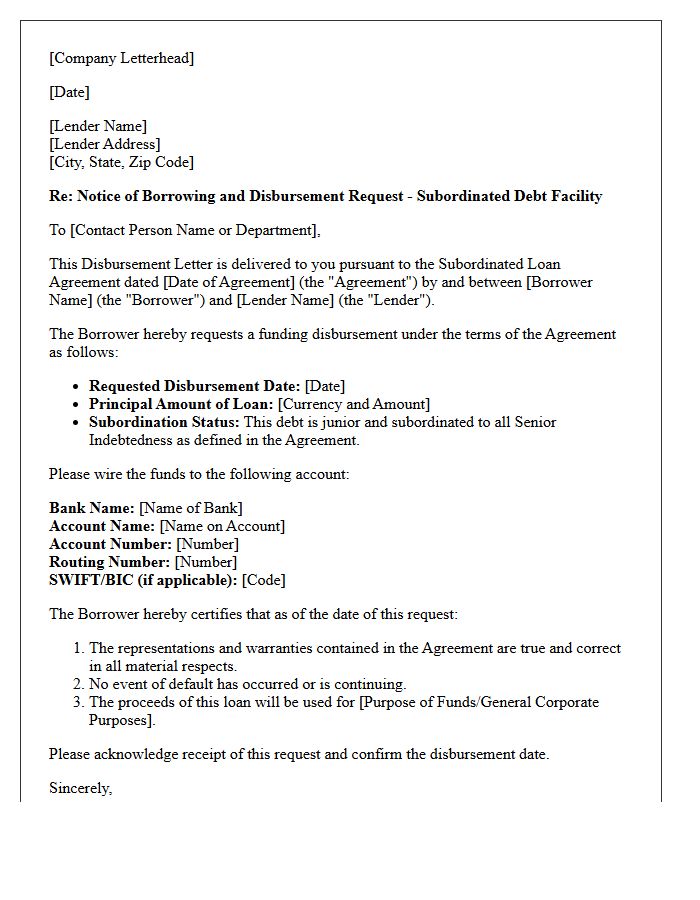
A Subordinated Debt Funding Disbursement Letter is a critical legal document that authorizes the release of loan proceeds while establishing repayment priority. It confirms that the debt ranks below senior obligations, meaning senior lenders are paid first during liquidation. This letter specifies the funding account details, precise disbursement amounts, and necessary closing conditions. For borrowers, it ensures funds are directed correctly; for senior creditors, it provides essential intercreditor protection by formalizing the junior status of the new capital, ensuring clear financial hierarchy and regulatory compliance during the funding process.
Subordinated Debt Covenant Compliance Letter
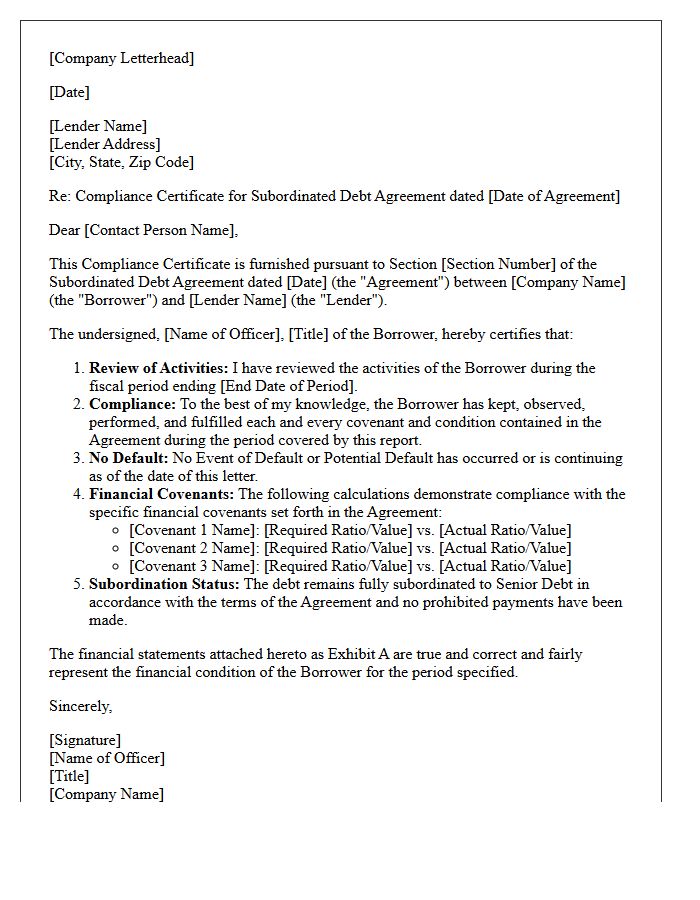
A Subordinated Debt Covenant Compliance Letter is a formal document certifying that a borrower adheres to specific financial restrictions outlined in a junior loan agreement. It ensures the debtor maintains agreed-upon ratios, such as leverage or interest coverage, while acknowledging the priority of senior lenders. This letter provides transparency for creditors regarding the firm's fiscal health and risk profile. Failing to provide this certification can trigger a default, potentially accelerating repayment obligations and impacting the overall capital structure of the business.
Subordinated Debt Condition Precedent Satisfaction Letter

A Subordinated Debt Condition Precedent Satisfaction Letter is a formal document confirming that a junior lender has met all contractual requirements stipulated by senior creditors. This letter acts as a legal trigger, allowing for the disbursement of funds or the activation of specific loan tranches. It ensures that subordination agreements and security interests are properly aligned before financing commences. For borrowers, receiving this letter is a critical milestone in debt restructuring or capital raising, proving that junior debt terms do not conflict with senior lender protections.
Subordinated Debt Intercreditor Acknowledgment Letter
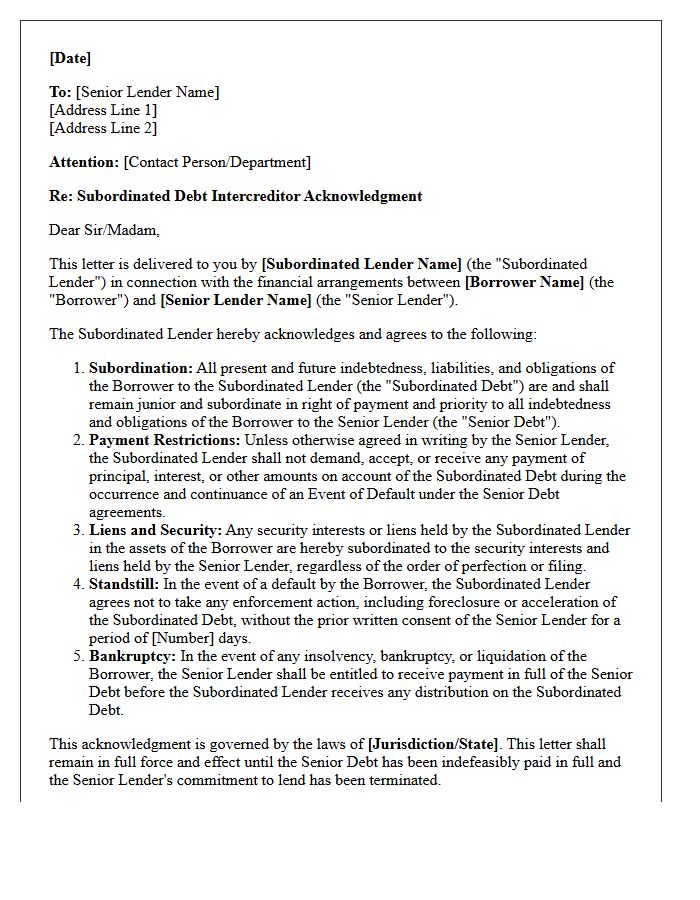
A Subordinated Debt Intercreditor Acknowledgment Letter is a legal document used to establish payment priority between multiple lenders. It formally confirms that the junior creditor agrees to rank behind the senior lender regarding repayment and collateral claims. This prioritization is essential during default or liquidation scenarios to ensure orderly debt recovery. By signing, the subordinated party acknowledges specific standstill provisions and payment restrictions, protecting the senior lender's interests while clarifying the hierarchical structure of the borrower's total debt obligations within a financing arrangement.
Subordinated Debt Default Waiver Letter
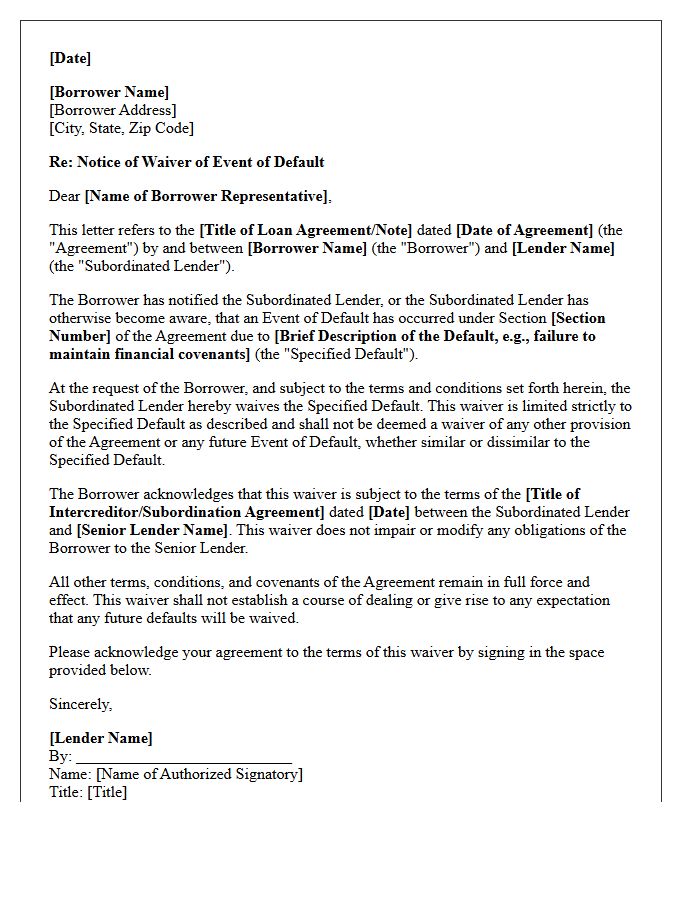
A Subordinated Debt Default Waiver Letter is a formal legal document where a senior lender or creditor agrees to relinquish their right to enforce specific default penalties against a borrower. Since subordinated debt holds lower priority during liquidation, this waiver is essential for maintaining financial stability. It prevents an immediate acceleration of debt repayment, allowing the company to continue operations despite technical or financial covenant breaches. Obtaining this letter is a critical step in debt restructuring and ensuring continued liquidity without triggering a total insolvency event.
Subordinated Debt Final Payoff Letter
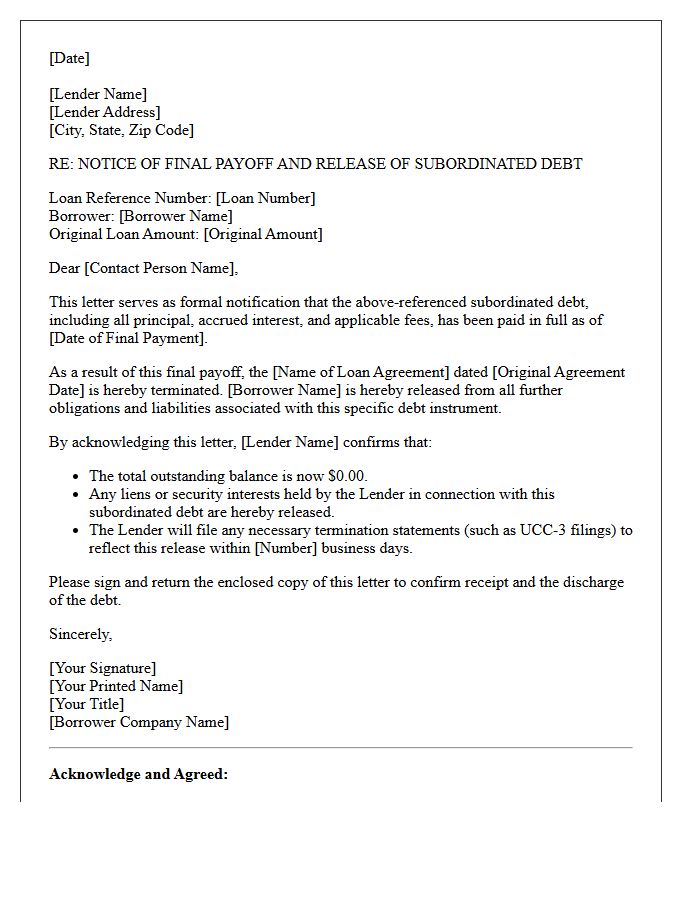
A Subordinated Debt Final Payoff Letter is a legal document confirming the complete repayment of a junior loan. Its primary purpose is to formally extinguish the debt obligation and release any remaining liens or claims held by the lender. Obtaining this letter is essential for borrowers to clear their balance sheets and improve creditworthiness. It serves as definitive proof that the subordination agreement is terminated, allowing senior creditors or future investors to verify that the junior liability has been satisfied in full according to the agreed terms.
What is a Subordinated Debt Financing Commitment Letter?
A Subordinated Debt Financing Commitment Letter is a legally binding agreement where a lender commits to providing junior debt capital to a borrower, typically specifying that the repayment rank is below senior debt obligations in the event of default or liquidation.
What are the typical conditions precedent in a subordinated debt commitment?
Common conditions precedent include the successful closing of a senior credit facility, completion of satisfactory financial due diligence, execution of a formal intercreditor agreement, and the absence of any material adverse change (MAC) in the borrower's financial position.
How does an intercreditor agreement impact a subordinated debt commitment?
The intercreditor agreement is a critical component that defines the relationship between senior and subordinated lenders, outlining "standstill" periods, payment blockage notices, and the specific subordination of liens and payment rights.
Is a Subordinated Debt Financing Commitment Letter legally binding?
Yes, provided it contains essential terms such as the loan amount, interest rate, and maturity date. However, the obligation to fund is usually subject to the "flex" provisions and the execution of definitive long-form loan documentation.
What is the difference between a highly confident letter and a commitment letter?
A commitment letter represents a firm legal obligation by the lender to provide funds under specific terms, whereas a highly confident letter is a non-binding statement expressing the lender's opinion that they can successfully arrange the financing.


Comments