
A Foreign Account Tax Compliance Act (FATCA) Status Declaration Letter is a formal document used by non-U.S. entities to certify their tax residency and compliance status to financial institutions. This letter ensures adherence to international reporting standards and helps avoid mandatory withholding taxes on cross-border payments. To simplify your compliance process, below are some ready to use template.
Image cover: FATC Declaration: Official Status Letter Samples and Templates
Letter Samples List
- Individual FATCA Status Declaration Letter
- Corporate Entity FATCA Status Declaration Letter
- Foreign Financial Institution FATCA Status Declaration Letter
- Non-Financial Foreign Entity FATCA Status Declaration Letter
- Exempt Beneficial Owner FATCA Status Declaration Letter
- Non-Participating Financial Institution FATCA Status Declaration Letter
- Participating Foreign Financial Institution FATCA Status Declaration Letter
- United States Person FATCA Status Declaration Letter
- Non-United States Citizen FATCA Status Declaration Letter
- Joint Banking Account FATCA Status Declaration Letter
- Sponsored Investment Entity FATCA Status Declaration Letter
- Complex Trust Account FATCA Status Declaration Letter
Individual FATCA Status Declaration Letter
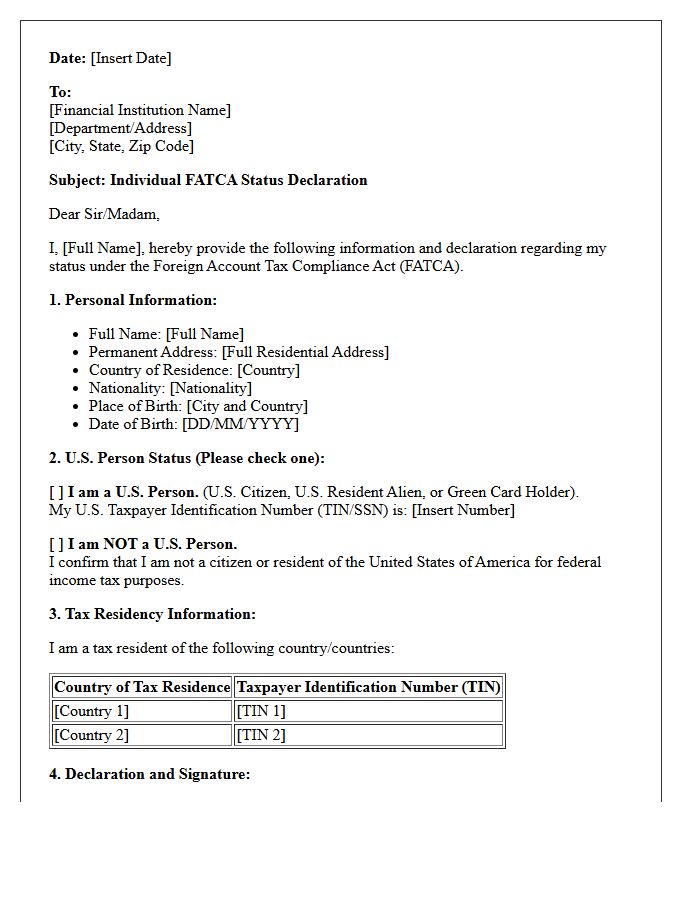
An Individual FATCA Status Declaration Letter is a mandatory document used by financial institutions to identify tax residency. Under the Foreign Account Tax Compliance Act, individuals must disclose if they are U.S. persons for tax purposes. This form helps prevent international tax evasion by ensuring that relevant account information is reported to the IRS. Providing accurate details regarding your citizenship and residency is essential to maintain compliance and avoid potential account restrictions or withholding penalties during the onboarding process or periodic reviews.
Corporate Entity FATCA Status Declaration Letter
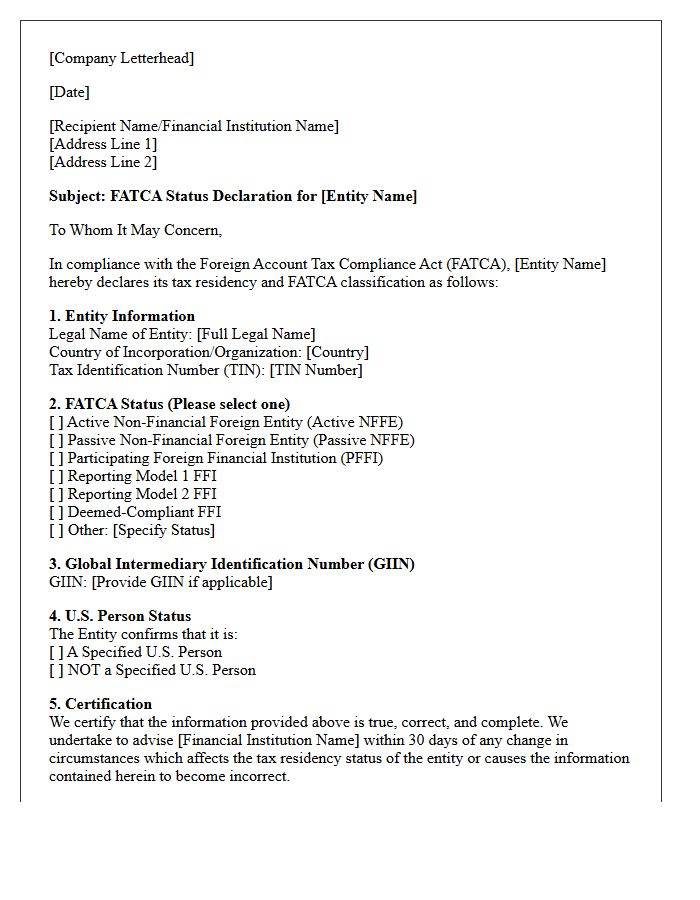
A Corporate Entity FATCA Status Declaration Letter is a vital document used to confirm an organization's tax residency and classification under the Foreign Account Tax Compliance Act. This letter helps financial institutions determine if a business is a Specified U.S. Person or a Foreign Financial Institution. Providing an accurate declaration is essential to avoid mandatory withholding taxes on offshore income and ensure full regulatory compliance. It serves as a formal self-certification, detailing the entity's global tax obligations and preventing potential penalties during international financial transactions.
Foreign Financial Institution FATCA Status Declaration Letter
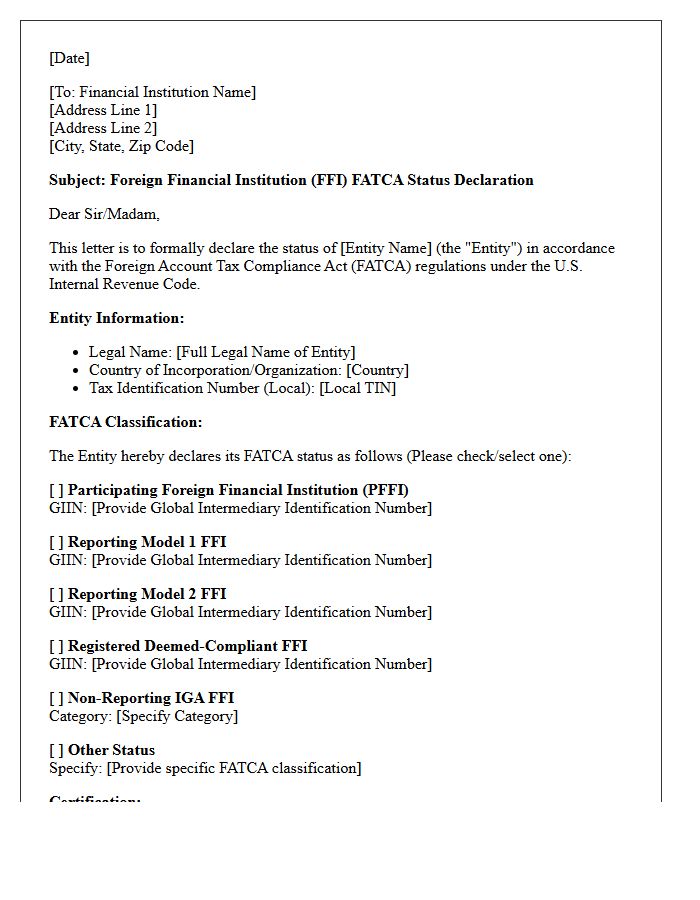
A Foreign Financial Institution (FFI) FATCA Status Declaration Letter is a formal document used to certify an entity's classification under the Foreign Account Tax Compliance Act. It allows organizations to confirm their compliance status to withholding agents or counterparties, helping to avoid the mandatory 30% federal tax penalty on US-source income. The letter typically includes the entity's Global Intermediary Identification Number (GIIN) and specific chapter 4 status. Providing this declaration ensures transparency in international financial transactions and maintains seamless global banking relationships by verifying tax residency and reporting obligations.
Non-Financial Foreign Entity FATCA Status Declaration Letter
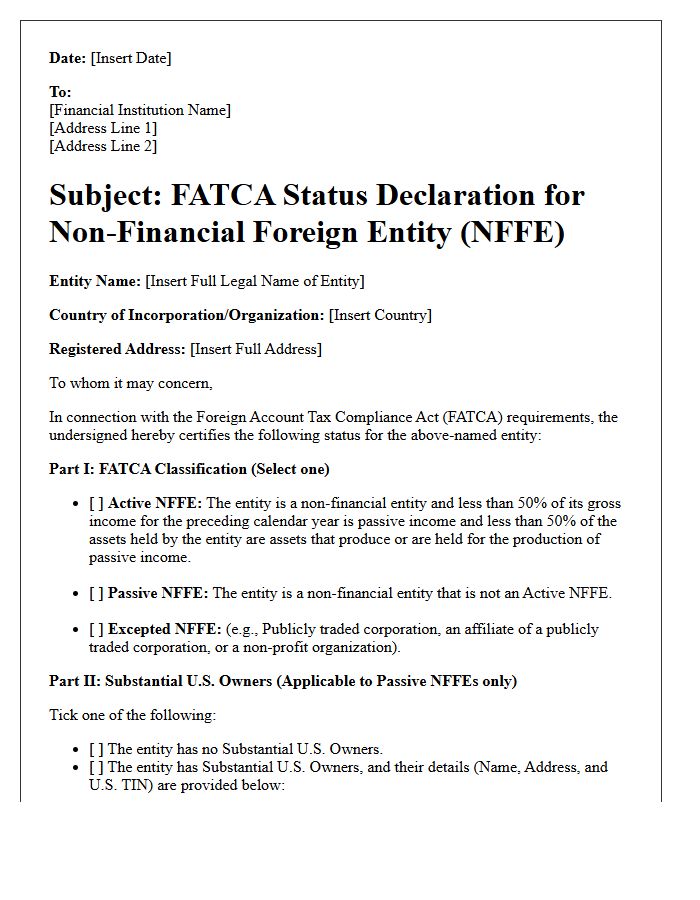
A Non-Financial Foreign Entity (NFFE) FATCA Status Declaration Letter is a critical document used by non-U.S. organizations to certify their tax residency and compliance with the Foreign Account Tax Compliance Act. This letter helps financial institutions determine if an entity is an Active NFFE, typically engaged in regular business, or a Passive NFFE, which primarily earns investment income. Providing an accurate declaration is essential to avoid withholding taxes on U.S. source payments and ensures seamless international banking operations by confirming the entity's specific classification under global regulatory frameworks.
Exempt Beneficial Owner FATCA Status Declaration Letter
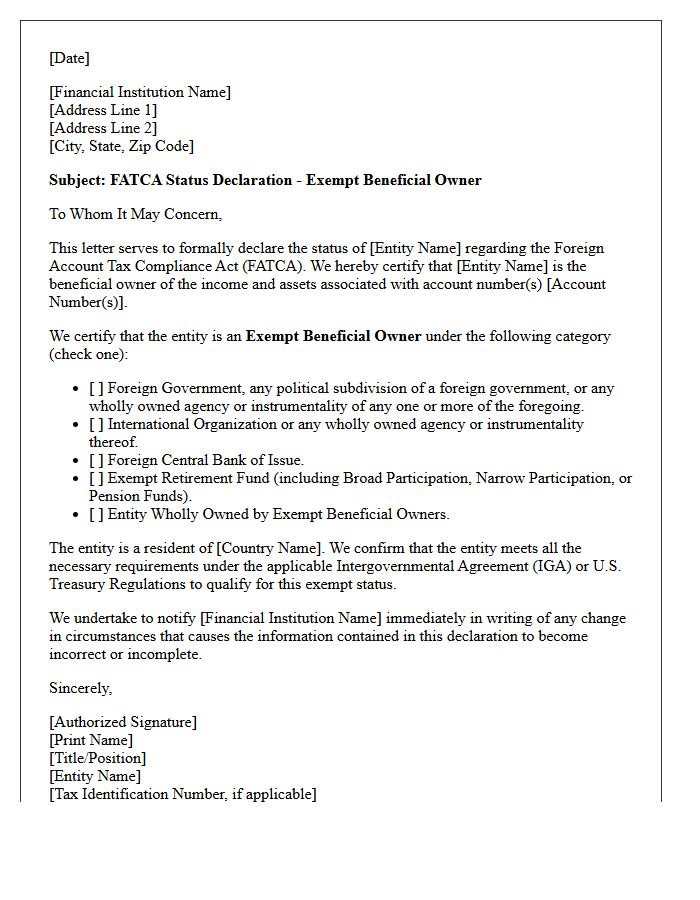
An Exempt Beneficial Owner FATCA Status Declaration Letter is a formal document used by entities to certify their exemption from U.S. tax withholding and reporting requirements. This letter confirms that the entity qualifies for exempt status under the Foreign Account Tax Compliance Act, typically applying to foreign governments, international organizations, or retirement funds. Providing this declaration helps financial institutions verify your tax-exempt classification, preventing unnecessary tax deductions and ensuring global regulatory compliance during cross-border financial transactions and account maintenance.
Non-Participating Financial Institution FATCA Status Declaration Letter
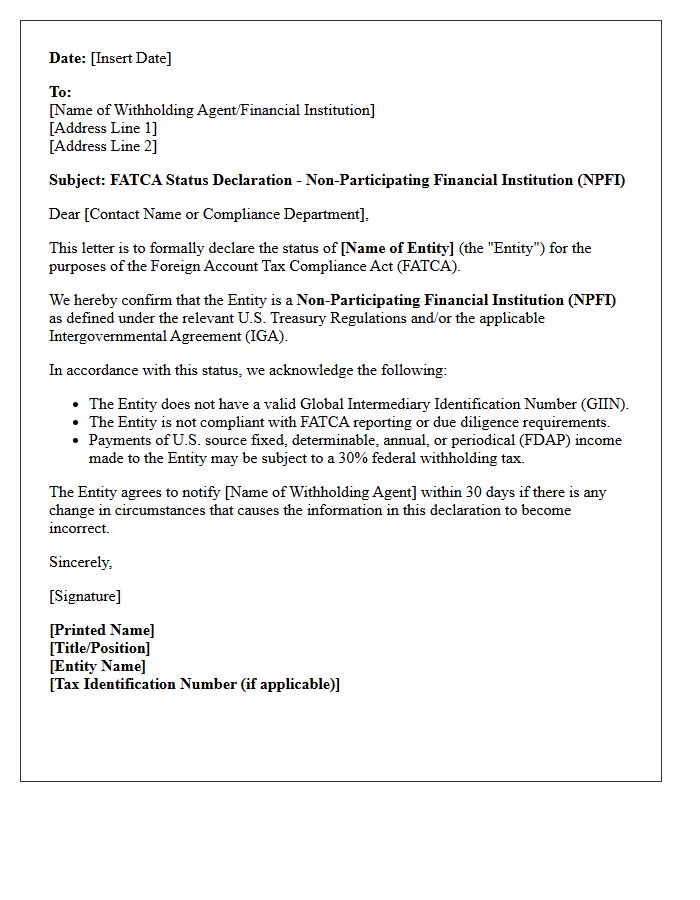
A Non-Participating Financial Institution (NPFI) FATCA Status Declaration Letter is a critical compliance document used to notify global entities of a firm's non-compliant standing. Under FATCA regulations, being classified as an NPFI often triggers a mandatory 30% withholding tax on U.S. source payments. This letter formally confirms that the institution does not adhere to the reporting requirements set by the IRS. Financial counterparts use this declaration to fulfill their due diligence obligations, assess potential tax risks, and ensure proper withholding during cross-border transactions to avoid legal penalties.
Participating Foreign Financial Institution FATCA Status Declaration Letter
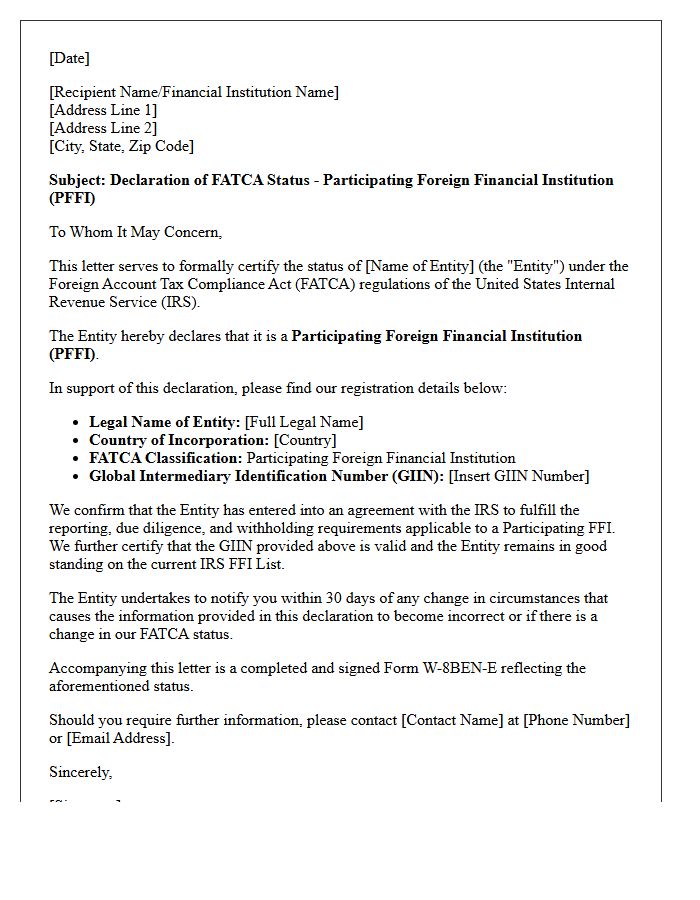
A Participating Foreign Financial Institution (PFFI) status declaration letter is a critical compliance document used to certify an entity's FATCA classification. It confirms that the institution has entered into an agreement with the IRS to report account information regarding U.S. persons. This letter helps global counterparts avoid mandatory 30% withholding taxes on certain payments. Providing an accurate declaration ensures transparency in international financial transactions and maintains regulatory compliance. It is essential for financial institutions to keep this documentation current to facilitate seamless cross-border banking and investment activities within the global tax reporting framework.
United States Person FATCA Status Declaration Letter
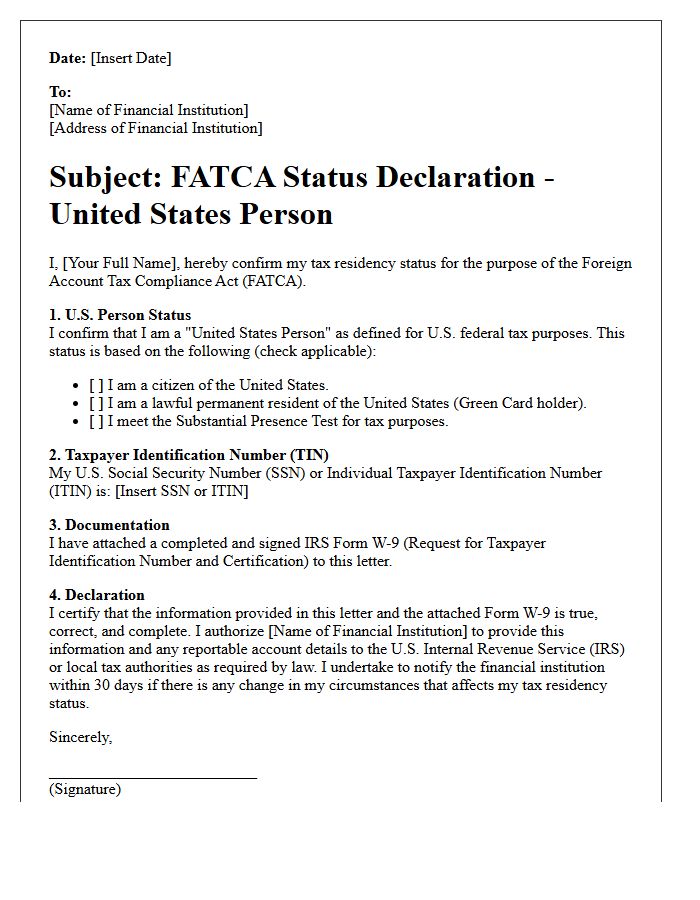
A United States Person FATCA Status Declaration Letter is a mandatory compliance document used by foreign financial institutions to identify U.S. taxpayers. This form confirms your residency and tax status to ensure adherence to the Foreign Account Tax Compliance Act. By signing, you declare whether you are a U.S. citizen or resident alien, helping prevent offshore tax evasion. Providing accurate information is essential, as non-compliance can lead to account restrictions, withholding taxes, or significant legal penalties from the Internal Revenue Service.
Non-United States Citizen FATCA Status Declaration Letter
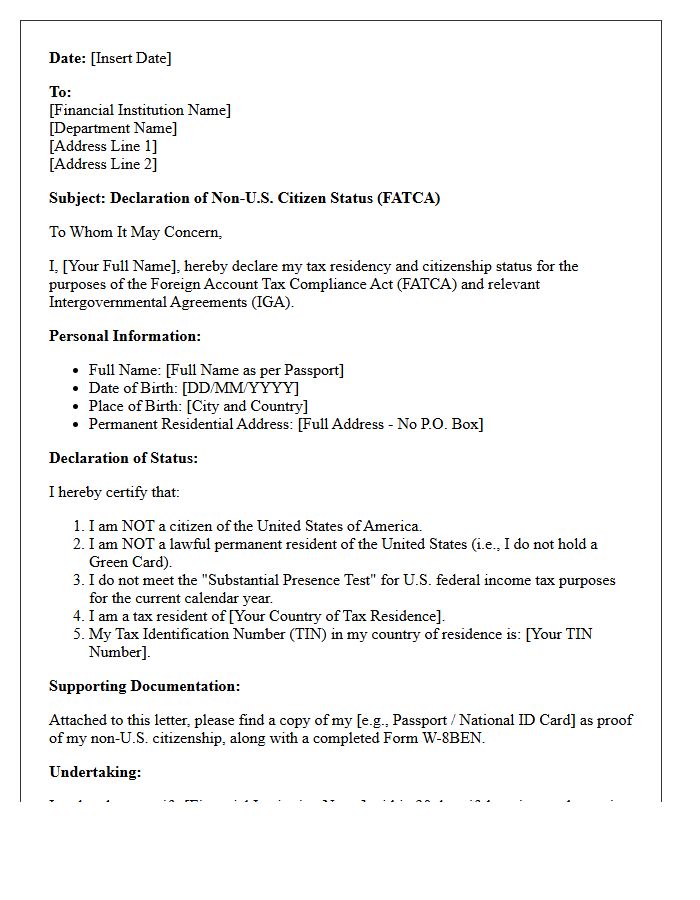
A Non-United States Citizen FATCA Status Declaration Letter is a critical document used by foreign financial institutions to verify your tax residency. It confirms that you are not a U.S. person, helping institutions comply with the Foreign Account Tax Compliance Act. Providing this declaration prevents unnecessary withholding taxes on your global income and ensures your accounts remain active. Accurately disclosing your citizenship and tax identification details is essential to avoid legal complications and maintain international regulatory compliance while managing assets outside the United States.
Joint Banking Account FATCA Status Declaration Letter
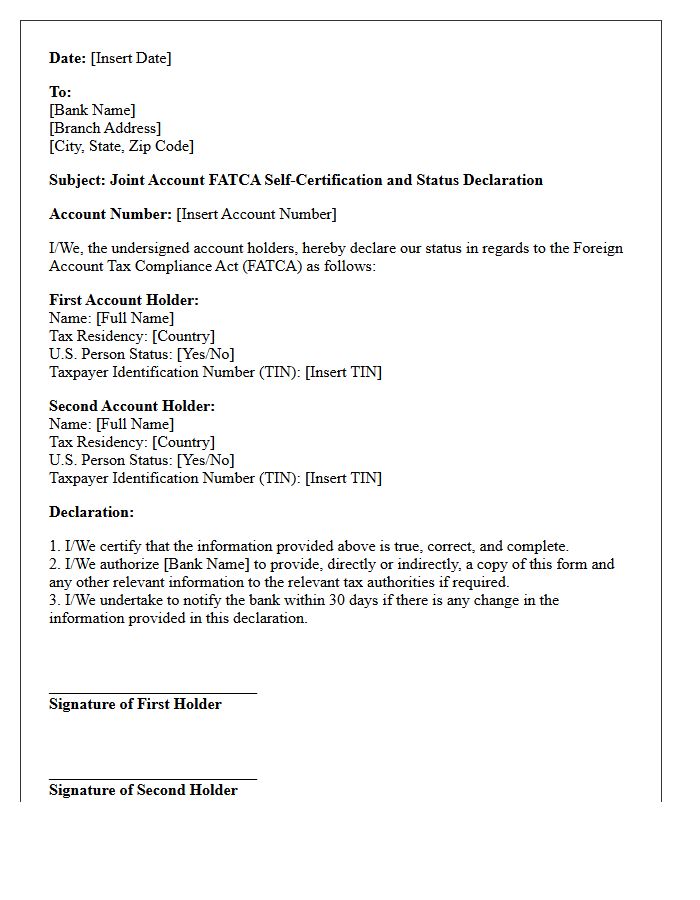
A Joint Banking Account FATCA Status Declaration Letter is a mandatory document used by financial institutions to ensure tax compliance with the United States. Each account holder must disclose their residency and citizenship status to determine if the account falls under reporting requirements. This process prevents tax evasion by identifying U.S. persons holding foreign assets. Failing to provide accurate information or a signed declaration can lead to account restrictions, mandatory withholding taxes, or eventual closure. It is a critical component of global regulatory transparency between international banks and the IRS.
Sponsored Investment Entity FATCA Status Declaration Letter
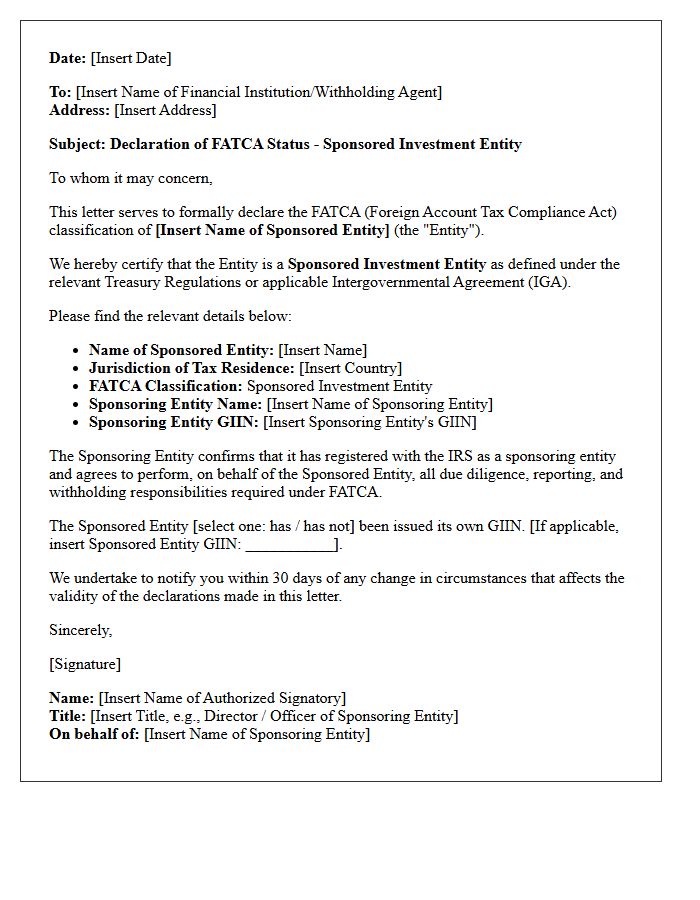
A Sponsored Investment Entity FATCA Status Declaration Letter is a formal document used to certify a fund's tax compliance status. It confirms that a Sponsoring Entity has assumed all FATCA reporting and due diligence obligations on behalf of the investment vehicle. This letter is essential for financial institutions to prevent 30% withholding taxes on U.S. source income. It typically includes the sponsor's Global Intermediary Identification Number (GIIN) and ensures the entity is correctly classified under FATCA regulations to maintain global financial transparency and regulatory alignment.
Complex Trust Account FATCA Status Declaration Letter
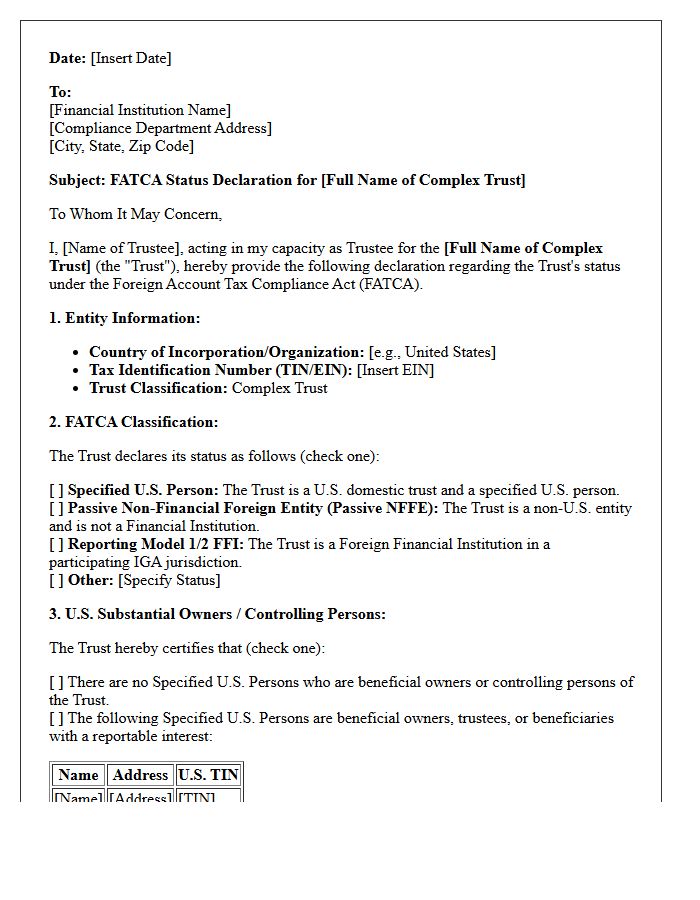
A Complex Trust Account FATCA Status Declaration Letter is a critical compliance document used by financial institutions to determine a trust's tax residency. It helps identify Foreign Financial Institutions or Non-Financial Foreign Entities to prevent offshore tax evasion. Trustees must accurately declare the entity's status to avoid mandatory withholding tax on U.S. source income. Providing precise information ensures adherence to the Foreign Account Tax Compliance Act regulations, protecting the trust from legal penalties and ensuring seamless global banking operations.
What is a Foreign Account Tax Compliance Act (FATCA) Status Declaration Letter?
A FATCA Status Declaration Letter is a formal document provided by an account holder to a financial institution to certify their tax residency and confirm whether they are a "U.S. Person" under federal tax law. This letter helps the institution determine if the account is subject to reporting to the Internal Revenue Service (IRS).
Who is required to provide a FATCA Status Declaration?
Both individuals and entities (such as corporations or trusts) who hold financial accounts with foreign financial institutions (FFIs) are required to provide this declaration. It applies to U.S. citizens, residents, and certain foreign entities with substantial U.S. ownership or business activities.
What information must be included in a FATCA Declaration Letter?
The letter must typically include the account holder's legal name, permanent address, Taxpayer Identification Number (TIN) or Social Security Number (SSN), and a clear statement of tax residency. For entities, it must also specify the FATCA classification, such as a Passive Non-Financial Foreign Entity (NFFE) or a Participating FFI.
Why do banks request a FATCA Status Declaration Letter?
Financial institutions request this letter to comply with international tax compliance regulations and avoid penalties. Under FATCA, banks must identify U.S. accounts and report specific financial information to the IRS or their local tax authority to prevent tax evasion by U.S. persons holding offshore assets.
What happens if I fail to submit a FATCA Status Declaration?
Failure to provide a valid FATCA declaration may result in the financial institution applying a mandatory 30% withholding tax on certain payments originating from the U.S. Additionally, the institution may be legally required to freeze or close the account to remain compliant with regulatory standards.


Comments