
A Demand Letter for Subordination Agreement Violation is a formal legal notice issued when a creditor breaches the established priority of liens. This document asserts your contractual rights, demands immediate corrective action, and outlines potential legal consequences to protect your financial interests. Ensuring compliance is vital for maintaining security interest seniority. To assist your legal strategy, below are some ready to use template.
Image cover: Enforcing Compliance: Demand Letter Templates for Subordination Agreement Violations
Letter Samples List
- Demand Letter for Subordination Agreement Violation
- Formal Notice and Demand Letter for Subordination Breach
- Senior Creditor Demand Letter for Subordination Noncompliance
- Banking Institution Demand Letter for Subordination Agreement Violation
- Notice of Default and Demand Letter for Subordination Violation
- Legal Demand Letter for Unauthorized Subordinate Debt Payment
- Intercreditor Demand Letter for Subordination Agreement Breach
- Final Demand Letter for Breach of Subordination Obligations
- Commercial Bank Demand Letter for Subordination Clause Violation
- Urgent Demand Letter Restricting Subordinate Lender Payments
- Financial Institution Demand Letter for Senior Debt Priority Violation
- Cease and Desist Demand Letter for Subordination Agreement Breach
Demand Letter for Subordination Agreement Violation
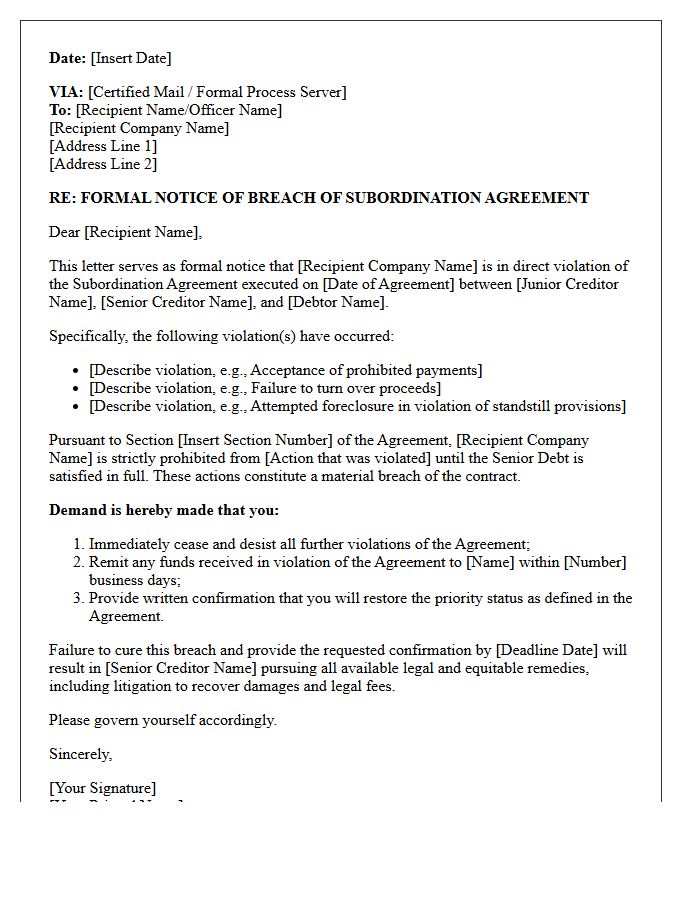
A demand letter for a subordination agreement violation is a formal legal notice issued when a junior lienholder breaches the priority ranking established by contract. It serves to notify the defaulting party of their non-compliance, such as failing to record documents correctly or interfering with the senior lender's rights. This document is a critical first step to enforce legal rights, demand immediate corrective action, and mitigate financial risk. Failure to resolve the breach outlined in the letter often leads to litigation or foreclosure proceedings to protect the senior creditor's security interest.
Formal Notice and Demand Letter for Subordination Breach
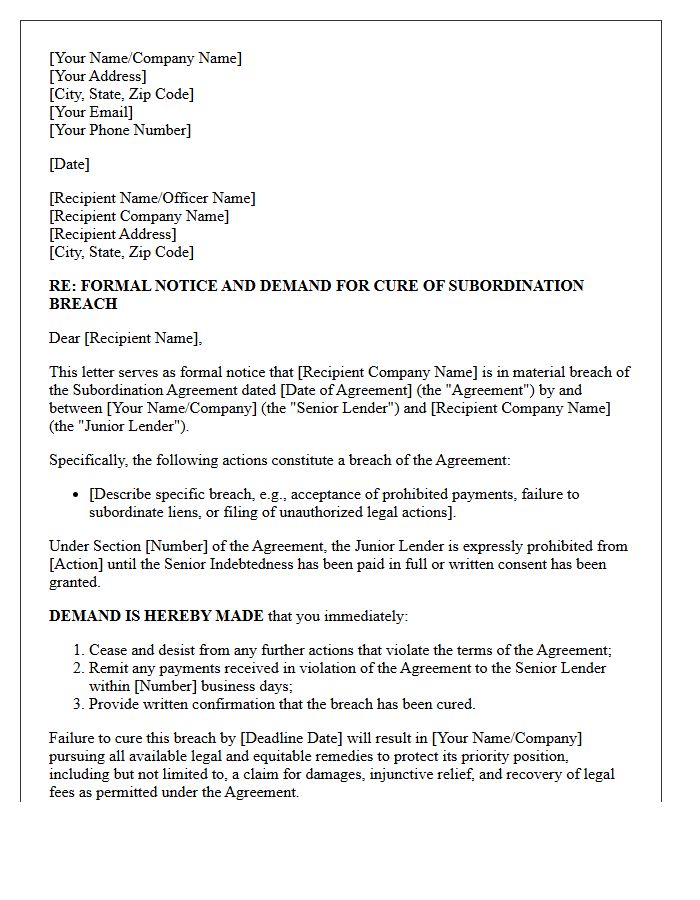
A formal notice and demand letter for a subordination breach serves as a critical legal instrument when a junior lender or party violates the agreed-upon priority of claims. This document officially notifies the breaching party of their failure to respect lien seniority or payment hierarchies. It outlines the specific default, demands immediate remedial action, and preserves the senior creditor's right to pursue litigation or foreclosure. Timely delivery is essential to protect financial interests and enforce the contractual intercreditor agreement terms effectively under commercial law.
Senior Creditor Demand Letter for Subordination Noncompliance
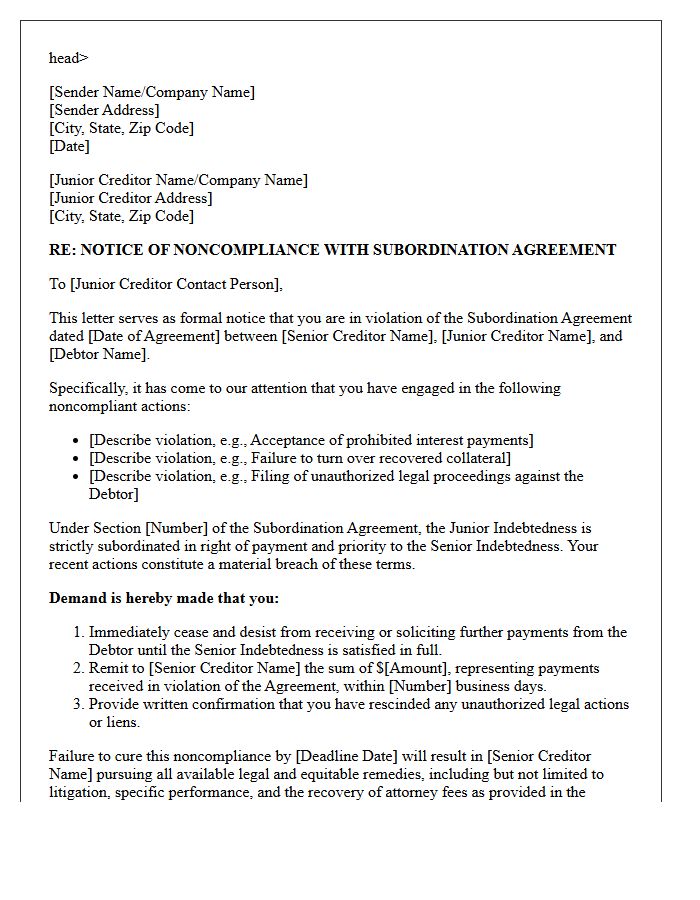
A senior creditor demand letter addresses a junior lender's failure to adhere to subordination agreement terms. This formal notice asserts the senior lender's priority rights over collateral and cash flows, demanding immediate corrective action to remedy the noncompliance. Failure to resolve these breaches can trigger a default, allowing the senior creditor to block junior payments or initiate legal enforcement. It is a critical enforcement tool used to protect the senior lender's first-position claim and ensure the agreed-upon debt hierarchy is strictly maintained during financial restructuring or liquidation scenarios.
Banking Institution Demand Letter for Subordination Agreement Violation
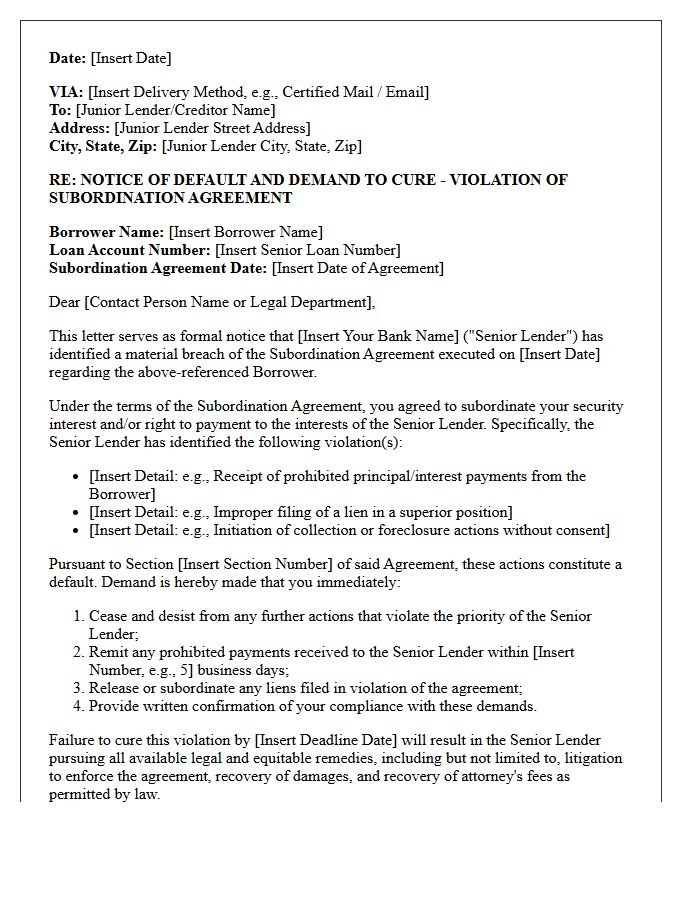
A banking institution demand letter for a Subordination Agreement Violation is a formal notice issued when a junior lender or debtor breaches contractual priority rankings. This legal document asserts the senior lienholder's priority rights over collateral and repayment. Common violations include accepting unauthorized payments or failing to record documents correctly. The letter demands immediate corrective action to restore the agreed-upon debt hierarchy. Ignoring this notice can trigger a technical default, leading to accelerated loan repayment demands or foreclosure actions to protect the primary lender's financial interest and security position.
Notice of Default and Demand Letter for Subordination Violation
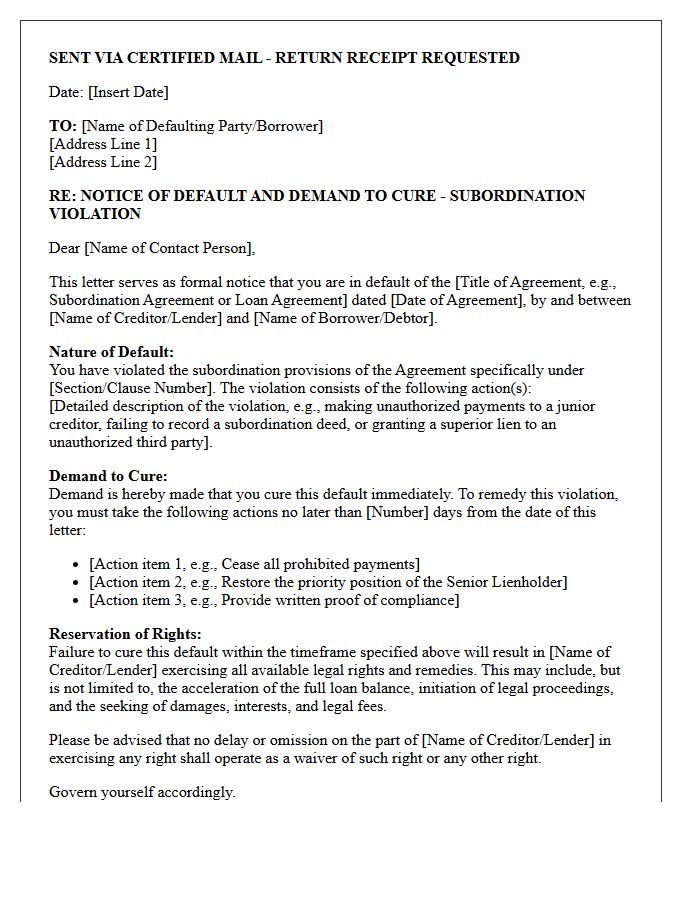
A Notice of Default and Demand Letter for a subordination violation is a formal legal warning issued when a junior lienholder ignores their agreed-upon priority status. This document highlights a contractual breach, typically occurring when a lender fails to subordinate their claim to a primary loan as previously promised. It serves as a final opportunity to cure the default before the senior creditor pursues foreclosure or litigation. Understanding these notices is vital for protecting your property interest and ensuring all financial obligations align with established lien priority agreements.
Legal Demand Letter for Unauthorized Subordinate Debt Payment
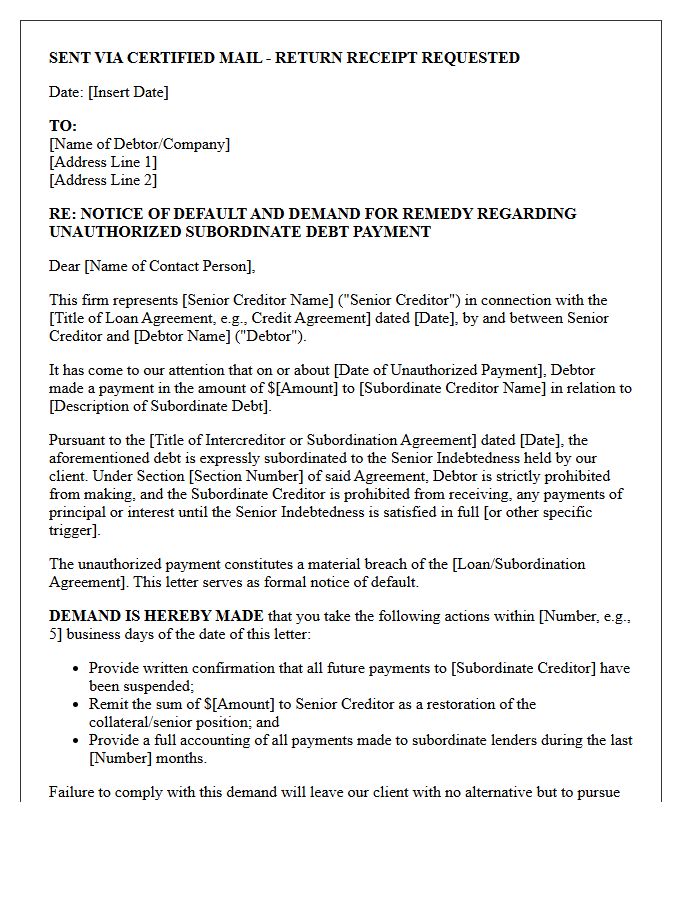
A legal demand letter for unauthorized subordinate debt payment is a formal notice sent when a junior creditor receives funds in violation of a subordination agreement. This document asserts that the senior lender's right to priority payment was bypassed. It demands the immediate return of the funds to the senior creditor or an escrow account. The letter serves as a critical first step in enforcing contractual seniority, mitigating financial loss, and establishing a legal record of the breach before initiating formal litigation or seeking injunctive relief against the non-compliant parties.
Intercreditor Demand Letter for Subordination Agreement Breach
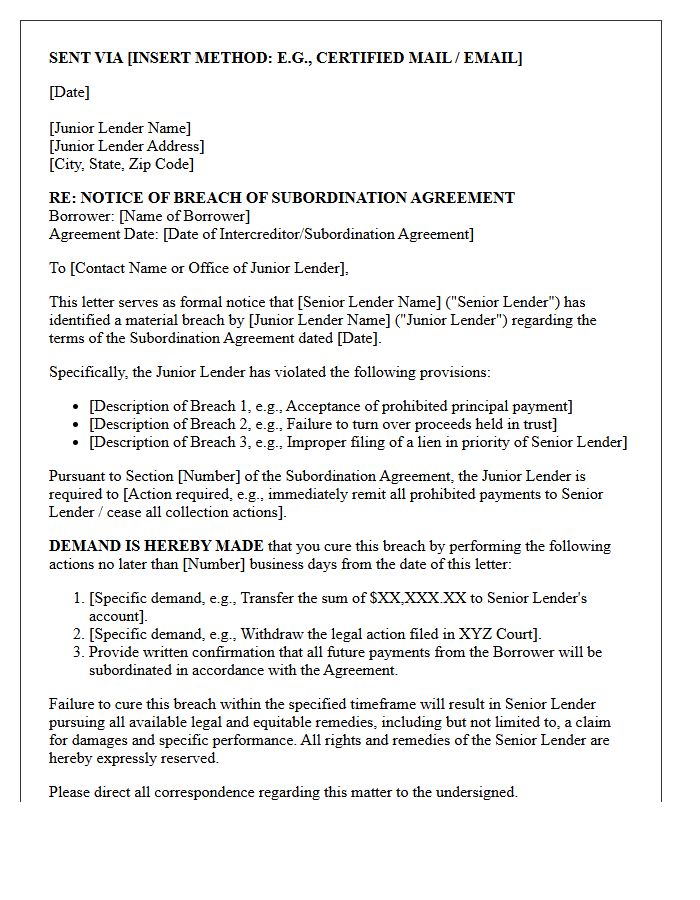
An Intercreditor Demand Letter is a formal legal notice issued when a junior lender violates the specific terms of a subordination agreement. This document serves as a critical enforcement tool for senior creditors to halt unauthorized payments or collateral actions by secondary lenders. It demands immediate remedy of the breach to preserve the agreed-upon payment priority and security rankings. Failure to comply typically triggers litigation or accelerates loan defaults, making it essential for protecting senior priority rights during financial restructuring or borrower insolvency proceedings.
Final Demand Letter for Breach of Subordination Obligations
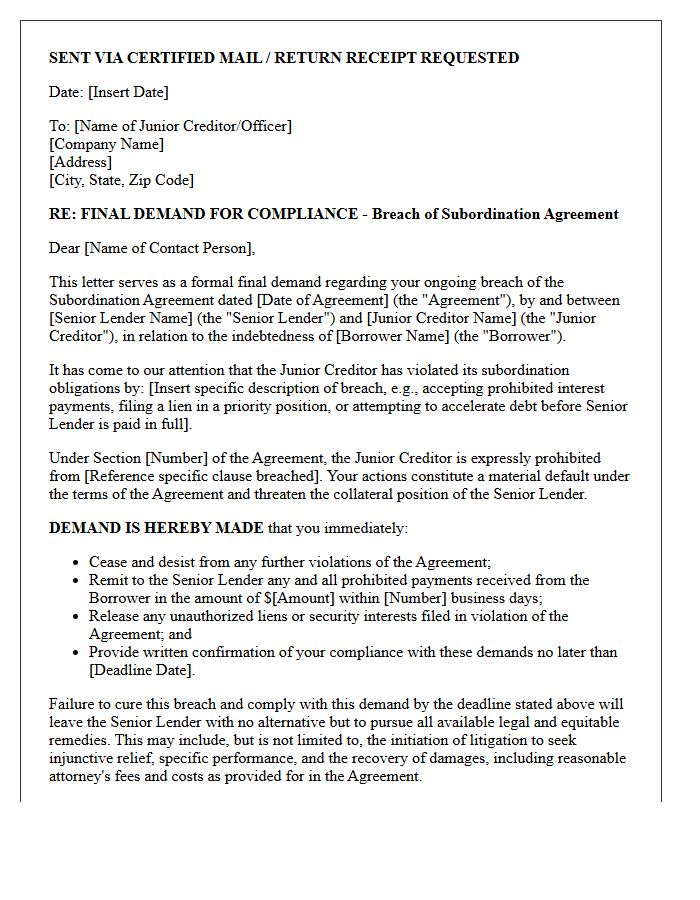
A Final Demand Letter serves as the ultimate formal notice before initiating legal action for breach of subordination obligations. It highlights the junior creditor's failure to respect payment priorities or lien rankings established in a subordination agreement. This document effectively formalizes the default, demands immediate remedial action, and outlines potential litigation to enforce creditor rights. Precise language is essential to preserve legal standing and ensure the senior lender's priority remains protected against unauthorized collections or claims. Failure to comply typically results in an acceleration of remedies or court-ordered performance.
Commercial Bank Demand Letter for Subordination Clause Violation
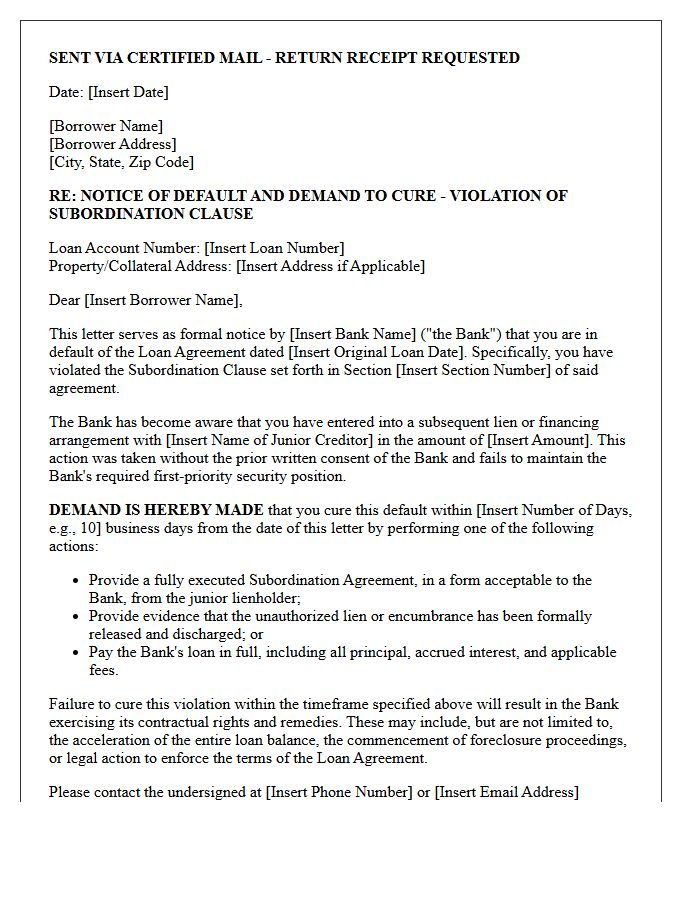
A commercial bank demand letter for a subordination clause violation is a legal notice issued when a borrower secures secondary financing without prior consent. This breach of the intercreditor agreement jeopardizes the primary lender's priority position. Failure to rectify this default often triggers an immediate acceleration of the total loan balance. To mitigate risk, borrowers must ensure all junior debt is properly subordinated and documented. Addressing such violations promptly is critical to maintaining financial stability and avoiding foreclosure or aggressive debt recovery actions by the primary lending institution.
Urgent Demand Letter Restricting Subordinate Lender Payments
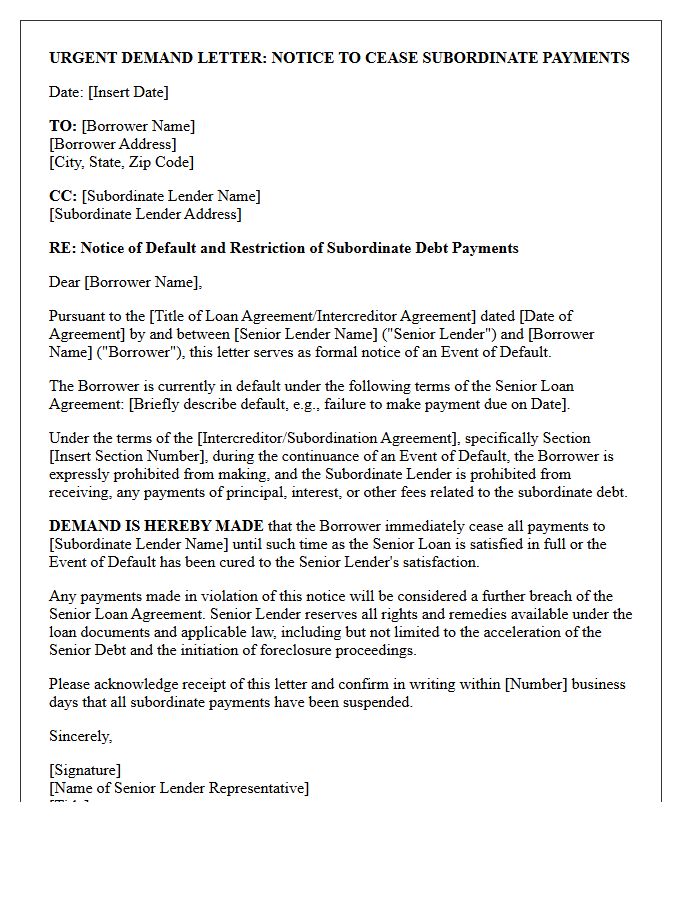
An urgent demand letter restricting subordinate lender payments is a critical legal notice issued by a senior creditor to a junior lienholder. This document activates subordination agreements to halt junior debt servicing during a borrower's financial distress. It ensures the priority of the senior debt is maintained, preventing the depletion of assets before primary obligations are settled. Receiving this notice signifies an immediate payment blockage, requiring the subordinate lender to cease collections. Understanding these intercreditor dynamics is essential for protecting capital and managing default risks in multi-tiered financing structures.
Financial Institution Demand Letter for Senior Debt Priority Violation
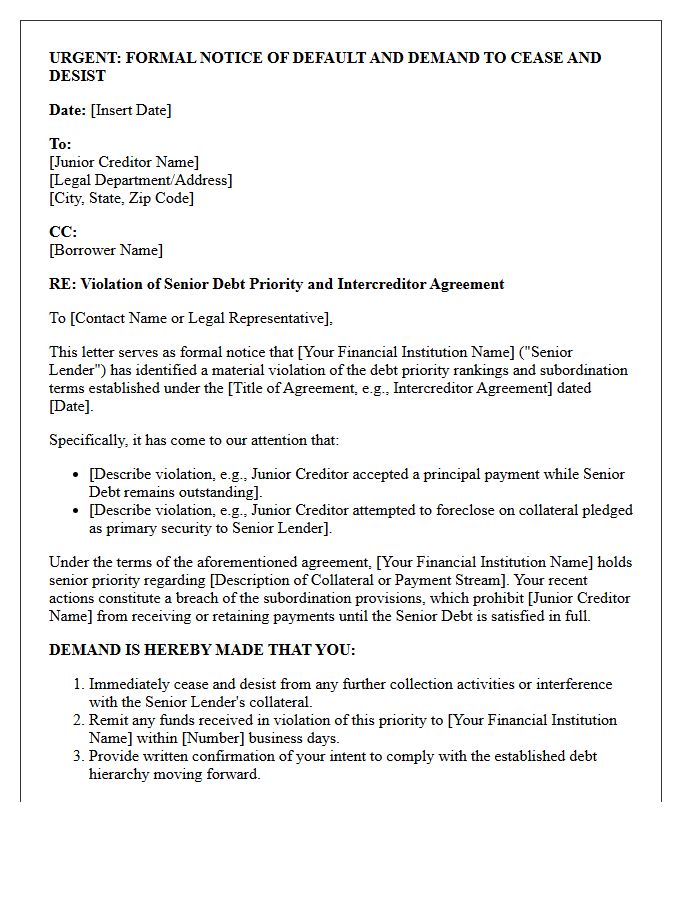
A financial institution issues a demand letter when a senior debt priority violation occurs, typically involving a breach of intercreditor agreements. This formal notice asserts that a subordinate lender or the borrower has improperly diverted funds or assets, bypassing the established payment waterfall. The letter demands immediate rectification to protect the senior lender's first-priority security interest. Understanding these demands is critical because non-compliance often triggers acceleration of debt and legal enforcement actions to recover collateral before further value erosion occurs.
Cease and Desist Demand Letter for Subordination Agreement Breach
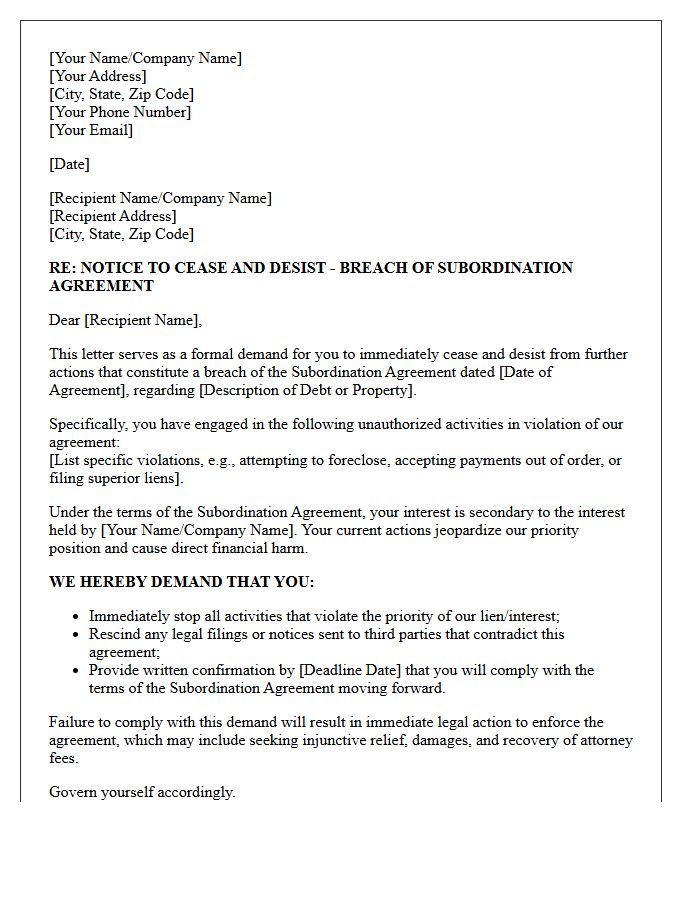
A Cease and Desist Demand Letter is a critical legal notice issued when a party violates a Subordination Agreement. This document formally demands the immediate halt of unauthorized actions, such as accepting payments or enforcing liens ahead of a senior lender. It serves as essential evidence of a contractual breach and provides a final opportunity for remediation before escalating to litigation. Sending this letter protects the priority of security interests and ensures that the agreed-upon debt hierarchy remains legally enforceable against junior creditors or uncooperative borrowers.
What constitutes a violation of a Subordination Agreement?
A violation typically occurs when a junior lienholder attempts to leapfrog a senior creditor's priority, fails to remit payments according to the agreed-upon "waterfall" structure, or takes legal action against the debtor without the senior lender's required consent.
What should be included in a Demand Letter for a Subordination Agreement breach?
The letter must clearly identify the specific provisions of the Intercreditor or Subordination Agreement that were breached, provide evidence of the unauthorized claim or payment, and set a definitive deadline for the violating party to cure the default or return misapplied funds.
Can a senior lender sue for damages if a Subordination Agreement is violated?
Yes, the senior lender can seek a court order to enforce the priority ranking, request an injunction to stop unauthorized collection efforts, and sue for monetary damages if the junior lender's actions resulted in a financial loss or diminished collateral value.
How does a Demand Letter help resolve priority disputes without litigation?
A formal Demand Letter serves as a prerequisite for legal action and often prompts the junior lienholder to acknowledge the contractual hierarchy, preventing costly litigation by establishing a record of the breach and the senior lender's intent to enforce its rights.
What is the "Cure Period" in a Subordination Agreement violation notice?
The cure period is a specific timeframe-usually 10 to 30 days-defined in the Demand Letter during which the breaching party must rectify the violation, such as rescinding a foreclosure notice or returning funds, to avoid further legal escalation.

Comments