
Banks and financial institutions issue a Dormant Account and Escheatment Notice Letter to notify owners of inactive assets before funds are transferred to the state. This legal requirement helps prevent property abandonment and protects your financial holdings from being classified as unclaimed. Understanding these notices is essential for maintaining account security. Below are some ready to use template.
Image cover: Reclaiming Lost Funds: Dormant Account and Escheatment Notice Templates
Letter Samples List
- Initial Inactive Account Warning Letter
- Pre-Dormancy Status Notification Letter
- Dormant Account Reactivation Request Letter
- Action Required To Prevent Dormancy Letter
- Returned Mail Dormancy Warning Letter
- Official Account Dormancy Notice Letter
- Notice Of Imminent Account Escheatment Letter
- Final Pre-Escheatment Warning Letter
- Unclaimed Property Escheatment Pending Letter
- State Escheatment Transfer Notice Letter
- Escheatment Processing Notification Letter
- Safe Deposit Box Escheatment Warning Letter
- Funds Remitted To State Escheatment Letter
Initial Inactive Account Warning Letter
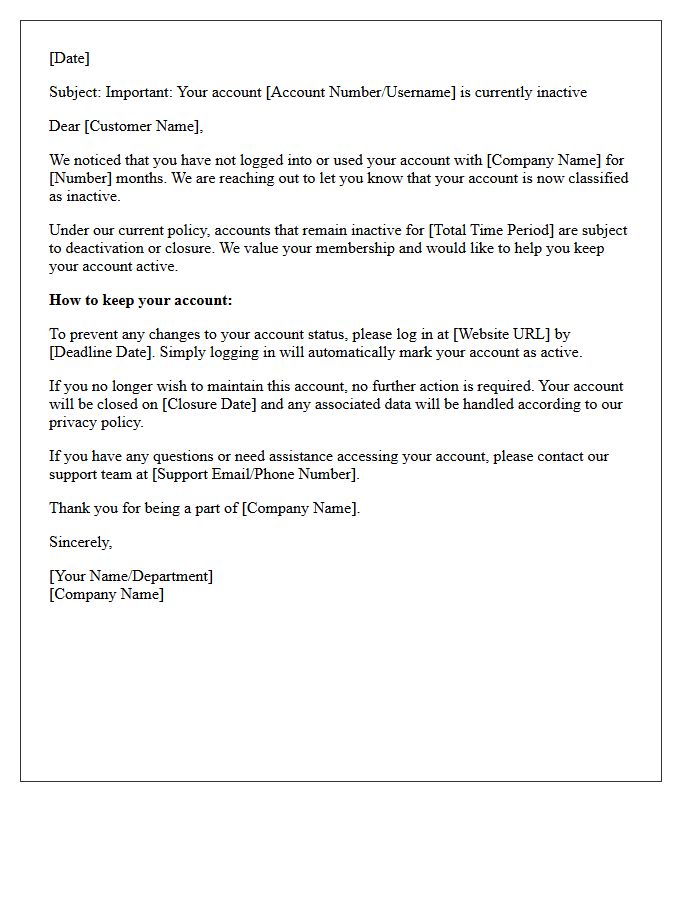
An Initial Inactive Account Warning Letter is a formal notice sent to users who have not logged in for an extended period. This communication serves as a preliminary alert before potential account suspension or permanent deletion. It is crucial to reactivate your profile by logging in or performing a specific action to prevent data loss or the removal of associated services. Always verify the sender's authenticity to avoid phishing, as these letters outline the final deadline for maintaining your digital presence and protecting your personal information from being purged.
Pre-Dormancy Status Notification Letter
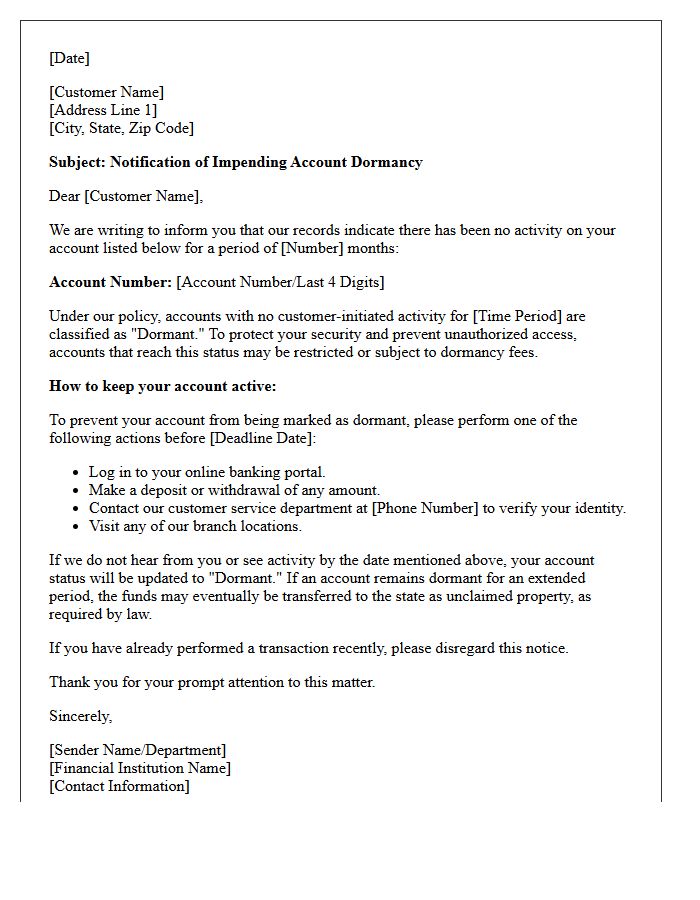
A Pre-Dormancy Status Notification Letter is a formal notice sent by financial institutions to inform account holders that their assets are nearing unclaimed property status. This critical communication warns that without immediate activity, the account will be classified as dormant and eventually escheated to the state. To prevent the transfer of funds to government custody, recipients must respond promptly by making a transaction or contacting the bank to verify their active interest. Monitoring these letters is essential to maintaining control over your personal financial holdings and preventing asset forfeiture.
Dormant Account Reactivation Request Letter
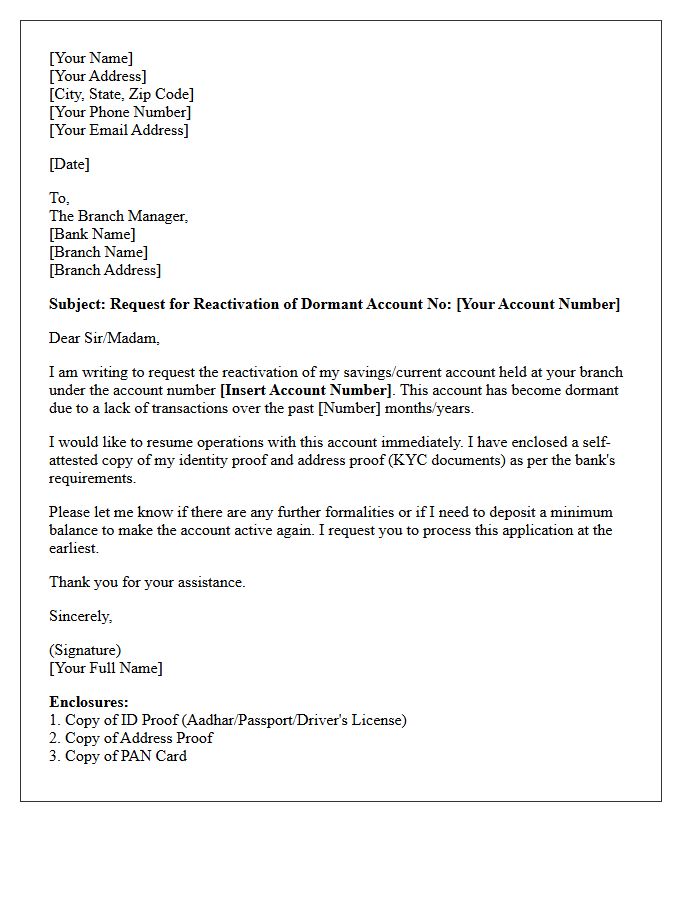
A Dormant Account Reactivation Request Letter is a formal document sent to a bank to restore access to an inactive account. To ensure a smooth process, you must include your full name, account number, and valid identification documents. Clearly state your intent to resume transactions and mention any required minimum balance or fees. Providing current contact details helps the financial institution update your profile. Submitting this request promptly prevents permanent closure and ensures the security of your funds while regaining full control over your banking services.
Action Required To Prevent Dormancy Letter
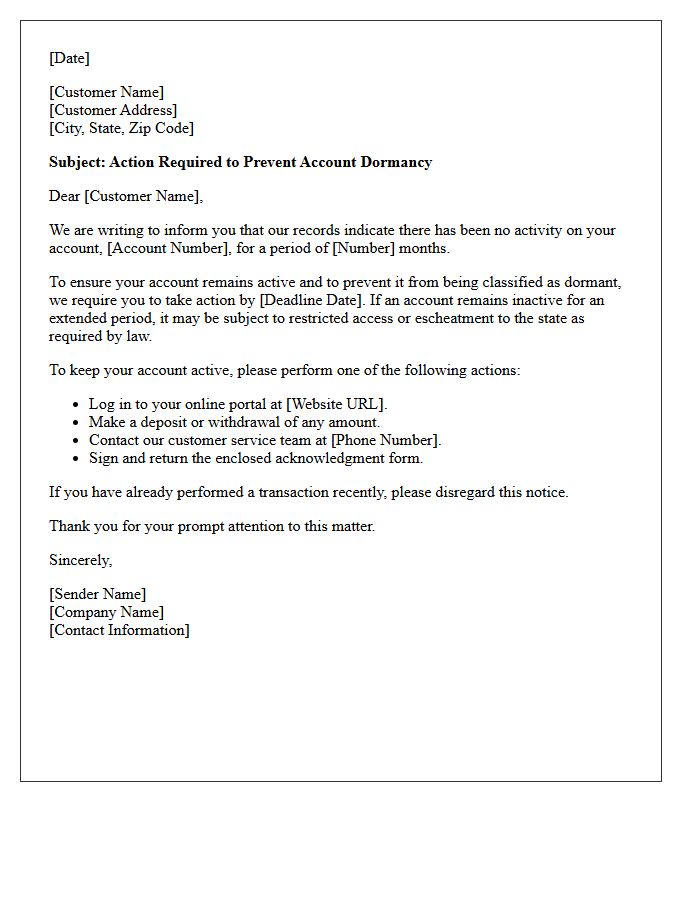
An Action Required To Prevent Dormancy Letter is a formal notice sent by financial institutions warning that an account is becoming inactive. To avoid escheatment, where assets are legally transferred to the state, you must perform a qualifying transaction or contact the holder immediately. Taking quick action ensures your funds remain accessible and prevents the complex process of reclaiming unclaimed property from government agencies. Always verify the letter's authenticity to protect against potential fraud or phishing attempts.
Returned Mail Dormancy Warning Letter
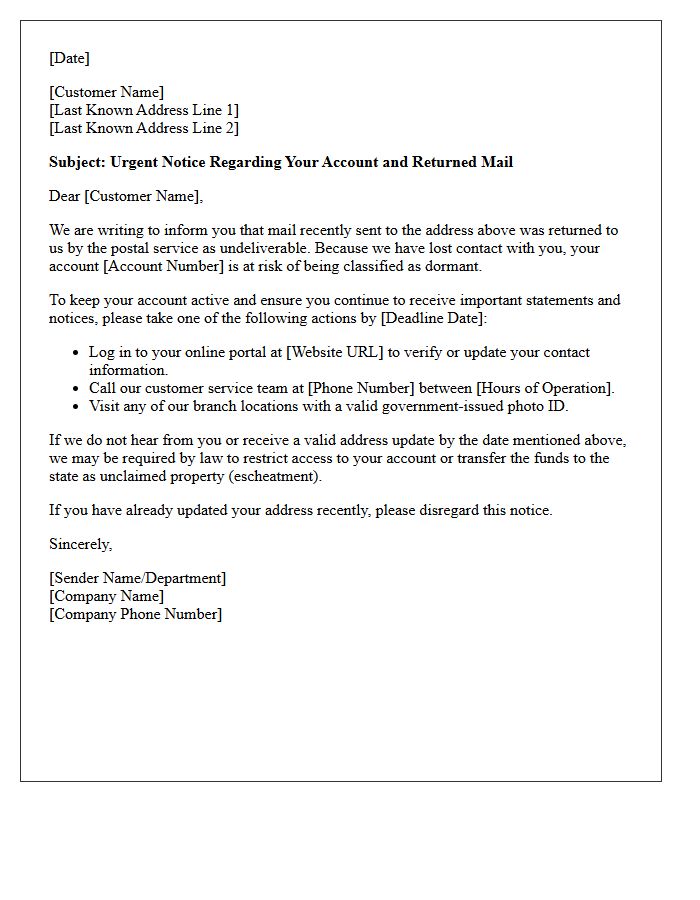
A Returned Mail Dormancy Warning Letter notifies account holders that official correspondence was undeliverable. This critical alert serves as a final notice before an account is legally classified as inactive. To prevent your assets from being escheated to the state as unclaimed property, you must contact your financial institution immediately. Verifying your current mailing address and performing a transaction are essential steps to maintain account activity and safeguard your funds from government seizure. Prompt action ensures your account status remains active and secure.
Official Account Dormancy Notice Letter
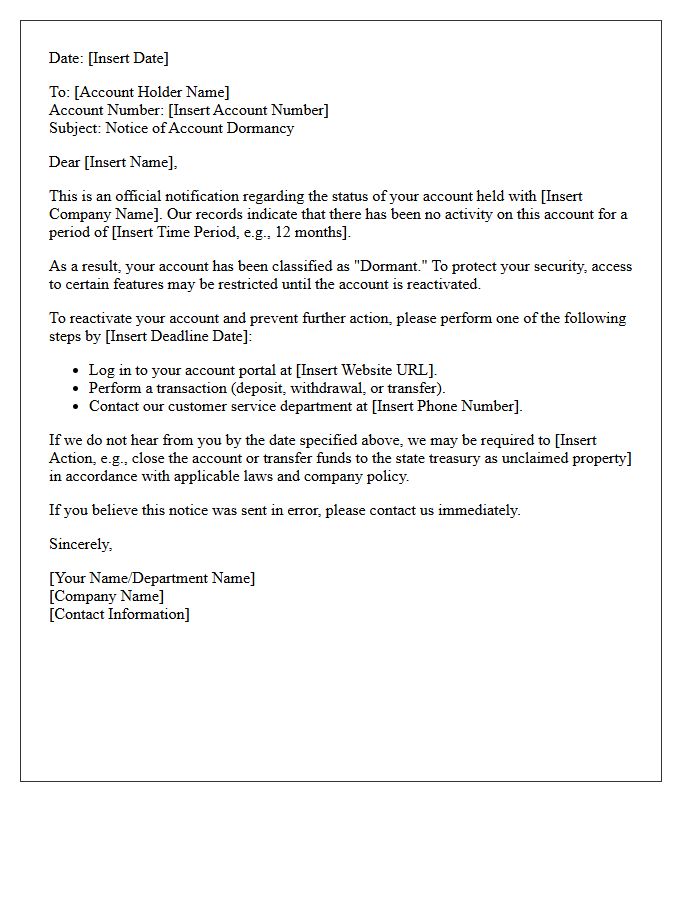
An Official Account Dormancy Notice Letter is a formal notification sent to users whose accounts have been inactive for a specific duration. This letter serves as a final warning before the service provider initiates permanent closure or archival of the profile. It outlines the steps required to maintain access, typically involving a simple login or activity confirmation. Understanding these notices is crucial to preventing the loss of data, stored funds, or digital assets associated with the inactive account. Prompt action ensures your account remains active and secure.
Notice Of Imminent Account Escheatment Letter
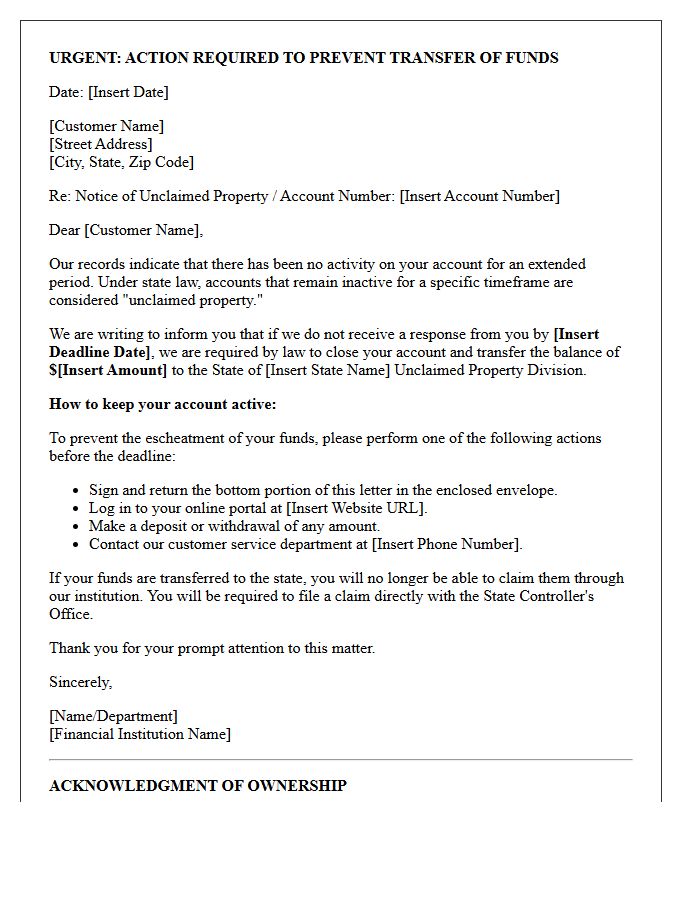
A Notice of Imminent Account Escheatment is a final warning that your unclaimed property will be transferred to the state treasury. This happens after a period of prolonged inactivity. To prevent your funds from being turned over to the government, you must immediately contact the financial institution to reactivate your account or claim the balance. Failure to respond by the specified deadline results in the state becoming the legal custodian of your assets, requiring a formal claims process to recover your money later.
Final Pre-Escheatment Warning Letter
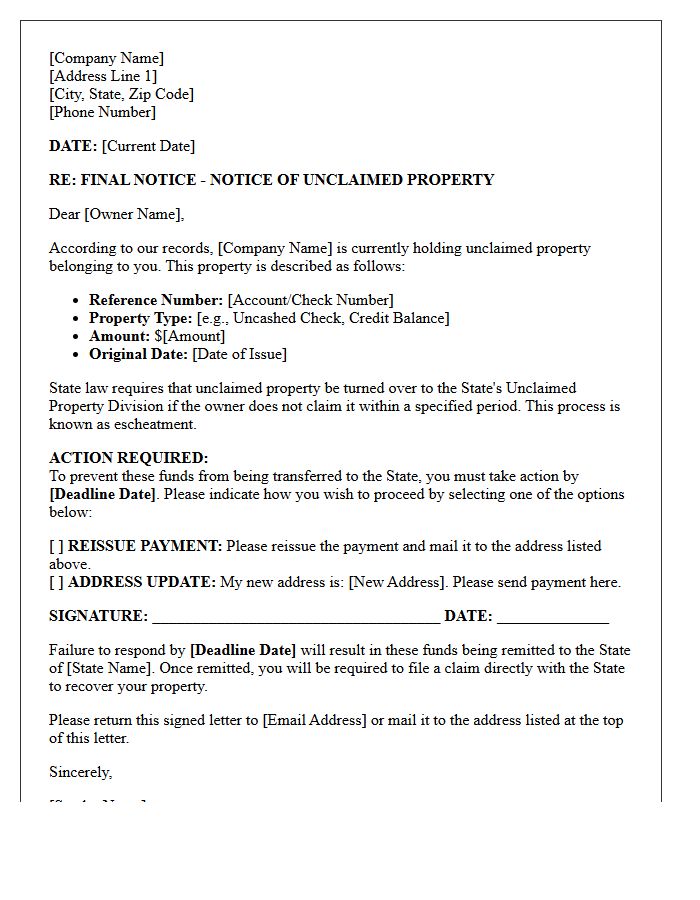
A Final Pre-Escheatment Warning Letter is a critical legal notice informing you that your property is classified as inactive. It serves as a final opportunity to claim your funds before they are transferred to state custody under unclaimed property laws. To prevent this transfer, you must respond immediately by contacting the holder or performing the requested account activity. Ignoring this document means you will eventually have to file a formal claim with the government to recover your assets, a process that can be significantly more time-consuming.
Unclaimed Property Escheatment Pending Letter
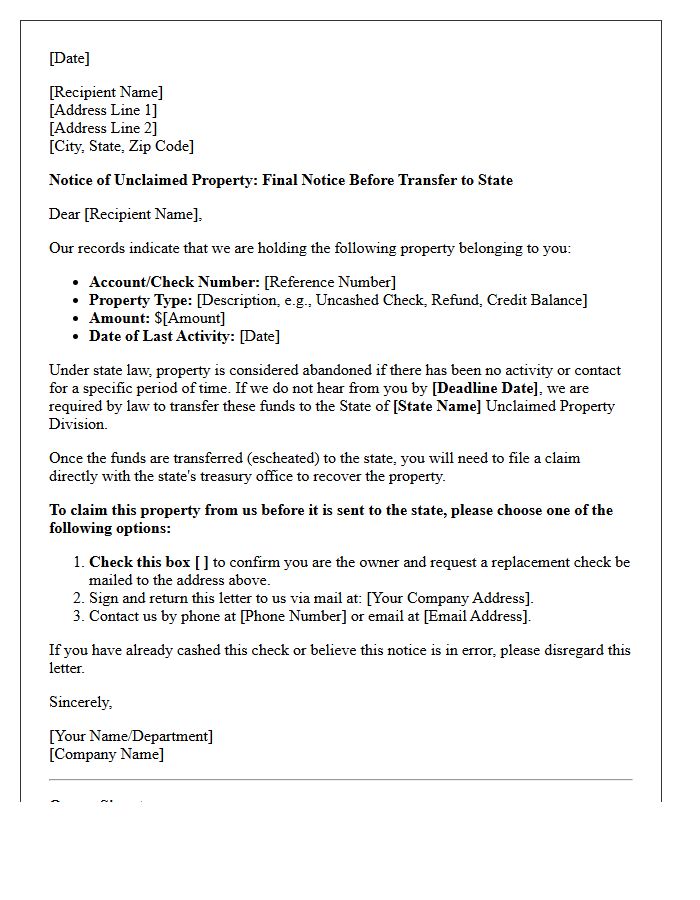
An unclaimed property escheatment pending letter is a formal notice from a business or financial institution regarding dormant accounts. It serves as a final warning that your assets, such as uncashed checks or dividends, are at risk of being transferred to the state government. To prevent this legal transfer, known as escheatment, you must respond immediately by following the instructions to verify ownership. Acting quickly ensures your property remains in your possession rather than being held in a state-run unclaimed property fund indefinitely.
State Escheatment Transfer Notice Letter
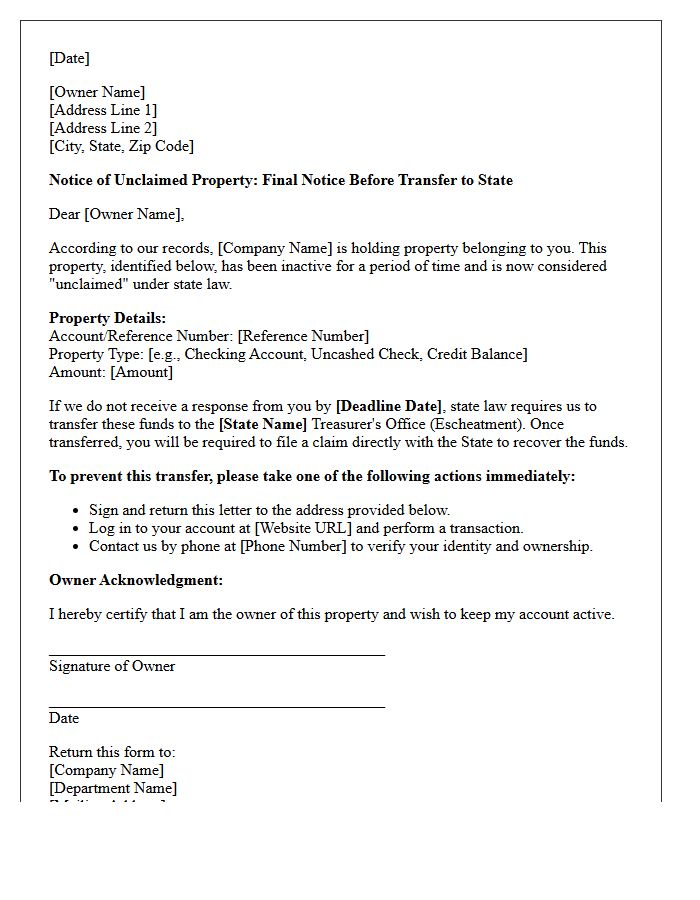
A State Escheatment Transfer Notice Letter is a critical warning that your unclaimed property is at risk of being turned over to the government. Financial institutions send these notices when accounts show no activity for a specific period, known as the dormancy period. To prevent this legal transfer, you must respond immediately by contacting the holder or performing a transaction. Failure to act will result in your assets being sent to the state treasury, requiring a formal legal claim process to recover your missing funds or securities.
Escheatment Processing Notification Letter
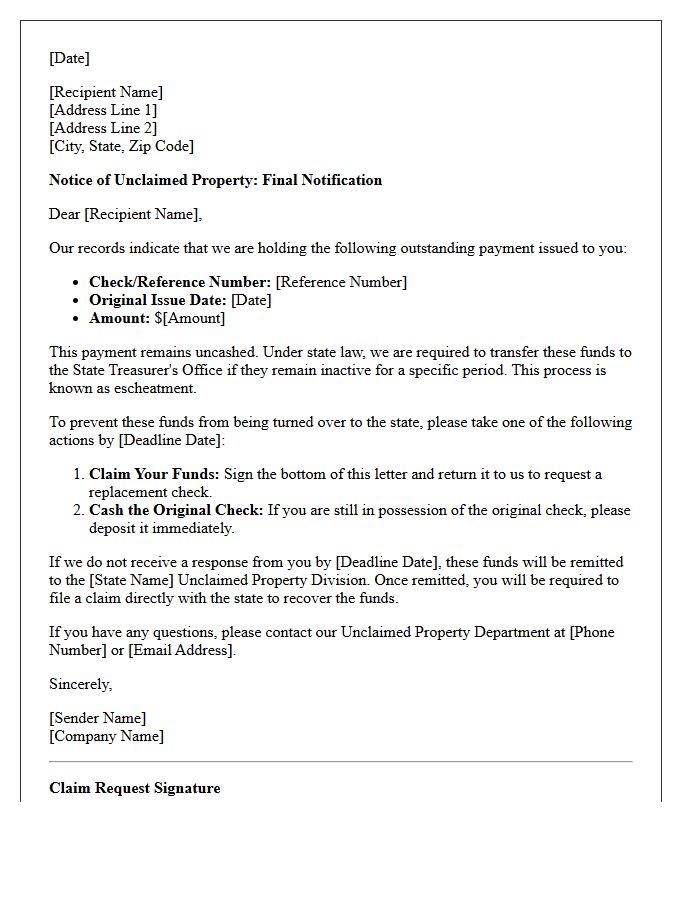
An escheatment processing notification letter is a legal warning sent to owners of unclaimed property before funds are transferred to the state. This due diligence notice informs you that your account is considered inactive or abandoned. To prevent your assets from being turned over to government custody, you must respond by the specified deadline or perform account activity. Taking immediate action is essential to maintain control of your financial assets and avoid the lengthy process of reclaiming property from state authorities later.
Safe Deposit Box Escheatment Warning Letter
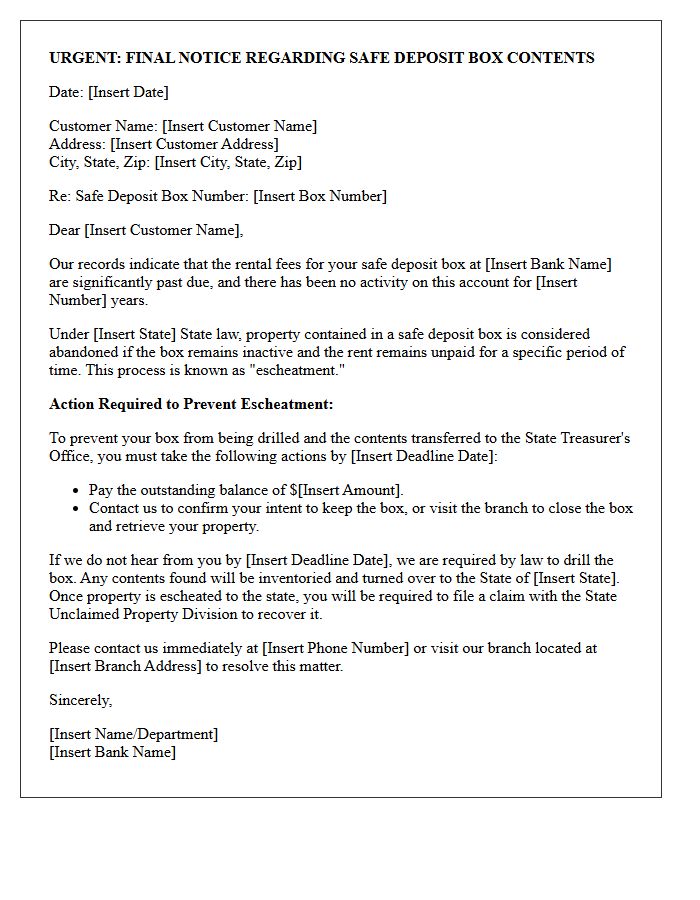
A Safe Deposit Box Escheatment Warning Letter is a critical notice from your bank regarding unclaimed property. This document alerts you that your box is considered inactive under state law. To prevent your valuables and documents from being turned over to the government, you must contact the financial institution immediately to verify activity. Failing to respond by the specified deadline results in the contents being liquidated or transferred to the state treasury. Always ensure your current contact information is updated to avoid permanent loss of physical assets.
Funds Remitted To State Escheatment Letter
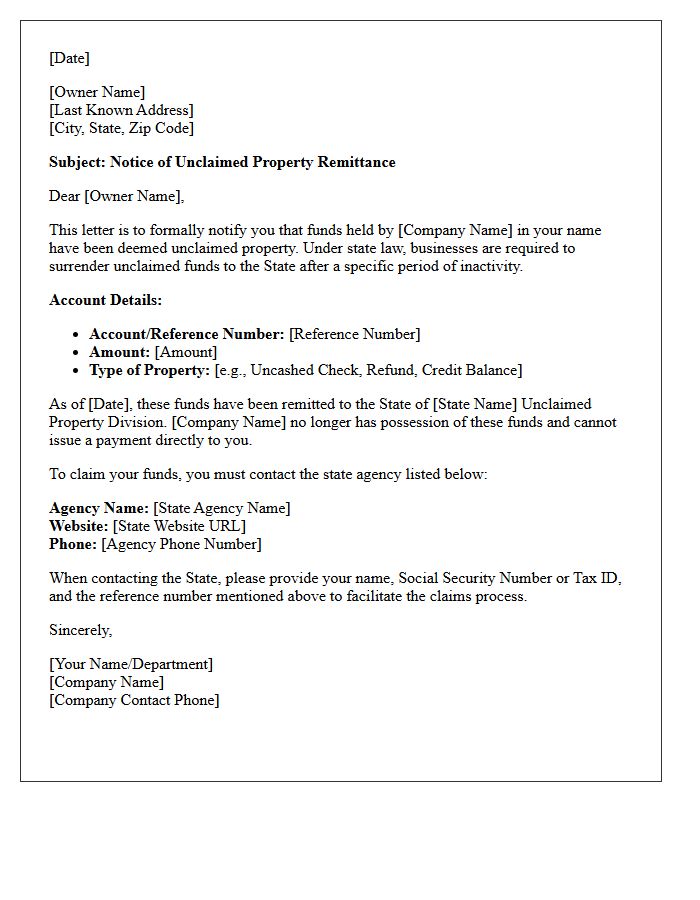
A Funds Remitted to State Escheatment Letter is a final notice regarding unclaimed property. Financial institutions send these when an account remains inactive for a specific statutory period. To prevent your assets from being transferred to the government, you must contact the holder immediately to verify account activity. If the deadline passes, the state assumes custody of the abandoned funds. Once escheated, you must file a formal claim with the State Controller's Office or the relevant Treasury department to recover your money.
What is a Dormant Account and Escheatment Notice letter?
A Dormant Account and Escheatment Notice is a formal communication sent by a financial institution to inform an account holder that their account has had no activity for a specific period. The letter serves as a final warning that if the account remains inactive, the balance will be legally transferred to the state treasury as unclaimed property under escheatment laws.
Why did I receive a notice about my account being inactive?
You received this notice because your bank or financial institution has recorded no customer-initiated activity (such as deposits, withdrawals, or logged-in inquiries) on your account for a timeframe defined by state law, typically between three to five years. This letter is a proactive step to help you retain your funds before they are classified as abandoned.
How can I prevent my funds from being sent to the state?
To prevent escheatment, you must take immediate action by following the instructions in the notice. Usually, this involves signing and returning the response form included with the letter, making a deposit or withdrawal, or logging into your online banking portal to verify your continued ownership of the account.
What happens if I do not respond to the escheatment notice?
If you do not respond by the deadline specified in the letter, the financial institution is legally required to close your account and remit the remaining balance to the state's unclaimed property division. Once the funds are transferred to the state, the bank can no longer assist with the recovery, and you must file a claim directly with the government agency.
Is there a fee associated with dormant accounts or escheatment?
Many financial institutions charge "dormancy fees" or "inactivity fees" once an account meets the criteria for lack of use. These fees are deducted from the balance until the account is either reactivated or escheated to the state. Reviewing your account terms or responding to the notice promptly can help you avoid further administrative costs.


Comments