
Discovering a forged signature on a cleared check requires immediate action to protect your finances. This guide explains how to notify your bank, prove the unauthorized transaction, and recover your stolen funds through formal documentation. Understanding your legal rights helps mitigate losses and prevent further identity theft. To simplify the process, below are some ready to use template.
Image cover: Reporting a Forged Signature: Formal Letter Samples and Templates for Cleared Checks
Letter Samples List
- Initial Notification Letter Regarding Forged Signature on Cleared Check
- Affidavit of Forgery Submission Letter to Bank
- Fraud Investigation Request Letter for Forged Check
- Bank Acknowledgment Letter for Forged Signature Claim
- Formal Demand Letter for Reimbursement of Forged Funds
- Police Report Enclosure Letter for Check Fraud
- Account Freeze and Security Hold Request Letter
- Fraudulent Check Dispute Letter to Banking Institution
- Bank Resolution Letter for Forged Signature Claim
- Claim Denial Letter for Disputed Check Signature
- Escalation Letter to Branch Manager Regarding Cleared Forgery
- Provisional Credit Notification Letter for Forged Check
Initial Notification Letter Regarding Forged Signature on Cleared Check
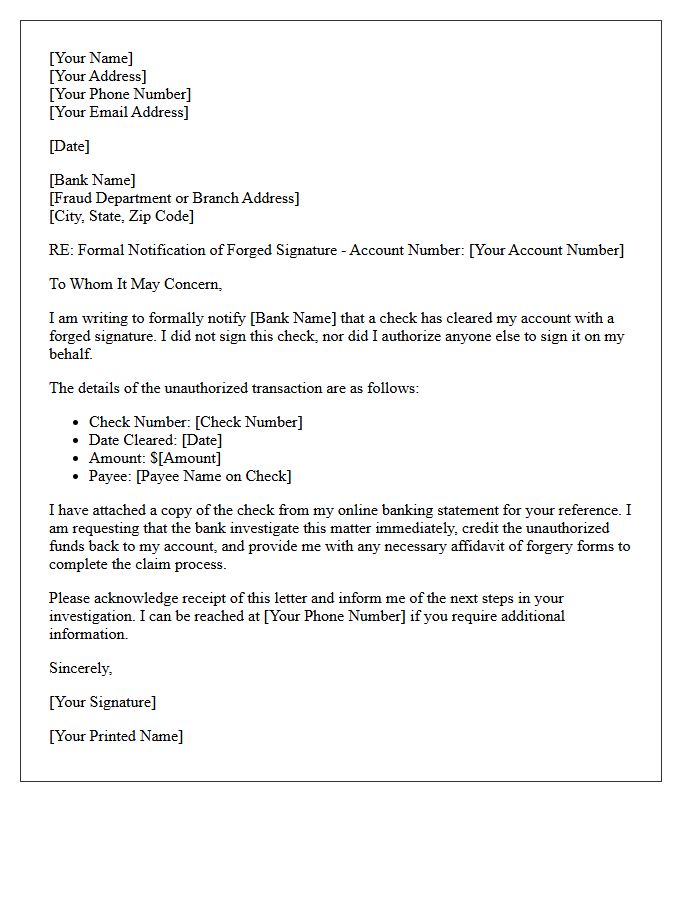
An Initial Notification Letter is a formal document sent to your bank to report a forged signature on a cleared check. This critical notice initiates a fraud investigation and asserts your right to a reimbursement under the Uniform Commercial Code. To protect your account, you must act quickly, clearly identifying the check number and transaction date. Providing a sworn affidavit of forgery alongside this letter helps expedite the recovery of stolen funds while establishing a legal record of the unauthorized activity to prevent further financial loss.
Affidavit of Forgery Submission Letter to Bank
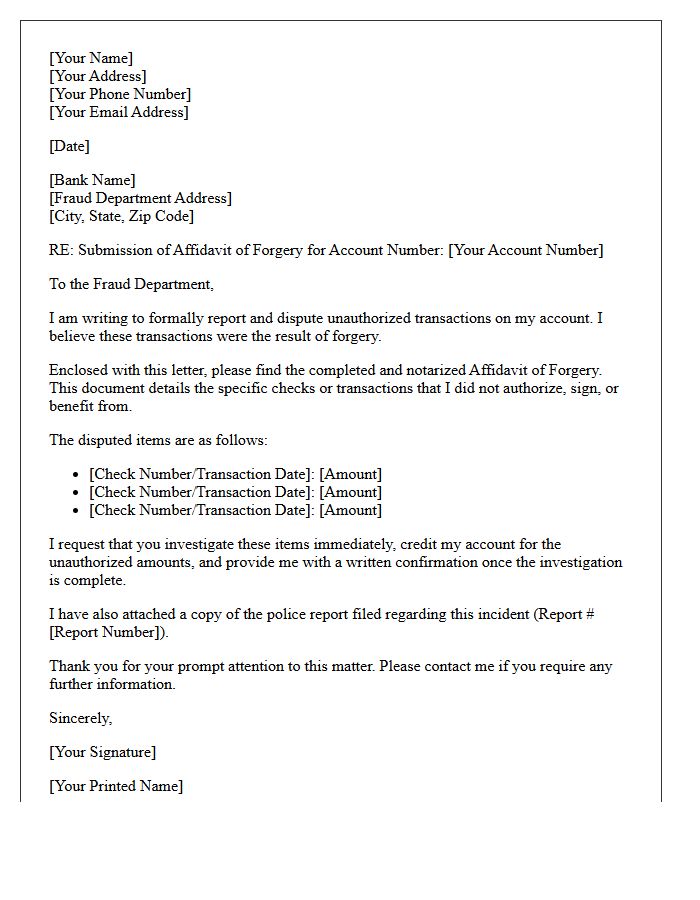
An Affidavit of Forgery is a sworn legal statement used to notify your bank of unauthorized transactions. When submitting this letter, you must clearly identify each fraudulent charge, including dates and specific amounts. This document protects your consumer rights under banking regulations, shifting liability back to the institution. Ensure the letter is notarized to verify its authenticity. Timely submission is critical to expedite the investigation and secure a reimbursement of stolen funds while protecting your financial reputation from further criminal exploitation.
Fraud Investigation Request Letter for Forged Check
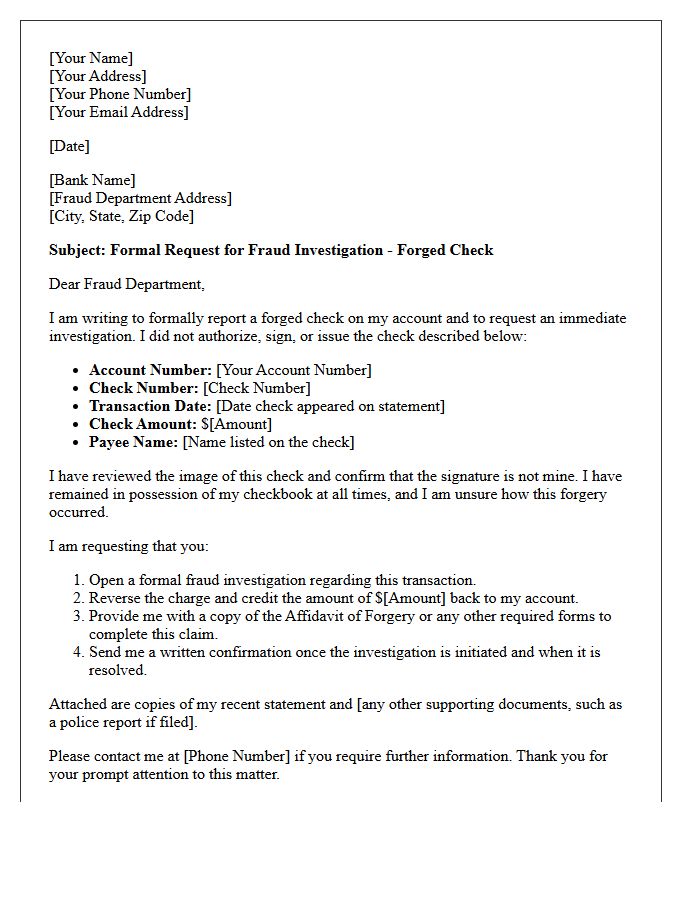
When drafting a fraud investigation request letter for a forged check, you must act quickly to protect your legal rights. Clearly state that you did not authorize the signature or transaction and provide the specific check number, date, and amount. Attach a formal affidavit of forgery to verify your claim under penalty of perjury. Request an immediate reversal of funds and a written confirmation of the investigation status. Always send this document via certified mail to ensure a documented paper trail for your financial institution and potential police reports.
Bank Acknowledgment Letter for Forged Signature Claim
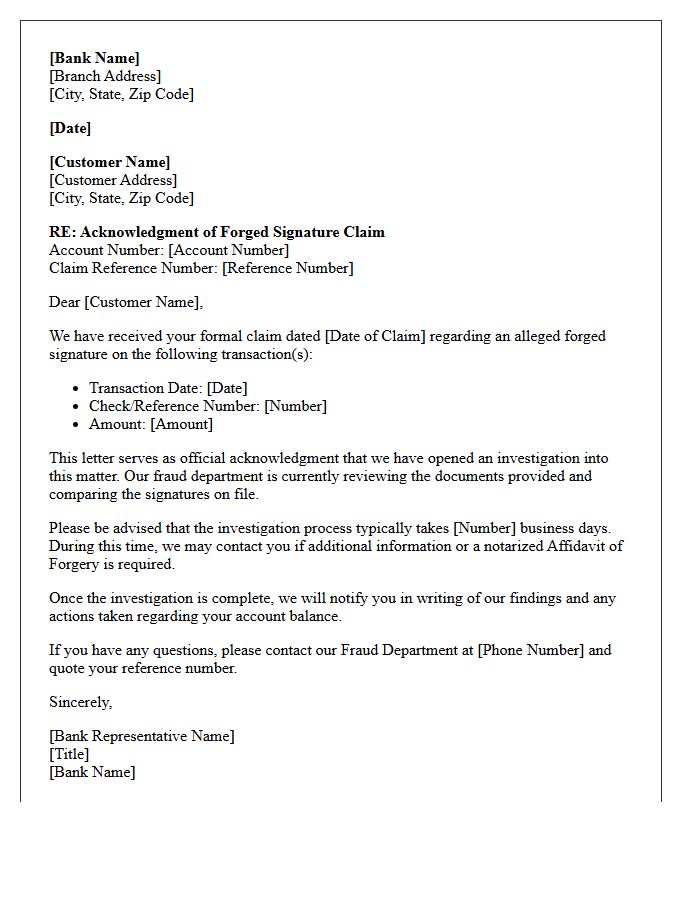
A Bank Acknowledgment Letter confirms that your financial institution has officially received a forged signature claim. This document is a critical part of the fraud investigation process, providing a formal record of your dispute. It typically includes a case reference number and outlines the expected timeline for the bank's review. Retain this letter as legal evidence that you reported the unauthorized activity. Once the signature is verified as counterfeit, the bank will determine your eligibility for a reimbursement of the disputed funds based on internal security protocols and banking regulations.
Formal Demand Letter for Reimbursement of Forged Funds
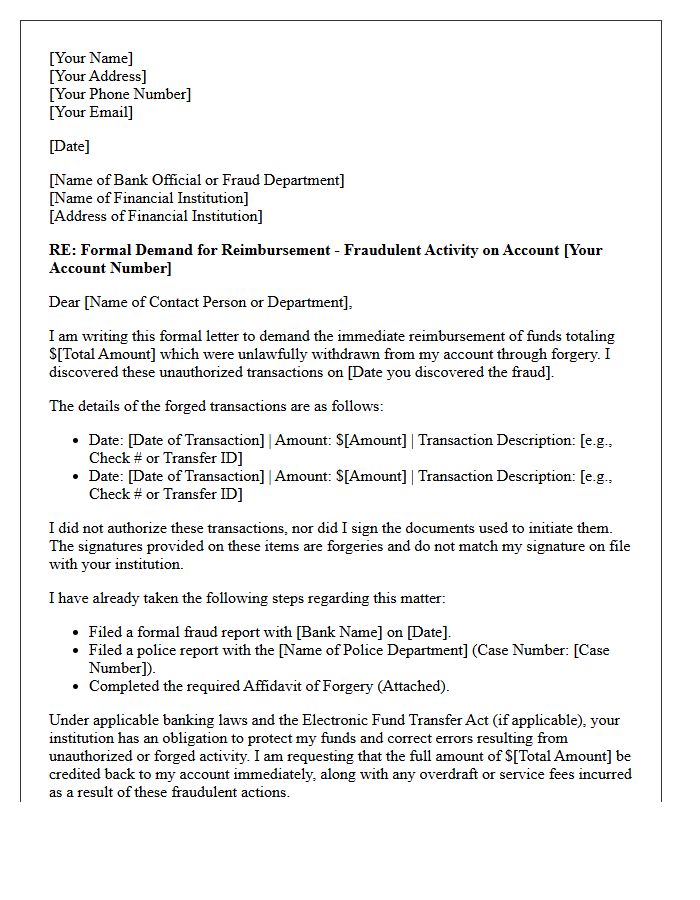
A formal demand letter serves as legal notice to a financial institution regarding unauthorized transactions. It must clearly detail the specific dates, amounts, and account information associated with the fraud. Explicitly state that the signatures or authorizations were forged and demand a full reimbursement within a set timeframe, typically ten business days. Citing relevant consumer protection laws, such as Regulation E, strengthens your position. Ensure the letter is sent via certified mail to create a formal paper trail, which is essential if future litigation or regulatory complaints become necessary to recover your funds.
Police Report Enclosure Letter for Check Fraud
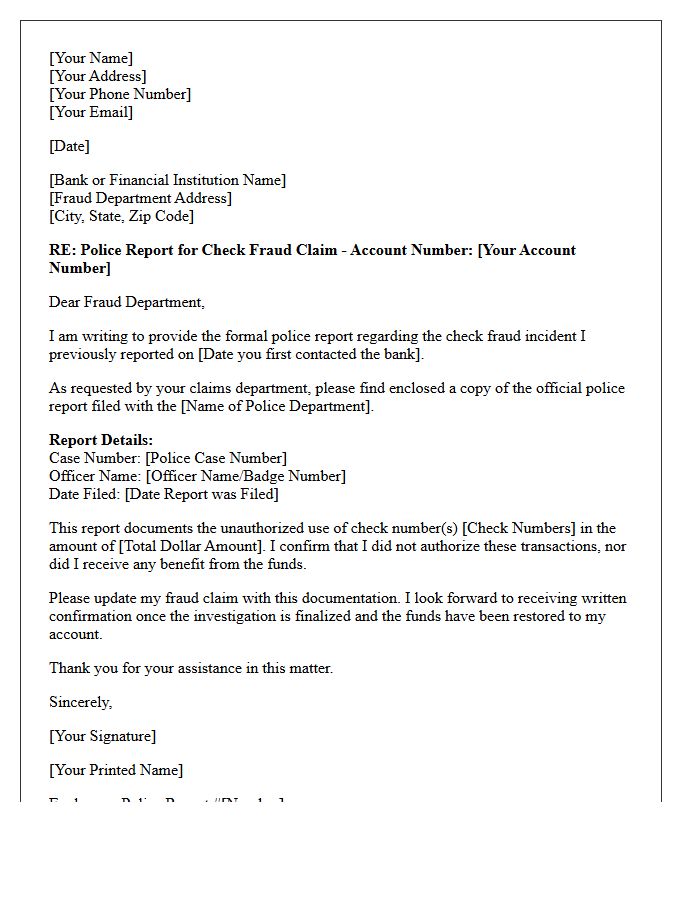
A police report enclosure letter is a formal document sent to financial institutions or credit bureaus to verify a check fraud claim. This letter serves as official notification that a crime occurred, protecting the victim from liability for unauthorized transactions. It must include the case number, the officer's name, and a summary of the incident. Attaching the full police report provides legal proof, which is essential for disputing fraudulent charges and initiating a bank investigation to recover lost funds or restore account security.
Account Freeze and Security Hold Request Letter
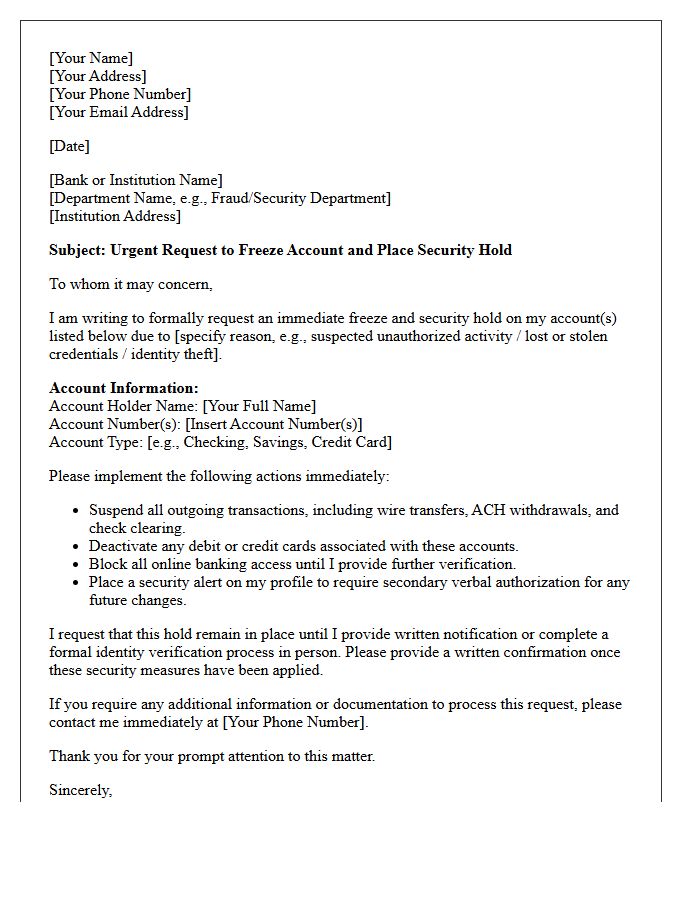
An Account Freeze and Security Hold Request Letter is a formal legal document used to protect your assets from unauthorized access. This written notice instructs a financial institution to temporarily suspend all outgoing transactions to prevent potential identity theft or fraud. It is essential to include your account details, the specific reason for the request, and a formal demand for verification of all future activity. Sending this via certified mail ensures a paper trail, establishing legal accountability and securing your finances during a security breach or period of vulnerability.
Fraudulent Check Dispute Letter to Banking Institution
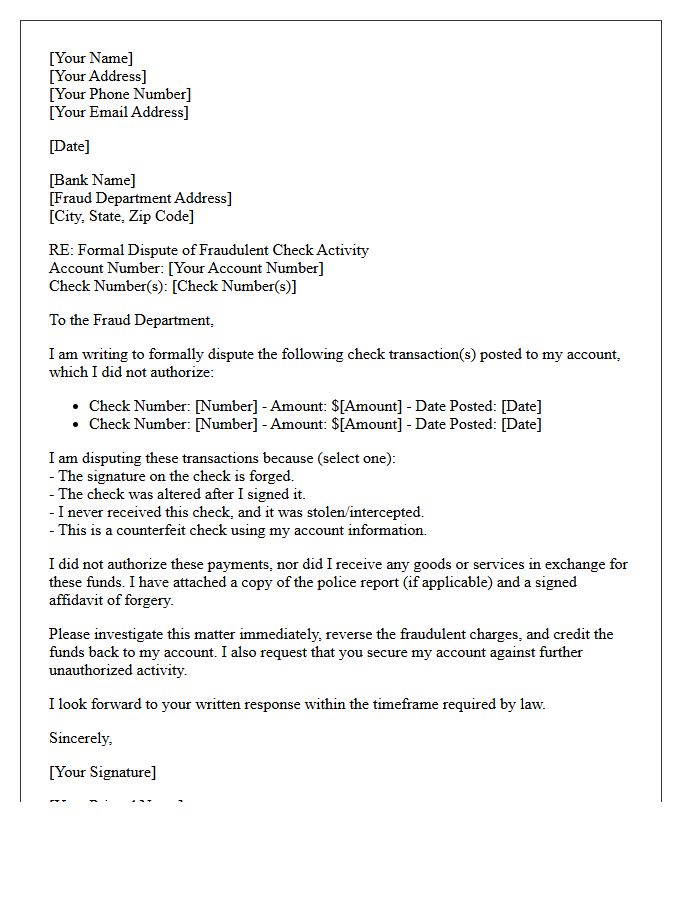
When drafting a Fraudulent Check Dispute Letter, you must act quickly to protect your legal rights under the Electronic Fund Transfer Act or Uniform Commercial Code. Clearly state that the signature is unauthorized or the instrument was altered. Include specific details like the check number, date, and exact dollar amount. Attach a copy of your police report or identity theft affidavit to validate your claim. Formally demand a reversal of charges and a correction of your account balance to ensure your financial standing remains intact during the investigation.
Bank Resolution Letter for Forged Signature Claim
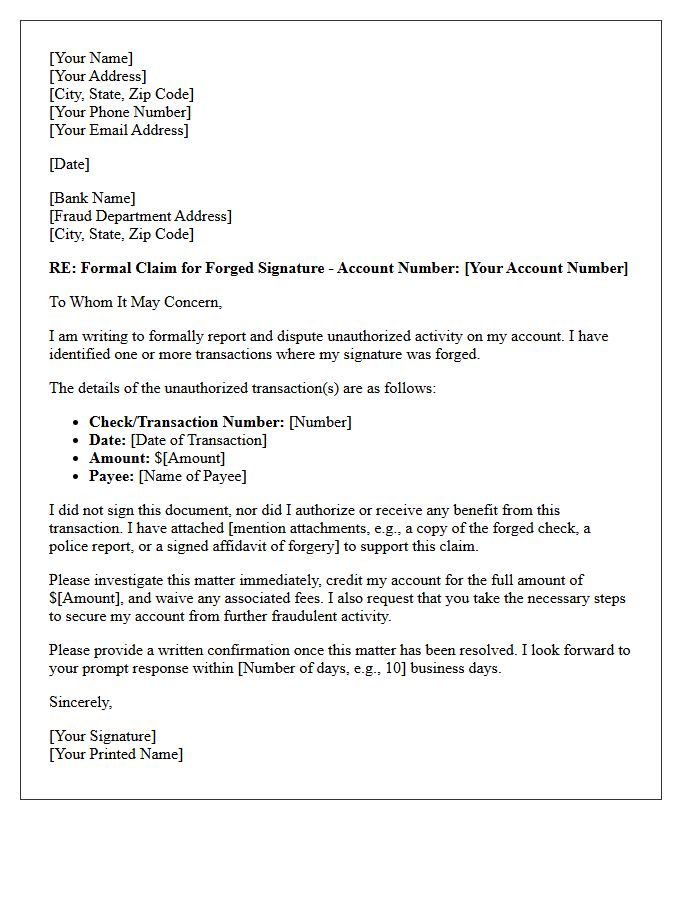
A Bank Resolution Letter is the official document confirming the outcome of an investigation into a forged signature claim. It details whether the financial institution found evidence of unauthorized activity or identity theft. If the claim is validated, this letter outlines the reimbursement process and restored funds. It serves as essential legal proof of the dispute resolution, which may be required for credit reporting adjustments or law enforcement reports. Always retain this letter to protect your financial rights and document that the fraudulent liability was formally resolved by the bank.
Claim Denial Letter for Disputed Check Signature
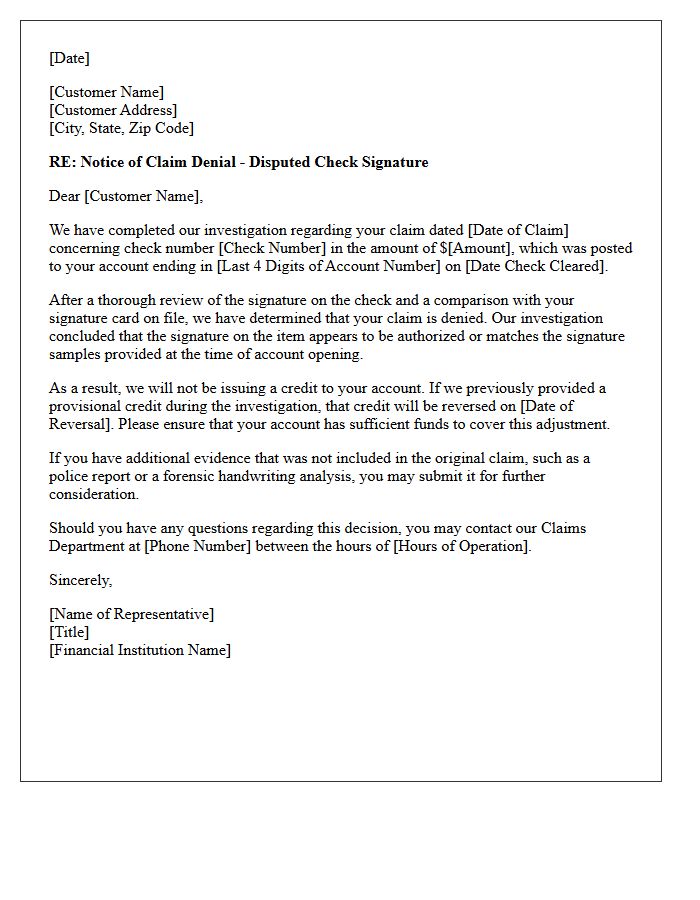
Receiving a Claim Denial Letter regarding a disputed check signature indicates that the financial institution has rejected your forgery claim. The bank typically denies liability if their investigation suggests the signature is authentic or if there was negligence in securing your checkbook. It is crucial to review the specific reason for denial immediately. You must provide supplemental evidence, such as a police report or handwriting analysis, to challenge the decision. Timely action is essential, as strict statutory deadlines apply for appealing the bank's final determination and recovering lost funds.
Escalation Letter to Branch Manager Regarding Cleared Forgery
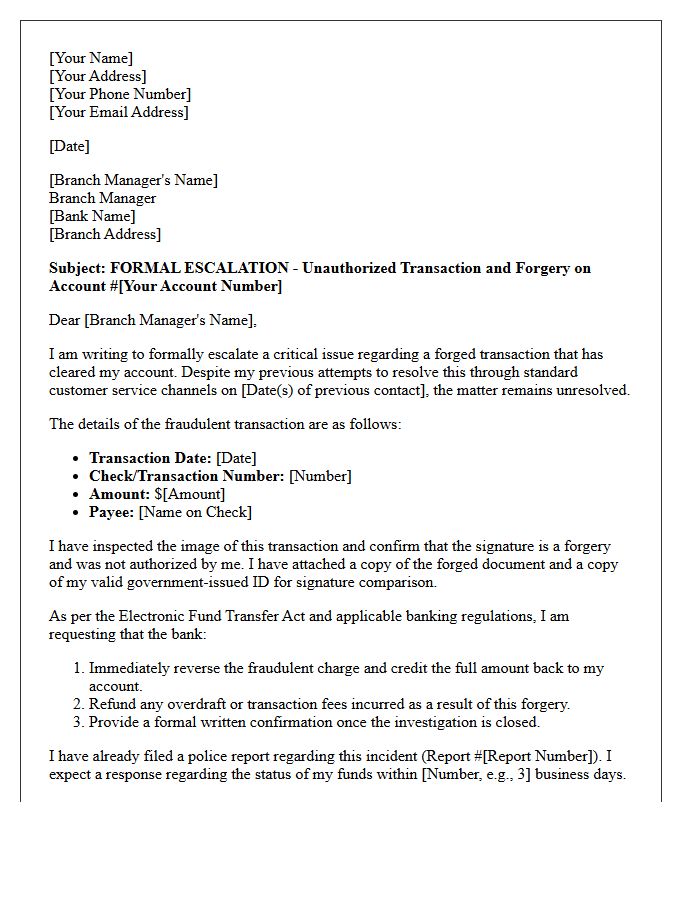
When drafting an escalation letter regarding a cleared forgery, you must provide the specific transaction details and copies of the unauthorized checks. Formally state that you did not authorize the signature and demand a full reimbursement under banking regulations. Clearly outline the timeline of your previous reports and the branch's failure to resolve the issue. Highlighting the legal implications of negligence ensures the manager prioritizes your claim. Maintain a professional tone while insisting on an immediate investigation into the security breach to protect your account standing.
Provisional Credit Notification Letter for Forged Check
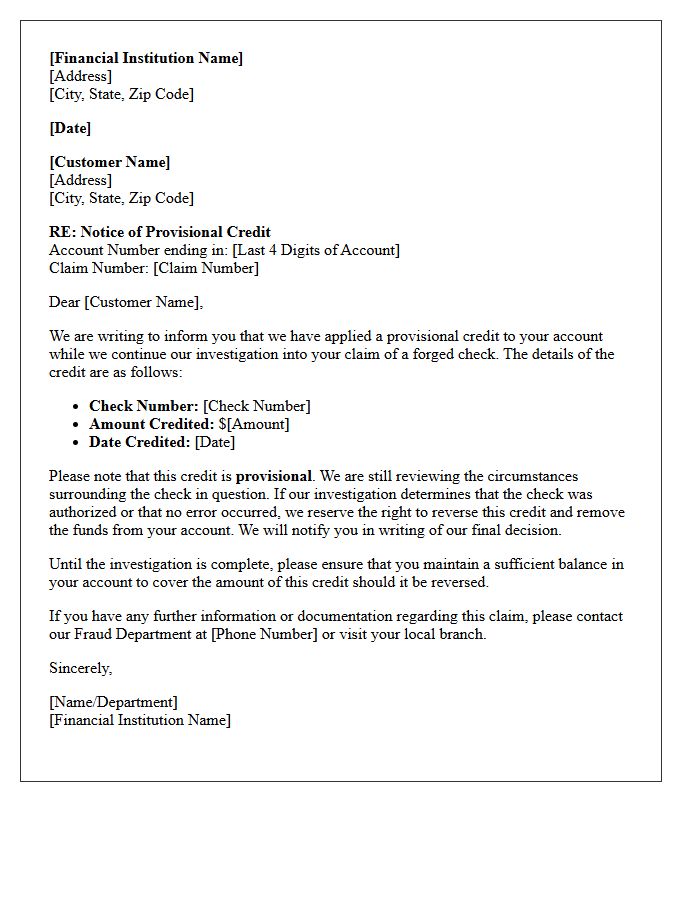
A Provisional Credit Notification Letter informs a bank customer that funds have been temporarily restored to their account during a forged check investigation. This letter confirms that the financial institution is reviewing the unauthorized signature claim under Regulation E or the Uniform Commercial Code. While the credit allows immediate access to displaced funds, it remains subject to reversal if the bank determines the check was legitimate or the claim is denied. Customers must retain this document as a formal record of the bank's interim decision and the ongoing resolution timeline.
What should I do immediately if I discover a forged signature on a cleared check?
You must notify your bank's fraud department immediately to report the unauthorized transaction. Request to place a formal "stop payment" or "fraud alert" on your account and ask for the specific procedure to file a forgery affidavit to initiate the recovery process.
How long do I have to report a forged signature on a check to my bank?
Under the Uniform Commercial Code (UCC), you generally have 30 days from the date your bank statement was made available to report a forgery. However, specific state laws and your individual deposit account agreement may shorten this reporting window to as little as 14 days to maintain your right to a refund.
Will the bank refund my money if a check was cleared with a forged signature?
In most cases, banks are strictly liable for paying checks that are not "properly payable," which includes those with forged drawer signatures. Provided you report the forgery within the legal timeframe and did not contribute to the fraud through negligence, the bank is typically required to credit your account.
What documentation is required to file a forged check claim?
You will typically need to complete a notarized Affidavit of Forgery, provide a copy of the fraudulent check, and file a formal police report. The bank uses these documents to verify that the signature does not match your authorized signature card on file.
Can a bank deny a claim for a forged signature on a cleared check?
A bank may deny a claim if they can prove "account holder negligence," such as leaving your checkbook in an unsecured location or failing to review your bank statements for an extended period. They may also deny claims if you fail to report the forgery within the timeframe specified in your account agreement.

Comments