
Effective financial stability requires a robust Counterparty Credit Risk Assessment Letter to evaluate the solvency and reliability of business partners. This document formalizes the evaluation of potential credit defaults, ensuring your organization maintains secure lending standards and mitigates financial exposure. Streamline your due diligence process by utilizing professional documentation. To help you get started, below are some ready to use template.

Image cover: Mastering Counterparty Credit Risk: Professional Assessment Letter Samples and Templates
Letter Samples List
- Initial Counterparty Credit Risk Assessment Letter
- Counterparty Credit Risk Limit Approval Letter
- Annual Counterparty Credit Risk Review Letter
- Counterparty Credit Risk Exposure Confirmation Letter
- Counterparty Credit Risk Collateral Demand Letter
- Counterparty Credit Risk Margin Call Letter
- Counterparty Credit Risk Limit Breach Notice Letter
- Counterparty Credit Risk Downgrade Notification Letter
- Counterparty Credit Risk Mitigation Agreement Letter
- Counterparty Credit Risk Reassessment Request Letter
- Counterparty Credit Risk Suspension Warning Letter
- Counterparty Credit Risk Default Declaration Letter
- Counterparty Credit Risk Clearance And Onboarding Letter
Initial Counterparty Credit Risk Assessment Letter
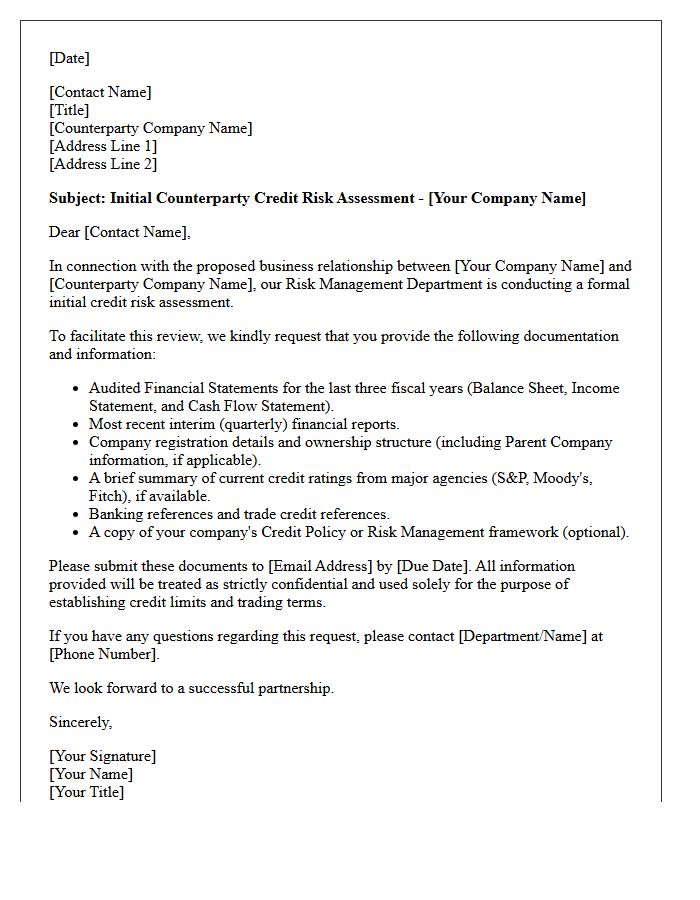
An Initial Counterparty Credit Risk Assessment Letter is a formal document used to evaluate the financial stability and default probability of a potential business partner. It outlines key risk metrics, credit limits, and collateral requirements necessary to mitigate exposure before entering a contract. This assessment ensures that institutions understand the creditworthiness of their counterparties, helping to prevent systemic loss. Accurate reporting in this letter is essential for maintaining regulatory compliance and establishing a secure framework for complex financial transactions or long-term trade agreements.
Counterparty Credit Risk Limit Approval Letter
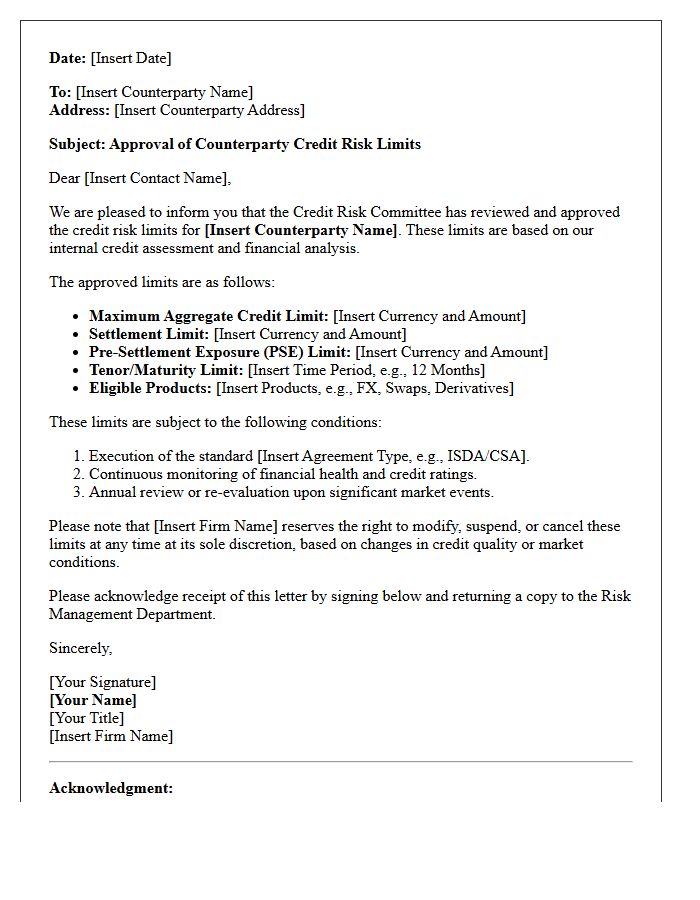
A Counterparty Credit Risk Limit Approval Letter is a formal document issued by a financial institution defining the maximum exposure permitted for a specific trading partner. It outlines authorized credit limits, approved financial instruments, and necessary collateral requirements to mitigate potential default losses. This letter serves as a critical internal control, ensuring that all derivatives and securities transactions remain within the firm's established risk appetite. It establishes a clear legal and operational framework for managing institutional relationships while maintaining regulatory compliance and financial stability during market fluctuations.
Annual Counterparty Credit Risk Review Letter
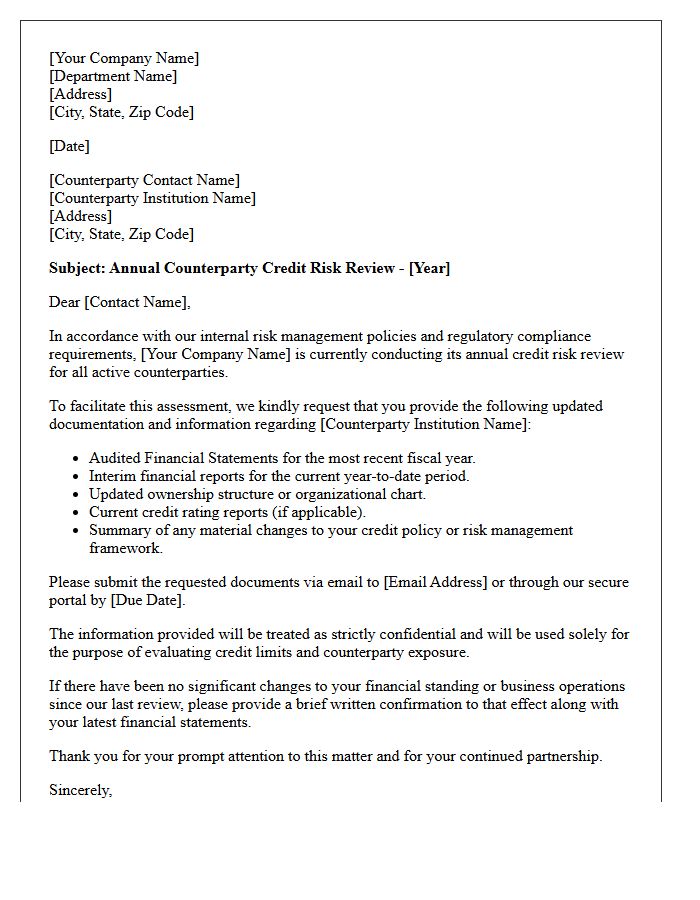
An Annual Counterparty Credit Risk Review Letter is a formal notification issued by financial institutions to assess the creditworthiness of their trading partners. This document evaluates financial stability, risk exposure, and compliance with regulatory standards like Basel III. It ensures that credit limits remain appropriate relative to the counterparty's current fiscal health. Timely responses are critical to avoid disruptions in trading capabilities or credit line suspensions. Understanding these reviews is essential for maintaining transparent institutional relationships and mitigating potential systemic risk within global financial markets.
Counterparty Credit Risk Exposure Confirmation Letter
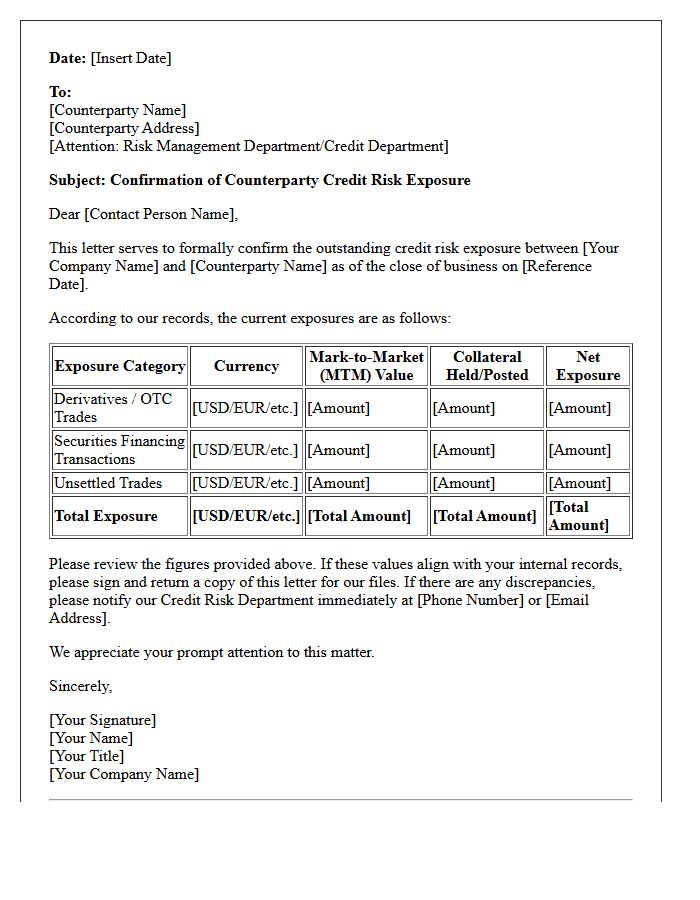
A Counterparty Credit Risk Exposure Confirmation Letter is a formal document used to validate outstanding financial obligations between two parties. It serves as a critical reconciliation tool to ensure both entities agree on current exposure levels, collateral held, and potential default risks. Financial institutions issue these letters to maintain regulatory compliance, verify internal ledger accuracy, and mitigate systemic credit risk. By confirming net exposures regularly, firms can identify discrepancies early, enhance balance sheet transparency, and safeguard against operational losses within complex derivative or lending portfolios.
Counterparty Credit Risk Collateral Demand Letter
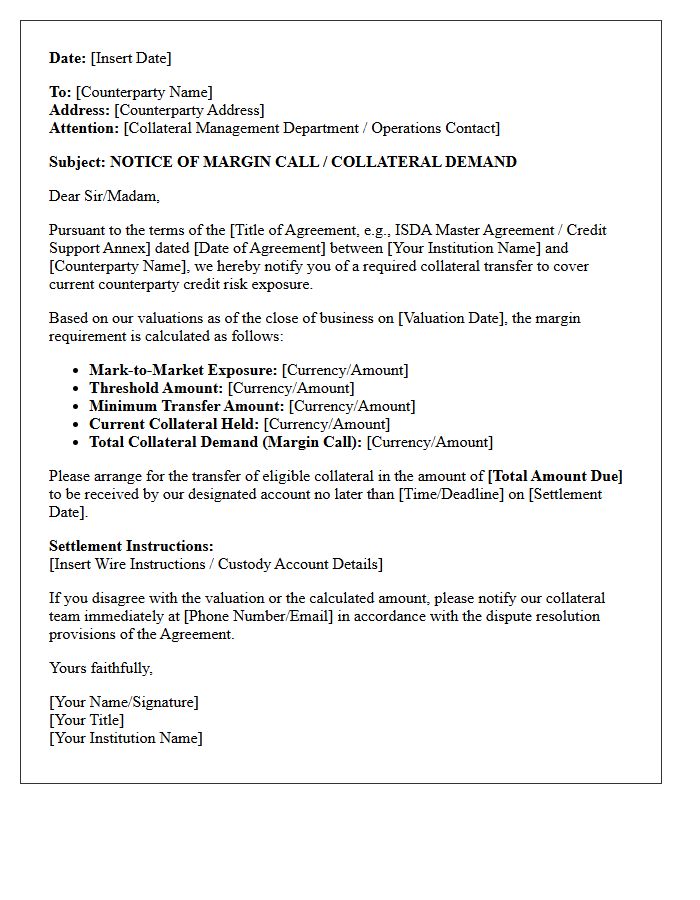
A Counterparty Credit Risk Collateral Demand Letter is a formal notification issued when a trading partner fails to meet financial obligations or margin requirements. It serves as a legal request for the immediate transfer of eligible assets to mitigate potential losses. This document typically outlines the specific valuation haircut, the total exposure amount, and the strict deadline for delivery. Understanding these demands is critical for maintaining liquidity management and ensuring compliance with Credit Support Annex (CSA) agreements to prevent a formal event of default.
Counterparty Credit Risk Margin Call Letter
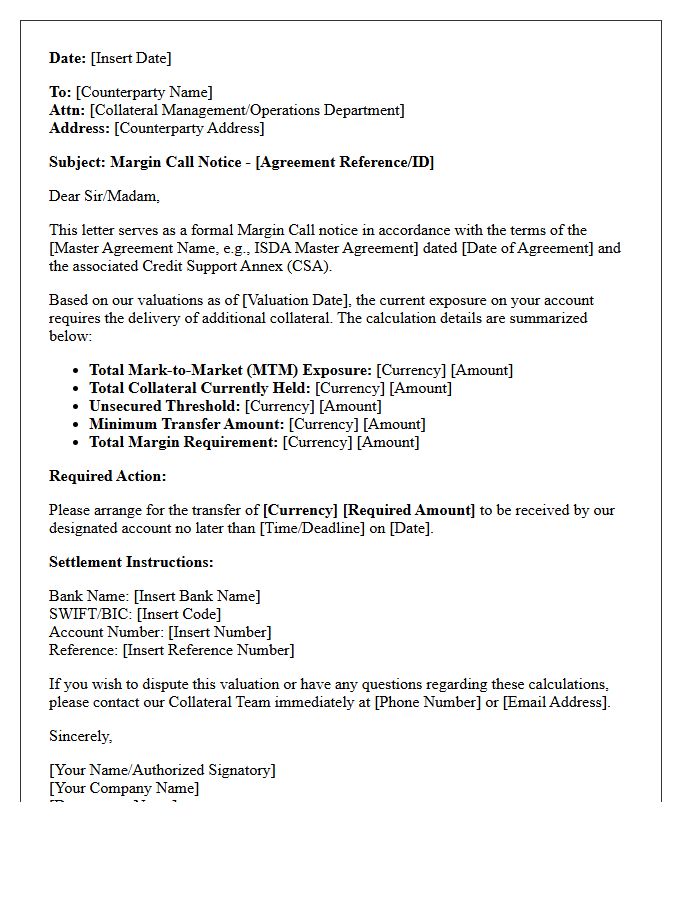
A Counterparty Credit Risk Margin Call Letter is a formal notification issued when the exposure between two financial entities exceeds pre-agreed thresholds. It demands the immediate transfer of collateral, such as cash or securities, to cover potential losses from market fluctuations. This mechanism is essential for mitigating default risk in derivative transactions. Failure to meet the call can trigger a technical default, leading to position liquidation. Understanding the specific Credit Support Annex (CSA) terms is vital for managing liquidity and ensuring regulatory compliance in over-the-counter markets.
Counterparty Credit Risk Limit Breach Notice Letter
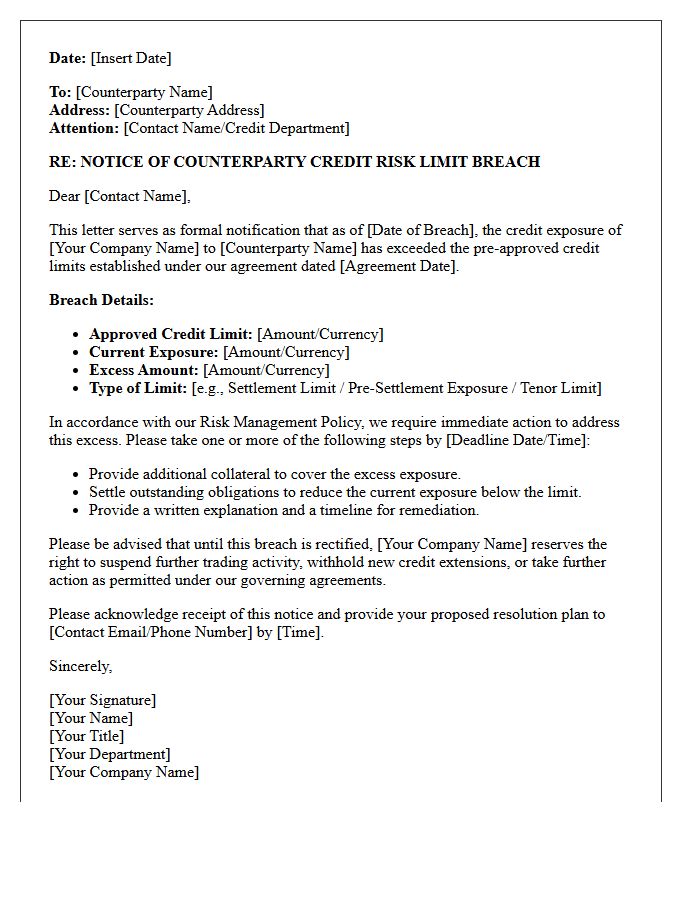
A Counterparty Credit Risk Limit Breach Notice Letter is a formal notification issued when a trading partner exceeds their pre-approved exposure threshold. This critical document serves as an immediate remediation trigger to mitigate potential financial loss. It outlines the specific breach details, calculates the current overage, and demands urgent action, such as posting additional collateral or suspending further trades. Timely delivery is essential for maintaining regulatory compliance and ensuring the stability of a firm's risk management framework during periods of market volatility or credit deterioration.
Counterparty Credit Risk Downgrade Notification Letter
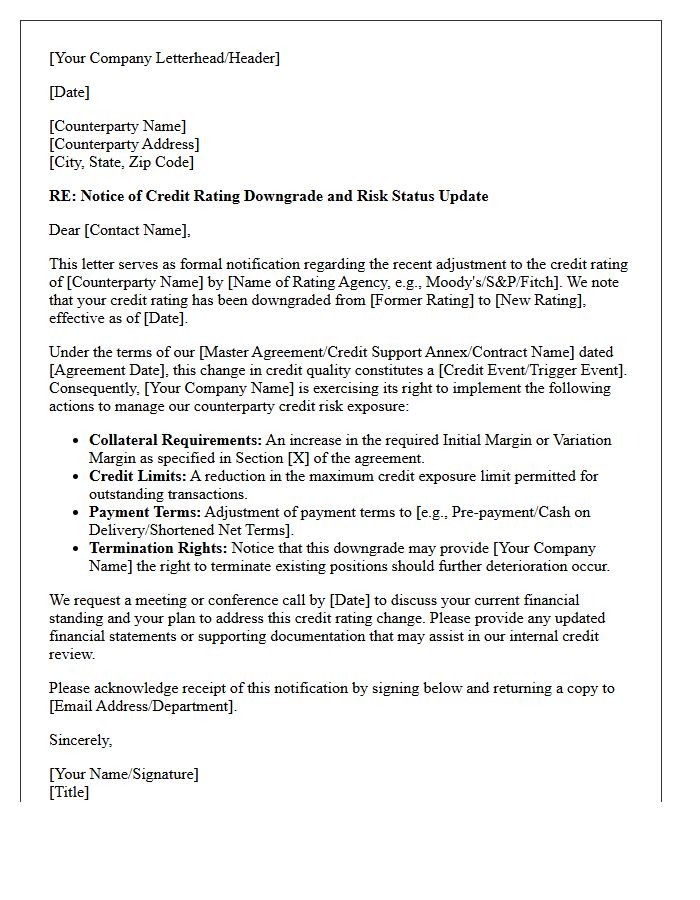
A Counterparty Credit Risk Downgrade Notification Letter is a formal communication issued when a participant's credit rating falls below a specific contractually mandated threshold. This event of default or termination event often triggers the right to demand additional collateral or terminate outstanding derivative transactions. It is a vital risk management tool used to mitigate potential financial exposure. Timely issuance ensures legal protection under ISDA agreements, allowing firms to protect liquidity and minimize counterparty exposure during periods of financial instability or deteriorating creditworthiness.
Counterparty Credit Risk Mitigation Agreement Letter
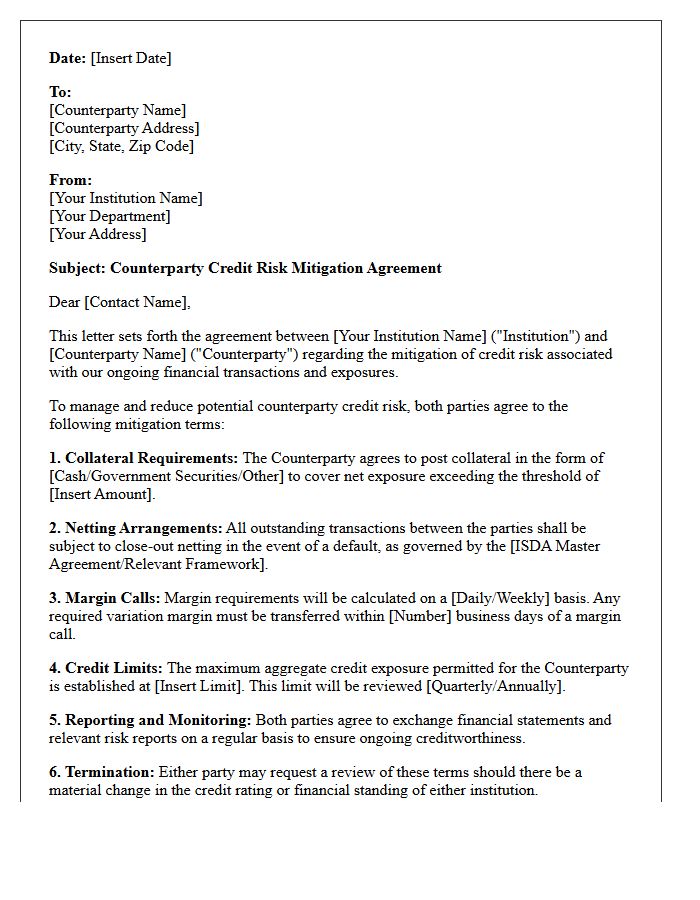
A Counterparty Credit Risk Mitigation Agreement Letter is a legal document used to manage potential default risks in financial transactions. It establishes formal protocols for collateral management, netting arrangements, and credit support obligations between parties. By outlining specific margin requirements and valuation frequency, the letter minimizes exposure to financial loss during market volatility. This agreement ensures institutional stability by providing a clear framework for risk mitigation and regulatory compliance, protecting both entities from the adverse effects of a counterparty's inability to meet its contractual debt obligations.
Counterparty Credit Risk Reassessment Request Letter
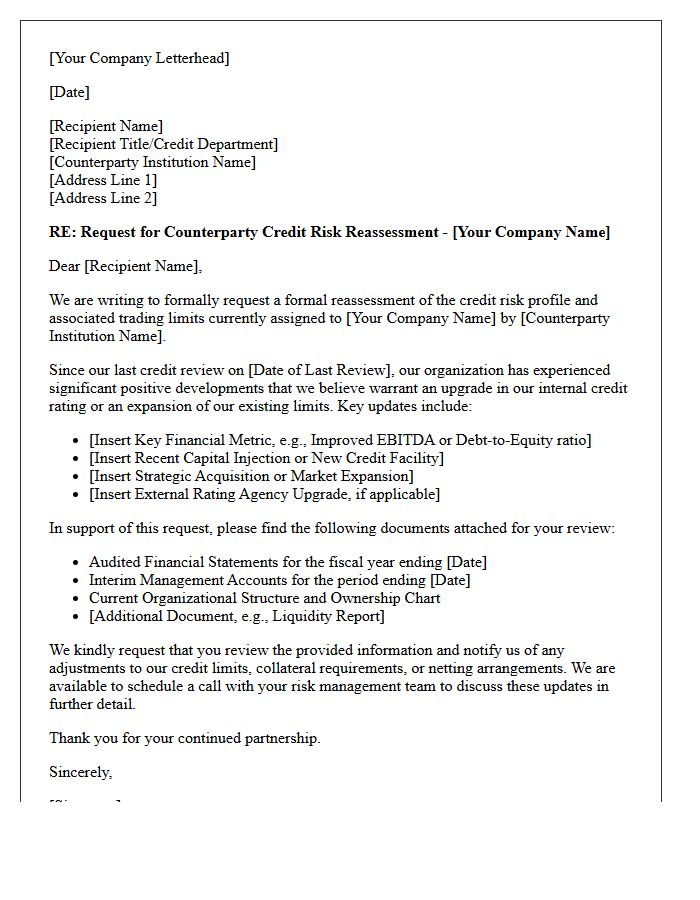
A Counterparty Credit Risk Reassessment Request Letter is a formal document used to initiate a review of a partner's financial stability. Businesses issue this when adverse market conditions or shifting creditworthiness signals potential default. The goal is to re-evaluate exposure limits, collateral requirements, and settlement terms to mitigate financial loss. Clearly stating the grounds for review ensures transparency and maintains risk management standards during volatile economic periods. Providing supporting documentation helps expedite the credit evaluation process and protects the firm's liquidity position against counterparty failure.
Counterparty Credit Risk Suspension Warning Letter
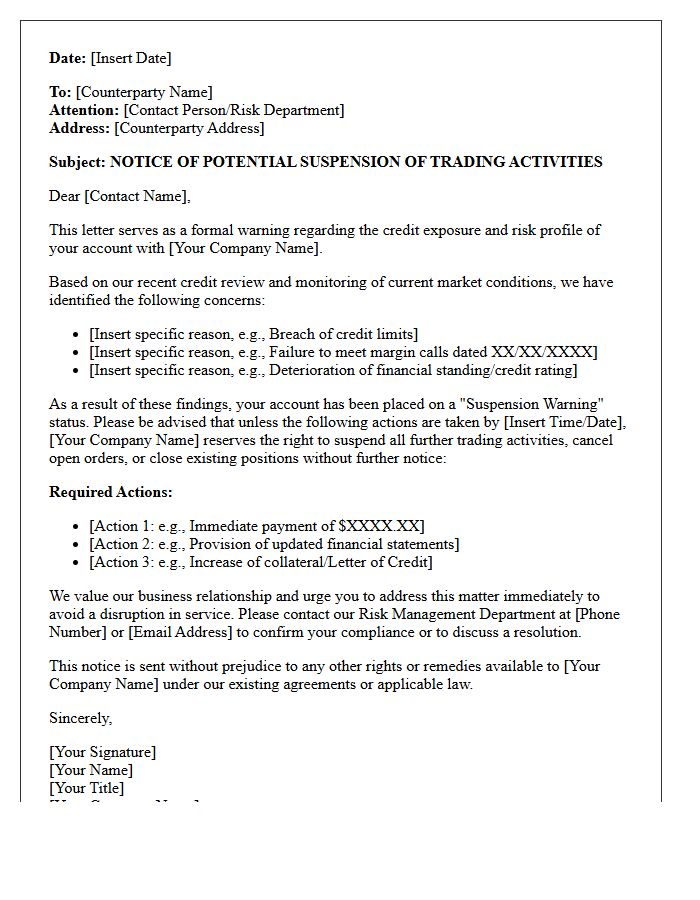
A Counterparty Credit Risk Suspension Warning Letter is a formal notice issued when a firm's financial stability or collateral adequacy fails to meet regulatory or contractual standards. This document serves as a final alert before a total trading halt occurs. It outlines specific breaches, such as credit limit violations or missed margin calls, that jeopardize market integrity. Receivers must immediately provide remediation or additional liquidity to prevent the termination of active trading agreements and mitigate systemic risk within the financial network.
Counterparty Credit Risk Default Declaration Letter
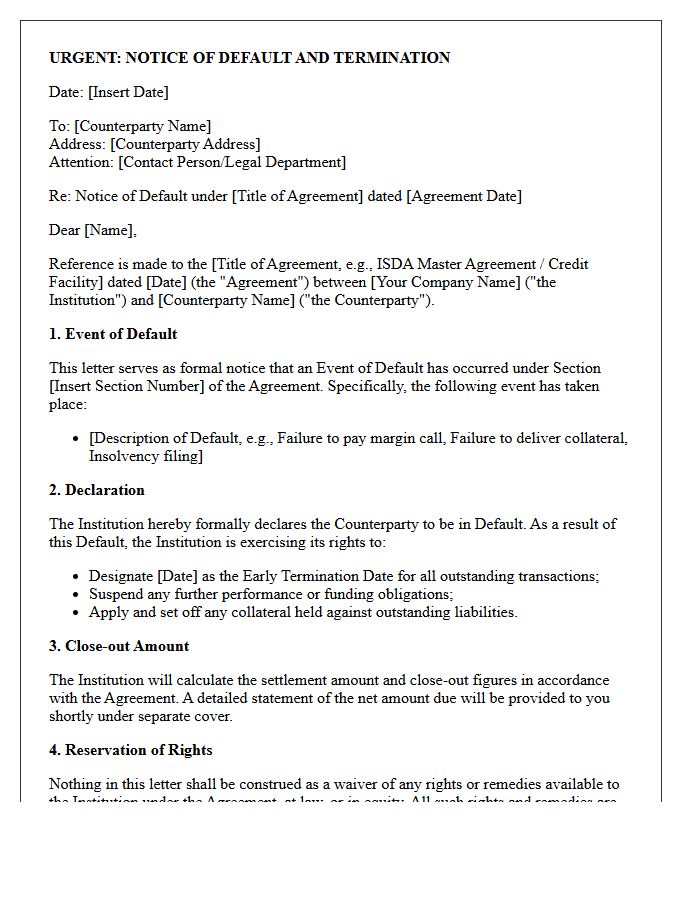
A Counterparty Credit Risk Default Declaration Letter is a formal notification issued when a financial partner fails to meet contractual obligations. This document officially triggers default proceedings, allowing the non-defaulting party to terminate trades and begin the close-out netting process. It serves as critical legal evidence for calculating replacement costs and seizing collateral. Promptly issuing this letter is essential for risk mitigation, ensuring that credit exposure is frozen and legal rights under ISDA Master Agreements or similar frameworks are fully protected during a counterparty's insolvency or technical breach.
Counterparty Credit Risk Clearance And Onboarding Letter
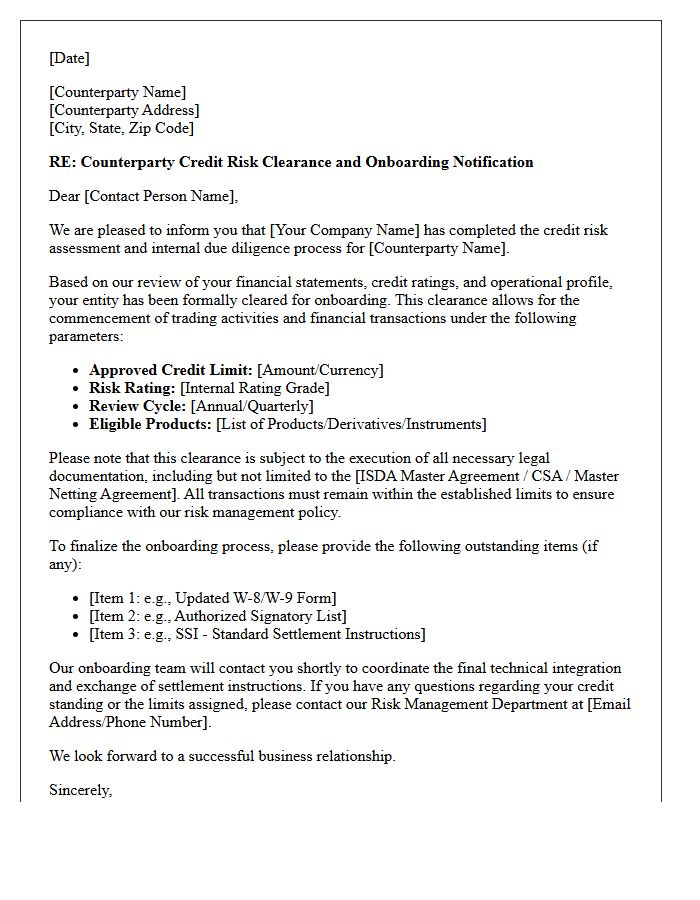
A Counterparty Credit Risk Clearance and Onboarding Letter is a critical document formalizing the credit approval process between financial institutions. It confirms that a counterparty has passed rigorous financial assessments and risk due diligence protocols. This letter establishes specific trading limits and operational parameters necessary to mitigate potential default exposure. Receiving this clearance is an essential prerequisite for executing over-the-counter derivatives or complex financing agreements, ensuring that all regulatory compliance and risk management standards are met before active market engagement begins.
What is a Counterparty Credit Risk Assessment Letter?
A Counterparty Credit Risk Assessment Letter is a formal document issued by a financial institution or credit department that evaluates the creditworthiness of a trading partner. It outlines the counterparty's ability to meet its financial obligations and details any credit limits or risk mitigation requirements imposed for future transactions.
What are the key components included in a credit risk assessment letter?
The letter typically includes the counterparty's credit rating, a summary of financial statement analysis, internal risk scores, recommended exposure limits, and any required collateral or credit enhancements. It may also provide a qualitative outlook on the counterparty's industry stability and operational reliability.
Why do businesses require a risk assessment letter before entering a contract?
Businesses use these letters to mitigate the risk of financial loss due to a counterparty's default. It provides an objective basis for setting payment terms, determining the size of trade lines, and ensuring that the level of credit extended aligns with the firm's overall risk appetite and regulatory compliance standards.
How often should a Counterparty Credit Risk Assessment Letter be updated?
Risk assessment letters are generally updated annually or whenever a significant "credit event" occurs, such as a merger, acquisition, or a sharp decline in market performance. Regular reviews ensure that credit limits remain appropriate relative to the counterparty's current financial health and prevailing market conditions.
What is the difference between an internal and external credit risk assessment?
An internal assessment letter is generated by a company's own credit team based on proprietary data and relationship history, whereas an external assessment relies on reports from third-party agencies like S&P, Moody's, or Fitch. Both are often used in tandem to provide a comprehensive view of counterparty reliability.


Comments