
An Anti-Money Laundering Compliance Certification Letter is a formal document verifying that a financial institution or business adheres to legal AML regulations and internal control standards. It provides essential assurance to partners and regulators that your organization actively prevents financial crimes. Streamline your documentation process today; below are some ready to use templates.
Image cover: Official AML Compliance Certification Letter: Professional Samples and Templates
Letter Samples List
- Annual Anti-Money Laundering Compliance Certification Letter
- Correspondent Banking Anti-Money Laundering Certification Letter
- Customer Due Diligence Compliance Certification Letter
- Foreign Bank Anti-Money Laundering Attestation Letter
- Patriot Act Anti-Money Laundering Certification Letter
- Wolfsberg Group Anti-Money Laundering Certification Letter
- Sanctions and Anti-Money Laundering Compliance Letter
- Know Your Customer and Anti-Money Laundering Certification Letter
- Independent Audit Anti-Money Laundering Certification Letter
- Board of Directors Anti-Money Laundering Approval Letter
- Regulatory Anti-Money Laundering Compliance Attestation Letter
- Beneficial Ownership Anti-Money Laundering Declaration Letter
Annual Anti-Money Laundering Compliance Certification Letter
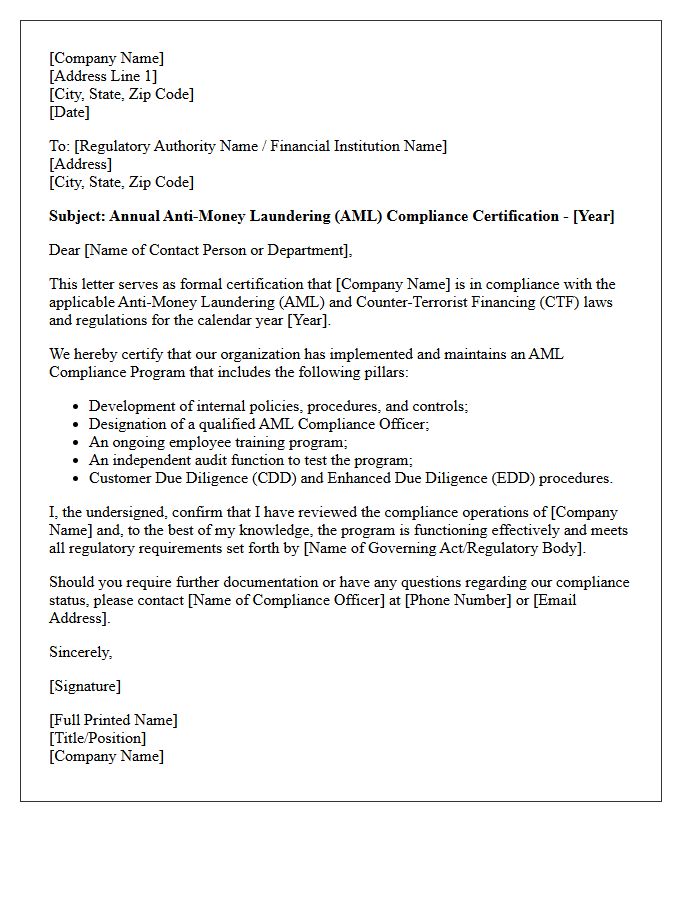
The Annual Anti-Money Laundering Compliance Certification Letter is a mandatory document submitted to regulatory bodies to verify that a financial institution's AML program remains effective. It serves as formal attestation from senior management that the organization adheres to legal requirements, such as the Bank Secrecy Act. This letter confirms that internal risk assessments, employee training, and monitoring systems are fully operational. Failure to submit this certification can lead to severe regulatory penalties, legal sanctions, and significant reputational damage, making it a critical component of institutional governance and financial integrity.
Correspondent Banking Anti-Money Laundering Certification Letter
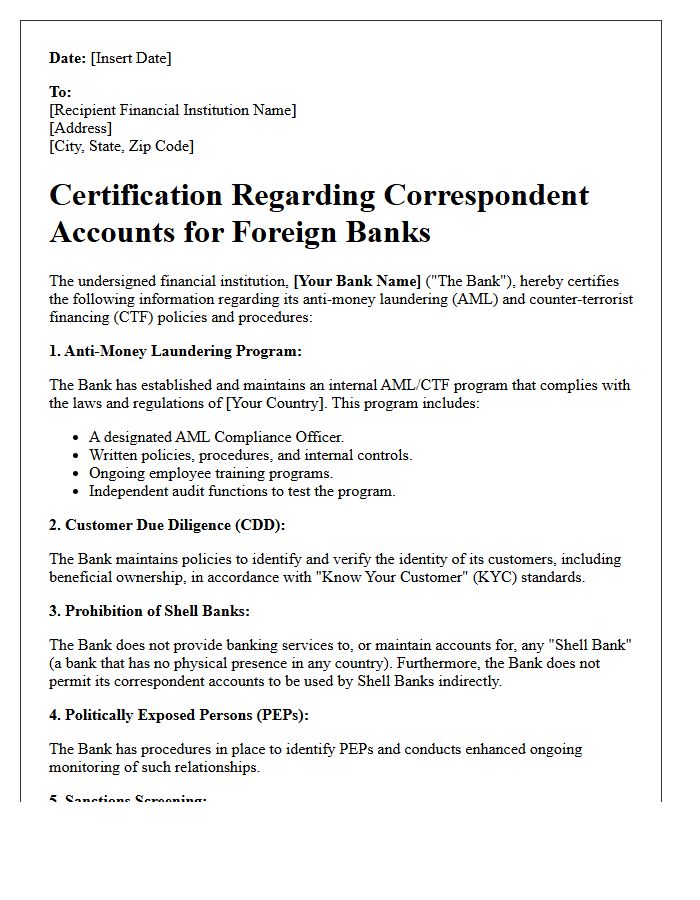
A Correspondent Banking Anti-Money Laundering Certification Letter is a formal document used to verify that a financial institution complies with AML/CFT regulations. It ensures that the bank has robust due diligence protocols, effective monitoring systems, and strict Know Your Customer (KYC) procedures. These letters are essential for establishing correspondent relationships, as they provide assurance to partner banks that the institution is not involved in illicit activities like money laundering or terrorist financing. Maintaining updated certifications is critical for facilitating secure cross-border transactions and global financial connectivity.
Customer Due Diligence Compliance Certification Letter
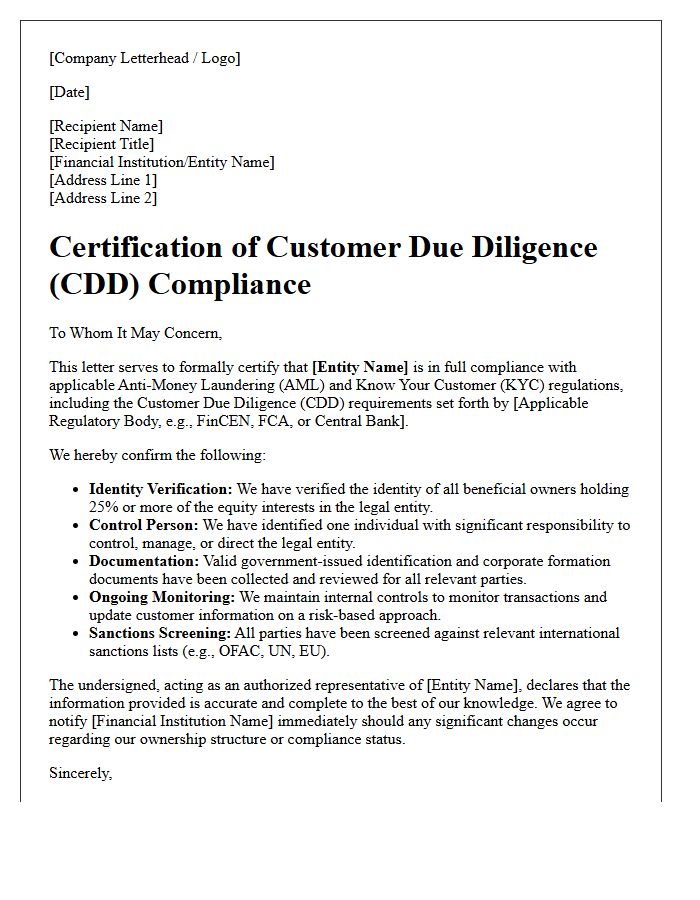
A Customer Due Diligence Compliance Certification Letter is a formal document verifying that a financial institution has performed mandatory Know Your Customer (KYC) procedures. It confirms the identification and verification of ultimate beneficial owners to prevent financial crimes like money laundering or terrorism financing. This letter is essential for maintaining regulatory compliance during audits or when establishing correspondent banking relationships. By signing this certification, an organization legally attests that it has mitigated risks and adhered to global anti-money laundering (AML) standards and due diligence protocols.
Foreign Bank Anti-Money Laundering Attestation Letter
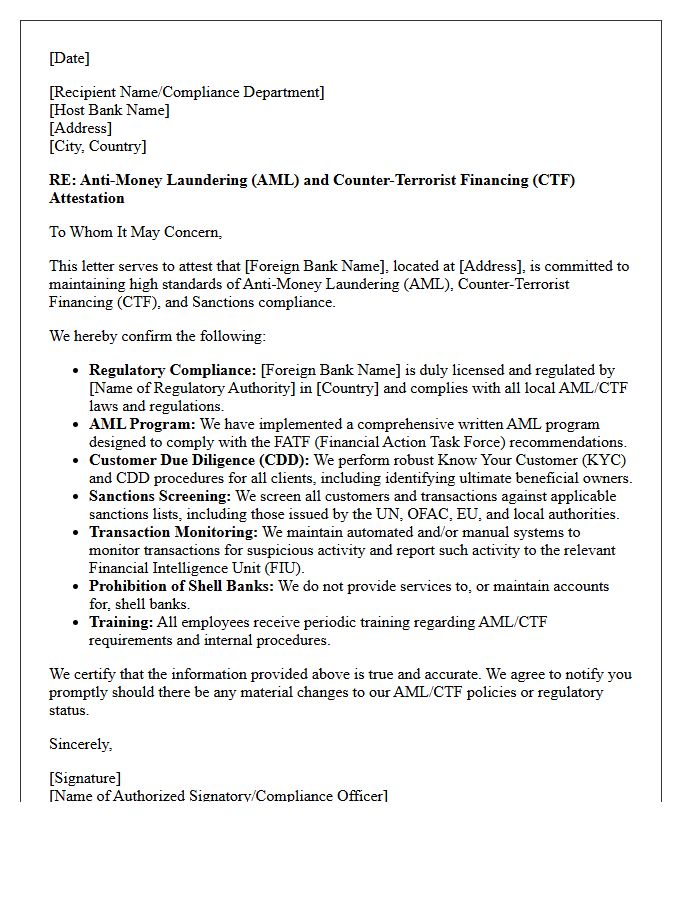
A Foreign Bank Anti-Money Laundering Attestation Letter is a formal document where a financial institution confirms its compliance with global AML/CFT standards. This letter assures correspondent banks that the entity has implemented rigorous due diligence, monitoring, and reporting protocols to prevent financial crimes. It is essential for maintaining international banking relationships and ensuring cross-border transparency. By signing this attestation, the bank verifies it does not provide services to shell banks and strictly adheres to regulatory frameworks like the USA PATRIOT Act or FATF recommendations.
Patriot Act Anti-Money Laundering Certification Letter
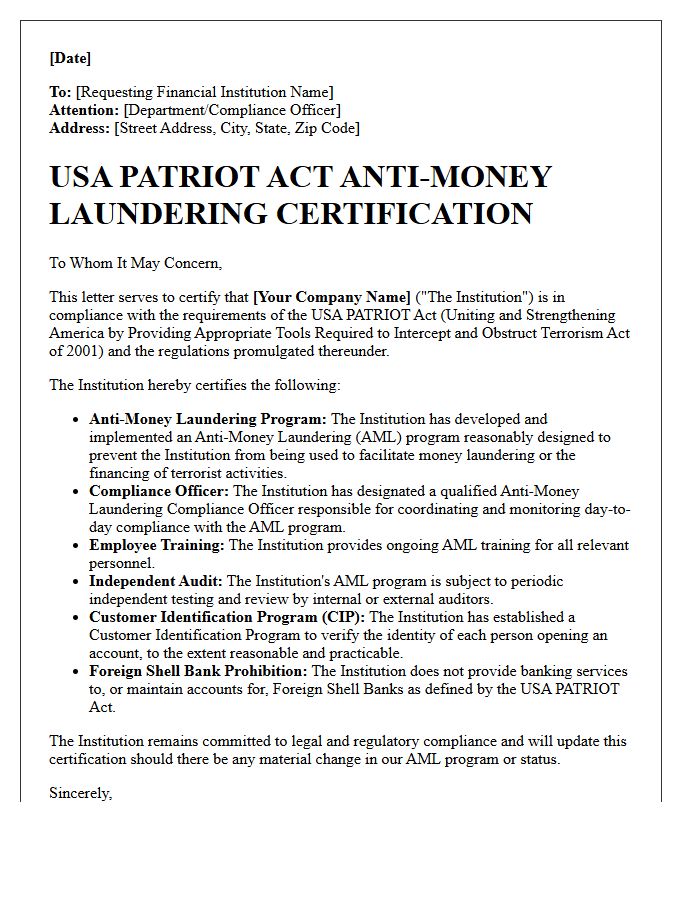
A Patriot Act Anti-Money Laundering Certification Letter is a formal document used by foreign banks to certify they are not shell banks. Under Section 313 of the USA PATRIOT Act, U.S. financial institutions are prohibited from maintaining correspondent accounts for foreign entities that lack a physical presence or regulatory supervision. This certification ensures transparency and helps prevent money laundering or terrorist financing. Foreign banks must typically recertify every three years to maintain their banking relationships within the United States, confirming their compliance with global anti-financial crime standards.
Wolfsberg Group Anti-Money Laundering Certification Letter
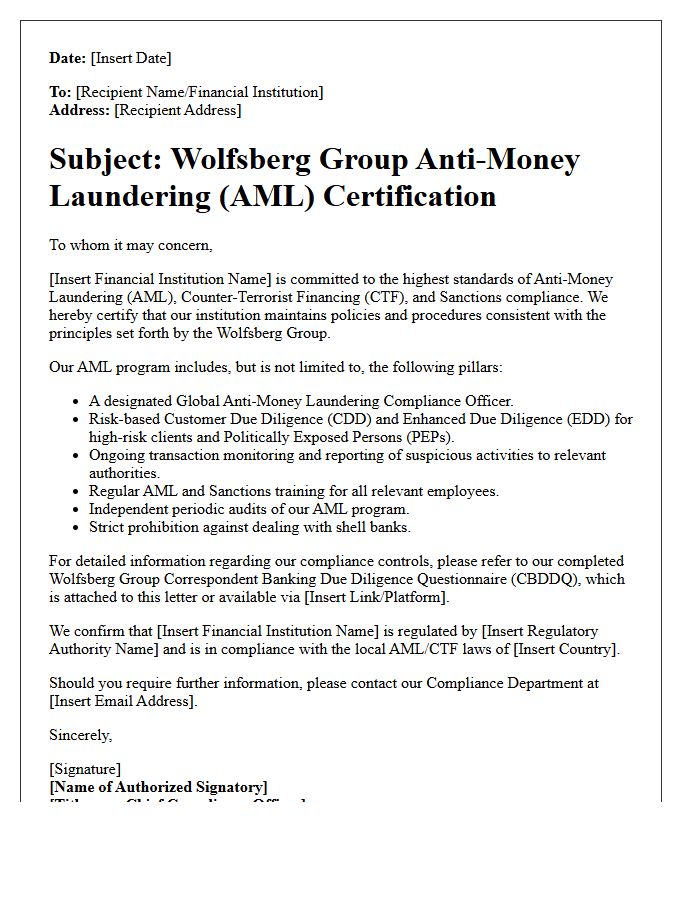
The Wolfsberg Group Anti-Money Laundering Certification Letter is a standardized document used by financial institutions to confirm their compliance with global financial crime standards. It simplifies the due diligence process by providing a uniform template that outlines an entity's AML policies, sanctions screening, and counter-terrorist financing frameworks. By using this proactive tool, banks can efficiently demonstrate their commitment to regulatory transparency and risk management, facilitating smoother correspondent banking relationships and ensuring consistent oversight across the international financial system.
Sanctions and Anti-Money Laundering Compliance Letter
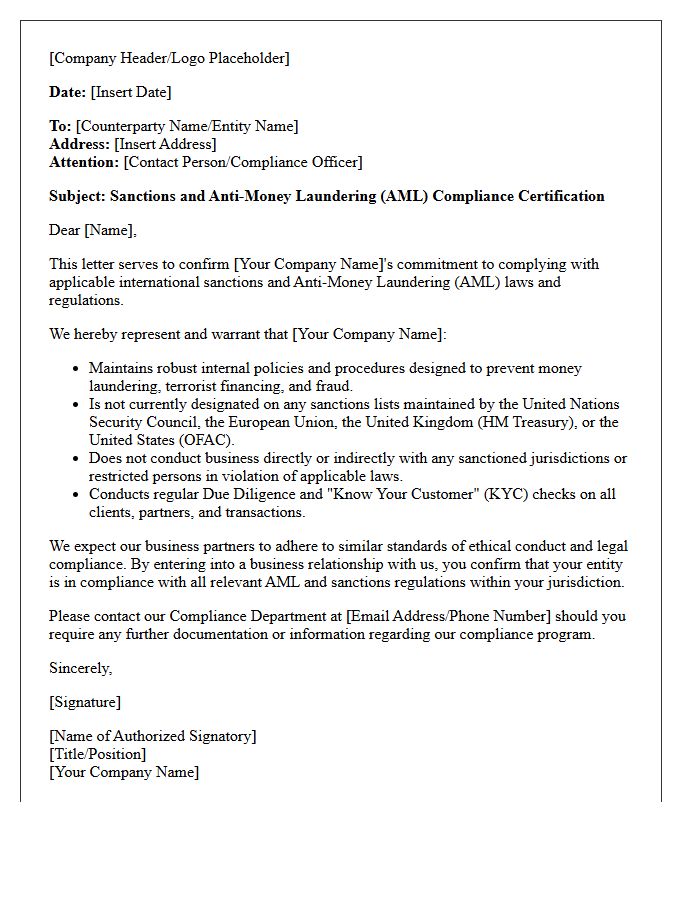
A Sanctions and Anti-Money Laundering Compliance Letter is a formal document verifying that an entity adheres to financial regulations and legal frameworks. It serves as written assurance that the organization has implemented robust internal controls to prevent illegal activities like terrorism financing or tax evasion. Financial institutions and global partners require this letter to mitigate operational risk and ensure transparency during due diligence. This compliance certification is essential for maintaining international banking relationships and proving that all transactions align with global legal standards and trade restrictions.
Know Your Customer and Anti-Money Laundering Certification Letter
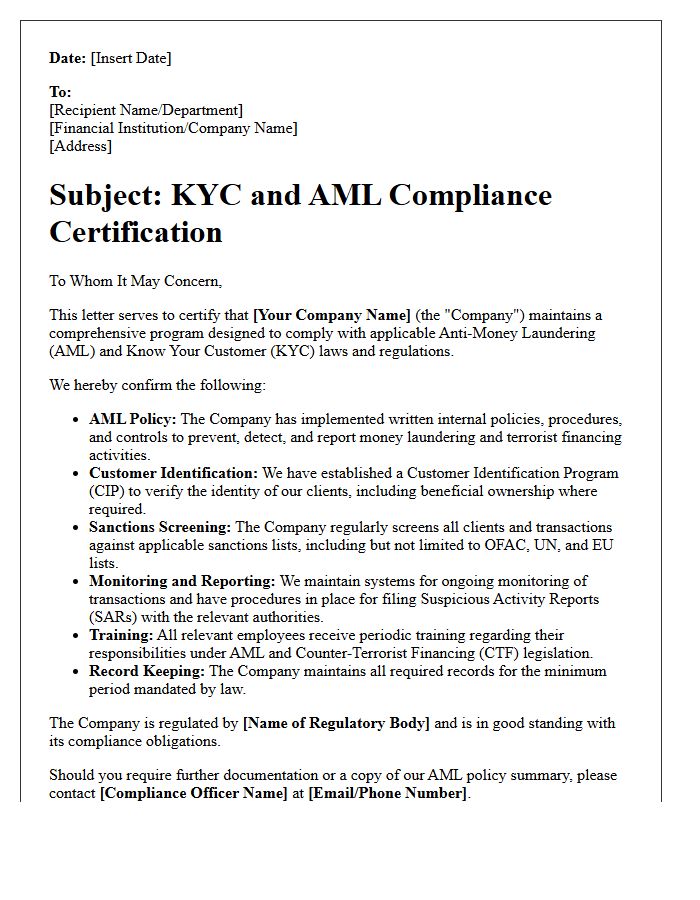
A Know Your Customer and Anti-Money Laundering Certification Letter is a formal document verifying that a financial institution has implemented due diligence procedures. It confirms compliance with global regulatory standards to prevent financial crimes. This letter reassures correspondent banking partners that identity verification and risk assessment protocols are strictly followed. By providing this certification, entities streamline onboarding processes and maintain transparency within the international financial system, ensuring that all monetary transactions are legitimate and protected against illicit activities like terrorism financing or fraud.
Independent Audit Anti-Money Laundering Certification Letter
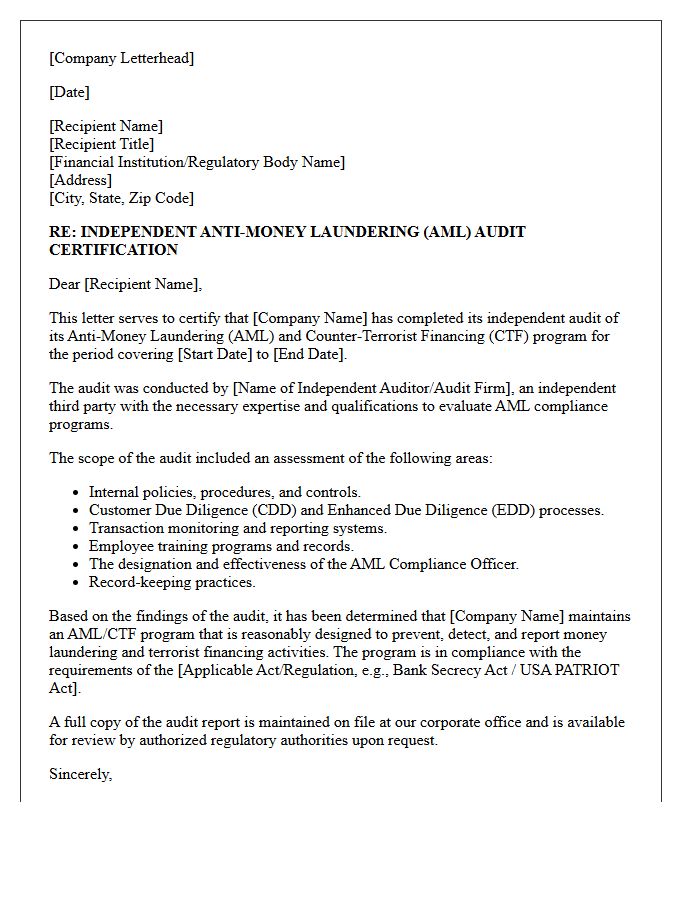
An Independent Audit AML Certification Letter provides formal verification that a financial institution's anti-money laundering program meets regulatory compliance standards. Issued by an objective third party, this document confirms the effectiveness of internal controls, risk assessments, and reporting systems. It is essential for establishing trust during correspondent banking relationships and ensuring adherence to global legal frameworks. This certification serves as high-level evidence that an organization actively mitigates financial crime risks and maintains robust oversight to prevent illicit activities within the global financial system.
Board of Directors Anti-Money Laundering Approval Letter
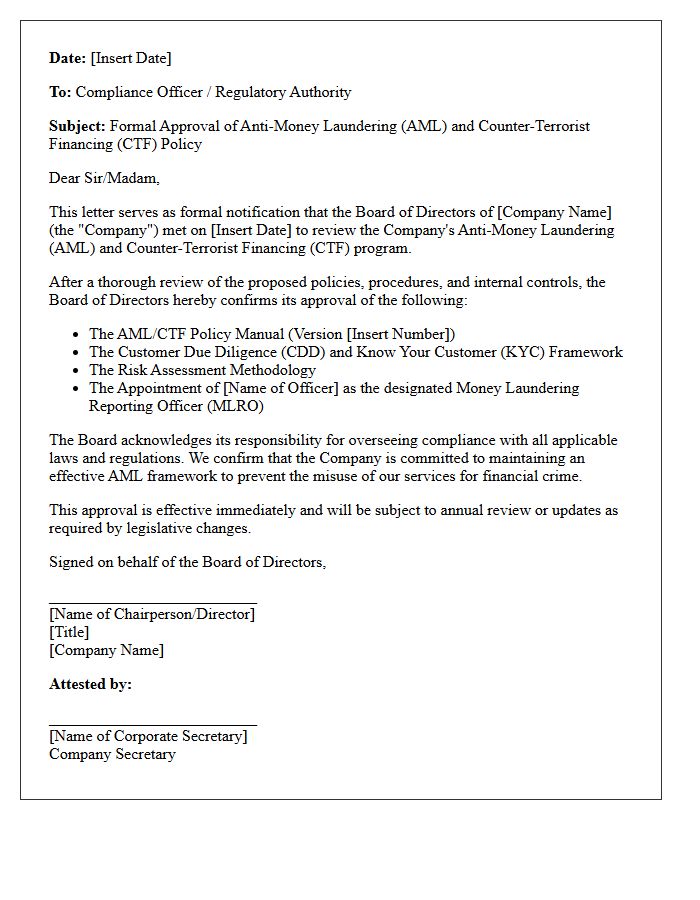
A Board of Directors Anti-Money Laundering Approval Letter is a critical document confirming that a company's governing body has formally reviewed and authorized its compliance framework. It serves as official evidence that leadership oversees AML policies and internal controls to prevent financial crimes. Regulators and financial institutions often require this signed letter during audits or onboarding to verify senior management accountability. By documenting this approval, the board ensures the organization adheres to legal standards, effectively mitigating risks associated with money laundering and terrorist financing activities.
Regulatory Anti-Money Laundering Compliance Attestation Letter
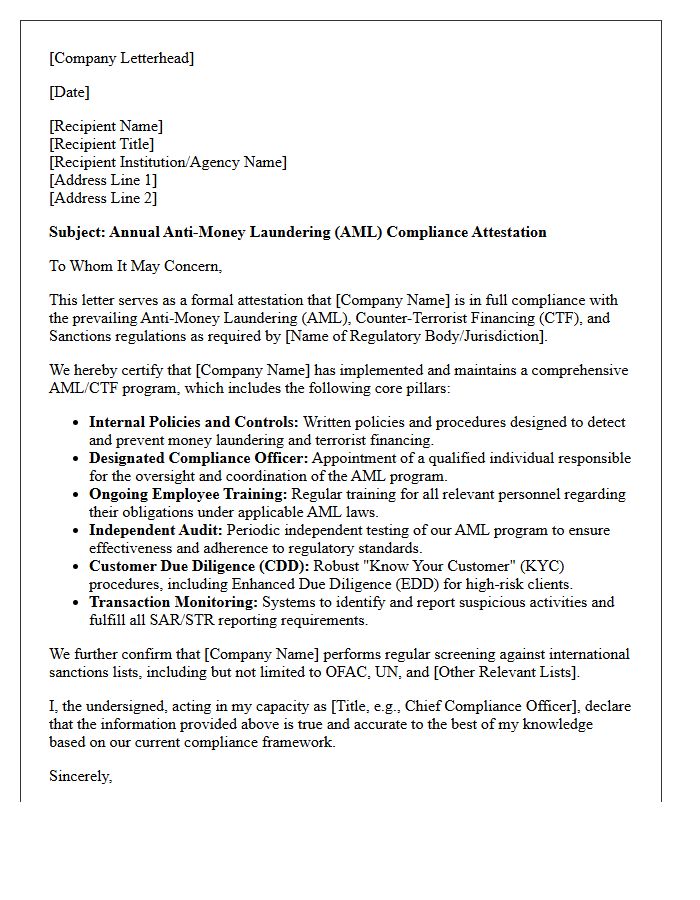
A Regulatory Anti-Money Laundering Compliance Attestation Letter is a formal document certifying that a financial institution adheres to strict AML/CFT regulations. It serves as verified evidence that the entity has implemented robust internal controls, risk assessments, and know-your-customer protocols to prevent financial crimes. This letter is essential for establishing correspondent banking relationships and maintaining international regulatory trust. By signing this attestation, senior management confirms their commitment to monitoring transactions and reporting suspicious activities, ensuring the integrity of the global financial system against money laundering and terrorism financing.
Beneficial Ownership Anti-Money Laundering Declaration Letter
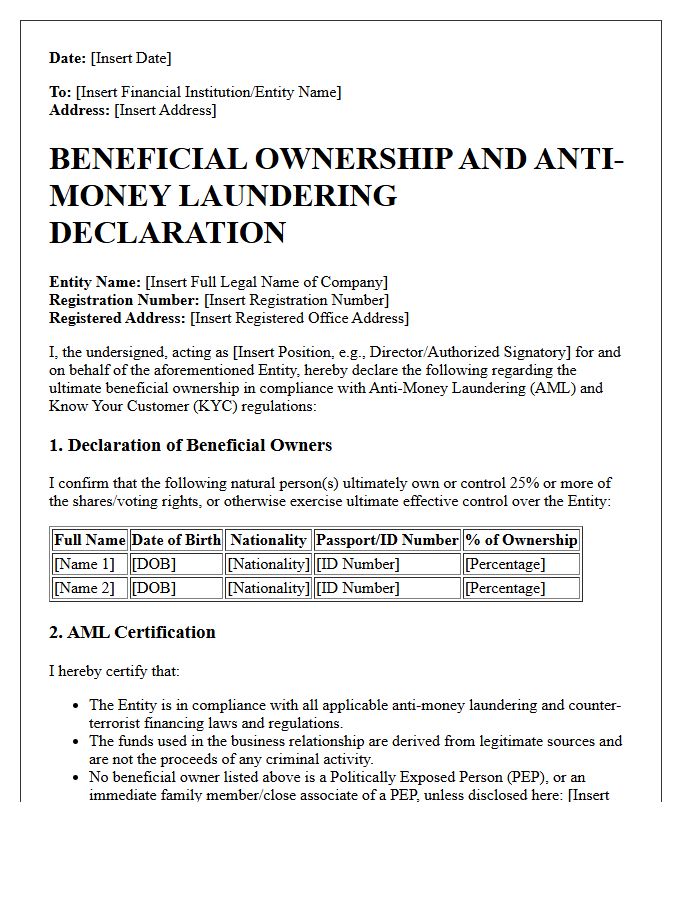
A Beneficial Ownership Anti-Money Laundering Declaration Letter is a critical compliance document used to identify individuals who exercise ultimate effective control over a legal entity. Financial institutions require this letter to verify the identity of beneficial owners holding a significant percentage of shares or voting rights. By documenting these stakeholders, organizations prevent financial crimes like money laundering and terrorism financing. Providing accurate information ensures transparency and aligns with global regulatory standards, helping banks mitigate risks while maintaining legal integrity during account opening or periodic due diligence reviews.
What is an Anti-Money Laundering (AML) Compliance Certification Letter?
An AML Compliance Certification Letter is a formal document issued by a financial institution or regulated entity confirming that they have implemented robust policies, controls, and procedures to prevent money laundering and terrorist financing in accordance with applicable laws.
Who is responsible for signing an AML Compliance Certification?
The letter is typically signed by the designated Anti-Money Laundering Compliance Officer (AMLCO), the Money Laundering Reporting Officer (MLRO), or a senior executive authorized to attest to the organization's regulatory standing.
What key components are included in an AML Certification Letter?
A standard letter includes confirmation of Customer Due Diligence (CDD) processes, Know Your Customer (KYC) protocols, employee training programs, independent audit schedules, and verification that the entity does not conduct business with prohibited or sanctioned individuals.
Why do financial institutions request AML Certification Letters from partners?
Institutions request these letters as part of their due diligence process to mitigate third-party risk, ensuring that correspondents and business partners maintain regulatory standards that prevent the movement of illicit funds through the global financial system.
How often should an AML Compliance Certification Letter be updated?
To remain valid and semantically relevant for compliance audits, these letters should be updated annually or whenever there is a significant change in the organization's AML policy, ownership structure, or relevant jurisdictional regulations.

Comments