
The Comprehensive Capital Analysis and Review (CCAR) Submission Letter is a critical executive summary provided to the Federal Reserve. It outlines a bank's capital planning process, governance framework, and stress testing results to ensure financial resilience. Crafting a precise narrative is essential for regulatory compliance and demonstrating robust risk management. To assist your filing, below are some ready to use template.

Image cover: Effective CCAR Submission Letters: Professional Samples and Templates
Letter Samples List
- Board of Directors Capital Plan Approval Letter
- Chief Executive Officer CCAR Attestation Letter
- Chief Financial Officer Capital Adequacy Certification Letter
- Chief Risk Officer Stress Testing Assumption Letter
- Federal Reserve CCAR Submission Transmittal Letter
- Internal Audit CCAR Process Validation Letter
- Baseline Scenario Economic Assumption Letter
- Severely Adverse Scenario Justification Letter
- Planned Capital Distribution Request Letter
- Model Risk Management Compliance Assessment Letter
- Post-Stress Capital Minimums Confirmation Letter
- Qualitative Framework Enhancement Update Letter
- Material Risk Identification Acknowledgment Letter
Board of Directors Capital Plan Approval Letter
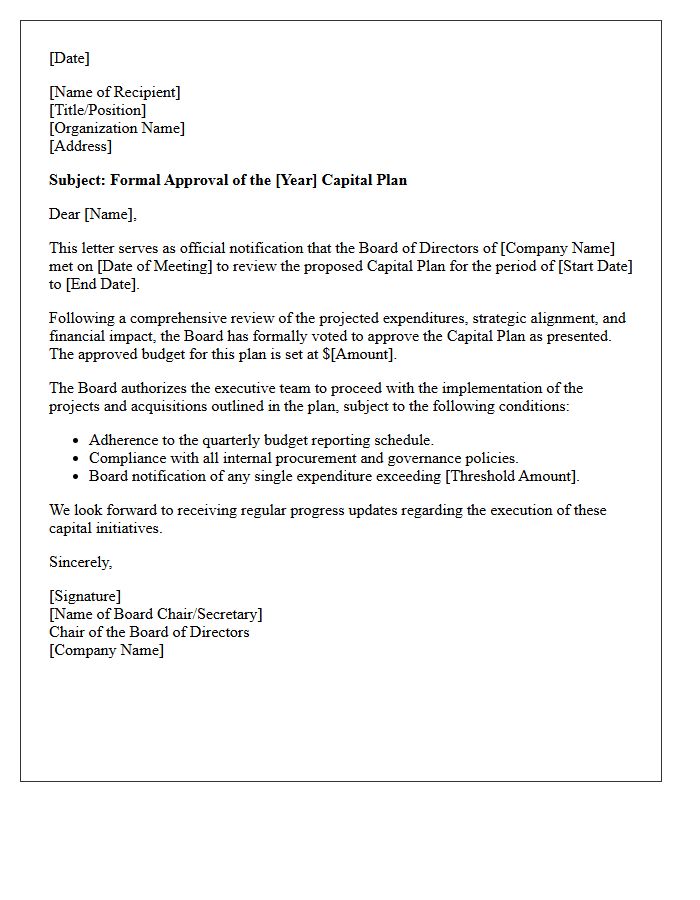
A Board of Directors Capital Plan Approval Letter is a formal document verifying that the governing body has officially authorized the organization's strategic financial strategy. This letter confirms that the board reviewed and endorsed the projected capital expenditures, funding sources, and risk assessments for the upcoming period. It serves as a critical compliance record for regulators and stakeholders, demonstrating fiduciary oversight. By signing this approval, the board ensures that planned investments align with long-term corporate goals, providing the necessary mandate for management to execute high-value projects and maintain fiscal stability.
Chief Executive Officer CCAR Attestation Letter
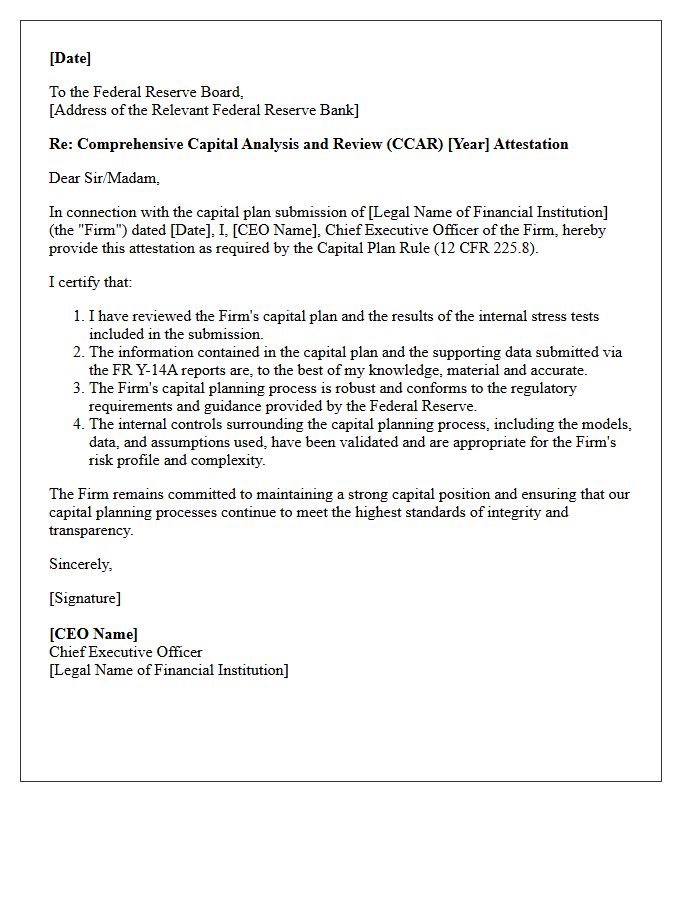
The CCAR Attestation Letter is a formal commitment required by the Federal Reserve from the Chief Executive Officer of large financial institutions. This document mandates that the CEO personally certifies the accuracy of the firm's capital planning processes and internal controls. It ensures accountability for the data integrity and underlying projections used in stress testing. Failure to maintain rigorous standards can lead to a qualitative objection from regulators, potentially restricting a bank's ability to distribute dividends or execute share buybacks, making it a critical component of regulatory compliance.
Chief Financial Officer Capital Adequacy Certification Letter
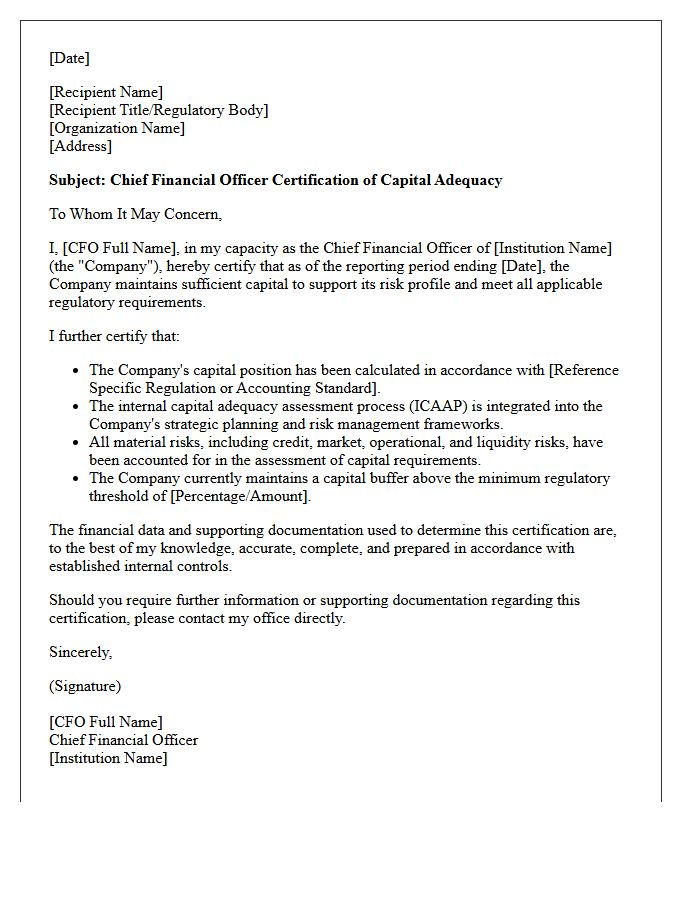
The Chief Financial Officer Capital Adequacy Certification Letter is a critical regulatory document confirming that a financial institution maintains sufficient liquidity and capital reserves to cover operational risks. This formal attestation ensures compliance with statutory requirements and strengthens stakeholder confidence. By signing this letter, the CFO provides a guarantee of the firm's financial stability and its capacity to absorb potential losses during economic stress. It is a vital component of regulatory reporting and risk management frameworks, demonstrating that the organization remains solvent and capable of meeting its ongoing financial obligations.
Chief Risk Officer Stress Testing Assumption Letter
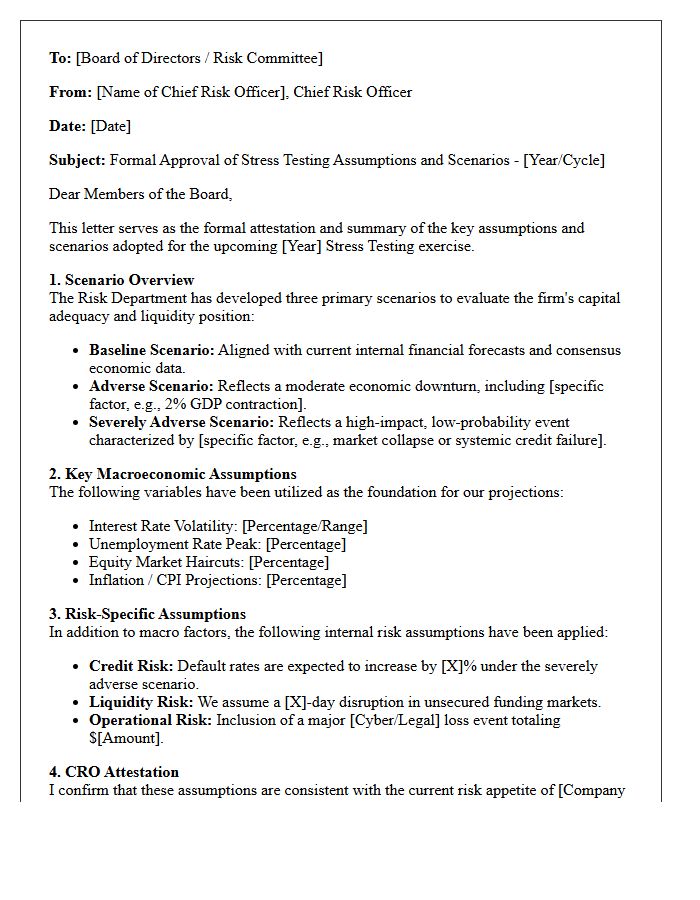
The Chief Risk Officer (CRO) Stress Testing Assumption Letter is a critical governance document that defines the hypothetical scenarios and economic parameters used to evaluate a bank's financial resilience. It outlines the specific methodologies, conservative biases, and risk factors approved by leadership to ensure regulatory compliance. This letter serves as the formal foundation for capital planning, ensuring that all stress test results are based on transparent, audited, and realistic adverse conditions to protect the institution's stability during market volatility.
Federal Reserve CCAR Submission Transmittal Letter
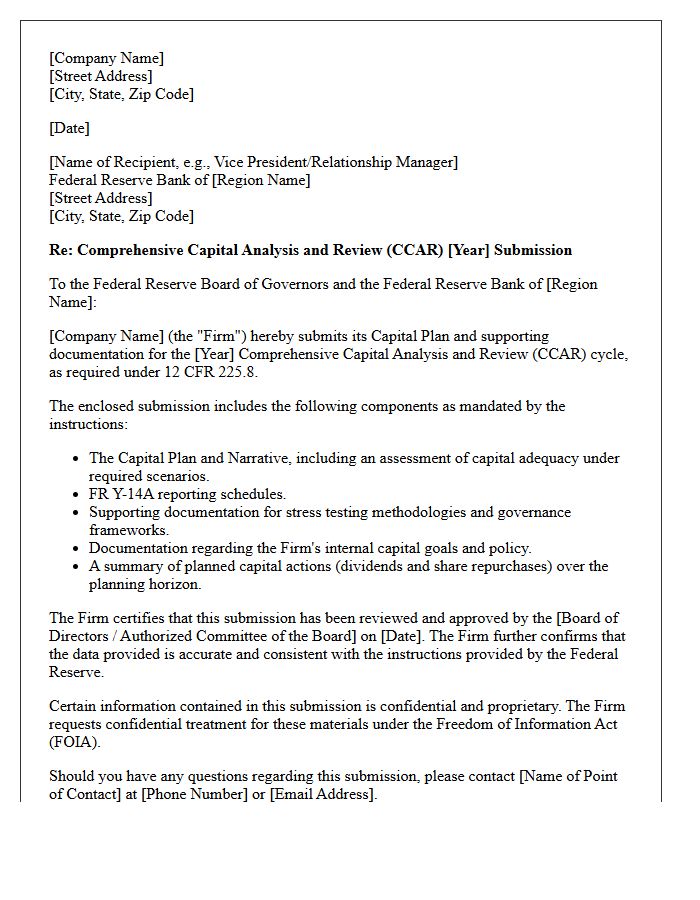
The CCAR Submission Transmittal Letter is a formal document required by the Federal Reserve from large financial institutions. It serves as the official certification for a bank's annual capital plan, confirming that senior management and the board of directors have reviewed and approved the stress testing results. This letter must detail material changes to the capital plan and affirm the integrity of the data submitted. It is a critical component of regulatory compliance, ensuring transparency regarding a bank's ability to maintain operations during economic downturns.
Internal Audit CCAR Process Validation Letter
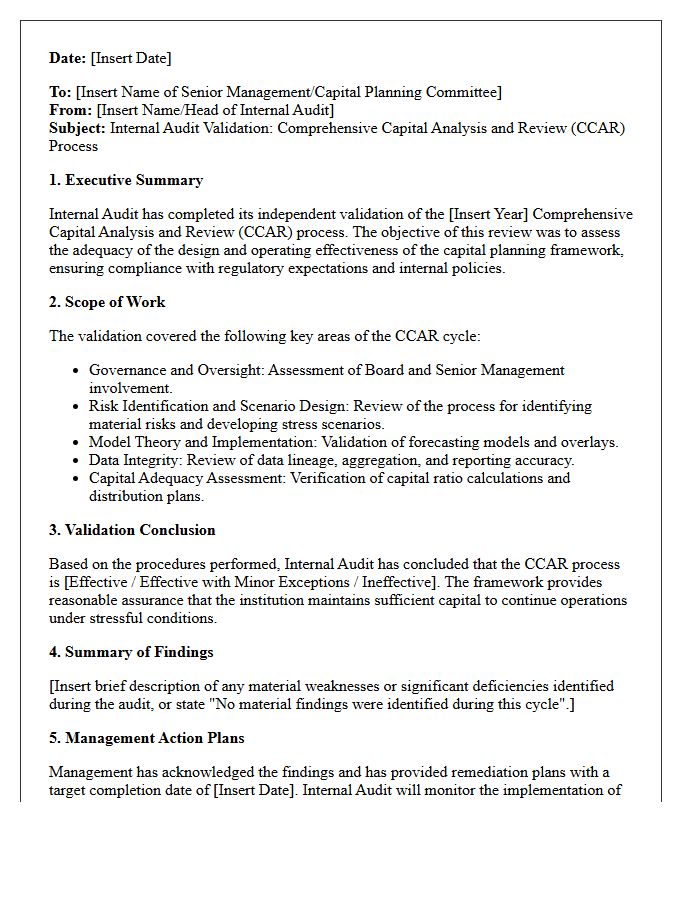
The Internal Audit CCAR Process Validation Letter is a critical regulatory requirement for large financial institutions. It serves as formal assurance that the capital stress testing framework, including data integrity and model governance, complies with Federal Reserve standards. This document confirms that internal controls have been rigorously tested and that the Comprehensive Capital Analysis and Review (CCAR) submission is accurate. It identifies material weaknesses or control deficiencies, ensuring senior management and regulators that the bank's capital planning process is statistically sound and operationally reliable for maintaining financial stability.
Baseline Scenario Economic Assumption Letter
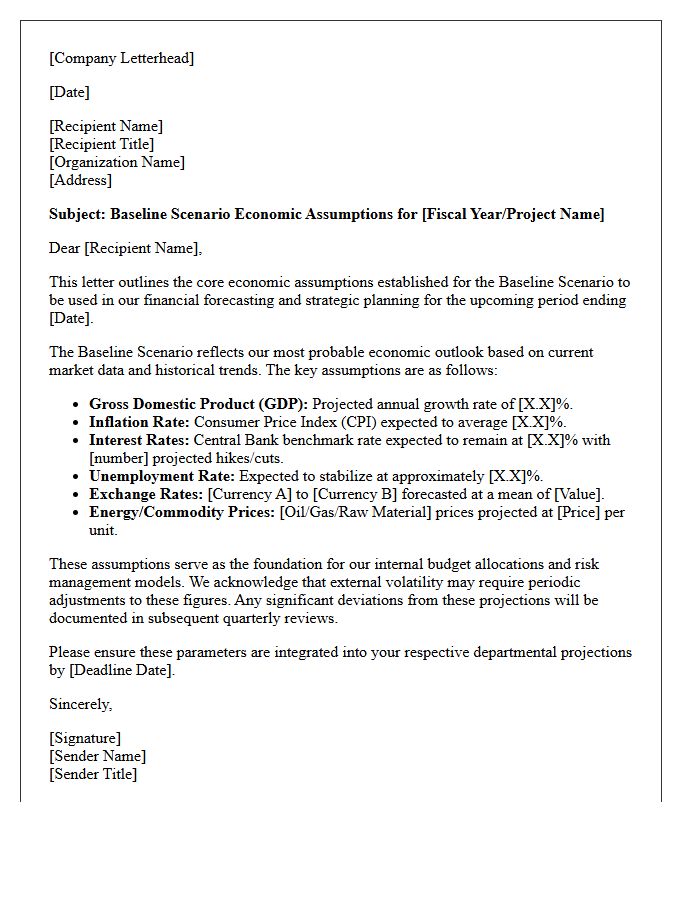
A Baseline Scenario Economic Assumption Letter is a formal document outlining the projected economic conditions used for financial forecasting and risk assessment. It serves as the foundation for stress testing and strategic planning, typically including variables like GDP growth, inflation, and interest rates. This letter ensures that all stakeholders align on a plausible economic outlook before modeling potential deviations. By establishing these core metrics, organizations can accurately evaluate their financial stability and maintain compliance with regulatory reporting standards under normal market conditions.
Severely Adverse Scenario Justification Letter
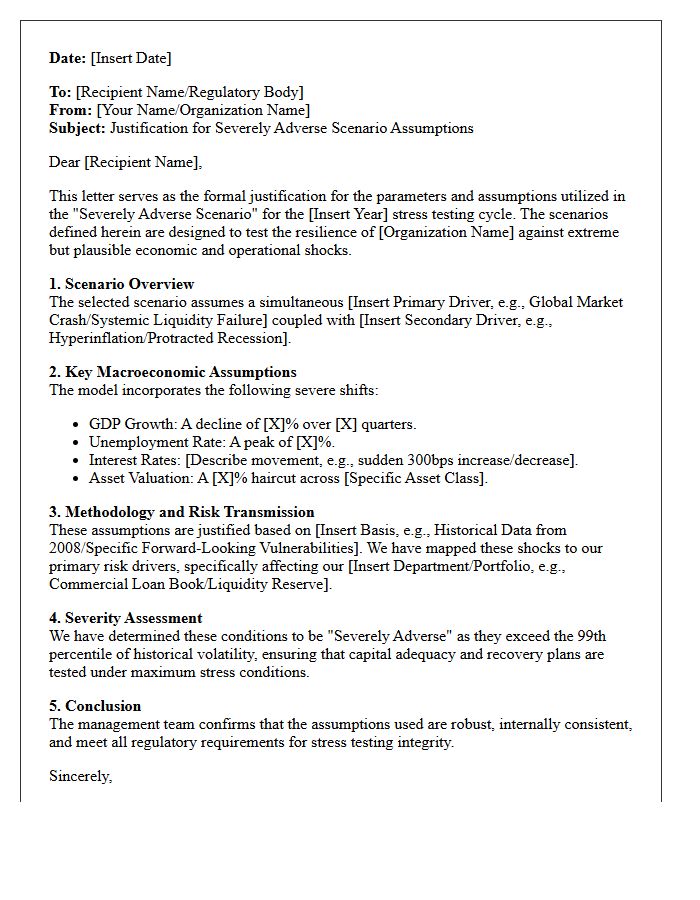
A Severely Adverse Scenario Justification Letter is a critical regulatory document used in stress testing to explain the specific assumptions behind extreme economic downturns. It provides logical rationale for variables like unemployment spikes or stock market crashes, ensuring a bank's capital planning is robust. This letter must align with CCAR or DFAST requirements, demonstrating that the chosen stressors are sufficiently severe to test institutional resilience. By documenting these risk drivers, financial institutions prove to regulators that their risk management framework can withstand catastrophic financial shocks without collapsing.
Planned Capital Distribution Request Letter
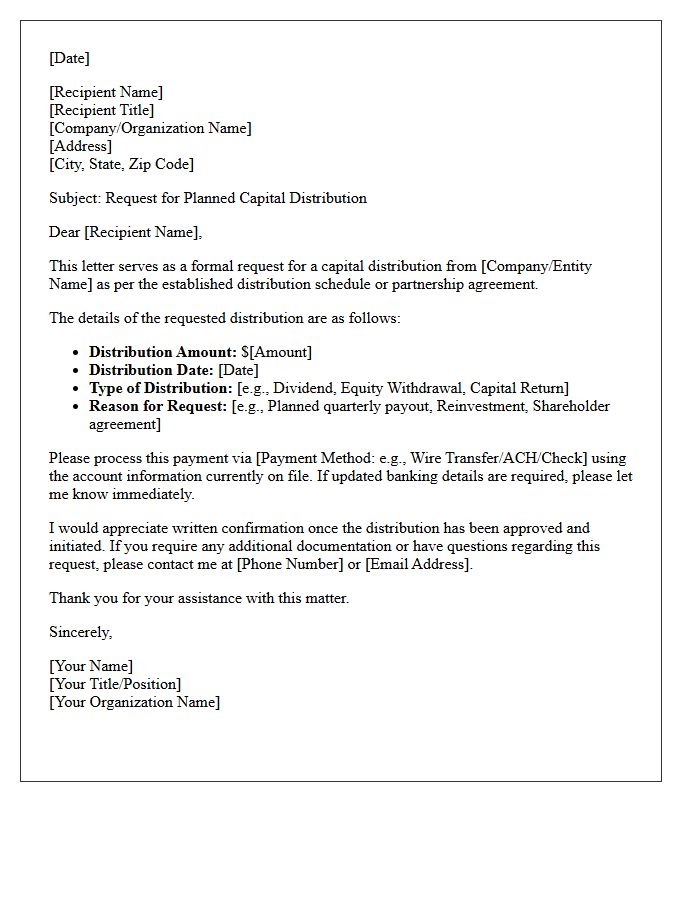
A Planned Capital Distribution Request Letter is a formal document submitted by financial institutions to regulatory bodies, such as the Federal Reserve, to seek approval for returning capital to shareholders. This letter outlines proposed dividends and share buybacks based on rigorous stress testing results and capital adequacy ratios. It demonstrates that the bank maintains sufficient liquidity and reserves to withstand economic downturns while rewarding investors. Ensuring regulatory compliance and financial stability is the primary objective when drafting this essential strategic communication.
Model Risk Management Compliance Assessment Letter
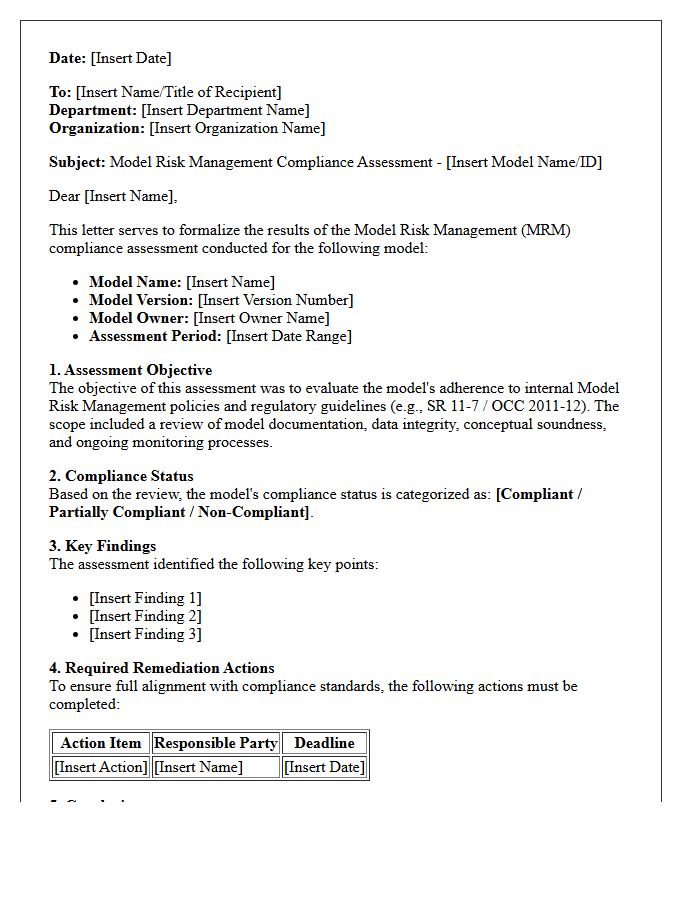
A Model Risk Management Compliance Assessment Letter is a formal document verifying that an organization's predictive tools adhere to regulatory standards, such as SR 11-7. It provides an independent validation of model integrity, data accuracy, and governance frameworks. This assessment is crucial for mitigating financial losses and operational failures caused by flawed algorithmic outputs. Stakeholders use this letter to ensure regulatory compliance and to confirm that rigorous risk mitigation protocols are active, protecting the institution from potential legal penalties and systemic instability resulting from unmonitored model errors.
Post-Stress Capital Minimums Confirmation Letter
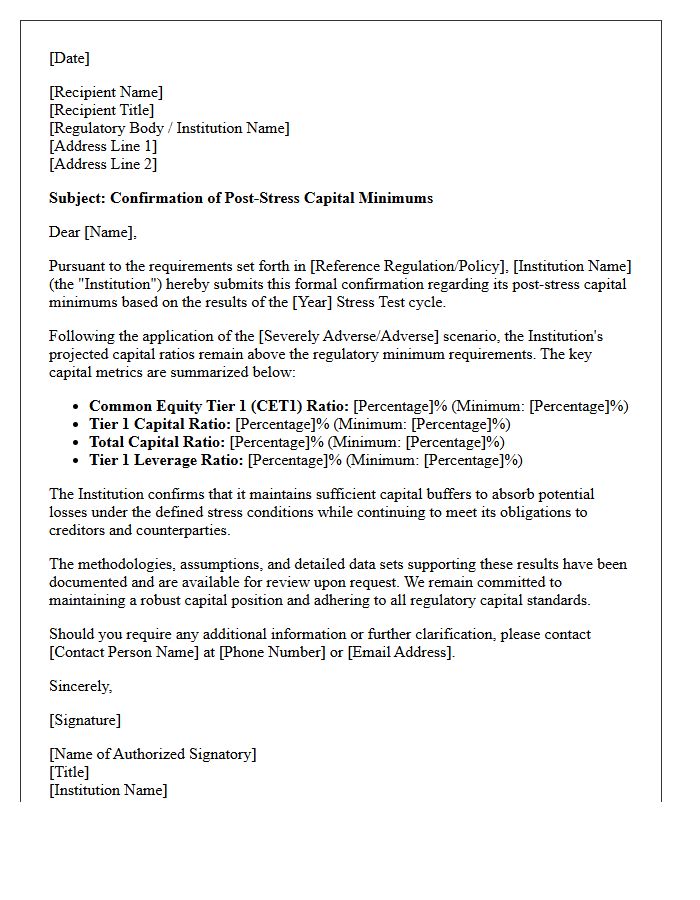
The Post-Stress Capital Minimums Confirmation Letter is a formal document issued by regulatory bodies like the Federal Reserve to financial institutions. It confirms the specific Common Equity Tier 1 (CET1) capital requirements a bank must maintain following annual stress tests. This letter integrates the Stress Capital Buffer (SCB), ensuring banks hold sufficient assets to withstand economic downturns. Understanding these figures is vital for regulatory compliance and strategic dividend planning, as falling below these thresholds triggers mandatory restrictions on capital distributions and discretionary bonus payments.
Qualitative Framework Enhancement Update Letter
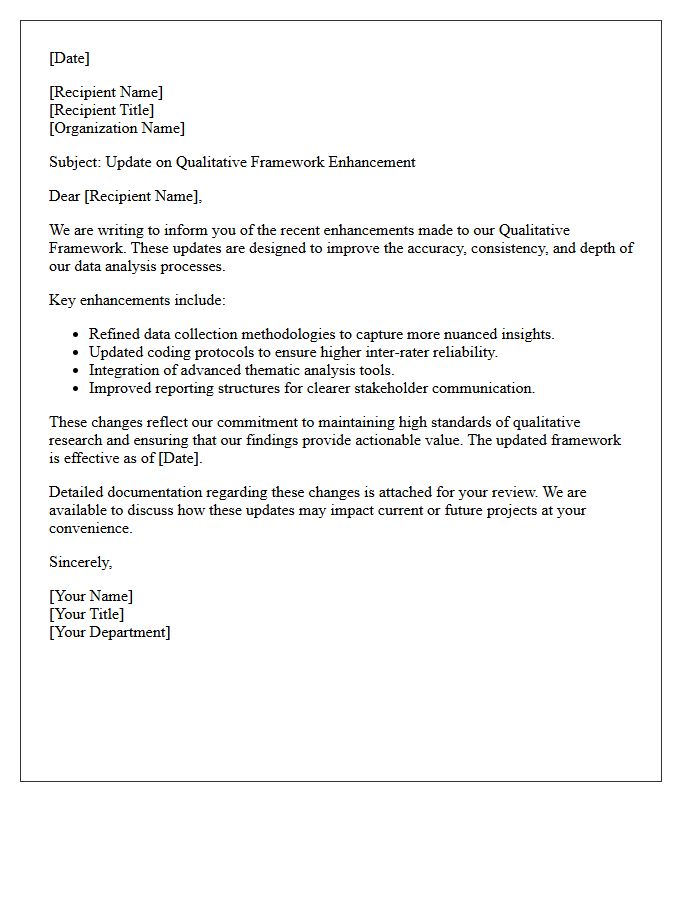
A Qualitative Framework Enhancement Update Letter informs stakeholders about critical methodological improvements designed to refine data interpretation. This document outlines refined evaluation criteria and systematic updates to analytical processes, ensuring higher precision in non-numerical assessments. Key highlights include enhanced reporting standards and adjusted benchmarks for organizational transparency. Recipients should review these changes to align their strategic documentation with the new quality assurance protocols. This update ensures that all qualitative insights remain consistent, credible, and professionally rigorous across all institutional frameworks.
Material Risk Identification Acknowledgment Letter
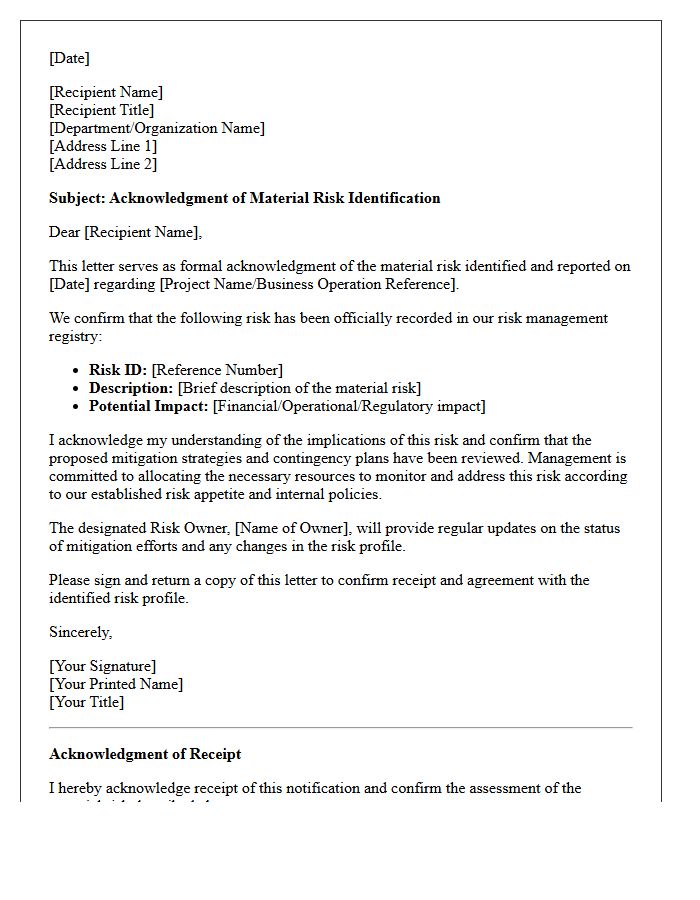
A Material Risk Identification Acknowledgment Letter is a formal document used in financial institutions to confirm that an individual has been designated as a Material Risk Taker. This letter ensures the employee understands their role in the organization's risk profile and accepts the associated regulatory implications. It typically outlines how their decisions impact the firm's stability and details specific remuneration policies, such as bonus clawbacks or deferrals. Signing this acknowledgment is a critical compliance step to meet prudential supervision standards and ensure accountability in high-level financial decision-making processes.
What is the primary purpose of a CCAR Submission Letter?
The CCAR Submission Letter serves as the formal transmittal document that accompanies a bank holding company's capital plan. It provides a high-level summary of the firm's capital adequacy assessment, the results of internal stress tests, and the specific capital actions, such as dividends or share repurchases, for which the firm is seeking regulatory approval.
Who are the main recipients of the CCAR Submission Letter?
The submission letter is addressed to the Federal Reserve Board of Governors. It acts as the official certification from the firm's senior management and Board of Directors that the submitted capital plan complies with the requirements set forth in the Capital Rule and the annual CCAR instructions.
What core components must be included in a CCAR Submission Letter?
A comprehensive submission letter must include the firm's planned capital actions over the nine-quarter planning horizon, a summary of the stress scenarios used (Baseline and Severely Adverse), a description of the governance process, and a formal statement of the Board of Directors' approval of the capital plan.
How does the CCAR Submission Letter address the Stress Capital Buffer (SCB)?
The letter typically outlines how the firm's projected capital ratios remain above the regulatory minimums, including the Stress Capital Buffer. It demonstrates that the firm maintains sufficient capital to continue operations and meet its obligations to creditors and counterparties during periods of economic and financial stress.
What is the significance of the Board of Directors' signature in the submission?
The inclusion of a formal approval or signature from the Board of Directors signifies that the governing body has critically reviewed the capital planning process. It confirms that the board oversees the risk management framework and accepts responsibility for the integrity of the stress testing results and the sustainability of the proposed capital distributions.

Comments