
Ensuring compliance with financial regulations requires a formal Third-Party Vendor Risk Management Regulatory Submission Letter. This document demonstrates your organization's oversight of external partners and adherence to safety standards during audits. It validates that your risk assessment frameworks meet strict legal expectations. To streamline your documentation process and ensure accuracy, below are some ready to use template.
Image cover: Regulatory Submission Letter Templates for Third-Party Risk Management
Letter Samples List
- Initial Regulatory Notification Letter for Critical Third-Party Vendor Onboarding
- Annual Third-Party Risk Management Framework Compliance Submission Letter
- Vendor Data Breach Regulatory Incident Reporting Letter
- Material Outsourcing Agreement Regulatory Approval Request Letter
- Fourth-Party Subcontractor Risk Assessment Regulatory Submission Letter
- Third-Party Concentration Risk Analysis Regulatory Submission Letter
- Offshore Vendor Operations Regulatory Notification Letter
- Termination of Critical Outsourcing Arrangement Regulatory Submission Letter
- Vendor Business Continuity Plan Regulatory Submission Letter
- Third-Party Risk Management Audit Remediation Submission Letter
- Material Change in Vendor Service Level Agreement Regulatory Letter
- Cloud Service Provider Risk Assessment Regulatory Submission Letter
- Vendor Financial Viability Regulatory Reporting Letter
- Cross-Border Data Transfer Outsourcing Compliance Submission Letter
- Third-Party Risk Mitigation Strategy Regulatory Submission Letter
Initial Regulatory Notification Letter for Critical Third-Party Vendor Onboarding
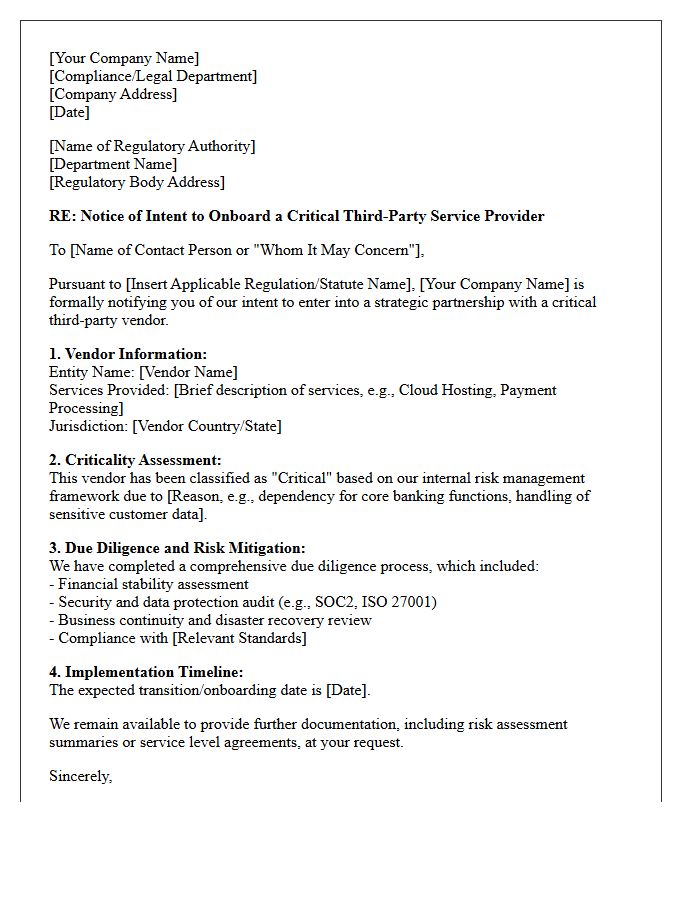
An Initial Regulatory Notification Letter is a mandatory compliance document sent to financial supervisors when onboarding a critical third-party vendor. This formal notice ensures oversight of systemic risks and operational resilience. It must detail the scope of services, data security measures, and exit strategies to mitigate potential disruptions. Timely submission is essential to satisfy regulatory requirements, such as DORA or the Bank of England guidelines, preventing legal penalties while ensuring that the outsourcing arrangement does not compromise the institution's financial stability or customer protection standards.
Annual Third-Party Risk Management Framework Compliance Submission Letter
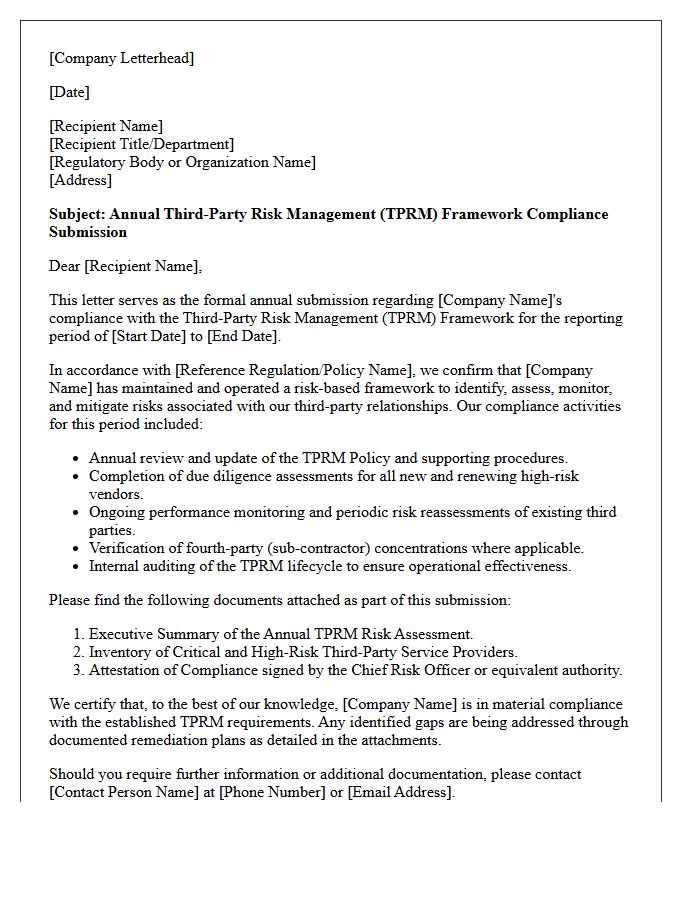
The Annual Third-Party Risk Management Framework Compliance Submission Letter is a mandatory document ensuring that service providers adhere to established security and regulatory standards. It serves as formal verification that an organization's risk mitigation strategies are active and effective. This submission is critical for maintaining regulatory compliance and building trust within the supply chain. Organizations must provide accurate data to prove they are managing external threats and protecting sensitive information throughout the fiscal year. Failure to submit can result in severe operational penalties or contract termination.
Vendor Data Breach Regulatory Incident Reporting Letter
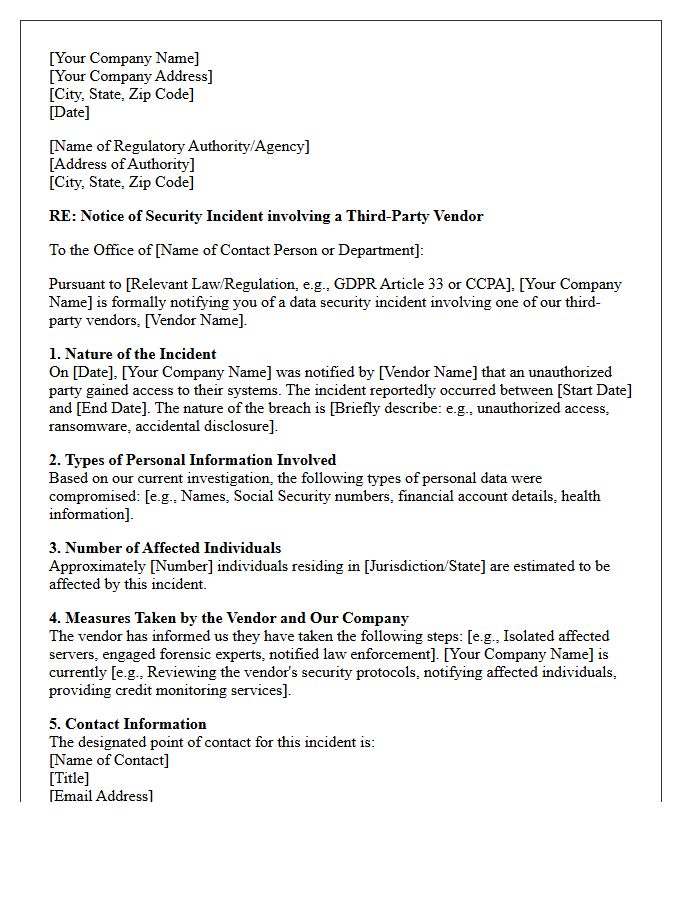
A Vendor Data Breach Regulatory Incident Reporting Letter is a formal notification sent to government authorities following a security failure at a third-party provider. Organizations must disclose the nature of the breach, the specific types of compromised data, and the total number of affected individuals. Compliance is critical, as strict legal deadlines under frameworks like GDPR or HIPAA require rapid reporting. Failing to submit an accurate letter can lead to severe regulatory fines and legal liabilities. This document serves as an essential record of the entity's transparency and remediation efforts during a crisis.
Material Outsourcing Agreement Regulatory Approval Request Letter
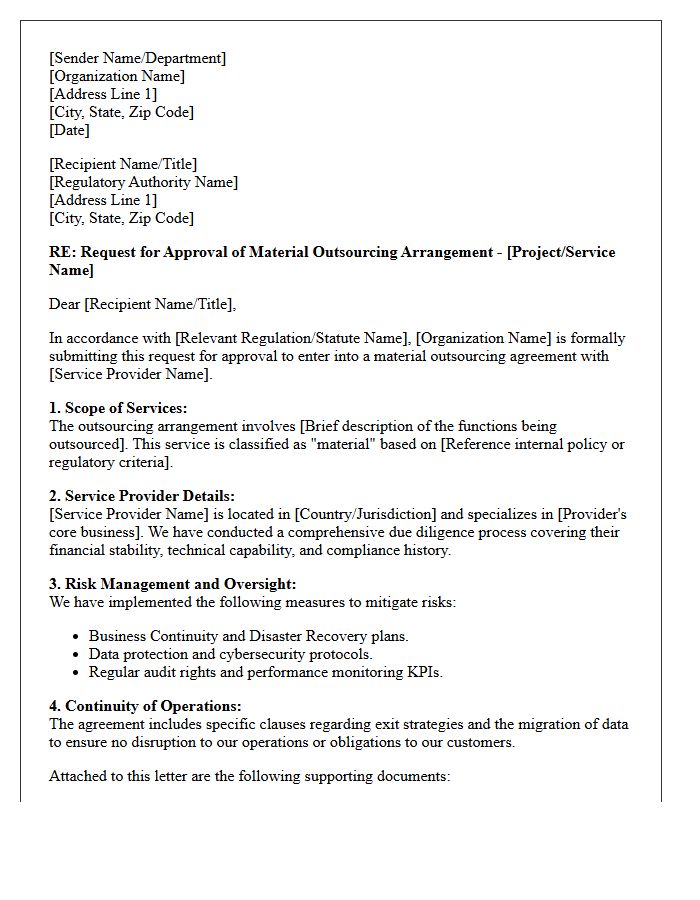
A Material Outsourcing Agreement Regulatory Approval Request Letter is a formal notification sent to financial authorities to seek permission for subcontracting critical functions. The most critical element is demonstrating operational resilience by ensuring the third-party vendor complies with risk management standards. The letter must provide a detailed service scope, contingency plans, and data protection measures to mitigate systemic threats. Regulatory bodies evaluate these requests to prevent disruptions in essential services, making it vital to prove that the partnership will not compromise institutional stability or consumer security during the transition.
Fourth-Party Subcontractor Risk Assessment Regulatory Submission Letter
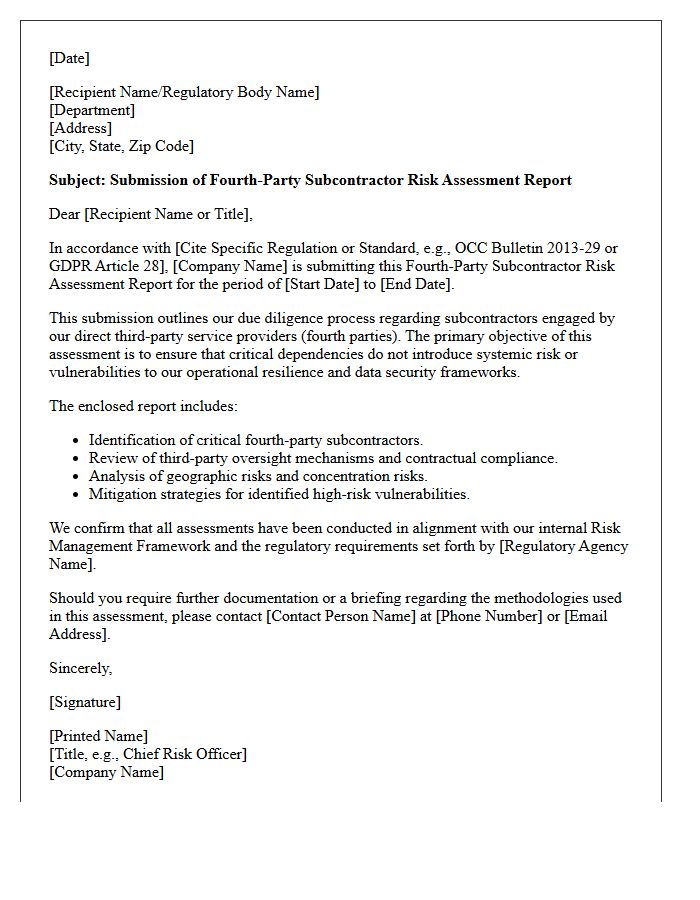
A Fourth-Party Subcontractor Risk Assessment Regulatory Submission Letter is a formal document proving your organization manages extended supply chain risks. Regulators require this to ensure transparency beyond direct vendors, focusing on concentration risk and operational resilience. The letter must demonstrate that you have audited your third-party's subcontractors to prevent service disruptions. Key elements include due diligence summaries, compliance mapping, and mitigation strategies for critical dependencies. Submitting this maintains regulatory standing by proving you possess full visibility into the nested outsourcing ecosystem protecting sensitive data and essential business functions.
Third-Party Concentration Risk Analysis Regulatory Submission Letter
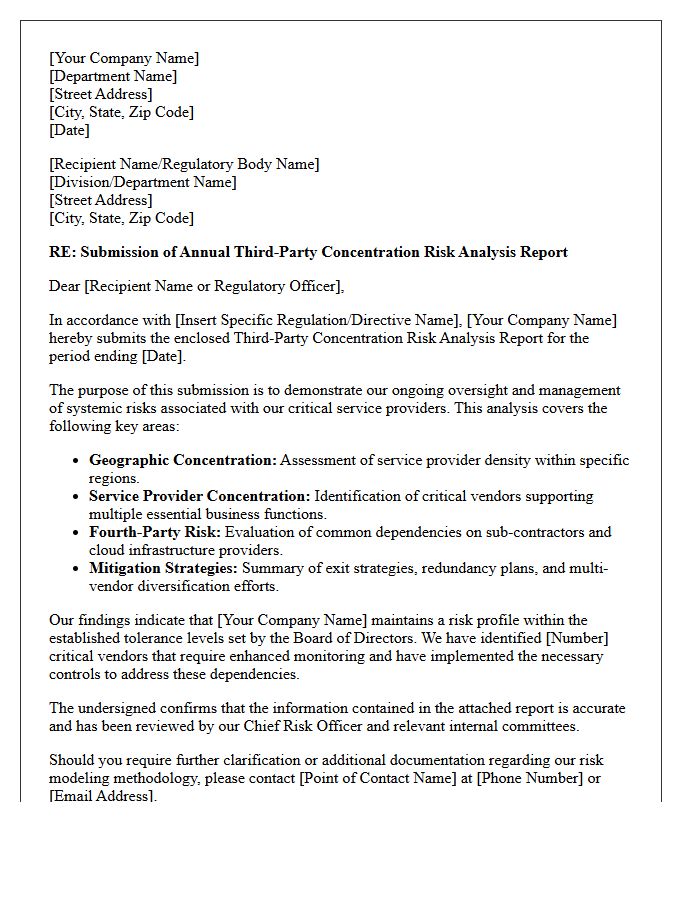
A Third-Party Concentration Risk Analysis Regulatory Submission Letter is a formal document addressing systemic vulnerability within financial institutions. It evaluates dependencies on a limited number of service providers to prevent widespread operational failure. This letter demonstrates compliance with regulatory mandates by detailing risk mitigation strategies and contingency planning for critical outsourced functions. It ensures that concentration risk-arising when multiple entities rely on the same vendor-is monitored to maintain market stability and resilience. Providing clear data on vendor exposure helps supervisors assess potential contagion effects across the global financial infrastructure.
Offshore Vendor Operations Regulatory Notification Letter
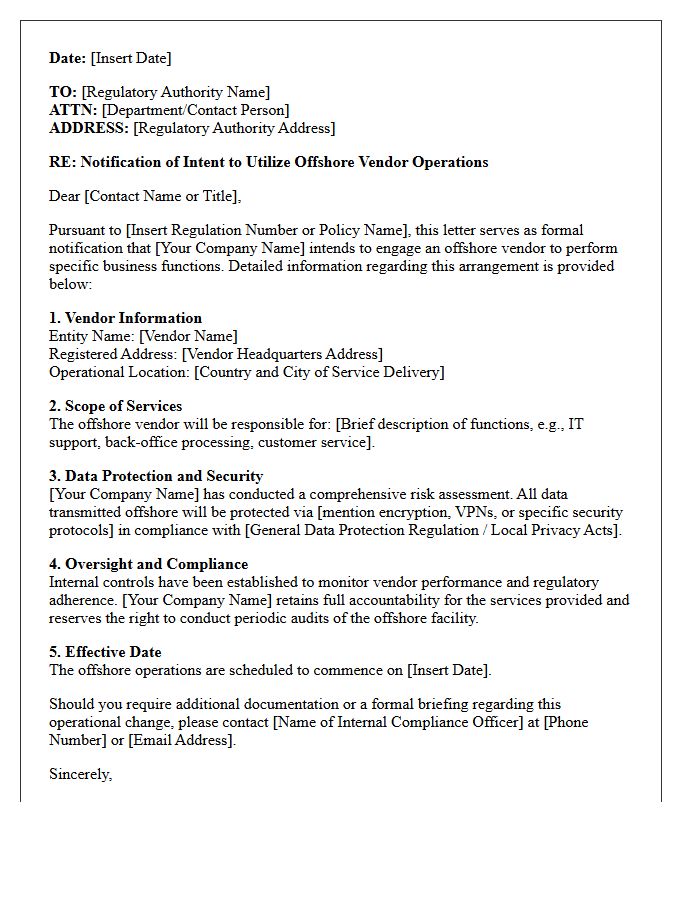
An Offshore Vendor Operations Regulatory Notification Letter is a mandatory formal communication sent to financial authorities when outsourcing critical functions abroad. This document ensures compliance with cross-border data protection and operational risk standards. It must detail the vendor's location, the nature of handled data, and specific risk mitigation strategies. Regulators use this information to oversee systemic stability and ensure that third-party governance remains transparent. Failing to submit this notification can result in significant legal penalties and operational audits for the institution involved.
Termination of Critical Outsourcing Arrangement Regulatory Submission Letter
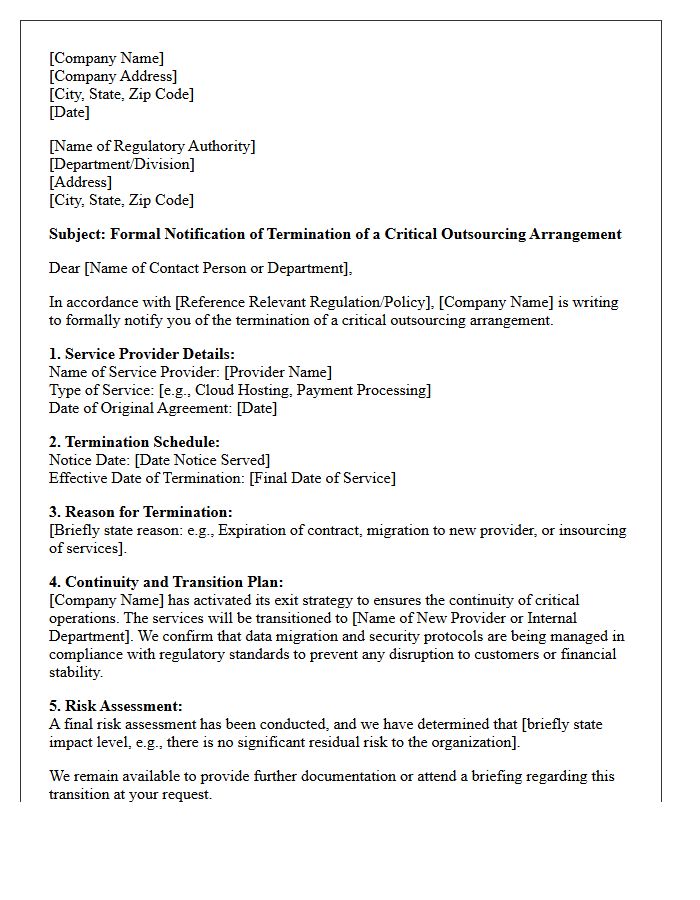
Financial institutions must submit a Regulatory Submission Letter when a Termination of Critical Outsourcing Arrangement occurs. This formal notification ensures that regulators are aware of changes in operational risk and service continuity. The document must detail the transition plan, data migration strategies, and how exit strategies will be executed without disrupting essential business functions. Timely submission is mandatory to maintain compliance with financial stability standards and to demonstrate that the entity can effectively manage the withdrawal from a material service provider while protecting consumer interests.
Vendor Business Continuity Plan Regulatory Submission Letter
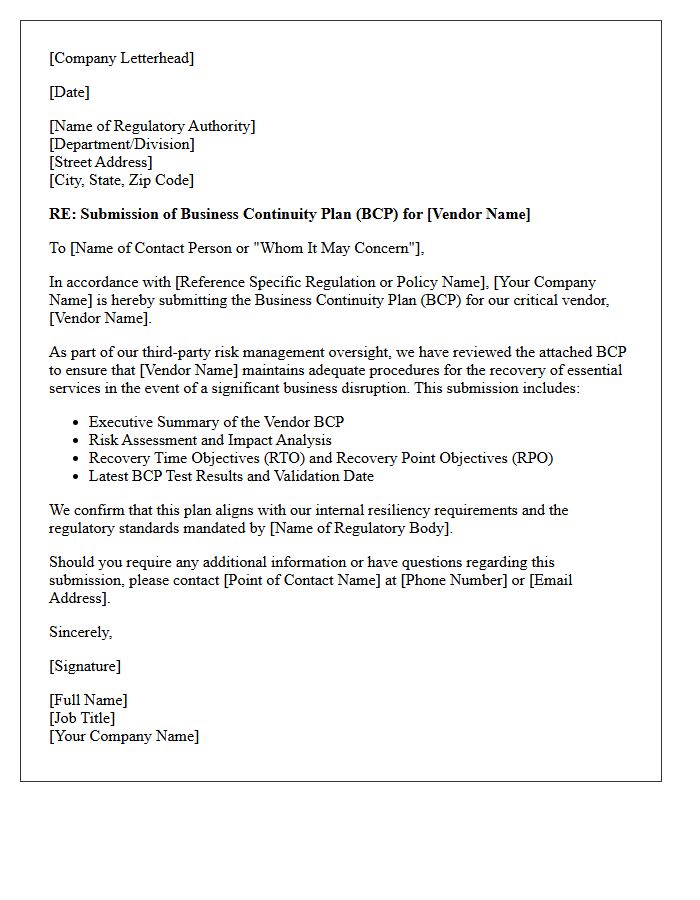
A Vendor Business Continuity Plan Regulatory Submission Letter is a formal document verifying that a critical third-party service provider maintains robust disaster recovery protocols. Financial institutions and healthcare entities must submit these letters to regulatory bodies to prove operational resilience. The letter confirms that the vendor can sustain essential services during unforeseen disruptions, thereby mitigating systemic risk. Ensuring your vendor provides this compliance verification is essential for meeting legal safety standards and protecting sensitive data workflows during a crisis.
Third-Party Risk Management Audit Remediation Submission Letter
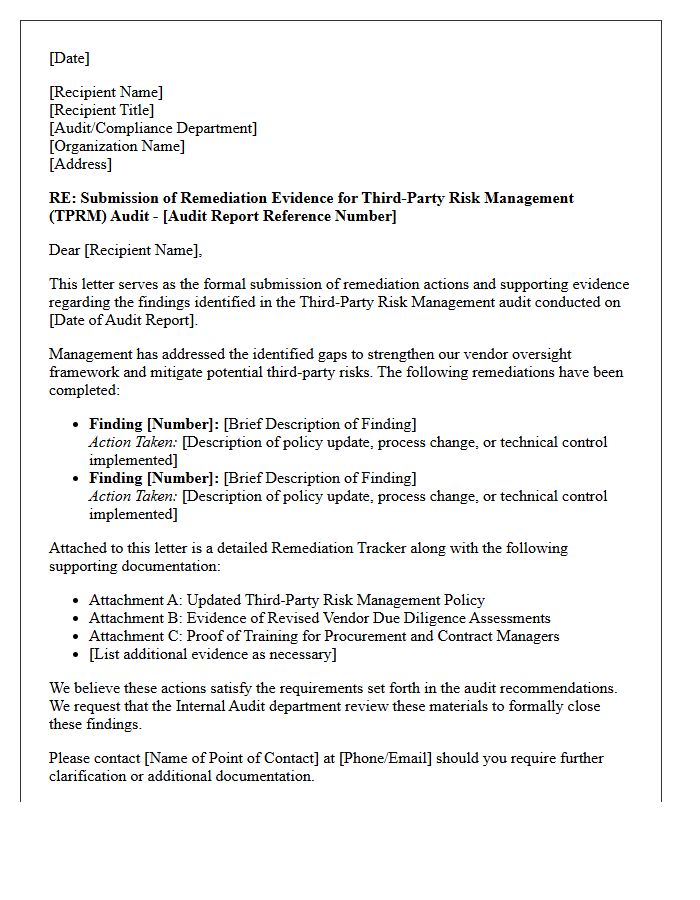
A Third-Party Risk Management audit remediation submission letter is a formal document verifying that security vulnerabilities identified during a vendor assessment have been resolved. This letter serves as official proof of compliance, detailing specific corrective actions taken to mitigate risks. It must include clear evidence of remediation, such as updated policies or technical configurations. Timely submission is critical to maintaining business continuity and building trust between partners. Ultimately, this document confirms that the service provider meets the required safety standards to protect sensitive data within the supply chain.
Material Change in Vendor Service Level Agreement Regulatory Letter
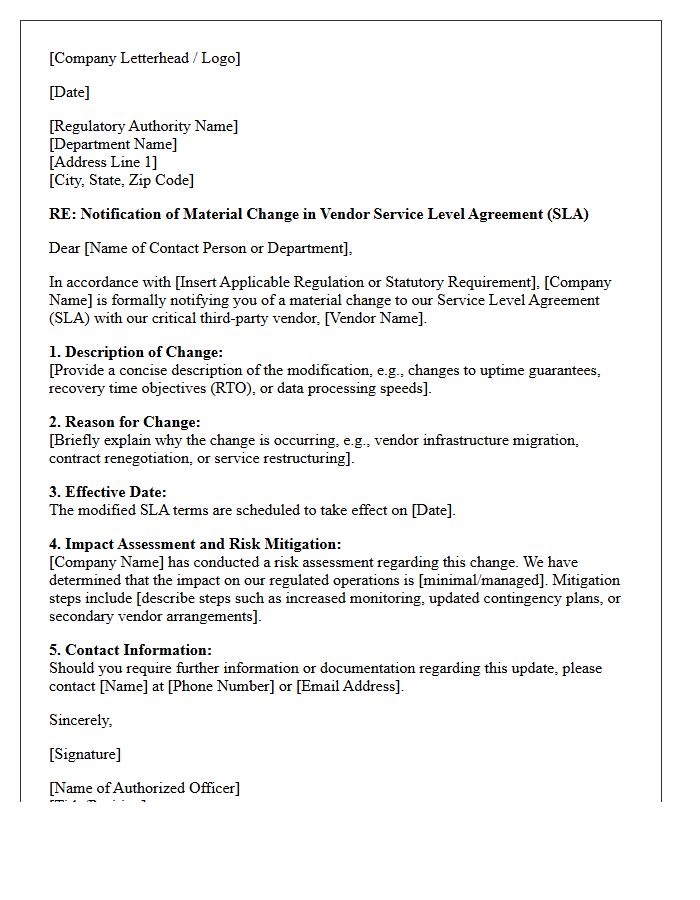
A Material Change regulatory letter is a formal notification issued when significant alterations impact a vendor's ability to meet agreed standards. Regulators require these updates to ensure operational resilience and risk mitigation. It is essential to document changes in service performance, security protocols, or financial stability that could affect compliance. Organizations must evaluate these shifts to maintain regulatory compliance and prevent service disruptions. Prompt reporting ensures transparency with oversight bodies and helps manage third-party risk effectively within the legal framework.
Cloud Service Provider Risk Assessment Regulatory Submission Letter
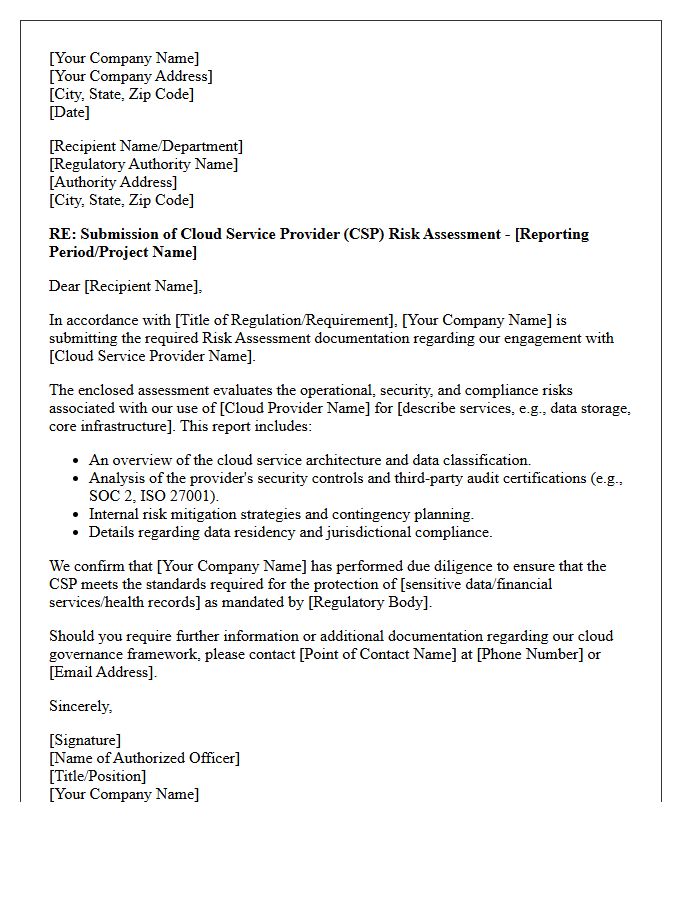
A Regulatory Submission Letter is a formal document required by financial authorities to validate a firm's outsourcing governance. It ensures that a Cloud Service Provider (CSP) meets stringent security and operational standards. The letter confirms that the institution has performed a comprehensive risk assessment, addressing data privacy, service continuity, and audit rights. This filing is essential for legal compliance, demonstrating that the organization retains oversight of its critical functions while leveraging third-party infrastructure. Proper submission mitigates supervisory concerns regarding systemic stability and data integrity in digital banking environments.
Vendor Financial Viability Regulatory Reporting Letter
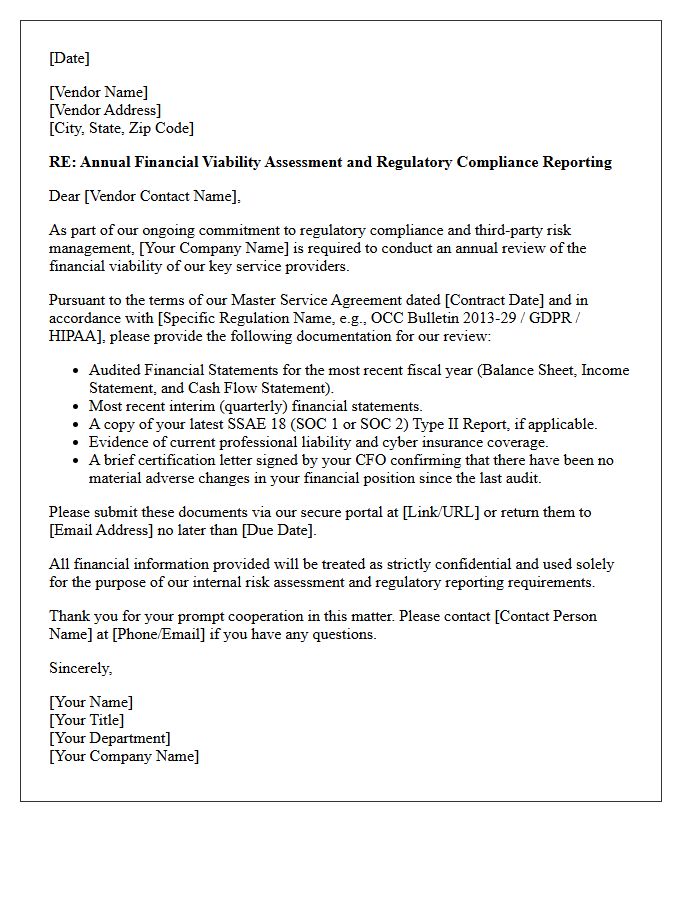
A Vendor Financial Viability Regulatory Reporting Letter is a formal document used by financial institutions to assess a third-party's fiscal health. It ensures that critical service providers maintain the economic stability required to meet contractual obligations without disruption. Regulators mandate these reviews to mitigate systemic risk and ensure operational resilience. Organizations must evaluate key metrics, such as liquidity and debt levels, to satisfy compliance standards and safeguard against potential vendor insolvency, which could impact sensitive consumer data or essential banking functions.
Cross-Border Data Transfer Outsourcing Compliance Submission Letter
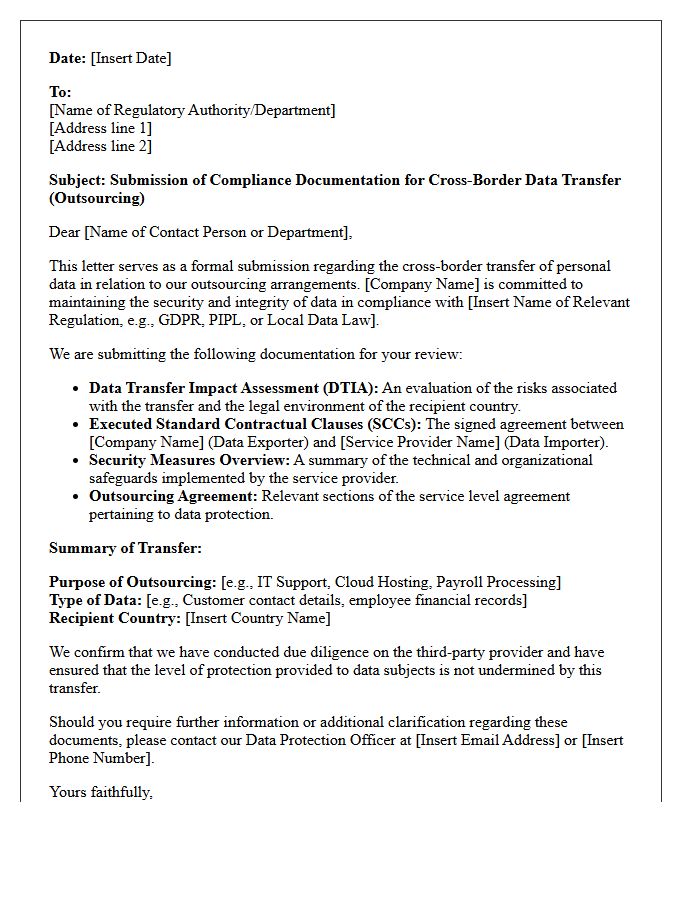
A Cross-Border Data Transfer Outsourcing Compliance Submission Letter is a formal document required by regulators to authorize the movement of sensitive information across international boundaries. It ensures that third-party vendors adhere to strict data protection standards and local legal frameworks. Organizations must use this letter to demonstrate accountability, detailing security measures and risk mitigation strategies used during the outsourcing process. Submitting this compliance letter is essential for maintaining regulatory transparency, avoiding legal penalties, and protecting the privacy rights of data subjects when delegating operational tasks to foreign service providers.
Third-Party Risk Mitigation Strategy Regulatory Submission Letter
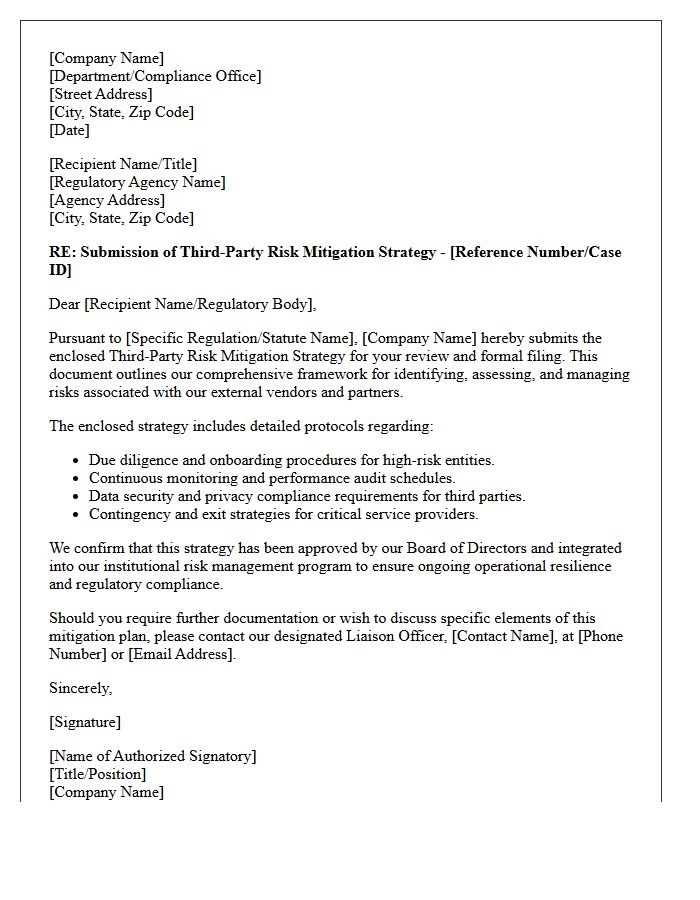
A Third-Party Risk Mitigation Strategy Regulatory Submission Letter is a formal document demonstrating how an organization manages vendor vulnerabilities. It outlines specific controls, oversight frameworks, and contingency plans used to protect sensitive data and maintain operational resilience. Regulators review this letter to ensure compliance with security standards and to verify that external partnerships do not compromise institutional integrity. Providing clear evidence of risk assessment and ongoing monitoring is essential for achieving regulatory approval and building trust within complex supply chains.
What is a Third-Party Vendor Risk Management Regulatory Submission Letter?
A Third-Party Vendor Risk Management Regulatory Submission Letter is a formal document submitted to financial or data privacy regulators outlining an organization's framework, due diligence processes, and oversight mechanisms for managing risks associated with external service providers.
What are the essential components of a compliant regulatory submission letter for vendor risk?
Essential components include a summary of the vendor inventory, risk categorization methodologies, results of recent due diligence audits, evidence of continuous monitoring, and a description of the organization's fourth-party risk oversight and exit strategies.
How does a submission letter demonstrate compliance with OCC and interagency guidelines?
The letter demonstrates compliance by explicitly mapping the organization's vendor management lifecycle-planning, due diligence, contract negotiation, ongoing monitoring, and termination-to the specific safety and soundness standards mandated by regulatory bodies.
What documentation should accompany a vendor risk management submission letter?
Accompanying documentation typically includes the formal Vendor Risk Management (VRM) Policy, a sample of high-risk vendor assessments, SOC 2 Type II report summaries, business continuity plans, and evidence of board-level oversight of third-party risks.
How often must an organization update its third-party risk regulatory submission?
While the frequency depends on specific regional mandates, most organizations update their submission letter annually or whenever there is a significant change in the vendor landscape, such as the onboarding of a critical "Tier 1" cloud service provider or a major update to regulatory requirements.


Comments