
A Regulatory Reporting Deficiency Letter is a formal notice issued by financial authorities highlighting inaccuracies or omissions in submitted data. Addressing these gaps is critical to maintaining compliance and avoiding penalties. This article explores common triggers for these notices and provides effective response strategies to mitigate risk. To help you respond effectively, below are some ready to use template.
Image cover: Standard Templates and Response Strategies for Regulatory Reporting Deficiency Letters
Letter Samples List
- Call Report Accuracy Deficiency Letter
- Bank Secrecy Act Suspicious Activity Reporting Deficiency Letter
- Liquidity Coverage Ratio Calculation Deficiency Letter
- Capital Adequacy Stress Testing Submission Deficiency Letter
- Late Regulatory Filing Deficiency Letter
- Internal Controls Over Financial Reporting Deficiency Letter
- Credit Risk Exposure Reporting Deficiency Letter
- Market Risk Data Aggregation Deficiency Letter
- Home Mortgage Disclosure Act Data Deficiency Letter
- Foreign Bank Account Reporting Deficiency Letter
- Community Reinvestment Act Data Collection Deficiency Letter
- Basel III Standardized Approach Reporting Deficiency Letter
- Resolution Plan Submission Deficiency Letter
- Cybersecurity Incident Prompt Reporting Deficiency Letter
Call Report Accuracy Deficiency Letter
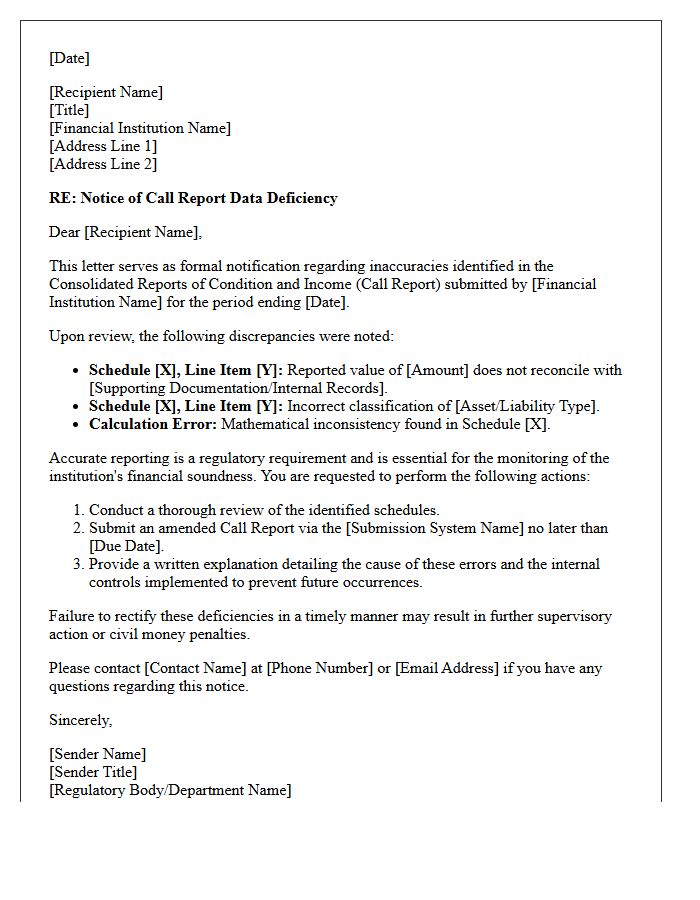
A Call Report Accuracy Deficiency Letter is a formal notification from regulators, such as the FDIC, indicating data reporting errors within a financial institution's quarterly filing. These letters highlight inconsistencies or mathematical inaccuracies that undermine the reliability of the bank's financial health assessment. Receivers must promptly investigate, provide explanations, or file amended reports to ensure compliance. Maintaining precise documentation is essential to avoid increased regulatory scrutiny, potential civil money penalties, and negative impacts on the bank's composite rating during official examinations.
Bank Secrecy Act Suspicious Activity Reporting Deficiency Letter
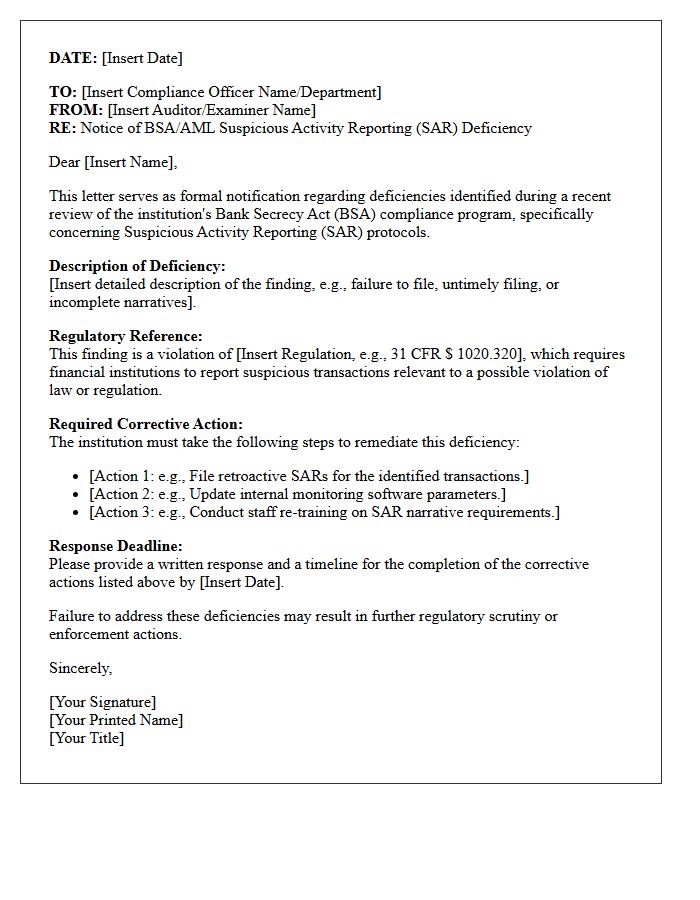
A Bank Secrecy Act Suspicious Activity Reporting Deficiency Letter is a formal notification issued by regulators when a financial institution fails to meet compliance standards for monitoring or documenting questionable transactions. It identifies specific weaknesses in anti-money laundering (AML) protocols and internal controls. Receiving this letter indicates that the bank's reporting processes are inadequate, requiring immediate remediation to avoid penalties. Addressing these gaps is essential for maintaining regulatory standing and ensuring the effective detection of financial crimes, such as fraud or terrorist financing, within the global banking system.
Liquidity Coverage Ratio Calculation Deficiency Letter
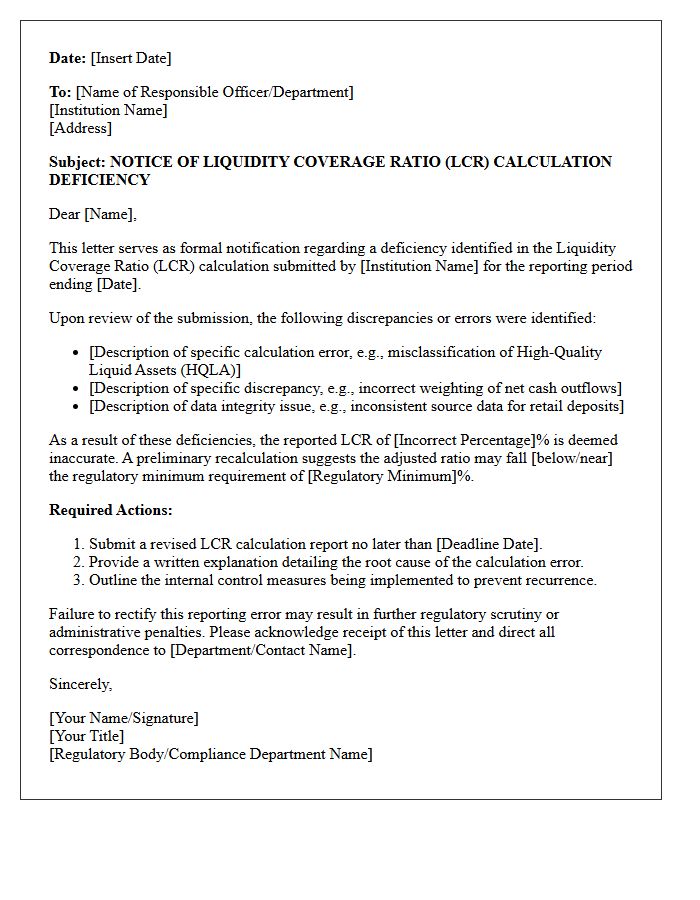
A Liquidity Coverage Ratio (LCR) Calculation Deficiency Letter is a formal notification from regulatory bodies, such as the Federal Reserve, indicating that a financial institution's reporting methodology contains errors. This letter specifies failures in calculating high-quality liquid assets or projected net cash outflows. Receiving this notice implies that the bank's internal controls are inadequate to ensure compliance with liquidity standards. Banks must promptly rectify these technical calculation inaccuracies to avoid enforcement actions, as these deficiencies undermine the accuracy of the firm's short-term solvency profile during a 30-day stress scenario.
Capital Adequacy Stress Testing Submission Deficiency Letter
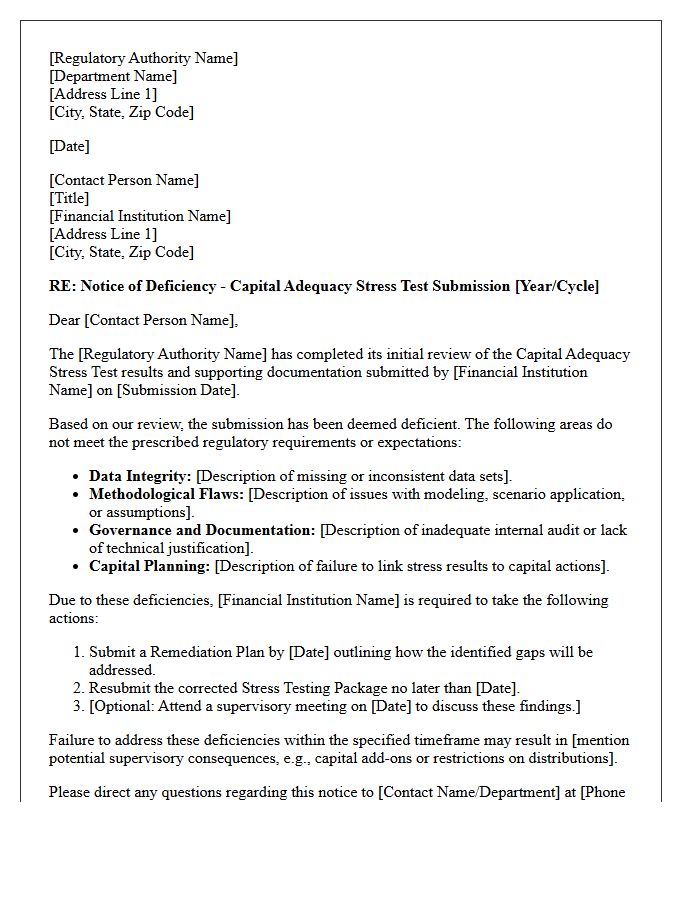
A Capital Adequacy Stress Testing Submission Deficiency Letter is a formal regulatory notification issued by authorities, such as the Federal Reserve, indicating that a financial institution's capital planning process is inadequate. Receiving this letter suggests significant weaknesses in risk identification, governance, or quantitative methodologies. It often requires the bank to resubmit its Comprehensive Capital Analysis and Review (CCAR) plan. Failure to rectify these deficiencies can lead to restrictions on capital distributions, such as dividend payments and share buybacks, ensuring the bank maintains a sufficient buffer against economic downturns.
Late Regulatory Filing Deficiency Letter
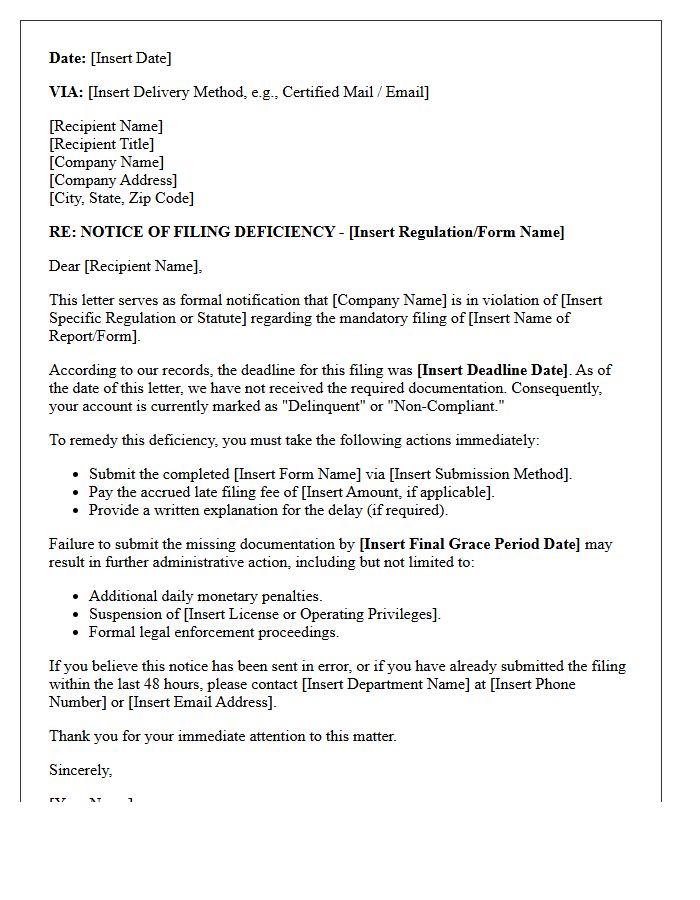
A Late Regulatory Filing Deficiency Letter is an official notice issued by exchange regulators, such as the NASDAQ or NYSE, when a public company fails to submit required financial reports on time. This document warns that the firm is non-compliant with listing standards. Receiving this letter triggers a mandatory public disclosure via an 8-K filing. If the company fails to rectify the reporting gap or submit a viable compliance plan within the specified grace period, it faces potential delisting from the stock exchange.
Internal Controls Over Financial Reporting Deficiency Letter
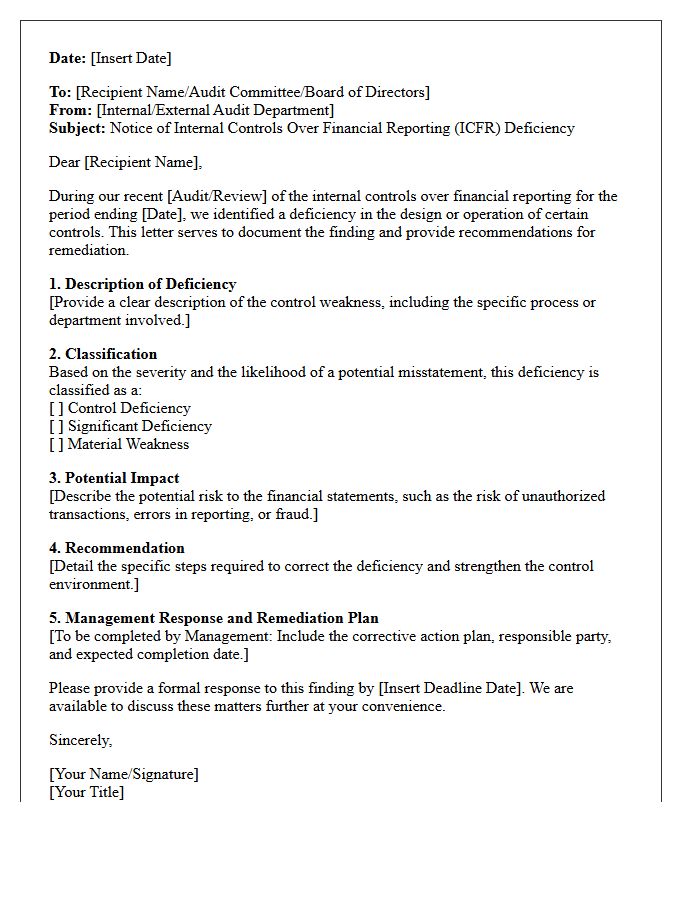
An internal controls over financial reporting deficiency letter is a critical communication from auditors identifying weaknesses in an organization's financial oversight. These letters categorize issues as control deficiencies, significant deficiencies, or material weaknesses. Understanding these findings is essential for remediation and ensuring the accuracy of financial statements. Management must address these gaps to prevent misstatements, maintain regulatory compliance, and uphold investor confidence. Timely action on a deficiency letter demonstrates a commitment to robust governance and long-term financial integrity within the corporate structure.
Credit Risk Exposure Reporting Deficiency Letter
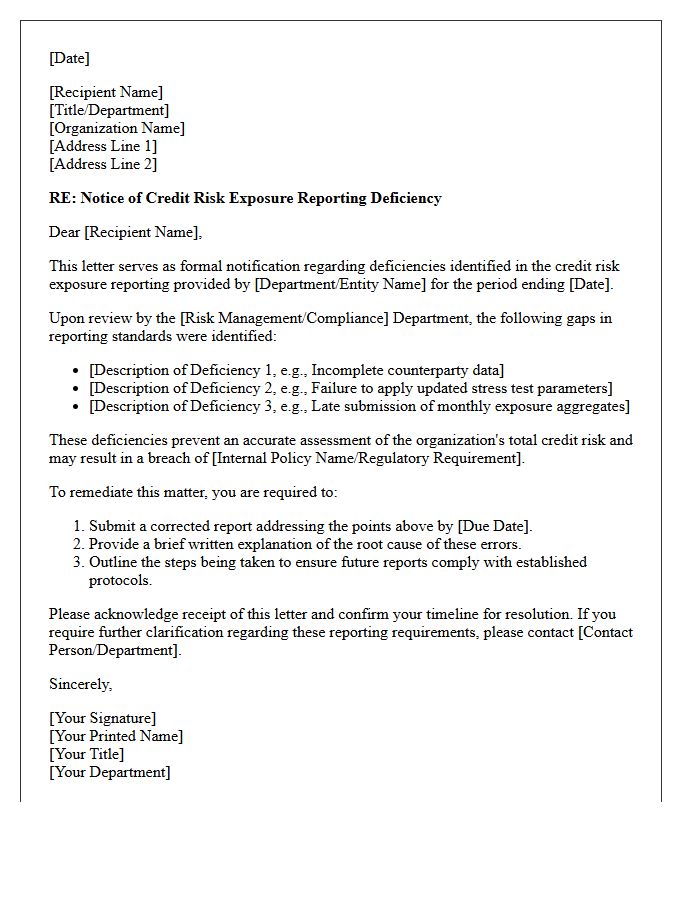
A Credit Risk Exposure Reporting Deficiency Letter is a formal regulatory notice issued when a financial institution fails to accurately measure or report potential losses. This document highlights compliance gaps in data aggregation, risk modeling, or internal controls. Recieving this letter requires immediate remediation to prevent supervisory actions or penalties. Banks must address the specific weaknesses identified in their risk frameworks to ensure they maintain adequate capital reserves against counterparty defaults and market volatility. Promptly fixing these reporting errors is essential for maintaining regulatory standing and overall financial stability.
Market Risk Data Aggregation Deficiency Letter
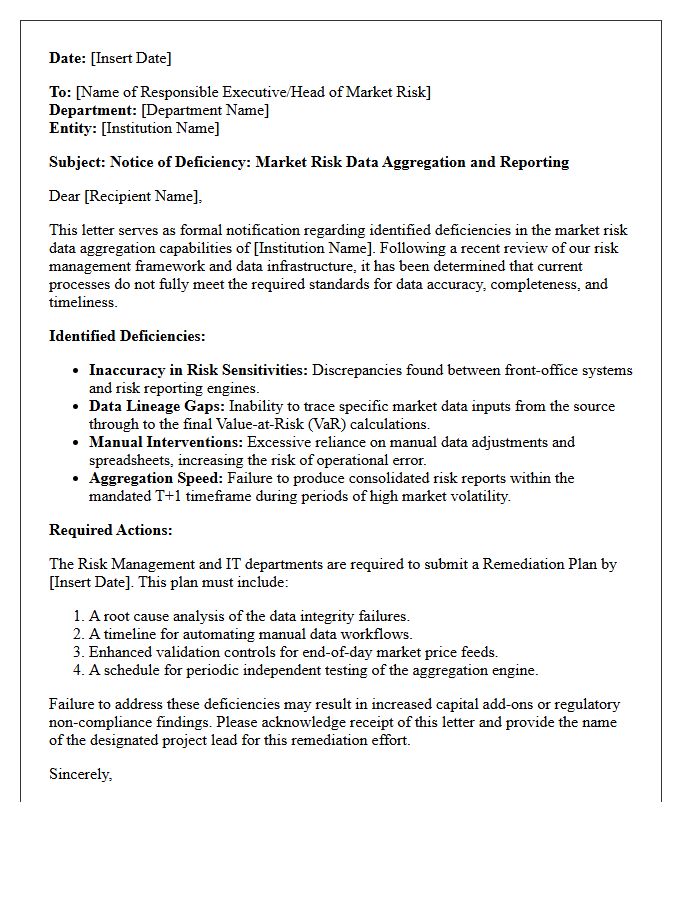
A Market Risk Data Aggregation Deficiency Letter is a formal regulatory notice issued when a financial institution fails to meet BCBS 239 standards. It highlights critical failures in data integrity, accuracy, and reporting speed during stress tests. Receiving this letter signifies that the bank's risk management infrastructure cannot reliably consolidate exposure metrics across legal entities. Addressing these gaps is essential to avoid capital add-ons, regulatory fines, and heightened supervision. Banks must implement robust governance frameworks and automated lineage tools to remediate identified weaknesses and ensure transparent risk oversight.
Home Mortgage Disclosure Act Data Deficiency Letter
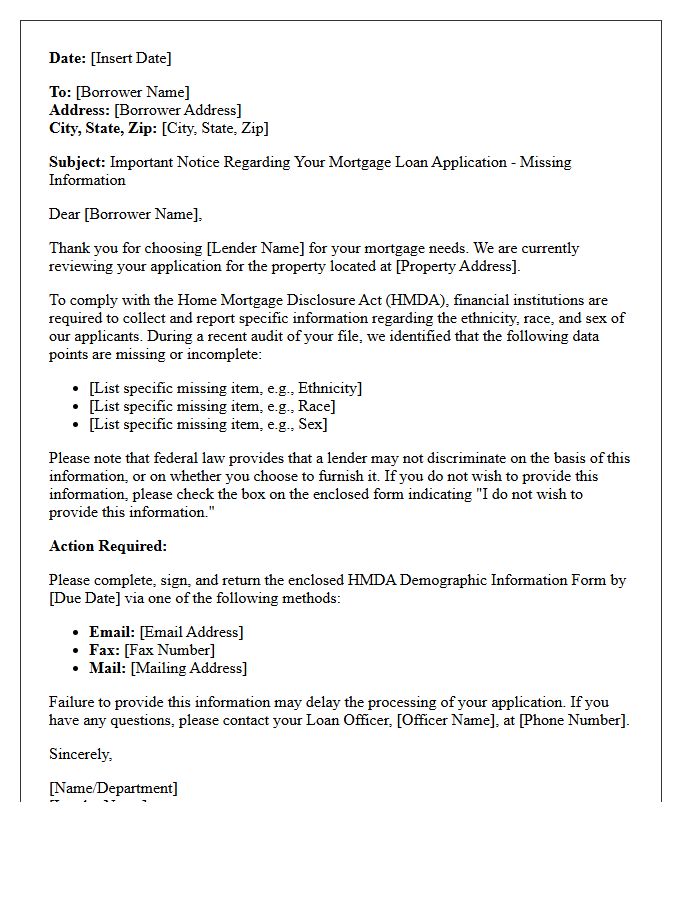
A Home Mortgage Disclosure Act (HMDA) Data Deficiency Letter is a formal notification from regulators indicating reporting errors or omissions in a financial institution's Loan Application Register. Receiving this letter signifies that your data integrity fails to meet compliance standards, potentially triggering mandatory audits or civil money penalties. To mitigate risks, lenders must implement robust quality control measures and perform timely data scrubs. Addressing these deficiencies promptly is essential to ensure accurate fair lending analysis and maintain a positive standing with regulatory agencies during examinations.
Foreign Bank Account Reporting Deficiency Letter
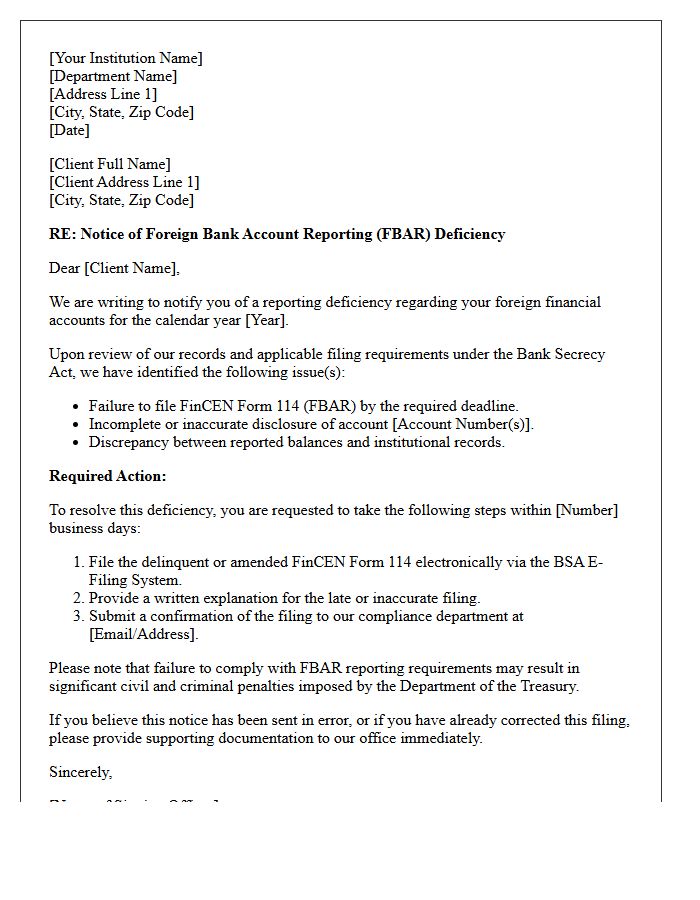
Receiving a Foreign Bank Account Reporting Deficiency Letter from the IRS indicates potential errors or omissions in your FBAR filing. This official notice specifies missing information or non-compliance with FinCEN Form 114 regulations. It is crucial to address these discrepancies immediately to avoid significant penalties or legal audits. Review your records carefully, provide the requested documentation, and consider consulting a tax professional. Timely rectification of reporting deficiencies is essential for maintaining legal standing and ensuring full transparency regarding your offshore financial assets and international bank accounts.
Community Reinvestment Act Data Collection Deficiency Letter
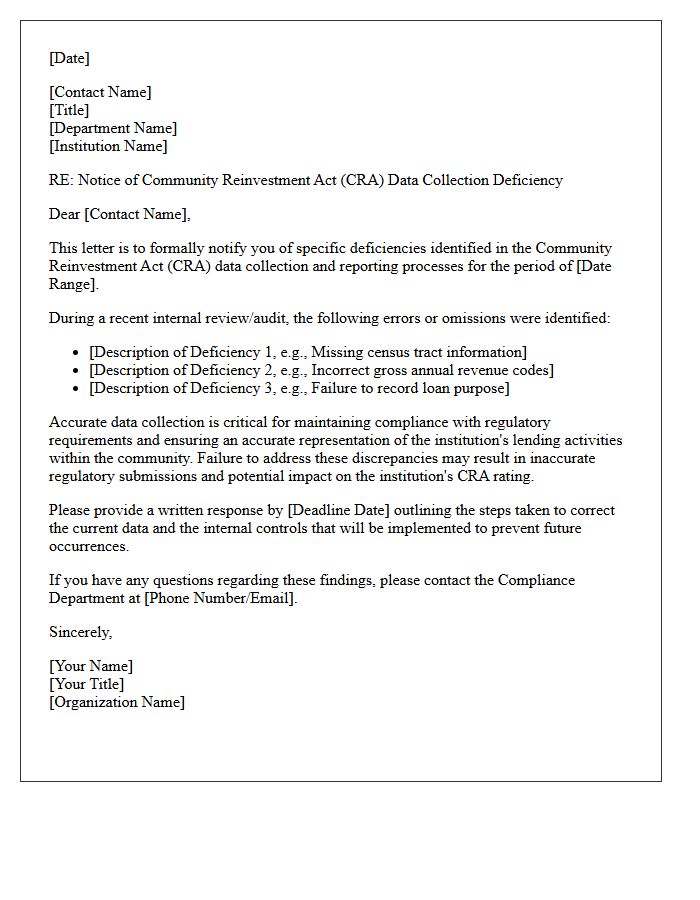
A Community Reinvestment Act (CRA) Data Collection Deficiency Letter is a formal notice issued by regulators when a financial institution fails to accurately report small business, farm, or consumer loan data. This letter highlights data integrity issues that can negatively impact a bank's official CRA rating. Financial institutions must implement immediate corrective actions to improve their compliance monitoring systems and reporting accuracy. Addressing these deficiencies is crucial to avoid regulatory penalties and ensure a transparent evaluation of the bank's commitment to serving its entire community, including low-income neighborhoods.
Basel III Standardized Approach Reporting Deficiency Letter
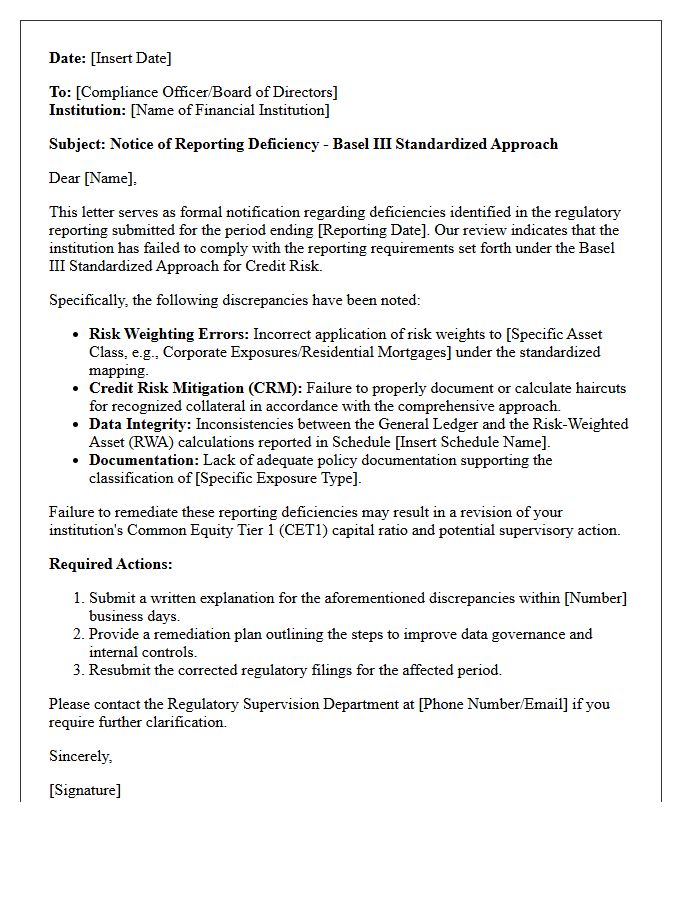
A Basel III Standardized Approach Reporting Deficiency Letter is a formal regulatory notice issued when a financial institution fails to accurately calculate or report Risk-Weighted Assets. These letters highlight data integrity issues, inadequate documentation, or methodological errors in credit, market, or operational risk assessments. Receiving one indicates that your bank's regulatory capital ratios may be misstated, necessitating immediate corrective actions to improve compliance and governance. Addressing these findings is crucial to avoid heightened supervisory scrutiny, potential capital surcharges, or legal penalties under the international banking regulatory framework.
Resolution Plan Submission Deficiency Letter
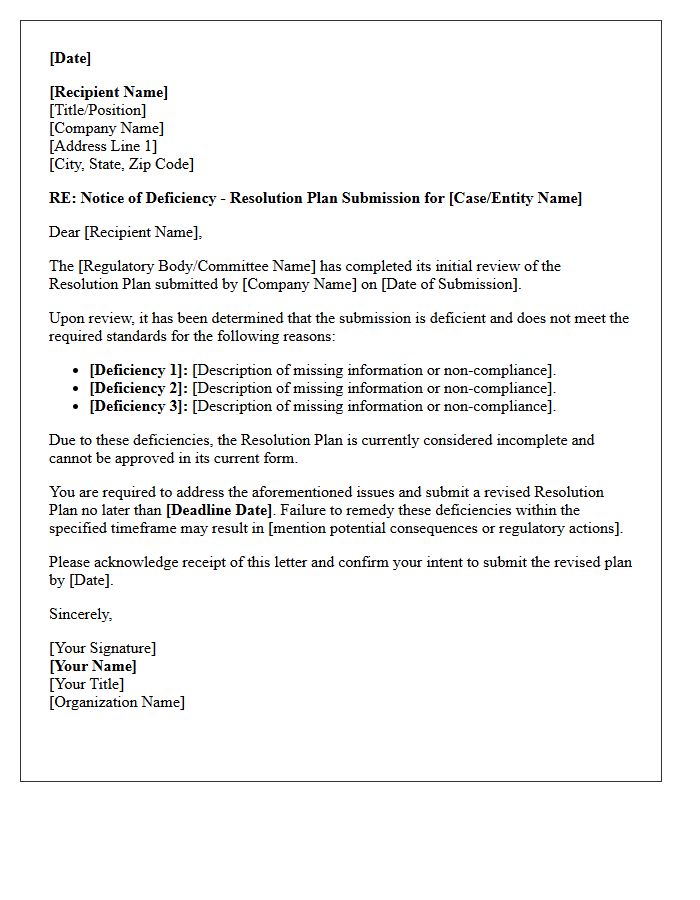
A Resolution Plan Submission Deficiency Letter is a formal notice issued by regulatory authorities, such as the RBI, when a proposed restructuring scheme lacks critical information or fails to meet legal guidelines. It highlights specific gaps in financial projections, repayment schedules, or compliance requirements. Receiving this letter means the insolvency professional must rectify errors promptly to avoid rejection. Addressing these discrepancies is essential for the plan's approval, ensuring the distressed asset's viable recovery and adherence to the Insolvency and Bankruptcy Code framework.
Cybersecurity Incident Prompt Reporting Deficiency Letter
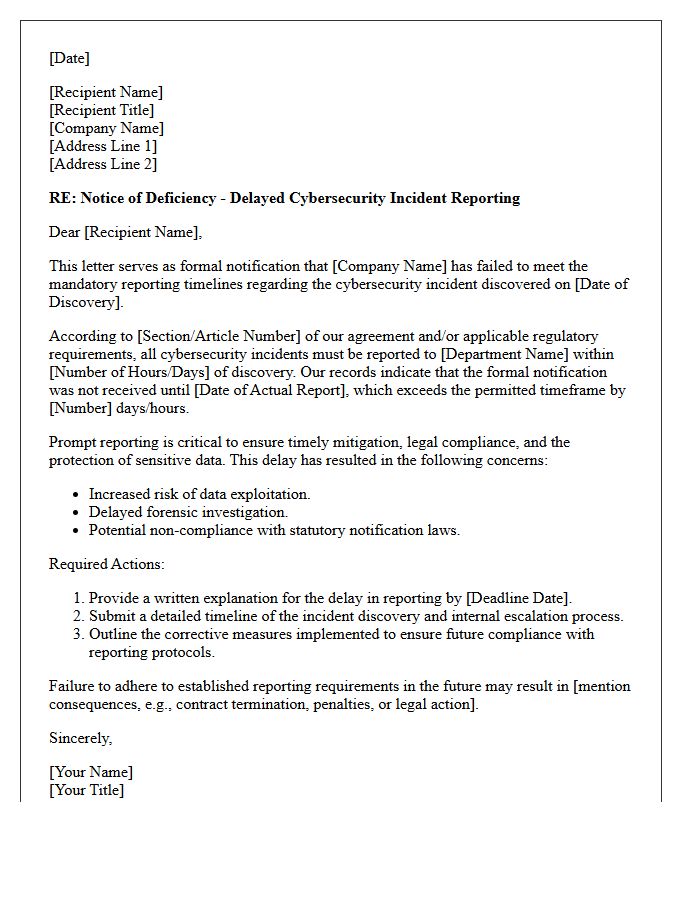
A Cybersecurity Incident Prompt Reporting Deficiency Letter is an official notice issued by regulators, such as the SEC, when a firm fails to disclose a material breach within mandated timeframes. This letter highlights compliance failures in meeting transparency requirements. Organizations must respond by documenting their incident response protocols and remediation steps to avoid legal penalties or enforcement actions. Timely notification is essential to maintain regulatory standing and protect investor interests, as delays are viewed as significant governance weaknesses that jeopardize market integrity and data security standards.
What is a Regulatory Reporting Deficiency Letter?
A Regulatory Reporting Deficiency Letter is an official communication issued by a financial regulator, such as the SEC, FINRA, or FCA, notifying a firm that their submitted data-such as MiFID II, EMIR, or CAT reporting-contains errors, omissions, or fails to meet established technical standards.
What are the most common causes of a reporting deficiency notice?
Common triggers include data mapping errors, late submissions (breaching T+1 deadlines), inconsistent formatting, missing mandatory fields (LEIs or timestamps), and reconciliation discrepancies between the firm's internal records and the trade repository data.
How should a firm respond to a Deficiency Letter from a regulator?
Firms should provide a formal written response that acknowledges the specific reporting gaps, outlines a detailed remediation plan with clear timelines, and identifies the root cause of the error to demonstrate proactive compliance and internal oversight.
What are the potential penalties for failing to address a Deficiency Letter?
Failure to remediate reported deficiencies can result in significant outcomes, including formal enforcement actions, substantial financial fines, mandatory third-party audits (such as a Section 166 review), and increased ongoing supervisory scrutiny from the regulator.
How can firms prevent recurring regulatory reporting deficiencies?
Prevention involves implementing automated data validation rules, conducting regular independent reporting audits, maintaining robust data lineage documentation, and utilizing specialized regulatory technology (RegTech) to perform daily reconciliations before final submission.


Comments