
A Capital Adequacy Assessment Submission Letter is a formal document sent to financial regulators to demonstrate that an institution maintains sufficient capital against its risk profile. This critical filing outlines internal risk assessments and ensures compliance with regulatory standards. Effective documentation ensures transparency and financial stability. To assist your reporting process, below are some ready to use template.

Image cover: Mastering Your Capital Adequacy Assessment: Submission Letter Templates and Best Practices
Letter Samples List
- Internal Capital Adequacy Assessment Process Submission Letter
- Annual Regulatory Capital Adequacy Review Cover Letter
- Comprehensive Capital Analysis And Review Submission Letter
- Board Approved Capital Adequacy Statement Letter
- Pillar Two Capital Adequacy Assessment Letter
- Consolidated Capital Adequacy Report Cover Letter
- Minimum Capital Requirement Compliance Declaration Letter
- Stressed Capital Adequacy Assessment Submission Letter
- Supervisory Capital Assessment Review Letter
- Baseline Capital Adequacy Projection Cover Letter
- Interim Capital Adequacy Assessment Submission Letter
- Capital Adequacy Remediation Plan Notification Letter
Internal Capital Adequacy Assessment Process Submission Letter
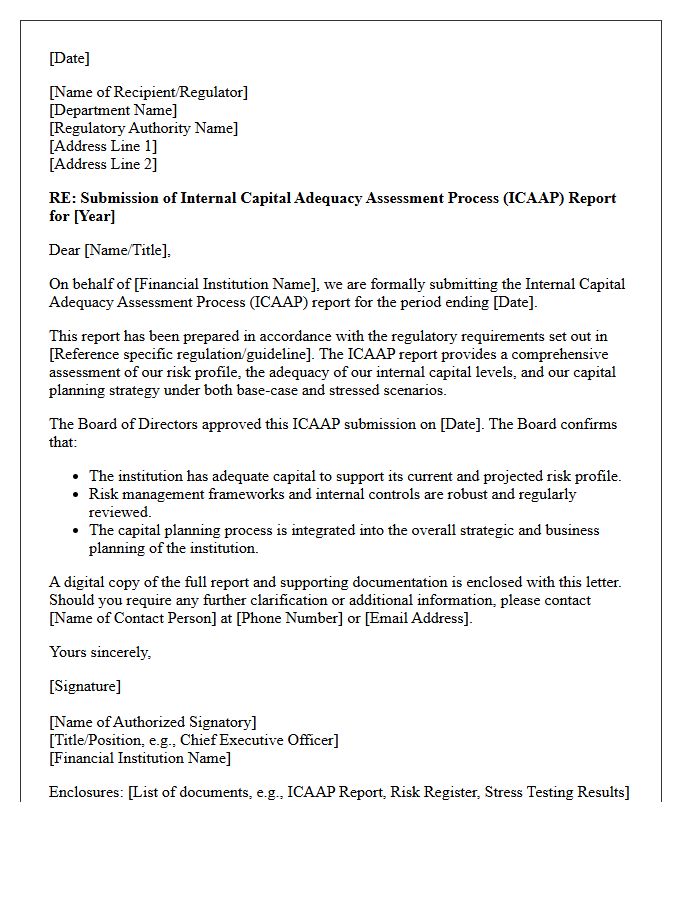
The ICAAP Submission Letter is a formal document sent by financial institutions to regulators, confirming that their board of directors has reviewed and approved the internal risk assessment. It serves as a compliance attestation, certifying that the bank holds sufficient capital to cover its specific risk profile. This letter validates the integrity of the Internal Capital Adequacy Assessment Process, ensuring that stress testing, risk management frameworks, and strategic capital planning align with regulatory expectations and supervisory requirements for long-term financial stability.
Annual Regulatory Capital Adequacy Review Cover Letter
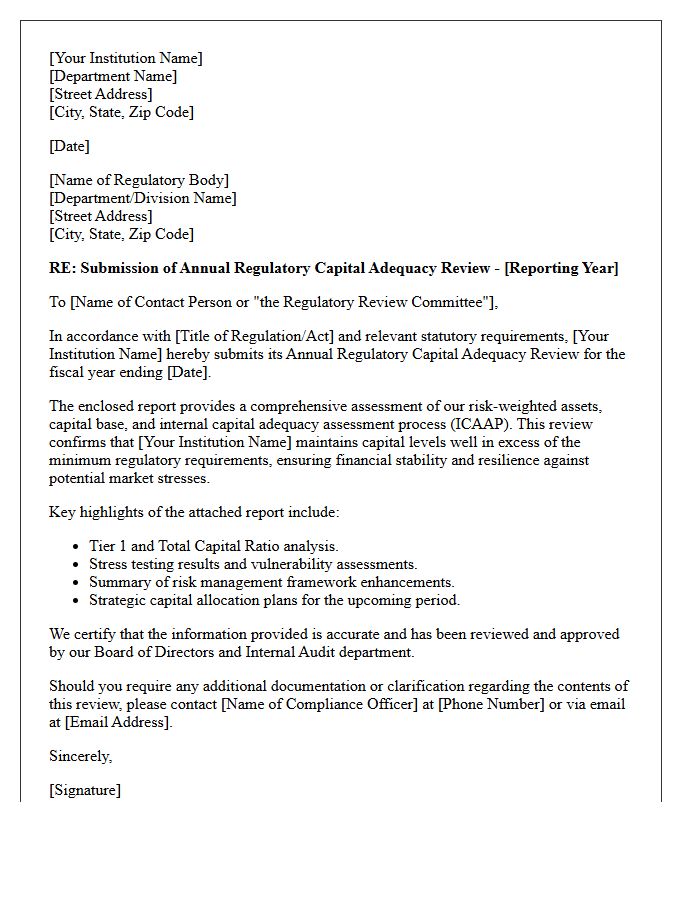
The Annual Regulatory Capital Adequacy Review Cover Letter serves as a formal declaration certifying that a financial institution maintains sufficient liquidity and reserves to withstand economic stress. This document provides executive oversight and summarizes key findings from internal risk assessments. It is essential for ensuring compliance with Basel III or national standards, acting as the primary narrative for regulators to evaluate a firm's financial health. A well-structured letter highlights capital ratios, methodology changes, and board approval, facilitating a transparent supervisory review process.
Comprehensive Capital Analysis And Review Submission Letter
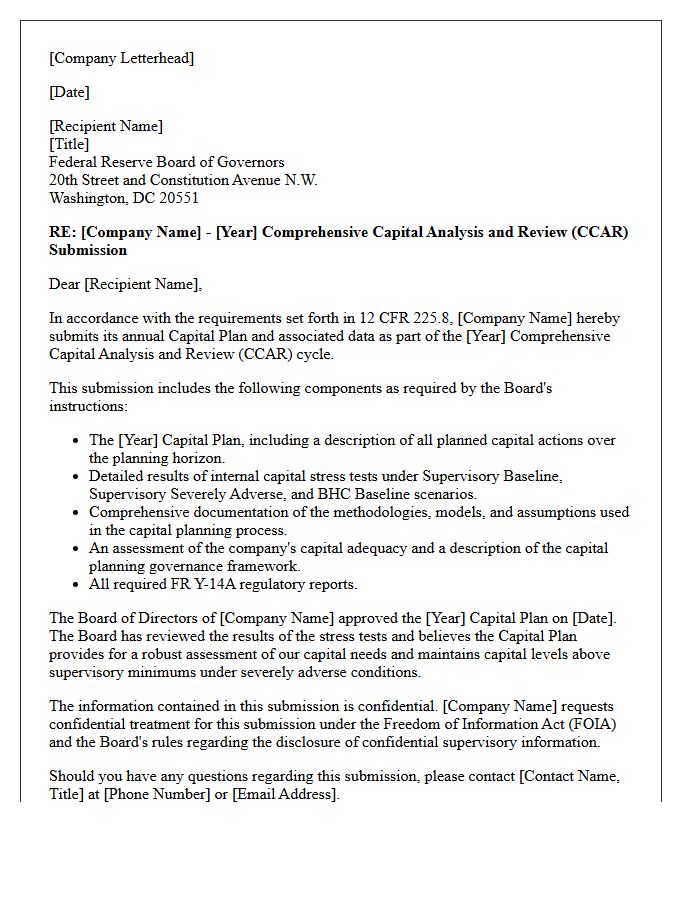
A Comprehensive Capital Analysis and Review (CCAR) submission letter is a formal document sent by large financial institutions to the Federal Reserve. It serves as the official attestation for their annual capital plan, detailing how the bank intends to manage capital distributions like dividends and share buybacks. The letter must demonstrate that the firm maintains robust internal risk management processes and sufficient capital to withstand severe economic stress. Compliance ensures the bank remains stable while supporting the economy, making the accuracy of this regulatory filing critical for financial oversight.
Board Approved Capital Adequacy Statement Letter
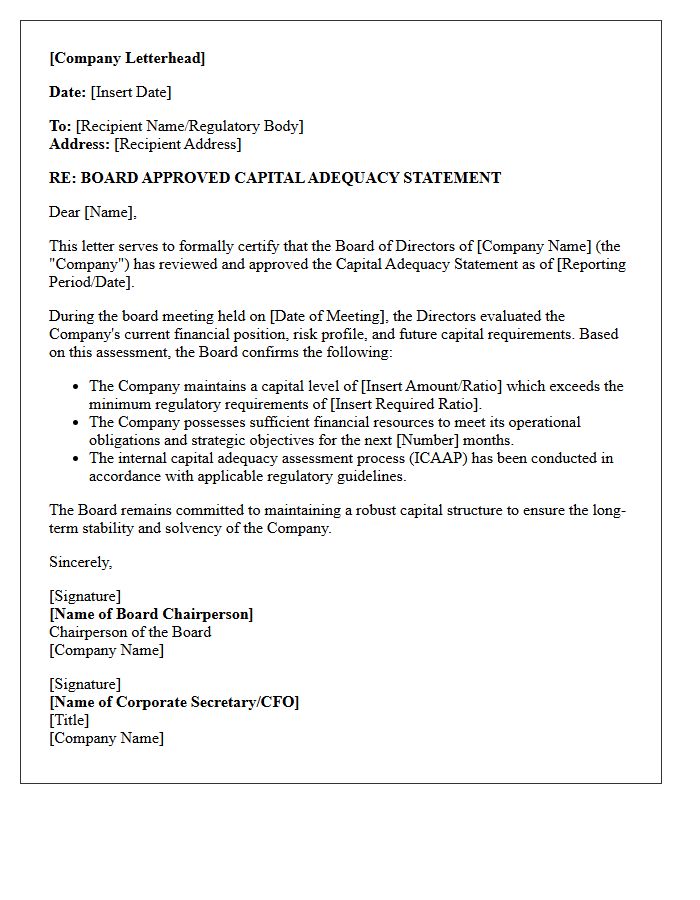
A Board Approved Capital Adequacy Statement Letter is a critical regulatory document confirming that a financial institution maintains sufficient regulatory capital to cover its risk profile. This formal declaration, signed by directors, ensures solvency and compliance with legal reserve requirements. It serves as an internal assessment of financial health, proving the organization can absorb unexpected losses while remaining operational. Regulators review this letter to evaluate risk management effectiveness and to ensure the entity's long-term stability within the broader economic landscape.
Pillar Two Capital Adequacy Assessment Letter
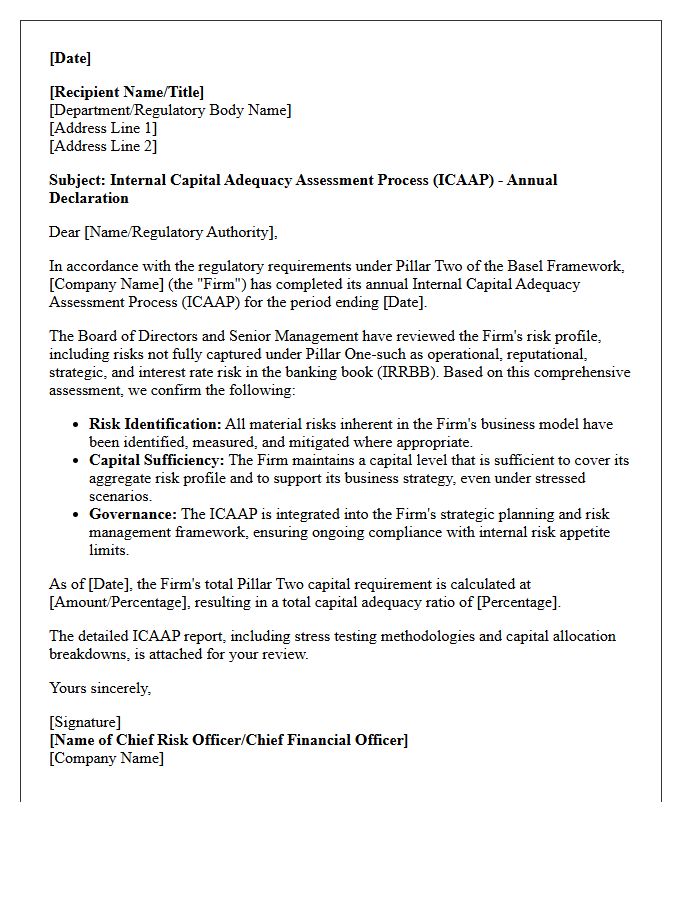
The Pillar Two Capital Adequacy Assessment Letter is a formal notification issued by financial regulators to banks regarding their specific ICAAP results. It details the additional individual capital requirement a firm must hold to cover risks not fully captured under Pillar One. This letter is crucial for strategic planning as it dictates the minimum solvency levels and defines the supervisory capital buffer expectations. Understanding this document is essential for maintaining regulatory compliance and ensuring the institution possesses sufficient financial strength to withstand idiosyncratic economic stress scenarios.
Consolidated Capital Adequacy Report Cover Letter
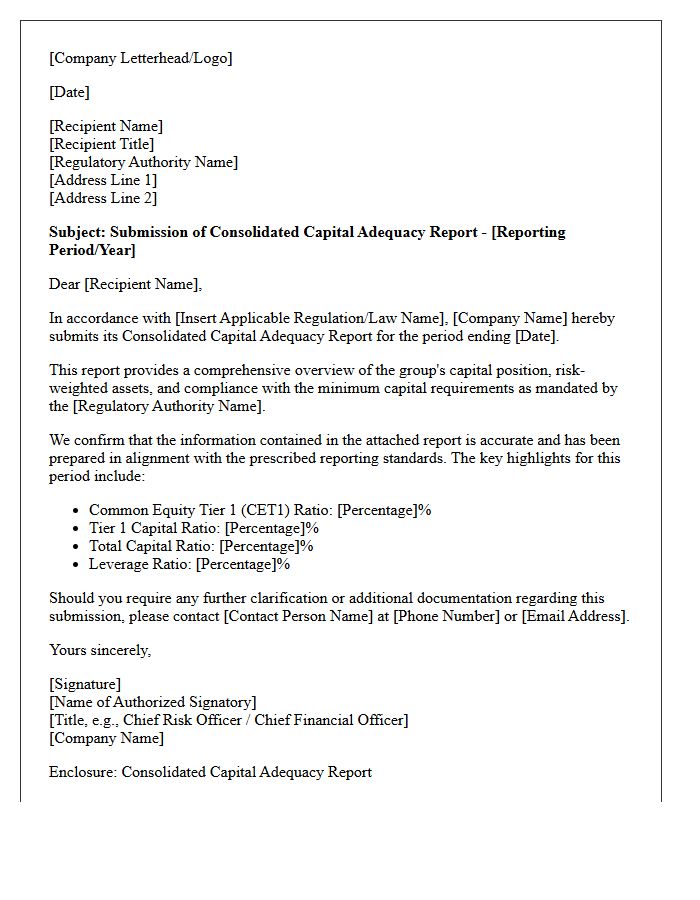
A Consolidated Capital Adequacy Report Cover Letter is a formal document submitted to regulators to summarize a financial institution's risk-weighted assets and capital ratios. It provides an executive overview of the bank's ability to absorb losses and remain solvent under economic stress. This letter validates that the reported data complies with Basel III standards and internal governance policies. Its primary purpose is to ensure transparency between the reporting entity and supervisory authorities, certifying that the organization maintains sufficient capital buffers to support its overall risk profile.
Minimum Capital Requirement Compliance Declaration Letter
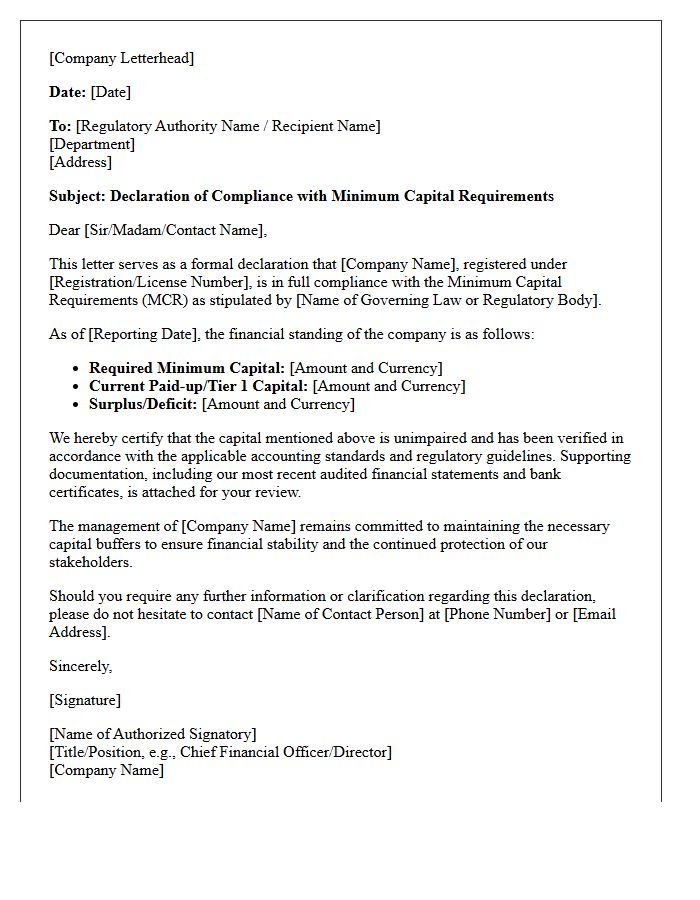
A Minimum Capital Requirement Compliance Declaration Letter is a formal document certifying that an entity maintains the mandatory liquidity and net worth required by financial regulators. This statement serves as official evidence that a firm can absorb operational losses and protect stakeholders. Accurate reporting is essential, as this declaration ensures adherence to solvency standards and legal frameworks. Failure to provide this proof can result in license suspension or severe penalties. It is a critical component of financial transparency and corporate governance in regulated industries.
Stressed Capital Adequacy Assessment Submission Letter
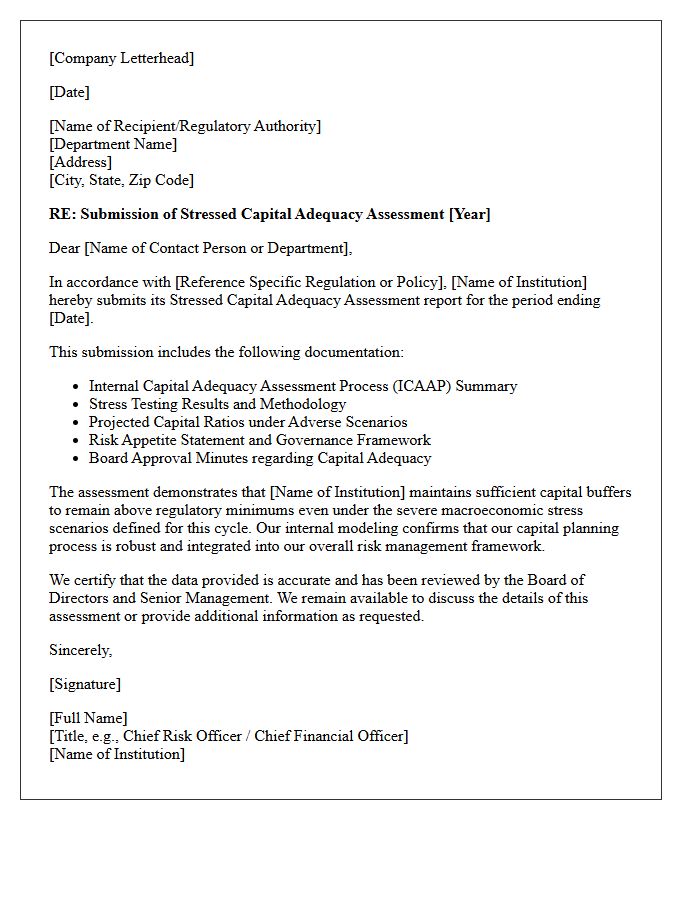
The Stressed Capital Adequacy Assessment Submission Letter is a critical regulatory document certifying that a financial institution maintains sufficient capital to withstand severe economic shocks. It accompanies the ICAAP report, formalizing board approval and senior management accountability for risk modeling accuracy. The letter ensures transparency regarding capital buffers, risk appetite, and strategic resilience. Providing clear justification for capital planning under stress is essential for regulatory compliance and maintaining market confidence in the firm's long-term financial stability.
Supervisory Capital Assessment Review Letter
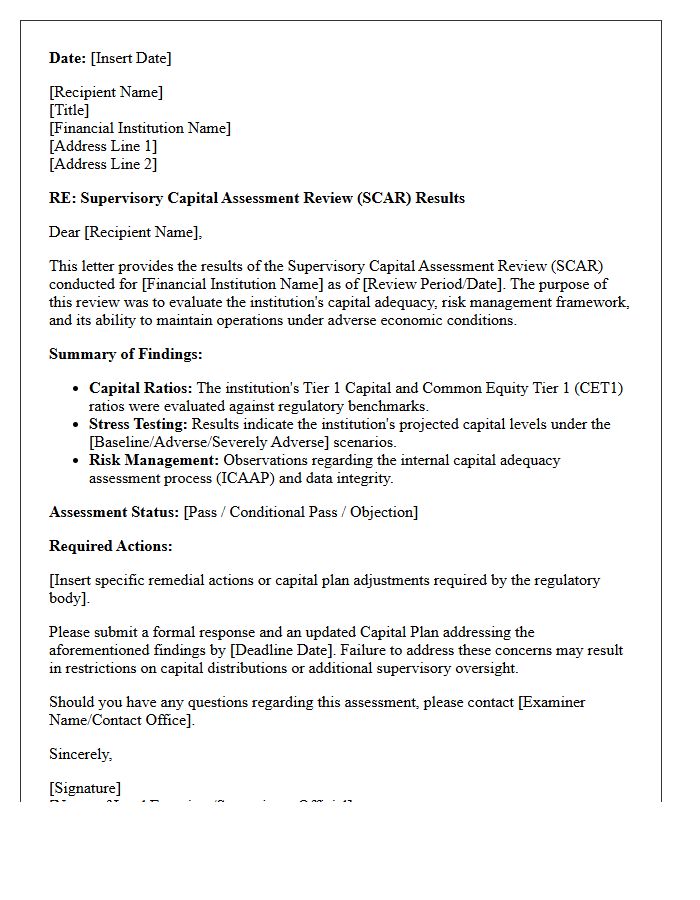
The Supervisory Capital Assessment Review (SCAR) letter is a critical regulatory document used by the Federal Reserve to communicate the results of bank stress tests. It evaluates whether major financial institutions maintain sufficient capital to survive severe economic downturns. This letter outlines specific capital requirements and potential restrictions on dividends or share buybacks. Understanding the SCAR letter is essential for assessing a bank's financial resilience and its ability to withstand systemic risk while continuing to lend during periods of intense market instability.
Baseline Capital Adequacy Projection Cover Letter
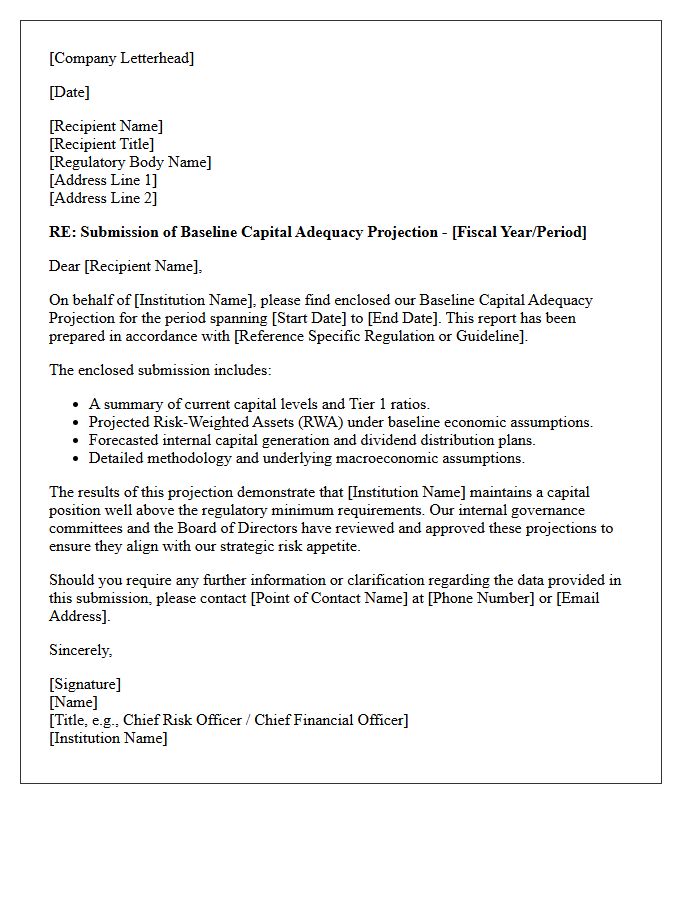
The Baseline Capital Adequacy Projection Cover Letter is a critical regulatory document ensuring financial stability. It summarizes a bank's internal assessment of capital reserves relative to risk exposure under normal economic conditions. This letter must clearly articulate the methodology used for projections, highlighting the institution's ability to maintain operations during growth. It serves as the formal narrative for supervisors, bridging the gap between raw data and strategic planning. Accuracy in this submission demonstrates effective risk management and compliance with international banking standards, such as Basel III, to maintain overall market confidence.
Interim Capital Adequacy Assessment Submission Letter
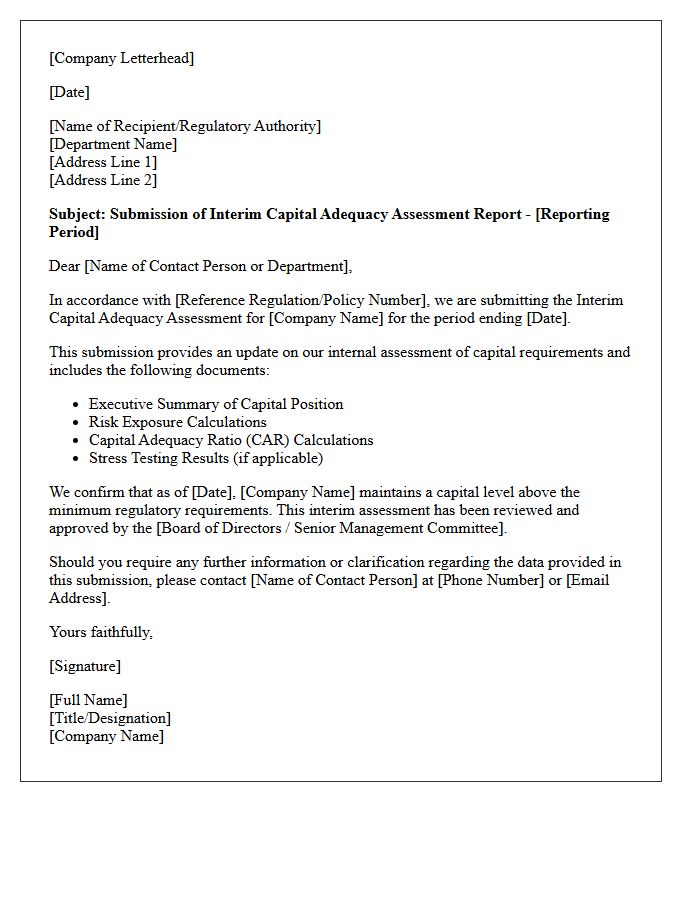
The Interim Capital Adequacy Assessment Submission Letter is a formal regulatory document submitted by financial institutions to confirm their internal solvency levels between full annual reviews. It serves as an official declaration that the firm maintains sufficient regulatory capital to cover unexpected risks. This letter highlights material changes in the risk profile or business strategy that may impact financial stability. Timely submission ensures compliance with banking authorities, demonstrating proactive risk management and the ability to absorb potential losses during volatile market periods without breaching minimum capital requirements.
Capital Adequacy Remediation Plan Notification Letter
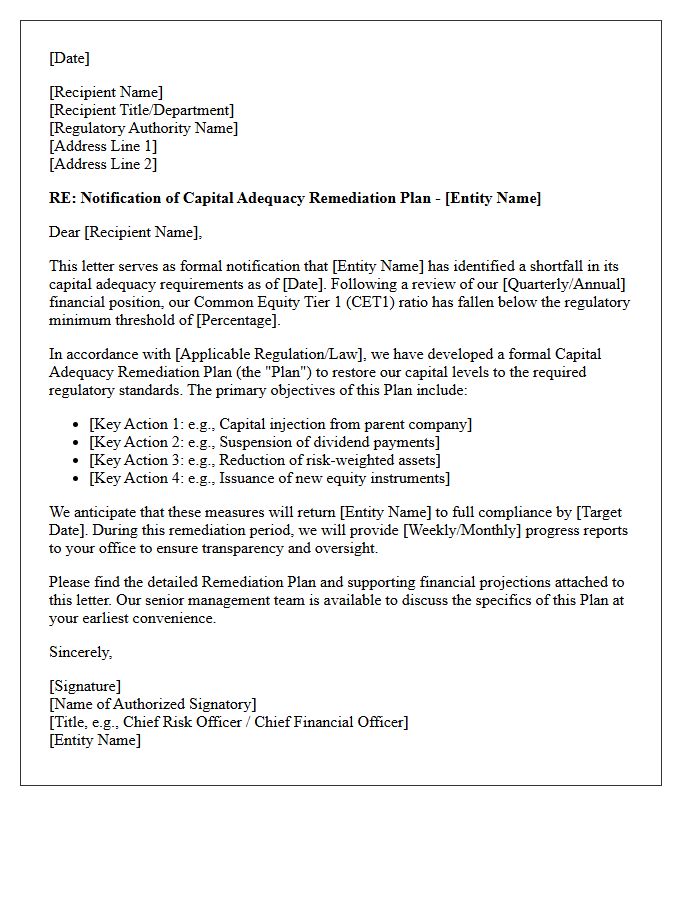
A Capital Adequacy Remediation Plan Notification Letter is a formal regulatory directive issued when a financial institution's capital reserves fall below mandatory thresholds. This document requires the entity to submit a detailed remediation plan outlining specific actions to restore financial stability and meet regulatory requirements. It serves as a critical warning to address solvency risks promptly. Failure to comply can lead to severe enforcement actions, restrictions on business operations, or loss of banking licenses. Understanding the timeline and corrective measures specified in this notification is essential for maintaining institutional compliance and market confidence.
What is a Capital Adequacy Assessment Submission Letter?
A Capital Adequacy Assessment Submission Letter is a formal document sent by a financial institution to a regulatory body, such as the central bank, certifying that the organization maintains sufficient capital to cover its operational, credit, and market risks.
What are the key components of a Capital Adequacy Assessment Letter?
The letter typically includes the current capital adequacy ratio (CAR), a summary of the Internal Capital Adequacy Assessment Process (ICAAP) results, a statement of compliance with regulatory thresholds, and the signature of a senior executive or board member.
Why is the Capital Adequacy Assessment Submission mandatory?
The submission is a regulatory requirement designed to ensure financial stability, protect depositors, and verify that banks have enough equity to absorb potential losses while maintaining solvency during economic stress.
Who is responsible for signing the Capital Adequacy Submission Letter?
In most jurisdictions, the letter must be signed by high-level management, such as the Chief Risk Officer (CRO), Chief Financial Officer (CFO), or the CEO, to indicate formal accountability for the accuracy of the reported capital figures.
When must the Capital Adequacy Assessment Letter be submitted?
Submission timelines vary by jurisdiction but generally occur on an annual or quarterly basis, often aligned with the filing of the ICAAP report or after the completion of mandated stress tests.

Comments