
Financial institutions must issue a Warning Letter for Suspected Money Laundering when account activity deviates from established profiles. This formal notice alerts clients to suspicious transactions and outlines necessary compliance actions to mitigate legal risks. Maintaining robust anti-money laundering protocols is essential for regulatory adherence and institutional security. To help you draft these critical documents, below are some ready to use templates.
Image cover: Official Notice of Suspicious Account Activity and Anti-Money Laundering Compliance Review
Letter Samples List
- Warning Letter for Unusual Account Activity
- Letter of Inquiry Regarding Source of Wealth and Funds
- Notice Letter for Unverified Large Currency Transactions
- Compliance Warning Letter for Suspected Transaction Structuring
- Pre-Closure Warning Letter for High-Risk Financial Behavior
- Letter of Account Suspension Pending Money Laundering Investigation
- Enhanced Due Diligence Information Request Letter
- Warning Letter for Unexplained International Wire Transfers
- Account Freeze Notification Letter for Suspicious Activity
- Letter of Demand for Corporate Beneficial Ownership Documentation
- Final Warning Letter for Persistent Non-Compliant Transaction Patterns
- Warning Letter for Rapid Fund Movement and Pass-Through Activity
Warning Letter for Unusual Account Activity
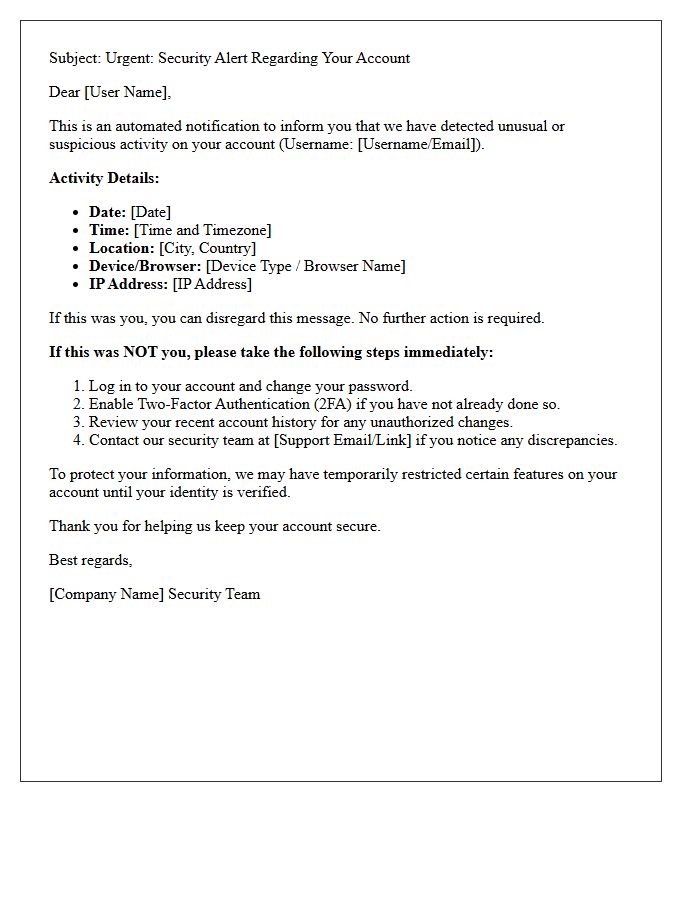
A Warning Letter for Unusual Account Activity is a security notification sent when a system detects potential unauthorized access. This alert typically triggers due to logins from unrecognized devices, strange geographical locations, or multiple failed password attempts. Upon receiving this, you must immediately verify your identity and update your credentials to prevent data breaches. If the activity was not yours, secure your account by enabling multi-factor authentication and reviewing recent transactions. Treat these warnings as high-priority alerts to protect your personal information and financial data from cyber threats.
Letter of Inquiry Regarding Source of Wealth and Funds
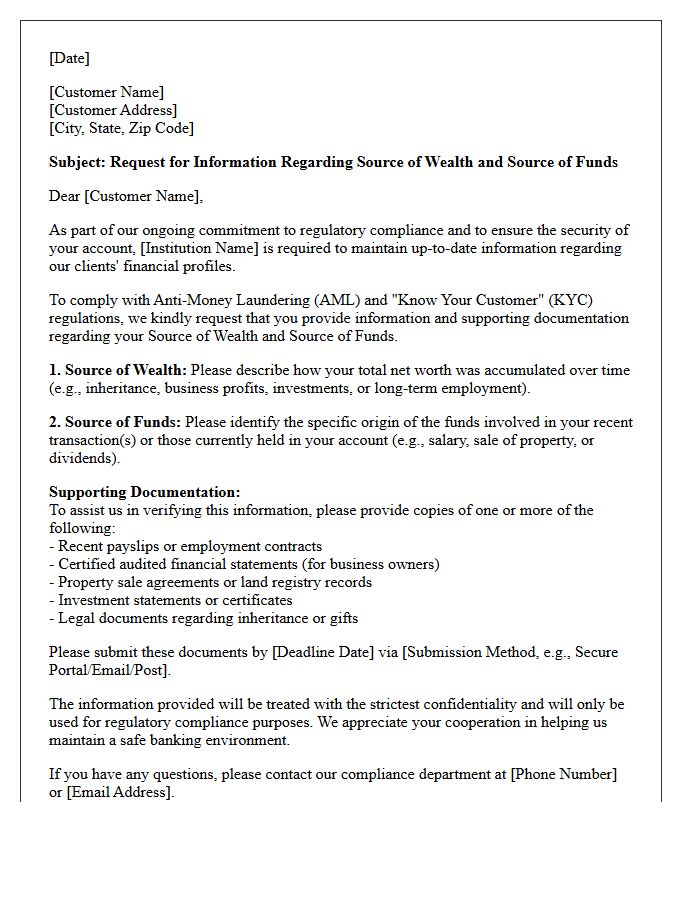
A Letter of Inquiry regarding Source of Wealth (SoW) and Source of Funds (SoF) is a compliance request used by financial institutions to verify the origin of a client's assets. Banks must document how your total net worth was accumulated over time and identify the specific origin of transaction capital. This process is essential for Anti-Money Laundering (AML) regulations. To ensure a smooth review, you must provide clear supporting documentation, such as bank statements, inheritance records, or investment portfolios, to prove your wealth was obtained through legitimate, legal means.
Notice Letter for Unverified Large Currency Transactions
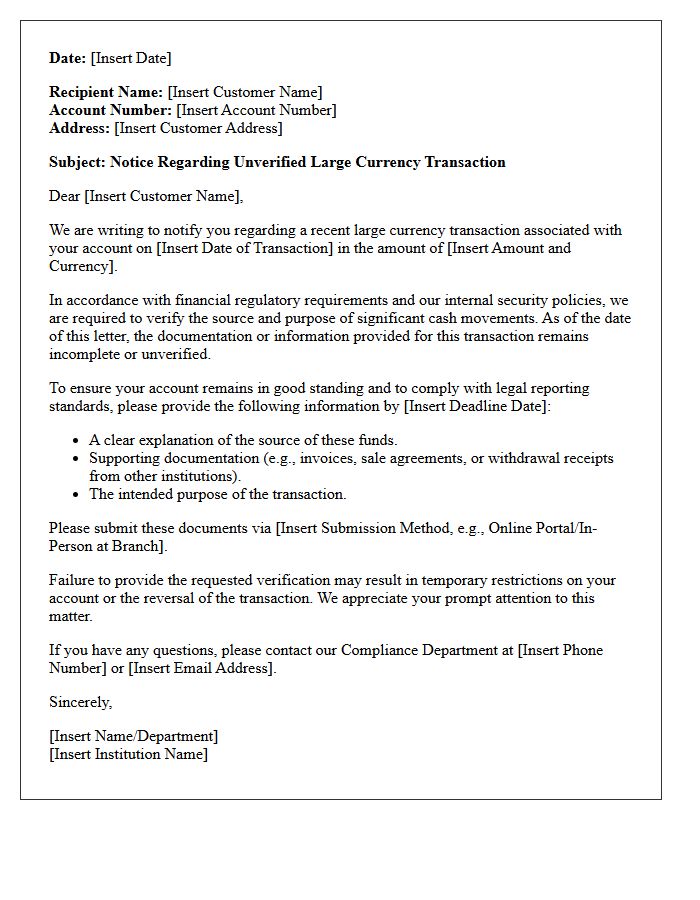
A Notice Letter for Unverified Large Currency Transactions is a formal notification issued when a financial institution identifies a cash deposit or withdrawal exceeding regulatory thresholds that lacks sufficient documentation. Recipients must provide legitimate proof of funds to ensure compliance with Anti-Money Laundering (AML) laws. Failure to respond or verify the source of wealth may result in account restrictions, closure, or mandatory reporting to government authorities. Always maintain accurate records of significant cash movements to prevent legal complications or suspicions of financial structuring.
Compliance Warning Letter for Suspected Transaction Structuring
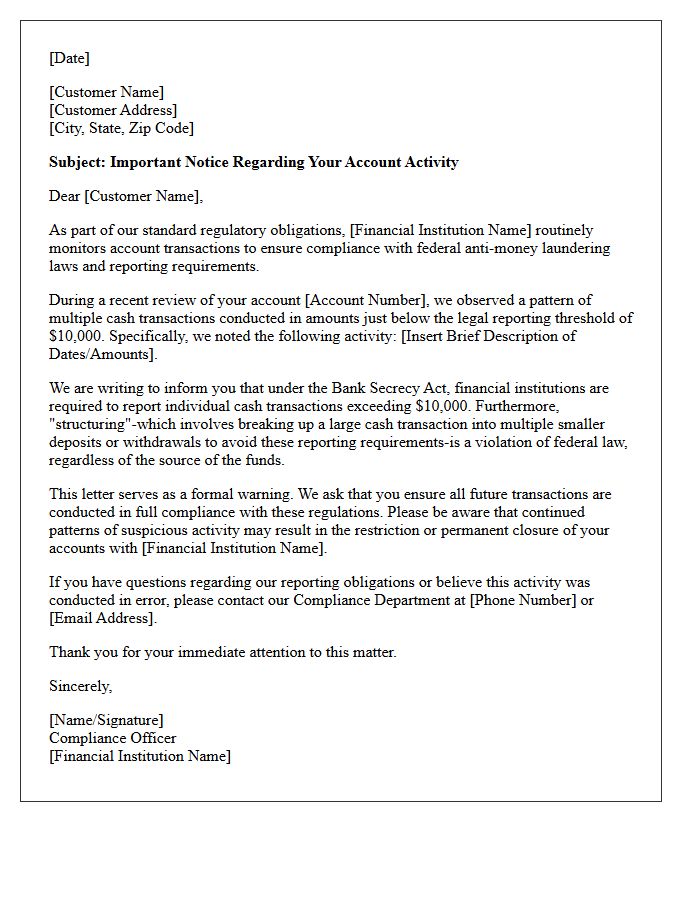
A compliance warning letter for suspected transaction structuring signifies that a financial institution has detected patterns designed to evade anti-money laundering reporting thresholds. Structuring involves splitting large cash deposits into smaller amounts to avoid triggers like the Currency Transaction Report. Receiving this notice is a serious legal red flag indicating potential criminal scrutiny. To protect your standing, you must immediately cease these patterns, provide legitimate documentation for the funds, and consult legal counsel. Ignoring these warnings can lead to account termination, asset seizure, or formal federal prosecution for financial crimes.
Pre-Closure Warning Letter for High-Risk Financial Behavior
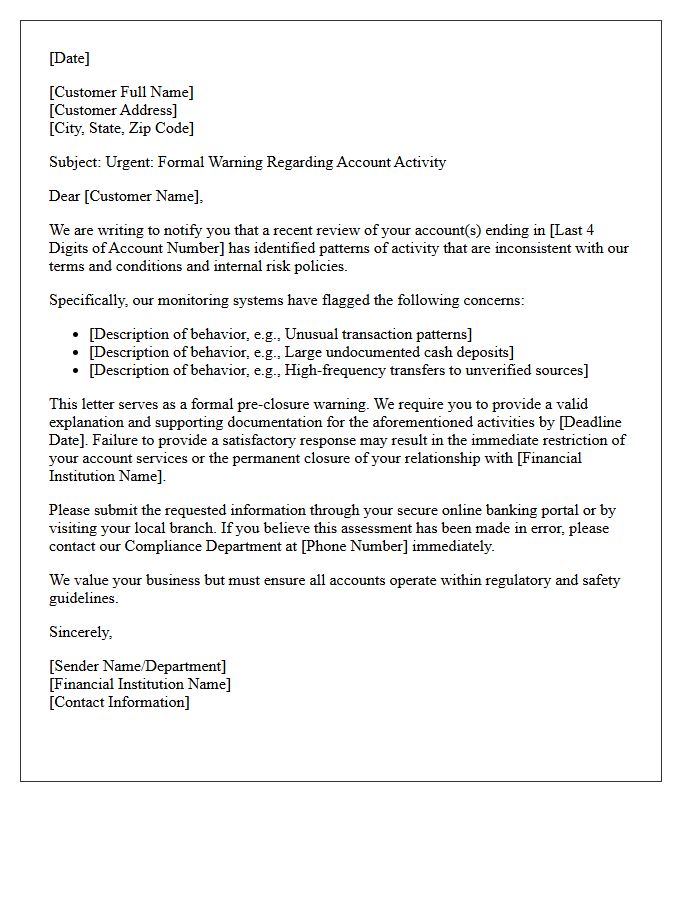
A Pre-Closure Warning Letter serves as a formal notification that a bank may terminate your account due to high-risk financial behavior. This typically involves suspicious patterns like large cash structuring, frequent international transfers to sanctioned zones, or inconsistent business activities. To protect your banking relationship, you must provide immediate source of funds documentation and clarify transaction purposes. Ignoring this warning often leads to mandatory account closure, reported internal flags, and significant difficulty opening future accounts at other financial institutions. Timely compliance is essential to maintaining your fiscal standing.
Letter of Account Suspension Pending Money Laundering Investigation
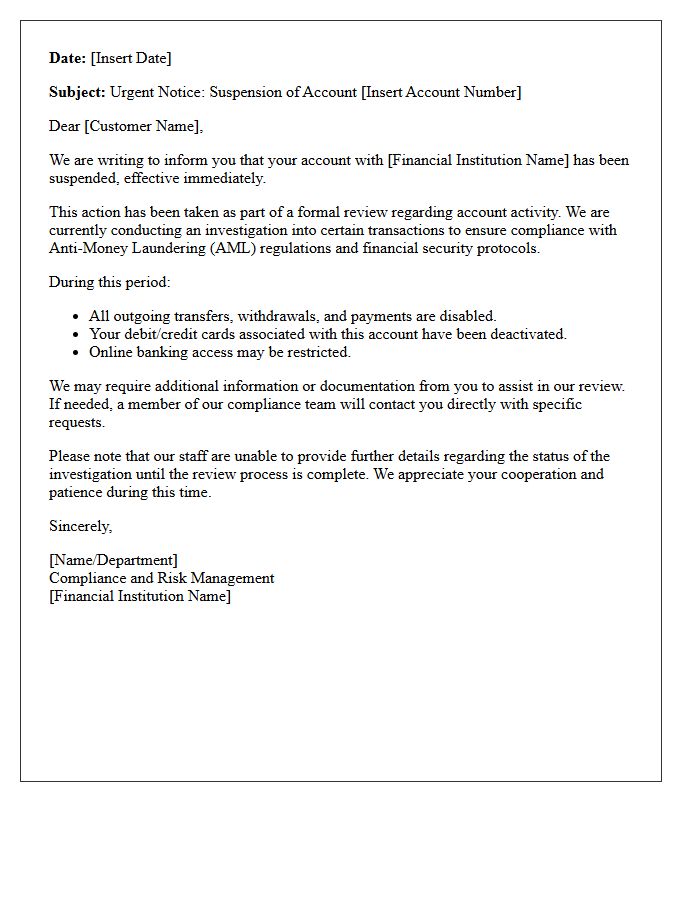
Receiving a Letter of Account Suspension indicates that your financial institution has detected suspicious activity triggering a Money Laundering Investigation. Under strict compliance laws, banks must freeze access to funds to prevent illicit transfers while auditing transactions. During this period, "tipping off" regulations often prevent staff from disclosing specific details. It is crucial to remain patient, avoid multiple aggressive inquiries, and provide any requested Proof of Funds or documentation promptly. Seeking legal advice can help ensure your rights are protected while the bank verifies your financial source of wealth.
Enhanced Due Diligence Information Request Letter
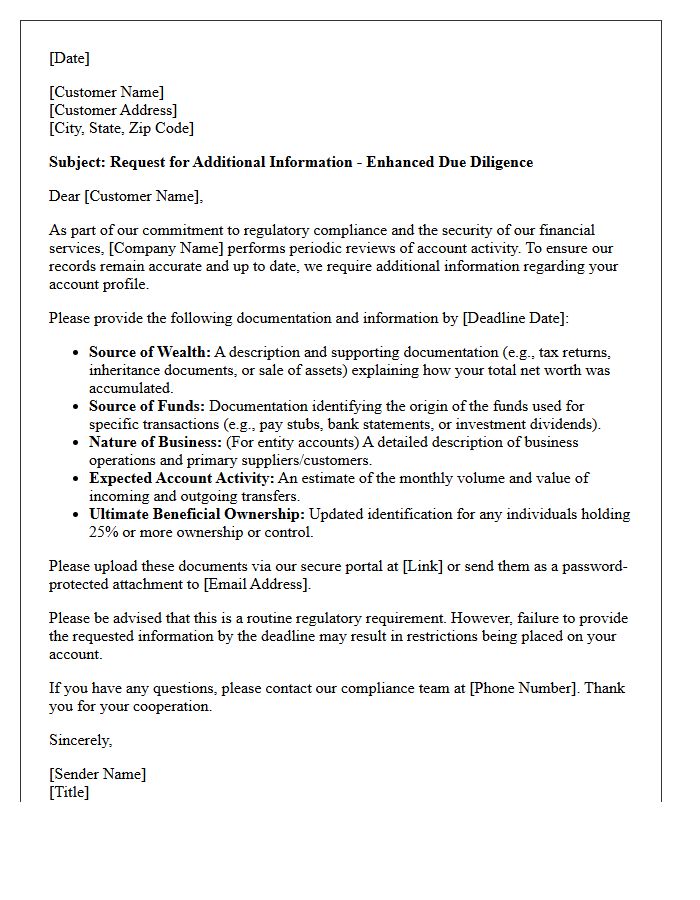
An Enhanced Due Diligence (EDD) Information Request Letter is a formal inquiry sent by financial institutions to high-risk clients. Its purpose is to mitigate financial crime risks by gathering detailed documentation. Typically, these letters request information regarding the Source of Wealth, Source of Funds, and ultimate beneficial ownership. Providing clear, verified evidence is essential to satisfy regulatory compliance under AML/KYC frameworks. Failure to respond accurately or promptly may lead to account restrictions or termination, as banks must ensure all complex transactions align with a client's known legitimate profile.
Warning Letter for Unexplained International Wire Transfers
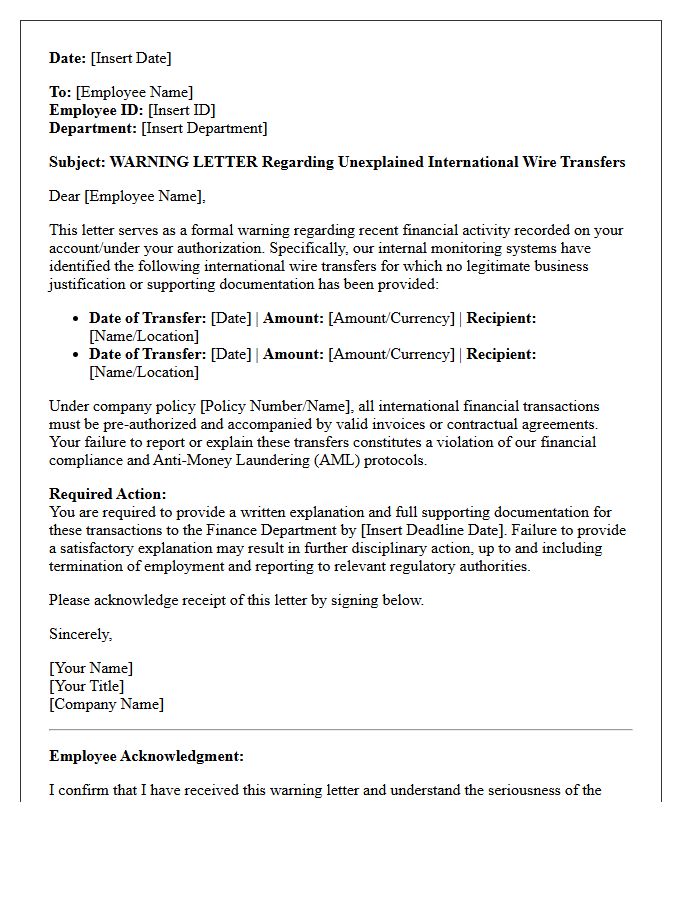
Receiving a warning letter for unexplained international wire transfers is a serious matter involving Anti-Money Laundering (AML) compliance. Financial institutions issue these notices when cross-border transactions lack clear economic purpose or documentation. To protect your account, you must provide verifiable proof of the source of funds and the reason for the transfer. Failure to respond accurately can lead to immediate account suspension, permanent closure, or reports to regulatory authorities. Ensuring transparency and maintaining detailed records of all foreign remittances is essential to maintaining your banking relationship and avoiding legal scrutiny.
Account Freeze Notification Letter for Suspicious Activity
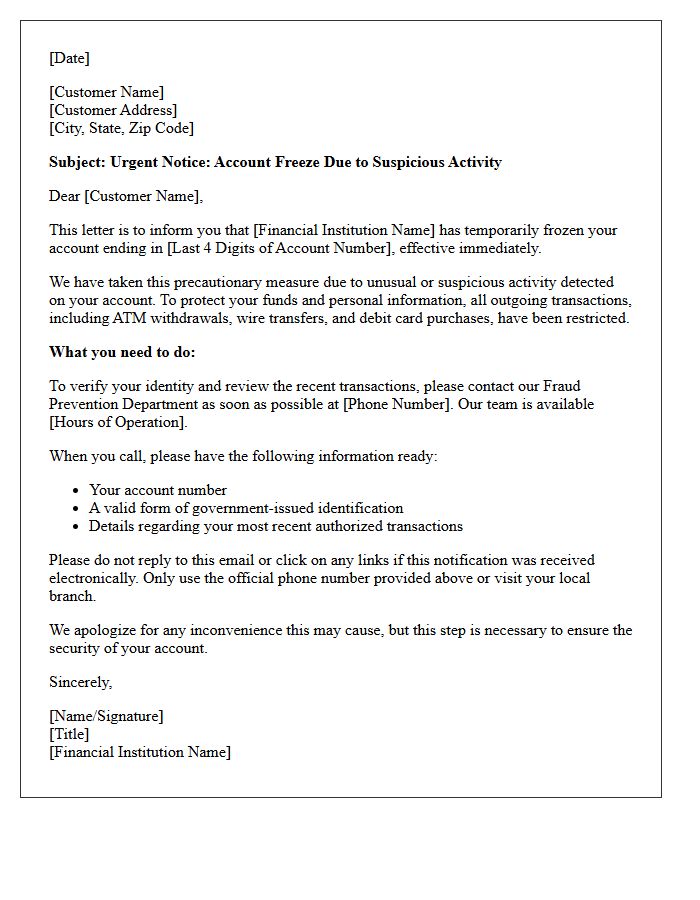
Receiving an Account Freeze Notification Letter indicates that a financial institution has detected suspicious activity or potential fraud within your account. This formal notice serves to protect your assets by temporarily restricting all outgoing transactions. Upon receipt, it is critical to verify the letter's authenticity to avoid phishing scams. Contact your bank immediately using an official phone number to verify your identity and review recent transactions. Resolving this security hold promptly is essential to regain access to your funds and ensure your financial security remains uncompromised.
Letter of Demand for Corporate Beneficial Ownership Documentation
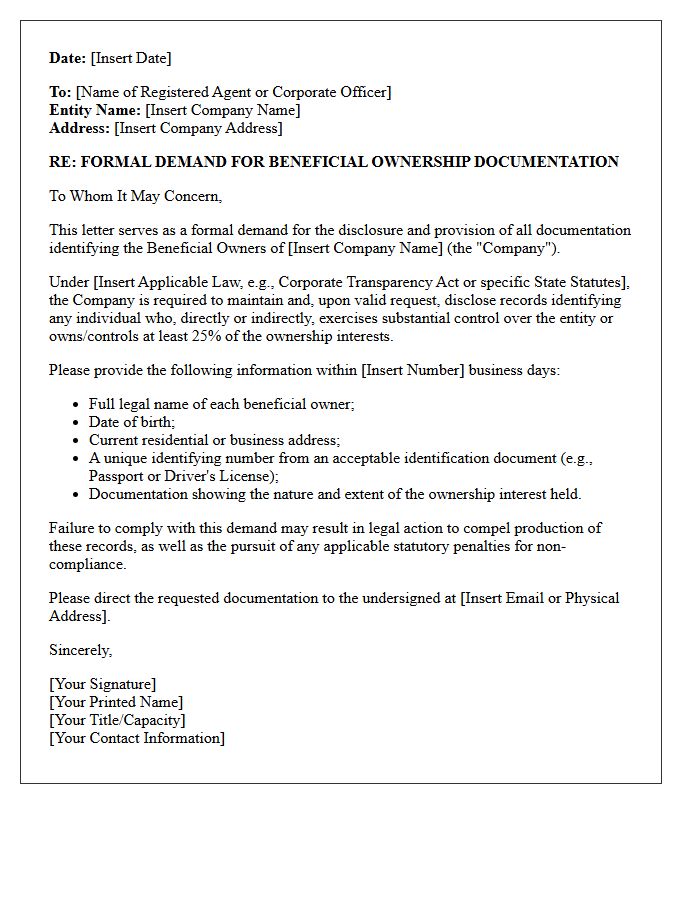
A Letter of Demand for Corporate Beneficial Ownership Documentation is a formal legal request used to identify the individuals who exercise ultimate control over a legal entity. Under modern transparency regulations like the Corporate Transparency Act, companies must disclose beneficial owners to prevent financial crimes. Failing to provide this information upon receipt of a demand can lead to severe civil penalties, compliance violations, and legal action. This document is essential for due diligence, verifying ownership structures, and ensuring corporate accountability in legal or financial transactions.
Final Warning Letter for Persistent Non-Compliant Transaction Patterns
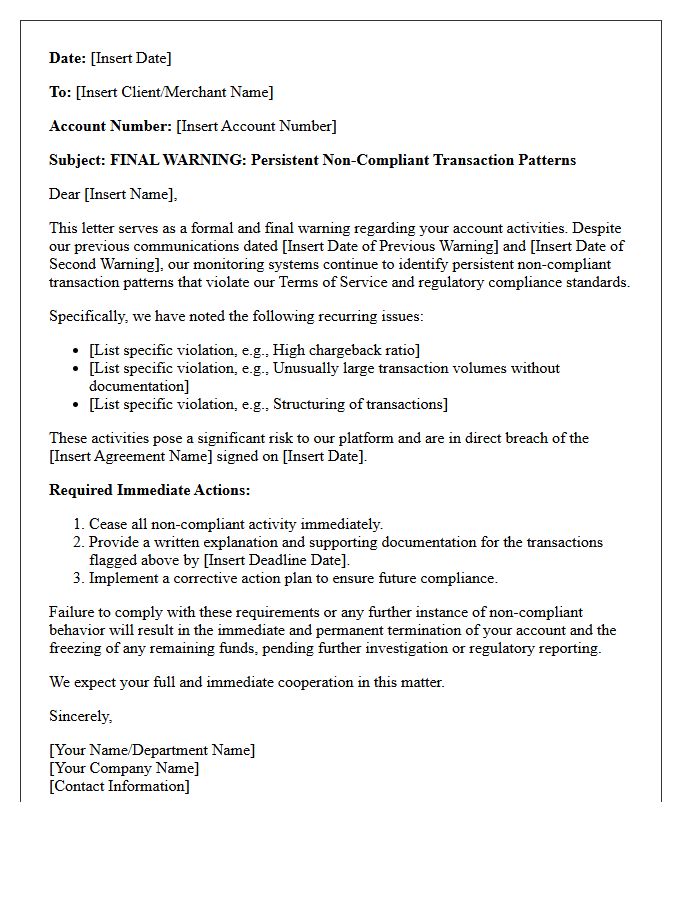
A Final Warning Letter serves as the ultimate formal notice regarding persistent non-compliant transaction patterns. It indicates that previous corrections were ignored and immediate remediation is mandatory to avoid account termination or legal action. This document outlines specific breaches of financial protocols, such as suspicious activity or policy violations. Recipients must ensure strict adherence to compliance standards and provide a comprehensive response detailing corrective measures. Failure to rectify these behavioral trends promptly will result in permanent suspension of services and potential reporting to regulatory authorities.
Warning Letter for Rapid Fund Movement and Pass-Through Activity
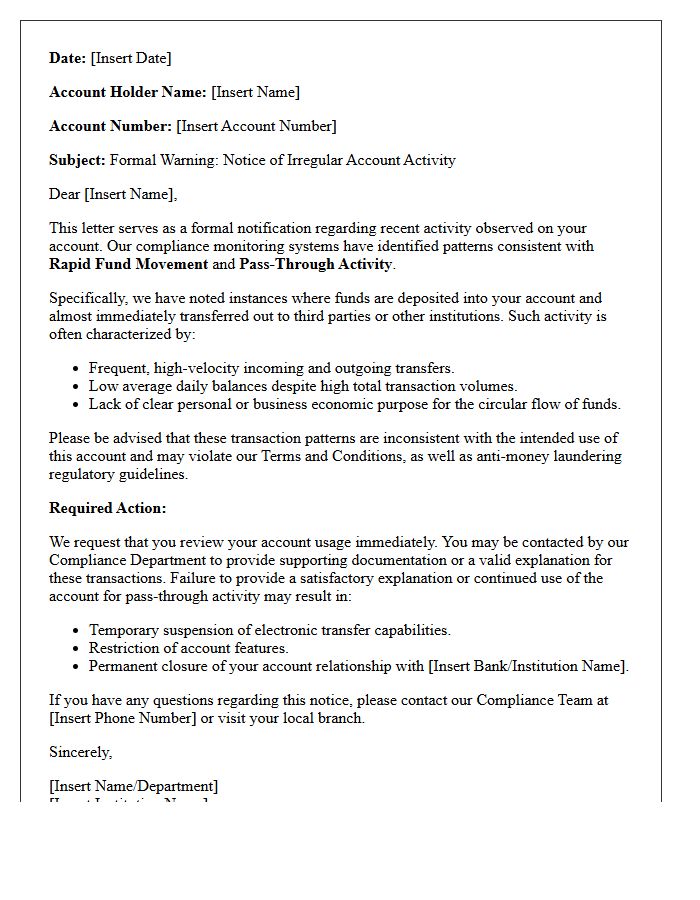
A Warning Letter for rapid fund movement indicates that your account exhibits patterns of pass-through activity, where funds are transferred in and out quickly with no clear economic purpose. Financial institutions issue these notices to mitigate money laundering risks and ensure regulatory compliance. Such behavior often triggers automated monitoring systems, flagging potential structuring or illicit flows. To protect your banking relationship, you must provide legitimate documentation for these transactions and ensure your account activity aligns with your stated financial profile to avoid potential closure or legal scrutiny.
What is a Warning Letter for Suspected Money Laundering Activities?
A Warning Letter for Suspected Money Laundering is a formal notification issued by a financial institution or regulatory body informing a client that their account activity has triggered red flags consistent with illicit financial flows or anti-money laundering (AML) violations.
Why did I receive a warning letter regarding my recent transactions?
You may receive this letter if your account exhibits patterns such as large unexplained cash deposits, frequent rapid transfers to high-risk jurisdictions, or transaction volumes that do not align with your stated income or business profile.
What actions should I take after receiving an AML warning letter?
You should immediately provide the requested documentation to verify the source of funds (SOF) or source of wealth (SOW), clarify the economic purpose of the flagged transactions, and ensure your KYC (Know Your Customer) information is fully up to date.
Can my bank account be frozen due to suspected money laundering?
Yes, financial institutions have the legal authority to temporarily freeze accounts or restrict outgoing transfers while they conduct a formal investigation into suspicious activity to comply with global AML regulations.
What are the consequences of failing to respond to an AML warning?
Failure to respond or provide sufficient evidence of legal funding typically results in the permanent closure of your accounts, a formal report being filed with financial intelligence units (such as FinCEN or FIU), and potential legal prosecution.

Comments