
Maintain your savings by submitting a Good Student Discount auto policy renewal letter to your insurer. Most providers require updated proof of academic excellence, such as a recent transcript, to continue applying lower rates to your premium. Keeping your documentation current ensures your teen driver benefits from significant safety incentives. To simplify this process, below are some ready to use templates.
Image cover: Maintaining Your Good Student Discount: Policy Renewal Letter Templates and Guide
Letter Samples List
- Good Student Discount Auto Policy Renewal Letter
- Academic Excellence Auto Policy Discount Renewal Letter
- Honor Roll Student Auto Insurance Renewal Letter
- Dean's List Auto Policy Discount Renewal Letter
- College Student Auto Insurance Policy Renewal Letter
- High School Good Student Policy Renewal Letter
- Annual Auto Policy Renewal Good Student Discount Letter
- Student Driver Discount Auto Policy Renewal Letter
- Outstanding Academic Achievement Auto Policy Renewal Letter
- Good Student Premium Reduction Policy Renewal Letter
- Semester Grade Verification Auto Policy Renewal Letter
- Youth Driver Academic Discount Policy Renewal Letter
Good Student Discount Auto Policy Renewal Letter
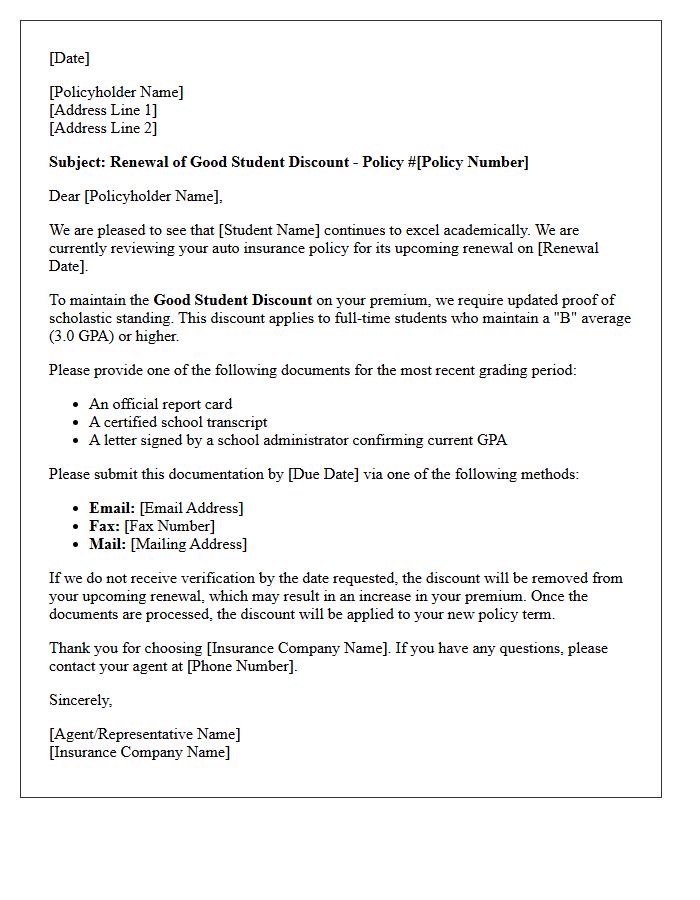
A Good Student Discount Auto Policy Renewal Letter confirms your ongoing eligibility for reduced premiums based on academic excellence. To maintain these savings, insurers typically require proof of a 3.0 GPA or higher, such as a recent transcript or dean's list letter. It is crucial to submit documentation before the deadline mentioned in the notice to avoid a rate increase. Consistently high grades demonstrate responsibility to underwriters, often resulting in significant discounts for drivers under twenty-five. Always verify that your current academic standing meets the specific criteria outlined in your policy renewal terms.
Academic Excellence Auto Policy Discount Renewal Letter
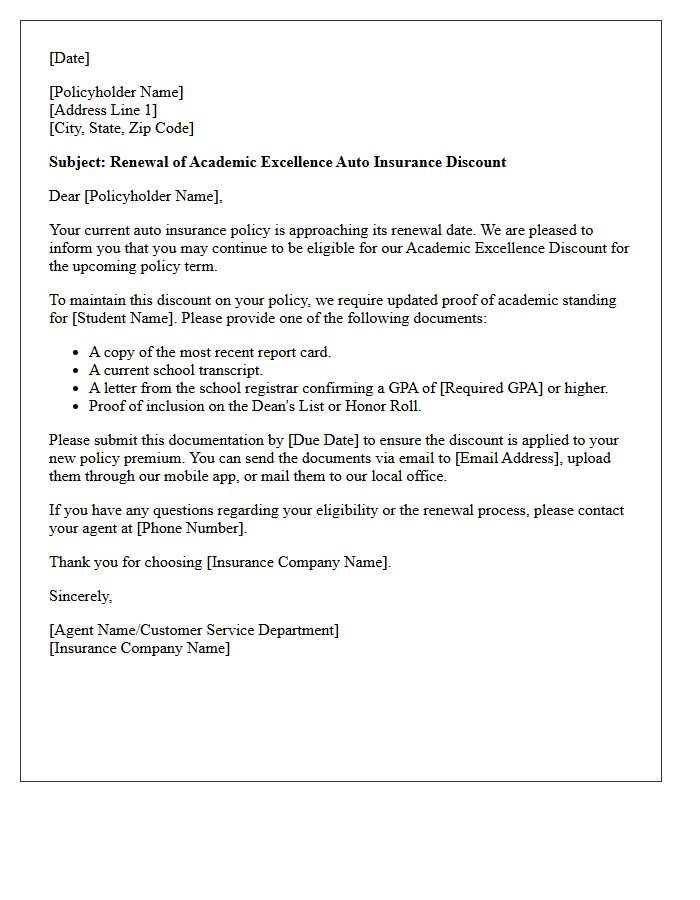
An Academic Excellence Auto Policy Discount Renewal Letter confirms the extension of savings for high-achieving students. To maintain this financial incentive, insurers typically require updated proof of academic performance, such as a recent transcript or dean's list notification. Ensuring your GPA meets the eligibility threshold is critical for premium reduction. Review the renewal terms carefully to confirm that the good student discount remains active on your policy, as this significantly lowers the overall cost of coverage for young drivers demonstrating responsible behavior both on the road and in the classroom.
Honor Roll Student Auto Insurance Renewal Letter
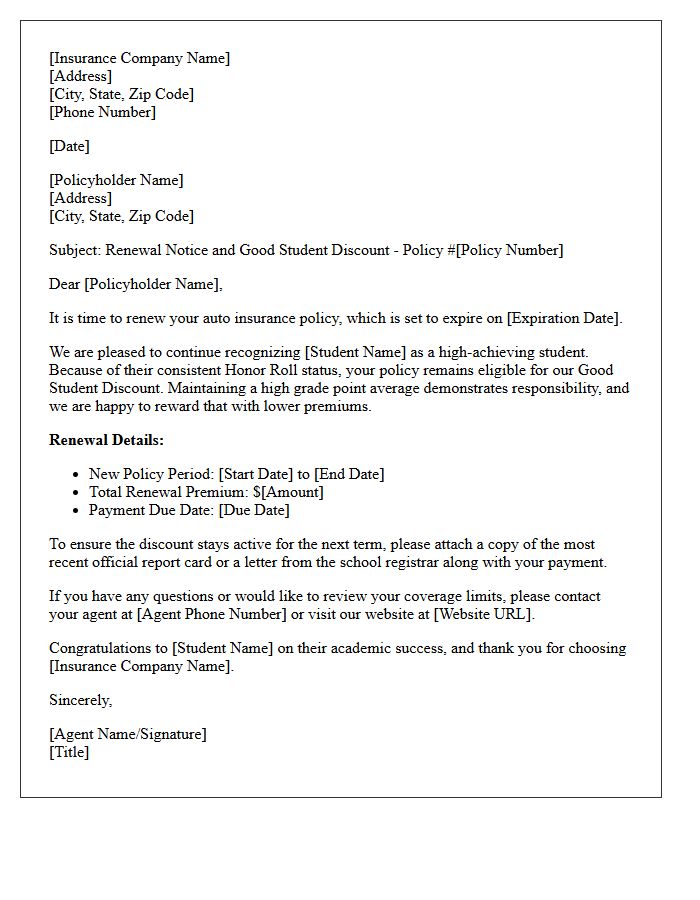
An Honor Roll Student Auto Insurance Renewal Letter is a crucial document used to verify academic excellence for a Good Student Discount. Most insurers require a current report card or transcript during the renewal period to maintain lower premiums. This renewal notice ensures that young drivers continue receiving reduced rates based on their GPA, typically a 3.0 or higher. Keeping these records updated is the most effective way for families to sustain significant savings on their vehicle coverage costs throughout the academic year.
Dean's List Auto Policy Discount Renewal Letter
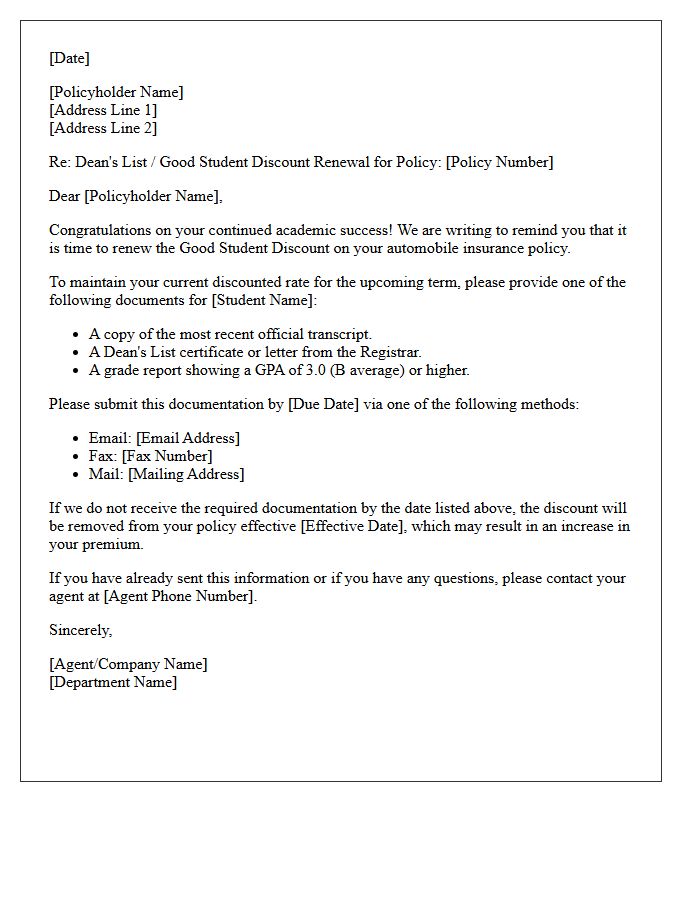
A Dean's List Auto Policy Discount Renewal Letter confirms that a student has maintained the high GPA required to keep their academic insurance savings. To ensure the discount stays active, policyholders must typically provide updated proof of enrollment and a current official transcript. This document serves as a eligibility verification, informing you of any premium adjustments for the upcoming term. Timely submission of academic records is essential to lower car insurance costs consistently throughout your educational career. Always review the specific deadlines mentioned in your renewal notice to avoid losing these savings.
College Student Auto Insurance Policy Renewal Letter
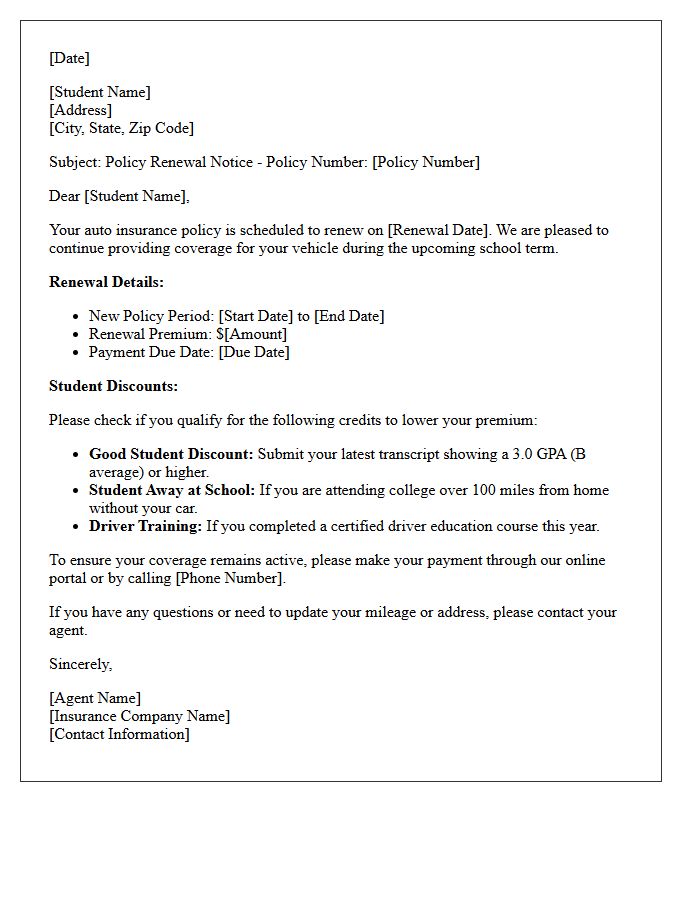
Receiving a college student auto insurance policy renewal letter is the ideal time to compare rates and ensure accurate coverage. Students should verify if they qualify for a Good Student Discount by maintaining a high GPA. If the vehicle remains at home while the student is away at school, the "resident student" status can significantly lower premiums. Always review the mileage limits and liability options to match current driving habits. Updating your insurer about changes in location or academic status guarantees continuous protection and prevents unnecessary costs during the upcoming term.
High School Good Student Policy Renewal Letter
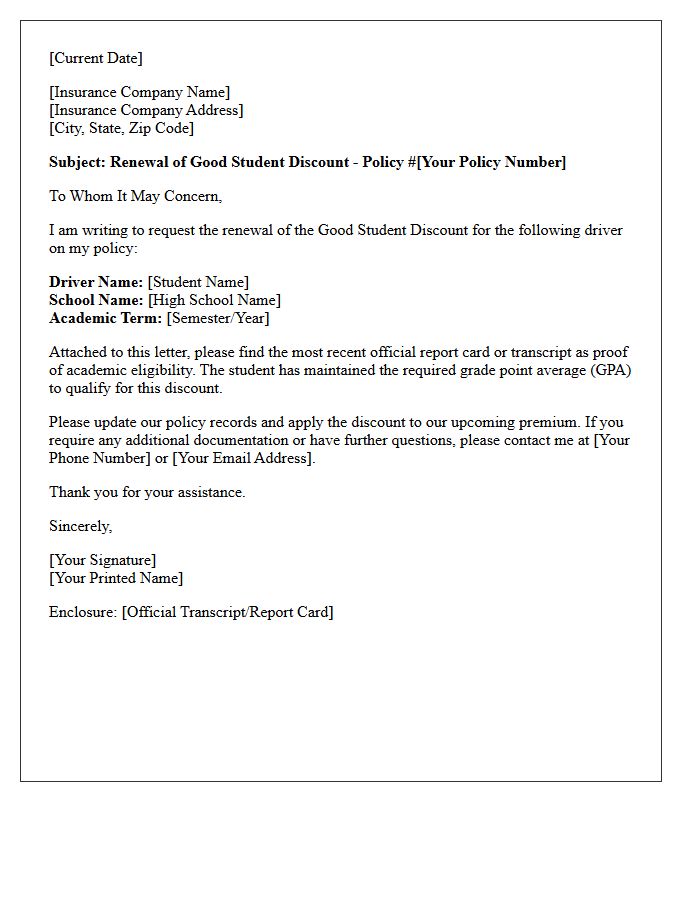
A High School Good Student Policy Renewal Letter is a formal document required by insurance companies to maintain premium discounts. To qualify, students typically need a B average or a 3.0 GPA. Parents must submit updated proof of academic performance, such as a recent report card or a signed school official's statement. Timely submission is essential to ensure the car insurance savings continue without interruption. Always verify specific grade requirements and deadlines with your agent to keep the policy active at the lower rate.
Annual Auto Policy Renewal Good Student Discount Letter
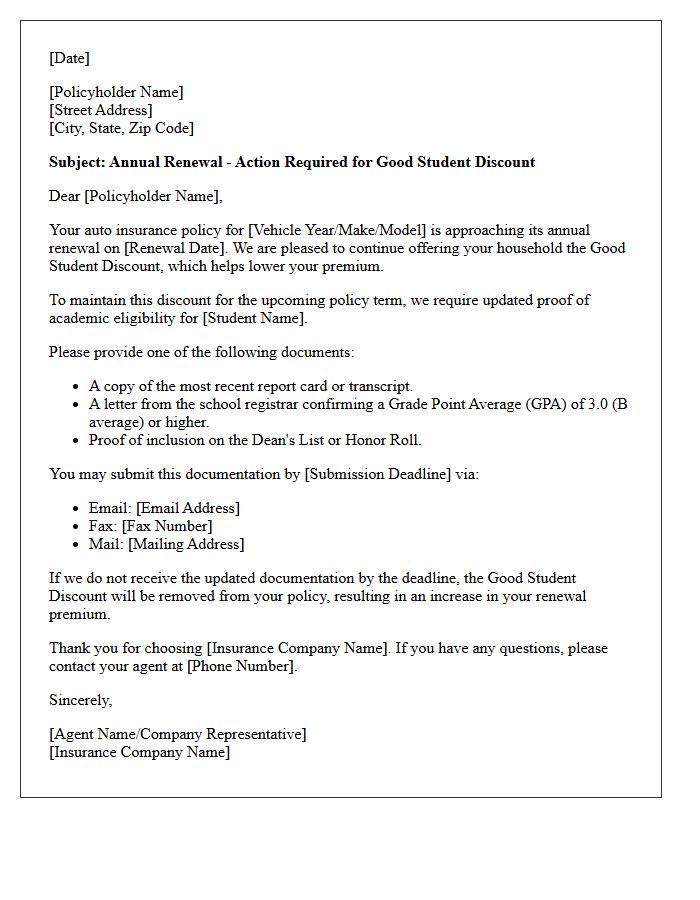
An Annual Auto Policy Renewal is the perfect time to submit a Good Student Discount Letter to reduce your premiums. Insurance providers offer this incentive to full-time students who maintain a GPA of 3.0 or higher, as they are statistically lower-risk drivers. To secure the savings, you must provide official academic transcripts or a signed letter from school administrators during each renewal cycle. This simple verification process can significantly lower insurance costs for young drivers, making it an essential step for budget-conscious households every year.
Student Driver Discount Auto Policy Renewal Letter
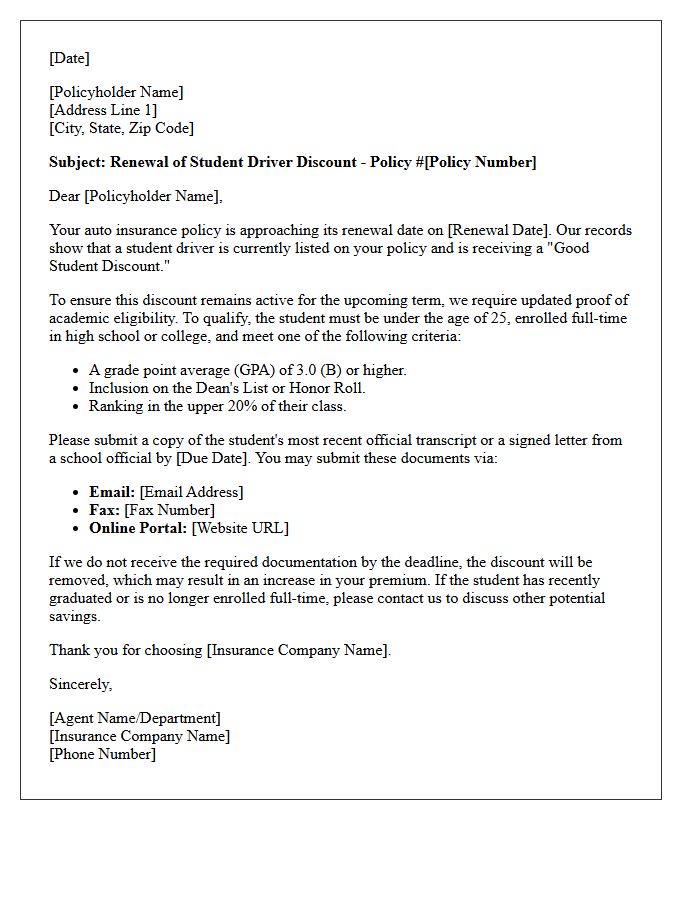
Your Student Driver Discount requires periodic verification during your auto policy renewal. To maintain these savings, the insurance company typically needs updated proof of academic performance, such as a recent report card or transcript. Most insurers reward full-time students who maintain a "B" average or higher. Review your renewal letter carefully to submit documentation before the deadline, ensuring your premium remains affordable. Promptly confirming eligibility prevents the loss of this significant credit and helps manage the higher costs associated with young drivers on your policy.
Outstanding Academic Achievement Auto Policy Renewal Letter
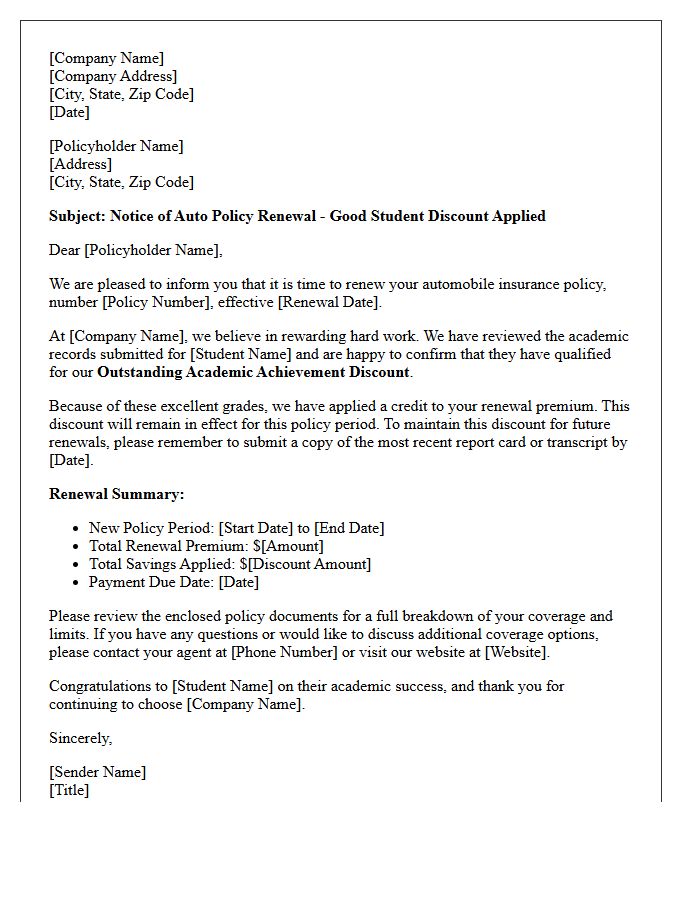
Receiving an Outstanding Academic Achievement Auto Policy Renewal Letter signifies that a student driver has qualified for a Good Student Discount. Insurance providers offer these rate reductions to reward high-performing students who maintain a specific grade point average, typically a "B" or higher. To maintain this financial benefit, you must provide updated transcripts or proof of enrollment during the renewal process. This incentive promotes safe driving habits while significantly lowering insurance premiums for young drivers and their families through consistent academic excellence.
Good Student Premium Reduction Policy Renewal Letter
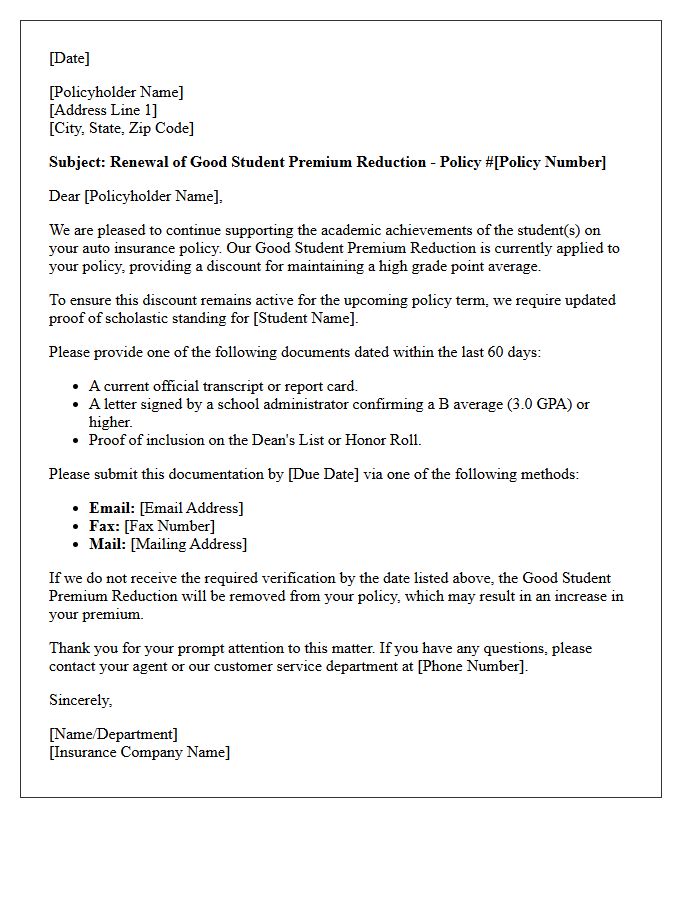
A Good Student Premium Reduction Policy Renewal Letter confirms the extension of your insurance discount based on academic excellence. To maintain this financial benefit, you must typically provide updated proof of a B average or 3.0 GPA. Ensure you submit current transcripts or a dean's list letter before the deadline to avoid a rate increase. This document serves as an official notice that your eligibility is being re-evaluated for the upcoming term, rewarding responsible behavior and high achievement with lower premiums.
Semester Grade Verification Auto Policy Renewal Letter
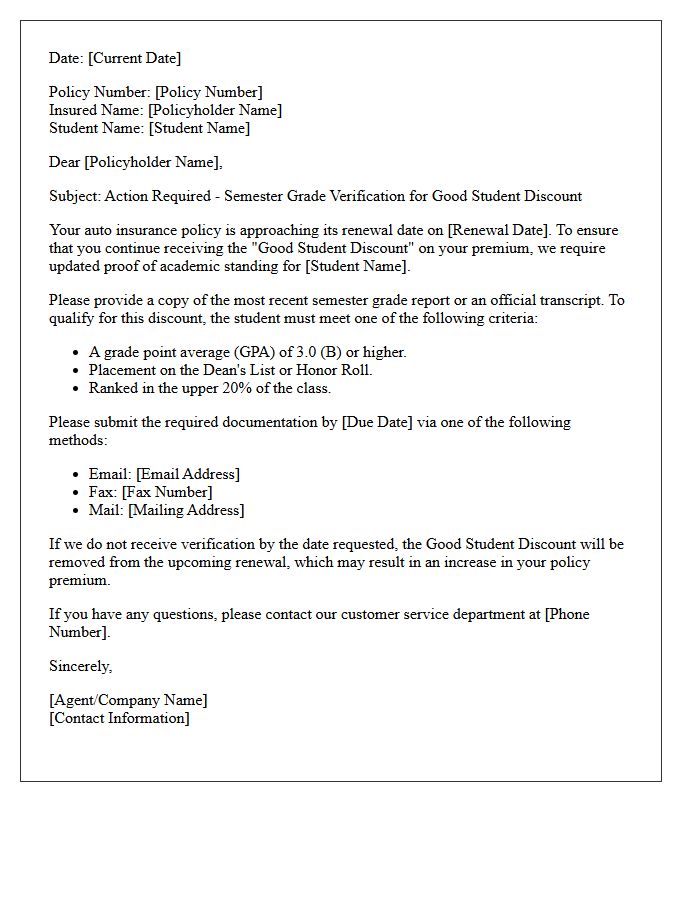
A Semester Grade Verification Auto Policy Renewal Letter is a formal request from insurers to confirm a student's academic standing. Maintaining a high Grade Point Average (GPA), typically a 3.0 or B average, is essential to qualify for the Good Student Discount. Policyholders must submit official transcripts or report cards by the deadline to ensure the premium reduction automatically renews. Failing to verify grades can lead to a significant increase in auto insurance rates. Always review the specific credit hour requirements to keep your financial savings active for the upcoming term.
Youth Driver Academic Discount Policy Renewal Letter
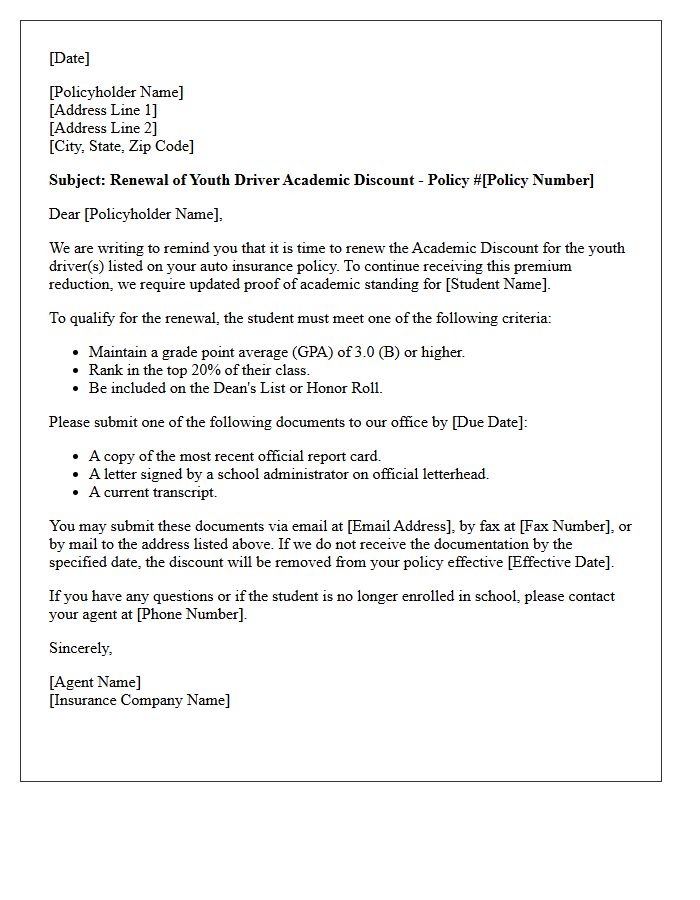
A youth driver academic discount policy renewal letter confirms the extension of lower insurance premiums based on a student's educational performance. To maintain this benefit, parents must provide updated proof of grades, such as a report card or transcript, showing a qualifying GPA (typically a B average or higher). Failing to submit these documents during the renewal window can result in significant rate increases. Ensure the academic verification is current to keep the good student discount active on your policy for the upcoming term.
How do I maintain the Good Student Discount on my auto policy renewal?
To keep the discount active, you must submit an updated transcript or report card showing a 3.0 (B) grade point average or higher. Proof of full-time enrollment for the upcoming semester is also required to validate continued eligibility.
What documents are accepted as proof for the Good Student Discount?
Acceptable documentation includes an official school transcript, a signed letter from a school administrator verifying academic standing, or a dean's list certificate. All documents must clearly show the student's name, school name, and the most recent semester's GPA.
Does the Good Student Discount automatically carry over to my next policy term?
No, most insurance carriers require recertification at each renewal period. If updated academic records are not received by the deadline stated in your renewal letter, the discount will be removed, and your premium may increase.
Is there an age limit for the Good Student Discount at renewal?
Yes, the discount typically applies to full-time students between the ages of 16 and 24. Once the student reaches age 25 or graduates and is no longer enrolled full-time, the discount is removed during the subsequent renewal cycle.
What happens to my premium if I no longer qualify for the academic discount?
If your GPA falls below the 3.0 threshold or you transition to part-time status, the discount will be removed at renewal. This usually results in a premium increase of 5% to 25% depending on your specific insurance carrier's rating structure.

Comments