
A Commercial Loan Covenant Waiver Agreement is a formal legal document where a lender agrees to temporarily overlook a borrower's breach of specific financial or operational requirements. This agreement prevents an immediate default, providing the business with vital flexibility to restore compliance and maintain its credit relationship. Below are some ready to use templates.
Image cover: Expert Guide to Commercial Loan Covenant Waiver Agreements and Templates
Letter Samples List
- Request Letter for Commercial Loan Covenant Waiver
- Approval Letter for Financial Covenant Waiver Agreement
- Conditional Waiver Letter for Commercial Loan Covenants
- Denial Letter for Commercial Loan Covenant Waiver
- Debt Service Coverage Ratio Covenant Waiver Letter
- Late Financial Reporting Covenant Waiver Letter
- Temporary Covenant Relief and Waiver Letter
- Cover Letter for Commercial Loan Covenant Waiver Agreement
- Extension Letter for Existing Covenant Waiver Agreement
- Breach Acknowledgment and Covenant Waiver Letter
- Waiver Fee Assessment Letter for Commercial Loan Covenants
- Reservation of Rights and Covenant Waiver Letter
Request Letter for Commercial Loan Covenant Waiver
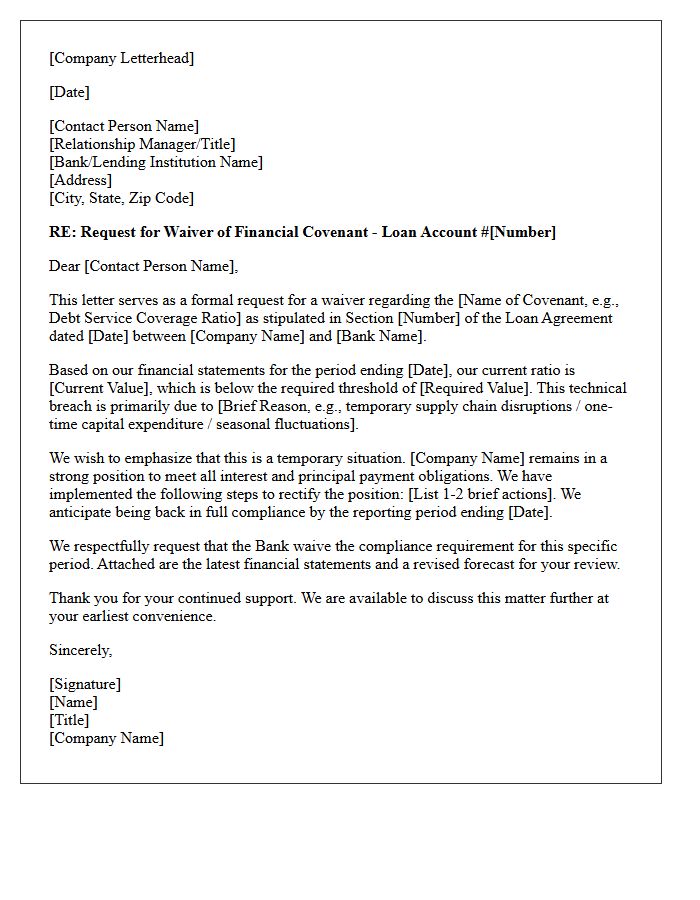
A request letter for a commercial loan covenant waiver is a formal document submitted to lenders when a business anticipates a breach of financial ratios. It is crucial to maintain transparency by explaining the root cause of the violation and providing a credible repayment plan or recovery strategy. Early communication helps preserve the lender-borrower relationship and prevents a technical default. Proactively seeking a waiver demonstrates financial responsibility, potentially securing temporary relief and avoiding immediate acceleration of debt while the company stabilizes its cash flow and operations.
Approval Letter for Financial Covenant Waiver Agreement
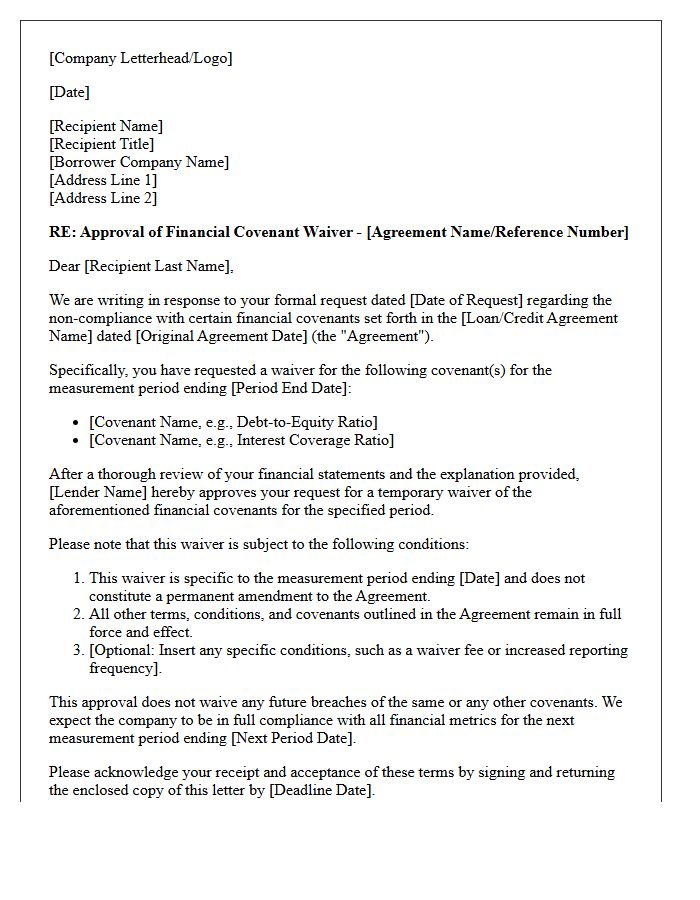
An Approval Letter serves as formal confirmation that a lender has granted a Financial Covenant Waiver Agreement. This essential document prevents a technical default when a borrower breaches specific financial ratios. It outlines the specific terms, duration of the waiver, and any associated amendment fees. Obtaining this letter is critical for maintaining corporate liquidity and protecting the company's credit standing. Borrowers must ensure all conditions are met to keep the underlying credit facility in good standing and avoid immediate debt acceleration or potential foreclosure actions by the financial institution.
Conditional Waiver Letter for Commercial Loan Covenants
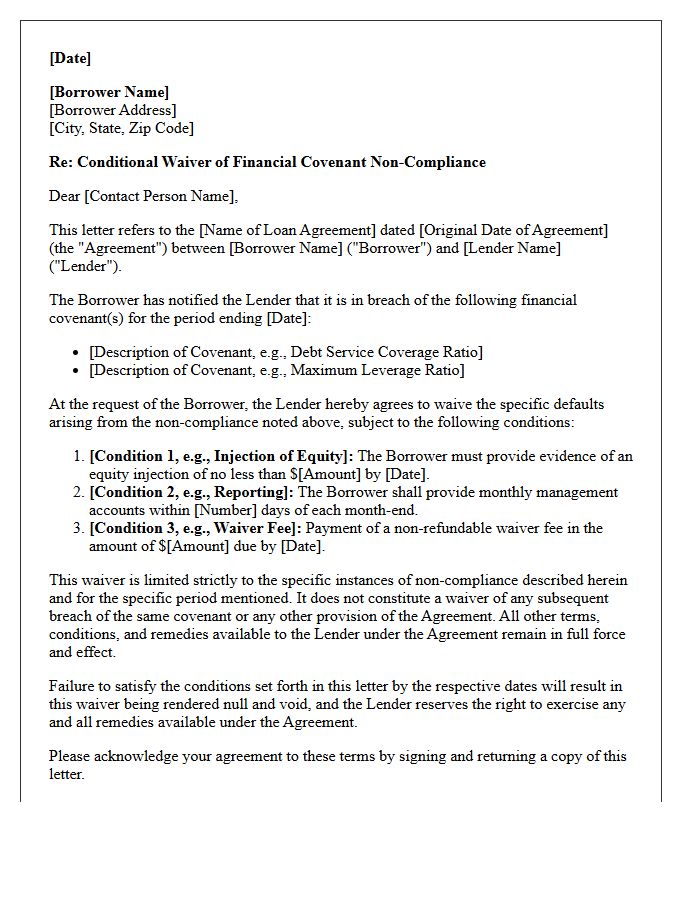
A Conditional Waiver Letter is a legal document where a lender agrees to temporarily overlook a specific loan covenant breach. This waiver is typically granted only if the borrower meets certain requirements, such as paying a fee, increasing collateral, or providing additional financial reporting. It is vital to understand that this is not a permanent amendment; failure to satisfy the specified conditions can reinstate the default status. Borrowers must review all stipulations carefully to maintain credit stability and avoid immediate loan acceleration or foreclosure actions by the financial institution.
Denial Letter for Commercial Loan Covenant Waiver
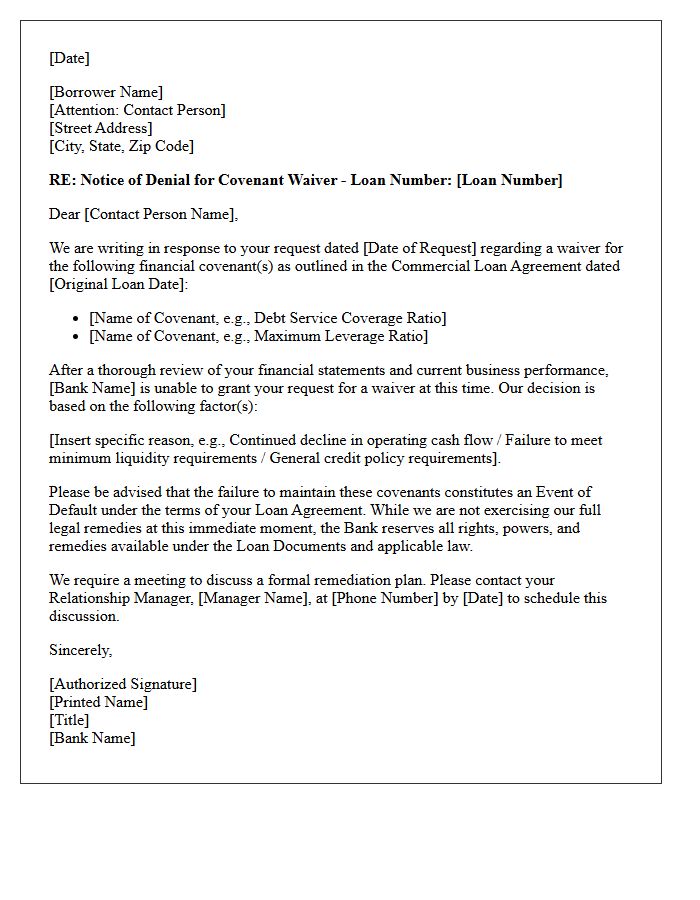
Receiving a Denial Letter for Commercial Loan Covenant Waiver signifies that a lender has refused to overlook a technical default or financial breach. This formal notice often triggers a Notice of Default, potentially leading to loan acceleration or increased interest rates. Borrowers must immediately evaluate their liquidity and engage in transparent negotiations to propose a workout plan. Understanding the specific reason for denial is critical to preventing foreclosure and maintaining debt service coverage. Swift communication with legal counsel is essential to mitigate long-term impacts on your business credit and collateral security.
Debt Service Coverage Ratio Covenant Waiver Letter
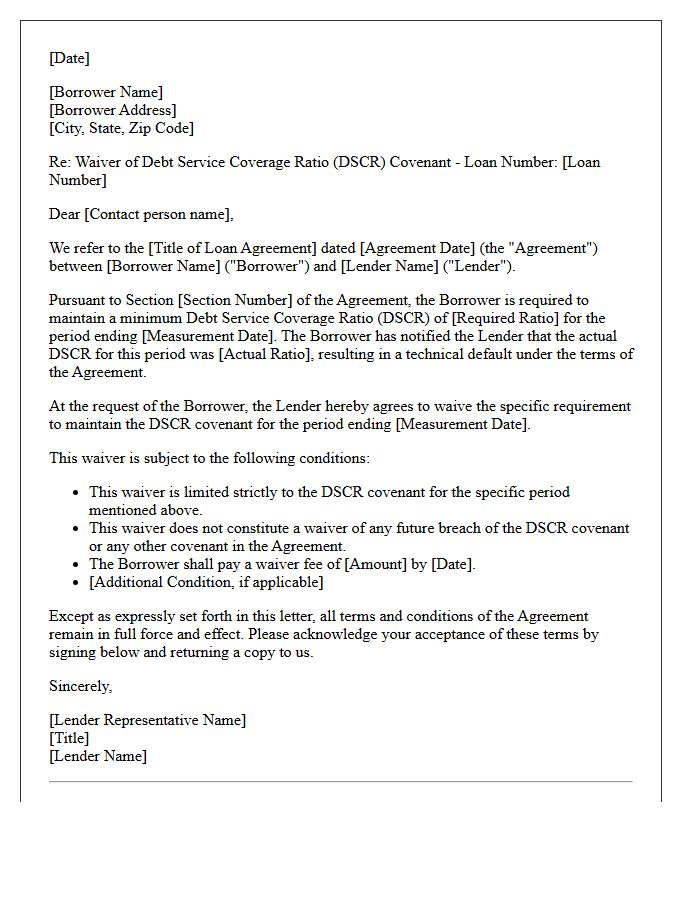
A Debt Service Coverage Ratio (DSCR) covenant waiver letter is a formal legal document issued by a lender to temporarily excuse a borrower's failure to maintain the required cash flow levels. This amendment prevents a technical default, ensuring the loan remains in good standing despite a breach. Borrowers must negotiate these waivers to avoid immediate repayment demands or increased interest rates. It is crucial to understand that a waiver is often conditional, requiring specific fees or stricter reporting standards in exchange for the lender's forbearance during financial volatility.
Late Financial Reporting Covenant Waiver Letter
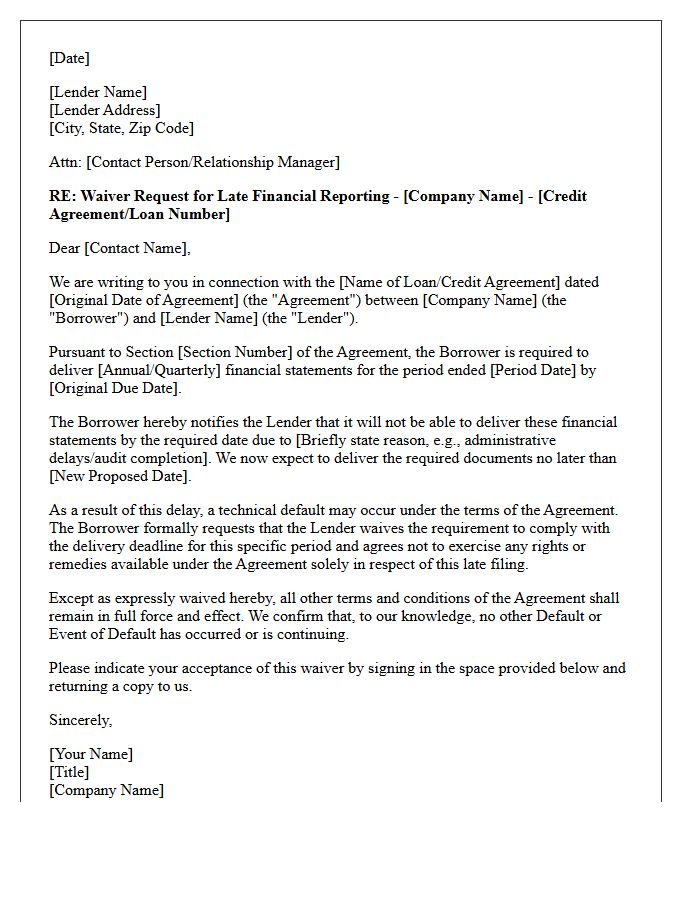
A Late Financial Reporting Covenant Waiver Letter is a legal agreement where a lender formally agrees to overlook a borrower's failure to provide financial statements by the contractual deadline. This document prevents a technical default, maintaining the loan's stability. It typically outlines the specific reporting period involved, any conditions for the extension, and potential amendment fees. Obtaining this waiver is critical to preserving corporate liquidity and protecting the business relationship, as it ensures that the lender does not exercise acceleration rights or increase interest rates due to the delay.
Temporary Covenant Relief and Waiver Letter
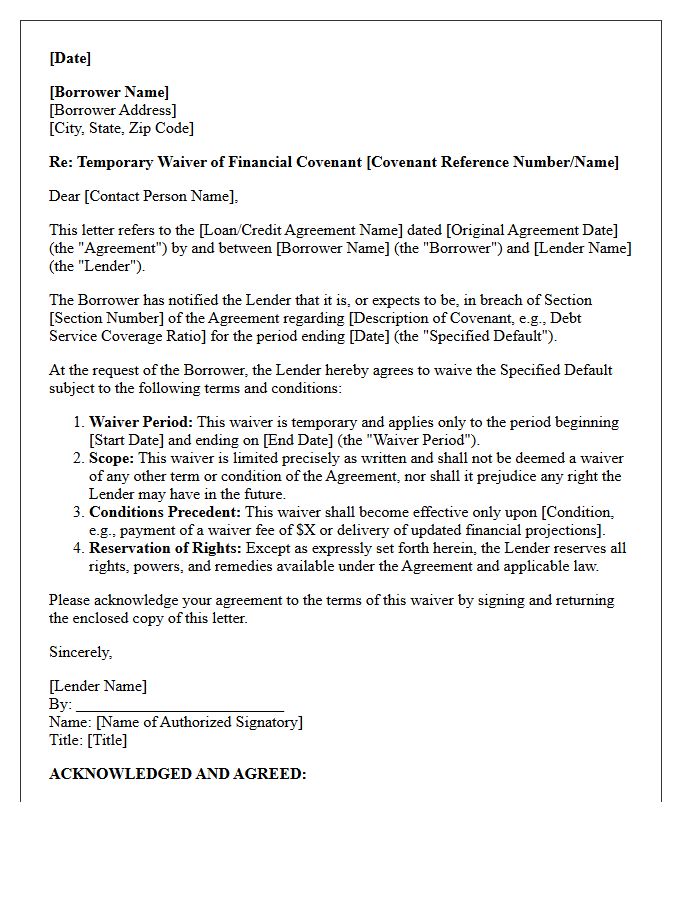
A Temporary Covenant Relief and Waiver Letter is a formal legal agreement where a lender agrees to suspend or modify specific financial requirements for a borrower. This document prevents a technical default during periods of financial distress. It typically specifies a fixed duration, after which original terms resume. Borrowers must understand that these waivers often come with conditions, such as increased interest rates or reporting obligations. Timely negotiation is essential to maintain liquidity and preserve the ongoing relationship between the borrower and the financial institution.
Cover Letter for Commercial Loan Covenant Waiver Agreement
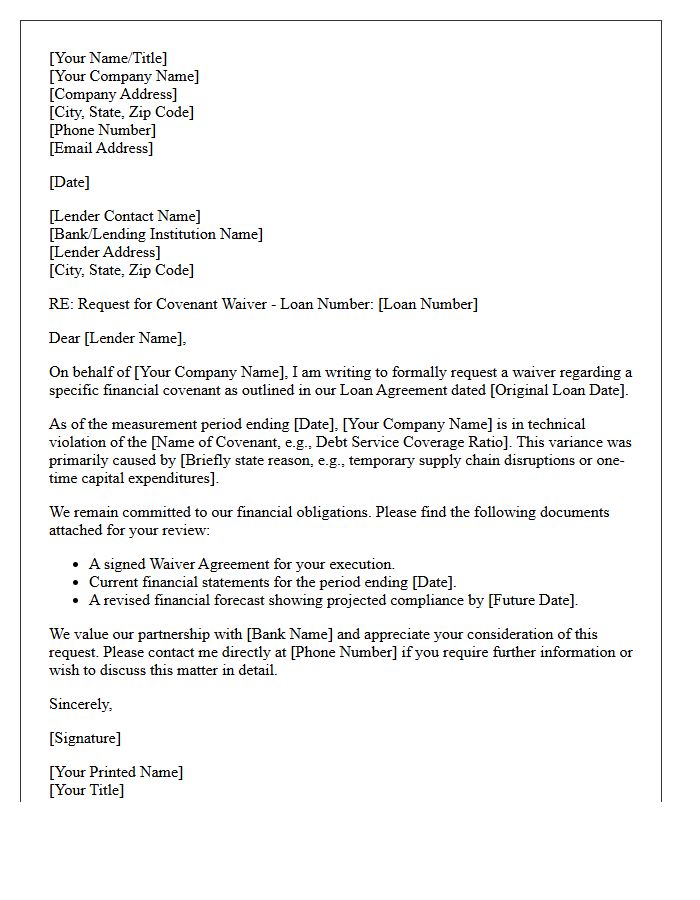
A cover letter for a commercial loan covenant waiver agreement is a formal request to your lender to waive a specific financial violation. It must transparently explain the root cause of the breach, such as temporary cash flow fluctuations or unexpected market shifts. The document should highlight the corrective actions being implemented to restore compliance and provide a timeline for recovery. By demonstrating proactive communication and a solid plan, you maintain creditor trust and protect your business's creditworthiness during the formal amendment process.
Extension Letter for Existing Covenant Waiver Agreement
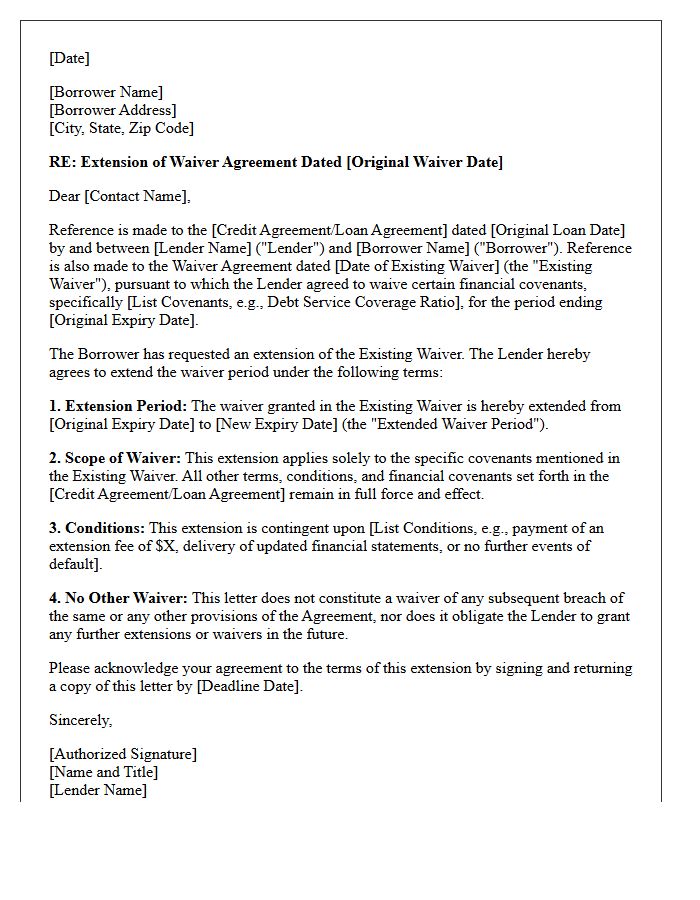
An Extension Letter for an existing covenant waiver agreement is a formal legal document used to prolong the relief period granted by lenders. It prevents a technical default when a borrower cannot meet specific financial ratios or obligations by the original deadline. This document ensures continuous compliance without renegotiating the entire credit facility. It is essential to ensure all parties sign before the current waiver expires to maintain operational stability and avoid immediate debt acceleration or penalties. Precise language regarding the new maturity date and any additional conditions is critical for legal protection.
Breach Acknowledgment and Covenant Waiver Letter
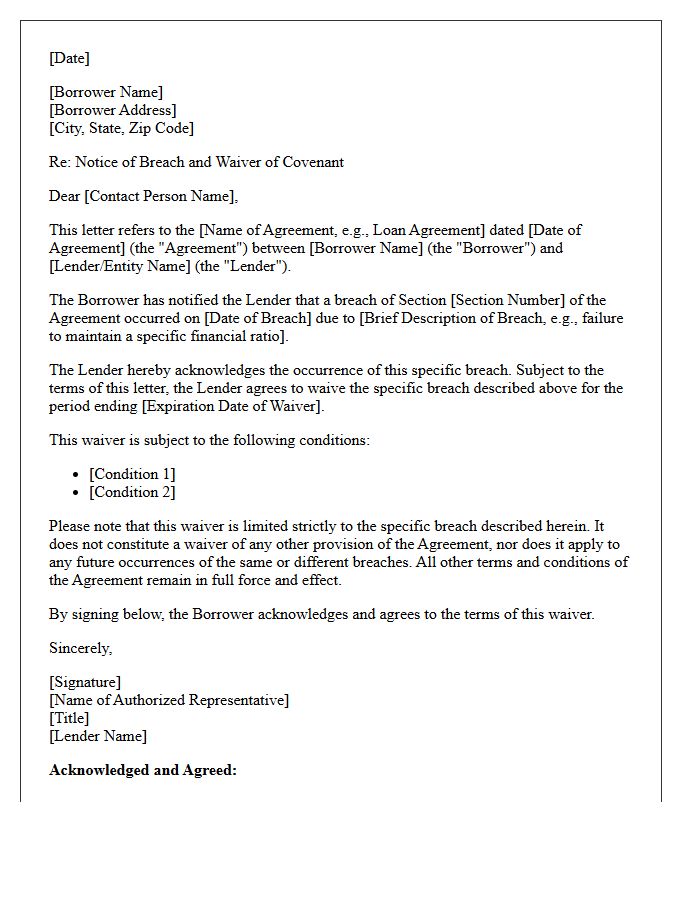
A Breach Acknowledgment and Covenant Waiver Letter is a formal agreement where a lender recognizes a loan default but agrees to temporarily waive their right to take legal action. This document ensures the borrower remains in good standing despite failing to meet specific financial ratios or reporting requirements. It typically outlines the specific breach, the duration of the waiver, and any new conditions or fees required to maintain the credit facility. Obtaining this letter is critical for businesses to prevent immediate loan acceleration and maintain financial stability during periods of technical non-compliance.
Waiver Fee Assessment Letter for Commercial Loan Covenants
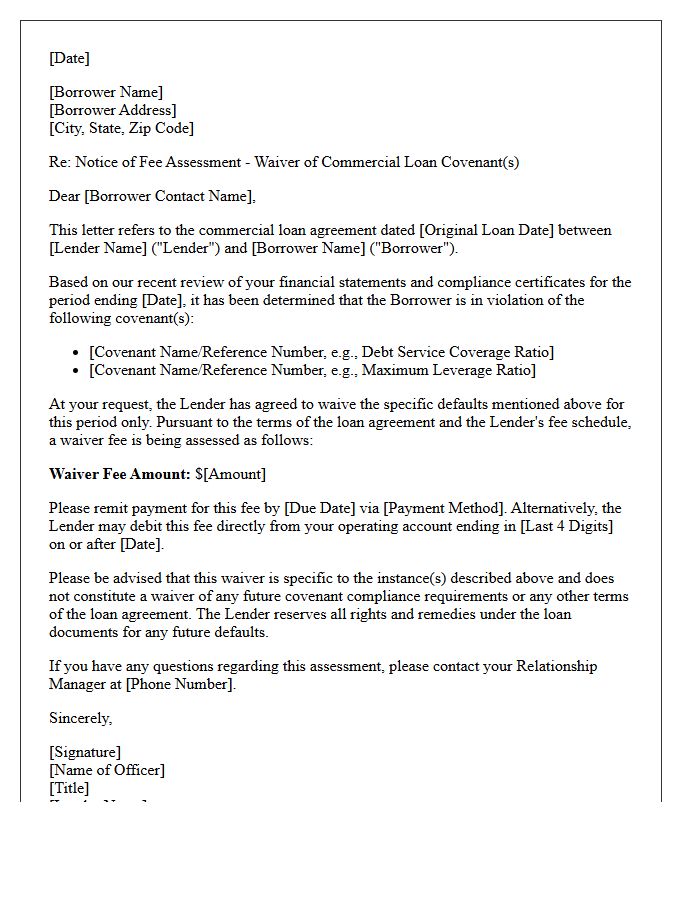
A Waiver Fee Assessment Letter is a formal notification issued by a lender when a borrower violates specific commercial loan covenants. This document outlines the nature of the default and stipulates the monetary penalty required to waive the breach temporarily. It serves as a critical legal record, ensuring the lender maintains its rights while allowing the borrower to avoid immediate foreclosure. Understanding the terms is essential, as these fees compensate the institution for the increased credit risk and administrative costs associated with managing a non-compliant loan agreement.
Reservation of Rights and Covenant Waiver Letter
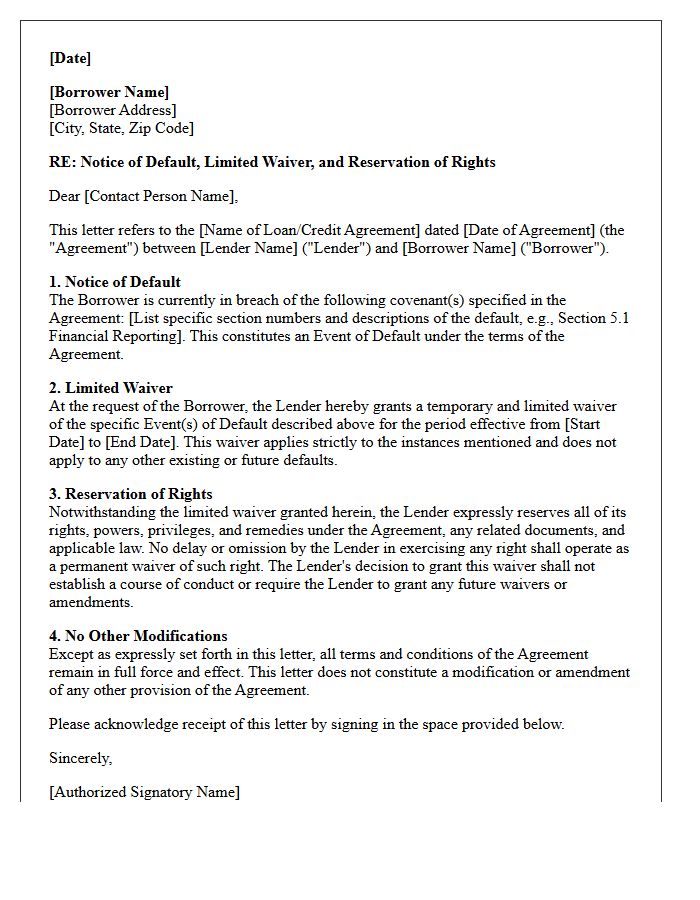
A Reservation of Rights and Covenant Waiver Letter is a legal notice issued by a lender when a borrower defaults. It confirms the lender is aware of the breach but chooses not to exercise immediate remedies, such as acceleration. Crucially, this document ensures that temporary forbearance does not constitute a permanent waiver of rights. Borrowers must understand that the lender retains the full authority to enforce contractual obligations or pursue legal action in the future. It serves as a protective measure to maintain creditor protections while allowing time for potential restructuring or resolution.
What is a Commercial Loan Covenant Waiver Agreement?
A Commercial Loan Covenant Waiver Agreement is a legal document in which a lender formally agrees to overlook a borrower's specific breach of financial or operational covenants for a defined period. This agreement prevents the lender from declaring a default and accelerating the loan repayment despite the technical violation of the original loan terms.
What is the difference between a temporary waiver and a permanent waiver?
A temporary waiver excuses a covenant breach for a specific window of time or a single reporting period, after which the borrower must resume compliance. A permanent waiver, or a loan amendment, indefinitely removes or modifies the specific covenant from the loan agreement, typically used when a borrower's financial structure has fundamentally changed.
Does a covenant waiver agreement incur additional fees or interest?
Yes, lenders often charge a waiver fee to compensate for the increased risk and administrative costs associated with the breach. Additionally, the lender may use the waiver negotiation as an opportunity to increase the interest rate, require additional collateral, or impose stricter reporting requirements on the commercial borrower.
What happens if a lender refuses to sign a covenant waiver?
If a lender refuses to grant a waiver, the covenant breach is treated as an event of default. This gives the lender the legal right to "call" the loan, demanding immediate repayment of the full balance, or to initiate foreclosure proceedings against the commercial assets securing the debt.
How does a waiver agreement affect future covenant compliance?
A standard Commercial Loan Covenant Waiver Agreement typically includes a "non-waiver" clause. This stipulates that the lender's decision to excuse one specific breach does not set a precedent or obligate them to waive future violations of the same or other covenants in the loan documentation.

Comments