
Delivering a skill assessment rejection letter requires a balance of professionalism and empathy. Providing clear feedback helps candidates understand where their technical abilities fell short while maintaining your employer brand. This guide explains how to communicate results constructively to unsuccessful applicants. To streamline your hiring process, below are some ready to use templates.
Image cover: How to Write a Professional Skill Assessment Rejection Letter: Samples and Templates
Letter Samples List
- Unsuccessful Technical Skill Assessment Rejection Letter
- Unsuccessful Language Proficiency Assessment Rejection Letter
- Unsuccessful Administrative Skill Assessment Rejection Letter
- Unsuccessful Customer Service Role Assessment Rejection Letter
- Unsuccessful Creative Portfolio Skill Assessment Rejection Letter
- Unsuccessful Financial Accounting Skill Assessment Rejection Letter
- Unsuccessful Leadership Competency Assessment Rejection Letter
- Unsuccessful Cognitive Aptitude Assessment Rejection Letter
- Unsuccessful Software Proficiency Assessment Rejection Letter
- Unsuccessful Written Communication Skill Assessment Rejection Letter
- Unsuccessful Data Analysis Skill Assessment Rejection Letter
- Unsuccessful Sales Pitch Practical Assessment Rejection Letter
Unsuccessful Technical Skill Assessment Rejection Letter
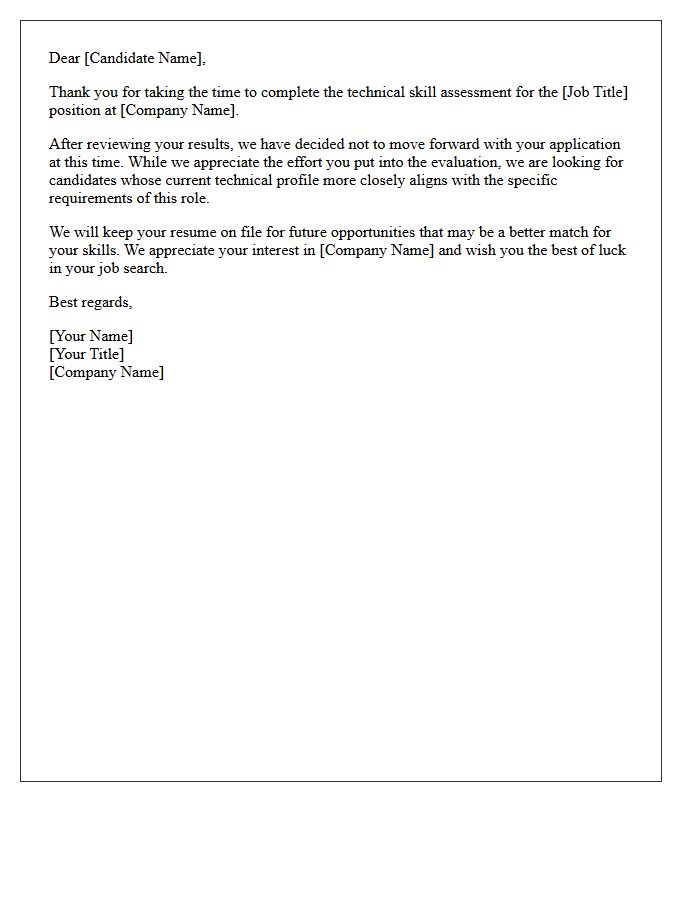
Receiving an unsuccessful technical skill assessment rejection letter is a common part of the hiring process. This document formally notifies candidates that their coding exercise or technical test did not meet the specific requirements for the role. It is important to remember that rejection often stems from relative performance compared to other applicants rather than a total lack of ability. Always request constructive feedback to identify knowledge gaps, refine your problem-solving approach, and better prepare for future opportunities. Use this experience as a learning milestone to improve your technical proficiency.
Unsuccessful Language Proficiency Assessment Rejection Letter
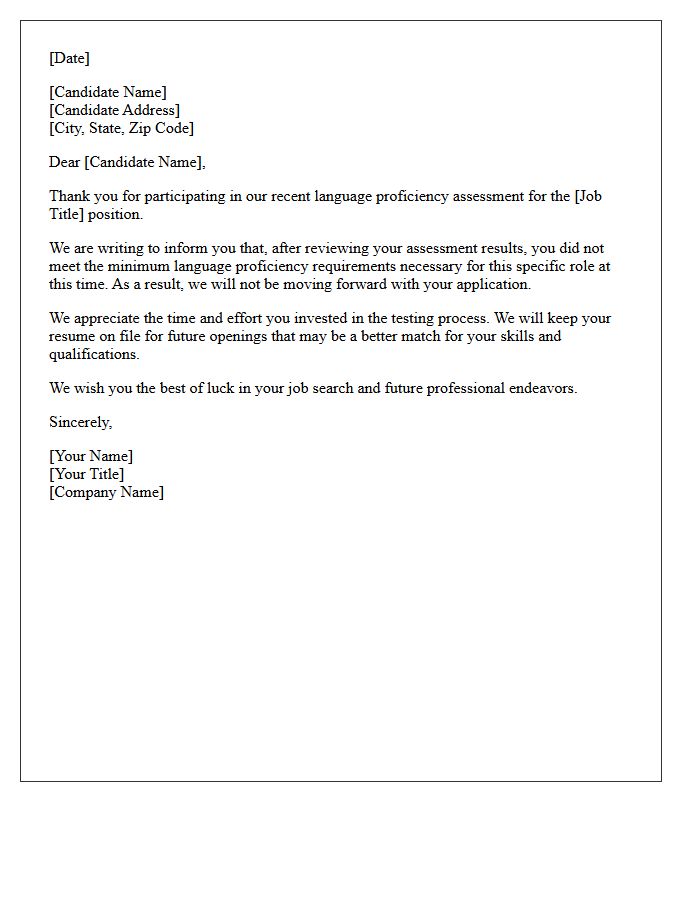
Receiving an Unsuccessful Language Proficiency Assessment Rejection Letter indicates that a candidate did not meet the required linguistic benchmarks for a specific role or academic program. This document typically outlines the evaluated criteria, such as fluency, grammar, or comprehension. It is important to request detailed feedback to identify specific weaknesses. Most institutions allow for a retest after a mandatory waiting period. View this outcome as a diagnostic tool to guide your future language training and improve your chances of success in subsequent evaluations.
Unsuccessful Administrative Skill Assessment Rejection Letter
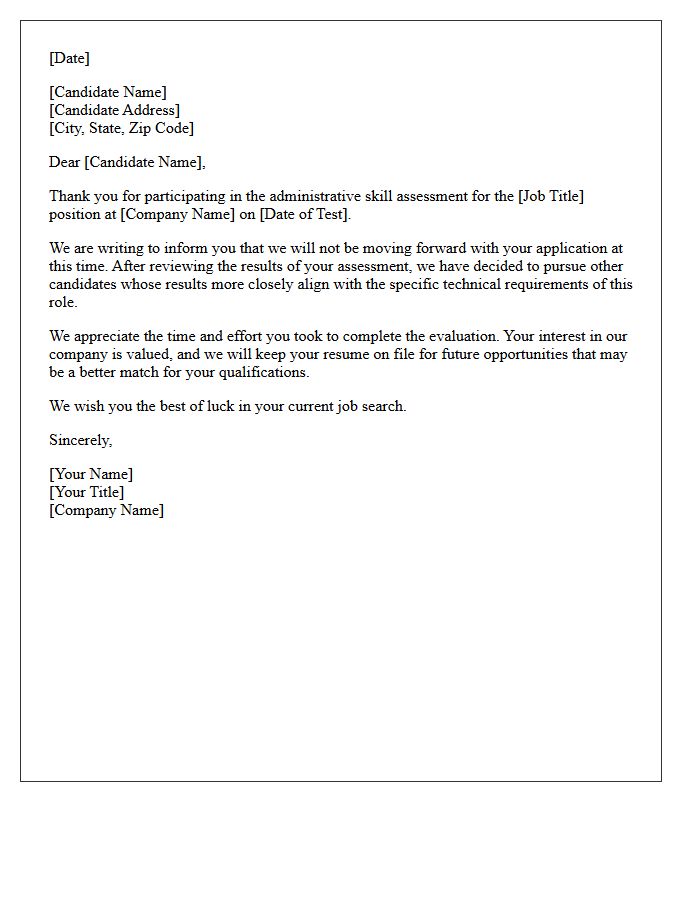
Receiving an Unsuccessful Administrative Skill Assessment Rejection Letter typically indicates that your professional experience or qualifications did not meet the specific benchmarks required for the role. This document serves as formal notification that your application will not proceed. Key reasons for rejection often include insufficient evidence of core competencies, gaps in technical proficiency, or failure to align with industry-standard criteria. Reviewing the specific feedback provided is essential for identifying skill gaps, allowing you to pursue further training or certification to strengthen future applications within the administrative sector.
Unsuccessful Customer Service Role Assessment Rejection Letter
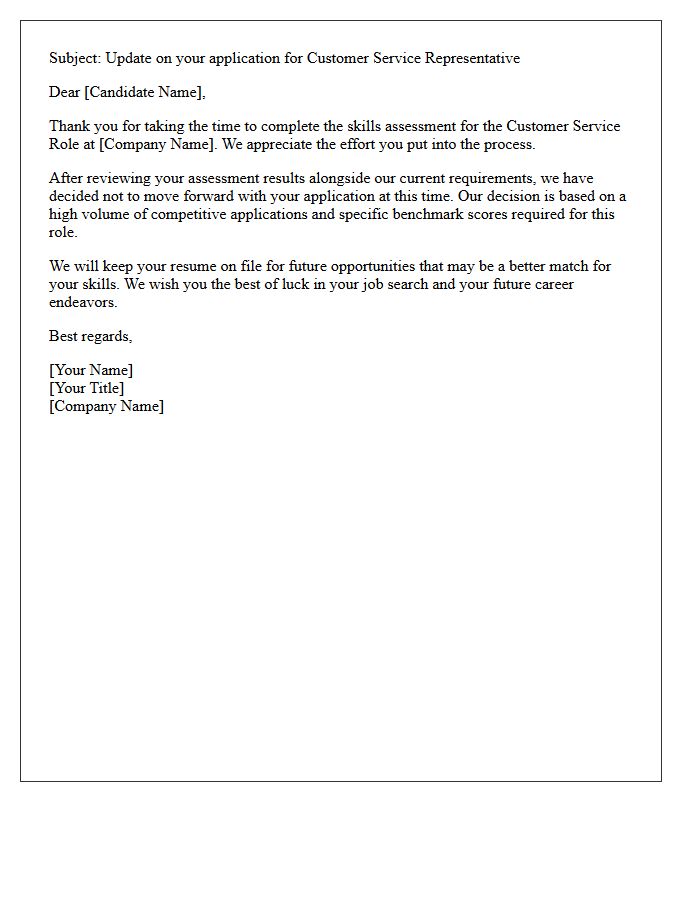
Receiving an unsuccessful assessment rejection letter for a customer service role is often based on specific behavioral competencies or situational judgment scores. Companies use these automated filters to measure empathy, problem-solving, and communication speed. While disappointing, this feedback is a valuable benchmark for identifying skill gaps. To improve future outcomes, request a performance breakdown if available. Use this data to refine your responses for subsequent applications, ensuring you better align with the specific service standards and cultural expectations required by top-tier employers in the hospitality and support sectors.
Unsuccessful Creative Portfolio Skill Assessment Rejection Letter
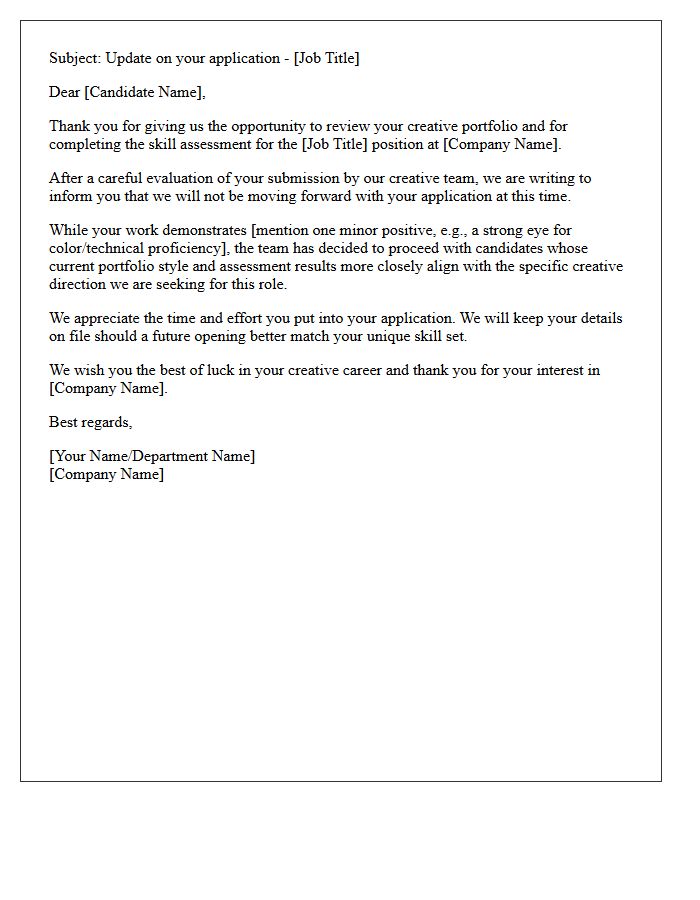
Receiving an unsuccessful skill assessment rejection letter for a creative portfolio is a common step in professional growth. This document identifies specific gaps between your current work and industry standards. To move forward, focus on the constructive feedback provided regarding technical execution or conceptual depth. Use this rejection as a roadmap to refine your projects, enhance your storytelling, and align your aesthetic with the specific requirements of the role or institution. Remember, a rejection is not a permanent failure, but an invitation to strengthen your creative portfolio for future success.
Unsuccessful Financial Accounting Skill Assessment Rejection Letter
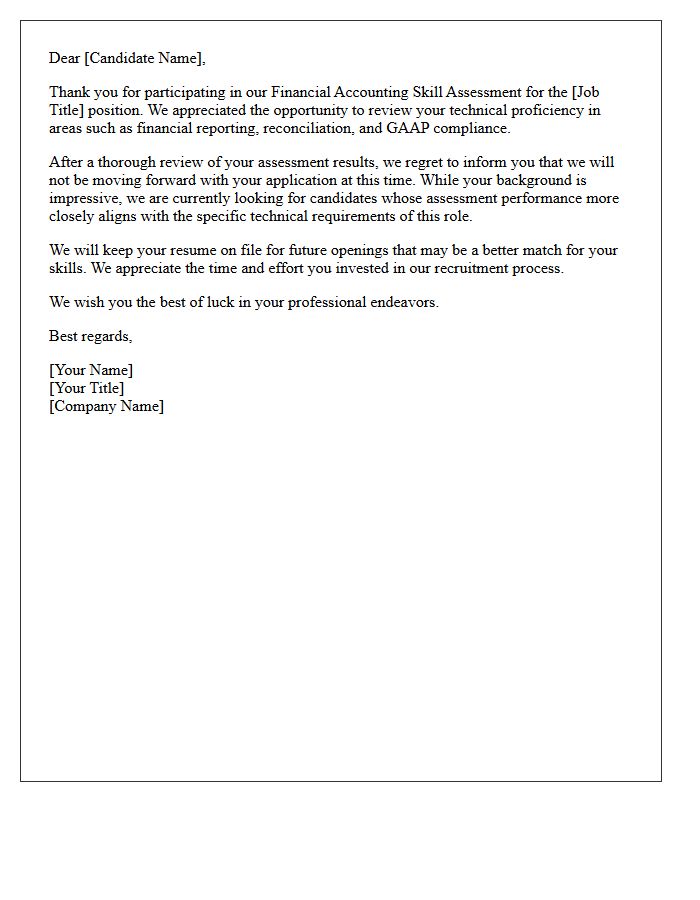
Receiving an unsuccessful financial accounting skill assessment rejection letter indicates that a candidate did not meet the specific technical benchmarks required for the role. These evaluations typically measure proficiency in GAAP standards, financial reporting, and analytical accuracy. It is essential to request feedback to identify knowledge gaps in areas like ledger management or tax compliance. View this outcome as a professional development opportunity to refine your quantitative skills and enhance your accounting expertise for future career opportunities in the financial sector.
Unsuccessful Leadership Competency Assessment Rejection Letter
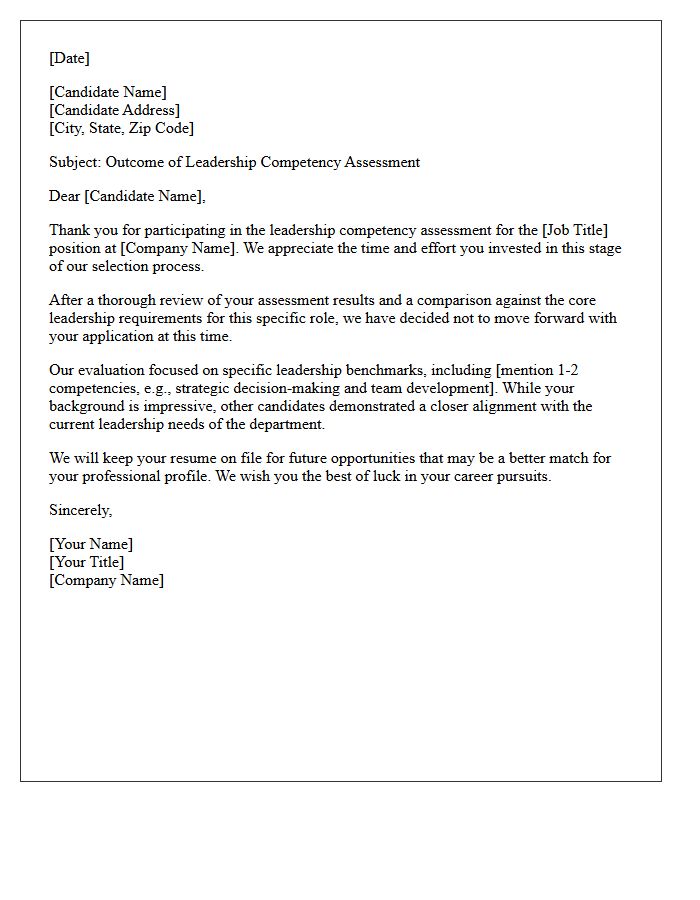
Receiving an Unsuccessful Leadership Competency Assessment Rejection Letter typically indicates a gap between your current performance and the specific behavioral benchmarks required for senior roles. This document serves as a strategic roadmap for professional growth rather than a final dismissal. It is essential to request detailed feedback on the specific competencies where you fell short, such as strategic thinking or emotional intelligence. Use this evaluation to create a targeted development plan, seeking mentorship or training to refine your leadership capabilities for future internal or external advancement opportunities.
Unsuccessful Cognitive Aptitude Assessment Rejection Letter
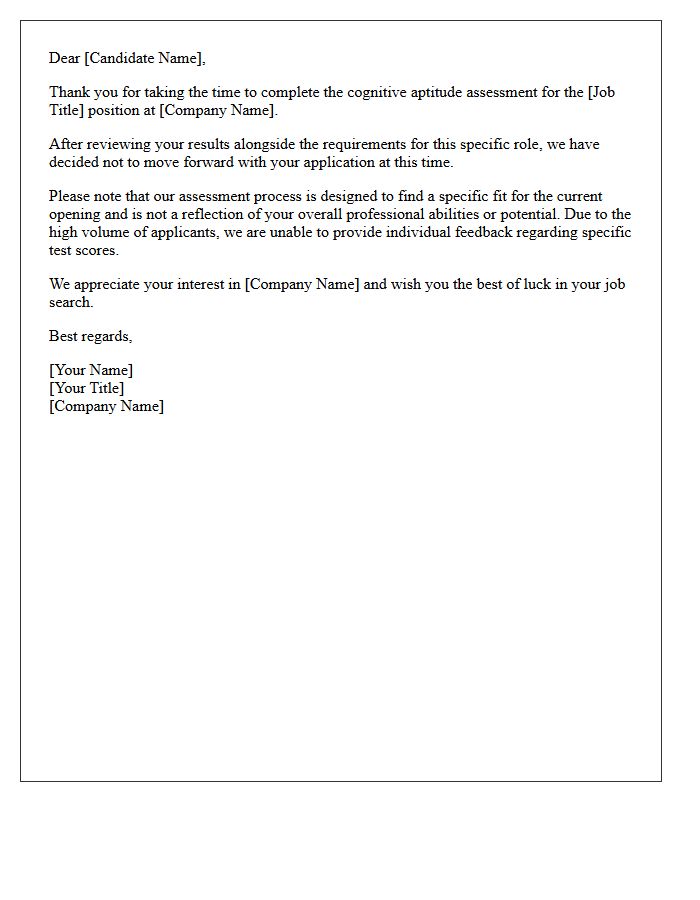
Receiving an unsuccessful cognitive aptitude assessment rejection letter indicates that your current test scores did not align with the employer's specific performance benchmarks. These automated evaluations measure critical thinking, problem-solving, and learning speed rather than your professional experience. To improve, focus on practice assessments to familiarize yourself with time constraints and question formats. Remember, a rejection is often based on a rigid cutoff score and does not reflect your overall career potential or intelligence. Use the feedback to refine your cognitive agility for future recruitment opportunities in competitive job markets.
Unsuccessful Software Proficiency Assessment Rejection Letter
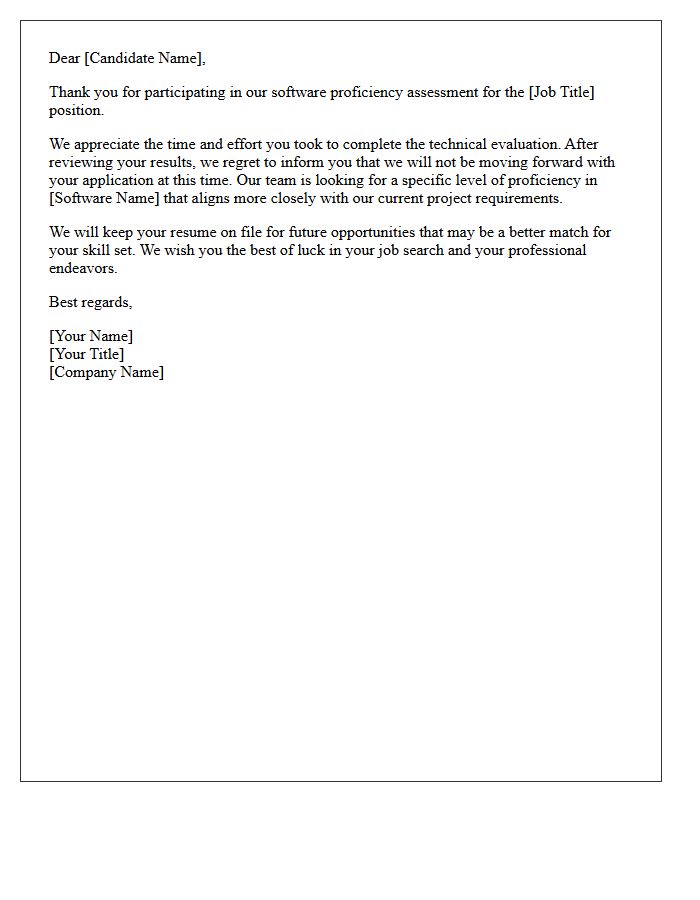
Receiving an Unsuccessful Software Proficiency Assessment Rejection Letter indicates that a candidate did not meet the specific technical benchmarks required for a role. This document often highlights a gap between current technical skills and the platform-specific expertise demanded by the employer. To improve future outcomes, candidates should request a detailed feedback report to identify weak areas. Using this information to pursue targeted upskilling or certifications is essential for overcoming proficiency barriers and succeeding in subsequent technical evaluations or coding challenges during the hiring process.
Unsuccessful Written Communication Skill Assessment Rejection Letter
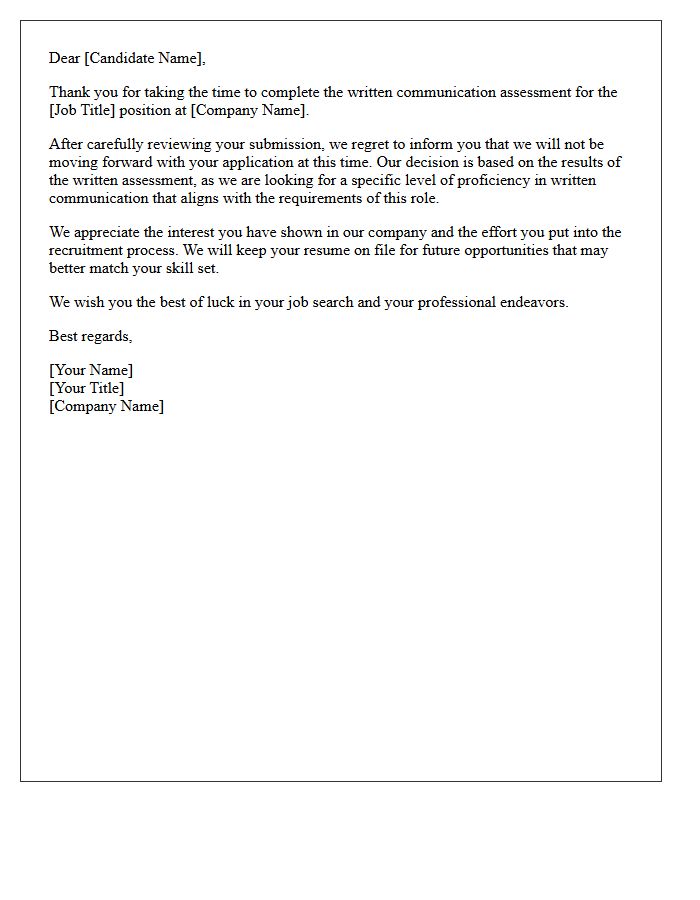
Receiving an unsuccessful assessment letter regarding written communication skills indicates a need to improve clarity, grammar, or professional tone. Organizations use these evaluations to ensure candidates can convey ideas effectively. To succeed next time, focus on structuring your arguments logically and eliminating redundant language. Always request specific feedback to identify exact weaknesses, such as spelling errors or poor formatting. Viewing this rejection as a developmental milestone allows you to refine your ability to produce high-quality, persuasive documentation essential for professional advancement and effective workplace collaboration.
Unsuccessful Data Analysis Skill Assessment Rejection Letter
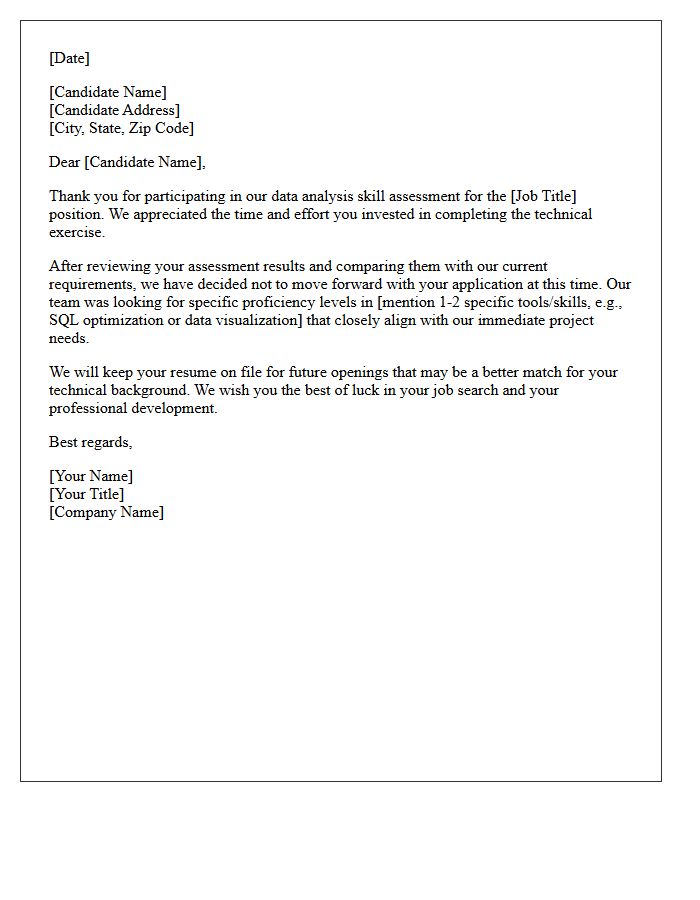
Receiving an unsuccessful data analysis skill assessment rejection letter often highlights gaps in specific technical competencies. It is crucial to request constructive feedback to identify whether the issue was related to SQL proficiency, statistical modeling, or data visualization clarity. Use this outcome as a roadmap for professional development by focusing on the identified weaknesses. Remember that rejection is a standard part of the competitive hiring process, serving as an opportunity to refine your analytical approach and technical execution for future roles in the data industry.
Unsuccessful Sales Pitch Practical Assessment Rejection Letter
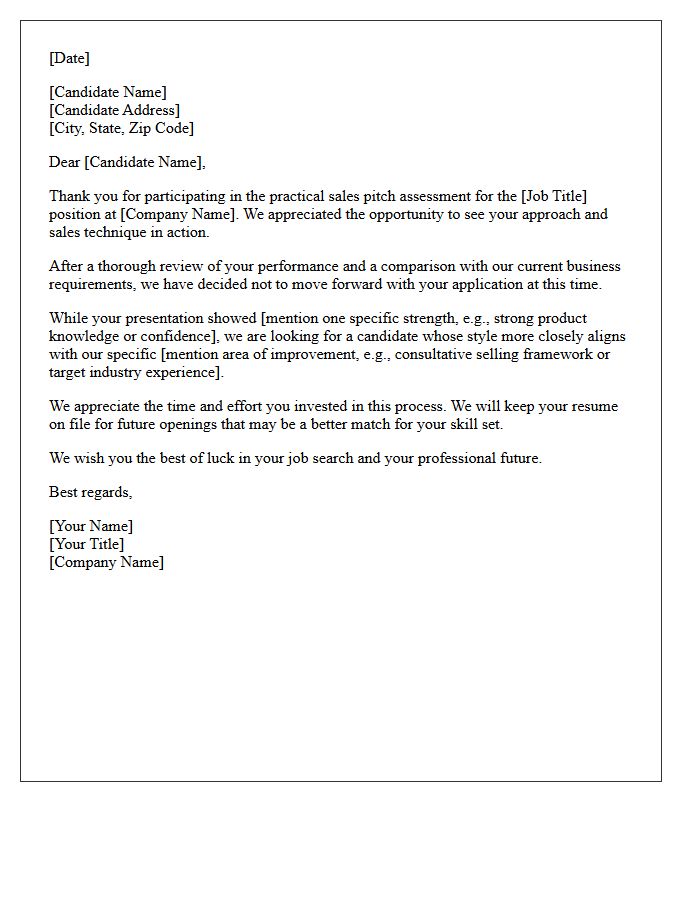
An unsuccessful sales pitch rejection letter serves as a formal notification that your practical assessment did not meet specific criteria. It is important to view this as a professional feedback opportunity rather than a failure. Key elements often include performance observations regarding your value proposition, communication style, or handling of objections. Use this document to identify skill gaps and refine your strategy for future opportunities. Maintaining a positive rapport after rejection demonstrates resilience and professional maturity within the competitive sales industry.
What should I do if my skill assessment is unsuccessful?
If you receive an unsuccessful skill assessment rejection letter, the first step is to carefully review the feedback provided by the assessing authority. You typically have the option to request a formal review, lodge an appeal, or submit a new application with additional evidence that addresses the specific reasons for the initial refusal.
Can I appeal a skill assessment rejection?
Yes, most assessing authorities allow applicants to appeal a negative outcome within a specific timeframe, usually 30 to 60 days. An appeal is appropriate if you believe the assessor made an error based on the documents already submitted, whereas a review may allow you to provide supplementary documentation to clarify your work experience or qualifications.
What are the common reasons for a skill assessment being unsuccessful?
Common reasons for rejection include a lack of "highly relevant" work experience, insufficient documentation (such as missing pay slips or detailed reference letters), qualifications that do not meet the Australian standard, or failing to demonstrate the required level of English language proficiency for that specific occupation.
How long do I have to wait before reapplying for a skill assessment?
There is generally no mandatory waiting period to submit a new skill assessment application after receiving a rejection letter. However, it is advisable to wait until you have gained further work experience or obtained new qualifications that directly address the gaps identified in your unsuccessful result notice.
Will an unsuccessful skill assessment affect my future visa application?
An unsuccessful skill assessment prevents you from proceeding with certain skilled migration visas (like the Subclass 189, 190, or 491) for that specific occupation at that time. While it does not automatically result in a visa ban, you must ensure that any future applications provide accurate information that is consistent with the claims made in your previous unsuccessful assessment.


Comments