
Preparing for a public listing requires meticulous financial reporting and governance. An Initial Public Offering Readiness Advisory Letter outlines the essential strategic shifts, compliance requirements, and operational improvements needed to transition from private to public ownership successfully. This formal document serves as a roadmap for management to address critical gaps before filing. To assist your process, below are some ready to use template.

Image cover: Mastering the IPO Journey: Strategic Readiness Advisory Letters and Templates
Letter Samples List
- Corporate Governance and Board Structure IPO Readiness Advisory Letter
- Regulatory Compliance and Basel Framework IPO Readiness Advisory Letter
- Financial Reporting and Historical Audit IPO Readiness Advisory Letter
- Internal Controls and Risk Management IPO Readiness Advisory Letter
- Capital Adequacy and Liquidity Strategy IPO Readiness Advisory Letter
- Anti-Money Laundering and Financial Crime Compliance IPO Advisory Letter
- Information Technology and Cybersecurity IPO Readiness Advisory Letter
- Asset Quality and Credit Risk Management IPO Readiness Advisory Letter
- Equity Story Formulation and Market Positioning IPO Advisory Letter
- Environmental, Social, and Governance Strategy IPO Readiness Letter
- Tax Structuring and Operational Efficiency IPO Readiness Advisory Letter
- Executive Compensation and Incentive Plan IPO Readiness Advisory Letter
Corporate Governance and Board Structure IPO Readiness Advisory Letter
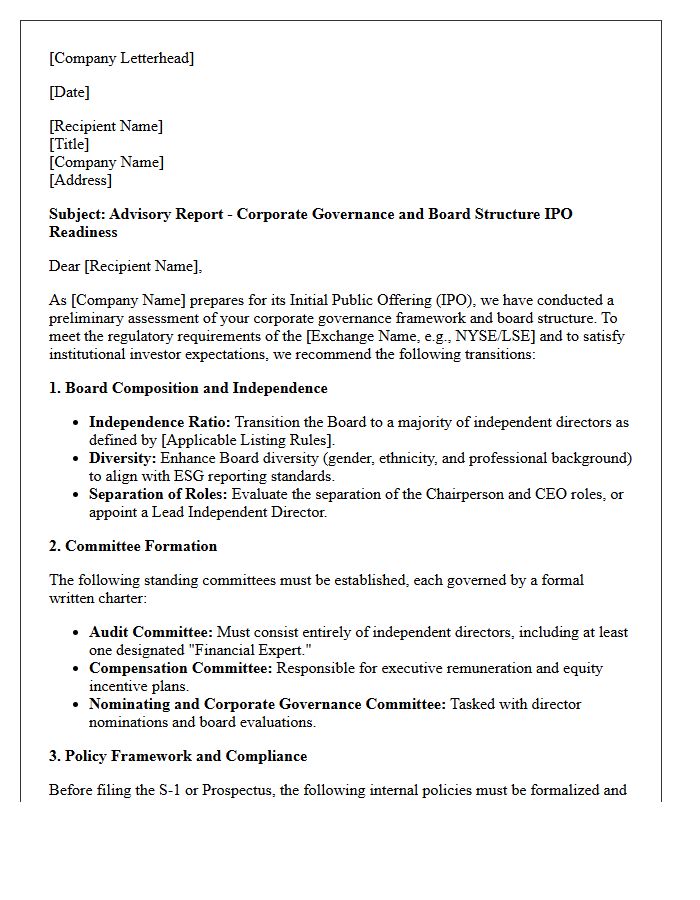
A Corporate Governance and Board Structure IPO Readiness Advisory Letter outlines essential reforms needed to transition from private to public status. It assesses board composition, emphasizing the requirement for independent directors to meet stock exchange listing standards. The letter evaluates audit, compensation, and nominating committees to ensure regulatory compliance and robust internal controls. By addressing structural gaps early, this advisory minimizes legal risks and enhances investor confidence. It serves as a strategic roadmap for establishing the transparency and fiduciary accountability necessary for a successful initial public offering and sustainable long-term growth.
Regulatory Compliance and Basel Framework IPO Readiness Advisory Letter
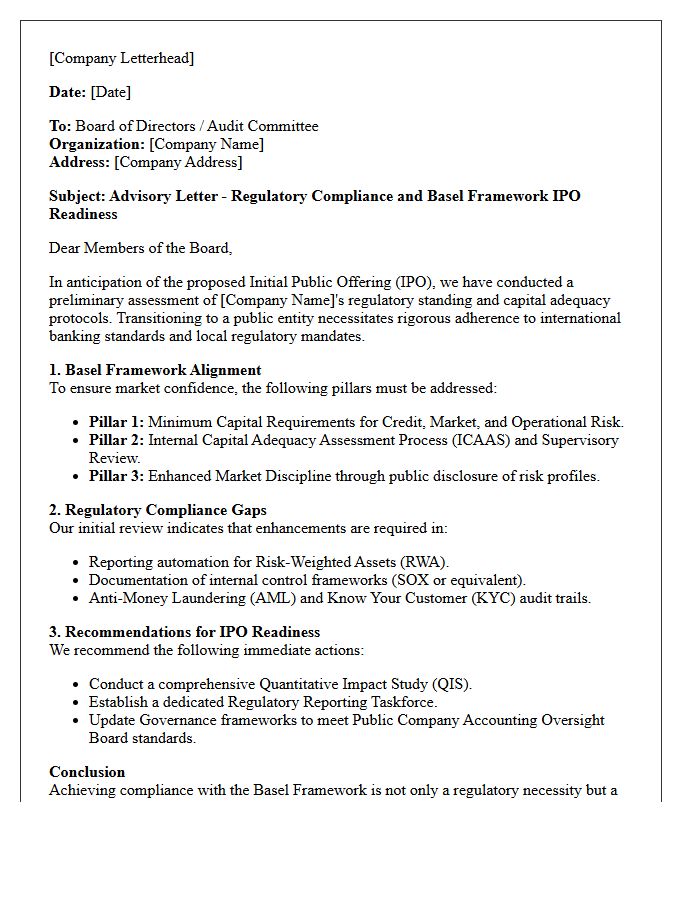
An advisory letter on IPO readiness ensures a company meets strict Regulatory Compliance standards before going public. It evaluates internal controls, financial reporting, and risk management through the lens of the Basel Framework, which stabilizes global banking systems. This assessment identifies gaps in capital adequacy and governance, providing a roadmap to mitigate risks. By aligning with these international prudential standards, a firm demonstrates transparency and institutional maturity, which are vital for building investor confidence and securing a successful market debut.
Financial Reporting and Historical Audit IPO Readiness Advisory Letter
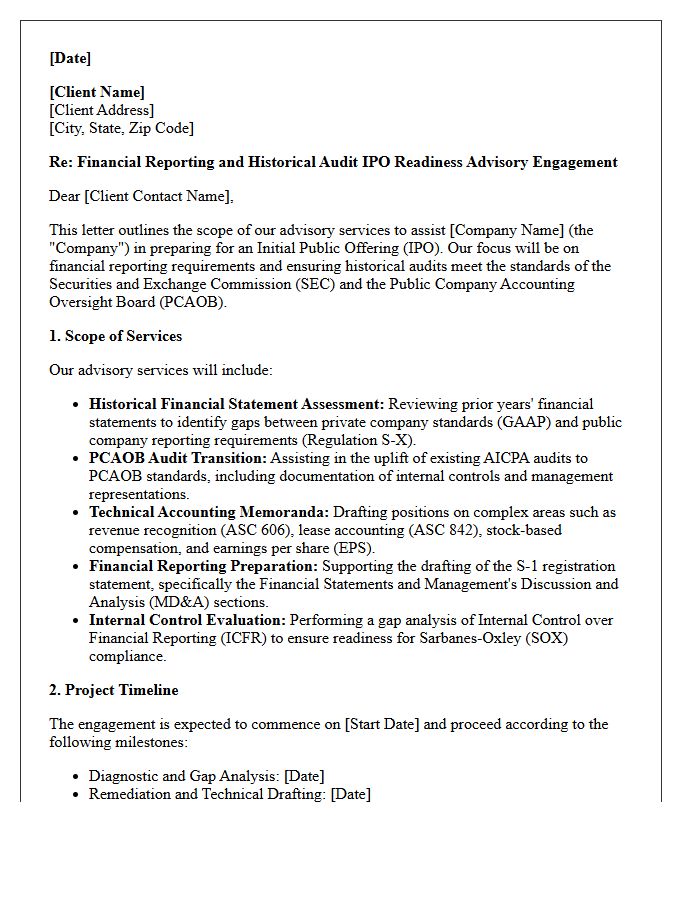
A Financial Reporting and Historical Audit IPO Readiness Advisory Letter evaluates a company's readiness for public markets by identifying gaps in financial statements. This gap analysis ensures compliance with PCAOB standards and SEC regulations. It assesses internal controls, historical financial data, and reporting processes to mitigate risks before a filing. Engaging in this advisory process streamlines the underwriting phase, reduces delays during the initial public offering, and provides stakeholders with confidence in the accuracy of the issuer's financial disclosures.
Internal Controls and Risk Management IPO Readiness Advisory Letter
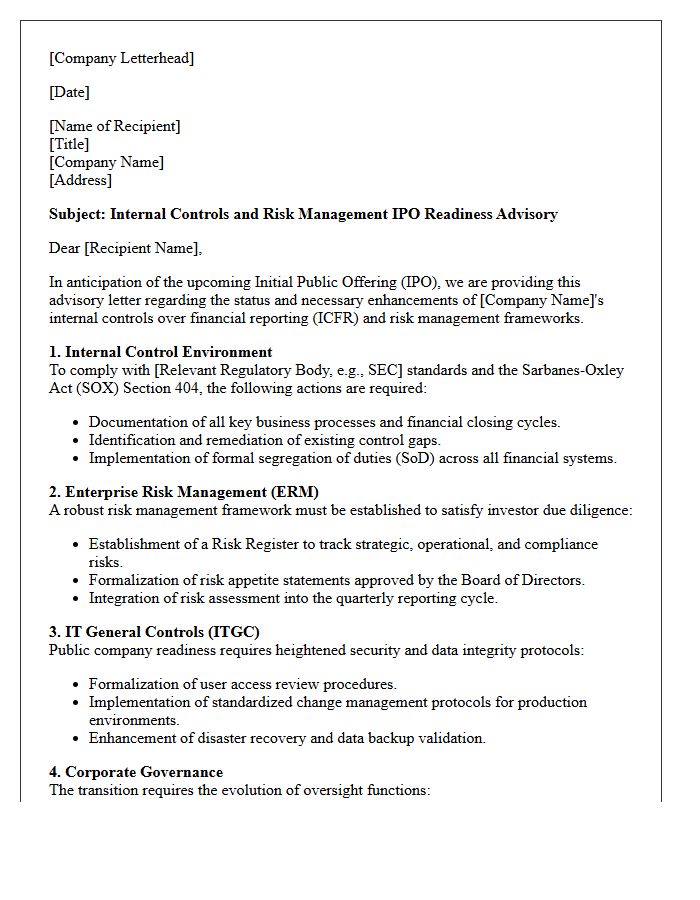
An Internal Controls and Risk Management IPO Readiness Advisory Letter evaluates a company's financial reporting maturity and governance frameworks before going public. It identifies critical gaps in internal controls to ensure compliance with Sarbanes-Oxley standards. This document provides a strategic roadmap for remediation, helping leadership mitigate operational risks and build investor confidence. By addressing these deficiencies early, firms can prevent costly delays, avoid regulatory scrutiny, and demonstrate the institutional stability required for a successful initial public offering in a competitive market.
Capital Adequacy and Liquidity Strategy IPO Readiness Advisory Letter
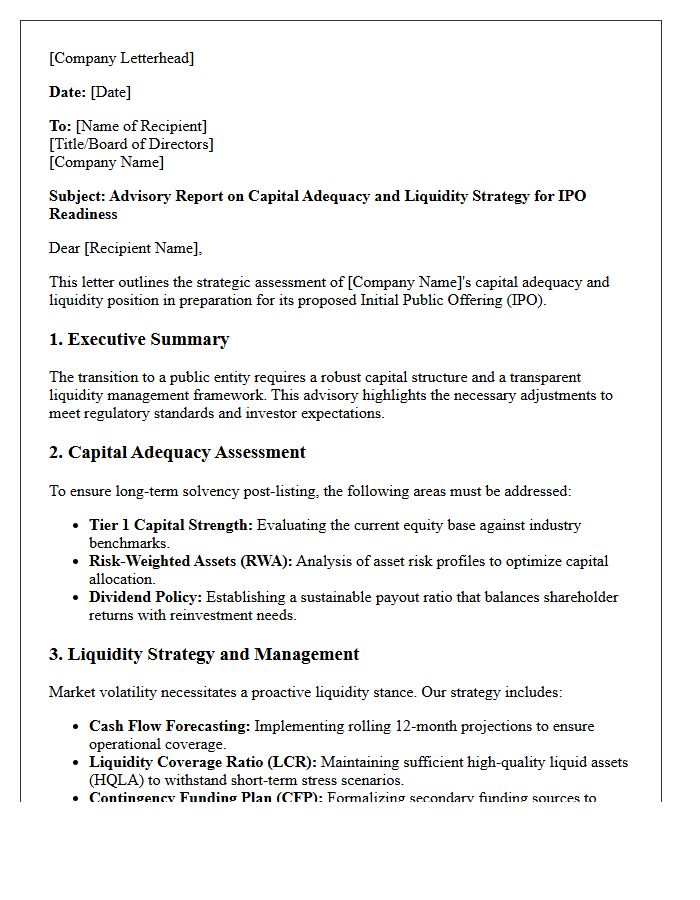
A Capital Adequacy and Liquidity Strategy IPO Readiness Advisory Letter evaluates a firm's financial resilience before going public. It assesses whether capital reserves meet regulatory standards and internal growth targets. The letter focuses on liquidity risk management, ensuring the company maintains sufficient cash flow to satisfy short-term obligations under stress. This strategic document provides investors with confidence that the entity possesses the structural stability and governance frameworks necessary for a successful initial public offering and long-term market sustainability.
Anti-Money Laundering and Financial Crime Compliance IPO Advisory Letter
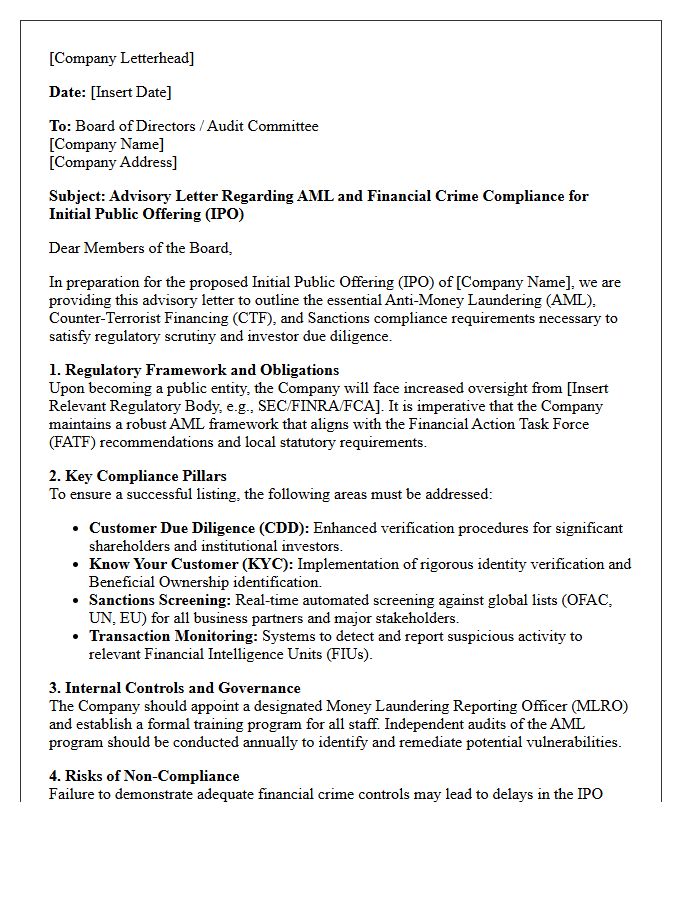
An Anti-Money Laundering (AML) and Financial Crime Compliance IPO Advisory Letter is a critical document for companies seeking to go public. It provides an independent assessment of a firm's risk management frameworks, ensuring they meet regulatory standards required by exchanges and underwriters. This letter verifies that robust controls are in place to detect illicit activities, protecting the issuer from legal liabilities and reputational damage. Obtaining this advisory ensures investor confidence and smooths the transition into a highly regulated public market environment by demonstrating full compliance with global financial crime laws.
Information Technology and Cybersecurity IPO Readiness Advisory Letter
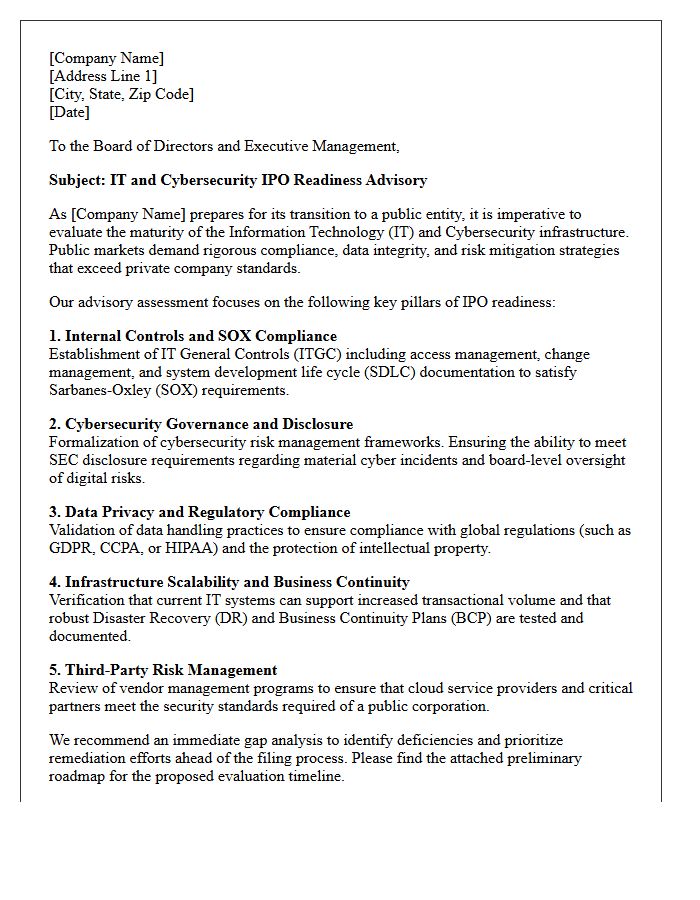
An Information Technology and Cybersecurity IPO Readiness Advisory Letter evaluates a company's digital infrastructure and data protection maturity before going public. This essential document identifies compliance gaps and operational risks that could hinder SEC filings. By addressing governance, risk management, and internal controls, the advisory letter provides investors with assurance regarding technical stability. It ensures that the organization meets rigorous regulatory standards, protecting long-term shareholder value through a robust, secure, and scalable technology framework designed for the public market's scrutiny.
Asset Quality and Credit Risk Management IPO Readiness Advisory Letter
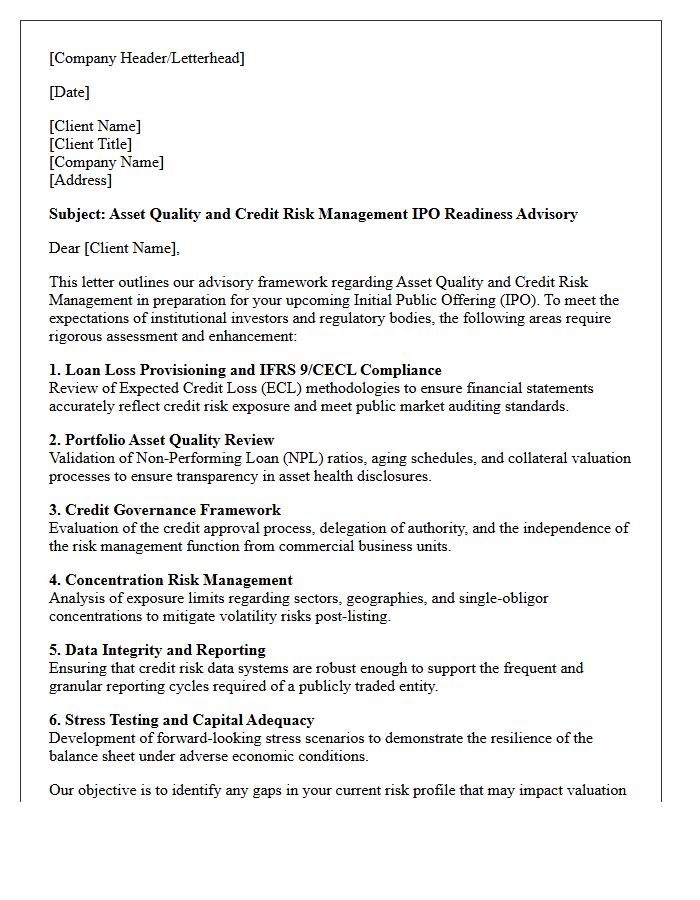
An Asset Quality and Credit Risk Management advisory letter is essential for firms seeking IPO readiness. This document evaluates the health of a loan portfolio and the effectiveness of risk mitigation frameworks. It provides institutional investors with assurance regarding credit underwriting standards and loss provisioning accuracy. By identifying potential financial vulnerabilities and governance gaps, the advisory letter ensures transparency and regulatory compliance. Ultimately, it builds market confidence by demonstrating that the issuer maintains robust risk controls and sustainable asset performance before debuting on public exchanges.
Equity Story Formulation and Market Positioning IPO Advisory Letter
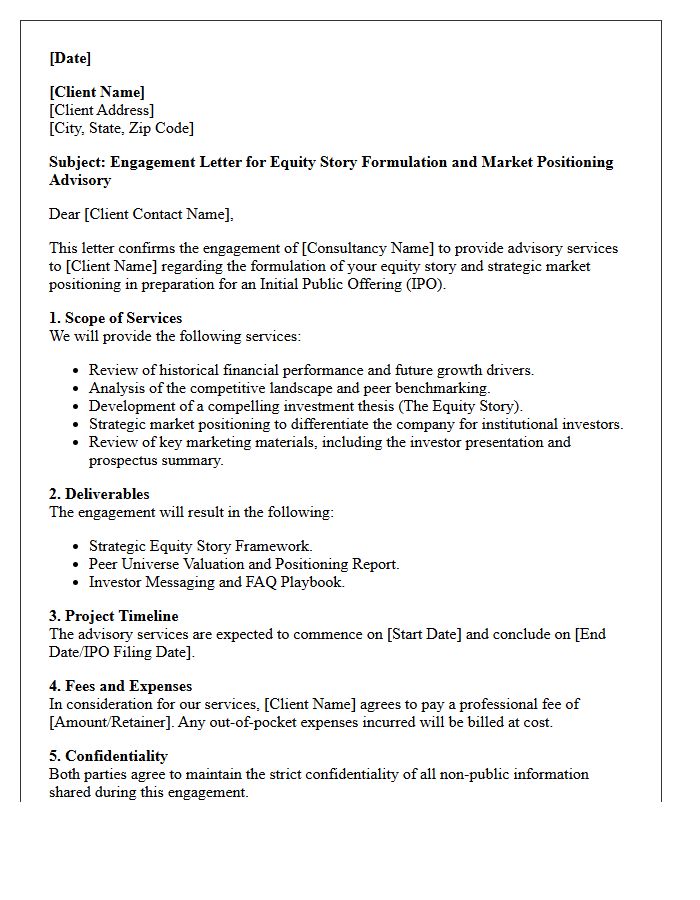
An effective Equity Story Formulation is essential for a successful IPO, as it translates complex financial data into a compelling narrative for potential investors. Market Positioning ensures the company stands out against competitors by highlighting its unique value proposition and growth scalability. Professional IPO Advisory letters provide the strategic framework needed to align internal goals with external market expectations. This process minimizes investment risks and optimizes valuation by building trust through transparency and a clear vision for long-term profitability within the capital markets.
Environmental, Social, and Governance Strategy IPO Readiness Letter
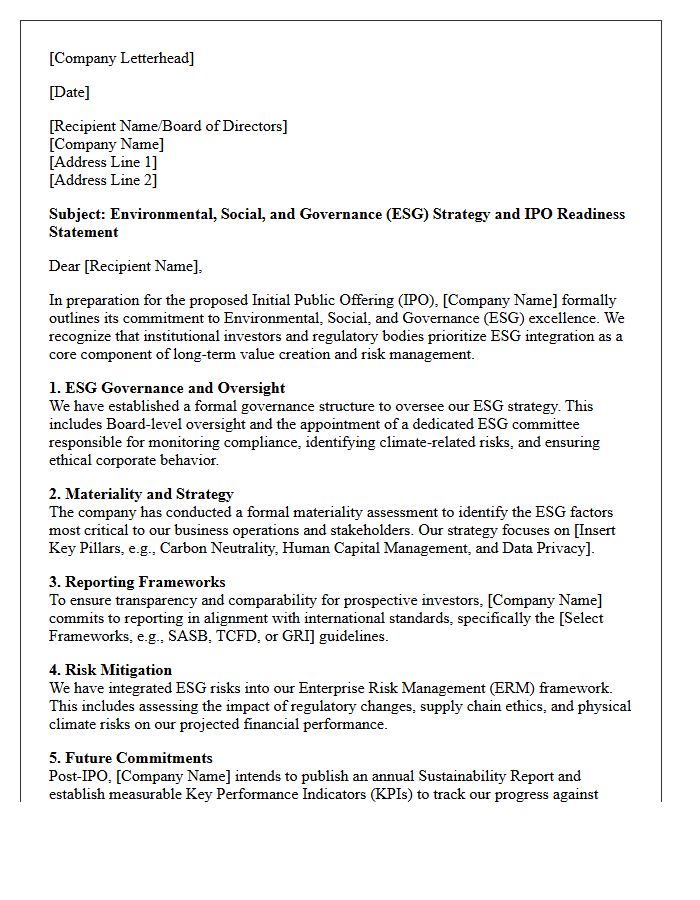
An ESG Strategy IPO Readiness Letter is a critical document validating that a company meets institutional investor expectations before going public. It highlights the integration of sustainability risks and ethical governance into the core business model. This formal assessment ensures compliance with evolving disclosure regulations, demonstrating long-term value creation. By addressing environmental impact and social responsibility, the letter builds investor confidence, mitigates legal exposure, and secures a competitive market valuation during the transition to a public entity.
Tax Structuring and Operational Efficiency IPO Readiness Advisory Letter
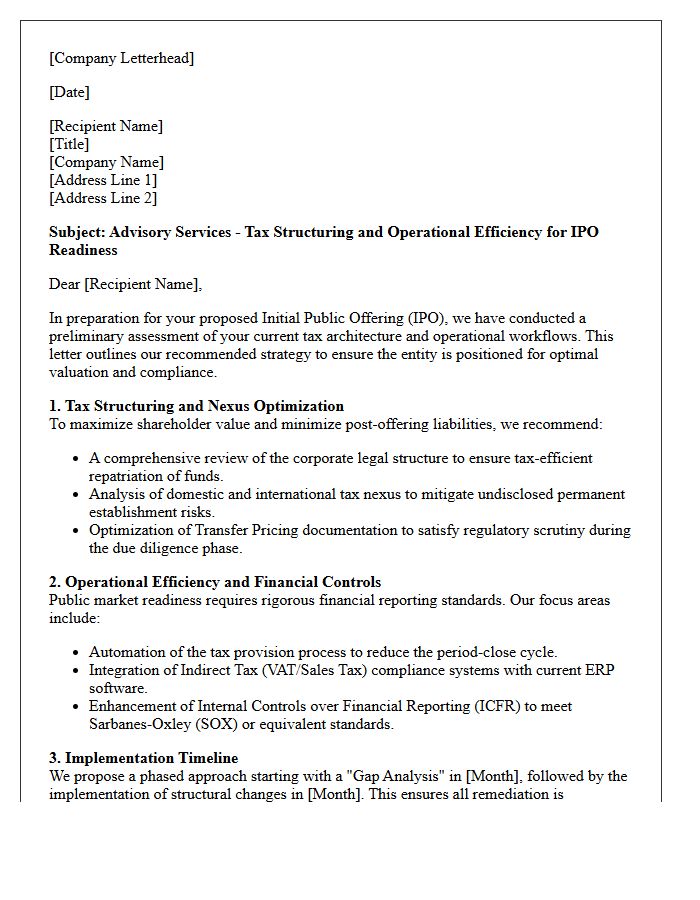
A Tax Structuring and Operational Efficiency IPO Readiness Advisory Letter evaluates a company's internal frameworks before going public. It identifies tax optimization opportunities and streamlines operational workflows to ensure compliance with capital market standards. By addressing potential liabilities and enhancing structural efficiency, the letter provides a roadmap to maximize shareholder value. This advisory process is crucial for mitigating risks, improving financial transparency, and ensuring the entity is fully prepared for the rigorous due diligence required during an initial public offering.
Executive Compensation and Incentive Plan IPO Readiness Advisory Letter
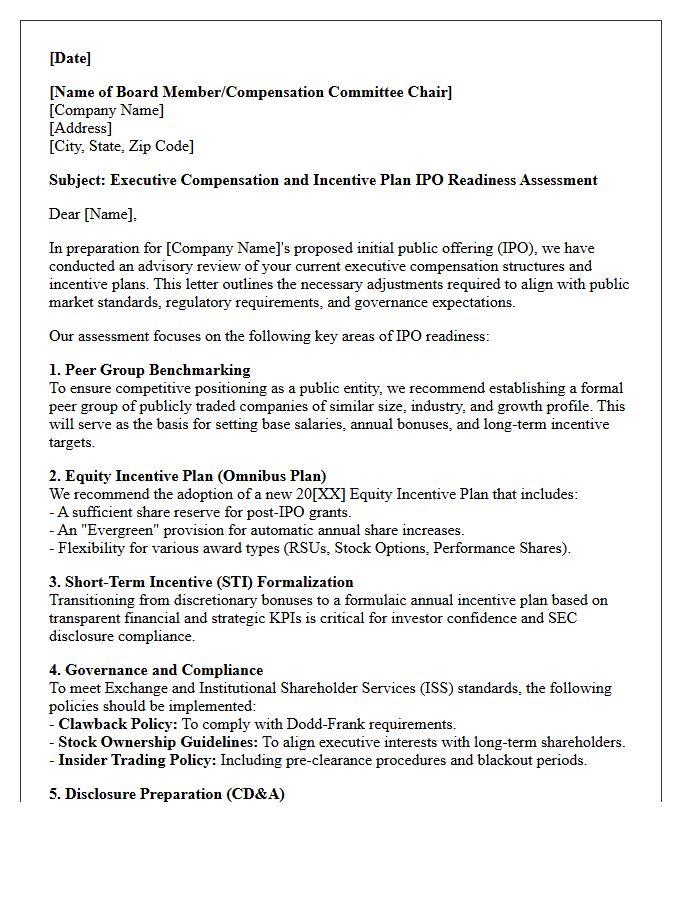
An Executive Compensation and Incentive Plan IPO Readiness Advisory Letter evaluates if a company's pay structures meet public market standards. It ensures equity distribution, performance benchmarks, and governance policies align with investor expectations and SEC regulations. This document is crucial for retaining top talent while demonstrating fiscal responsibility to potential shareholders. By addressing regulatory compliance and competitive benchmarking before the offering, the letter mitigates legal risks and strengthens the corporate governance framework essential for a successful transition from private to public ownership.
What is an IPO Readiness Advisory Letter?
An IPO Readiness Advisory Letter is a formal document issued by financial consultants or auditors that assesses a company's internal controls, financial reporting systems, and governance structures to determine its preparedness for listing on a public exchange.
What are the primary components of an IPO Readiness Assessment?
The assessment typically evaluates historical financial statement integrity, PCAOB auditing standards compliance, corporate governance frameworks, internal control over financial reporting (ICFR), and the maturity of the company's legal and tax structures.
Why do underwriters require an IPO Advisory Letter?
Underwriters and investment banks require this letter to mitigate risk, ensuring that the issuing company has the necessary infrastructure to meet rigorous SEC reporting deadlines and transparency requirements post-offering.
When should a company seek an IPO Readiness Advisory Letter?
Ideally, a company should engage advisors 12 to 24 months before a planned public filing to allow sufficient time to remediate material weaknesses, institutionalize financial processes, and close any identified regulatory gaps.
How does an IPO Readiness Advisory Letter impact company valuation?
By identifying and resolving financial reporting risks early, the advisory letter increases investor confidence and reduces execution risk, which can lead to a more stable roadshow and a more favorable valuation during the pricing phase.

Comments