
Staying compliant with evolving financial regulations is essential for institutional security. This guide outlines the latest Memorandum on Anti-Money Laundering Policy Updates, focusing on enhanced due diligence and risk assessment protocols to prevent illicit activities. Learn how these changes impact your operational framework and reporting requirements. To simplify your documentation process, below are some ready to use template.
Image cover: Modernizing Compliance: Anti-Money Laundering Policy Update Templates and Strategic Memorandum Guide
Letter Samples List
- Cover Letter for the Official Memorandum on Anti-Money Laundering Policy Updates
- Letter of Notification on Revised Anti-Money Laundering Guidelines for Branch Managers
- Executive Summary Letter Regarding Annual Anti-Money Laundering Policy Enhancements
- Directives Letter for Compliance Officers on New Anti-Money Laundering Frameworks
- Official Letter to Regulatory Authorities Detailing Anti-Money Laundering Policy Updates
- Customer Advisory Letter on Updated Anti-Money Laundering Verification Procedures
- Mandatory Training Letter on Enhanced Anti-Money Laundering Compliance Protocols
- Vendor Notification Letter Concerning Anti-Money Laundering Policy Revisions
- Internal Audit Letter Assessing Recent Anti-Money Laundering Policy Modifications
- Technical Requirements Letter for Implementing Anti-Money Laundering System Updates
- Board of Directors Acknowledgment Letter on Anti-Money Laundering Strategic Updates
- Enhanced Due Diligence Letter for High-Risk Clients Under Updated Anti-Money Laundering Policies
Cover Letter for the Official Memorandum on Anti-Money Laundering Policy Updates
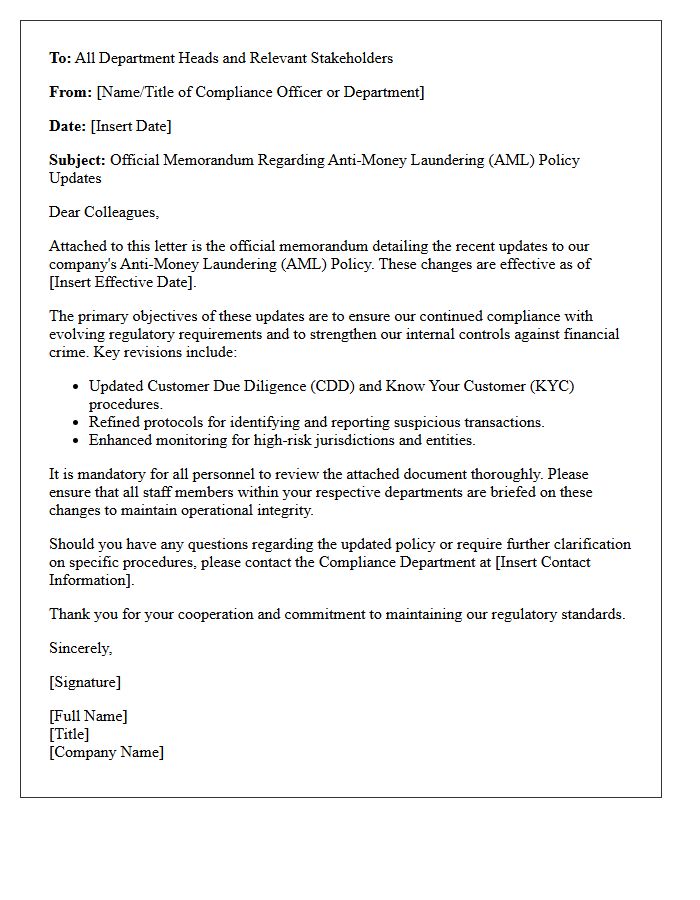
A cover letter for an official memorandum on Anti-Money Laundering (AML) policy updates serves as a formal summary of regulatory changes. It must clearly outline the scope of revisions, implementation deadlines, and compliance expectations for all personnel. By highlighting key amendments to customer due diligence and reporting protocols, this document ensures institutional alignment with legal standards. Its primary purpose is to provide context and authoritative guidance, ensuring that every stakeholder understands their responsibility in mitigating financial crime risks and maintaining organizational integrity during the transition to updated procedures.
Letter of Notification on Revised Anti-Money Laundering Guidelines for Branch Managers
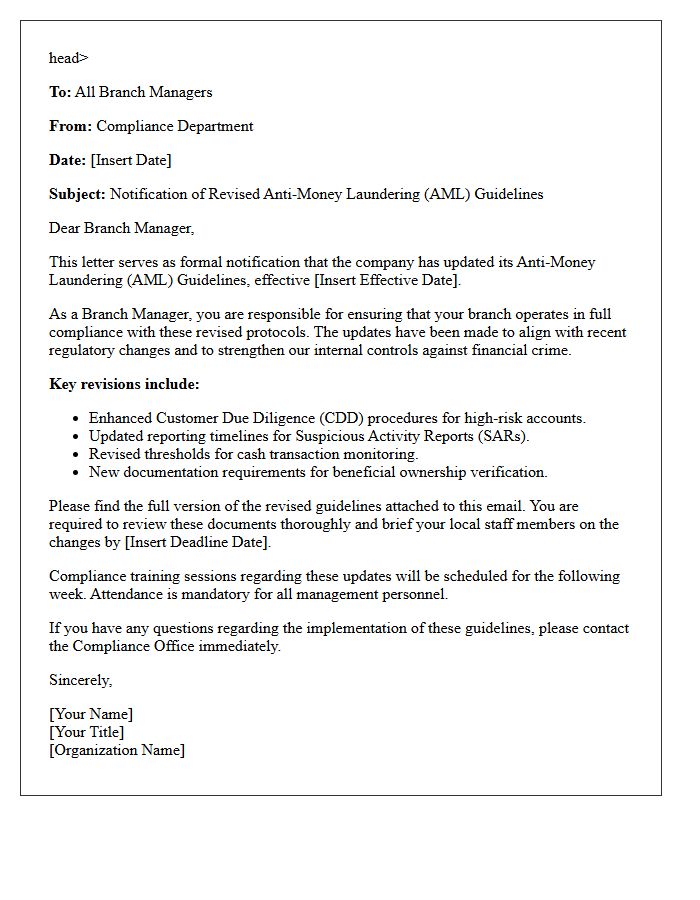
The Letter of Notification on Revised Anti-Money Laundering Guidelines serves as a mandatory directive for branch managers to enhance institutional security. It outlines updated compliance protocols designed to detect and prevent illicit financial activities effectively. Managers must implement these rigorous monitoring standards to ensure all transactions align with current legal frameworks. Key updates focus on risk-based assessments and improved reporting accuracy to mitigate financial crimes. Adherence to these revised guidelines is essential for maintaining regulatory integrity and protecting the institution from legal penalties or reputational damage.
Executive Summary Letter Regarding Annual Anti-Money Laundering Policy Enhancements
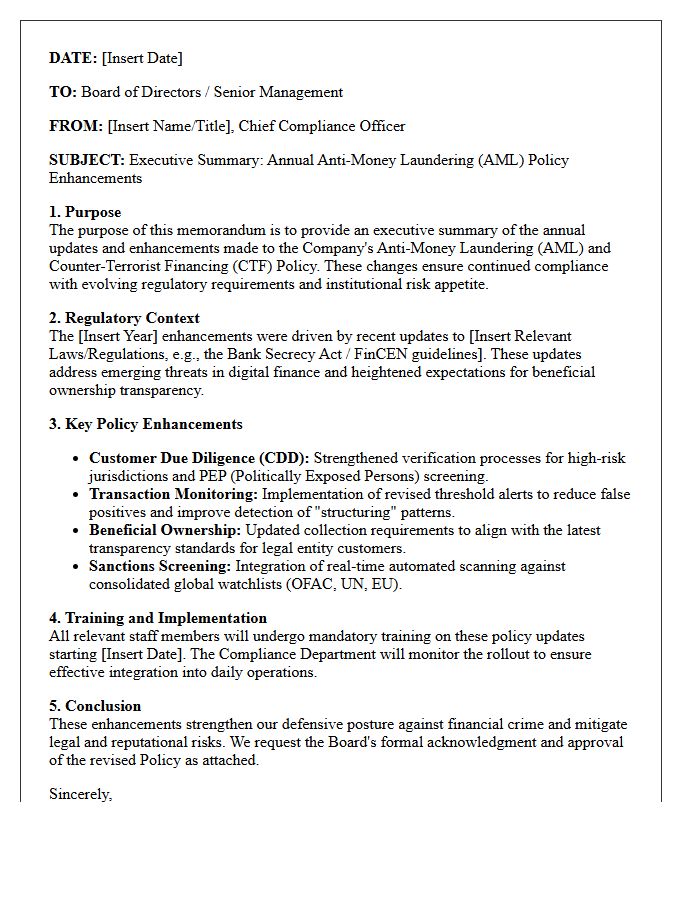
The Executive Summary Letter provides a high-level overview of critical Annual Anti-Money Laundering Policy Enhancements. It outlines updated risk assessment frameworks, refined customer due diligence protocols, and improved monitoring systems designed to combat financial crime. This document ensures regulatory compliance by aligning internal procedures with evolving global standards. Stakeholders must review these changes to understand their specific compliance obligations and the operational impact of new AML safeguards. This brief serves as a formal notification of the organization's commitment to maintaining financial integrity and mitigating institutional risk through proactive policy updates.
Directives Letter for Compliance Officers on New Anti-Money Laundering Frameworks
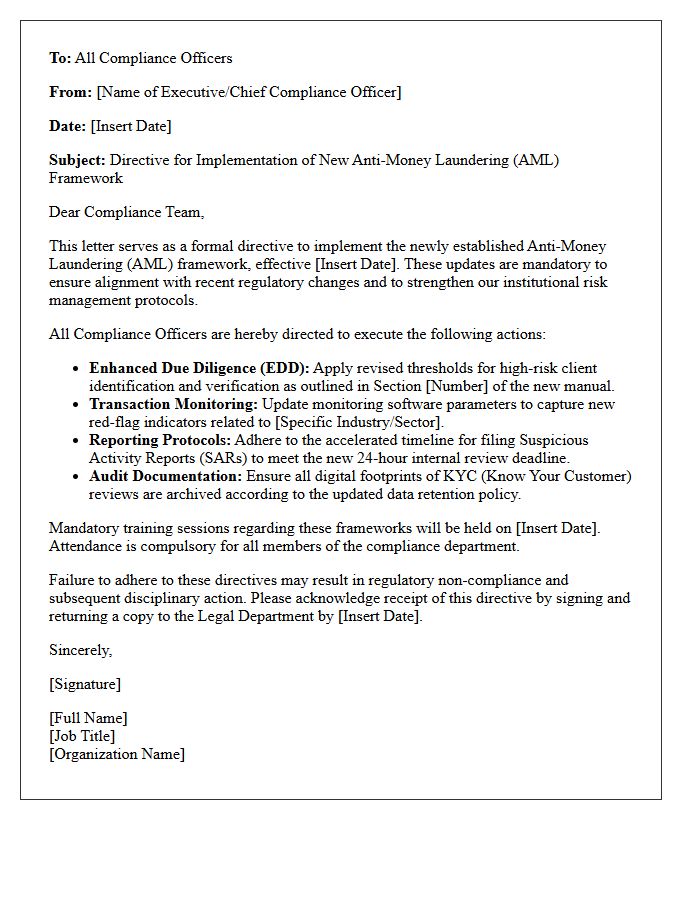
Compliance officers must prioritize the latest Directives Letter regarding new anti-money laundering frameworks. This official guidance outlines essential updates to regulatory reporting and risk assessment protocols. It emphasizes the integration of advanced due diligence technologies to identify suspicious activities more effectively. Adhering to these instructions is vital for maintaining legal compliance and avoiding severe penalties. Officers should focus on aligning internal controls with these evolving standards to ensure financial integrity and robust monitoring across all institutional operations in accordance with the new global mandates.
Official Letter to Regulatory Authorities Detailing Anti-Money Laundering Policy Updates
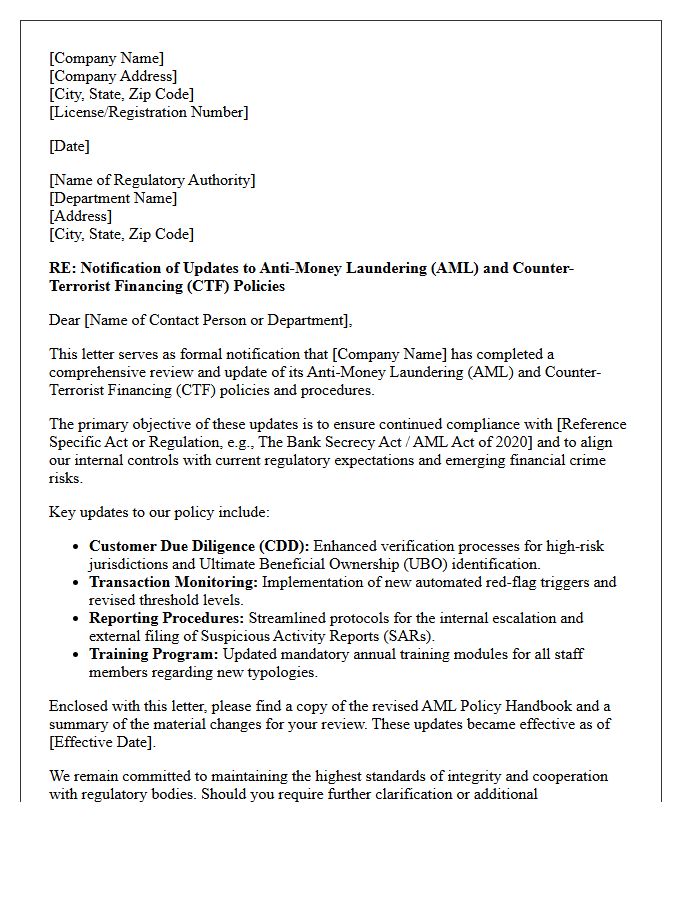
When drafting an Official Letter to Regulatory Authorities, transparency is paramount. The document must clearly outline Anti-Money Laundering (AML) policy updates, specifically addressing new risk assessment frameworks and internal control enhancements. It is essential to demonstrate full compliance with current financial legislation and reporting standards. By providing a detailed summary of structural changes and compliance monitoring improvements, your organization validates its commitment to preventing illicit activities. This proactive communication ensures regulatory alignment, fosters institutional trust, and mitigates potential legal risks associated with evolving global financial security mandates.
Customer Advisory Letter on Updated Anti-Money Laundering Verification Procedures
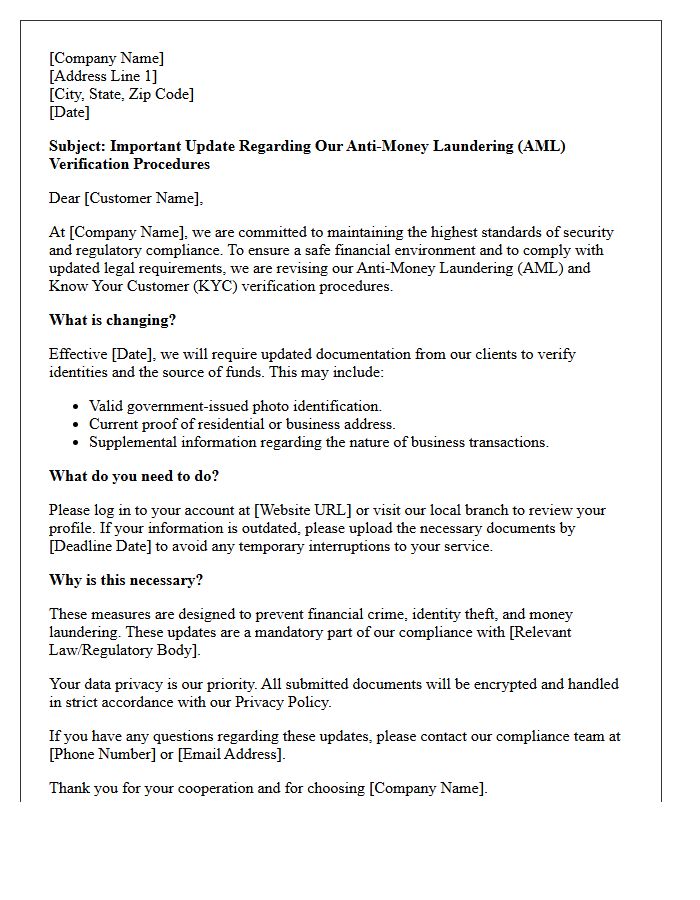
This Customer Advisory Letter outlines critical updates to our Anti-Money Laundering (AML) verification procedures. To ensure regulatory compliance and enhance security, we require updated identification and due diligence documentation from all clients. These changes help prevent financial crime and protect your account integrity. Please review the specific verification requirements and submission deadlines mentioned in the letter to avoid any service interruptions. Providing accurate information is essential for maintaining a transparent and secure banking environment for everyone.
Mandatory Training Letter on Enhanced Anti-Money Laundering Compliance Protocols
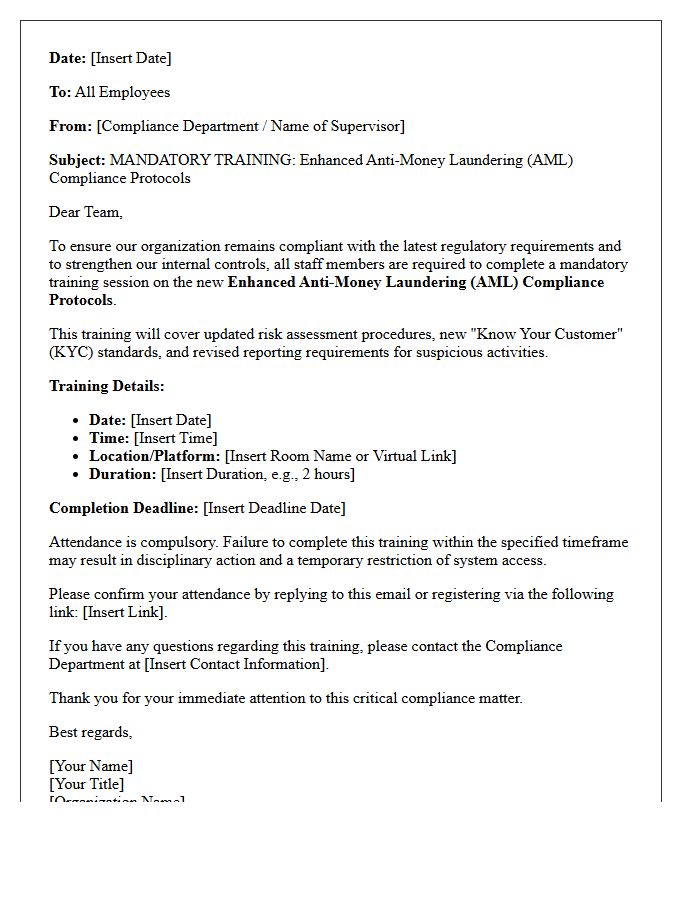
The Mandatory Training Letter signifies a critical update to organizational Anti-Money Laundering (AML) standards. All employees must complete this session to understand enhanced compliance protocols designed to detect financial crime. Failure to attend may result in disciplinary action, as these updates align with regulatory legal requirements to prevent money laundering and terrorist financing. Participants will learn advanced monitoring techniques and reporting obligations. Timely completion is essential to ensure the institution maintains its operational integrity and avoids significant legal penalties or reputational damage within the global financial sector.
Vendor Notification Letter Concerning Anti-Money Laundering Policy Revisions
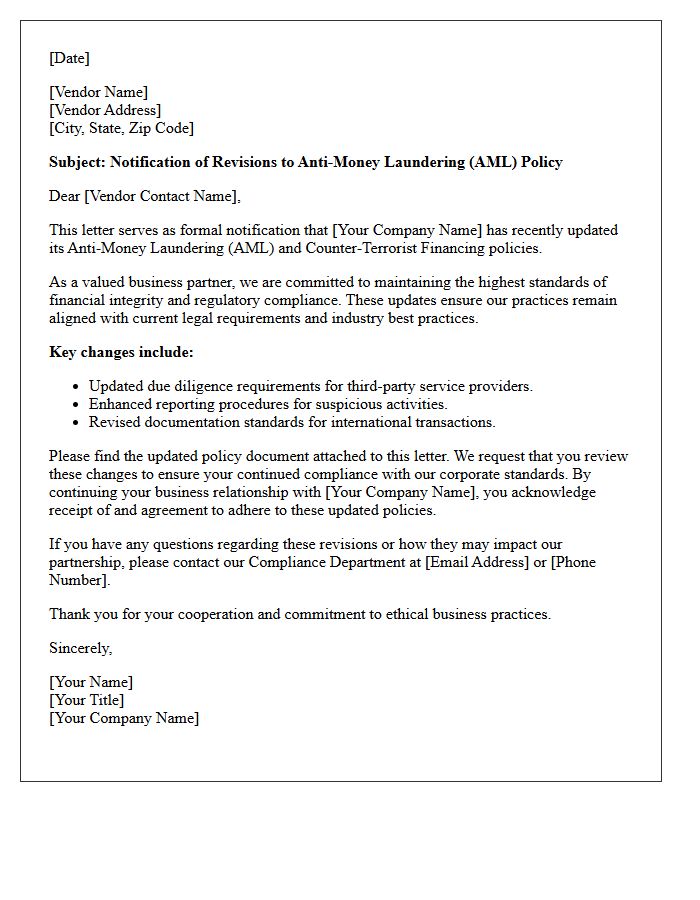
A Vendor Notification Letter informs business partners about essential Anti-Money Laundering (AML) policy revisions. This document ensures all third parties remain compliant with updated financial regulations and internal security protocols. It highlights new due diligence requirements, mandatory reporting procedures, and legal obligations to prevent illicit activities. Vendors must review these changes to maintain operational transparency and avoid service disruptions. Acknowledging this update confirms a shared commitment to regulatory integrity and mitigating financial crime risks within the supply chain.
Internal Audit Letter Assessing Recent Anti-Money Laundering Policy Modifications
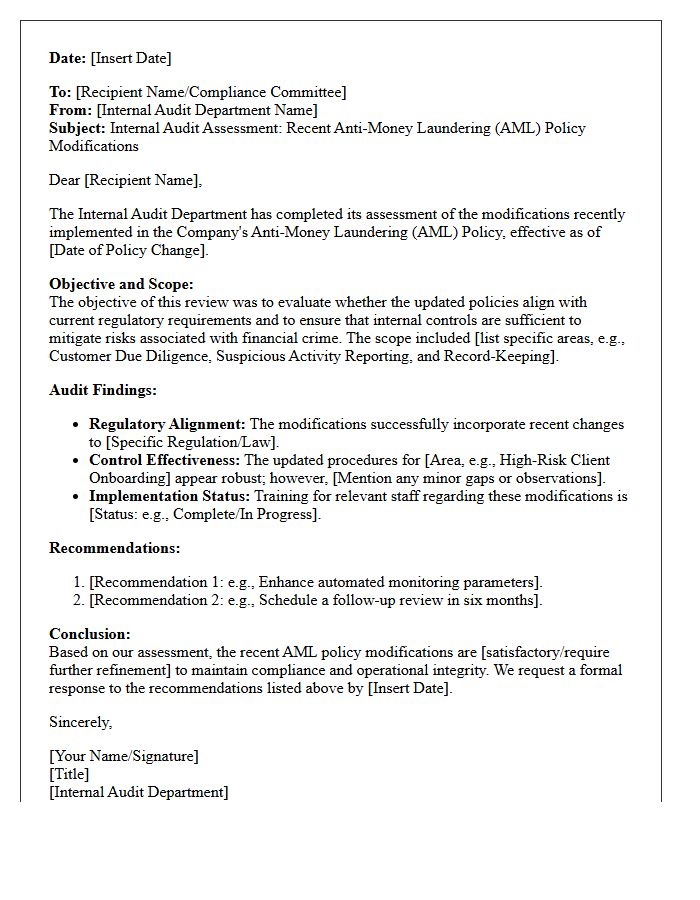
An internal audit letter evaluating anti-money laundering policy modifications is a critical document for regulatory compliance. It provides an independent assessment of whether updated controls effectively mitigate financial crime risks. The audit examines the alignment of new protocols with current legal frameworks and ensures staff implementation is consistent. This process identifies potential vulnerabilities in transaction monitoring and reporting systems, offering essential remediation steps to prevent penalties. Understanding this letter is vital for management to confirm that recent policy changes strengthen the organization's overall integrity and operational security.
Technical Requirements Letter for Implementing Anti-Money Laundering System Updates
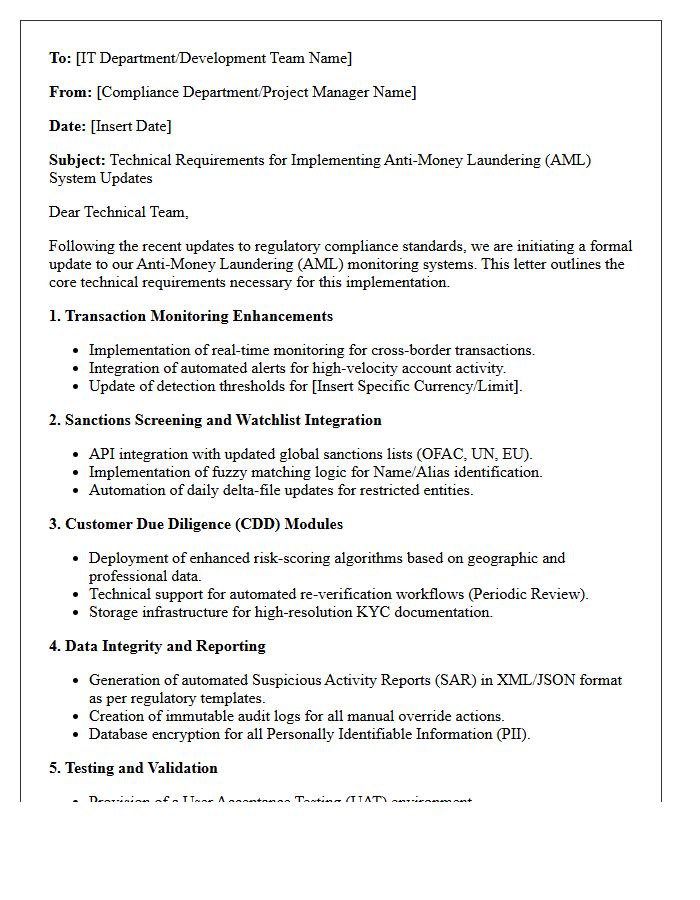
A Technical Requirements Letter outlines the essential specifications for upgrading Anti-Money Laundering (AML) software. It serves as a blueprint for developers, detailing data integration protocols, API connectivity, and real-time monitoring capabilities. Key sections must address system scalability, security encryption standards, and regulatory compliance features to ensure accurate transaction screening. Clear documentation of hardware needs and software dependencies is vital for a seamless deployment, reducing the risk of financial crime while maintaining operational efficiency during the update process.
Board of Directors Acknowledgment Letter on Anti-Money Laundering Strategic Updates
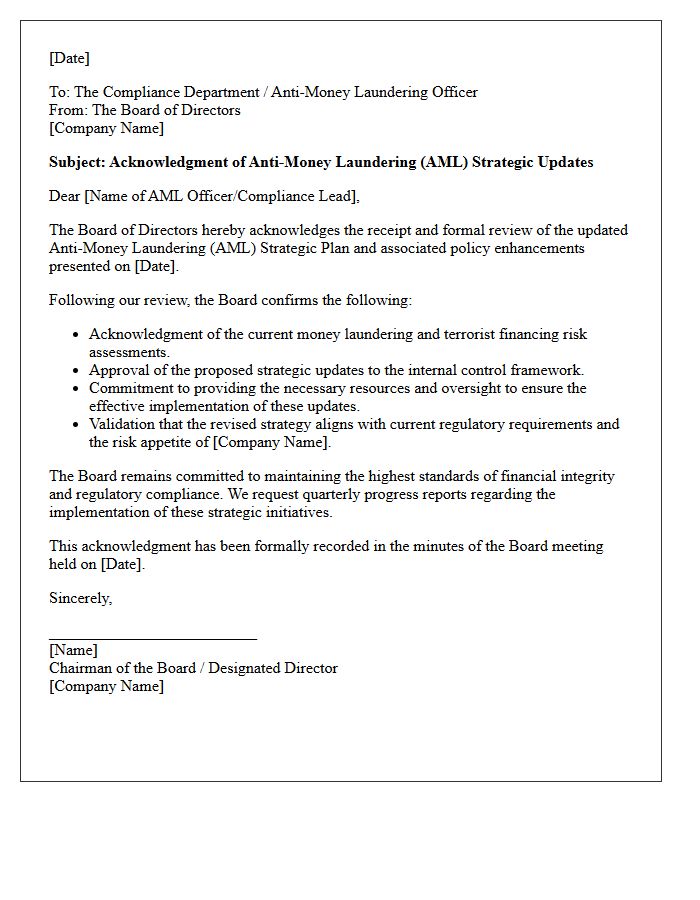
A Board of Directors Acknowledgment Letter confirms that leadership has reviewed and approved Anti-Money Laundering (AML) strategic updates. This formal document demonstrates regulatory compliance and reinforces the board's oversight of financial crime prevention frameworks. It ensures that directors are fully aware of evolving risk management protocols and resource allocations necessary to combat illicit activities. By signing, the board validates their commitment to maintaining a robust governance structure, which is essential for mitigating legal liabilities and protecting the institution's reputation during official audits.
Enhanced Due Diligence Letter for High-Risk Clients Under Updated Anti-Money Laundering Policies
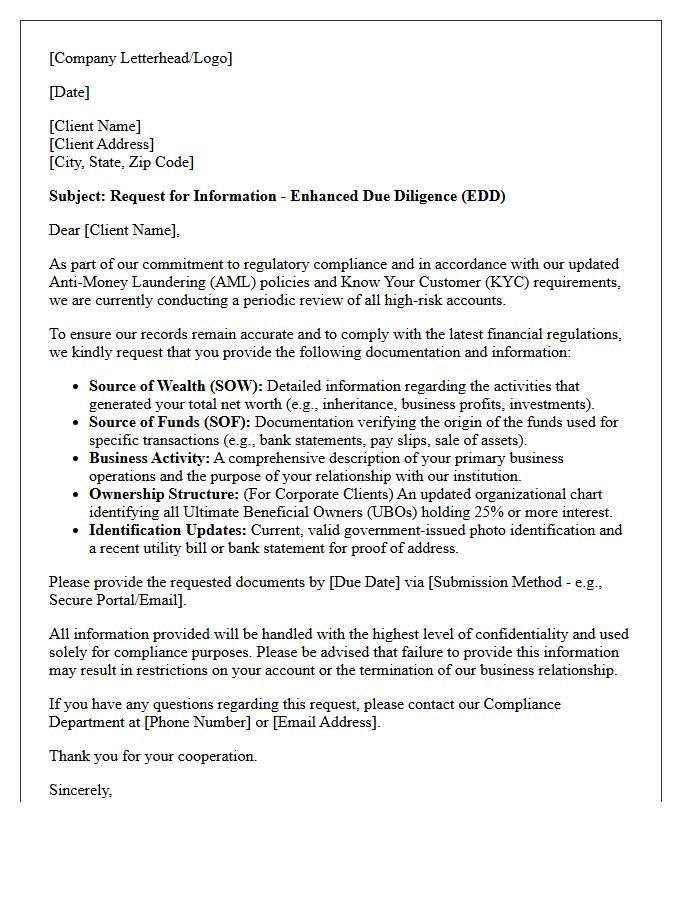
An Enhanced Due Diligence (EDD) letter is a formal request sent to high-risk clients to satisfy rigorous Anti-Money Laundering (AML) compliance standards. Under updated global policies, financial institutions must verify the Source of Wealth and Source of Funds to mitigate risks of financial crime. Recipients must provide detailed documentation regarding their business activities, asset origins, and transaction patterns. Failure to respond accurately or promptly to an EDD request may result in account restrictions or termination, as banks prioritize regulatory transparency to prevent money laundering and terrorism financing.
What are the primary objectives of the latest Anti-Money Laundering (AML) policy updates?
The updates aim to align our internal controls with evolving global regulatory standards, enhance our risk-based approach to customer due diligence, and integrate automated monitoring tools to detect suspicious financial patterns more effectively.
How do these policy changes affect the current Customer Due Diligence (CDD) procedures?
The revised policy mandates enhanced due diligence (EDD) for high-risk jurisdictions and requires more frequent updates to Ultimate Beneficial Ownership (UBO) documentation to ensure full transparency in corporate structures.
What are the new internal reporting requirements for suspicious activity?
Employees must now submit an Internal Suspicious Activity Report (ISAR) within 24 hours of identifying a red flag. The update centralizes the reporting process through a secured digital portal to ensure immediate review by the Compliance Officer.
Are there updated penalties for non-compliance with the revised AML guidelines?
Yes, the memorandum outlines stricter disciplinary actions for internal policy breaches and highlights increased statutory fines from regulatory bodies for institutional failures in maintaining adequate AML oversight.
What training is required for staff regarding the new AML memorandum?
All personnel are required to complete a mandatory certification module covering the specific policy updates, new reporting thresholds, and updated "red flag" indicators by the end of the current fiscal quarter.

Comments