
A Request for Cancellation of Letter of Credit is a formal formal notification sent to an issuing bank to terminate an active financial guarantee. This process requires mutual consent from the applicant and beneficiary to release committed funds and credit lines. Understanding the proper legal phrasing ensures a smooth revocation process. To simplify your documentation, below are some ready to use templates.

Image cover: Formal Letter of Credit Cancellation Request: Samples and Templates
Letter Samples List
- Mutual Agreement Letter of Credit Cancellation Request Letter
- Beneficiary Consent Letter for Letter of Credit Termination
- Expired Shipment Period Letter of Credit Cancellation Letter
- Unutilized Balance Letter of Credit Closure Request Letter
- Underlying Contract Termination Letter of Credit Cancellation Letter
- Alternative Payment Arrangement Letter of Credit Withdrawal Letter
- Force Majeure Event Letter of Credit Annulment Letter
- Beneficiary Non-Performance Letter of Credit Revocation Letter
- Commercial Trade Dispute Letter of Credit Cancellation Letter
- Regulatory Compliance Letter of Credit Nullification Letter
- Standby Letter of Credit Release and Cancellation Letter
- Import Letter of Credit Surrender Request Letter
Mutual Agreement Letter of Credit Cancellation Request Letter
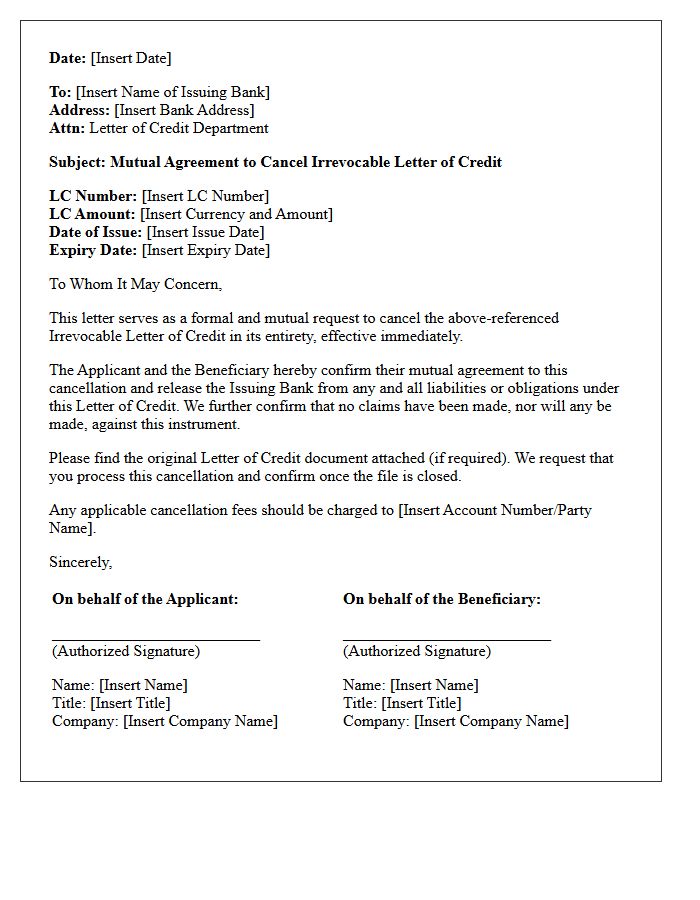
A Mutual Agreement Letter of Credit Cancellation Request is a formal document used when both the applicant and beneficiary agree to terminate a financial guarantee before its expiry. It is essential to include the unique LC number and the exact issuance date to ensure accuracy. This process requires written consent from all parties involved, including the advising bank, to release the legal obligations. Properly executing this request prevents unnecessary bank fees and restores the applicant's line of credit, ensuring a clean financial record for both trading partners.
Beneficiary Consent Letter for Letter of Credit Termination
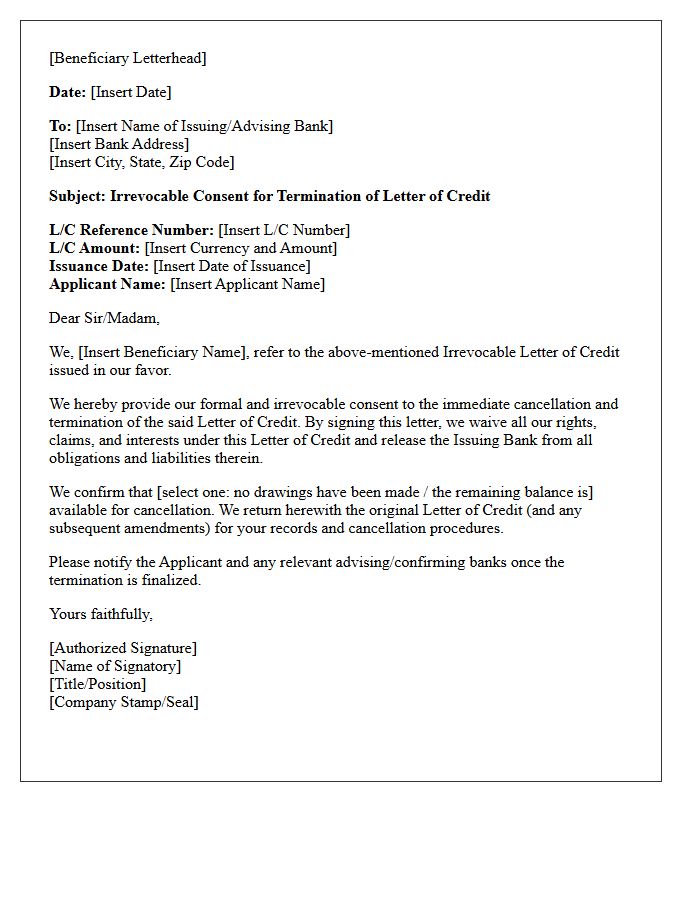
A Beneficiary Consent Letter is a critical document required for the early cancellation of an irrevocable letter of credit. Since the issuing bank and applicant cannot unilaterally terminate the agreement, the beneficiary must formally agree to waive their rights to payment. This signed statement confirms the beneficiary releases the bank from all financial obligations. Without this explicit written authorization, the credit remains legally binding until its expiry date. It ensures all parties are protected during the trade finance reconciliation process and facilitates the release of collateralized funds.
Expired Shipment Period Letter of Credit Cancellation Letter
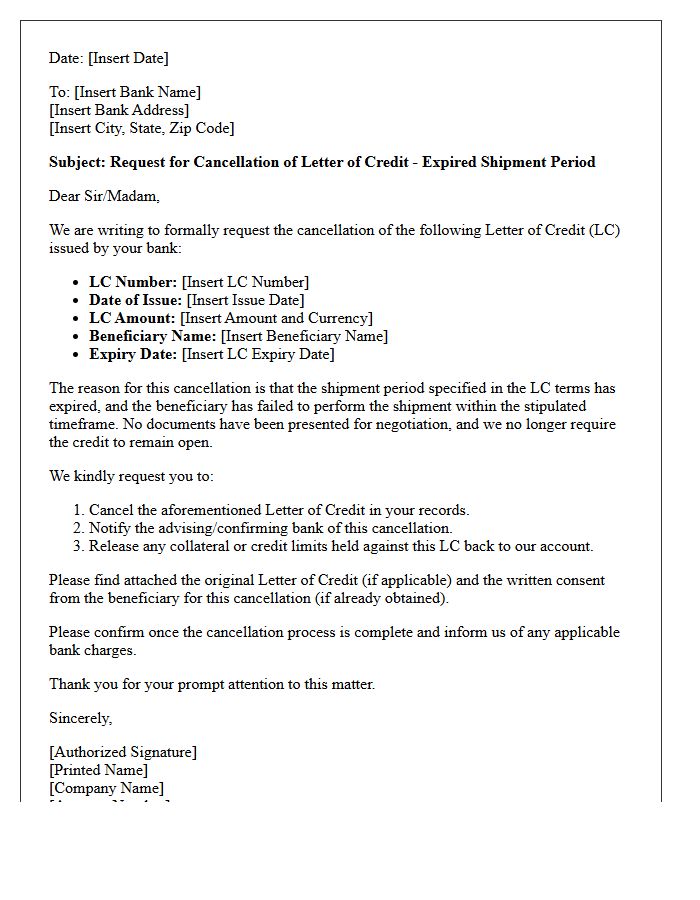
An Expired Shipment Period occurs when goods are not shipped by the latest date specified in a Letter of Credit. This discrepancy constitutes a material breach of terms, allowing the issuing bank or applicant to refuse payment. To formalize this, a Cancellation Letter must be issued to the advising bank to void the credit. This document ensures legal discharge of the buyer's financial liability and releases any collateral held by the bank, preventing unauthorized or late draws against the expired instrument.
Unutilized Balance Letter of Credit Closure Request Letter
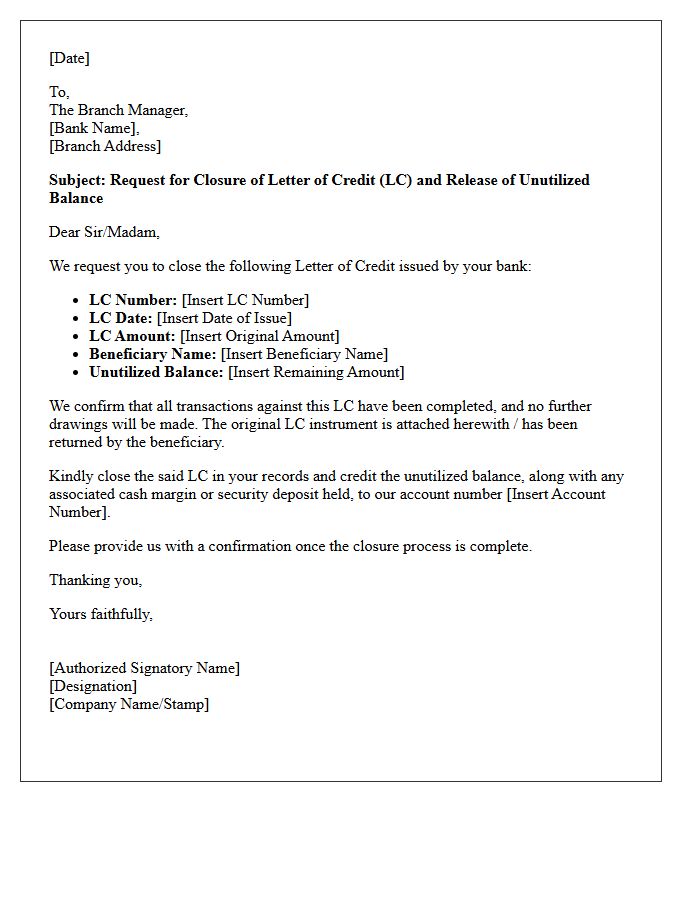
An Unutilized Balance Letter of Credit Closure Request Letter is a formal document sent to a bank to officially terminate an active LC. It is essential to ensure that the outstanding financial obligations are zero and all shipments are complete. Clearly state the LC reference number and instruct the bank to release any collateral or margin money held against the instrument. Timely closure prevents unnecessary commitment fees and improves your company's available credit limit for future trade finance transactions.
Underlying Contract Termination Letter of Credit Cancellation Letter
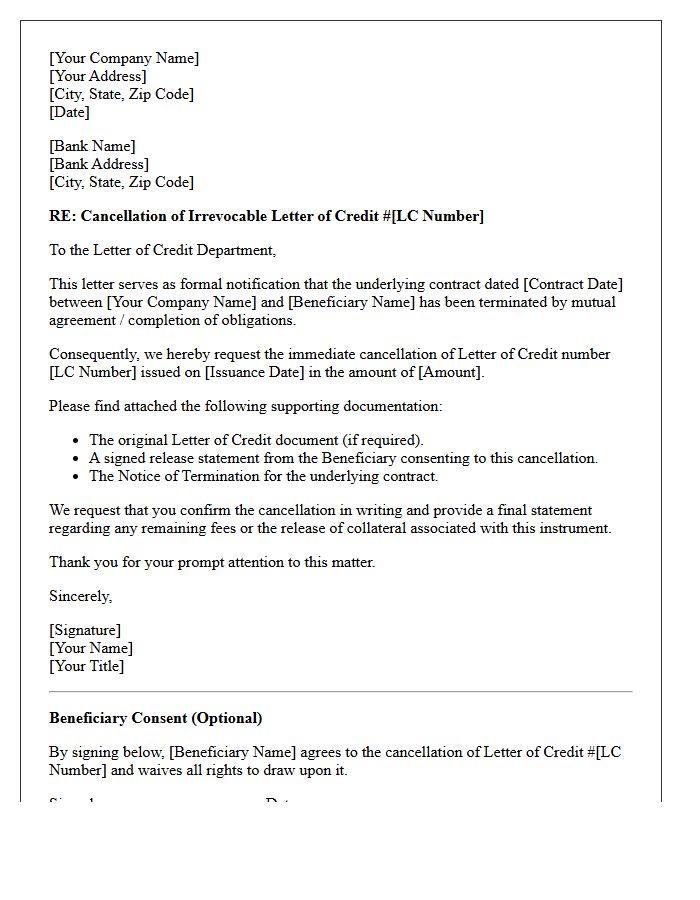
When drafting an Underlying Contract Termination, you must explicitly notify all parties to trigger a Letter of Credit Cancellation. A Letter of Credit is legally independent of the sales agreement; therefore, terminating the contract does not automatically void the financial instrument. You must provide a formal Cancellation Letter to the issuing bank, often requiring the beneficiary's written consent or the return of the original document. Ensuring these two processes are synchronized prevents unauthorized draws and avoids unnecessary bank fees after the business relationship ends.
Alternative Payment Arrangement Letter of Credit Withdrawal Letter
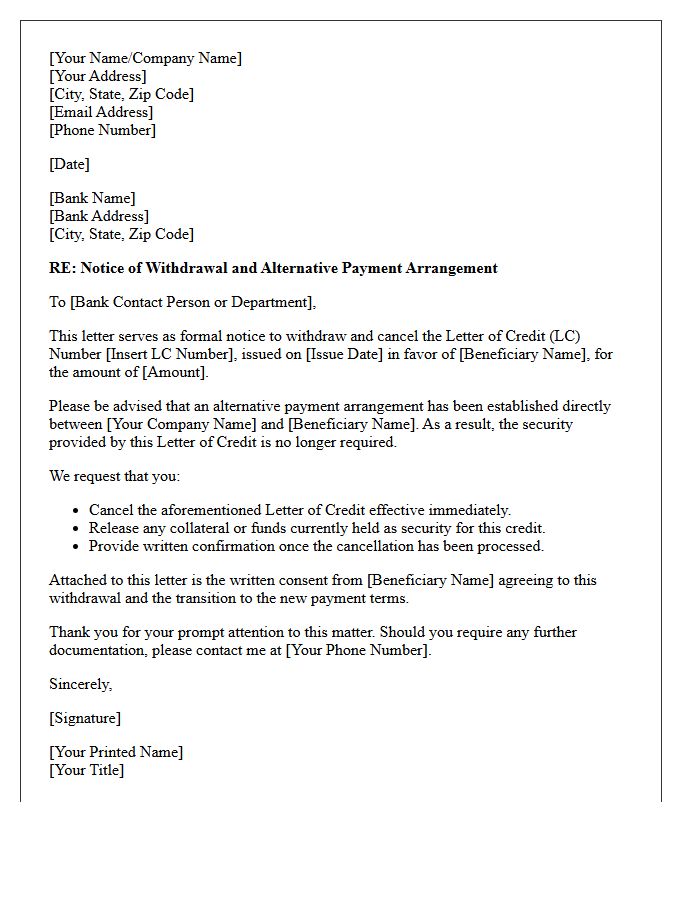
An Alternative Payment Arrangement Letter of Credit Withdrawal Letter is a formal notification used to access funds from a standby letter of credit. This document is essential when a primary payment obligation is not met, allowing the beneficiary to secure guaranteed payment from the issuing bank. It must strictly adhere to specified formatting and documentation requirements outlined in the original agreement. Ensuring accuracy in this letter is vital to avoid discrepancies that could delay the transfer of capital during financial settlements or contractual defaults.
Force Majeure Event Letter of Credit Annulment Letter
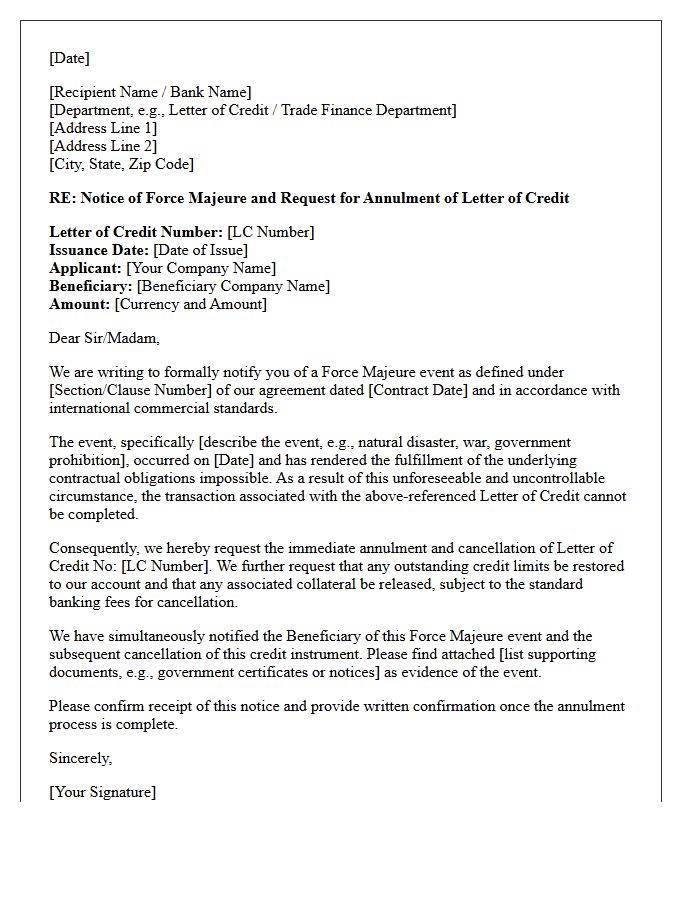
A Force Majeure Event Letter of Credit Annulment Letter is a formal legal notification used to cancel financial obligations due to unforeseeable, uncontrollable circumstances. This document informs the beneficiary that extraordinary events, such as natural disasters or war, have rendered contract performance impossible. It serves to protect the applicant from liability while officially requesting the nullification of the credit facility. Clear documentation of the specific event and its direct impact is essential to justify the termination of the financial instrument under international trade laws and banking regulations.
Beneficiary Non-Performance Letter of Credit Revocation Letter
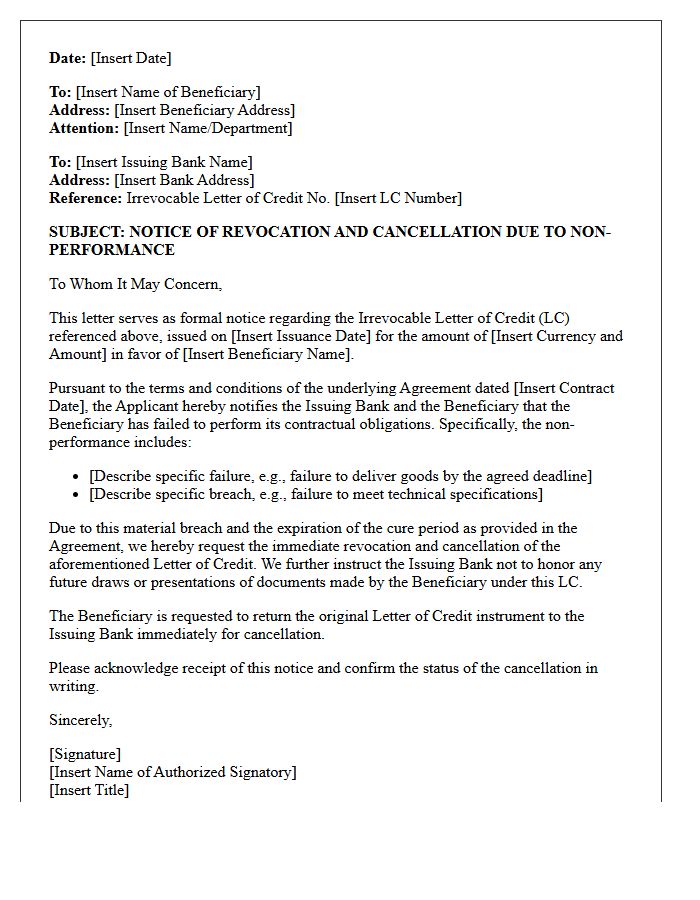
A Beneficiary Non-Performance Letter of Credit Revocation Letter is a formal notification used to cancel a financial guarantee when a seller fails to meet contractual obligations. This document provides legal evidence that the applicant is rescinding the credit due to a specific breach of terms. It is essential to clearly state the default reasons and reference the original credit number to ensure the issuing bank stops payment. Timely issuance prevents unauthorized draws and protects the buyer's liquidity from non-compliant international trade transactions.
Commercial Trade Dispute Letter of Credit Cancellation Letter
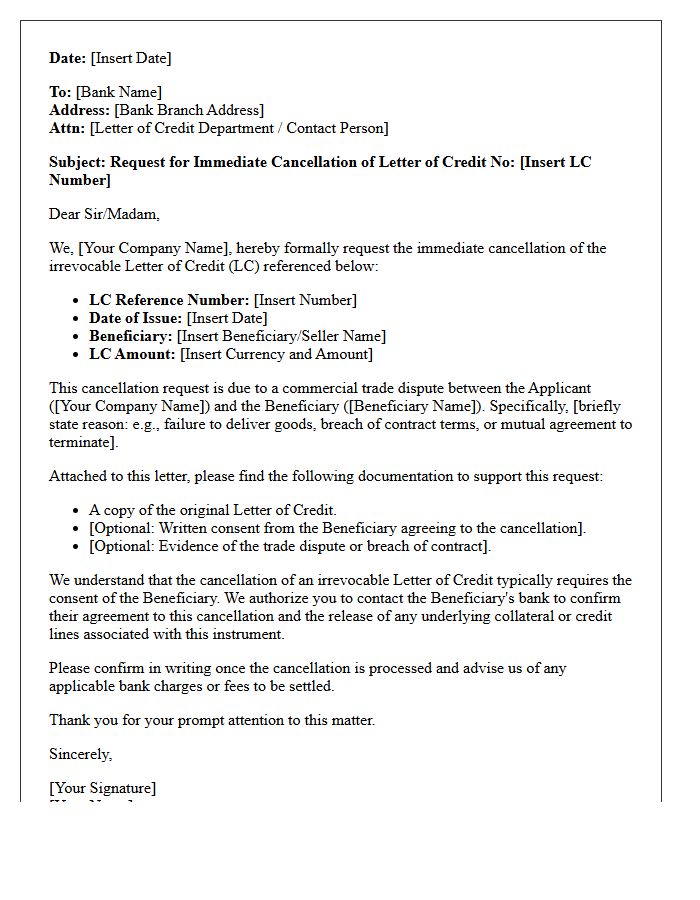
A commercial trade dispute Letter of Credit Cancellation Letter is a formal legal notification used to terminate a payment guarantee when a breach of contract occurs. It must clearly state the irrevocable nature of the credit and provide specific evidence of the dispute, such as non-delivery or defective goods. Both the beneficiary and the issuing bank must typically consent to the revocation to ensure financial discharge. Promptly issuing this document is essential to protect liquidity and prevent unauthorized fund drawdowns during international arbitration or legal mediation processes.
Regulatory Compliance Letter of Credit Nullification Letter
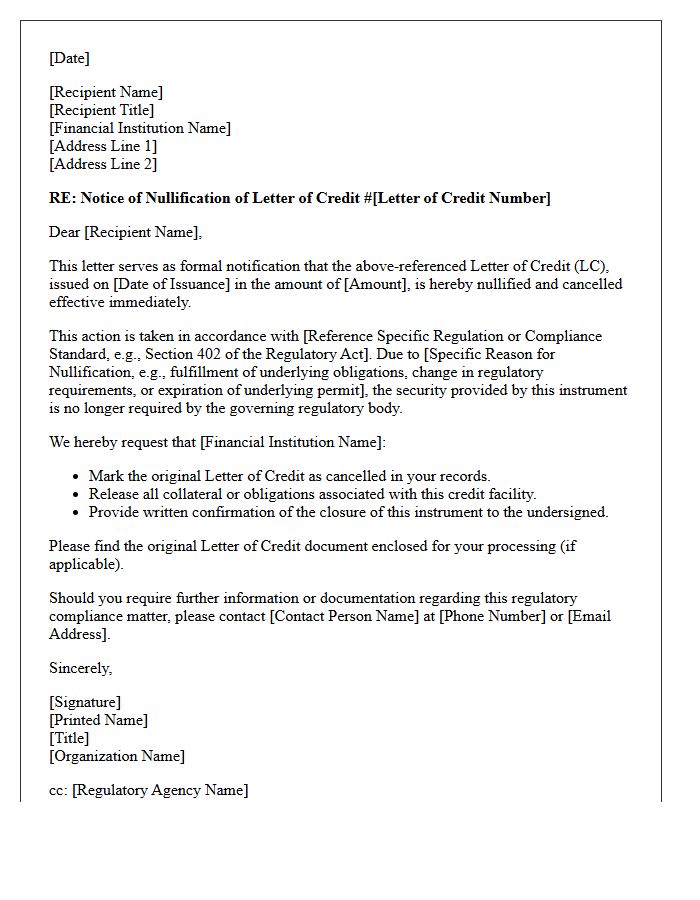
A Regulatory Compliance Letter of Credit Nullification Letter is a formal document used to cancel a financial guarantee when regulatory requirements are no longer applicable or have been satisfied. This letter officially notifies the issuing bank and the beneficiary that the obligation is void, ensuring the release of collateral and restoring the applicant's credit capacity. It is a critical administrative step in legal and trade finance sectors to prevent unauthorized draws and maintain accurate financial reporting once compliance standards are met or the underlying contract ends.
Standby Letter of Credit Release and Cancellation Letter
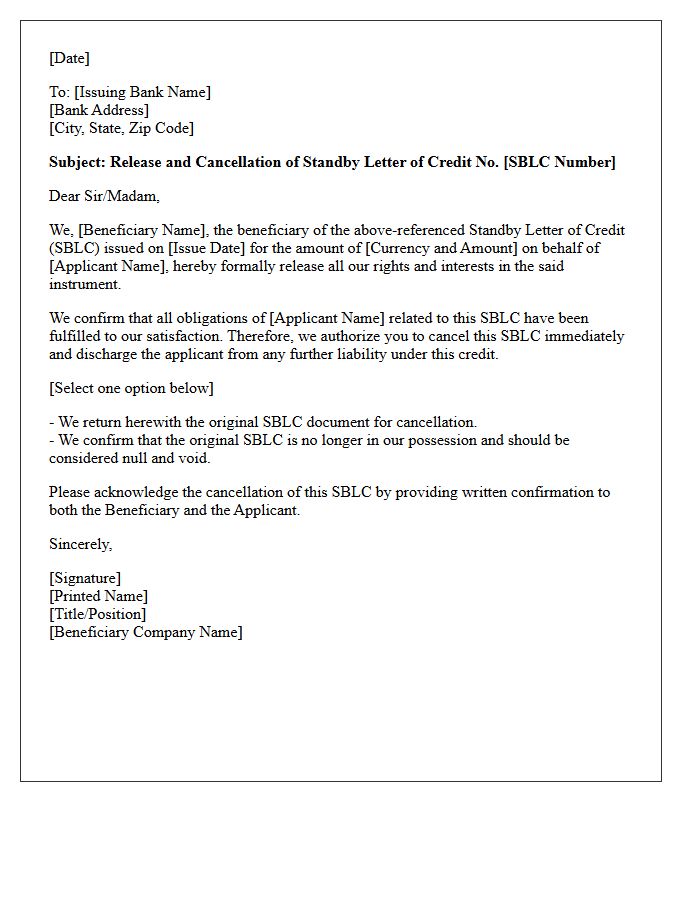
A Standby Letter of Credit (SBLC) Release and Cancellation Letter is a formal legal document issued by the beneficiary to the bank to terminate the financial obligation. It confirms that the underlying contract is fulfilled and the issuer is discharged from all liabilities. Timely submission is crucial to free up the applicant's collateral and credit lines. Without this official authorization, the bank may continue charging commitment fees even if the guarantee is no longer needed. Ensure the letter references the unique instrument number for accurate processing.
Import Letter of Credit Surrender Request Letter
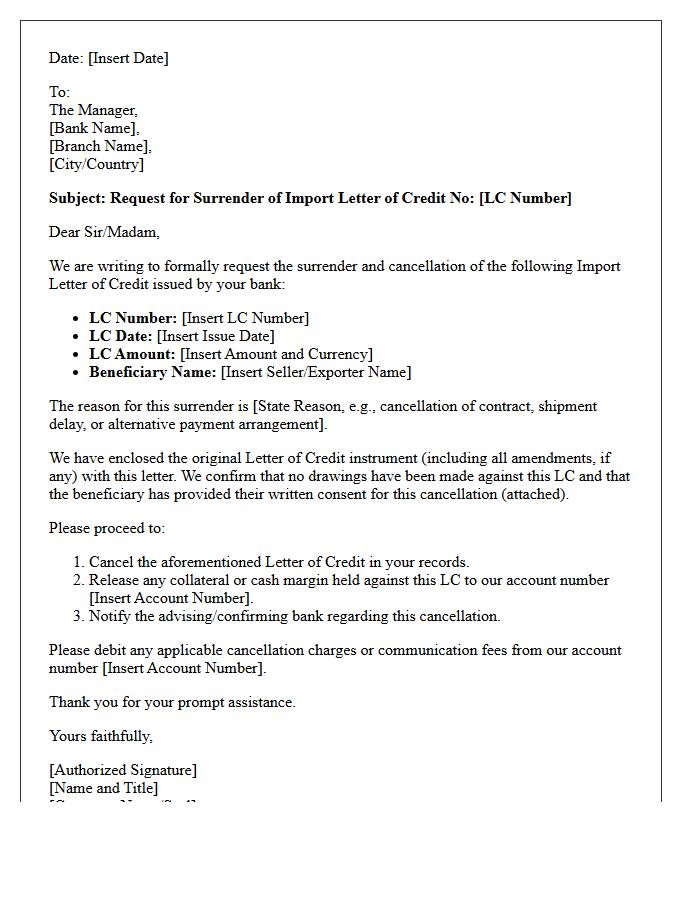
An Import Letter of Credit Surrender Request Letter is a formal document submitted by an importer to their bank to release original transport documents. This process is essential when the goods arrive before the physical paperwork. By issuing this letter of indemnity, the applicant requests the bank to endorse documents or issue a shipping guarantee. This ensures immediate cargo release while protecting the financial institution against potential discrepancies or claims. It is a critical tool for maintaining supply chain efficiency and avoiding costly demurrage charges at the port of entry.
How do I submit a request for the cancellation of a Letter of Credit?
To initiate a cancellation, the applicant must submit a formal written request to the issuing bank, typically accompanied by the original Letter of Credit document and a signed agreement from the beneficiary consenting to the cancellation.
Is beneficiary consent required to cancel an irrevocable Letter of Credit?
Yes, an irrevocable Letter of Credit cannot be cancelled or amended without the explicit written agreement of the beneficiary, the issuing bank, and, if applicable, the confirming bank.
What are the common reasons for requesting a Letter of Credit cancellation?
Common reasons include the mutual termination of the underlying sales contract, the fulfillment of payment through alternative methods, or the expiration of the credit term without the required shipment of goods.
Are there fees associated with cancelling a Letter of Credit?
Most financial institutions charge a specific cancellation fee or processing fee. Additionally, any communication costs, such as SWIFT charges used to notify the advising bank, will be billed to the applicant's account.
How long does the Letter of Credit cancellation process take?
The timeline depends on how quickly the beneficiary provides their consent. Once all parties agree and the original documents are returned to the issuing bank, the cancellation is typically processed within 3 to 5 business days.

Comments