
A Bank-to-Bank Comfort Letter serves as a critical document in trade finance, providing assurance between financial institutions regarding the creditworthiness of a client. It streamlines the issuance of Letters of Credit by verifying financial capabilities without creating a formal legal binding. This document facilitates smoother global trade transactions and builds mutual trust. Below are some ready to use templates.
Image cover: Mastering Bank-to-Bank Comfort Letters: Professional Samples and Proven Templates
Letter Samples List
- Issuing Bank Comfort Letter for Letters of Credit
- Advising Bank Comfort Letter for Letters of Credit
- Confirming Bank Comfort Letter for Letters of Credit
- Irrevocable Letter of Credit Bank Comfort Letter
- Standby Letter of Credit Bank Comfort Letter
- Revolving Letter of Credit Bank Comfort Letter
- Deferred Payment Letter of Credit Bank Comfort Letter
- Transferable Letter of Credit Bank Comfort Letter
- Back-to-Back Letter of Credit Bank Comfort Letter
- Red Clause Letter of Credit Bank Comfort Letter
- Sight Payment Letter of Credit Bank Comfort Letter
- Reimbursement Bank Comfort Letter for Letters of Credit
Issuing Bank Comfort Letter for Letters of Credit
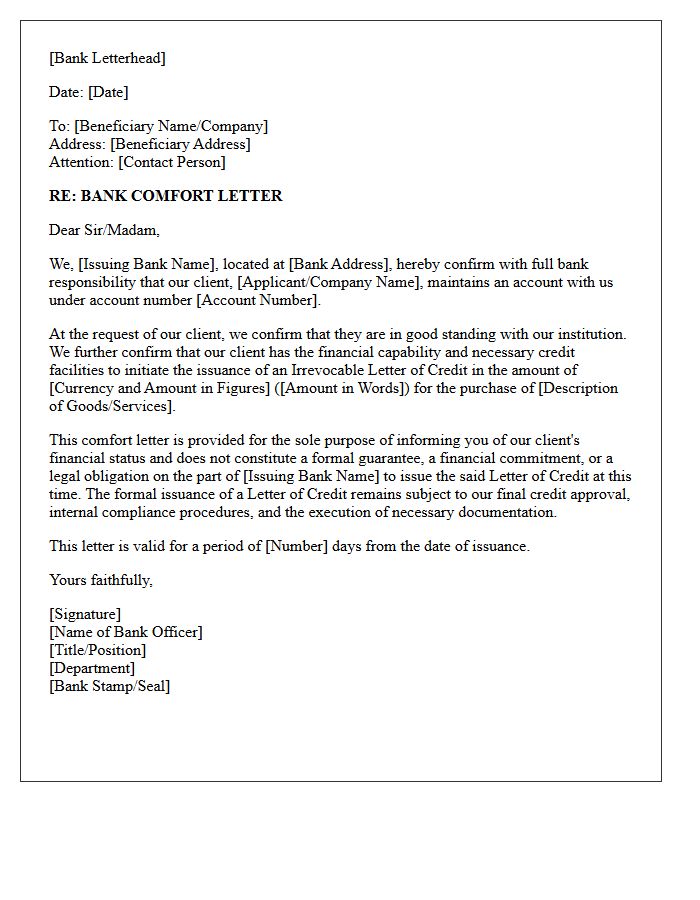
An Issuing Bank Comfort Letter (BCL) is a critical financial document confirming a client's creditworthiness and capacity to fund a specific transaction. It serves as a pre-advice, signaling the bank's readiness to open a formal Letter of Credit. While it demonstrates solvency and commitment, it is not a legally binding payment guarantee. Exporters use BCLs to verify a buyer's financial standing before finalizing contracts. Ensuring the bank is a reputable prime institution is essential for securing international trade deals and mitigating delivery risks.
Advising Bank Comfort Letter for Letters of Credit
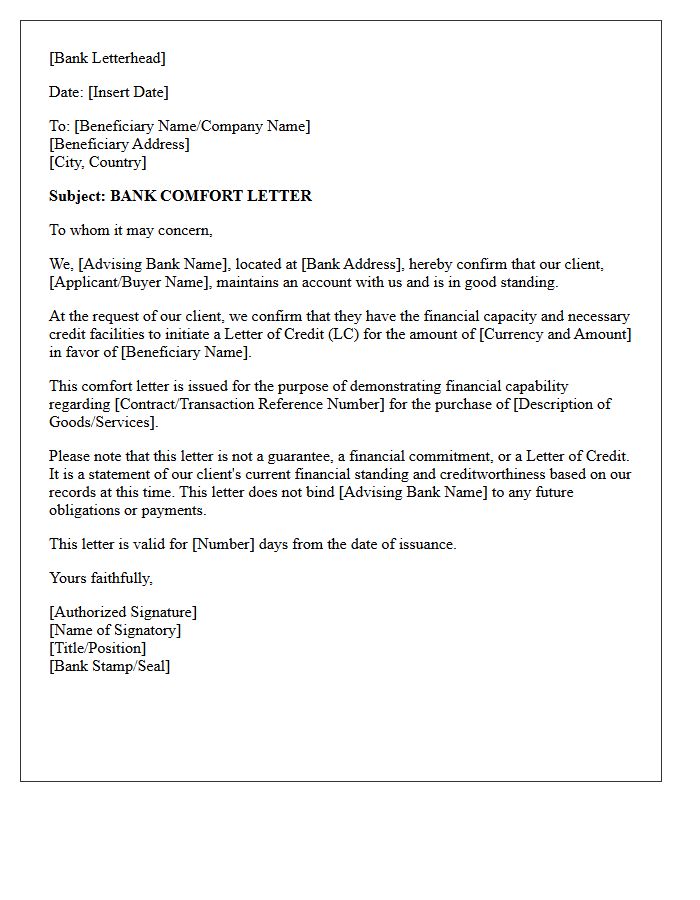
An Advising Bank Comfort Letter is a formal document issued by a bank to confirm its willingness to process a Letter of Credit (LC) on behalf of a beneficiary. While it provides assurance regarding the bank's involvement, it is not a financial guarantee or a binding payment commitment. Its primary purpose is to verify that banking channels are open and the institution is ready to advise the instrument upon receipt. Exporters use these letters to establish transactional confidence and demonstrate the operational feasibility of high-value international trade agreements before formal issuance.
Confirming Bank Comfort Letter for Letters of Credit
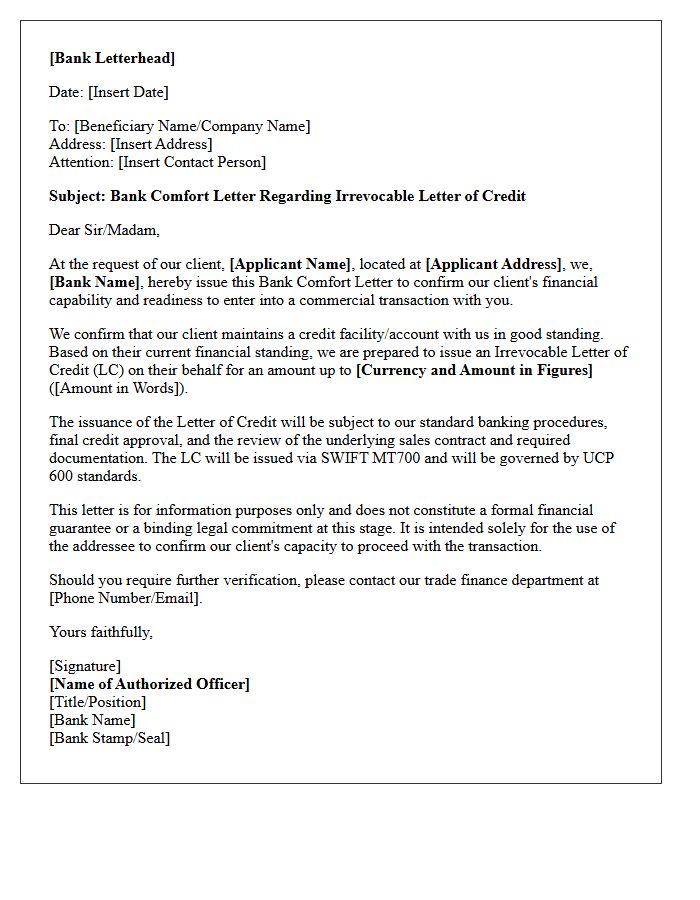
A Confirming Bank Comfort Letter (BCL) is a vital document issued by a financial institution to verify a buyer's solvency and asset availability. In the context of Letters of Credit, it provides preliminary assurance that the bank is prepared to back a specific transaction. While not a payment guarantee itself, it demonstrates financial capability, building trust between international trading partners. This document streamlines the credit approval process, ensuring the seller that the buyer possesses the necessary liquidity to fulfill contractual payment obligations securely and efficiently.
Irrevocable Letter of Credit Bank Comfort Letter
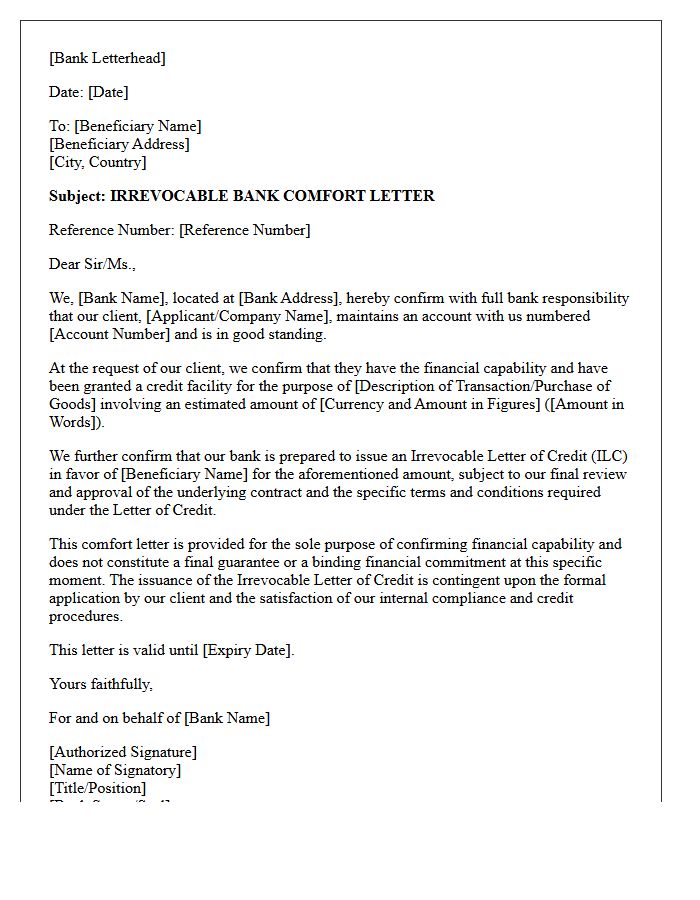
An Irrevocable Letter of Credit (ILOC) provides a legally binding payment guarantee that cannot be canceled without all parties' consent, ensuring financial security for international trade. Often supported by a Bank Comfort Letter (BCL), which confirms a client's solvency and creditworthiness, these documents verify that a buyer possesses the necessary funds to complete a large-scale transaction. Together, they mitigate risk by shifting payment liability to the issuing bank, facilitating trust between exporters and importers in global markets.
Standby Letter of Credit Bank Comfort Letter
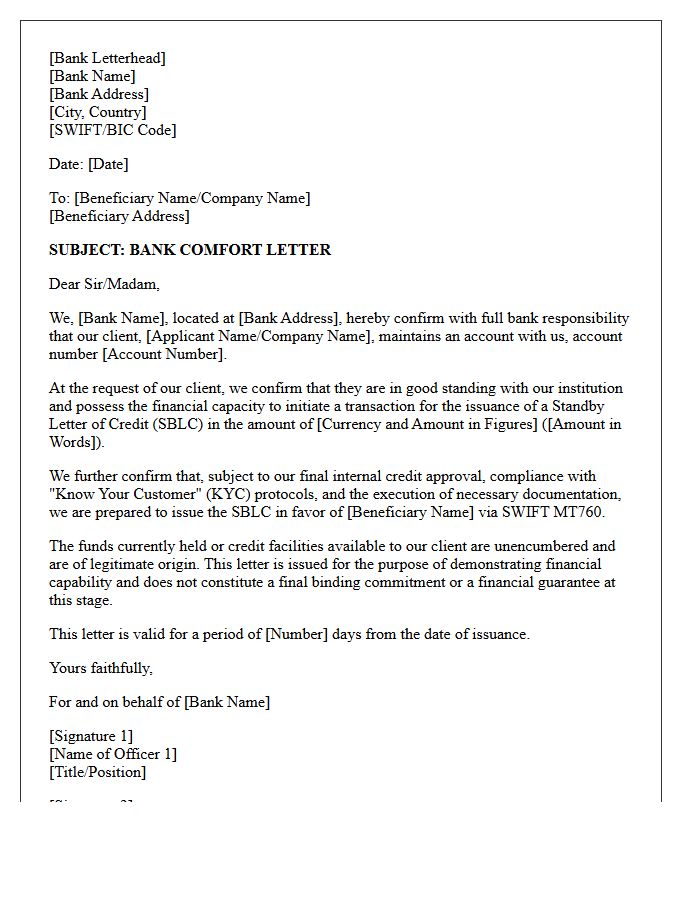
A Standby Letter of Credit (SBLC) serves as a legal guarantee from a financial institution that payment will be made if a client defaults on a contract. Unlike a standard letter of credit, it is a secondary payment mechanism used as a safety net. Often associated with this is a Bank Comfort Letter (BCL), which confirms a buyer's financial capability and creditworthiness to complete a specific large-scale transaction. Together, these instruments provide essential financial security and trust between international trading partners by mitigating non-payment risks in global commerce.
Revolving Letter of Credit Bank Comfort Letter
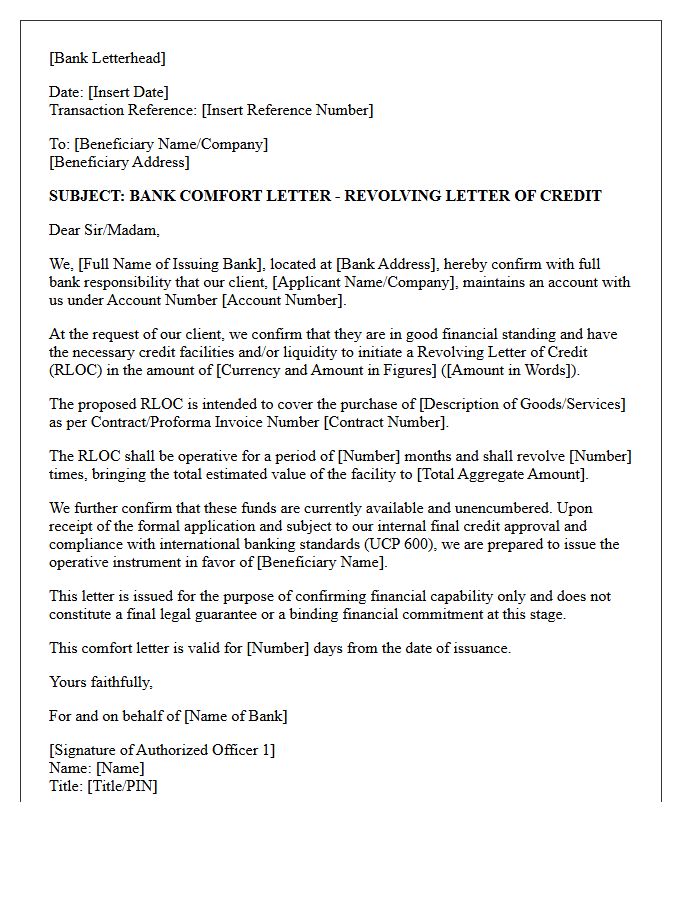
A Revolving Letter of Credit is a strategic financial instrument that automatically restores its value after each drawing, making it ideal for ongoing shipments. When paired with a Bank Comfort Letter (BCL), it serves as a powerful proof of solvency. The BCL confirms the buyer's financial capability to complete a specific transaction without creating a binding obligation. Together, these documents ensure continuous trade operations by guaranteeing payment availability for multiple cycles, providing sellers with the necessary security to maintain long-term supply chains and high-volume commodity contracts efficiently.
Deferred Payment Letter of Credit Bank Comfort Letter
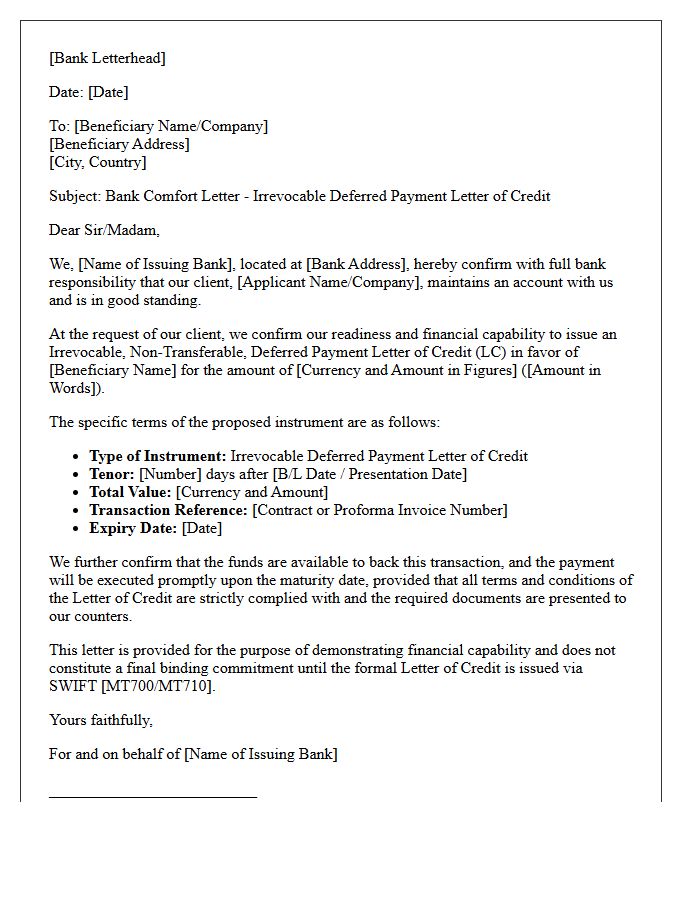
A Deferred Payment Letter of Credit is a financial instrument ensuring payment occurs at a specified future date after shipment. To strengthen this transaction, a Bank Comfort Letter (BCL) acts as a preliminary document confirming the buyer's financial capability to meet the obligation. Together, they mitigate risk for exporters by guaranteeing that the issuing bank will honor the debt, even if the buyer defaults. This combination is essential for international trade, providing security for sellers while offering flexible liquidity for buyers through credit-based terms.
Transferable Letter of Credit Bank Comfort Letter
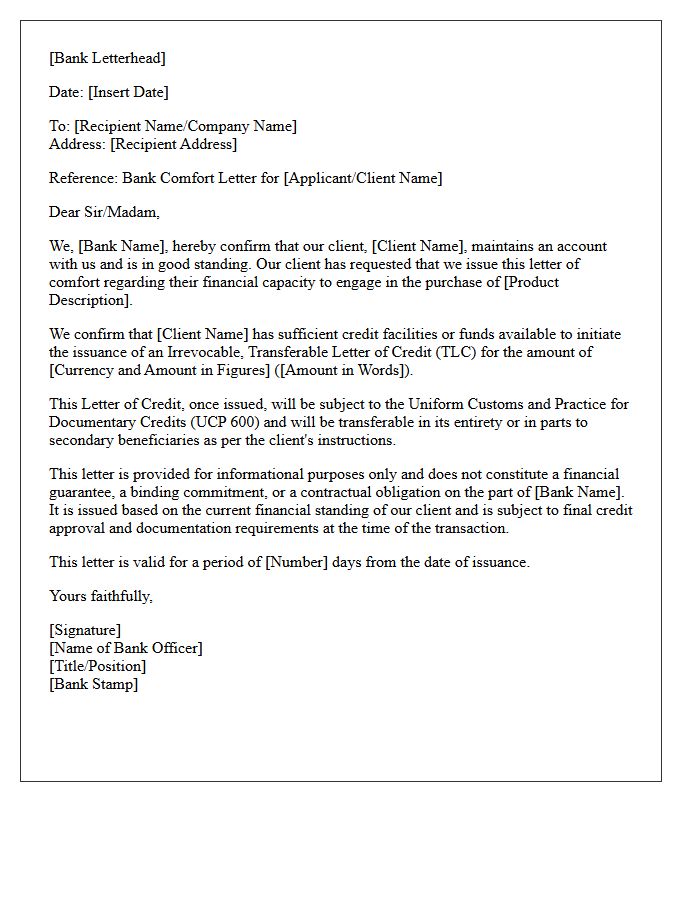
A Transferable Letter of Credit allows the first beneficiary to transfer credit rights to secondary suppliers, facilitating trade without using their own capital. To secure such transactions, a Bank Comfort Letter (BCL) is often required. This document serves as a financial statement confirming the buyer's capability to fund the trade. Together, they ensure payment security and provide assurance to suppliers that the necessary credit facilities are active. Understanding these tools is essential for intermediaries managing large-scale international shipments and complex supply chain financing arrangements.
Back-to-Back Letter of Credit Bank Comfort Letter
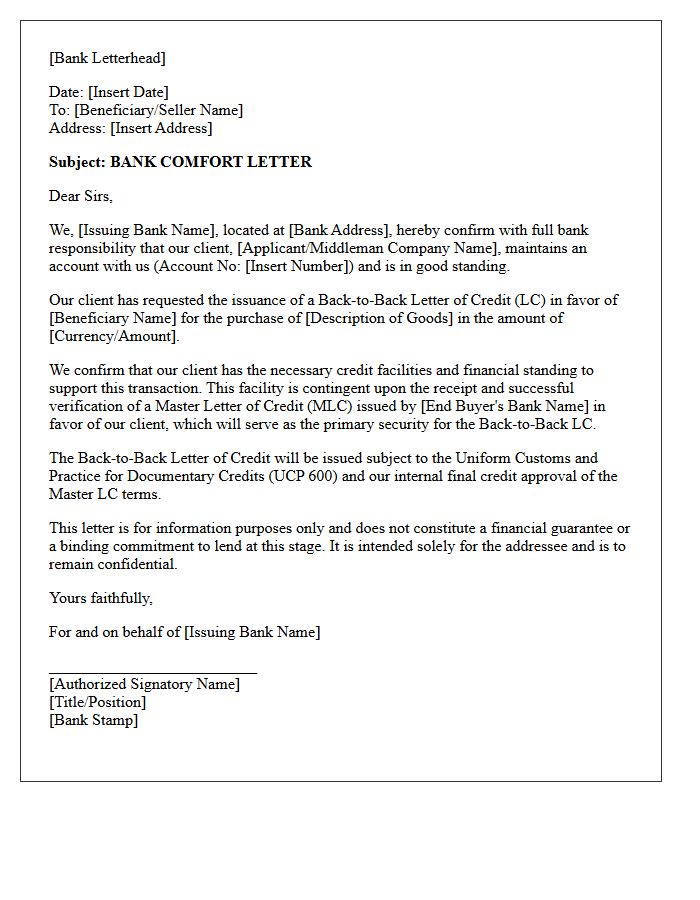
A Back-to-Back Letter of Credit (LC) allows a middleman to open a new credit line using an incoming LC as collateral. To facilitate this, a Bank Comfort Letter (BCL) is issued by a financial institution to confirm a client's financial capability and creditworthiness to fulfill a specific contract. The BCL serves as a preliminary assurance of solvency, while the back-to-back structure enables trade without the intermediary using their own liquid capital. Both documents are essential for securing trust and mitigating risks in complex international supply chain transactions.
Red Clause Letter of Credit Bank Comfort Letter
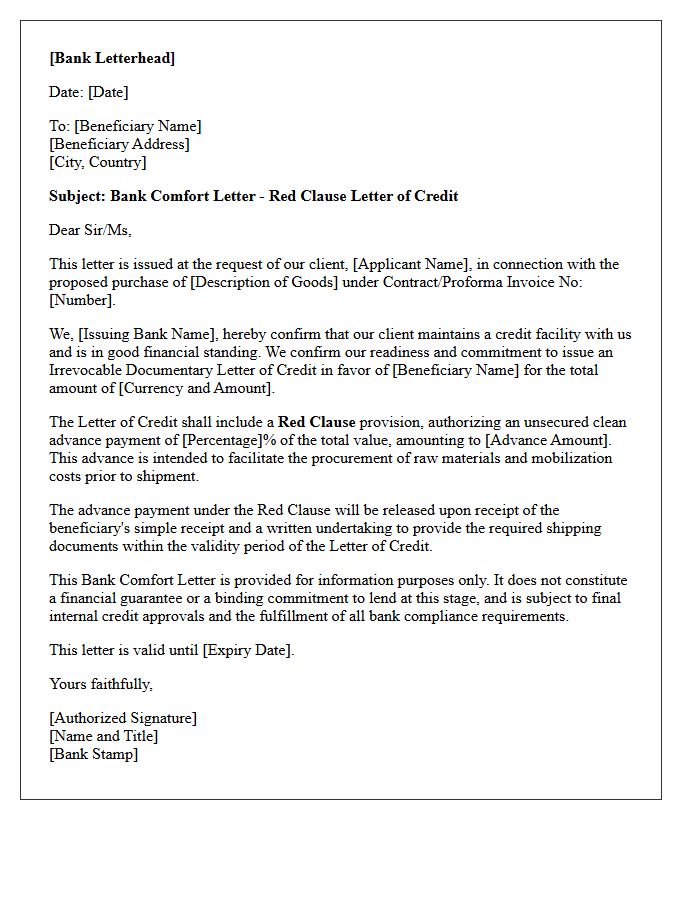
A Red Clause Letter of Credit is a specialized financial instrument allowing an exporter to receive unsecured pre-shipment advances from the nominating bank. This liquidity supports manufacturing or purchasing costs before goods are shipped. In contrast, a Bank Comfort Letter (BCL) is not a payment guarantee but a formal statement confirming a client's financial capability and creditworthiness to undertake a specific transaction. While the Red Clause LC provides immediate funding, the BCL merely demonstrates resources, making both essential for verifying liquidity and solvency in international trade operations.
Sight Payment Letter of Credit Bank Comfort Letter
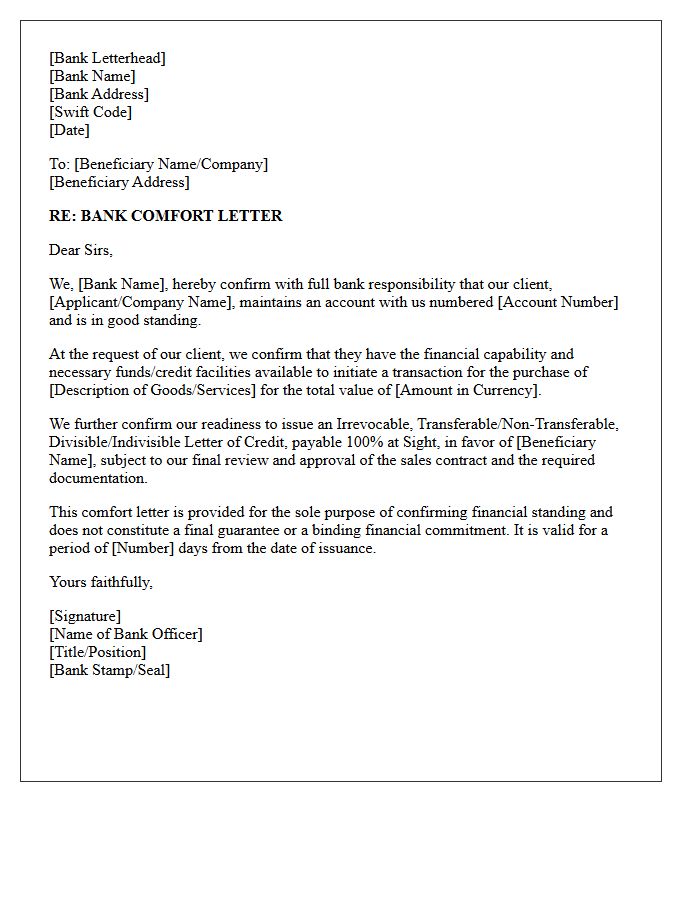
A Sight Payment Letter of Credit ensures immediate payment to the seller upon presenting compliant shipping documents. This financial instrument minimizes risk by guaranteeing funds once terms are met. Conversely, a Bank Comfort Letter (BCL) is a statement confirming a client's financial capability to complete a transaction. While a BCL demonstrates solvency and intent, it is not a payment guarantee. Understanding the distinction between these tools is vital for securing international trade deals and establishing trust between exporters, importers, and financial institutions.
Reimbursement Bank Comfort Letter for Letters of Credit
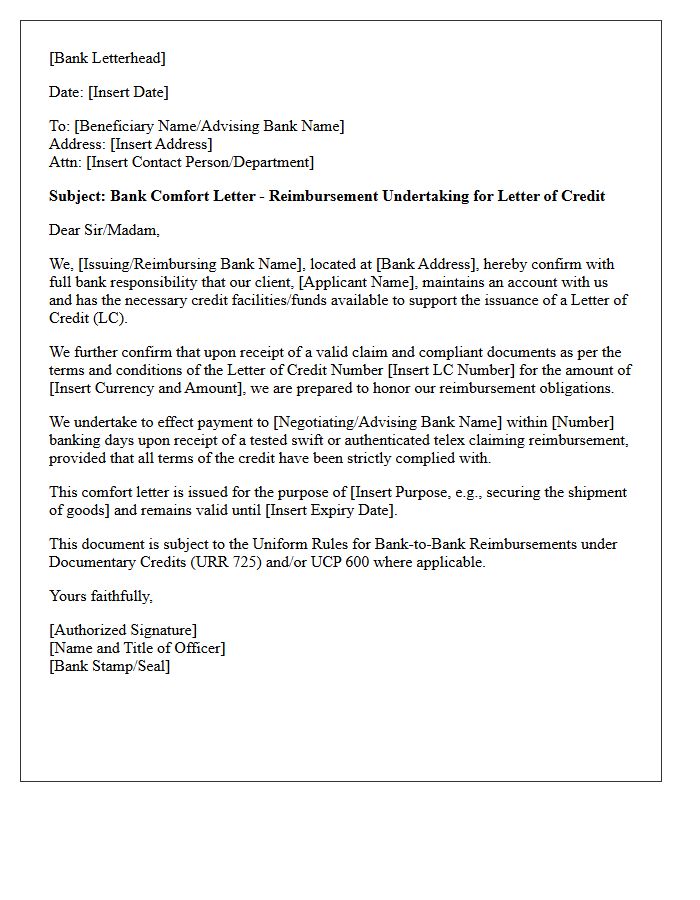
A Reimbursement Bank Comfort Letter (RBCL) is a critical financial document ensuring that a reimbursing bank honors payment claims under a Letter of Credit. It serves as a formal assurance to the negotiating bank that funds are available and will be transferred upon meeting specific compliance requirements. This instrument enhances transaction security by mitigating payment risks in international trade. Understanding the specific settlement terms within an RBCL is essential for exporters to guarantee liquidity and maintain a seamless global supply chain workflow.
What is a Bank-to-Bank Comfort Letter (BCL) in the context of Letters of Credit?
A Bank-to-Bank Comfort Letter is a formal document issued by a buyer's financial institution to a seller's bank, confirming the client's financial capability and creditworthiness to initiate a specific Letter of Credit (LC) transaction.
Is a Comfort Letter a legally binding guarantee of payment?
No, a Comfort Letter is not a guarantee of payment or a commitment to lend; it serves as a statement of "financial capacity" to reassure the seller's bank that the buyer has the necessary funds or credit lines available to open a Letter of Credit.
When is a BCL required during the trade finance process?
A BCL is typically required during the preliminary negotiation stage, before the official Letter of Credit is issued, to prove the buyer's "Proof of Funds" (POF) and move the purchase contract toward finalization.
What key information must be included in a Bank-to-Bank Comfort Letter?
A standard BCL should include the bank's letterhead, the specific account holder's name, a statement of the client's good standing, the total value the bank is willing to support for the transaction, and the validity period of the letter.
Does a Comfort Letter affect the credit limit of the applicant?
Generally, the issuance of a Comfort Letter does not freeze funds or impact the applicant's credit limit, as it is an information-only document; however, the subsequent issuance of the actual Letter of Credit will utilize the applicant's credit facility.


Comments