
A Verification of Trust Income Letter is an official document used to confirm the regular distributions a beneficiary receives from a trust. Lenders and agencies require this letter to validate consistent financial support when qualifying for loans or housing. It provides credible proof of ongoing supplemental wealth beyond traditional employment. To help you draft this documentation, below are some ready to use template.
Image cover: Reliable Templates and Samples for Trust Income Verification Letters
Letter Samples List
- Certified Public Accountant Verification of Trust Income Letter
- Trustee Declaration and Verification of Trust Income Letter
- Mortgage Underwriter Verification of Trust Income Letter
- Revocable Living Trust Income Verification Letter
- Irrevocable Trust Continuance of Income Verification Letter
- Financial Advisor Verification of Trust Income Letter
- Estate Attorney Verification of Trust Income Letter
- Fiduciary Distribution Verification of Trust Income Letter
- Borrower Beneficiary Verification of Trust Income Letter
- Third-Party Verification of Trust Income Letter
- Bank Depository Verification of Trust Income Letter
- Tax Preparer Verification of Trust Income Letter
Certified Public Accountant Verification of Trust Income Letter
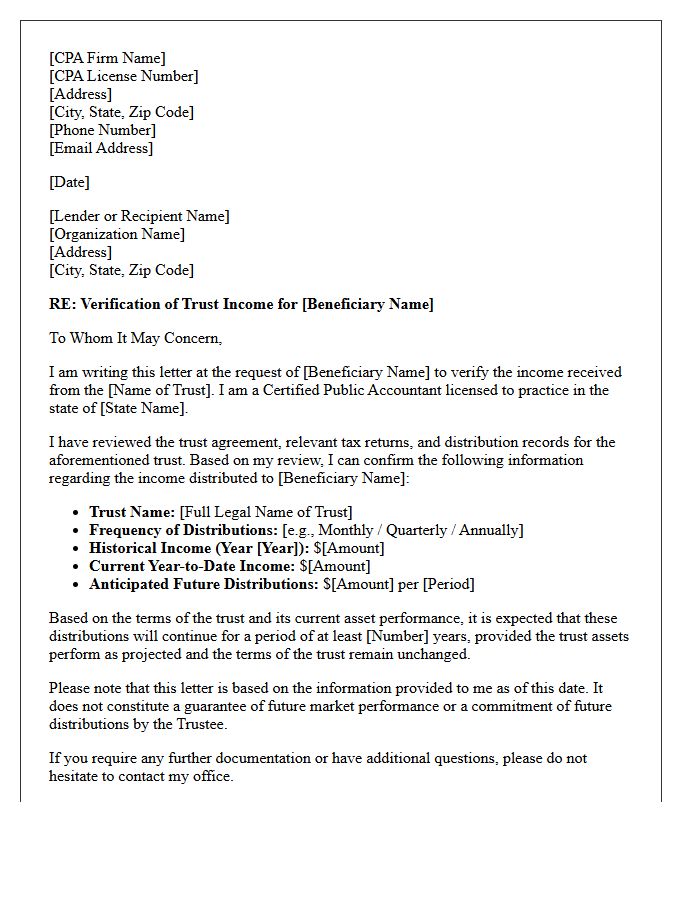
A Certified Public Accountant Verification of Trust Income Letter is a formal document used to validate a beneficiary's earnings for loan underwriting or legal requirements. Lenders require this CPA-signed statement to confirm the stability, history, and recurring nature of trust distributions when qualifying for a mortgage. It ensures the income is reliable and likely to continue. Because CPAs assume professional liability, they strictly verify the trust agreement and tax returns before issuance. This letter serves as critical third-party verification of non-employment cash flow to meet complex financial compliance standards.
Trustee Declaration and Verification of Trust Income Letter
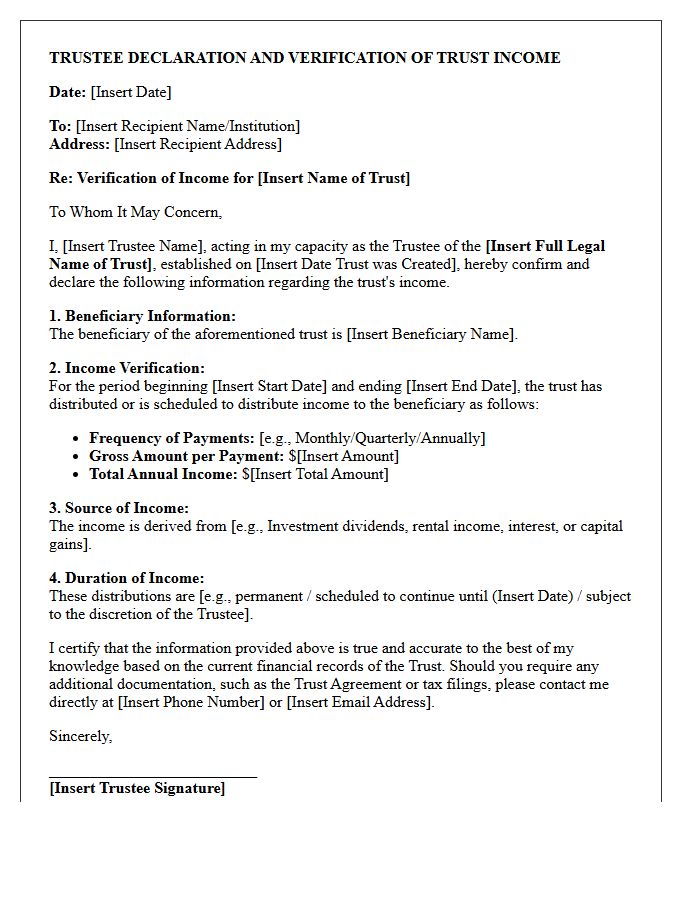
A Trustee Declaration is a formal document where trustees confirm their legal responsibilities and the trust's current status. Alongside a Verification of Trust Income Letter, these documents serve as critical proof for financial institutions or tax authorities regarding fund distribution and beneficiary entitlements. They validate that the trust is operating legally and accurately report all generated earnings. Providing these verified statements ensures regulatory compliance and transparency, which is essential when applying for loans or settling tax obligations involving fiduciary assets and managed wealth.
Mortgage Underwriter Verification of Trust Income Letter
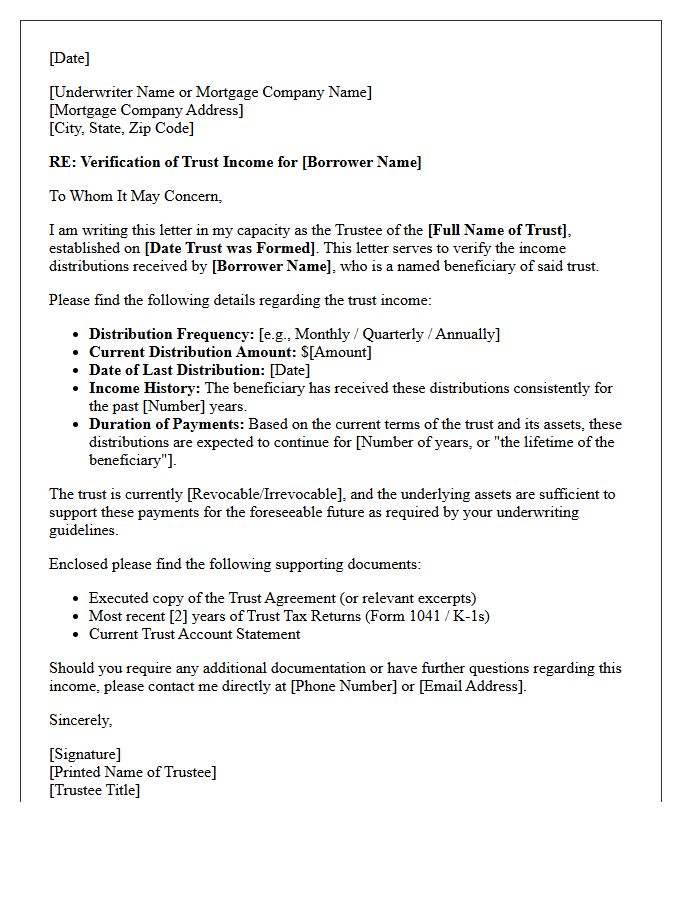
A mortgage underwriter requires a Trust Income Letter to verify the stability and duration of distributions. This document, typically authored by a trustee or CPA, confirms the specific payout amount and frequency. Crucially, the letter must demonstrate that the income is guaranteed to continue for at least three years from the loan closing date. Underwriters use this to calculate your debt-to-income ratio, ensuring the trust assets are sufficient to support ongoing mortgage eligibility and long-term repayment ability according to federal lending guidelines.
Revocable Living Trust Income Verification Letter
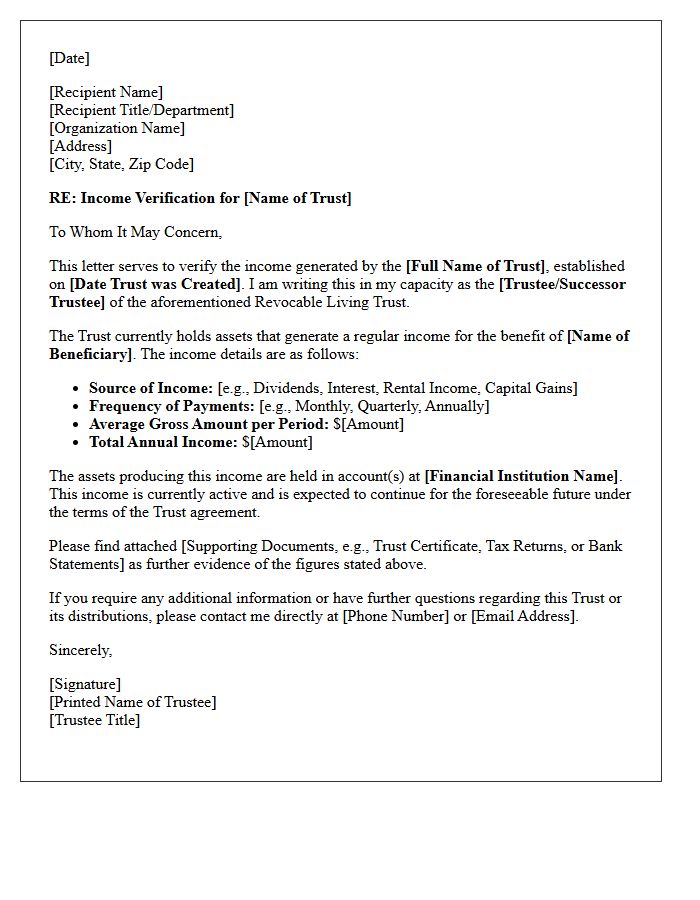
A Revocable Living Trust Income Verification Letter serves as formal proof of earnings generated by trust assets. Lenders or agencies use this document to confirm a beneficiary's financial stability and ongoing cash flow. Typically drafted by a trustee or CPA, the letter details the distribution frequency and source of funds held within the entity. It is essential for securing mortgages or loans when personal tax returns do not fully reflect trust-based wealth. This verification ensures the trust's income is recognized as a legitimate, reliable resource for meeting future financial obligations.
Irrevocable Trust Continuance of Income Verification Letter
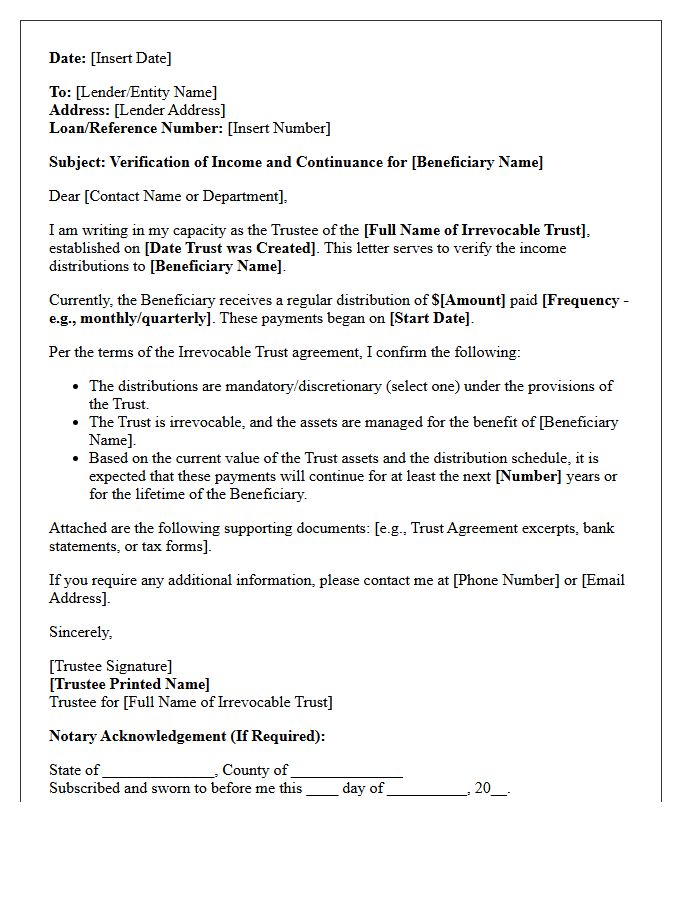
An Irrevocable Trust Continuance of Income Verification Letter is a legal document confirming that a beneficiary will receive ongoing distributions. Lenders require this to verify stable cash flow for mortgage qualifications or loan approvals. The letter must detail the distribution amount, frequency, and duration, signed by the Trustee to guarantee the trust's irrevocable nature. This ensures the income is reliable and likely to continue for at least three years, meeting strict underwriting guidelines for financial stability assessment.
Financial Advisor Verification of Trust Income Letter
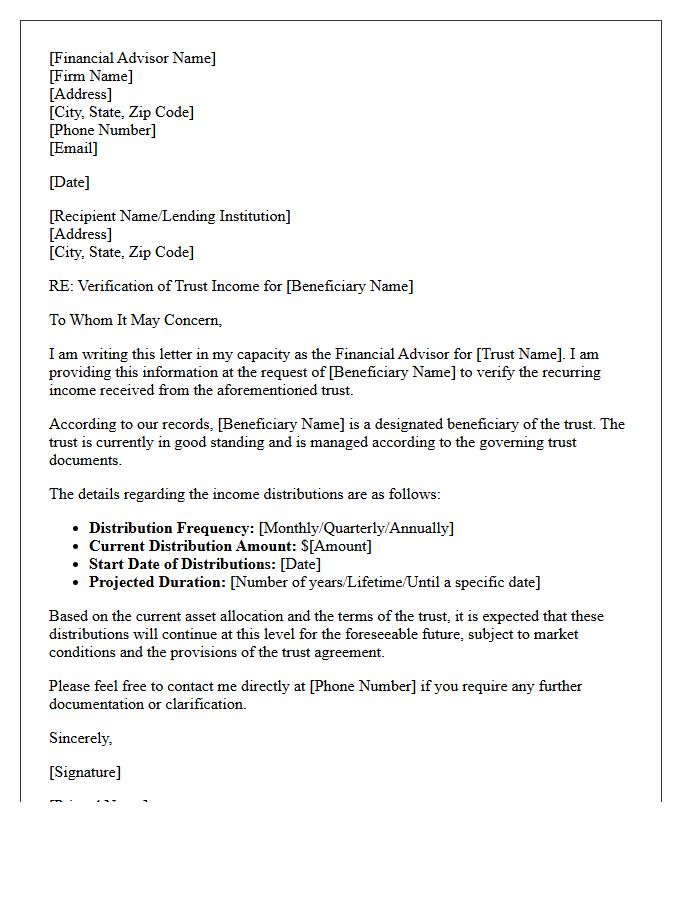
A Financial Advisor Verification of Trust Income Letter is a formal document used to confirm recurring distributions from a trust. Lenders require this to verify a borrower's stable income during mortgage underwriting. The letter must explicitly state the payment amount, frequency, and duration of payments to ensure the income will continue for at least three years. This verification provides proof of financial liquidity and long-term stability, allowing trust beneficiaries to qualify for loans based on assets held within a legal trust structure.
Estate Attorney Verification of Trust Income Letter
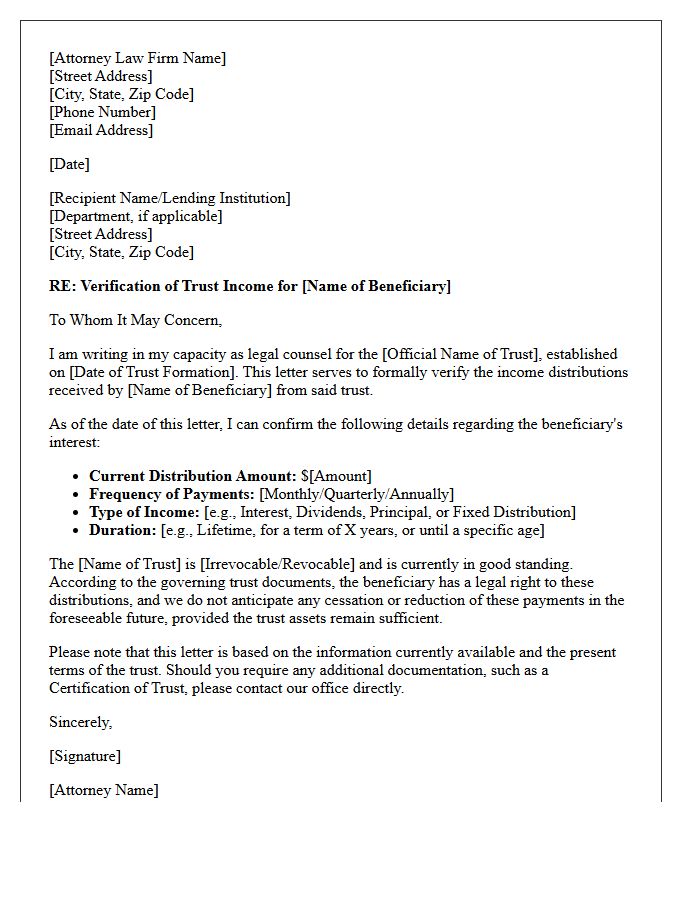
An Estate Attorney Verification of Trust Income Letter is a formal document used to confirm a beneficiary's recurring distributions to lenders or government agencies. This letter serves as official legal proof that the trust is active and provides stable financial support. It must detail the distribution amount, frequency, and duration to establish the recipient's creditworthiness or eligibility for services. Having a licensed attorney sign the document adds verified credibility, ensuring that the income is recognized as legitimate during financial underwriting processes or legal audits.
Fiduciary Distribution Verification of Trust Income Letter
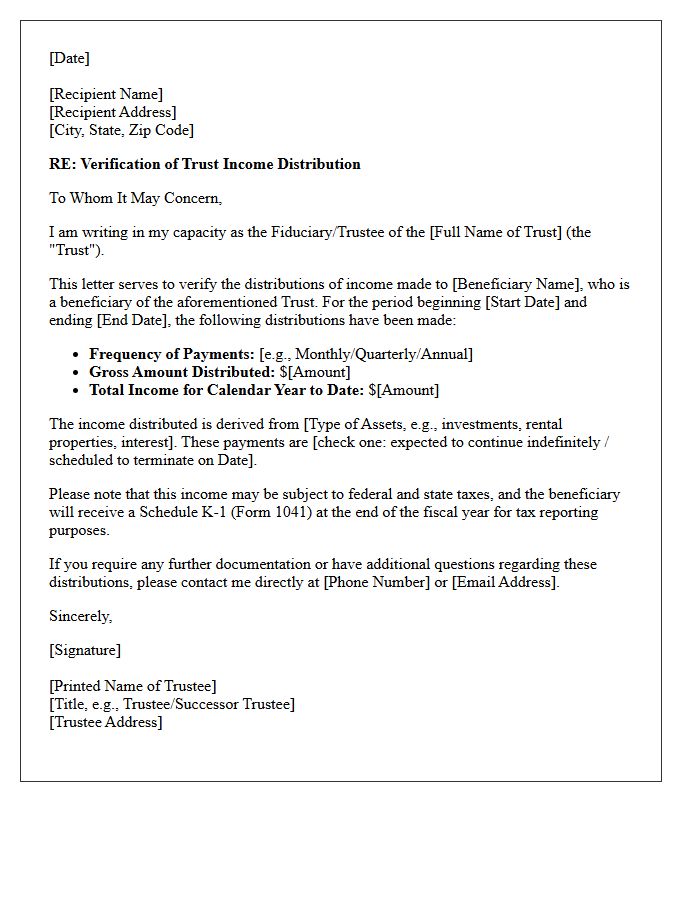
A Fiduciary Distribution Verification of Trust Income Letter is a formal document certifying the specific amount of income distributions paid to beneficiaries. It serves as essential proof for tax compliance and legal accounting, confirming that the trustee has fulfilled their fiduciary duty. This letter validates that funds were allocated according to the trust agreement, ensuring transparency for lenders or government agencies. It distinguishes between principal and taxable income, which is critical for accurate tax reporting and maintaining the trust's financial integrity during audits or loan applications.
Borrower Beneficiary Verification of Trust Income Letter
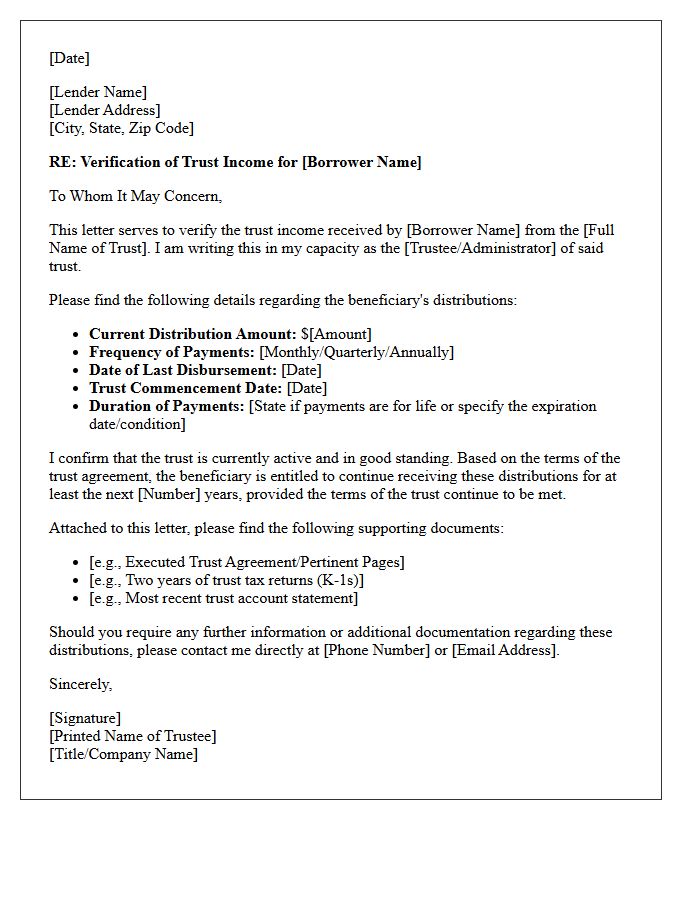
A Borrower Beneficiary Verification of Trust Income Letter is a crucial document used in mortgage underwriting to confirm consistent cash flow from a trust. This official statement, typically provided by a trustee, verifies the amount, frequency, and duration of payments. Lenders require this to ensure the income will continue for at least three years. Providing clear documentation of distribution history and legal trust terms helps establish the borrower's debt-to-income ratio and overall financial stability during the loan approval process.
Third-Party Verification of Trust Income Letter
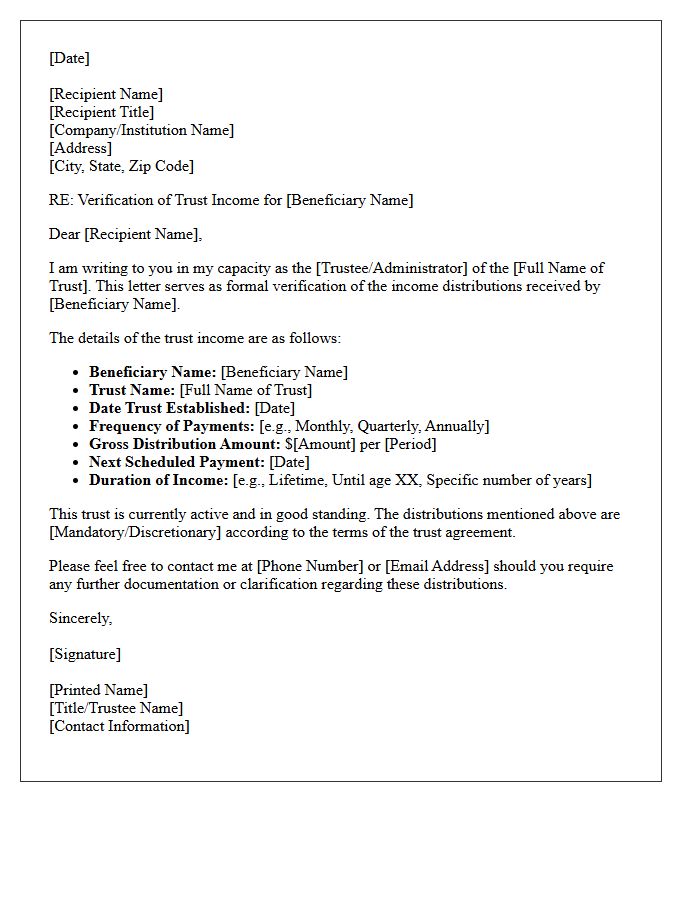
A Third-Party Verification of Trust Income Letter is an official document used to confirm a borrower's recurring distributions for mortgage qualification. Lenders require this independent validation from a CPA, attorney, or trust officer to ensure the stability and continuity of the funds. This letter must verify that the trust will continue for at least three years. Providing this professional documentation is essential for demonstrating reliable cash flow when trust distributions serve as a primary source of qualifying income during the home financing process.
Bank Depository Verification of Trust Income Letter
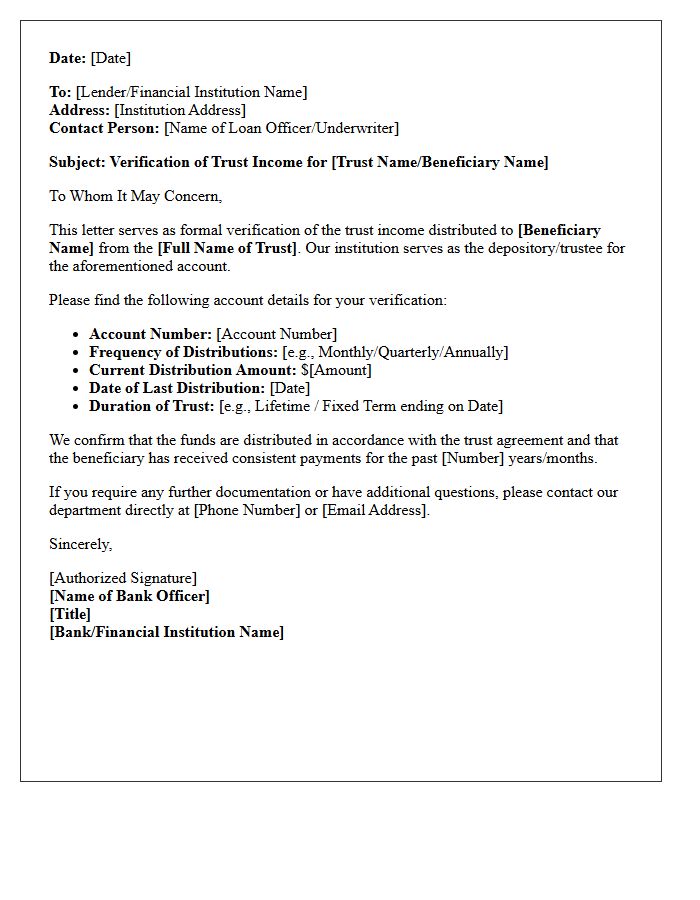
A Bank Depository Verification of Trust Income Letter is a formal document used to confirm recurring distributions from a trust fund. Lenders require this verification to validate stable cash flow for mortgage qualifications. It must detail the frequency, amount, and duration of payments to ensure the income will continue for at least three years. Providing an official bank-signed letter ensures financial transparency and helps satisfy underwriting requirements during the loan approval process by proving the applicant's long-term repayment capacity through established trust assets.
Tax Preparer Verification of Trust Income Letter
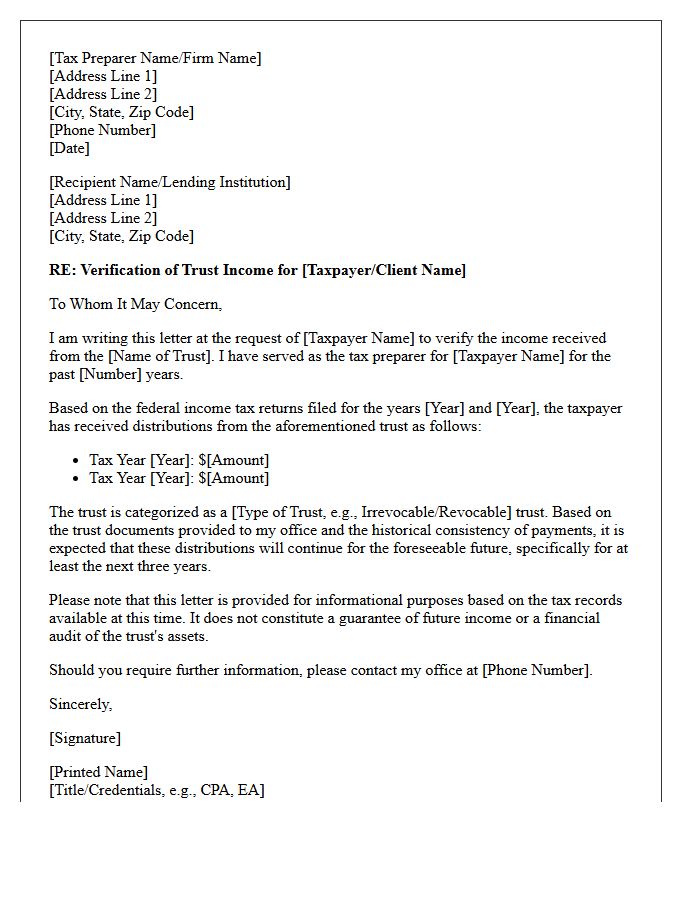
A Tax Preparer Verification of Trust Income Letter is a formal document requested by lenders to confirm a borrower's consistent cash flow. It verifies that distributions from a trust are recurring and expected to continue for at least three years. Mortgage underwriters use this to validate qualifying income for loan approval. The letter must be signed by a qualified professional, such as a Certified Public Accountant, ensuring the reported figures align with official tax returns and trust agreements to mitigate financial risk during the underwriting process.
What is a Verification of Trust Income Letter?
A Verification of Trust Income Letter is an official document, typically issued by a trustee or legal representative, that confirms the regular distribution amounts, frequency, and duration of income a beneficiary receives from a trust for the purpose of qualifying for a loan or mortgage.
What information is required in a Trust Income Verification Letter?
The letter should include the name of the trust, the beneficiary's name, the specific distribution amount, the frequency of payments (e.g., monthly or quarterly), the duration the payments are guaranteed to continue, and the trustee's contact information and signature.
Can trust income be used as qualifying income for a mortgage?
Yes, trust income can be used for mortgage qualification provided it is documented with a formal verification letter and tax returns, and the lender can verify that the distributions will continue for at least three years from the date of the mortgage application.
Who is authorized to sign a Verification of Trust Income Letter?
The letter must be signed by the appointed Trustee, a trust administrator, or an authorized representative from the financial institution or law firm managing the trust assets. It generally cannot be self-certified by the beneficiary.
Do I need to provide the full Trust Agreement alongside the verification letter?
Most lenders require both the Verification of Trust Income Letter and relevant excerpts from the Trust Agreement or the Certificate of Trust to confirm the trust's validity and the specific terms regarding the continuity of payments.

Comments