
Finding the right fit for off-site roles is essential for team success. If a candidate's location or setup does not align with your operational needs, a professional Remote Work Incompatibility Rejection Letter is necessary to maintain your employer brand. This guide explains how to communicate these constraints clearly while showing respect for the applicant's time. Below are some ready to use templates.
Image cover: Professional Remote Work Incompatibility Decline Letter Templates
Letter Samples List
- On-Site Client Policy Remote Work Incompatibility Rejection Letter
- Hybrid Schedule Requirement Remote Work Incompatibility Rejection Letter
- Geographic Jurisdiction Remote Work Incompatibility Rejection Letter
- Time Zone Misalignment Remote Work Incompatibility Rejection Letter
- In-Person Collaboration Remote Work Incompatibility Rejection Letter
- Physical Hardware Handling Remote Work Incompatibility Rejection Letter
- On-Site Training Period Remote Work Incompatibility Rejection Letter
- Insufficient Remote Infrastructure Remote Work Incompatibility Rejection Letter
- Security and Compliance Remote Work Incompatibility Rejection Letter
- Relocation Unwillingness Remote Work Incompatibility Rejection Letter
- Future Remote Opportunities Remote Work Incompatibility Rejection Letter
- Agency Standard Remote Work Incompatibility Rejection Letter
On-Site Client Policy Remote Work Incompatibility Rejection Letter
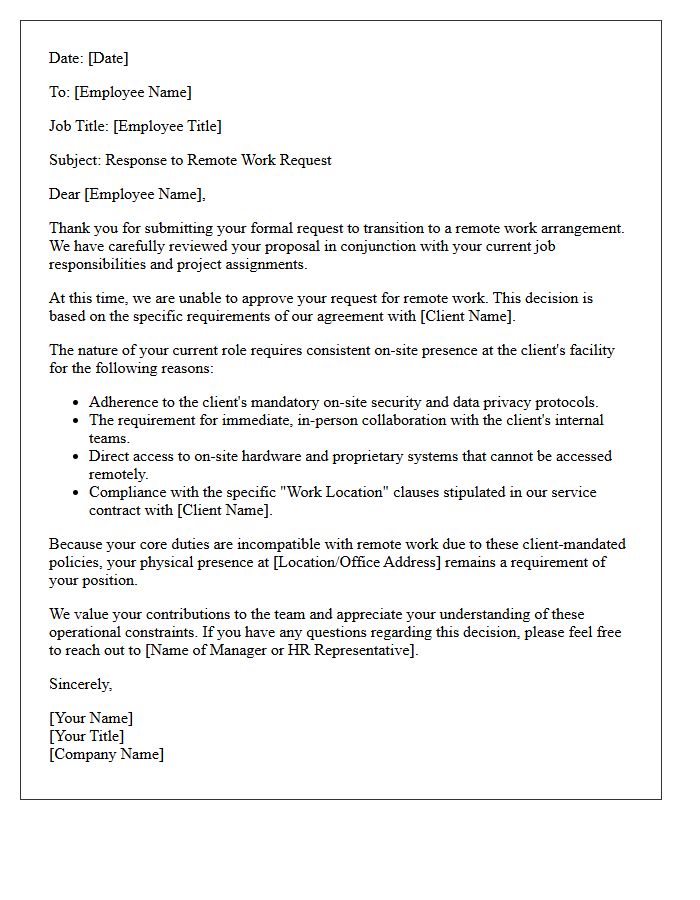
An On-Site Client Policy Remote Work Incompatibility Rejection Letter is a formal notification sent to job applicants or employees. It clarifies that a position requires a physical presence due to contractual obligations or security protocols mandated by the client. This letter serves as a transparent explanation for why remote or hybrid requests cannot be accommodated. Clearly stating these site-specific requirements helps manage expectations, ensures legal compliance with service level agreements, and maintains professional standards when candidate preferences do not align with the essential operational needs of the client location.
Hybrid Schedule Requirement Remote Work Incompatibility Rejection Letter
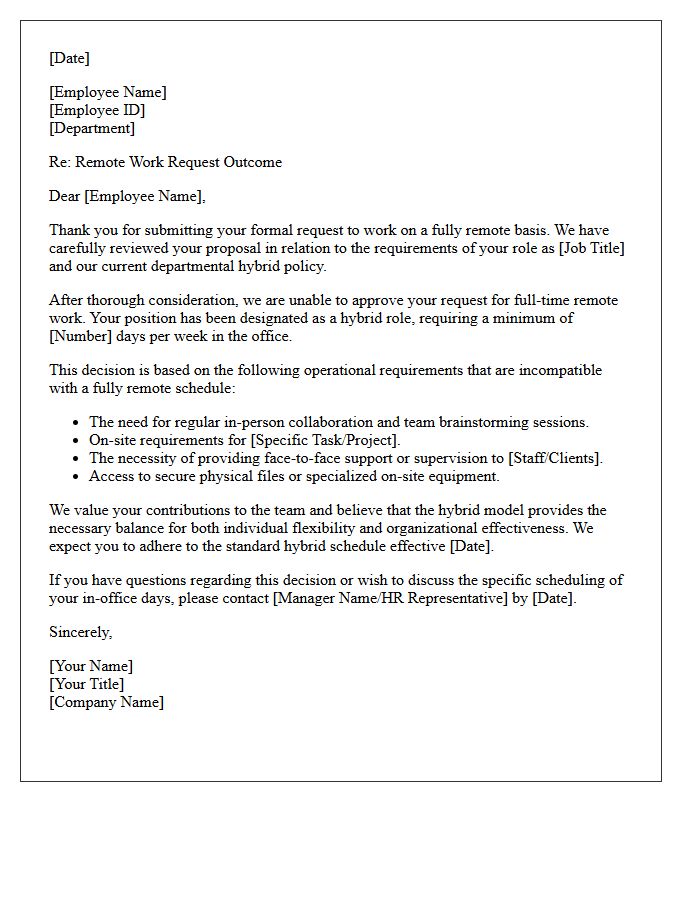
Receiving a rejection letter due to remote work incompatibility often indicates a strict hybrid schedule requirement. Many organizations now prioritize in-person collaboration, making mandatory office attendance a non-negotiable term for employment. If your professional needs demand a fully remote environment, this misalignment suggests the role's operational structure cannot support your flexibility requirements. Understanding this on-site necessity helps focus your future job search on companies that offer permanent telecommuting options rather than traditional office-centric models.
Geographic Jurisdiction Remote Work Incompatibility Rejection Letter
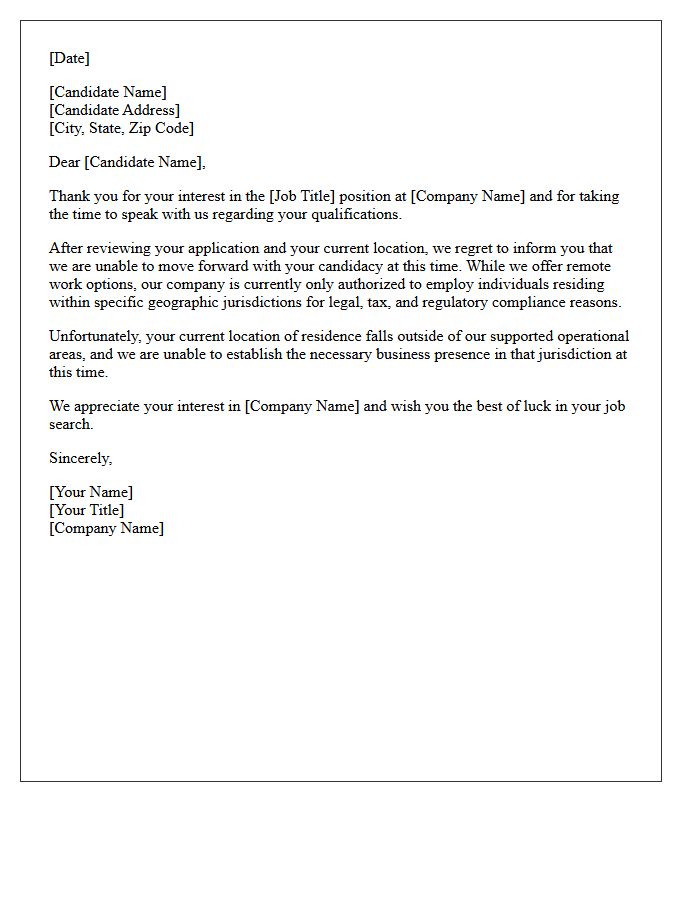
A geographic jurisdiction rejection letter informs candidates that their physical location is incompatible with company operations. Even for remote work, businesses must comply with specific state or country labor laws, tax regulations, and insurance requirements. If an applicant resides in a region where the employer is not legally registered to hire, they face immediate disqualification. This mismatch creates compliance risks regarding payroll taxes and benefits, making the candidate ineligible despite their qualifications. Understanding these nexus limitations is crucial for job seekers applying to distributed companies with strict regional boundaries.
Time Zone Misalignment Remote Work Incompatibility Rejection Letter
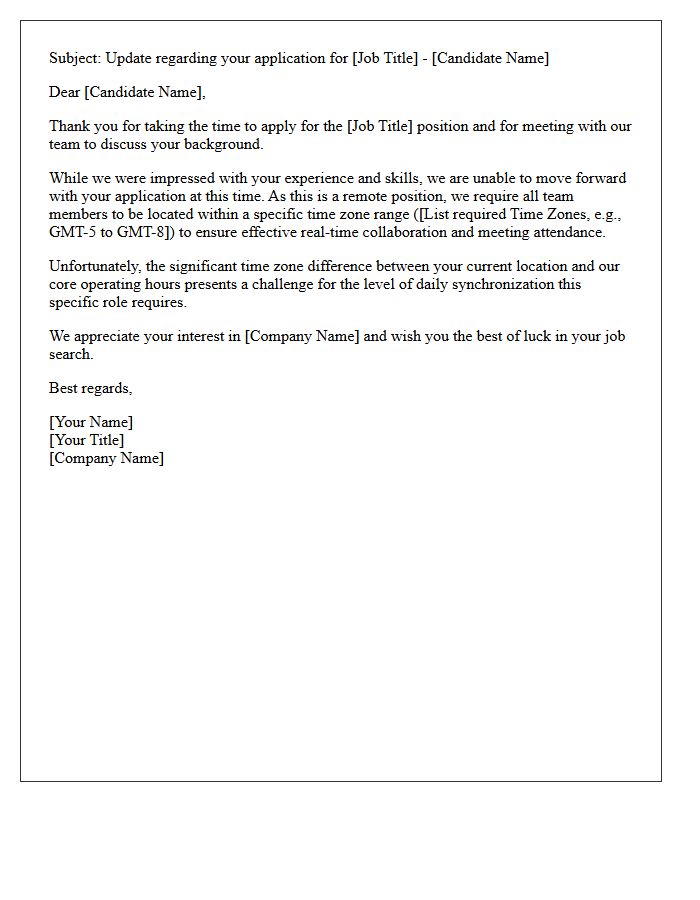
A rejection letter citing Time Zone Misalignment signifies a fundamental Remote Work Incompatibility between your location and the company's operational hours. Organizations often require specific overlapping windows for real-time collaboration, synchronous meetings, and rapid communication. Even if your qualifications are perfect, a significant hour gap can hinder team integration and project velocity. Receiving this notice means the employer prioritizes geographic proximity or specific time offsets to maintain workflow efficiency. Understanding these logistical constraints helps you target future remote roles within compatible global regions or companies offering flexible, asynchronous work cultures.
In-Person Collaboration Remote Work Incompatibility Rejection Letter
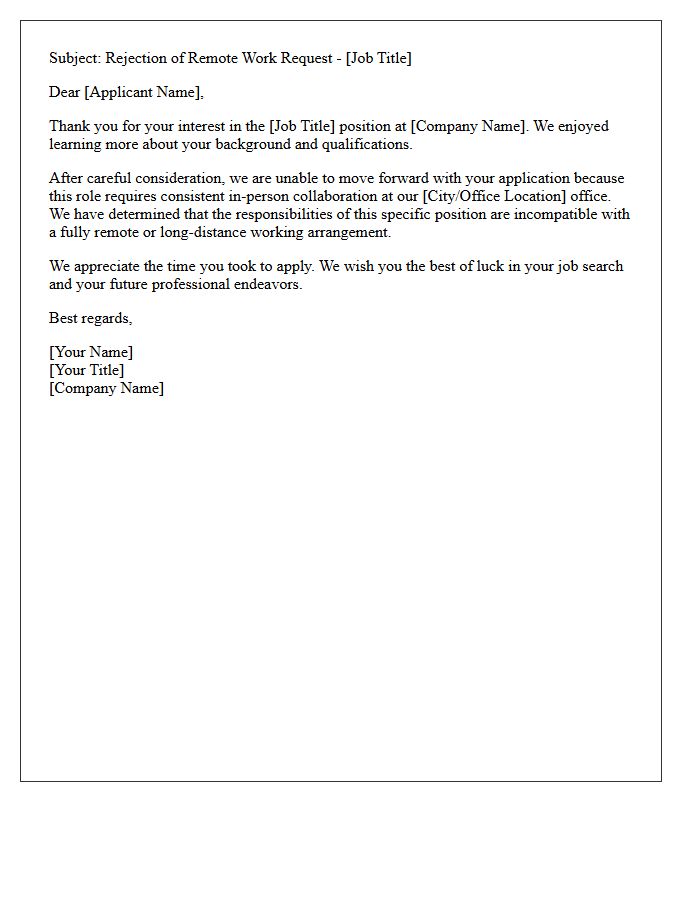
An In-Person Collaboration Remote Work Incompatibility Rejection Letter formally notifies candidates that their application cannot proceed due to mandatory on-site requirements. This document clarifies that the role necessitates physical presence for team synergy and immediate problem-solving, which remote arrangements cannot fulfill. It professionally explains the strategic misalignment between the applicant's location preferences and the company's operational model. Using clear language helps maintain employer branding while ensuring candidates understand that the decision is based strictly on the logistical demands of the specific position and corporate culture.
Physical Hardware Handling Remote Work Incompatibility Rejection Letter
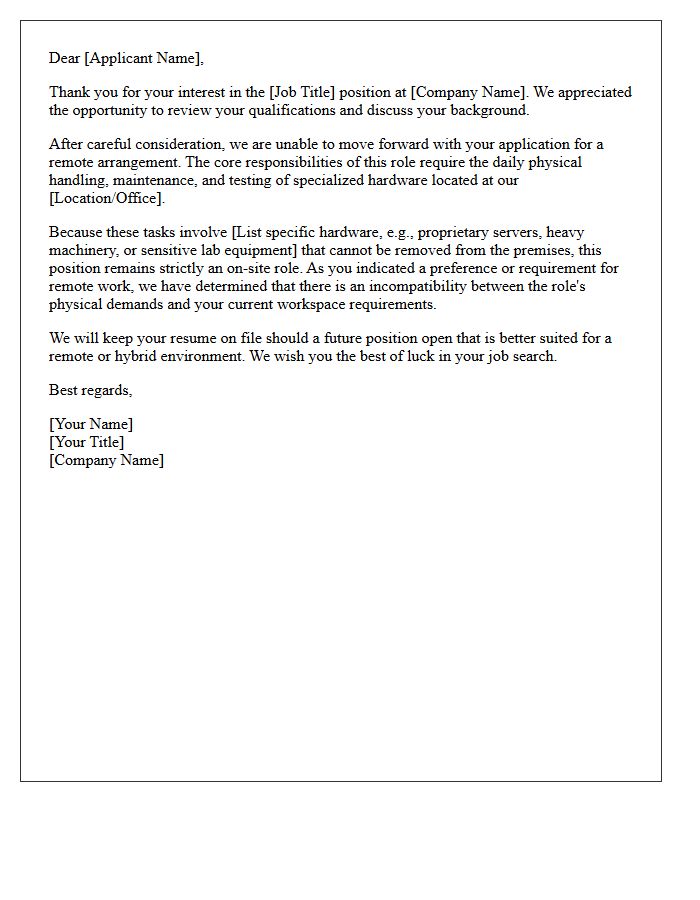
We regret to inform you that your application for the Hardware Technician position has been declined. Our current infrastructure requires on-site management, making Physical Hardware Handling strictly mandatory. Since your profile indicates a preference for remote operations, we must issue this Remote Work Incompatibility Rejection Letter. Effective maintenance of servers and components requires a manual presence that cannot be fulfilled virtually. We appreciate your interest and wish you success in finding a role that aligns with your flexible work requirements.
On-Site Training Period Remote Work Incompatibility Rejection Letter
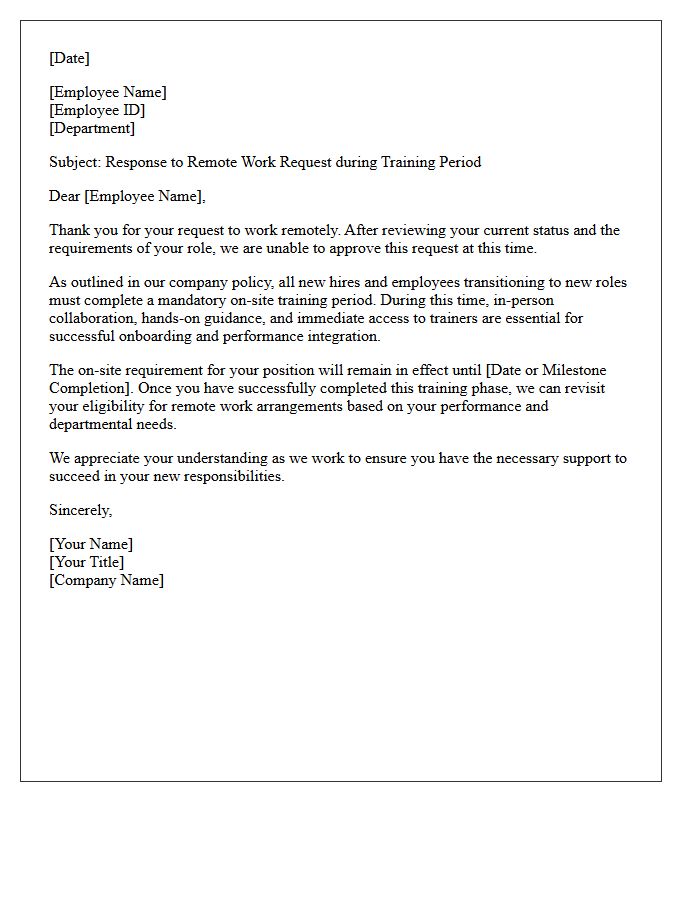
Receiving a rejection letter due to on-site training requirements highlights a fundamental remote work incompatibility within certain organizational structures. Even if a role is advertised as flexible, many companies mandate an initial period of in-person integration to ensure proper knowledge transfer and cultural alignment. This specific constraint often serves as a non-negotiable criterion for candidates who cannot commute. Understanding that physical presence during the onboarding phase is a prerequisite can help job seekers better target positions that offer full location independence from day one, avoiding disqualification based on geographic limitations.
Insufficient Remote Infrastructure Remote Work Incompatibility Rejection Letter
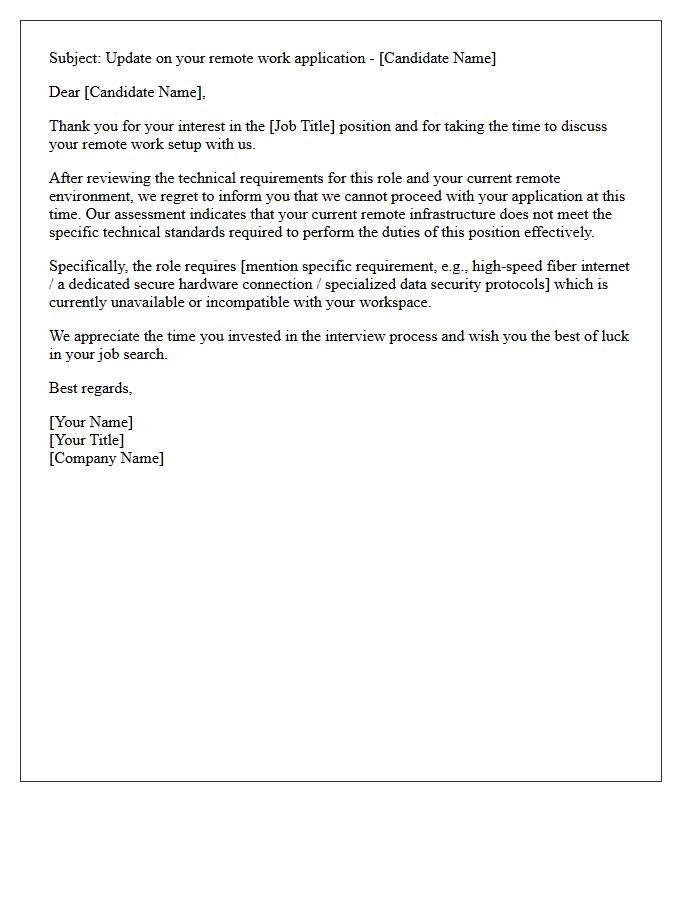
Receiving an Insufficient Remote Infrastructure rejection letter indicates your home workspace or technology does not meet specific company standards. Organizations often require high-speed internet, dedicated security hardware, or specialized software to ensure Remote Work Incompatibility is minimized. This decision is typically based on maintaining operational efficiency and data protection protocols. To improve future prospects, audit your setup to ensure it aligns with professional enterprise requirements, focusing on connectivity reliability and hardware performance to overcome potential technical barriers during the recruitment process.
Security and Compliance Remote Work Incompatibility Rejection Letter
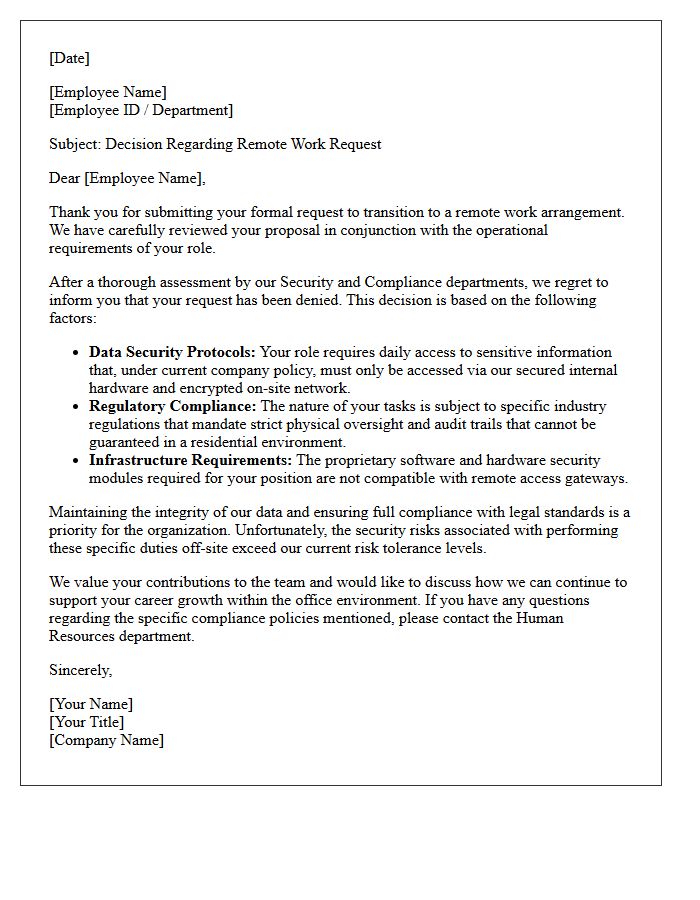
A rejection letter based on security and compliance remote work incompatibility signifies that a candidate's location or hardware fails to meet mandatory regulatory standards. Companies must enforce strict data protection protocols, such as GDPR or SOC2, which may prohibit remote access from specific regions or unsecured networks. This decision is often non-negotiable, as risk mitigation is vital for safeguarding sensitive intellectual property. Even highly qualified applicants may be declined if their home environment cannot guarantee the certified security infrastructure required to maintain organizational integrity and legal compliance in a distributed workforce.
Relocation Unwillingness Remote Work Incompatibility Rejection Letter
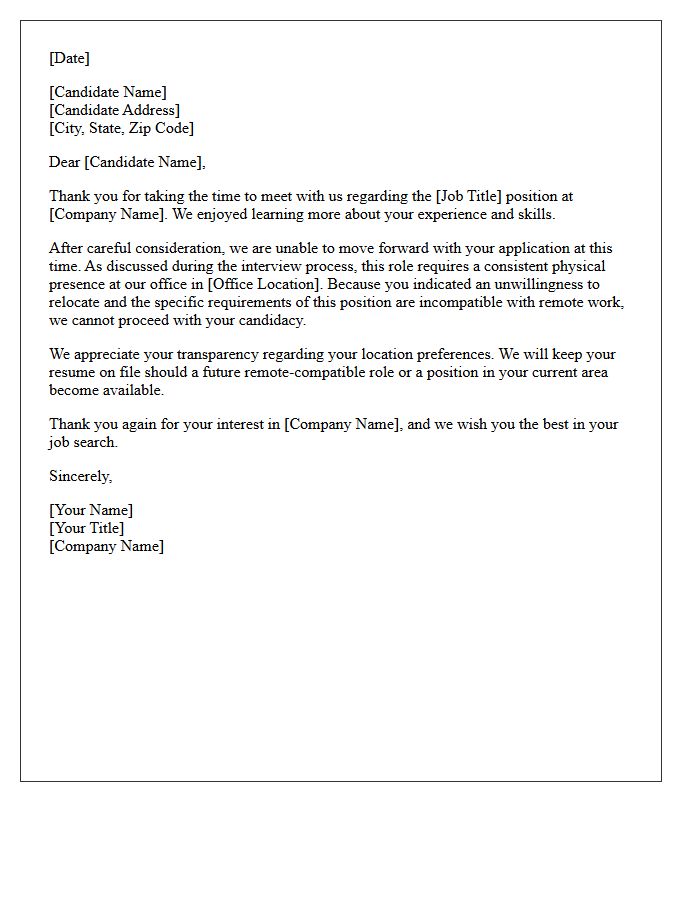
Receiving a rejection letter due to relocation unwillingness often signifies a fundamental remote work incompatibility with the company's current operational model. Even if your qualifications are superior, many organizations prioritize on-site collaboration or local residency for legal and logistical compliance. To mitigate future rejections, clarify geographic expectations early in the application process. Understanding a firm's workplace policy ensures you align your career goals with employers who support flexible or distributed environments, saving time for both parties during the recruitment cycle.
Future Remote Opportunities Remote Work Incompatibility Rejection Letter
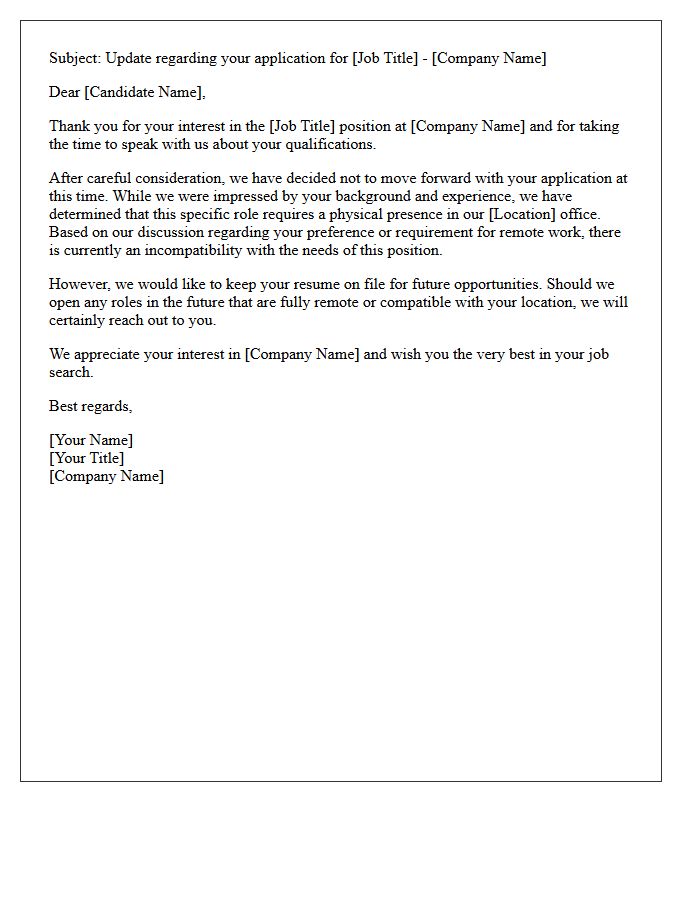
Receiving a Remote Work Incompatibility Rejection Letter often indicates a misalignment between your location and the company's operational requirements. This specific rejection suggests that while your skills are valued, legal, tax, or time zone constraints prevent immediate hiring. To secure future remote opportunities, maintain professional connections with the recruiter and inquire about expanding jurisdictions. Understanding these geographical limitations helps you target employers with established remote infrastructures in your region, ensuring a smoother application process and increasing your chances of landing a flexible role that fits your lifestyle.
Agency Standard Remote Work Incompatibility Rejection Letter
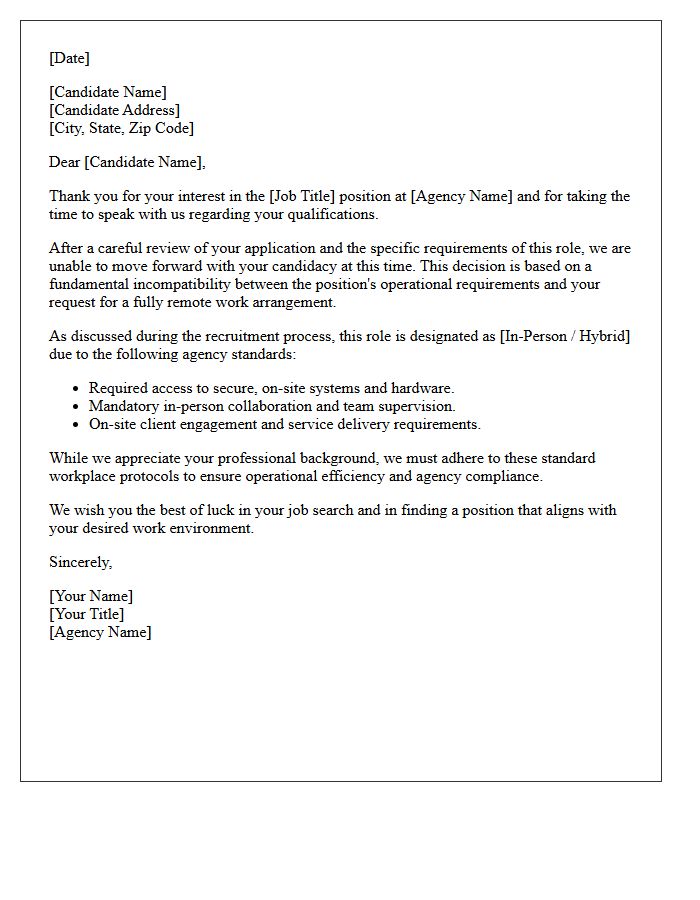
Receiving an Agency Standard Remote Work Incompatibility Rejection Letter indicates that your application was unsuccessful because the specific role mandates physical presence. These formal notices signify that the position's operational requirements, such as onsite collaboration or secure data access, do not align with telecommuting. It is crucial to recognize that this decision is often based on rigid departmental policies rather than your qualifications. Understanding this incompatibility helps candidates pivot their search toward firms that support flexible work models or remote-first environments better suited to their professional preferences.
What is a remote work incompatibility rejection letter?
A remote work incompatibility rejection letter is a formal notification sent to a job applicant explaining that their preference or requirement for remote work does not align with the company's specific in-office or hybrid operational requirements.
Why was my application rejected due to remote work preferences?
Applications are typically rejected for this reason when a role requires physical presence for hands-on collaboration, access to secure on-site hardware, or adherence to a strict corporate policy that mandates in-office attendance for all team members.
Can I appeal a rejection based on remote work incompatibility?
While most hiring decisions are final, you may appeal if you are willing to reconsider the in-office requirements. However, if the job description explicitly stated the role was not remote-eligible, the company is unlikely to make an exception.
Does a remote work rejection letter affect my future applications?
No, being rejected due to location or remote work incompatibility does not negatively impact your standing for future roles that may offer flexible arrangements or for positions where you are able to commute to the office.
What should I do if I receive a remote work incompatibility rejection?
If remote work is a non-negotiable requirement for you, it is best to thank the recruiter for their time and focus your search on "Remote-First" or "Fully Remote" companies that have the infrastructure to support off-site employees.


Comments