
Receiving a Consent Order Notification Letter indicates that a court has been asked to formalize a legal agreement between parties, often regarding finances or property. This document serves as official notice of the pending legal proceedings and outlines your rights to respond or object. To help you navigate this process efficiently, below are some ready to use templates.
Image cover: Official Consent Order Notification Letter Samples and Templates
Letter Samples List
- Board of Directors Consent Order Notification Letter
- Shareholder Consent Order Disclosure Letter
- Federal Reserve Consent Order Acknowledgment Letter
- Executive Management Consent Order Briefing Letter
- Office of the Comptroller Consent Order Notice Letter
- Anti-Money Laundering Consent Order Remediation Letter
- Correspondent Banking Consent Order Status Letter
- Institutional Investor Consent Order Update Letter
- State Banking Authority Consent Order Agreement Letter
- Deposit Insurance Corporation Consent Order Response Letter
- Capital Adequacy Consent Order Declaration Letter
- Consumer Compliance Consent Order Resolution Letter
Board of Directors Consent Order Notification Letter
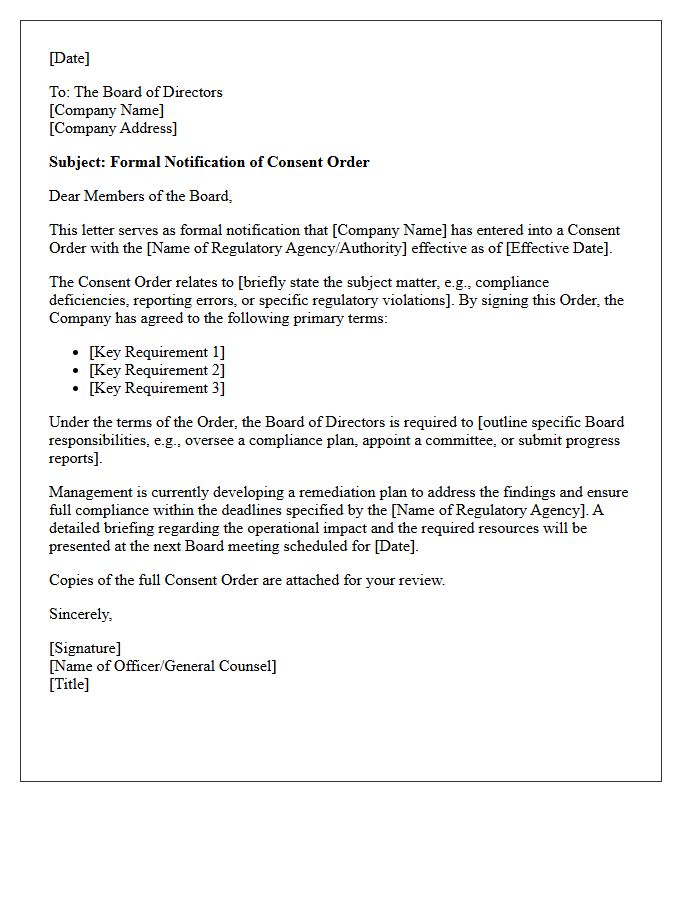
A Board of Directors Consent Order Notification Letter is a formal legal document informing stakeholders that a company's leadership has voluntarily accepted a regulatory enforcement action. This letter outlines specific compliance failures and the mandatory remedial measures required to address them. It serves as a transparent disclosure regarding legal mandates, ensuring that shareholders and partners understand the board's commitment to correcting governance issues. Receiving this notification indicates that the entity is under strict oversight to ensure future adherence to industry standards and legal frameworks.
Shareholder Consent Order Disclosure Letter
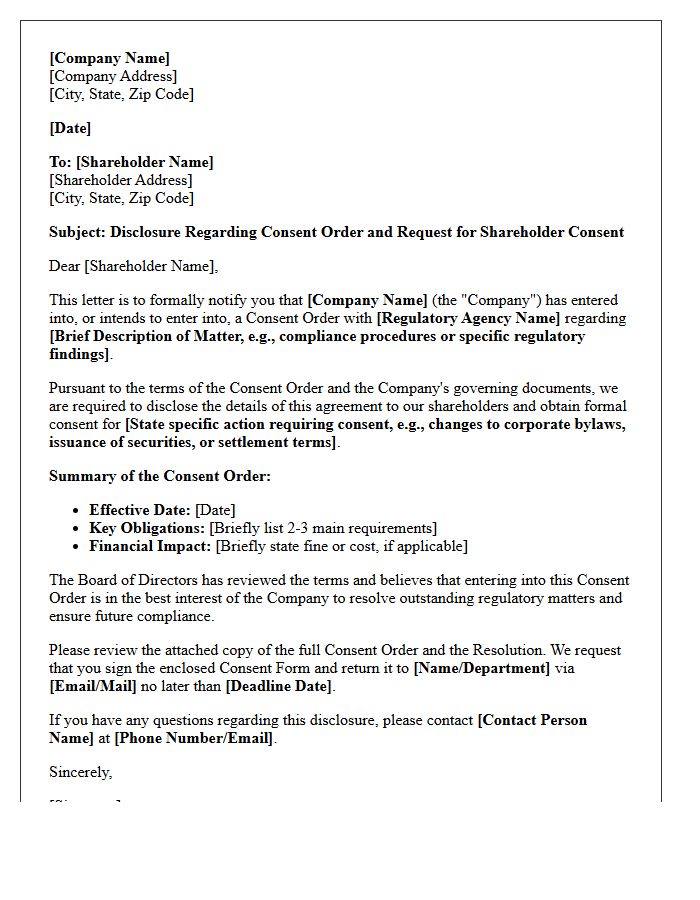
A Shareholder Consent Order Disclosure Letter is a vital legal document used during corporate transactions to qualify warranties. It ensures transparency by listing specific exceptions to the representations made by a company. By providing this detailed disclosure, directors protect themselves from potential breach of contract claims. Shareholders must review this letter carefully, as it effectively limits their indemnity protections by revealing known liabilities or operational issues beforehand. Properly drafting this document is essential for maintaining legal compliance and mitigating financial risk during the formal approval of major corporate structural changes.
Federal Reserve Consent Order Acknowledgment Letter
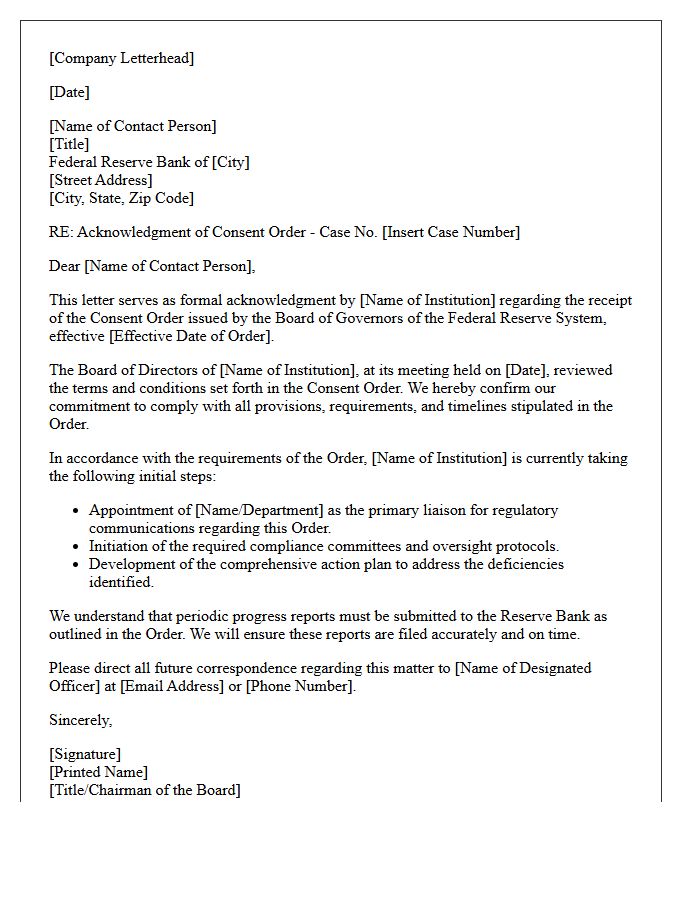
A Federal Reserve Consent Order Acknowledgment Letter is a formal document confirming that a financial institution's board of directors has received and accepted a regulatory enforcement action. This letter serves as a legally binding commitment to rectify specific compliance failures or safety and soundness deficiencies identified by examiners. It marks the official start of a mandatory remediation period where the bank must implement rigorous governance oversight and corrective internal controls. Failure to adhere to the stipulations outlined in the underlying order can lead to severe penalties or further restrictive supervisory actions.
Executive Management Consent Order Briefing Letter
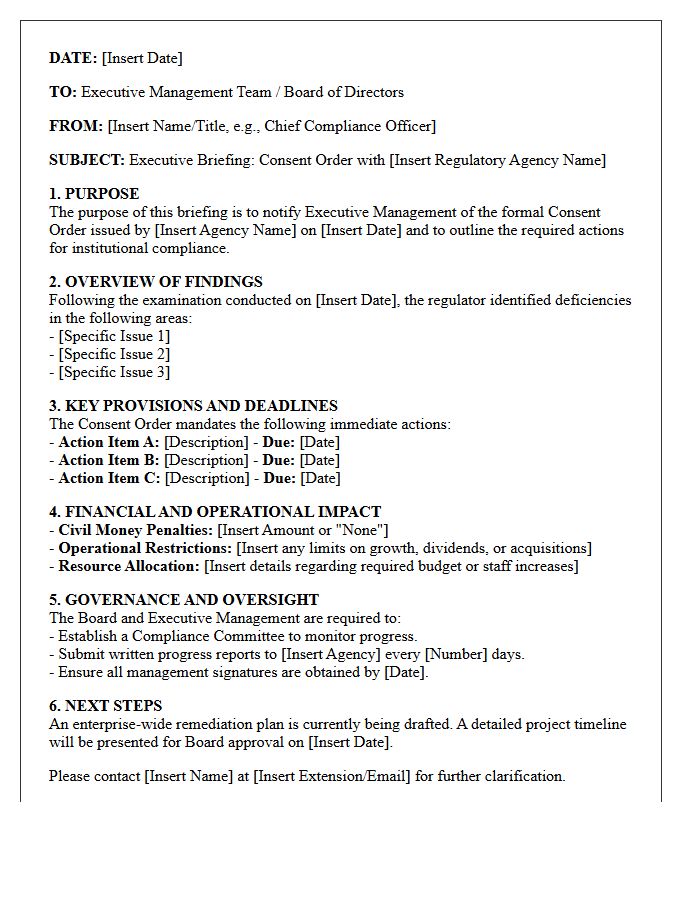
An Executive Management Consent Order Briefing Letter is a critical regulatory notification informing senior leadership of formal enforcement actions. This document outlines specific compliance failures and mandated corrective measures required by authorities. It serves as a strategic roadmap for remediation efforts, defining accountability and deadlines to ensure the institution addresses legal deficiencies. Understanding this briefing is essential for risk mitigation, as it highlights the operational changes necessary to satisfy regulatory mandates and avoid further penalties while restoring the organization's standing with governing bodies.
Office of the Comptroller Consent Order Notice Letter
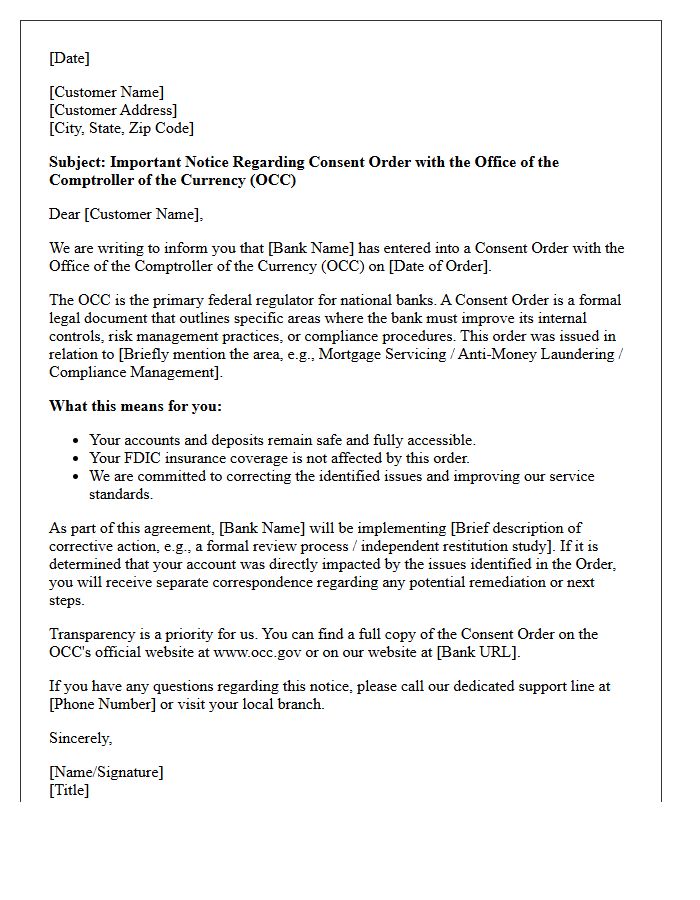
An Office of the Comptroller Consent Order Notice Letter informs customers about a settlement resulting from regulatory violations. It confirms that a financial institution failed to meet specific compliance standards, often related to mortgage servicing or foreclosure errors. The letter outlines your eligibility for potential restitution or remediation payments. It is crucial to follow the instructions provided to claim any owed compensation. Always verify the letter's authenticity through official channels to avoid scams, as these documents represent a formal legal mandate for corrective action and consumer protection.
Anti-Money Laundering Consent Order Remediation Letter
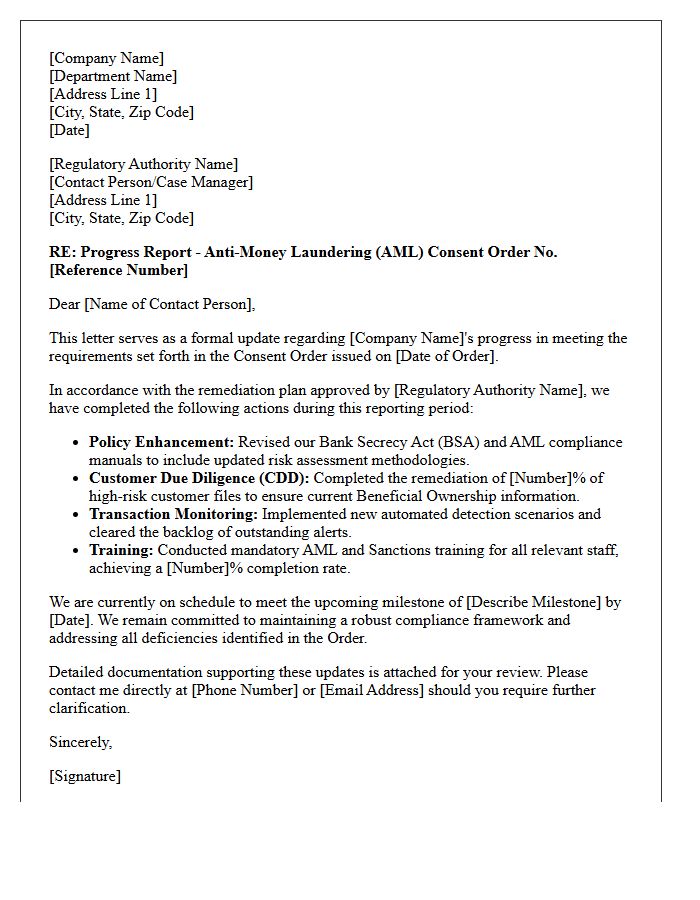
An Anti-Money Laundering Consent Order Remediation Letter is a formal notification from a regulatory authority detailing specific compliance failures within a financial institution. It outlines mandatory corrective actions required to resolve systemic weaknesses in monitoring and reporting. Recipients must implement a rigorous remediation plan to address internal control gaps and satisfy legal mandates. Failure to meet these requirements can lead to severe civil penalties, operational restrictions, or loss of licensure. Effectively managing this process is essential for restoring regulatory trust and ensuring long-term financial integrity.
Correspondent Banking Consent Order Status Letter
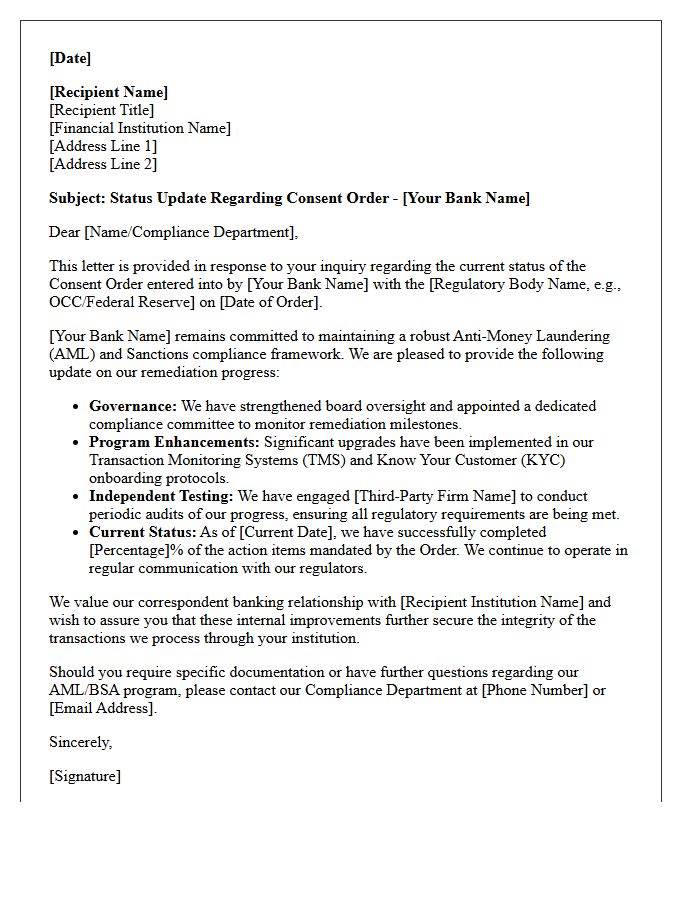
A Correspondent Banking Consent Order Status Letter is a formal document issued by regulators to provide updates on a financial institution's remediation progress. It outlines whether the bank has successfully addressed deficiencies in its Anti-Money Laundering (AML) and sanctions compliance frameworks. This letter is crucial for maintaining transparency with global partner banks, as it validates the institution's efforts to mitigate risks. Achieving a positive status is essential for preserving correspondent relationships and ensuring uninterrupted access to the international financial system while working toward the eventual termination of the legal order.
Institutional Investor Consent Order Update Letter
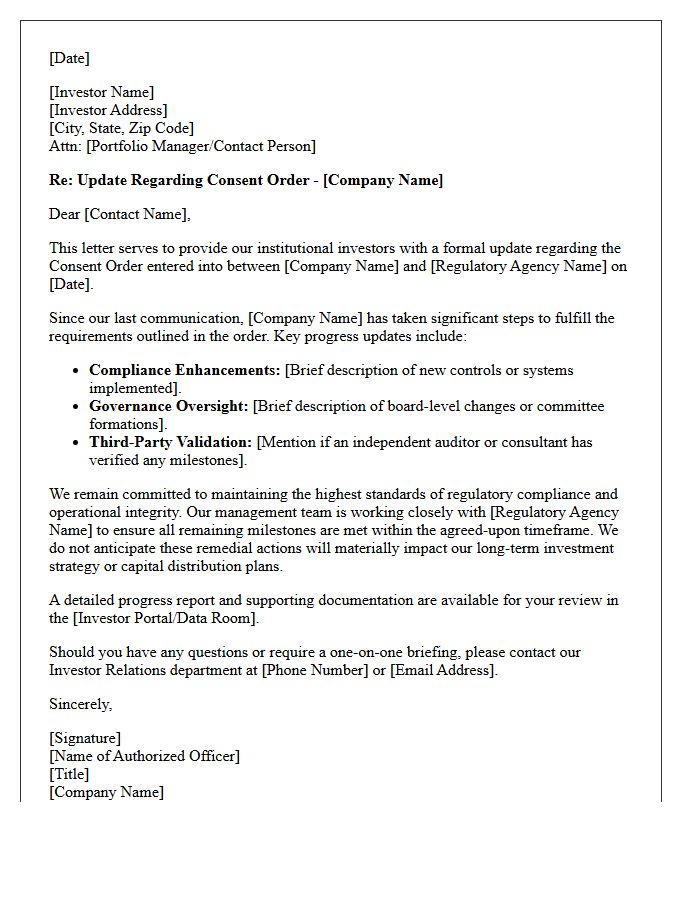
An Institutional Investor Consent Order Update Letter is a critical regulatory communication used to inform stakeholders about a financial institution's progress in rectifying compliance failures. These letters typically outline specific remediation milestones achieved under a formal enforcement action. Understanding these updates is essential for assessing the firm's operational stability and regulatory standing. Investors must monitor these disclosures to evaluate the effectiveness of newly implemented internal controls and the potential for the lifting of legal restrictions or oversight mandates previously imposed by governing authorities.
State Banking Authority Consent Order Agreement Letter
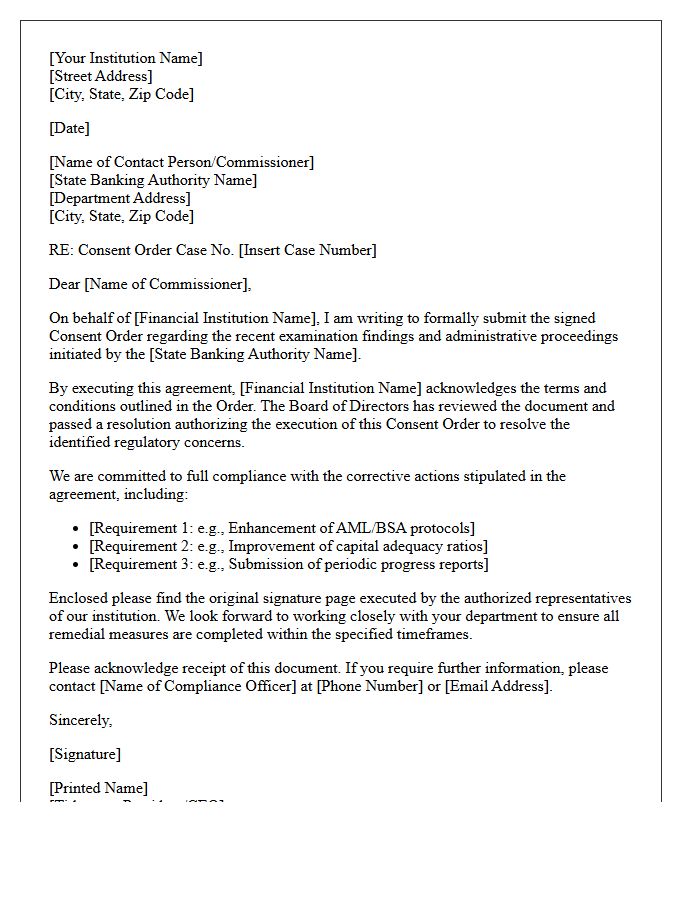
A State Banking Authority Consent Order is a formal enforcement action issued when regulators identify safety, soundness, or compliance failures. This legal agreement requires a financial institution to implement specific remedial measures within a set timeframe. It often demands increased capital levels, improved risk management, or better regulatory oversight to address deficiencies. Failure to comply can lead to severe penalties or charter revocation. Understanding the Consent Order Agreement Letter is vital because it outlines the mandatory steps a bank must take to avoid further litigation and restore its standing with authorities.
Deposit Insurance Corporation Consent Order Response Letter
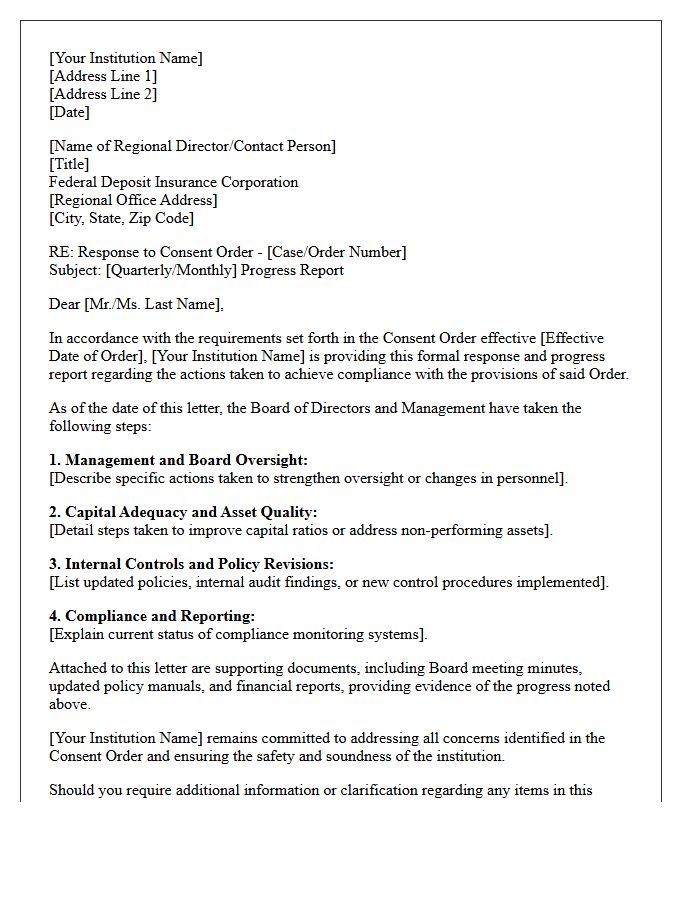
A Deposit Insurance Corporation Consent Order Response Letter is a formal document submitted by a financial institution to address identified regulatory deficiencies. This critical correspondence outlines specific corrective actions the bank will implement to satisfy safety and soundness requirements. It must detail clear timelines, governance improvements, and remediation strategies to resolve legal or operational issues cited in the order. Providing a comprehensive and transparent response is essential for maintaining a positive regulatory relationship and ensuring compliance with federal banking standards to protect consumer deposits and institutional stability.
Capital Adequacy Consent Order Declaration Letter
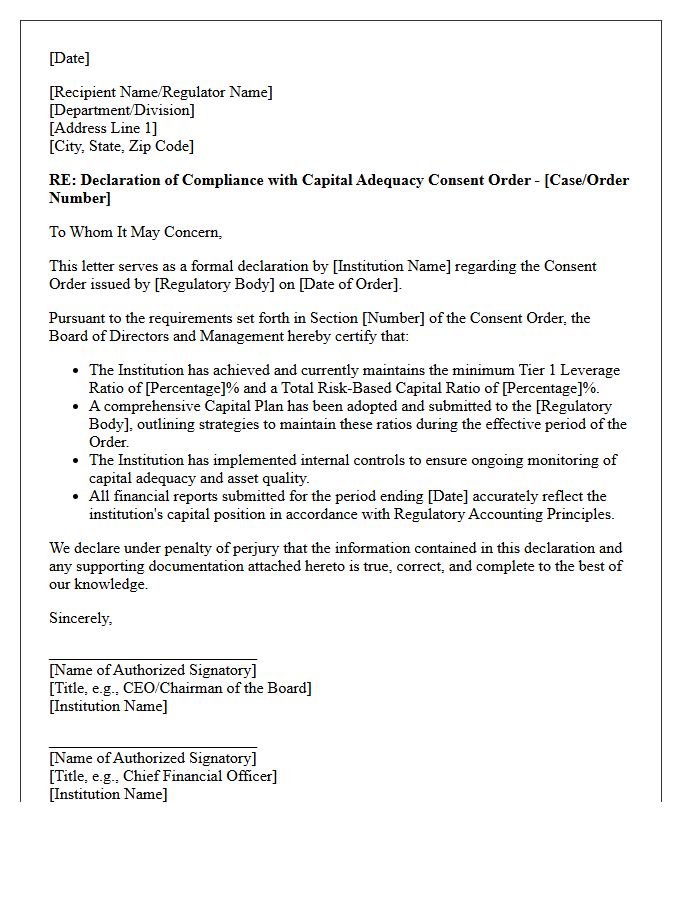
A Capital Adequacy Consent Order Declaration Letter is a formal document required by regulators when a financial institution operates under enforcement actions. It serves as an official certification that the bank maintains minimum capital ratios mandated by the order. This letter verifies that the board of directors and management are actively addressing solvency concerns to ensure long-term stability. Providing accurate data in this declaration is essential for regulatory compliance, as it confirms the institution has sufficient buffers to absorb potential losses and protect depositor interests during financial restructuring.
Consumer Compliance Consent Order Resolution Letter
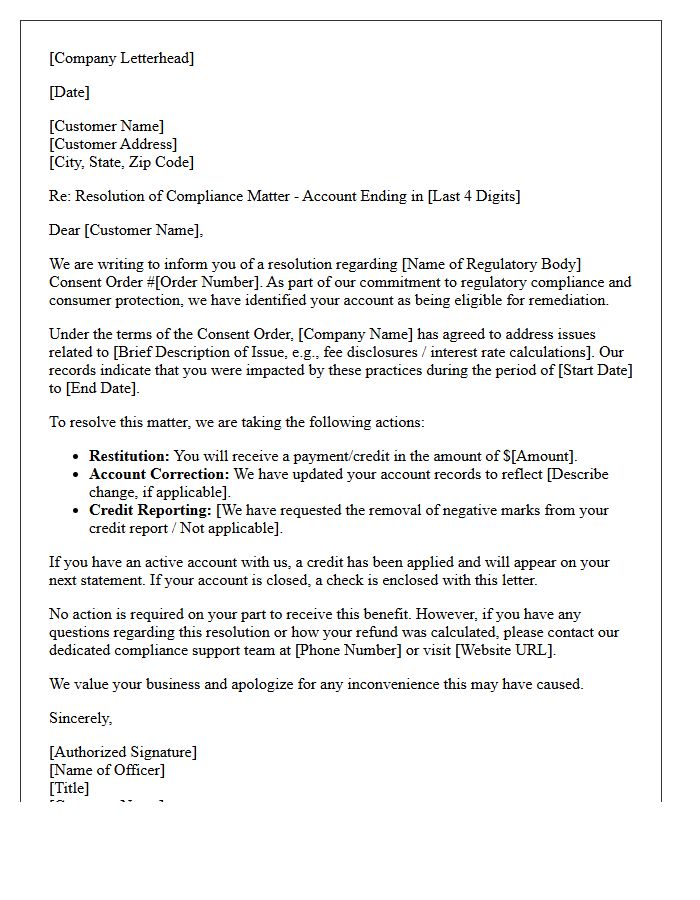
A Consumer Compliance Consent Order Resolution Letter is a formal notification confirming that a financial institution has successfully addressed regulatory violations identified by authorities. This document signifies the termination of legal enforcement actions after the entity proves full adherence to corrective mandates. It is a critical milestone for risk management and corporate reputation, ensuring the organization meets fair lending and consumer protection standards. Receiving this letter officially validates that the bank's internal controls are now robust enough to prevent future non-compliance and maintain operational integrity within the financial sector.
What is a Consent Order Notification Letter?
A Consent Order Notification Letter is a formal legal document sent to inform affected parties that a court has been asked to approve a voluntary agreement between two or more parties. It outlines the terms of the settlement and provides individuals with the opportunity to review, object, or consent to the proposed legal order.
Why did I receive a Consent Order Notification Letter?
You received this letter because you are identified as a stakeholder, class member, or interested party whose rights or interests may be impacted by a pending legal settlement. The court requires that all potentially affected individuals are formally notified before a Consent Order is finalized and legally binding.
How do I respond to a Consent Order Notification?
You should carefully review the terms outlined in the letter to determine how they affect you. Depending on the instructions provided, you may choose to take no action if you agree, submit a formal written objection by the specified deadline, or sign and return a joinder or consent form to indicate your approval.
What is the difference between a Consent Order and a Court Order?
A Consent Order is based on a mutual agreement reached between parties to resolve a dispute without further litigation, which the judge then signs to make enforceable. A standard Court Order is a decision imposed by a judge after hearing arguments or evidence, where the parties may not necessarily agree on the outcome.
Can a Consent Order be changed after it is issued?
Once a Consent Order is signed by a judge and filed, it is legally binding and difficult to change. It can typically only be modified if all parties agree to the amendment or if one party can prove in court that the order was obtained through fraud, duress, or a significant mistake of fact.

Comments